Mobile Development Languages: What’s the Best Choice for Your App?
Mobile development languages shape everything about your app. Namely, its performance, its cost to build, and how easy it will be to maintain five years from now. With global app downloads being roughly 225 billion in 2025, the pressure to ship quality products faster than competitors has never been greater. Yet one of the most consequential decisions in any mobile project, which language to build with, is often made too quickly, with too little context.
In this guide, we’ll give you a clear, practical breakdown of the best programming languages for mobile app development for iOS, Android, and cross-platform apps. Moreover, you’ll discover a decision framework that maps each language to specific project scenarios.
For anyone wanting to go deeper on the full process of planning, designing, and delivering a mobile product, HDWEBSOFT’s guide to mobile application design and development is a strong place to start.
- 1) What Should You Look for in a Mobile Development Language?
- 2) What Is the Best Language for iOS App Development?
- 3) What Is the Best Language for Android App Development?
- 4) What Is the Best Language for Cross-Platform Phone App Development?
- 5) How Do Mobile Development Languages Compare? (Side-by-Side)
- 6) Which Mobile Development Language Is Right for Your Project?
- 7) How Does Your Language Choice Affect Hiring and Development Costs?
- 8) Frequently Asked Questions About Mobile Development Languages
- 8.1) What is the best programming language for mobile app development?
- 8.2) Can I use the same language for both iOS and Android?
- 8.3) Is Kotlin or Java better for Android development?
- 8.4) What programming language do most mobile apps use?
- 8.5) Is Python good for mobile app development?
- 8.6) How do I choose a mobile development language if I have a web development team?
- 8.7) Which mobile development language is easiest to learn for beginners?
- 9) In A Nutshell
What Should You Look for in a Mobile Development Language?
The right decision in choosing mobile development languages is choosing the one that fits your project. And it’s not the one that’s trending on LinkedIn. Before comparing specific languages, it’s worth aligning on the five factors that consistently determine whether a language choice holds up over time.

The Five Factors That Actually Matter
Each of these dimensions will weigh differently depending on your context. A startup building an MVP cares more about speed and cost, while an enterprise team prioritizes long-term maintainability and developer availability.
Performance and hardware access
The best programming languages for mobile app development are the ones that compile directly to native code. They deliver tighter hardware integration and smoother performance, especially for animation-heavy or sensor-driven apps. The examples span between Swift, Kotlin, and Dart.
Community size and developer availability
Java and JavaScript have the largest global developer pools, which directly affects hiring costs and outsourcing flexibility. Moreover, smaller communities mean longer ramp-up times and fewer third-party libraries.
Learning curve and productivity
Kotlin and Swift are both approachable for developers already familiar with modern programming concepts. Dart has a steeper entry point but rewards teams with consistent cross-platform output.
Platform compatibility
Some mobile development languages are platform-specific (Swift for iOS, Kotlin for Android). Meanwhile, others like Dart and JavaScript target both platforms from a single codebase.
Long-term support and ecosystem maturity
Apple backs Swift; Google backs Kotlin and Dart. These are safe long-term investments. While still widely deployed, Objective-C and Java are increasingly used only for legacy maintenance.
What Is the Best Language for iOS App Development?
For iOS, the answer is clear: Swift is the best mobile development language for any new Apple platform project. The more nuanced question is when Objective-C still has a role and the answer is narrowing every year.
Swift: The Gold Standard for iOS
The language was introduced by Apple in 2014 to replace Objective-C, and it now powers the vast majority of modern iOS apps. It offers clean, readable syntax, built-in null safety features that eliminate an entire class of runtime crashes, and deep integration with Apple’s frameworks and mobile development languages. For instance, they include SwiftUI for declarative UI.
Swift compiles to native machine code, delivering fast performance across iPhones, iPads, Macs, and Apple Watch. Henceforth, Apple’s continuous investment in Swift’s roadmap makes it a safe long-term foundation for any iOS-first product.
Objective-C: Legacy Maintenance Only
On the contrary, Objective-C powered iOS development for over two decades and still underlies large portions of Apple’s own frameworks. If you’re extending an older codebase or integrating with C-based libraries, it remains relevant. For anything new, Objective-C’s verbose syntax and lack of modern language safety features make it slower to write, harder to maintain, and more error-prone compared to Swift.
Verdict: Choose Swift for all new iOS development. Use Objective-C only when your existing codebase or specific library integrations make migration impractical.
What Is the Best Language for Android App Development?
Android gives you two credible mobile development languages: Kotlin and Java. However, the right choice depends primarily on whether you’re building something new or extending something that already exists.
Kotlin: Google’s Officially Preferred Choice
Google officially designated Kotlin as its preferred mobile development language for Android in 2019. Since then, the developer community has followed. Kotlin’s concise syntax eliminates much of Java’s boilerplate, and its built-in null safety prevents NullPointerException. Historically, this has been one of the most common causes of Android crashes. Kotlin addresses it at the compiler level rather than at runtime.
JetBrains, Kotlin’s creator, has an active 2025 roadmap that includes stabilising Kotlin Multiplatform for shared logic across Android and iOS. From then, it’s increasingly attractive for teams who want native performance with some cross-platform efficiency.
Java: The Proven Enterprise Standard
Java has been Android’s foundation since the platform launched in 2008. Thereafter, it remains widely deployed as one of the most famous mobile development languages in enterprise environments. Its vast library ecosystem and “write once, run anywhere” philosophy made it the dominant mobile development language for Android for over a decade. As a matter of fact, it still powers high-profile apps at their core.
For large teams with deep Java expertise, or projects carrying significant legacy code, Java remains valid. However, its verbose syntax and lack of modern features make Kotlin the better default for new Android projects.
Verdict: Kotlin for new Android projects. Java where legacy codebases or deep team expertise justify it. HDWEBSOFT’s Android app development services cover both Kotlin and Java.
What Is the Best Language for Cross-Platform Phone App Development?
Cross-platform mobile development languages let you write once and deploy to both iOS and Android, cutting development time and cost significantly. Three options dominate in 2025, each optimized for a different type of team and project.
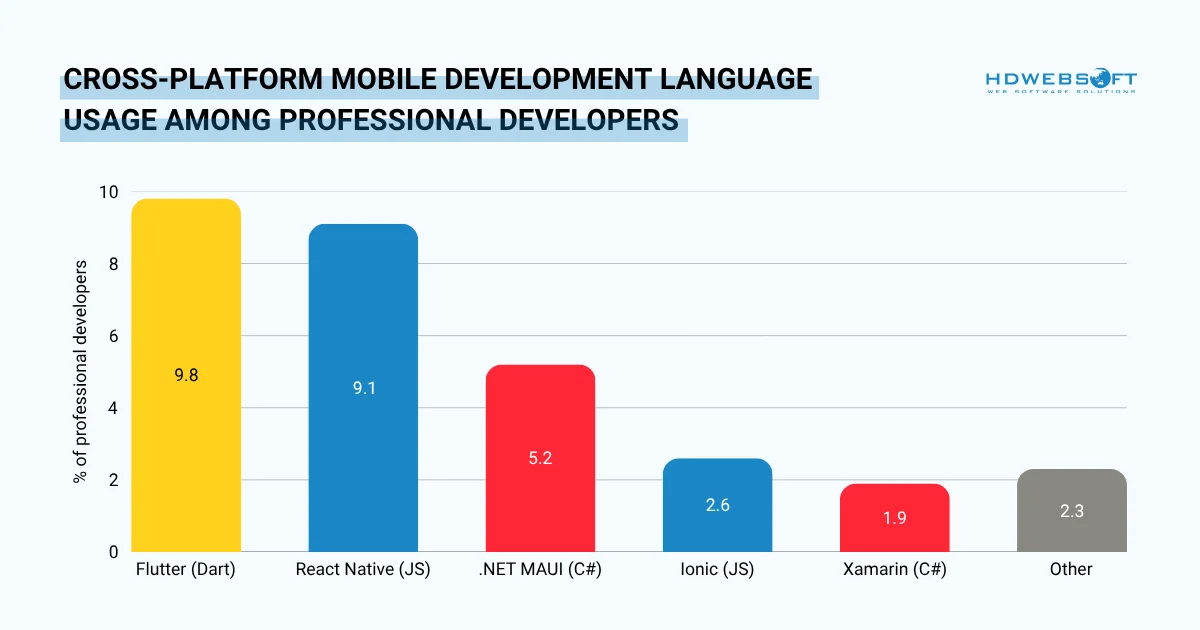
Based on Stack Overflow’s 2024 Developer Survey, this chart shows how Dart (Flutter) and JavaScript (React Native) have emerged as the two dominant cross-platform mobile development languages, each used by roughly 1 in 10 professional developers globally.
Dart (Flutter): Near-Native Performance with a Single Codebase
Dart is Google’s client-optimized mobile development language, purpose-built to power Flutter. Unlike JavaScript-based frameworks that bridge to native components, Flutter uses its own rendering engine and compiles Dart directly to ARM/x64 native code — delivering near-native performance across iOS, Android, web, and desktop from a single codebase. According to the Stack Overflow 2024 Developer Survey, Flutter was used by roughly 1 in 10 professional developers globally. For startups and MVPs that need fast delivery, consistent UI, and strong performance, Dart/Flutter is one of the most compelling options available today.
JavaScript / TypeScript (React Native): The Web Developer’s Path to Mobile
JavaScript is undoubtedly one of the world’s most widely used mobile development languages. And React Native brings it directly into mobile development.
React Native was created by Meta. It lets web development teams apply their existing JavaScript knowledge to build iOS and Android apps with shared business logic and UI components. TypeScript, a typed superset of JavaScript, is increasingly preferred in React Native projects because it improves error detection and long-term maintainability.
C# (.NET MAUI): The Enterprise Cross-Platform Option
C# with .NET MAUI (formerly Xamarin) is the preferred mobile development language for teams already embedded in Microsoft’s ecosystem. It compiles to native code and supports iOS, Android, Windows, and macOS from a single codebase. Consequently, it helps remove the need to adopt an entirely new technology stack.
For enterprise teams building internal tools or extending existing .NET applications to mobile, it’s a pragmatic, cost-effective choice.
For a framework-level deep dive into Flutter, React Native, .NET MAUI, and others, see our related guide: Top 5 Cross-Platform App Development Frameworks for 2025.
How Do Mobile Development Languages Compare? (Side-by-Side)
Choosing between mobile development languages becomes easier when you can see the key tradeoffs at a glance. The table below maps each major language against the factors that matter most in real projects.
You can use this as a quick reference when shortlisting options for your team or advising stakeholders on the right stack.
| Language / Framework | Platform(s) | Performance | Learning Curve | Developer Pool | Best For |
| Swift | iOS, iPadOS, macOS, watchOS, tvOS | Excellent | Moderate | Large | New Apple ecosystem apps |
| Objective-C | iOS, macOS legacy apps | Good | High | Shrinking | Maintaining legacy Apple apps |
| Kotlin | Android | Excellent | Low–Moderate | Large | New Android apps |
| Java | Android, backend, enterprise systems | Good | Moderate | Very Large | Legacy Android apps, enterprise Android, backend systems |
| Dart / Flutter | iOS, Android, Web, Desktop | Near-native | Moderate | Growing Fast | MVPs, cross-platform apps, consistent UI |
| JavaScript / TypeScript with React Native | iOS, Android; community support for Windows, macOS, visionOS | Good to Near-native | Low–Moderate | Massive | Cross-platform mobile apps, web-aligned teams, experienced JS teams |
| C# / .NET MAUI | iOS, Android, Windows, macOS | Good | Moderate | Large | Enterprise apps, Microsoft-stack teams, cross-platform business apps |
Which Mobile Development Language Is Right for Your Project?
The best mobile development languages are not the one with the most GitHub stars. It’s the one that matches your platform target, team expertise, and business goals. Therefore, you can use this framework to narrow your choice before committing to a stack.
A Practical Decision Framework
Answer each question honestly, especially the ones about team expertise. This is since retraining developers adds hidden cost and timeline risk that is easy to underestimate in early planning.
- Building for iOS only? Swift is the clear choice. It has the best Apple framework integration, the longest-term platform support, and access to the latest iOS features from day one.
- How about building for Android only? Choose Kotlin for new projects. If your team has deep Java expertise or you’re extending a legacy app, Java is still a viable path.
- Both platforms, with a web dev team? JavaScript / React Native is the fastest on-ramp. Your team applies existing skills immediately, reducing ramp-up time and initial cost.
- Both platforms, performance-first? Dart / Flutter compiles to native code and delivers the best cross-platform performance currently available.
- Enterprise environment with Microsoft stack? C# / .NET MAUI lets you extend your existing infrastructure to mobile without a full technology pivot.
- AI-heavy or data-driven app? Python (via Kivy or BeeWare) is worth exploring for apps where backend logic and ML models take priority over a rich native UI.
If you’re still working through the higher-level choice for mobile development languages between native, cross-platform, and web-first approaches, check out our post on PWA vs Native App: Choosing the Right Mobile Strategy lays out the full tradeoff framework in detail.
How Does Your Language Choice Affect Hiring and Development Costs?
Selecting the best language for mobile app development is not just a technical decision. It directly determines your talent pool, your hourly rates, and how expensive the app will be to maintain long after launch.
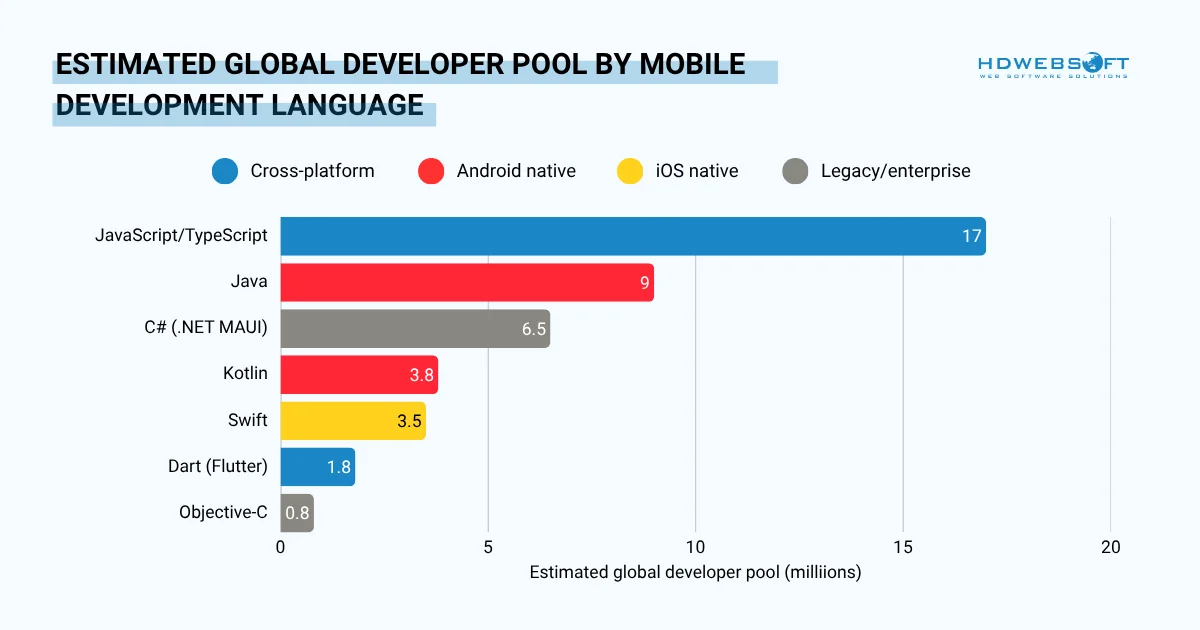
Teams evaluating mobile development languages for long-term projects will find this a useful anchor for cost planning.
Developer Availability by Language
Languages with larger, more established communities are consistently easier and cheaper to staff. It’s a factor that compounds over multi-year product lifecycles.
JavaScript
It has the largest global developer pool by a wide margin, which generally translates to more outsourcing options and competitive rates. Java and Kotlin have mature, well-documented communities with strong talent concentrations in Southeast Asia and Eastern Europe. Swift developers are more specialised and typically command a premium, though the talent pool grows steadily as iOS remains the high-value end of the app market.
Dart
Now, this mobile development languages is still maturing in terms of available senior talent, which can mean higher day rates for experienced Flutter developers. However, consolidating two native codebases into one typically offsets this premium significantly over the course of a project.
Planning for Long-Term Maintenance
Apps built in the best language for mobile app development with shrinking communities become progressively more expensive to maintain as experienced developers grow harder to find. The most prominent example here would be Objective-C. Hence, choosing a language with active, well-funded backing (Swift, Kotlin, Dart, or JavaScript) reduces this compounding cost risk substantially.
Frequently Asked Questions About Mobile Development Languages
These are the questions developers and business owners ask most often when evaluating the best programming language for mobile app development for a new project.
What is the best programming language for mobile app development?
There is no single best mobile development language for every project. Swift leads for iOS, Kotlin is Google’s preferred choice for Android. In addition, Dart (Flutter) or JavaScript (React Native) are the top picks for cross-platform development. The right answer depends on your target platform, team expertise, timeline, and performance requirements.
Can I use the same language for both iOS and Android?
Yes. Several mobile development languages support both platforms from a single codebase. Dart (via Flutter), JavaScript (via React Native), and C# (via .NET MAUI) all enable cross-platform development. Typically, they reduce time and cost significantly compared to maintaining two separate native codebases.
Is Kotlin or Java better for Android development?
Kotlin is the better choice for new Android projects. It is Google’s officially preferred mobile development language for Android, offers a more concise modern syntax, and eliminates many common Java errors at the compiler level. Java remains valid for enterprise environments and legacy codebases, but Kotlin is the recommended default for anything built today.
What programming language do most mobile apps use?
Native apps predominantly use Swift (iOS) and Kotlin or Java (Android). For cross-platform apps, JavaScript via React Native and Dart via Flutter are the most widely adopted options. According to the Stack Overflow 2024 Developer Survey (Stack Overflow), both Flutter and React Native were used by roughly 1 in 10 professional developers globally.
Is Python good for mobile app development?
Python is not considered as one of the primary mobile development languages. Nonetheless, it can be used via frameworks like Kivy and BeeWare for apps where AI/ML integration or data processing takes precedence over a polished native UI. For performance-intensive or visually rich applications, Swift, Kotlin, Dart, or JavaScript are all stronger choices.
How do I choose a mobile development language if I have a web development team?
Web development teams with JavaScript experience are best positioned to adopt React Native. This is because it allows developers to apply existing skills directly to mobile with minimal ramp-up. If your team already uses TypeScript, the transition is even smoother since it’s natively supported in React Native and improves code quality significantly.
Which mobile development language is easiest to learn for beginners?
Swift and Kotlin are widely considered the most approachable mobile development languages for native development. This is since they have clear syntax and strong official documentation.
In addition, JavaScript is the natural entry point for developers coming from a web background. Dart is more approachable for those who already know Java or JavaScript, but can be challenging as a first language.
In A Nutshell
Choosing a mobile development language is one of the most consequential early decisions in any app project. It shapes your performance ceiling, your hiring options, your maintenance costs, and your long-term flexibility. Swift and Kotlin are the gold standards for native iOS and Android development. Dart and JavaScript lead for cross-platform efficiency. All the while, C# fills a critical niche for enterprise teams in the Microsoft ecosystem.
At HDWEBSOFT, our mobile development team works across Swift, Kotlin, React Native, and Flutter to build apps that fit your business, not just your budget. Whether you’re shipping your first MVP or scaling an existing product, our mobile app development services are structured around your goals, timeline, and team. Talk to us about which mobile development language and stack is the right fit for your next project.