What is an AI platform and why does the answer matter more than ever right now? For organizations racing to extract real value from artificial intelligence, individual tools and isolated models are rarely sufficient. Building AI that actually reaches production demands an integrated environment: one that handles data, training, deployment, and monitoring under one coordinated system. That integrated environment is what an AI platform delivers.
As a matter of fact, AI is reshaping how industries operate at a fundamental level. Yet according to McKinsey research, realizing sustained business value from AI remains elusive for many organizations. The tools exist. The talent is increasingly available. What often holds teams back is the absence of the right infrastructure connecting everything together.
For teams already exploring how AI is changing the way software itself gets built, this topic connects directly to AI augmented software development. It is where platforms form the operational backbone of intelligent systems. This guide covers AI platform use cases across industries, the three main approaches to implementation, the key capabilities to evaluate, and the questions to ask before committing to any platform.
What Is an AI Platform?
Before evaluating options, pinning down a precise definition separates productive conversations from vendor-driven confusion.
Definition and core functions
At its core, an AI platform is an integrated set of technologies that enables teams to develop, test, deploy, and maintain machine learning (ML) and deep learning models. The operative word is integrated. An AI platform is not a single tool, a library, or a standalone application. It is a coordinated environment where data management, model training, deployment pipelines, governance, and monitoring all work together.
Understanding what is an AI platform at the enterprise level means recognizing it as infrastructure, not just tooling. Specifically, a well-designed AI platform enables five foundational capabilities:
- Centralizing data analysis and collaboration across data science teams
- Streamlining ML development and production workflows, commonly called MLOps
- Facilitating collaboration between data scientists, engineers, and IT administrators
- Automating repetitive tasks throughout the AI development lifecycle
- Monitoring models and AI systems continuously in production
Without these capabilities working in concert, teams face what practitioners call “glue code” — the undifferentiated engineering work of connecting tools, managing environments, and maintaining deployments. An AI platform exists, fundamentally, to eliminate that friction and let teams focus on building better models.
AI platform vs. standalone AI tool
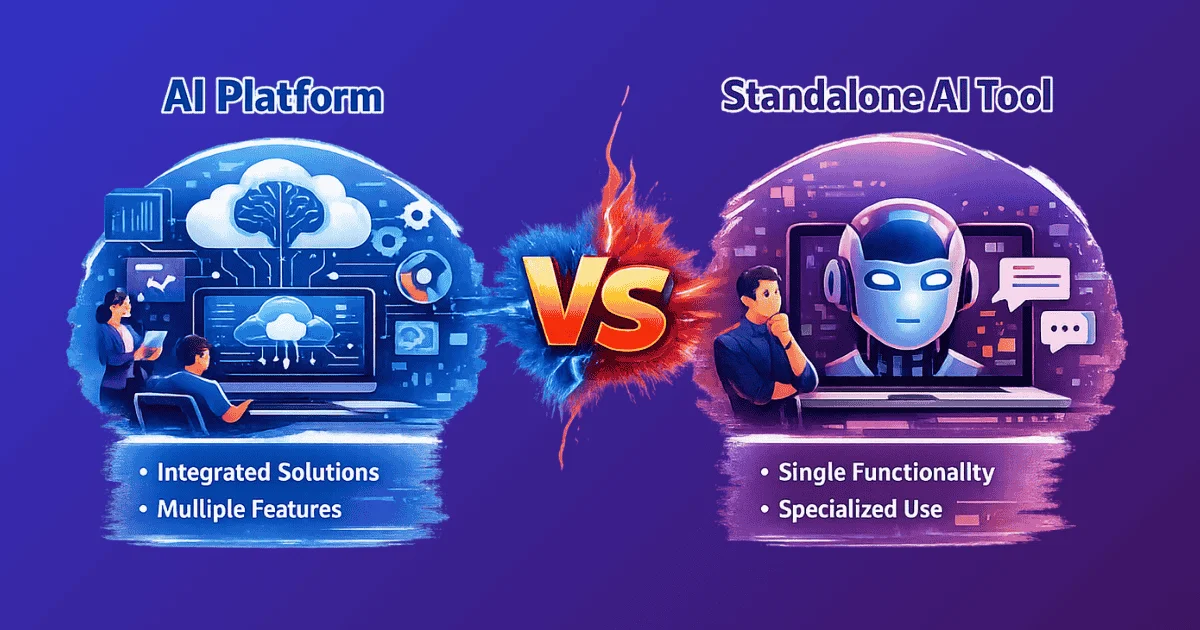
The distinction matters practically. A standalone AI tool solves one well-defined problem. For example, a computer vision API for image classification, or an NLP library for sentiment analysis. Powerful as they are, standalone tools do not manage pipelines, govern access, or scale across an organization.
Given the answer to what is an AI platform, by contrast, supports the entire lifecycle. Think of a standalone tool as a single instrument. Meanwhile, AI platform is the full orchestra as the conductor responsible for making them perform together. This distinction becomes critical as teams move from experimentation to production, where operational complexity grows rapidly.
Types of AI Platforms: Three Approaches
There is no universally correct way to build an AI platform. Organizations typically choose from three broad approaches, each with distinct trade-offs between speed, flexibility, cost, and control.
| Approach | Best for | Key benefits | Key challenges |
|---|---|---|---|
| Buy end-to-end (cloud)AWS SageMaker, Google Vertex AI, Azure ML | Teams needing fast deployment with enterprise support | ✓ Quick setup✓ Managed infrastructure✓ Regular security updates | ⚠ Higher cost⚠ Vendor lock-in risk⚠ May not fit niche use cases |
| Build your ownUber’s Michelangelo, Netflix’s Metaflow | Large teams with unique workflows and long-term infrastructure ownership goals | ✓ Full workflow control✓ Adapts to changing requirements | ⚠ High upfront investment⚠ Ongoing maintenance burden |
| Open-source stackPython ecosystem, MLflow, Jupyter, Hugging Face | Teams prioritizing flexibility, innovation, and community-driven security | ✓ Best tools per use case✓ Low licensing cost✓ Strong community vulnerability detection | ⚠ Requires strong internal expertise⚠ Integration effort falls on the team |
Cloud-based AI platforms
When asking what is an AI platform, one of the most common answers is the end-to-end cloud ecosystem offered by major providers. Companies such as Amazon Web Services, Google Cloud Platform, and Microsoft Azure are dominating the end-to-end market. Their platforms bundle pre-built tools, managed compute, and enterprise-grade support into one offering. Consequently, teams can move from prototype to deployment significantly faster than building from scratch.
The trade-off, however, is cost and potential lock-in: tools may not map cleanly onto highly specific use cases, and migrating away from a cloud platform later is rarely straightforward.
Build-your-own platforms
Organizations like Uber and Netflix chose to build custom platforms because their scale and unique operational requirements exceeded what off-the-shelf solutions could support. Uber built Michelangelo to solve a concrete operational problem: data scientists were training models only on laptops, and there was no process for storing model versions across teams.
To better understand what is an AI platform in this context, an in-house build is more than just a toolset. It’s a strategic infrastructure asset. Building in-house granted full control over the workflow but also demanded sustained engineering investment and ongoing maintenance responsibility. This path makes sense when the competitive advantage lies in the AI infrastructure itself, not just the models it produces.
Check out HDWEBSOFT’s AI development services for free consultation on building a secure AI platform.
Open-source AI platforms
Python remains the dominant language for data science and machine learning, supported by a rich ecosystem of open-source libraries: TensorFlow, PyTorch, scikit-learn, MLflow, and Jupyter Notebook among them. The open-source approach gives teams access to cutting-edge tools without licensing fees.
Moreover, the open-source community identifies and patches security vulnerabilities quickly,often faster than proprietary vendors. This is because thousands of practitioners are actively monitoring and contributing. The core requirement for this path, though, is a team with genuine expertise to assemble, integrate, and maintain the full stack.
AI Platform Use Cases by Industry
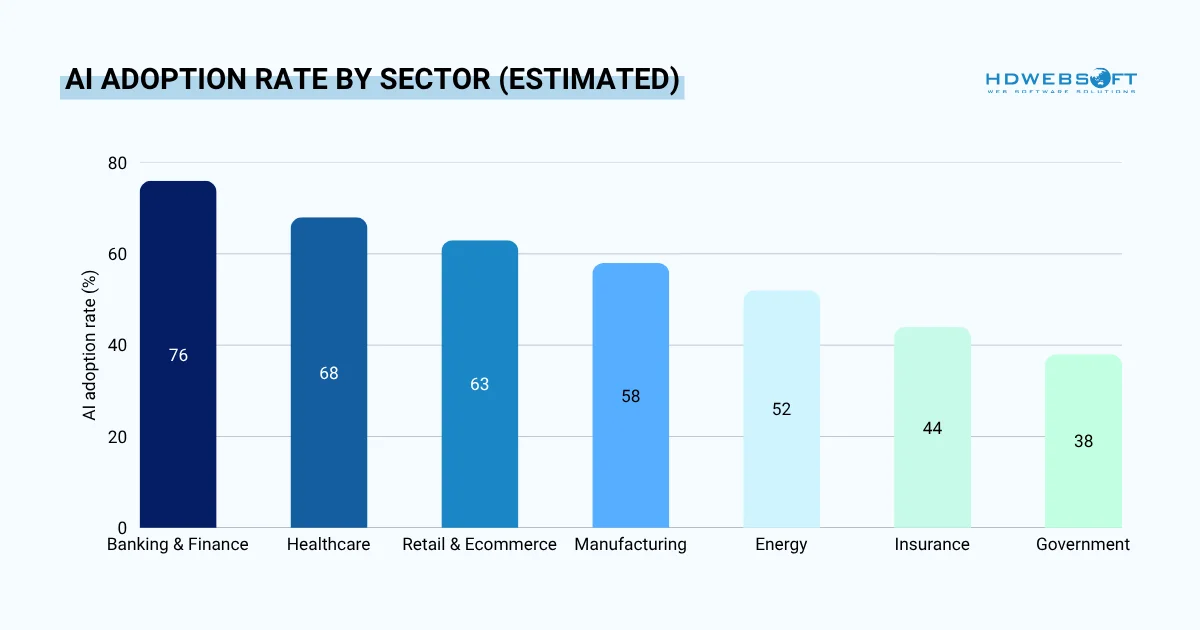
The practical value of understanding what is an AI platform becomes clearest when examining how different sectors are applying it today. Each industry brings its own data challenges, regulatory requirements, and performance thresholds.
Banking and finance
Financial institutions were among the earliest to extract measurable ROI from AI. Fraud detection algorithms now parse thousands of transaction records per second, simultaneously analyzing cardholder identity, transaction location, timing, and amount to flag anomalies in real time. Beyond fraud, banks deploy predictive models for credit scoring and risk analysis, moving away from generic third-party scores toward custom models trained on their own customer data.
The contract intelligence application built by JPMorgan, for instance, uses natural language processing to analyze commercial loan agreements. The result: an estimated 360,000 hours of manual legal review reduced per year. These are not edge-case AI platform use cases, they are core operations at scale.
Healthcare
Disease detection and medical imaging represent two of the highest-impact applications in healthcare. To understand what is an AI platform in a clinical setting, consider how deep learning models are trained and applied. They are used on radiographic datasets that now detect early-stage tumors in the lungs, breast, and brain. And sometimes, they work with greater accuracy than experienced radiologists working under heavy workloads.
One early detection tool developed at Houston Methodist Research Institute interprets mammograms at 99% accuracy and delivers results 30 times faster than manual review.
Furthermore, AI is accelerating drug development by analyzing molecular structures and predicting protein interactions at a speed no human research team can replicate. Harvard and McKinsey researchers estimated that AI adoption in healthcare could deliver annual savings between $200 billion and $360 billion. Primarily, the technology is applied through diagnostic accuracy, care delivery efficiency, and administrative automation.
Retail and ecommerce
Amazon’s recommendation engine, built on collaborative filtering algorithms, remains one of the most commercially significant applications of AI in retail. To understand what is an AI platform in ecommerce, consider how modern retail systems now support dynamic pricing, anticipatory shipping models, and highly personalized customer experiences.
Setting an example, Olay’s Skin Advisor application, powered by neural networks, doubled the brand’s sales conversion rates after launch. It has demonstrated that personalization at scale produces direct revenue impact.
Manufacturing
Quality control and predictive maintenance dominate manufacturing AI applications. Image recognition models inspect components as they come off assembly lines, detecting defects down to a fraction of a millimeter. It’s proven well beyond what consistent human inspection can achieve.
Simultaneously, predictive maintenance systems monitor sensor data across equipment to forecast failures before they occur, reducing unplanned downtime and the cascading costs that follow.
Additional industries applying AI platforms
| Industry | Representative AI platform use cases |
|---|---|
| Energy | Demand forecasting, predictive maintenance, smart grid optimization, storage efficiency |
| Insurance | Underwriting risk assessment, image-based claims adjustment, fraud detection |
| Government | Emergency response analytics, benefits administration, fraud prevention, climate modeling |
Market context: IDC projects that by 2030, 50% of new economic value generated by APJ digital businesses will come from companies investing in and scaling their AI capabilities today. For organizations, this is not a future trend; it is the competitive environment right now. Teams that delay building AI platform capabilities risk ceding ground to competitors who have already invested.
7 Key Capabilities of a Strong Enterprise AI Platform
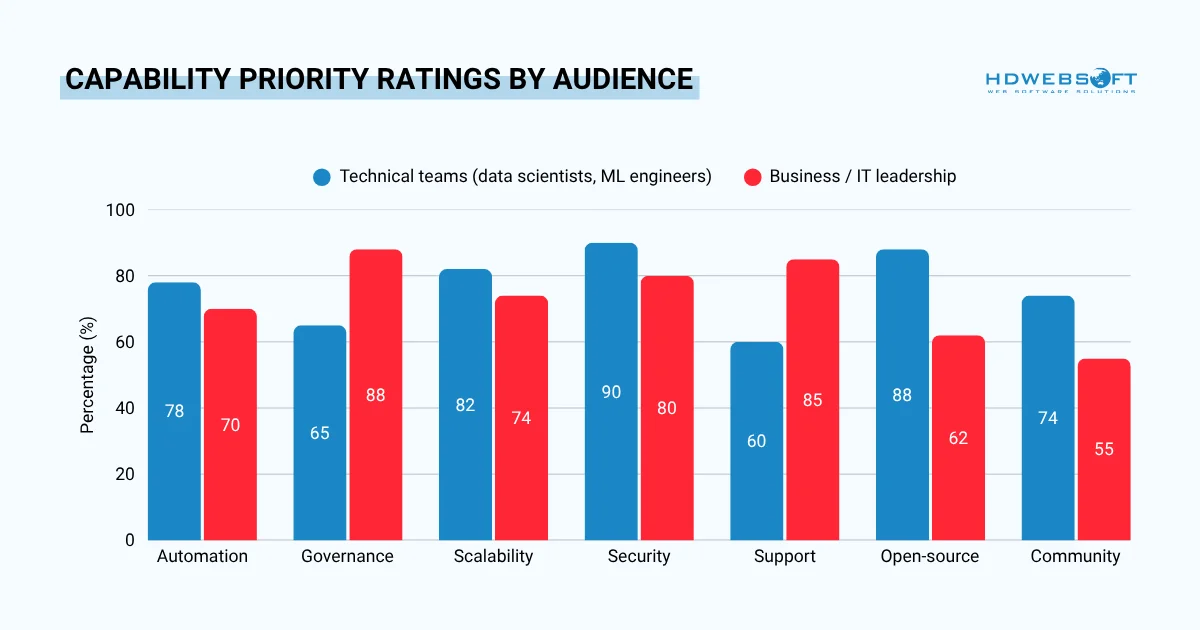
Not all platforms are equal. If you are asking what is an AI platform worth investing in, these seven capabilities separate solutions that scale from those that stall. Whether your choice is to buy, build, or assemble open-source tools.
- Automation: Automates proven workflows across the ML lifecycle, reducing the manual glue code that slows teams down.
- IT governance and control: Enables user provisioning, access management, audit trails, and compliance, critical for regulated industries.
- Scalability: Handles growth from a single practitioner’s laptop all the way to distributed production clusters without re-architecting.
- Security: Monitors CVEs in open-source packages, controls the software supply chain, and enforces access policies at every layer.
- Support: Provides onboarding resources, ongoing training, and enterprise SLAs, especially important when incidents affect production models.
- Open-source tool integration: Supports libraries like Jupyter, TensorFlow, scikit-learn, Keras, and MLflow without requiring custom wrappers.
- Community contribution: Platforms maintained by teams embedded in open-source communities bring faster vulnerability detection and innovation.
How to Choose the Right AI Platform for Business
Choosing a platform is a cross-functional decision. If you are asking what is an AI platform worth committing to, evaluate vendors, or your internal build plan, against these grouped questions before moving forward.
Governance and data management
Start by asking how the platform tracks data lineage and monitors data quality. Specifically, find out whether it supports GDPR, CCPA, and other relevant privacy regulations out of the box. Additionally, check whether IT administrators can provision and deactivate user accounts without engineering intervention.
Scale and infrastructure
Next, understand how practitioners will create environments for model training and experimentation. Ask what hardware is supported and what the associated costs are. A platform that works beautifully at small scale but requires a complete re-architecture for production is a significant risk.
Security
For any enterprise AI platform, security should be non-negotiable. Ask how many levels deep the provider monitors CVEs affecting their platform. Understand what access control looks like and how logging, monitoring, and alerting are managed for IT administrators.
Support and open source
Finally, evaluate the human side of the platform. If you are still asking what is an AI platform that teams can realistically adopt, look closely at onboarding effort and whether training is available continuously or only at implementation.
For open-source-based platforms, ask how the provider contributes to and monitors the open-source ecosystem. This is often a proxy for the quality of their security practices.
| Category | Key questions to ask |
|---|---|
| Governance | How is data lineage tracked? Does the platform support GDPR and CCPA compliance natively? |
| Scale | How does training scale from a single laptop to distributed clusters? What hardware is supported and at what cost? |
| Security | How deep does CVE monitoring go? What does access control, logging, and alerting look like for IT administrators? |
| Support | What does onboarding entail? Is training ongoing? What are the SLA tiers for production incidents? |
| Open source | Which libraries are supported natively? How does the provider actively contribute to open-source projects? |
Frequently Asked Questions
These are among the most commonly searched questions on the topic of what is an AI platform. Each answer is written to be concise enough to surface as a featured snippet while being informative enough to satisfy both technical and business readers.
What is the difference between an AI platform and an ML platform?
The terms are often used interchangeably. In practice, an ML platform typically focuses on model development and training workflows specifically. An AI platform, on the other hand, is broader. It includes full ML capabilities but also covers data ingestion, governance, deployment orchestration, and production monitoring.
Most platforms marketed today as AI platforms include comprehensive ML functionality as a core component.
What is a conversational AI platform?
A conversational AI platform is a specialized type of AI platform focused on building, training, and deploying chatbots and virtual assistants. It provides tools to manage natural language processing (NLP) models that interact with users through text or voice interfaces.
To better understand what is an AI platform in this category, consider well-known examples such as Amazon Lex, Google Dialogflow, and Microsoft Bot Framework. These platforms typically offer APIs for integrating conversational agents into existing messaging channels like Slack, WhatsApp, or web chat widgets.
What are the best AI platforms available?
There is no single best answer since the right choice depends on your team’s size, expertise, and specific use case.
- Cloud-based options like Google Vertex AI, AWS SageMaker, and Microsoft Azure Machine Learning suit teams needing fast, managed deployment.
- Open-source stacks built around Python, MLflow, Jupyter, and PyTorch suit teams prioritizing flexibility and community-driven innovation.
The 7-capability framework in this guide provides a vendor-neutral evaluation structure applicable to any option.
How do you build an AI platform?
Building your own AI platform typically involves assembling components across five layers. They are data ingestion and versioning, feature engineering infrastructure, model training (often GPU-backed), experiment tracking and model registry, and production serving with monitoring.
To understand what is an AI platform in a build-your-own context, companies like Uber (Michelangelo) and Netflix (Metaflow) offer useful reference models. The critical starting point is defining business requirements first, then selecting tools that fit those requirements, not the reverse.
How is an AI platform different from a BI tool?
Both serve important roles, but they address fundamentally different problems.
- A BI (Business Intelligence) tool is designed primarily for querying and visualizing historical data. In other words, it answers “what happened?”
- Meanwhile, an AI platform for data science is designed for building predictive and generative models. It answers “what will happen, and what action should follow?” BI tools describe the past. Simply speaking, AI platforms drive decisions about the future.
Conclusion
Knowing what is an AI platform is the foundation. However, the more important question is which approach fits your organization’s resources, timeline, and technical capabilities. Cloud-based platforms offer speed and support but may limit flexibility, while in-house builds provide control and customization at the cost of substantial engineering effort. Open-source stacks deliver flexibility and innovation but require deep expertise to integrate and maintain effectively.
No single path is universally best; the right choice depends on context. What matters most is evaluating every option against practical criteria and use a structured framework rather than vendor claims.