Understanding managed security service pricing is one of the most important decisions a business leader will make in today’s threat landscape. After years of advising organizations on managed cybersecurity services, one truth stands out: the cost of doing nothing far outweighs the cost of protection. According to IBM, the global average breach in 2024 costs $4.88 million. It’s a 10% jump from 2023 and the sharpest single-year increase since the pandemic.
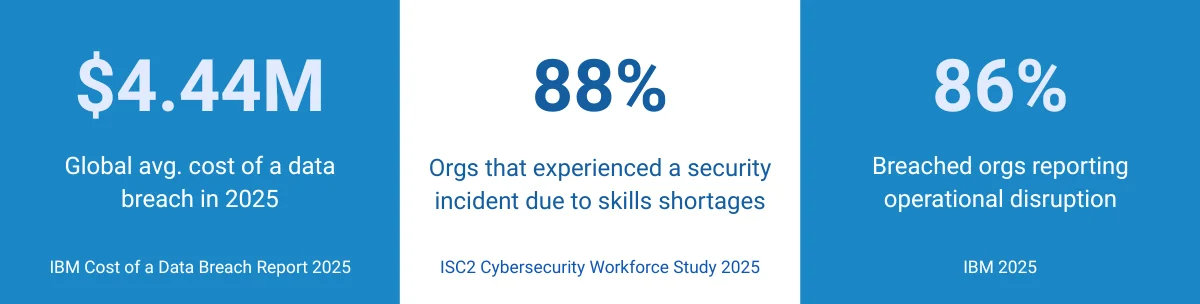
According to the IBM Report, the global average breach now costs $4.44 million. In the United States specifically, that figure has surged to an all-time high of $10.22 million, driven by steeper regulatory fines and escalating investigation costs.
So, what does managed security actually cost? The short answer is: it depends. Pricing varies based on your business size, the services you need, and the billing model your provider uses. However, the better question is not just how much it costs; it’s how much it saves. This guide breaks down every major MSSP pricing model, the per-device cost structure, and the real factors that shape your monthly bill.
What Is Included in Managed Security Service Pricing?
Before comparing numbers in different managed security service pricing models, it helps to understand exactly what you’re paying for. This is because the scope of services has a direct impact on the final price.
Think of managed security as the full stack of protection your organization needs, not just a firewall. A reputable managed security service provider (MSSP) covers everything from round-the-clock monitoring to post-breach response. So, the breadth of services determines whether you’re buying a basic safety net or a fully operational security function.
Typically, MSS pricing encompasses a core set of capabilities. These include 24/7 threat monitoring, Security Operations Center (SOC) access, Managed Detection and Response (MDR), endpoint protection, log management, vulnerability scanning, and cloud security. Beyond the baseline, many managed security service pricing also include compliance support for frameworks like HIPAA, PCI-DSS, and NIST. That is why it’s especially relevant for healthcare and financial organizations.
Furthermore, more comprehensive tiers add threat intelligence feeds, employee security awareness training, incident response (IR) retainer services, and business continuity planning (BCP). The more of these capabilities included in your package, the higher the managed security services pricing per endpoint or per user tends to be. However, the trade-off is significant: broader coverage means fewer gaps for attackers to exploit.
The numbers make the stakes clear. According to recent studies, the cost of under-investing in data security has never been higher: across financial loss, operational disruption, and talent shortfall alike.
The 6 MSSP Pricing Models Explained
Choosing the right MSSP pricing model is arguably the single biggest factor in determining your monthly spend. Each model suits a different business profile; so understanding the structure is essential before signing any contract.
1. Per-User Pricing
Rather than billing based on physical infrastructure, this model charges based on the number of employees accessing your systems. This managed security service pricing is best suited for organizations with a stable headcount and employees who regularly use multiple devices throughout their workday. In those environments, a per-user rate is more economical than tallying every laptop, mobile device, and workstation separately.
Typical Cost Range
Per-user pricing generally falls between $25-$75 per user per month, depending on the service tier and depth of coverage. However, as the workforce scales, this model can become complex to manage during periods of high hiring or turnover.
2. Managed Security Services Pricing Per Endpoint or Device
This is the most widely used model, and for good reason. Managed security services pricing per endpoint or device is transparent, predictable, and easy to audit. Each managed asset (workstation, server, mobile device, or virtual machine) carries an individual monthly rate. Because the billing is tied directly to your IT estate, cost forecasting becomes straightforward.
Per-Device Cost Breakdown by Asset Type
| Device Type | Typical Monthly Rate | Why It Varies |
|---|---|---|
| Workstation / Laptop | $30 – $60 / endpoint | Lower complexity, standard OS environments |
| Server | $60 – $120 / server | Higher criticality, more intensive monitoring required |
| Mobile Device | $15 – $35 / device | Typically lower risk surface; MDM integration varies |
| Cloud Workload / VM | $25 – $80 / workload | Depends on cloud provider, workload sensitivity |
It’s worth noting that per-device managed security service pricing can escalate as an organization grows its hardware fleet. Nevertheless, for businesses with lean teams and a broad device inventory, this model tends to offer the clearest line of sight into security spend.
3. A La Carte Pricing
Custom-built service packages give organizations maximum flexibility. Instead of buying a bundle that includes services they don’t need, businesses select exactly which security capabilities they want to deploy. This works especially well for organizations that already have partial in-house security coverage and need to fill specific gaps. For example, SOC monitoring, endpoint detection and response (EDR), or compliance reporting.
The downside, however, is complexity. Without a clear internal security roadmap, a la carte selections can lead to coverage gaps or overlapping tools. That’s why there should be a skilled MSSP partner to help guide these decisions during the scoping phase.
4. Tiered / Bundled Pricing
Pre-packaged managed security service pricing tiers, often labeled Basic, Business, and Enterprise, simplify the buying process. Each tier bundles a defined set of capabilities at a predictable price. This structure is ideal for small to mid-sized businesses with standard, stable security needs who want the ease of comparison without the complexity of custom configuration.
In fact, upgrading between tiers typically unlocks advanced features like 24/7 SOC access, MDR, or dedicated account management.
5. Flat Fee / All-Inclusive Pricing
The all-inclusive model offers the highest degree of budget certainty. One monthly fee covers remote support, on-site assistance, monitoring, response, and most other services in scope. Therefore, CFOs often favor this structure because there are no surprise line items mid-month.
That said, some providers using this model apply longer SLA response windows. As a result, organizations with zero tolerance for downtime should scrutinize their SLA carefully before committing.
6. Monitoring-Only Pricing
For businesses with a strong internal security team, monitoring-only managed security service pricing plans offer a cost-effective supplement. The MSSP handles alerts, notifications, and surveillance, though actual investigation and remediation remain in-house. This model pairs well with organizations that have invested in EDR or SIEM tools but lack the 24/7 staffing to fully leverage them.
In all, monitoring-only plans typically carry a flat monthly rate, with remediation billed separately on a time-and-materials basis.
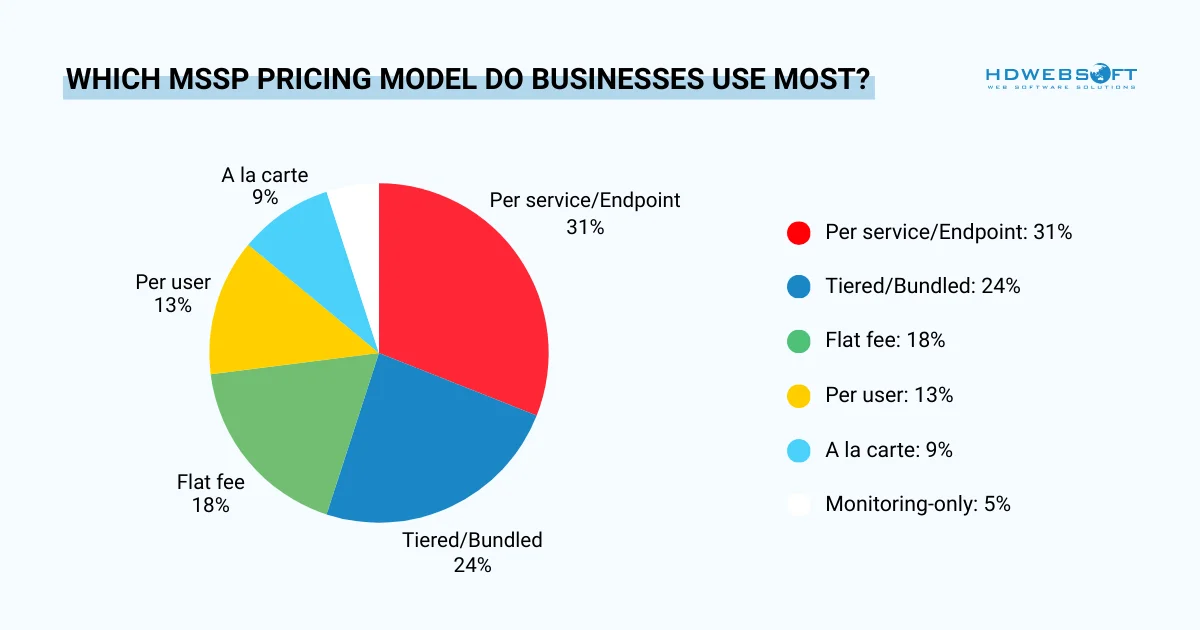
In fact, each model has its own popularity among businesses. Here’s a visual summary of which model is the most used.
“The right pricing model isn’t the cheapest one. It’s the one that aligns coverage depth with your actual risk exposure.”
— Mr. Hung Luu, CEO of HDWEBSOFT Perspective.
What Factors Drive Managed Security Service Pricing?
Even within the same pricing model, costs can vary significantly from one organization to the next. Several compounding factors determine where on the spectrum your quote will land.
Business Size and IT Complexity
Scale is the most obvious cost driver. More endpoints, users, servers, and network segments mean more assets to monitor and protect, adding to managed security service pricing. Beyond headcount, the architectural complexity of your environment (hybrid cloud, legacy systems, remote workforce infrastructure) directly influences the level of effort required from your MSSP.
Scope and Hours of Coverage
Coverage hours matter greatly. Business-hours monitoring costs considerably less than 24/7/365 SOC oversight. For many industries, however, round-the-clock monitoring is not optional. Cyberattacks don’t follow business hours and neither does the expectation of rapid response from enterprise clients or regulators.
Industry and Compliance Requirements
Regulatory obligations significantly raise the cost floor. Heavily regulated sectors must meet specific security and audit standards, which require additional tooling, reporting, and evidence collection. The following industries consistently pay premium rates for managed security:
| Industry | Primary Framework | Cost Impact |
|---|---|---|
| Healthcare | HIPAA | High — avg. breach cost $7.42M (IBM 2025) |
| Financial Services | PCI-DSS, SOC 2 | High — avg. breach cost $5.56M (IBM 2025) |
| Government / Defense | NIST, CMMC | High — strict access controls and audit trails |
| Manufacturing / Industrial | ICS/SCADA standards | Medium-High — avg. breach cost $5.56M (IBM 2025) |
| Retail / E-Commerce | PCI-DSS | Medium — volume of transaction data drives scope |
Monitoring vs. Full Managed Detection and Response
There is a meaningful managed security service pricing gap between alert-only monitoring and full MDR. Monitoring informs; MDR acts. With MDR, the MSSP investigates alerts, triages threats, contains incidents, and coordinates remediation, all on your behalf.
Consequently, MDR pricing runs higher than monitoring-only plans. Yet, for most mid-market organizations without a dedicated incident response team, the additional cost is well justified.
Contract Length and Commitment
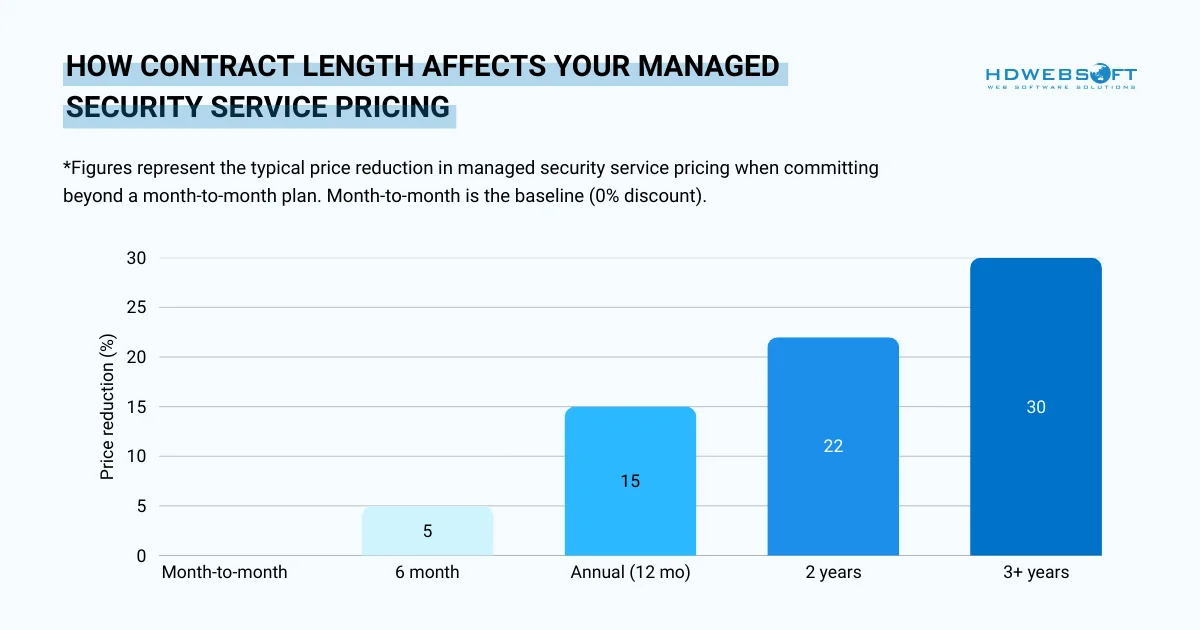
Like most enterprise services, longer contracts unlock lower unit rates. Month-to-month agreements offer flexibility but carry a premium. Meanwhile, annual commitments typically reduce per-user or per-device rates by 10–20%. Moreover, multi-year agreements can yield even deeper discounts, even though they require confidence in your provider relationship.
Average MSSP Cost: Realistic Ranges by Business Size
Published pricing is rare in the MSSP space — providers prefer custom scoping. Nevertheless, industry benchmarks offer useful ballpark figures for budget planning.
It’s important to emphasize that these are directional ranges, not fixed quotes. Actual figures depend heavily on the services selected, the managed security service pricing model used, and the specific provider. That said, working with an estimated range allows for meaningful budget conversations before entering the formal scoping process.
| Business Size | Employees | Estimated Monthly Range | Typical Scope |
|---|---|---|---|
| Small Business | 1 – 50 | $500 – $2,500 / mo | Endpoint monitoring, basic MDR, patch management |
| Mid-Market | 50 – 500 | $2,500 – $12,000 / mo | SOC access, MDR, SIEM, compliance reporting |
| Enterprise | 500+ | $12,000+ / mo (custom) | Full SOC, threat intel, IR retainer, cloud security |
To put these numbers in perspective: a single mid-tier cybersecurity analyst in the United States commands a base salary of $90,000 to $120,000 per year. For your information, this is before benefits, tools, training, and management overhead. That’s one person, covering one shift.
An MSSP, by contrast, provides a full team, an established SOC, and enterprise-grade tooling. And they are often at a comparable or lower annual cost than a two-person in-house team.
MSSP vs. In-House Security: A Direct Comparison
Executives often frame managed security service pricing as a build-vs-buy decision. In practice, it is a question of what level of coverage your budget can actually sustain.
The talent shortage makes in-house security increasingly difficult to staff, which is why many teams compare MSSPs against broader security-as-a-service models. According to the ISC2 2025 Cybersecurity Workforce Study has surveyed 16,029 professionals globally, concluding that organizations continue to face major talent gaps. 88% of them experienced at least one significant security incident in the past year due to skills shortages.
Furthermore, 33% of respondents said their organizations simply don’t have the resources to adequately staff their security teams. Hence, hiring is not just expensive; in many markets, the right talent is genuinely unavailable.
The Comparison
| In-House Security Team | Managed Security Service Provider |
|---|---|
| Full salary + benefits per analyst ($90K–$120K+/yr) | Predictable monthly cost with defined SLA |
| Significant tool licensing costs (SIEM, EDR, etc.) | Enterprise-grade tools included in service |
| Coverage gaps during nights, weekends, and holidays | 24/7/365 SOC coverage as a standard offering |
| Vulnerability to turnover and burnout | No recruitment or retention risk for you |
| Ongoing training and certification investment required | Continuous training handled by the provider |
| Limited threat intel beyond internal telemetry | Broad threat intelligence across many client environments |
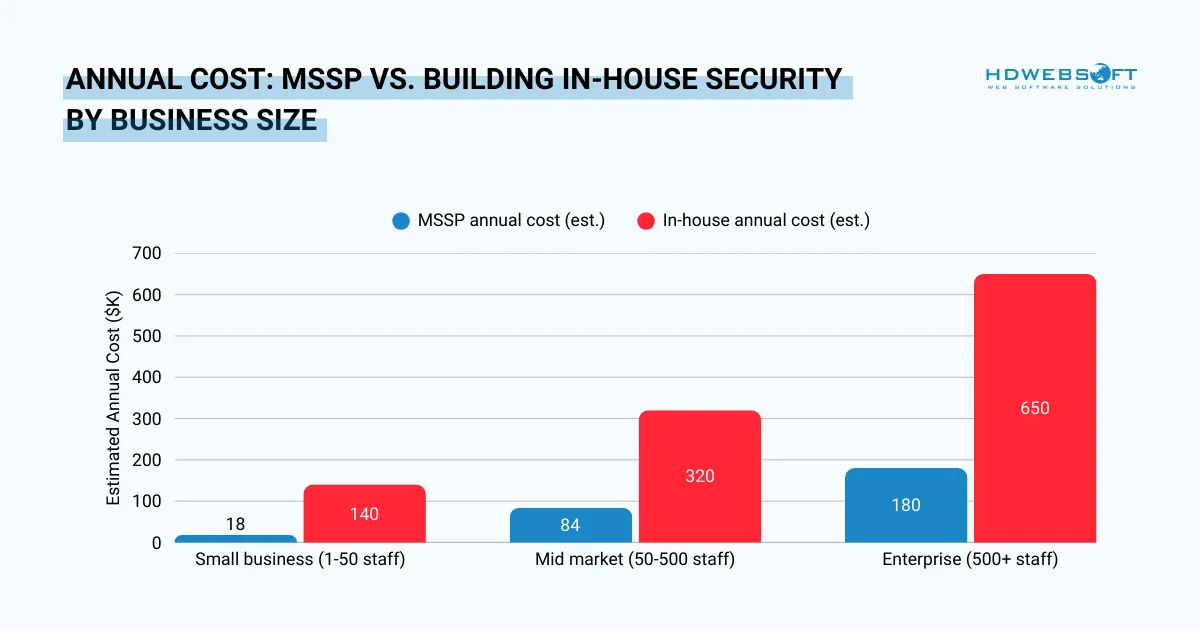
This comparison is not meant to suggest that in-house security teams have no place in competing in managed security service pricing. As a matter of fact, they do, particularly at the enterprise level. Rather, for most small and mid-market organizations, an MSSP delivers economies of scale that are very difficult to replicate internally. The question is not “can we afford an MSSP?” but “can we afford not to have one?”
How to Choose the Right MSSP Pricing Model for Your Business
Matching your organization’s profile to the right MSSP pricing model structure prevents overpaying for unused services. Plus, the underpaying for coverage you actually need.
There is no universal answer, but there is a logical framework. Start by mapping your current IT environment: how many endpoints, users, and cloud workloads do you manage? Then assess your compliance obligations and risk tolerance. Finally, evaluate whether your internal team has incident response capability, or whether you need an MSSP to own that function entirely.
| Your Situation | Recommended MSSP Pricing Model |
|---|---|
| Large device fleet, lean team | Per-Endpoint / Per-Device Pricing — costs scale with assets, not headcount |
| Stable headcount, multi-device users | Per-User Pricing — simplifies billing across complex device environments |
| Specific security gaps to fill | A La Carte — build a package around exactly what you’re missing |
| SMB with predictable, standard needs | Tiered / Bundled — easy to compare, budget-friendly, and scalable |
| CFO prioritizing budget certainty | Flat Fee / All-Inclusive — zero variable cost surprises month-to-month |
| Strong in-house IR team, monitoring gap | Monitoring-Only — supplements internal capability without replacing it |
Questions to Ask Before Signing

Beyond the managed security service pricing model itself, the contract terms define the real value of the relationship. Therefore, before committing to an MSSP, consider asking the following questions directly:
Scope and SLA
✔ What does incident response include and where does it stop?
✔ Is remediation covered, or does it trigger additional billing?
✔ What are the guaranteed response time commitments for critical, high, and medium severity alerts?
Pricing Transparency
✔ Are there overage fees if your device count or data volume exceeds plan limits?
✔ How does pricing change at contract renewal?
✔ Can you scale services up or down without penalty during the contract term?
Coverage and Staffing
✔ Is SOC coverage truly 24/7, or is it follow-the-sun with handoff risks?
✔ What certifications do the analysts hold?
✔ How is the team structured for escalation during a major incident?
Price Is Not the Strategy. Value Is
Managed security service pricing is not a simple line item; it is a strategic decision. The right model depends on your IT environment, compliance obligations, and internal capability. Whether you choose per-endpoint billing, a flat fee, or a custom a la carte package, the goal remains the same: consistent, expert-level protection without the overhead of building it from scratch.
The decision to invest in the MSSP pricing model should not be in question. In 2026, managed security is not a cost center. Rather, it is risk management infrastructure.
At HDWEBSOFT, our cybersecurity services are built around your business, not a generic price list. From endpoint protection to full SOC coverage, we help organizations of all sizes find the right level of security at a cost that makes sense. Reach out to our team for a free assessment and find out exactly what a tailored managed security plan looks like for your environment.