Why Most Mobile App Development Strategy Efforts Fail Before They Start
A well-defined mobile app development strategy is the single biggest factor separating apps that gain traction from those that quietly disappear. Yet most teams never build one. They confuse a feature list with a plan, a timeline with a strategy, and a tech stack decision with a business direction.
The result? A Statista report noted that user retention in mobile apps drops sharply after the first month, with many apps losing the majority of their users within 30 days of install. This isn’t because the apps were poorly built, but because they were built around the wrong assumptions.
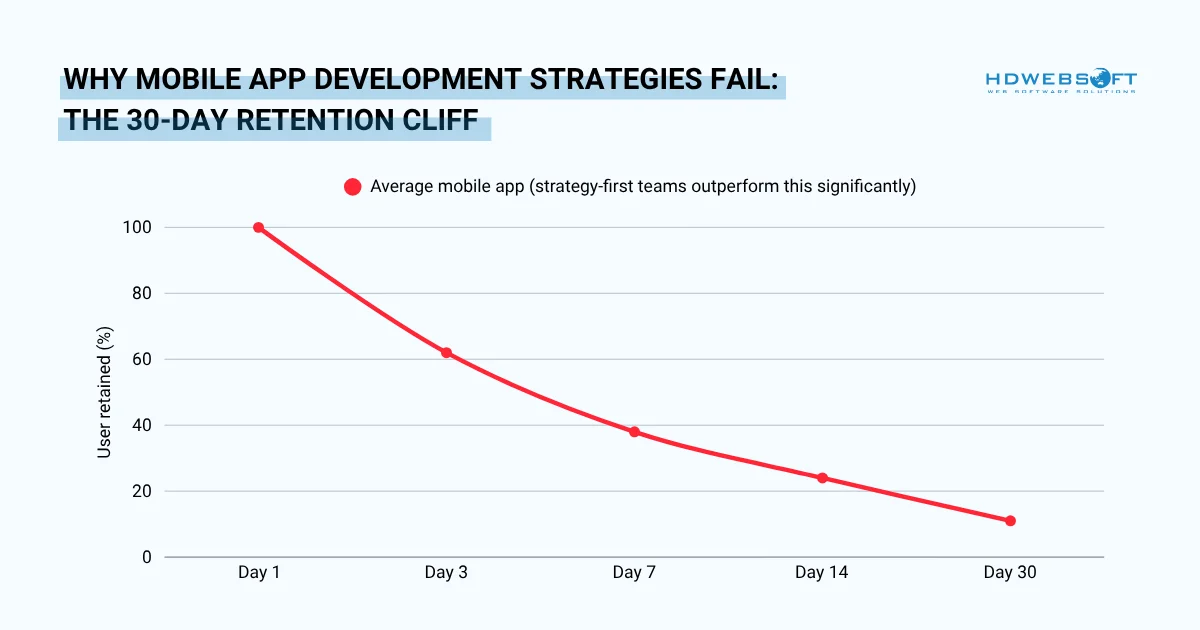
Most mobile apps lose the majority of their users before Day 30. It isn’t because of bad code, but because the mobile app development strategy behind them was built on invalidated assumptions.
This is not just a startup problem. Product managers at mid-sized companies and founders at SMEs face the exact same trap: they start a mobile app design and development before they have finished thinking. This guide is a practical, honest framework for developing a mobile application development strategy that holds up under real-world conditions like tight budgets, shifting priorities, and the unforgiving reality of competitive app stores.
- 1) What a Mobile App Development Strategy Actually Is (And What It Is Not)
- 2) Where Most Mobile App Strategies Break Down
- 3) How to Develop a Mobile App Strategy Before You Write a Line of Code
- 4) How to Plan Your Mobile App Development Strategy: The Decision Framework
- 5) Mobile App Development Strategies for the Build Phase
- 6) Mobile App Launch Strategy: The Release Is Not the Finish Line
- 7) Frequently Asked Questions About Mobile App Development Strategy
- 7.1) What is a mobile app development strategy?
- 7.2) How do I plan a mobile app development strategy as a small business?
- 7.3) What is the difference between a mobile app strategy and a development roadmap?
- 7.4) How long does it take to develop a mobile app strategy?
- 7.5) What should be included in a mobile app launch strategy?
- 8) Conclusion
What a Mobile App Development Strategy Actually Is (And What It Is Not)
A mobile app development strategy is not a document you write once and file away. It is a living framework that connects your business objective to your user’s reality, your platform decision to your go-to-market plan, and your MVP scope to your long-term iteration roadmap. Everything links. When one part changes, the others need to be revisited.
The Definition Most Teams Get Wrong
Most founders and product managers conflate strategy with execution artifacts. A product roadmap is not a strategy but it is a delivery schedule. A backlog is not a strategy, it is a prioritized task list. A tech stack decision also isn’t a strategy but a constraint you work within. These are all outputs of a strategy, not the strategy itself.
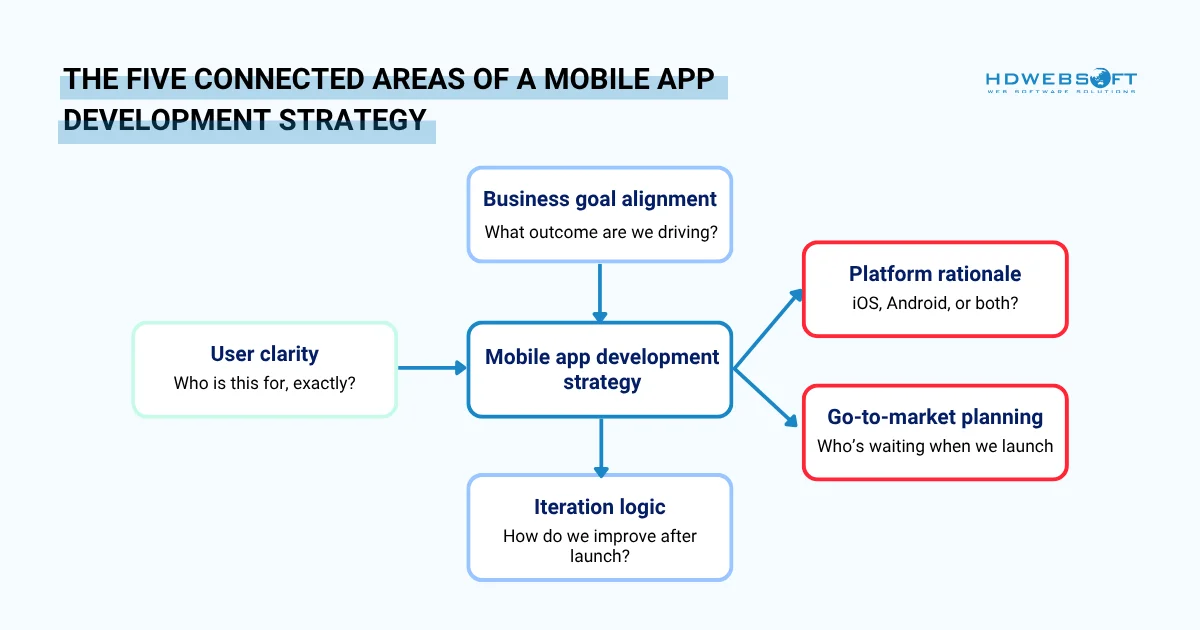
A mobile app development strategy isn’t a checklist. It’s five interdependent pillars. Shift one, and the others need to move with it.
A genuine mobile application development strategy answers four questions before a single sprint begins:
- What business outcome are we trying to achieve, and how does a mobile app move us closer to it?
- Who exactly is this for, and what problem does it solve in their daily life?
- Why mobile and why now? What makes this the right channel at this moment?
- How will we know it is working, and what will we do when the data tells us it is not?
If your team cannot answer these four questions clearly and consistently, you do not have a strategy yet.
What a Real Strategy Actually Covers
A complete mobile app development strategy spans five connected areas. They are business goal alignment, user clarity, platform rationale, go-to-market planning, and iteration logic. These are not sequential phases as they inform each other.
Your platform decision should be shaped by your users’ behavior. Your go-to-market plan should be shaped by your MVP scope. And your iteration logic should be shaped by your success metrics, which should be set before development begins.
Think of it as a map, not a checklist. You use a map to navigate — you can zoom in on one area, but you need the whole picture to understand where you are going.
Why This Distinction Matters More for SMEs Than Enterprises
Enterprise organizations have built-in safeguards that catch strategic gaps: product committees, stage-gate reviews, legal sign-off, QA processes, and budget governance. These mechanisms slow things down, but they also catch mistakes before they become expensive.
SMEs do not have these guardrails. A small team of five can build an entire product on a flawed assumption with no one catching it until launch day. That is not a resource problem but a strategy problem. For SMEs, a clear mobile app development strategy is not optional overhead. It is the cheapest form of risk management available.
Where Most Mobile App Strategies Break Down
Before covering how to build a strategy that works, it is worth understanding why most strategies fail. These are not theoretical failure modes. They are patterns that appear consistently across teams of every size.
| Mistake | What It Looks Like | Why It’s Costly |
| Validating the solution, not the problem | Surveys sent to friendly contacts; conversations with people too polite to say no. Validation that confirms what you already believe. | You build the wrong thing with full confidence. The error only surfaces at launch. |
| Over-scoping the MVP to impress rather than to learn | Features added to satisfy stakeholders or avoid embarrassment. A bloated first release that took twice as long to build. | More cost, longer timeline, and still no answer to the core question: does anyone want this? |
| Treating platform choice as a technical decision | iOS vs. Android chosen by the dev team based on preference or familiarity, without reference to user geography or business model. | A market alignment problem that costs months and significant budget to correct — if it gets corrected at all. |
| No alignment between product strategy and go-to-market strategy | Product and marketing operate in silos. Launch day arrives with no audience, no narrative. | A technically ready product with no traction. Go-to-market thinking must run in parallel with product development, not after it. |
| (Missing mistake label) | Distribution plan beyond submitting to the app store. | Product development is wasted if distribution isn’t considered early — not after launch. |
SME Callout: Why Constraints Make These Mistakes More Costly
For larger organizations, these mistakes in mobile app development strategy are expensive but survivable. A failed product launch might cost a year and a significant budget, but the company continues.
For an SME, the same failure can be existential. Limited runway means fewer opportunities to pivot, fewer resources to course-correct, and less tolerance for a second attempt.
This is not a reason to move slower. On the contrary, it is a reason to be more deliberate before you move at all.
How to Develop a Mobile App Strategy Before You Write a Line of Code
A solid mobile app development strategy is built in four steps, in this order. Skipping steps or running them in parallel is how teams end up making the mistakes described above.
Start With the Business Outcome, Not the Feature List
The first question is not “what should the app do?” It is “what should the app achieve for the business?” These are different questions with very different answers.
Here’s a useful exercise: write one sentence that describes the business outcome this app is meant to drive. Meanwhile, avoid the features it will have, not the users it will serve, but the concrete change it will make to your business. Revenue, retention, efficiency, market expansion are considered, though pick one primary outcome. If you cannot write that sentence clearly, the strategy is not ready.

Define Who You Are Building For And Pressure-Test That Assumption
User definition is where teams are most likely to be vague in their mobile app development strategy. “Small business owners” is not a user. “Freelance designers aged 28-40 who manage client invoicing manually and feel anxious about late payments” is a user. Thus, your specificity creates empathy, and empathy drives better product decisions.
Once you have a user definition, pressure-test it. Can you find ten real people who match it? Have you spent an hour watching someone like that do the task your app is meant to solve? Have you asked them what they already use, why it falls short, and what they would pay for something better? If not, the user definition is still theoretical.
Set Success Metrics Before You Set a Timeline
Most teams set timelines first and metrics later or never. This is backwards. Your metrics define what success looks like, which shapes your MVP scope, which determines your realistic timeline. Accordingly, setting a timeline before metrics is guessing, not planning.
For a consumer mobile app, relevant metrics might include Day 7 retention rate, monthly active users, or in-app conversion rate. For an enterprise mobile tool, they might include daily active usage, task completion rate, or time-to-value for new users. So, define these upfront, set a baseline target, and revisit them at every major milestone.
For SMEs: The One-Page Strategy Test
If your mobile app development strategy cannot be summarized on a single page, it is not ready. This is not about simplicity for its own sake, it is about clarity. A one-page summary forces you to make tradeoffs explicit: what is in scope and what is not, who you are building for and who you are not, what success looks like and what it does not.
The one-page test is also a practical communication tool. When your development partner, your investor, or your team asks “what are we building and why?”, you should be able to hand them one page and have them understand it in five minutes. If you cannot, your strategy clearly needs more work.
How to Plan Your Mobile App Development Strategy: The Decision Framework
Planning a mobile app development strategy is less about generating answers and more about asking the right questions in the right order. This section provides a decision framework, a set of lenses, not prescriptions, that applies across company sizes and contexts.

Platform Decision: A Lens, Not a Verdict
The platform decision, either iOS, Android, or cross-platform, should be driven by three questions:
- Where are your users? If you are targeting users in Southeast Asia or Latin America, Android dominates market share. If you are targeting premium consumers in Western markets, iOS has significantly higher average revenue per user.
- What is your update cadence? iOS review times are longer and less predictable than Google Play. If your product requires frequent updates — for compliance, for feature velocity, or for live data — factor this into the decision.
- What is your budget reality? Native development for both platforms simultaneously roughly doubles your build and maintenance cost. Cross-platform frameworks like React Native or Flutter have matured significantly, and for most use cases, they are a rational choice for teams with limited resources.
There is no universally correct answer to platform decisions in a mobile app development strategy. There is only the answer that fits your users, your business model, and your constraints.
Build Approach: What In-House, Agency, and Hybrid Actually Cost
The build approach decision is often made on sticker price alone. This is a mistake. The real cost of each model includes time, control, and quality risk — not just the invoice.
| Model | Best For | Strengths | Watch Out For |
| In-House | Teams with ongoing product development needs and budget for full-time engineers | Highest control, fastest iteration loops, deepest product context | Recruiting cost and time; knowledge risk when engineers leave |
| Agency | Defined-scope projects with a clear brief and limited internal technical capacity | Speed to start; no hiring overhead; broad skill coverage | Senior pitch, junior delivery. Always ask to meet the actual build team before signing |
| Hybrid | Teams with a small internal core who need to move faster than in-house capacity allows | Combines internal context with external velocity; flexible to scale | Requires clear ownership boundaries. Blurred accountability becomes a coordination bottleneck |
MVP Scoping: Cut It in Half, Then Cut It Again
The single most reliable heuristic for MVP scoping: take whatever your team agrees is the minimum, cut it in half, and ask whether the resulting scope still tests your core hypothesis. If it does, cut it again.
The question to ask for every proposed feature is not “would users want this?” but “do we need this to learn what we need to learn?” Features that do not contribute to the core learning objective belong in a future sprint, not the MVP.
Timeline and Budget: How to Avoid the Two Most Common Traps
Enterprise teams tend to over-pad timelines with approval cycles, compliance reviews, and stakeholder sign-offs in their mobile app development strategy. The risk is that market conditions shift during a lengthy build, and the product that launches is already behind the market.
Therefore, SME teams tend to under-budget by assuming best-case scenarios on everything. They range from development speed, QA time, app store review, to post-launch iteration.
There’s a practical rule: whatever your initial budget estimate is, add 30% for post-launch stabilization and iteration. Whatever your timeline estimate is, add a buffer for app store review and soft-launch learnings. Both are not optional as they are part of the build.
Mobile App Development Strategies for the Build Phase
Once the mobile app development strategy is set and planning is complete, execution begins. But even in the build phase, strategic decisions continue. And the teams that treat development as purely tactical tend to build products that are technically sound but strategically compromised.
Your Development Strategy Must Match Your Business Rhythm
Agile methodologies dominate mobile development for good reason: they allow for iterative learning and course correction. However, agile is not a strategy as it’s rather a process. The strategic question is how your development sprints connect to your business milestones.
If your business is preparing for a fundraising round in six months, your build priorities should reflect certain aspects. Namely, surface the features that demonstrate traction, not the infrastructure work that only engineers appreciate. If your business has a seasonal peak, your launch timing should precede it, not coincide with it. That’s when development velocity matters less than development direction.
The Feedback Loop Most Teams Skip
Structured beta testing is a real, managed process with recruited users, defined tasks, and documented observations. However, it’s often skipped by the majority of mobile development teams when creating mobile app development strategy. It is replaced with informal testing among colleagues, which is worse than useless because it generates false confidence.
A proper beta program does not need to be large. Twenty to thirty engaged users from your actual target segment, given access to the app before public launch, will surface the usability issues and feature gaps that matter. From then, the feedback from this group will produce more actionable insight than any amount of internal testing.

Performance and Scalability: What to Build For Now vs. What to Defer
A common and expensive mistake: building infrastructure for a scale that has not been achieved yet. Premature optimization consumes engineering resources that should be spent on product discovery. Moreover, it optimizes for a problem you may never actually have.
Here’s a practical framework for mobile app development strategy: build for the scale you expect to reach within 12 months. Design the architecture so that scaling beyond that point is possible without a full rebuild, but do not build for it now.
The exception is security and data privacy. These should be built correctly from day one, as retrofitting security is significantly harder than retrofitting scalability.
Enterprise vs. SME: Documentation and Governance
Documentation expectations differ significantly by company size — but both matter. The most common SME post-launch crisis is a developer departure that leaves no one who understands how the system works.
| Area | Enterprise | SME |
| Architecture | Formal architecture decision records (ADRs) with sign-off process | Documented key decisions and the reasoning behind them — even a shared doc is enough |
| APIs & Integrations | Formal API contracts, versioning policy, and integration test suites | Documented API structure and endpoint descriptions — essential for onboarding future developers |
| Security | Formal security assessments, penetration testing, and compliance sign-offs | Build security correctly from day one. Retrofitting is significantly harder than retrofitting scalability |
| Deployment | Change management processes, rollback procedures, and stakeholder communications | A deployment runbook: step-by-step instructions anyone on the team can follow |
Mobile App Launch Strategy: The Release Is Not the Finish Line
The mobile app launch strategy is perhaps the most consistently under-planned part of the entire development process. Teams spend months on the build and days on the launch. The result is a technically ready product with no audience, no narrative, and no distribution momentum.
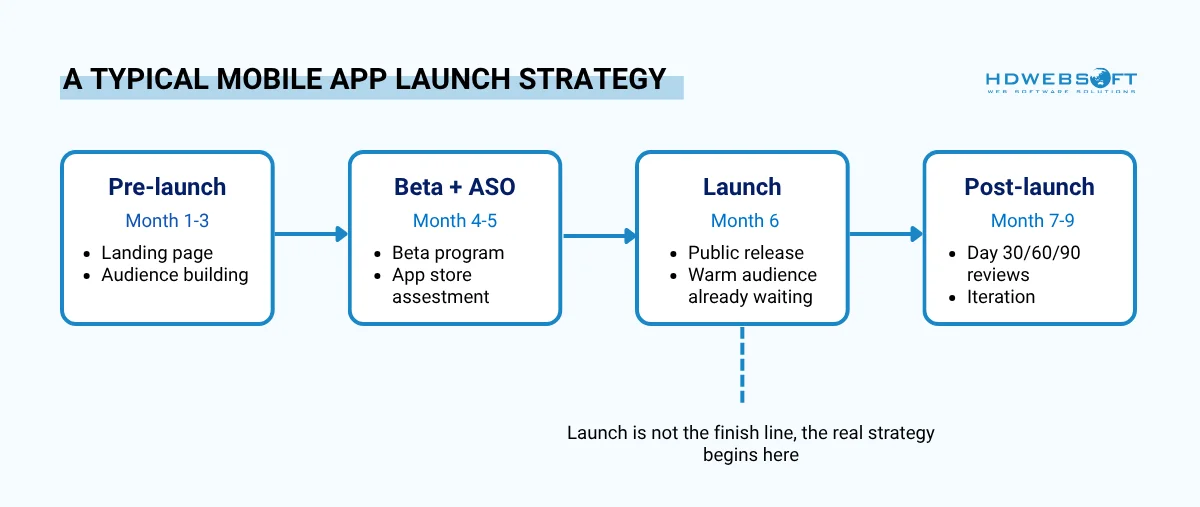
A mobile app launch strategy that starts the week before release isn’t a strategy; it’s damage control. The strongest launches begin 3–6 months before the product ships.
Pre-Launch: Building an Audience Before You Ship
The best launch strategies included in mobile app development strategy begin three to six months before the product is ready. This is not about generating hype but about building a warm audience that will generate the early reviews, the initial retention data, and the word-of-mouth that signals to app store algorithms that the product deserves visibility.
Practical pre-launch activities include a landing page with an email capture, content that educates your target users on the problem your app solves (not the features it has), early access or waitlist programs, and direct outreach to communities where your target users are active. None of this requires a significant budget. All of it requires time.
App Store Optimization: A Strategic Asset, Not an Afterthought
ASO, short for App Store Optimization, is the mobile equivalent of SEO. It is treated with the same disregard by most development teams. ASO covers the app title, subtitle, keyword field, description, screenshots, and preview video. Accordingly, all of which influence both discoverability and conversion rate.
The most impactful ASO investment in your mobile app development strategy is in screenshots and preview video. These are the first thing a potential user sees on your app store listing, and they need to communicate value instantly. Feature callouts, benefit-driven headlines, and contextual device mockups consistently outperform generic screenshots in conversion testing.
The First 90 Days Post-Launch: How to Read the Data
The first 90 days after a mobile app launch strategy generates the most important strategic data you will ever have.
- Acquisition source data tells you which channels are delivering users with the highest retention.
- Onboarding funnel data tells you where users disengage before they experience core value.
- Feature engagement data tells you what actually matters to users versus what you thought would matter.
This data should drive a structured review at Day 30, Day 60, and Day 90. Each review should produce a small number of concrete changes to onboarding, to messaging, to the feature prioritization in the next sprint. Henceforth, teams that treat the first 90 days as a monitoring exercise rather than a learning sprint consistently underperform against teams that treat it as the most active phase of product development.
When to Pivot, When to Persist
Post-launch decision-making is where mobile app development strategy meets psychology. Founders and product managers are emotionally invested in the products they have built, which makes objective reading of negative data genuinely difficult.
There’s a useful framework HDWEBSOFT uses: distinguish between a distribution problem and a product problem. A distribution problem means too few users are finding a product that works; fix it with go-to-market changes like ASO, channels, or positioning. A product problem means users find it but don’t stay; fix it by improving the product or pivoting if needed.
Furthermore, the key signal is retention. Strong retention with low volume points to distribution while good volume with early drop-off points to product. Both are solvable but require different solutions, and mixing them up is a common post-launch mistake.
Frequently Asked Questions About Mobile App Development Strategy

What is a mobile app development strategy?
A mobile app development strategy is a connected plan that aligns business goals, user needs, platform choices, and go-to-market thinking before development begins. It is distinct from a product roadmap or tech stack decision. Those are outputs of the strategy, not the strategy itself.
How do I plan a mobile app development strategy as a small business?
Start with the one-page strategy test: define your business outcome, your target user, your platform rationale, and your success metrics on a single page. If you cannot do this clearly, the strategy is not ready. Notably, prioritize problem validation over solution development, and treat your MVP as a learning tool rather than a launch product.
What is the difference between a mobile app strategy and a development roadmap?
A strategy defines what you are trying to achieve and why. A development roadmap defines what you will build and when. The roadmap should be derived from the strategy, not the other way around. Therefore, you need to build a roadmap before a strategy produces a schedule in search of a purpose.
How long does it take to develop a mobile app strategy?
For an SME, a focused mobile app development strategy process can be completed in two to four weeks if approached with discipline. Typically, it covers user validation, platform decision, MVP scoping, and go-to-market alignment
For enterprise organizations, the process typically takes longer due to stakeholder alignment requirements. However, the core strategic questions remain the same.
What should be included in a mobile app launch strategy?
A mobile app launch strategy should include a pre-launch audience-building plan, an ASO strategy covering title, keywords, and visual assets, a soft launch or beta program, a post-launch data review schedule (Day 30, Day 60, Day 90), and a clear decision framework for when to iterate versus when to pivot.
Conclusion
Most mobile apps do not fail because of bad code. They fail because the strategy behind them was either missing, rushed, or never connected to the reality of the users it was meant to serve. A strong mobile app development strategy does not guarantee success. It’s the absence of one almost that guarantees the kind of failure that could have been avoided.
Start with the one-page strategy test. If you can clearly articulate your business outcome, your user, your platform rationale, and your success metrics on a single page, you are ready to plan. If you cannot, that is the work that needs to happen before anything else. HDWEBSOFT’s mobile app development services can help you turn ambiguity into a clear, executable plan.