5 Signs Your Business Needs Managed Cybersecurity Services Today
Managed cybersecurity services have become essential for businesses navigating today’s complex threat landscape. Every day, companies face increasingly sophisticated cyberattacks that can cripple operations within minutes. Meanwhile, the cost of hiring skilled security professionals continues to skyrocket beyond what most organizations can afford.
This creates a critical dilemma. Organizations need robust protection, yet building an in-house security team remains financially unfeasible for many. Furthermore, the rapid evolution of cyber threats means yesterday’s defenses are often obsolete today. Attackers constantly develop new techniques to bypass traditional security measures. That’s where cyber security managed services offer a practical solution.
Throughout this article, you’ll discover the fundamentals of managed security. We’ll examine why businesses across industries are making this strategic shift. Additionally, we’ll identify clear signs that your organization could benefit from these services.
- 1) What Are Managed Cybersecurity Services?
- 2) Why Businesses Need Managed Cybersecurity Services
- 3) Key Benefits of Managed Cybersecurity Services
- 4) 5 Clear Signs Your Business Needs Managed Cybersecurity
- 5) Core Cyber Security Managed Services’ Offerings
- 6) Future-Proof Your Business with HDWEBSOFT
What Are Managed Cybersecurity Services?
Before selecting a security partner, understanding the fundamentals of managed cybersecurity services is crucial. This knowledge helps you make informed decisions about protecting your digital assets. Let’s explore what these services include and how they operate.
Definition and Core Concept
Cyber security managed services represent a comprehensive approach to protecting your organization’s digital infrastructure. Essentially, these services involve outsourcing your security operations to specialized providers called MSSPs (Managed Security Service Providers). Unlike traditional security models, this approach combines cutting-edge technology with human expertise.
Think of it as having a dedicated security team without the overhead. The provider handles everything from threat monitoring to incident response. Additionally, they continuously update their tools and tactics to stay ahead of emerging threats.
This model differs fundamentally from in-house security management. Instead of building your own security operations center, you leverage the provider’s existing infrastructure. Consequently, you gain immediate access to enterprise-level protection at a fraction of the cost. The economies of scale that MSSPs achieve make this possible across their entire client base.
How It Works: Two Main Approaches
Understanding the operational model of managed cybersecurity services helps clarify their value proposition. Two primary approaches dominate the market today, each suited to different organizational needs.
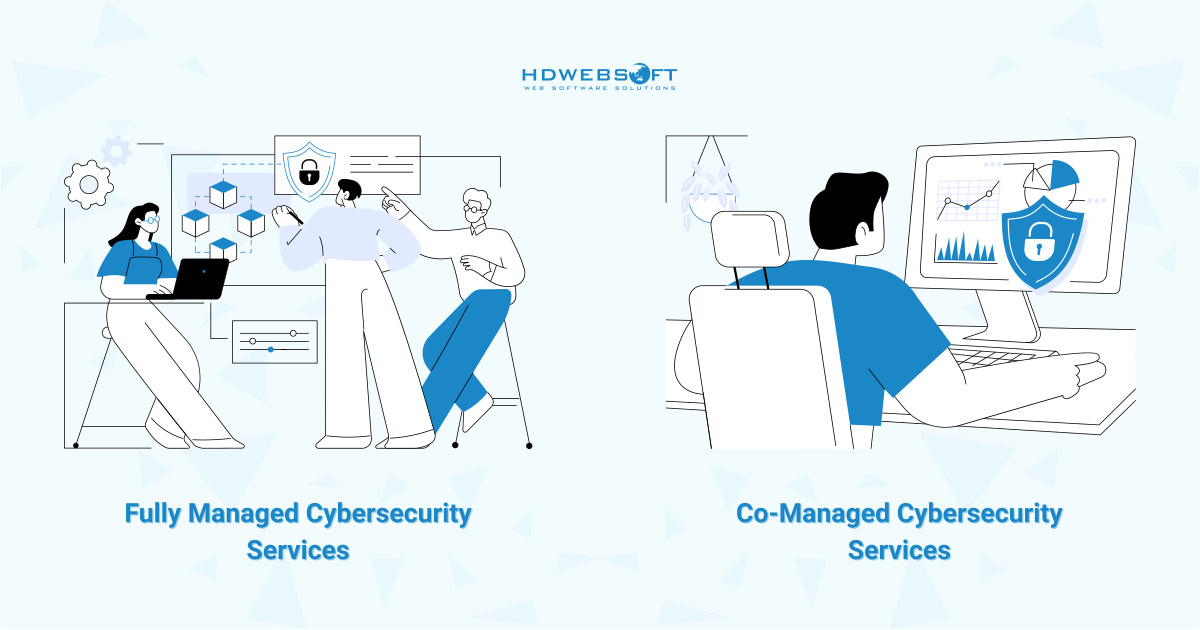
Fully managed services
They provide complete security operations outsourcing. The MSSP handles every aspect of your cybersecurity program, including threat detection, response, remediation, and reporting. Your internal team can focus entirely on core business functions.
This approach works best for organizations lacking dedicated security staff. Moreover, it’s ideal for companies wanting to eliminate the complexity of managing security tools. The provider assumes full responsibility for your security posture. As a result, they become an extension of your organization without the employment overhead.
Co-managed services
They complement your existing security capabilities. Your internal team maintains certain responsibilities while the MSSP fills critical gaps. This hybrid model offers flexibility and control while ensuring 24/7 coverage.
Organizations with some security expertise often prefer this approach of managed cybersecurity services. It allows them to retain strategic oversight while gaining external support. Furthermore, it’s perfect for ensuring round-the-clock protection without hiring additional staff. You maintain control over key decisions while benefiting from expert assistance.
The Managed Security Ecosystem
The landscape of cyber security managed services includes several specialized service types. Each addresses specific security challenges organizations face today.
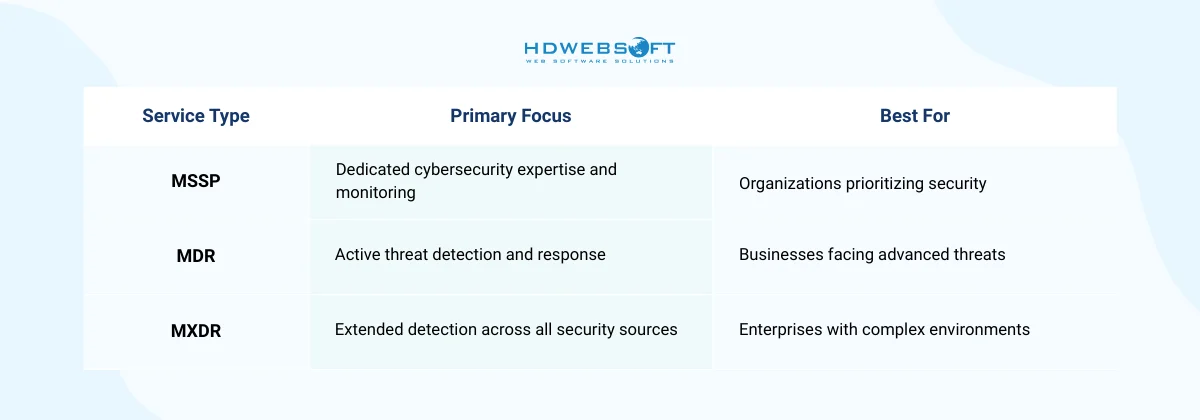
Managed Detection and Response (MDR)
It combines technology with human-led threat hunting. Security analysts actively search for threats across your environment. When they find something suspicious, they respond immediately to contain the threat.
MDR services go beyond simple alert generation. Analysts investigate each alert to determine its legitimacy as they distinguish between genuine threats and benign anomalies. This human expertise dramatically reduces false positives that waste valuable time.
Managed Extended Detection and Response (MXDR)
This type of service takes this further. It correlates data from multiple security tools for comprehensive visibility. This holistic approach represents the current gold standard in solutions of managed cybersecurity services.
MXDR integrates endpoint, network, cloud, and application security data. This unified view enables faster, more accurate threat identification. Hence, security teams can track threats across your entire infrastructure seamlessly.
Why Businesses Need Managed Cybersecurity Services
Modern organizations face unprecedented security challenges that make cyber security managed services increasingly necessary. These challenges stem from multiple converging factors affecting businesses globally. Therefore, understanding these drivers helps contextualize the value of outsourced security.
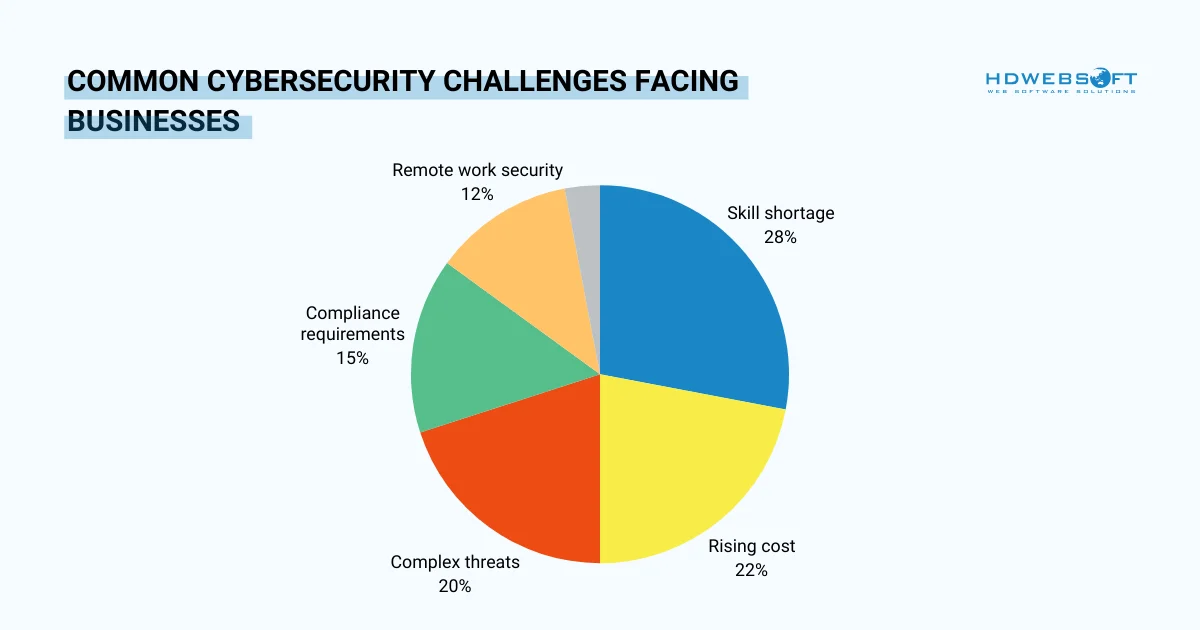
The Cybersecurity Challenges Facing Modern Businesses
Today’s threat landscape has evolved dramatically as cybercriminals now operate with industrial-level sophistication and organization. They’ve transformed from individual hackers into coordinated criminal enterprises.
Rising Attack Sophistication
Attack methods have grown exponentially more complex. Hackers now employ artificial intelligence to identify vulnerabilities faster than ever. Additionally, they’ve reduced breakout times to mere minutes in some cases.
Recent reports show a 54% increase in direct attack to compromise cloud-based infrastructure. This dramatic surge demonstrates how quickly threats evolve. Meanwhile, businesses struggle to keep pace with these rapid changes. Traditional security approaches simply cannot adapt fast enough compared to using managed cybersecurity services.
Moreover, ransomware attacks have become particularly devastating since organizations face not only data encryption but also public data leaks. Therefore, the stakes have never been higher for maintaining robust security. The financial and reputational damage can be catastrophic.
The Global Talent Shortage
Finding qualified security professionals has become nearly impossible. Currently, there’s a global shortage of 4 million cybersecurity workers. This gap continues widening despite increased educational programs.
Consequently, companies compete fiercely for limited talent. Salaries for experienced security professionals have skyrocketed accordingly. That’s why small to medium-sized businesses often cannot compete with enterprise-level compensation packages.
Even when organizations successfully hire security staff, retention poses another challenge. Burnout rates in cybersecurity roles remain exceptionally high. As in 2024, job satisfaction among cybersecurity professionals dropped to 66%, a decline of four percentage points compared to the previous year. Consequently, this creates a revolving door that disrupts security operations. Knowledge walks out the door with departing employees, while partnering with managed cybersecurity services is the opposite.
Escalating Breach Costs
The financial impact of successful attacks has reached staggering levels. Global data breach costs now average $4.4 million per incident. These costs extend far beyond immediate remediation expenses, making organizations face regulatory fines, legal fees, and reputation damage. Furthermore, many businesses never fully recover from major security incidents. Customer trust, once broken, proves incredibly difficult to rebuild.
Furthermore, recovery time also represents a significant hidden cost. Operations may remain disrupted for weeks or months. During this period, revenue generation completely stops while expenses continue mounting. Thus, the cumulative impact can threaten organizational survival.
Complex Attack Surfaces
Modern business operations have created increasingly complex attack surfaces. The shift to remote work multiplied potential entry points exponentially. Each employee’s home network now represents a potential vulnerability.
Cloud adoption adds another layer of complexity. Organizations now manage data across multiple cloud platforms. Each platform requires different security configurations and monitoring approaches. Maintaining consistency across this hybrid environment challenges even experienced teams as managed cybersecurity services.
Moreover, the proliferation of connected devices expands the attack surface further. For instance, IoT devices, mobile phones, and tablets all require protection. Managing security across this diverse ecosystem overwhelms traditional approaches.
The Case for Outsourcing Security
Given these challenges, outsourcing security operations makes compelling business sense. Cyber security managed services address each pain point effectively while providing additional strategic benefits.
Financial Efficiency
Building an internal security team requires substantial investment as preparing a budget for salaries, training, tools, and infrastructure are a must. Additionally, companies face ongoing costs for technology updates and staff development.
In contrast, managed cybersecurity solutions offer predictable monthly pricing that eliminates large capital expenditures. This converts unpredictable security costs into manageable operational expenses. Furthermore, you gain immediate access to mature security capabilities without lengthy buildout periods.
The economies of scale MSSPs achieve make this possible. They spread infrastructure costs across multiple clients. Consequently, each client benefits from enterprise-grade tools which managed cybersecurity services provide at a fraction of the cost.
Continuous Protection
Cyber threats don’t respect business hours or holidays. Attackers often strike during weekends and off-hours specifically. This timing exploits when security teams are typically understaffed or unavailable.
Additionally, cyber security managed services provide round-the-clock monitoring without requiring shift work. Security operations centers operate continuously across different time zones. Therefore, your organization remains protected regardless of the time or day.
This constant vigilance proves particularly valuable for detecting subtle threats. Many sophisticated attacks unfold gradually over days or weeks. Continuous monitoring ensures these slow-burn attacks get detected early. The faster you detect threats, the less damage they cause.
Staying Current
MSSPs maintain currency with evolving threats as their core business function. They invest heavily in threat intelligence and research. Moreover, they participate in industry forums and information-sharing networks.
This collective intelligence benefits all their clients simultaneously using managed cybersecurity services. When one client faces a new threat, others receive immediate protection. Hence, this network effect provides significant security advantages unavailable to individual organizations.
Moreover, security professionals at MSSPs see more attacks in a month than most internal teams see in years. This exposure develops pattern recognition skills that prove invaluable. Their experience translates directly into better protection for your organization.
Key Benefits of Managed Cybersecurity Services
Organizations partnering with MSSPs for cyber security managed services gain numerous strategic advantages. These benefits extend far beyond basic threat protection to transform how businesses approach security.
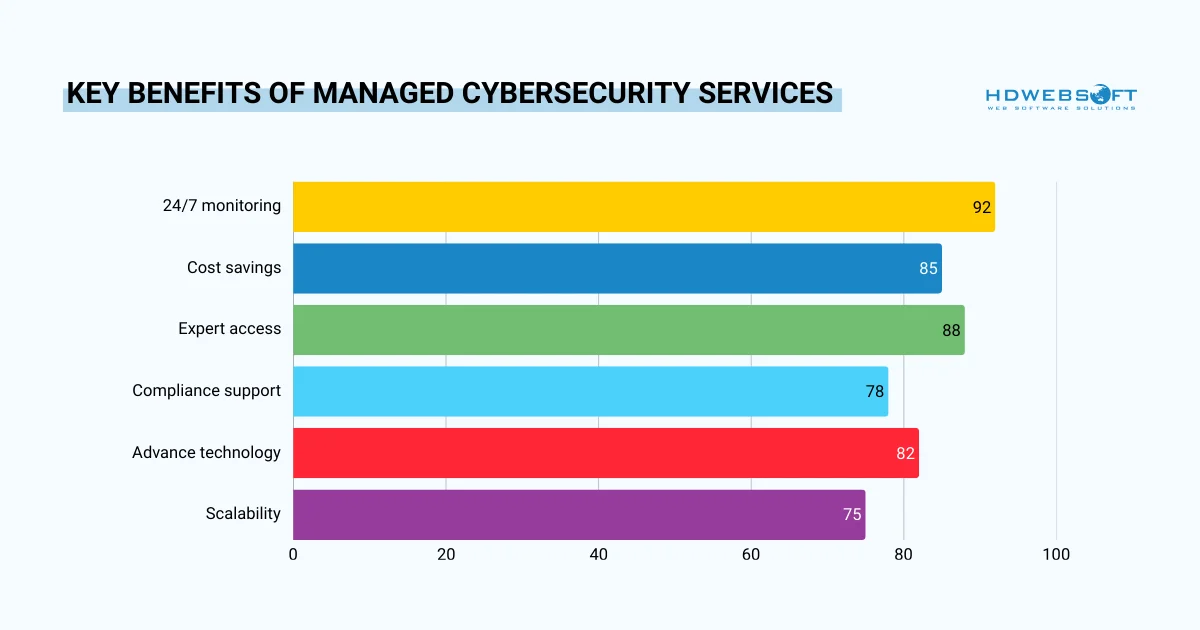
Access to Specialized Expertise
Security requires deep, specialized knowledge that takes years to develop. Managed cybersecurity solutions provide immediate access to this expertise without the recruitment challenges.
MSSPs employ teams of certified security professionals with diverse specializations. These experts focus exclusively on cybersecurity, unlike generalist IT staff. For instance, their daily work involves combating the latest threats across multiple client environments.
This concentrated experience from managed cybersecurity services creates unmatched expertise. A single MSSP analyst may handle more security incidents monthly than an in-house team sees annually. Consequently, they develop pattern recognition and response skills that prove invaluable.
Certified Professionals and Continuous Training
Furthermore, these professionals maintain numerous industry certifications. Credentials like CISSP, CISM, and CEH demonstrate their commitment to excellence. Your organization benefits from this expertise without bearing certification costs.
The continuous training MSSPs provide keeps skills sharp and knowledge fresh. Security professionals attend industry conferences and workshops frequently. Additionally, they participate in threat simulation exercises and capture-the-flag competitions. This ongoing development ensures they stay current with emerging threats.
Furthermore, experienced MSSPs understand industry-specific nuances thoroughly. They’ve helped numerous organizations navigate similar challenges. This contextual knowledge proves invaluable when designing security strategies tailored to your sector.
24/7 Threat Monitoring and Rapid Response
Continuous vigilance forms the foundation of effective cybersecurity, and managed cybersecurity services deliver this through sophisticated operations centers.
Modern SOCs operate as high-tech nerve centers monitoring countless security events. Analysts watch for suspicious activities across all your systems simultaneously. Advanced correlation tools help them identify patterns that indicate attacks.
This continuous monitoring catches threats that batch processing would miss. Real-time analysis enables immediate response to developing situations. Consequently, potential breaches get stopped before causing significant damage.
Proactive Threat Hunting and Rapid Incident Response
Beyond reactive monitoring, skilled analysts actively search for hidden threats. This proactive approach uncovers sophisticated attacks designed to evade automated detection. Threat hunters use advanced techniques to identify subtle anomalies.
They examine your environment through the lens of attacker methodology. By thinking like adversaries, they find vulnerabilities before criminals exploit them. As a result, this offensive-minded approach from experienced managed cybersecurity services significantly strengthens your defensive posture.
When threats are detected, speed determines the outcome. Pre-established playbooks guide analysts through containment and remediation steps. Response times measured in minutes prevent threats from spreading while automated containment actions isolate affected systems immediately.
Advanced Technology and Tools
Effective cybersecurity requires sophisticated technology most organizations cannot justify purchasing. MSSPs provide access to these tools as part of their service.
Cyber security managed services include access to premium security platforms. These enterprise-level tools would cost hundreds of thousands annually if purchased directly. However, through managed services, you gain their benefits at a fraction of the price.
These platforms integrate multiple security functions into unified solutions. For example, endpoint protection, network monitoring, and threat intelligence merge seamlessly. This integration improves both effectiveness and operational efficiency.
In addition, modern threats require equally modern detection methods which managed cybersecurity services usually expertise in. AI and ML excel at identifying subtle attack patterns as these technologies analyze billions of events to spot anomalies humans would miss. Moreover, ML models improve continuously as they process more data that they learn normal behavior patterns for your specific environment. Deviations from these baselines trigger alerts for human investigation.
Cost Efficiency and Predictable Budgeting
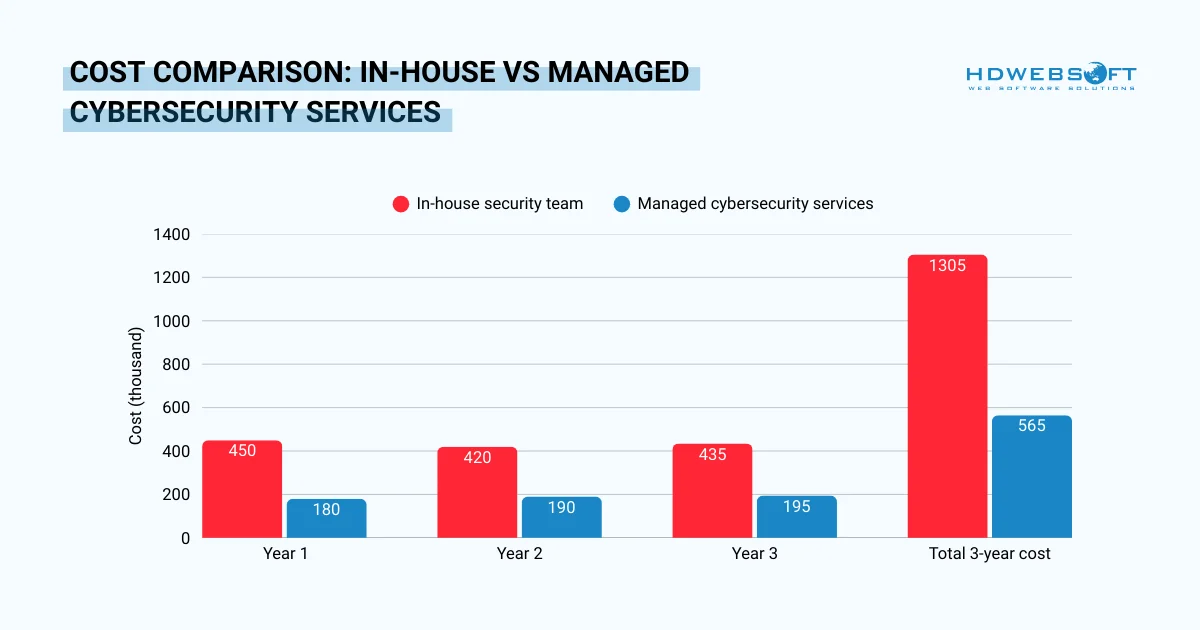
Building equivalent internal capabilities requires substantial capital investment; security tools, infrastructure, and personnel costs add up quickly. Additionally, you bear responsibility for ongoing maintenance and upgrades.
Managed services convert these capital expenses into predictable operational costs. Monthly fees cover all technology, infrastructure, and expertise. Conversely, this eliminates budget spikes and improves financial planning.
Budget certainty enables better strategic planning and resource allocation. Cyber security managed services typically use fixed monthly pricing models. This eliminates the financial uncertainty associated with security management; you know exactly what security will cost each month.
Regulatory Compliance Support
Navigating complex compliance requirements challenges organizations across all sectors. Managed cybersecurity services include expertise that simplifies this burden.
Different regulations govern various industries with unique requirements: HIPAA applies to healthcare, PCI-DSS to payment processing, GDPR to European data. Hence, maintaining compliance across these frameworks requires specialized knowledge.
Moreover, experienced MSSPs understand these regulations thoroughly. They’ve implemented compliant security programs for numerous organizations. This experience translates into faster, more reliable compliance achievement.
Regulatory audits require extensive documentation of security controls and processes. Gathering this evidence consumes significant time and resources, including comprehensive logging and reporting. All security activities get documented automatically in audit-ready formats.
5 Clear Signs Your Business Needs Managed Cybersecurity
Determining whether managed cybersecurity services fit your organization requires honest assessment. Several clear indicators suggest outsourcing makes strategic sense.
1. Limited Internal Security Resources or Expertise
Most organizations struggle to maintain adequate internal security capabilities. Small IT teams typically handle numerous responsibilities simultaneously. For example, they manage networks, support users, maintain applications, and somehow address security.
This divided attention means security receives insufficient focus. Additionally, generalist IT professionals often lack specialized security knowledge. They understand basic concepts but not advanced threat detection and response.
The situation worsens when key personnel leave the organization. All their security knowledge walks out the door with them. Thus, replacing this expertise takes months, leaving dangerous gaps. Managed cybersecurity solutions solve these problems by providing immediate access to deep security expertise.
2. Operating in a High-Risk or Regulated Industry
Certain industries face elevated cyber risks and strict compliance requirements. Healthcare, finance, legal, and education sectors particularly struggle with these challenges when using in-house teams instead of managed cybersecurity services.
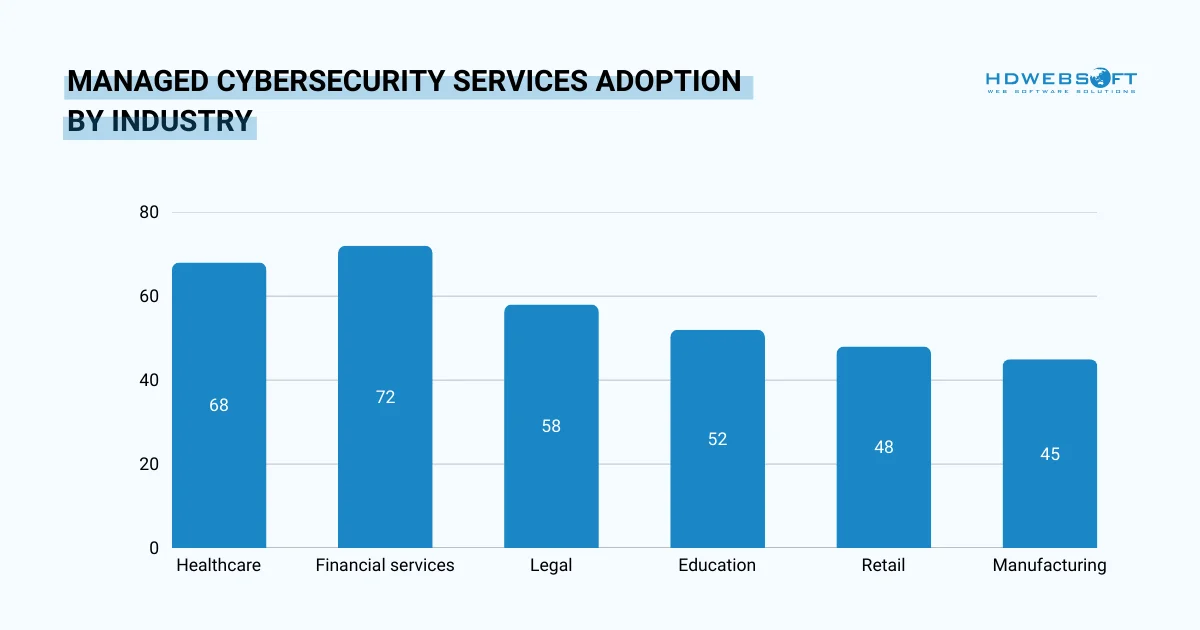
- Medical data represents extremely valuable targets for cybercriminals. Patient records sell for high prices on dark web markets. Additionally, healthcare systems cannot tolerate operational disruptions without endangering lives.
- HIPAA compliance adds another layer of complexity. Privacy rules strictly govern how patient data gets stored and transmitted while violations result in substantial fines and reputation damage.
- Financial institutions face constant attacks because that’s where the money is. Banks, credit unions, and investment firms must defend against sophisticated fraud techniques. PCI-DSS compliance governs how payment card data gets handled.
- Law firms manage sensitive client information where confidentiality breaches can destroy professional reputations. Moreover, attorney-client privilege makes security failures particularly serious. Regulatory bodies increasingly scrutinize law firm security practices.
Cyber security managed services specializing in these sectors understand unique pressures. They implement controls addressing both security and compliance simultaneously.
3. Complex or Expanding Threat Surface
Modern business operations create increasingly complex security challenges. According to managed cybersecurity services, there are several trends that have dramatically expanded organizational attack surfaces.
- The shift to remote work transformed security landscapes overnight. Employees now access company resources from home networks that often lack basic security controls. Each remote worker represents a potential entry point for attackers.
- Organizations increasingly move applications and data to cloud platforms. This shift improves flexibility but creates new security challenges. Each cloud provider uses different security models and controls.
- Multi-cloud strategies compound this complexity exponentially. Data and applications span AWS, Azure, Google Cloud, and others. Therefore, maintaining consistent security across these platforms proves extremely difficult.
- Business technology ecosystems expand continuously. Smartphones, tablets, IoT devices, and laptops all require security. Each represents another potential attack vector that must be monitored and protected.
- Managing security across this diverse ecosystem overwhelms traditional approaches. Cyber security managed services provide comprehensive visibility and control across all endpoints and applications.
4. Concerns About Cybersecurity Costs and ROI
Budget constraints affect organizations of all sizes. Building internal security capabilities requires substantial investment. Salaries for qualified professionals have increased dramatically. These costs continue indefinitely without guaranteeing adequate protection. Organizations may invest heavily yet still suffer breaches.
Managed cybersecurity services provide predictable costs with measurable outcomes. Monthly fees cover all aspects of security operations. Furthermore, service level agreements guarantee specific performance standards.
On top of that, the ROI becomes clearer and more immediate, given that you avoid breach costs that dwarf security expenditures. Additionally, you eliminate the expense of building internal capabilities.
5. Need for Proactive, Not Reactive, Security
Many organizations operate in perpetual reactive mode because they respond to incidents after damage has occurred. Constantly playing catch-up with threats creates organizational stress.
IT teams work endless hours responding to emergencies. Meanwhile, business operations suffer disruptions and delays. The financial costs of reactive security mount quickly.
As a matter of fact, organizations cannot afford downtime in today’s business environment. Even brief outages result in lost revenue and customer dissatisfaction. Extended outages can threaten organizational survival.
Managed cybersecurity services emphasize proactive threat prevention through active vulnerability hunting. Security teams actively hunt for vulnerabilities before attackers exploit them. This forward-looking approach minimizes incidents and their associated costs.
Core Cyber Security Managed Services’ Offerings
Understanding available services helps organizations select appropriate cyber security managed services. MSSPs typically offer several core capabilities that can be combined based on needs.
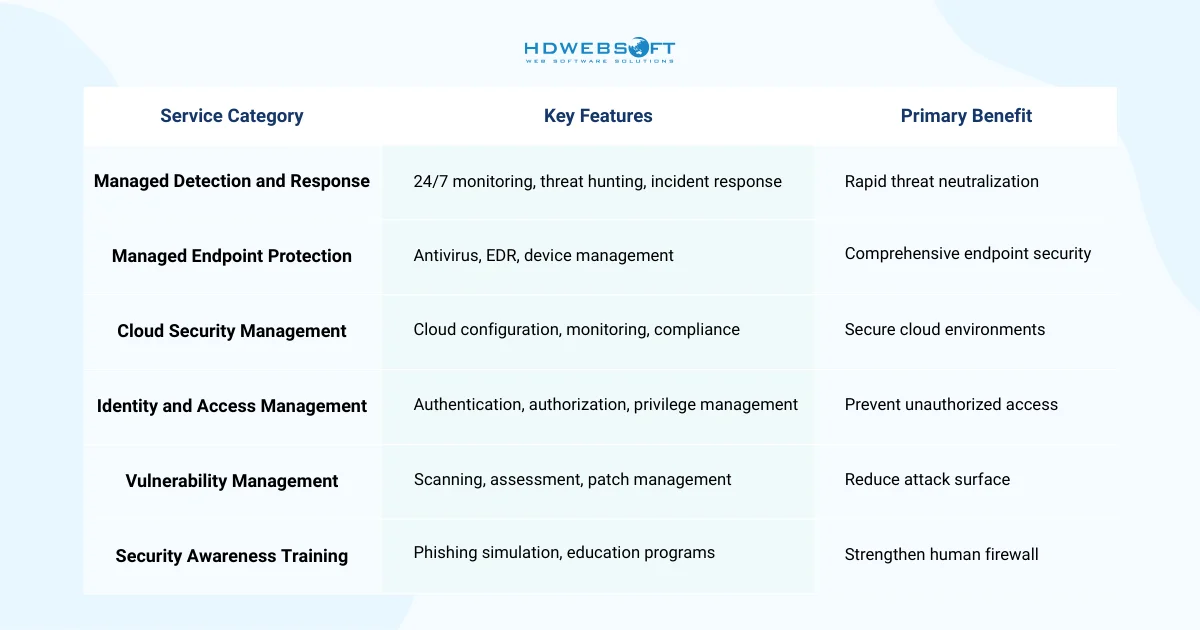
Future-Proof Your Business with HDWEBSOFT
The cybersecurity landscape continues evolving at an unprecedented pace, making cybersecurity services essential for modern businesses. The combination of global talent shortages, rising breach costs, and increasingly sophisticated threats makes internal security management impractical for most organizations. Meanwhile, cyber security managed services deliver enterprise-grade protection with specialized expertise, advanced technology, and 24/7 monitoring at accessible price points.
HDWEBSOFT understands the unique security challenges facing modern organizations. Our cybersecurity services combine cutting-edge technology with deep expertise developed across diverse industries. Whether you’re struggling with limited resources, facing regulatory pressures, or simply seeking better protection, our team stands ready to assess your current security posture and recommend appropriate solutions.