AI augmented software development is fundamentally changing how engineering teams build, test, and ship software. The old model, where developers work alone, end to end, on every line of code, is no longer the only option. Today, AI sits alongside engineers throughout the entire software lifecycle. It assists with everything from generating boilerplate to flagging security vulnerabilities before a single line reaches production.
This guide covers everything you need to know. You will learn what AI augmented development actually means, how it differs from traditional software engineering, where an AI platform fits, and where AI fits across the SDLC. You will also find an honest look at the benefits, risks, tools, the ROI of AI in software development, and when to bring in an AI augmented engineer or an external development partner.
What Is AI Augmented Software Development?
At its core, AI augmented software development integrates machine learning and AI-powered tools as collaborative layers across the development process. Rather than replacing human decision-making, these tools handle repetitive, time-consuming, or pattern-heavy tasks. Engineers remain firmly in control of architecture, product logic, and quality ownership.
Augmented vs. Automated: A Critical Distinction
Many people confuse augmentation with automation, but the difference is significant. Automation removes humans from a process entirely. Augmentation, by contrast, keeps humans in the loop while AI handles the heavy lifting. In practice, this means an engineer prompts an AI to generate a function, then reviews, edits, and approves it. The AI accelerates the work; the engineer owns the outcome. That ownership is what makes AI powered software engineering sustainable rather than reckless.
This matters for accountability. In AI augmented software development**,** the human remains responsible for what ships. AI is a powerful tool, yes. However, it’s not a decision-maker. Teams that forget this distinction tend to be the ones that end up with AI-generated bugs in production that nobody can explain.
Why AI Augmented Software Development Is Happening Now
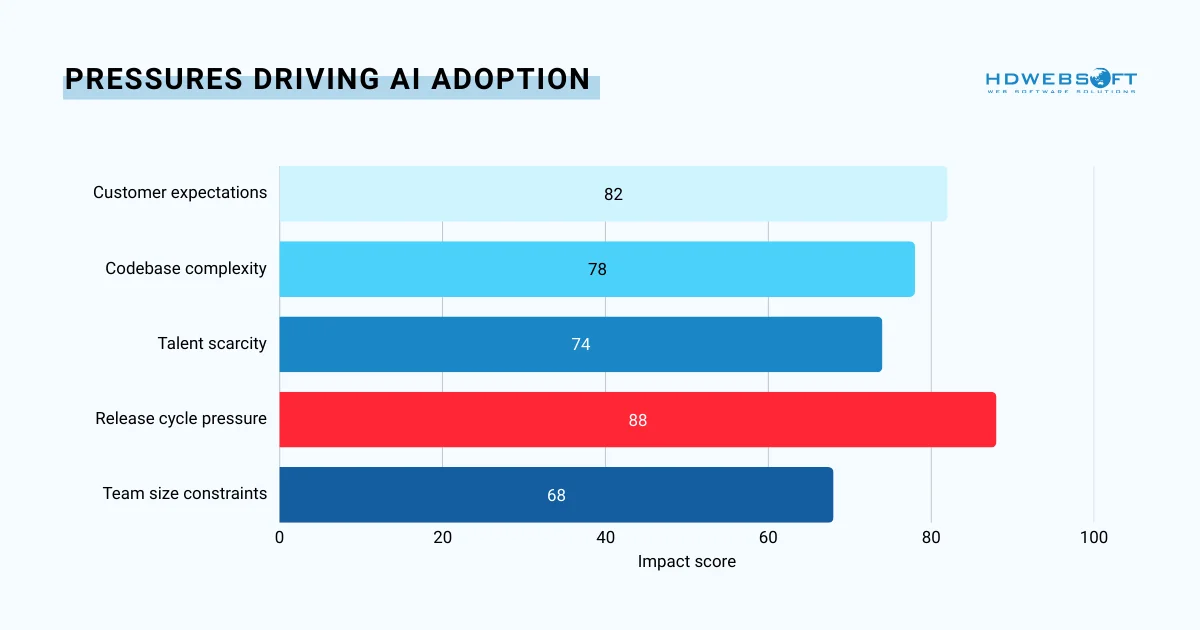
Several forces have converged to make this shift possible right now. Large language models trained on billions of lines of code have matured rapidly. Meanwhile, IDE integrations have made AI assistance seamless rather than disruptive. And the sheer complexity of modern software, distributed systems, microservices, multi-cloud deployments, has made the case for AI assistance compelling.
Moreover, the economics have shifted too. Earlier AI development tools were expensive, unreliable, and required significant setup. Today, capable AI assistance is available to individual engineers for the cost of a monthly subscription. That accessibility has moved AI augmented software development from a competitive edge to a competitive baseline.
As a result, teams that once treated AI tools as a novelty are now building them into their standard engineering workflows. The question is no longer whether to adopt it; it is how to do it well.
AI Augmented Development vs. Traditional Software Engineering
Understanding the shift from traditional to AI augmented development requires comparing how core engineering tasks are handled in each model. This is not a takedown of traditional methods. It is a look at how the same work gets done differently, and often better, with AI assistance.
| Dimension | Traditional Engineering | AI Augmented Development |
|---|---|---|
| Code Writing | Manual, developer-led from scratch | AI generates drafts; engineers review and refine |
| Debugging | Manual trace-and-search across logs | AI identifies root cause and suggests fixes |
| Code Review | Peer review only | AI flags issues; humans focus on logic and architecture |
| Testing | Manual scripts, some automation | AI-generated test cases, self-healing test scripts |
| Documentation | Manually written, often neglected | AI-generated, kept in sync with code changes |
| Project Planning | Human estimation and gut feel | AI-assisted risk modelling and resource allocation |
| Language Translation | Slow, error-prone manual rewriting | AI translates syntax structures across languages |
Across each of these dimensions, the AI augmented engineer is not doing less meaningful work. They are doing more of it: faster, with fewer errors, and with greater consistency. The table above shows the operational differences, but the strategic implication is broader: AI augmented software development changes what a given team size can realistically build and maintain.
The Role of Human Judgment
Even in the most advanced AI augmented development environments, human judgment remains non-negotiable. For instance, AI can generate a correct-looking function that solves the wrong problem. It can suggest an efficient algorithm that introduces a security vulnerability. Furthermore, it can write tests that mirror the same flawed assumptions as the code it is testing.
As a matter of fact, experienced engineers catch these issues. Junior engineers, over-reliant on AI output, sometimes do not. This is why AI augmented development works best when it amplifies good engineers and not when it substitutes for engineering rigor. The tool is only as good as the judgment of the person using it.
Further reading: Will AI replace software developers in the near future?
Where AI Fits in the Software Development Lifecycle (SDLC)
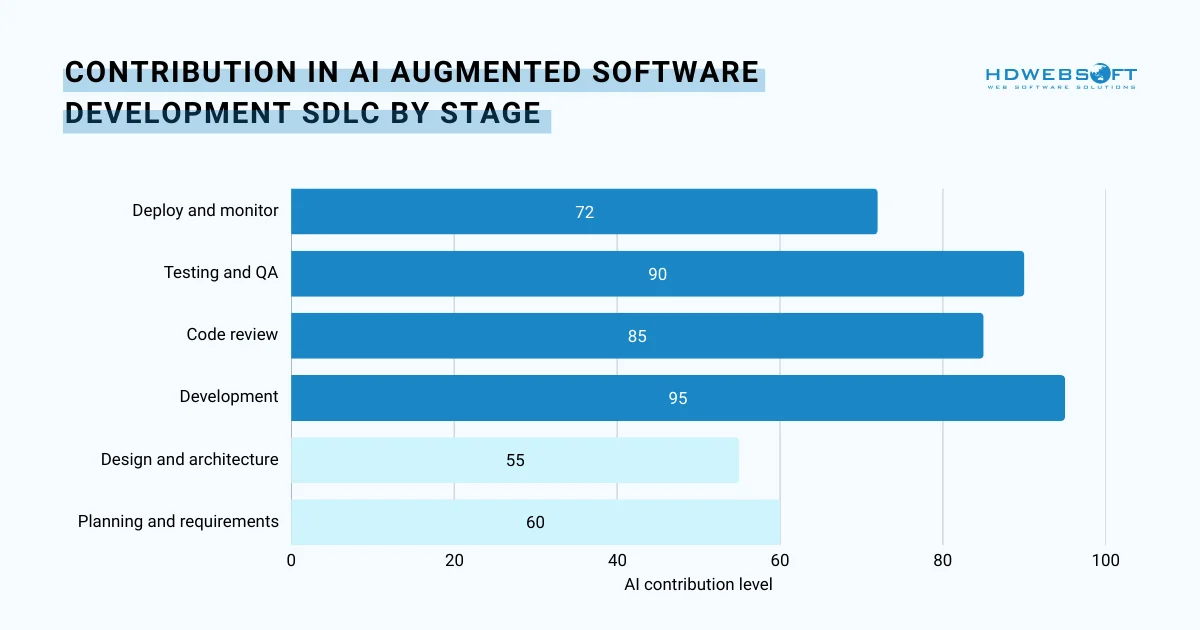
One of the most common misconceptions about AI augmented software development is that it only applies to writing code. In reality, AI can add value at every stage of the SDLC, from the first planning conversation to post-deployment monitoring. The following sections break down exactly how, stage by stage.
Planning and Requirements
Early-stage planning is often where AI augmented development delivers underappreciated value. AI tools can analyse stakeholder inputs and flag ambiguous or conflicting requirements before development begins. They can assist with effort estimation by drawing on historical data from similar projects. Moreover, some tools can model delivery risk based on team velocity, dependency complexity, and scope size.
Catching a misunderstood requirement before a single line of code is written is far cheaper than catching it in QA. AI powered software engineering tools bring a level of systematic review to the planning phase that most teams currently do informally, if at all.
Design and Architecture
Architecture decisions carry long-term consequences, so AI plays a supporting role here rather than a leading one. That said, AI augmented software development tools can surface relevant design patterns, flag known anti-patterns, and generate system diagrams from natural language descriptions. They can also help teams quickly evaluate trade-offs between architectural approaches.
Senior engineers still own these decisions entirely. But AI powered software development helps them explore the problem space faster and with greater confidence. The best architecture discussions happen when the team has already considered multiple options as AI makes generating those options much faster.
Development and Coding
This is where AI augmented development has the most visible impact. Code generation tools, such as GitHub Copilot, Cursor, and Amazon CodeWhisperer, allow engineers to describe what they need in natural language and receive working code in response. Beyond generation, these tools offer intelligent autocomplete, boilerplate elimination, and cross-language translation.
Code Generation
Modern code generation goes well beyond simple snippets. An AI augmented engineer can describe a complex function, specify edge cases, and receive a complete implementation, all ready for review, not from scratch. This dramatically reduces time spent on repetitive coding tasks and frees engineers to focus on the logic that actually requires expertise.
Thus, the shift from writing code to reviewing and refining AI output is one of the most significant workflow changes this movement has produced.
Language Translation
Legacy codebases often lock teams into outdated languages and frameworks. AI augmented software development tools can translate code across languages; for example, migrating Python 2 to Python 3, or COBOL to Java.
What previously required months of painful manual rewriting can now be accelerated significantly. Engineers still review and validate the output, but the bulk of the translation work shifts from manual labor to AI-assisted processing.
Code Review
Traditional code review is valuable but slow, so it becomes a bottleneck as teams scale. Reviewers must mentally trace logic, check for security issues, and enforce style standards, all manually. On the other hand, AI-assisted code review tools handle the mechanical parts of that process automatically.
Tools like Snyk, SonarQube, and DeepCode scan for security vulnerabilities, deprecated dependencies, and style violations in seconds. This frees human reviewers to focus on what AI cannot do well: evaluating design decisions, logic correctness, and architectural fit.
In high-volume engineering organisations, this distinction between AI-handled mechanics and human-handled judgment is what makes code review sustainable at scale.
Testing and Quality Assurance
Testing is one of the most resource-intensive parts of software engineering and one of the most frequently under-resourced. That’s why AI augmented software development changes the equation in several important ways.
AI-Generated Test Cases
Rather than writing unit tests manually after the fact, engineers can use AI to generate test suites alongside the code. These tools analyse function signatures and logic to produce relevant test cases, including edge cases that a developer under deadline pressure might miss.
Test coverage improves not because engineers work harder, but because AI makes comprehensive testing less costly to produce. This is one of the clearest quality wins the practice delivers.
Self-Healing Test Scripts
One of the biggest pain points in traditional test automation is script brittleness. A minor UI change can break hundreds of automated tests simultaneously. Self-healing test tools, a key feature of mature AI powered software engineering workflows, automatically detect and adapt to those changes.
The result is dramatically reduced test maintenance overhead and a testing suite that actually stays current. Teams using self-healing test tools consistently report fewer flaky tests and more reliable CI pipelines.
Deployment and Monitoring
Even after code ships, AI augmented software development continues to add value. AI-powered monitoring tools analyse logs in real time, detect anomalies before they escalate, and surface likely root causes before engineers have even been paged. In CI/CD pipelines, AI can recommend configuration tuning based on historical deployment patterns.
The connection between AI augmented development and AIOps is growing stronger. Together, they create a feedback loop: better development practices lead to cleaner deployments, and smarter monitoring catches the issues that slip through. This end-to-end view is what distinguishes mature AI powered software development practices from surface-level tool adoption.
Benefits of AI Augmented Software Development for Engineering Teams
The case for AI augmented software development rests on concrete, measurable outcomes, not abstract efficiency gains. Here is what engineering teams consistently experience after meaningful adoption, based on real-world evidence from teams across industries.
Faster Delivery Without Cutting Corners
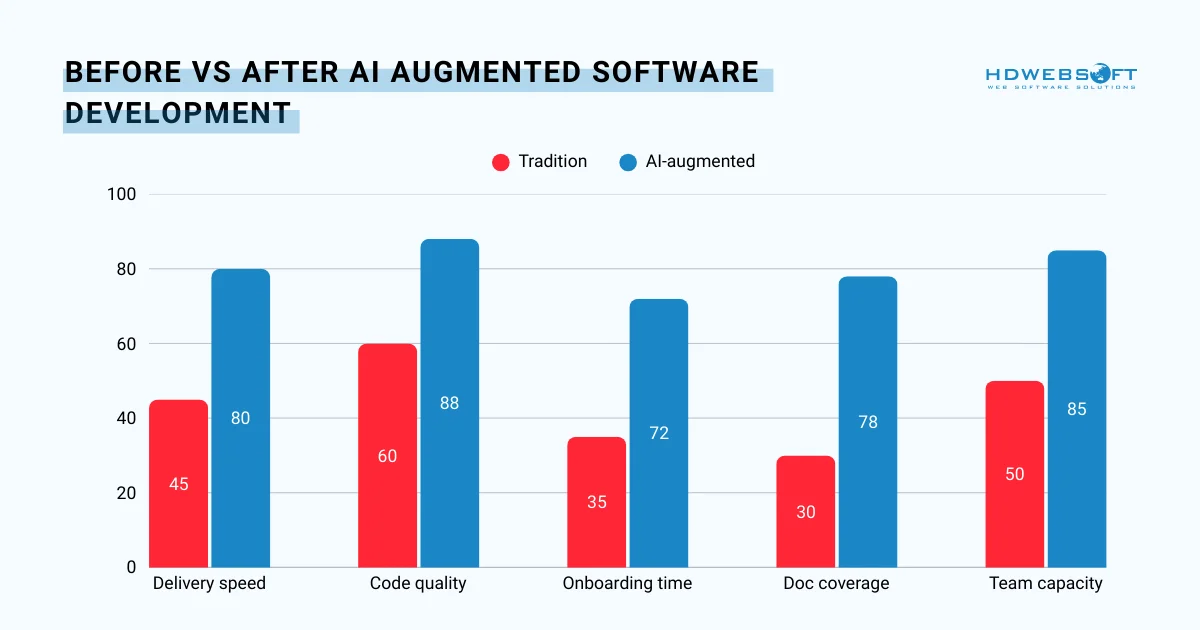
Speed is the most immediate benefit of AI augmented software development. Boilerplate code that once took hours to write can be generated in seconds. Debugging sessions that stretch across days can be resolved in minutes.
According to GitHub’s own research on Copilot, developers reported completing tasks significantly faster with AI assistance, showing up to 55% faster task completion.
Critically, this speed comes without sacrificing quality, provided engineers are reviewing AI output rather than blindly accepting it. The discipline of thoughtful review is what separates AI augmented development from simply shipping AI-generated code unchecked.
Consistent Code Quality
Human engineers have good days and bad days. Fatigue, context-switching, and deadline pressure all affect code quality in ways that are hard to manage at the individual level.
However, AI augmented software development tools enforce consistent standards every time, regardless of the circumstances. Style guides are followed automatically. Security patterns are applied consistently. And common mistakes are flagged before they reach a human reviewer. All of those perks reduce the burden on code review and improve what enters the main branch.
Faster Onboarding for New Engineers
Getting a new engineer productive in a complex codebase typically takes months. Legacy systems, undocumented decisions, and sprawling architecture all slow that process down. Consequently, AI tools change that dynamic meaningfully.
An AI augmented engineer joining a new team can use AI to explain unfamiliar code, surface architectural patterns, and generate contextual documentation on demand. Onboarding timelines shrink considerably and new team members contribute meaningfully far sooner than in traditional environments.
Reduced Documentation Debt
Documentation debt is endemic in software engineering. Developers write code quickly and document it slowly — or not at all. Over time, the gap between what the code does and what the documentation says grows until documentation becomes actively misleading.
AI augmented software development solves this by generating and updating documentation as a natural byproduct of the development process. Notably, not as a separate task that gets deprioritized under pressure. Some tools keep documentation in sync as the code evolves, eliminating one of the most persistent forms of technical debt.
Smaller Teams, Larger Surface Area
Perhaps the most strategically significant benefit: AI augmented development allows smaller engineering teams to maintain larger, more complex codebases. This is particularly valuable for scale-ups and enterprises managing significant technical surface area with limited headcount.
Instead of hiring linearly to scale output, teams can leverage AI to extend their effective capacity, shipping more without proportionally growing the team. For resource-constrained organizations, this capacity multiplier can be genuinely transformative.
Improved Developer Experience and Retention
There is a retention angle to AI powered software development that often goes undiscussed. Engineers generally entered the profession because they enjoy solving hard, interesting problems. They did not enter it to write repetitive boilerplate, maintain outdated documentation, or debug trivial issues for the third time this week.
Risks, Limitations, and Governance in AI Augmented Software Development
We can guarantee you that there is no honest guide to AI augmented software development that skips this section. The benefits are real, but so are the risks. Understanding both is what separates teams that use AI well from those that create new problems while solving old ones. The following covers the main risk categories and what effective governance looks like in practice, especially when teams are still learning how to use AI in coding safely.
Technical Risks
AI-generated code can look correct without being correct. Models hallucinate APIs, reference deprecated methods, and introduce subtle logic bugs that pass superficial review. Moreover, if AI-generated tests are written against AI-generated code, they may share the same flawed assumptions. It means defects survive into production undetected.
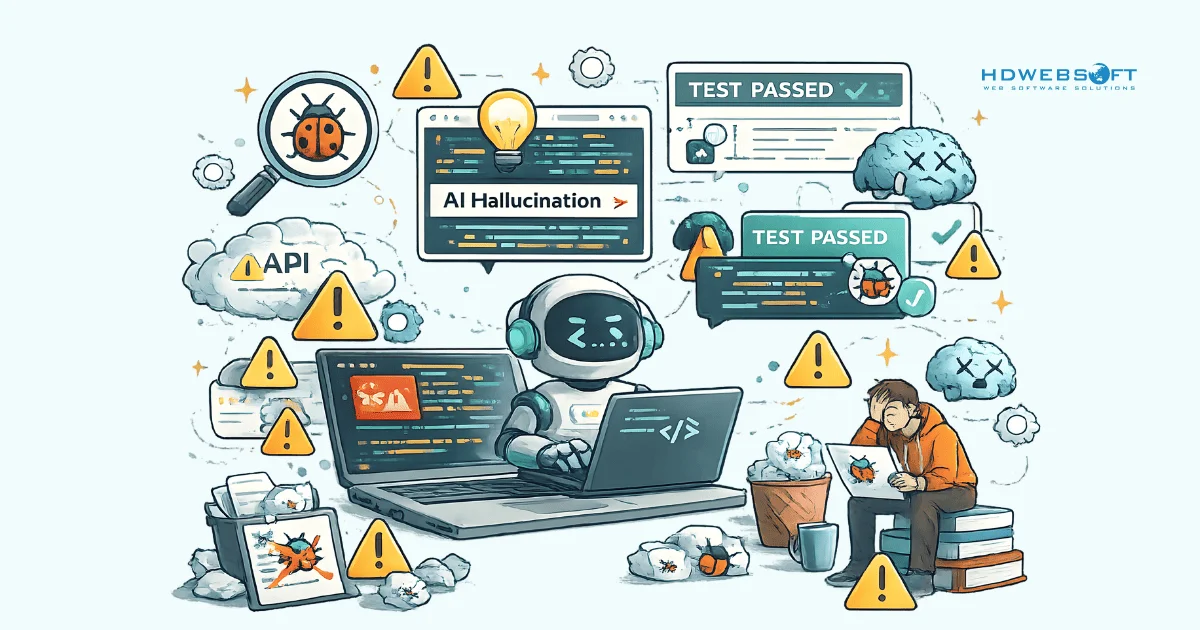
Engineers who skip foundational understanding and rely entirely on AI output are particularly vulnerable to these failure modes. Skill atrophy is a real risk in teams that over-automate before they have the judgment to supervise what AI produces. The best defense is maintaining strong engineering standards around code review. Instead, treat AI output as a first draft, not a final answer.
Security and Privacy Concerns
Sending code to an external AI model introduces data risk that many organizations underestimate. Sensitive credentials, proprietary business logic, and regulated personal data can all end up in prompts sent to third-party services. AI augmented software development programs need clear, enforced policies about what can and cannot be shared with external AI tools. Without these guardrails, a single careless prompt can expose information that should never leave your environment.
There is also the question of AI-suggested dependencies. This is because code generation tools sometimes recommend packages that are outdated, unmaintained, or contain known vulnerabilities. A governance layer that audits AI-suggested dependencies before they reach production is an essential component of any responsible program.
Organizational and Legal Risks
Ownership of AI-generated code remains a legally grey area in many jurisdictions. When something breaks in production, accountability must still sit with a human engineer. However, internal governance frameworks often have not caught up to the realities of AI powered software engineering at scale.
Also, organizations face internal resistance. Engineers who distrust AI output, or who fear displacement, may resist adoption in ways that undermine the team’s effectiveness.
Hence, change management is not a soft consideration. It is a core part of the governance challenge, just as much as policy and tooling. Successful programs address the human side of adoption as deliberately as the technical side.
What Good Governance Looks Like
Effective governance for AI augmented software development does not have to be bureaucratic or complicated. It needs to be practical, enforceable, and reviewed regularly as the tooling evolves. At a minimum, it should address the following areas.
| Governance Area | What It Should Cover |
|---|---|
| Prompt Policy | What data can be sent to external AI tools; what must stay internal or use on-premises models |
| Code Review Standards | Human-in-the-loop checkpoints before AI-generated code is merged into main branches |
| Dependency Auditing | Regular checks on AI-suggested packages for known vulnerabilities and licensing issues |
| Ownership & Accountability | Clear assignment of responsibility for AI-assisted code in production systems |
| Quality Audits | Periodic review of AI tool usage and output quality across the engineering team |
| Training & Supervision | Ensuring junior engineers build foundational skills alongside AI tool usage, not instead of it |
Real-World Use Cases for AI Augmented Software Development
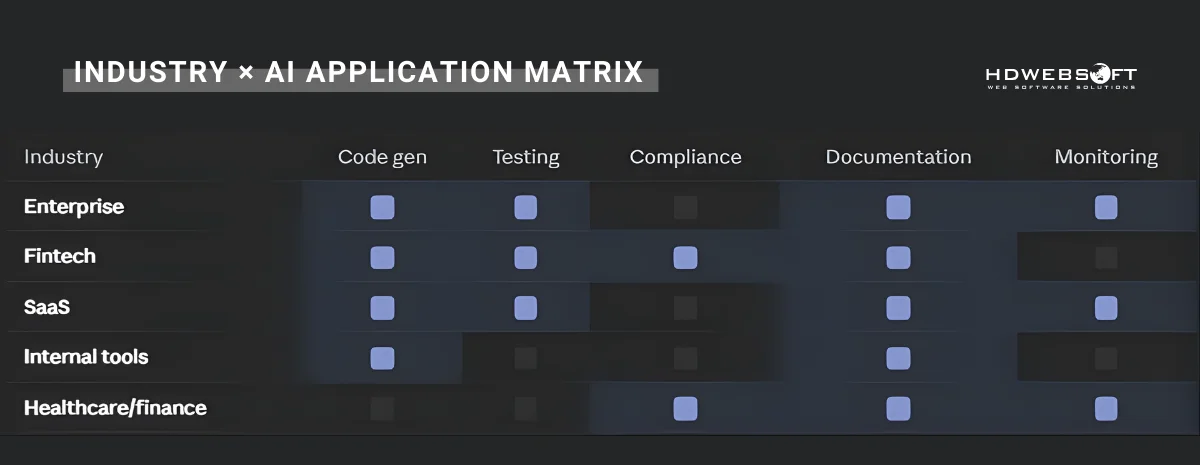
Theory is useful, but examples are better. Here is how AI augmented software development is already being applied across industries and engineering contexts. It is moving beyond proof-of-concept into everyday practice.
Legacy Modernization
Enterprise teams are using AI powered software engineering to accelerate one of the most painful and expensive tasks in engineering: modernising legacy codebases. AI tools can translate COBOL to Java, Python 2 to Python 3, and other language migrations. All the while, they simultaneously generate updated documentation for the translated code.
Projects that previously required years of careful, expensive manual work can now proceed far faster and with lower risk of translation errors. The human engineer’s role shifts to validation and architectural oversight rather than line-by-line rewriting.
Fintech: Compliance-Aware Development
Financial services teams operate under strict regulatory requirements that intersect directly with the engineering workflow. In this context, AI powered software engineering tools are being used to build compliance checks directly into the pull request workflow.
Every code change is automatically scanned against relevant regulatory patterns before a human reviewer even looks at it. The result is faster compliance validation and a more consistent audit trail, made without adding headcount to the compliance team.
SaaS Product Teams: Rapid Release Cycles
Fast-moving SaaS teams use AI augmented software development to maintain high release velocity without sacrificing quality. AI-generated test suites cover new features quickly, reducing the time between code completion and confident deployment. Self-healing test scripts reduce the overhead of maintaining automation across rapid UI changes.
The result is shorter QA cycles, more frequent releases, and greater team confidence in what is being shipped. For SaaS businesses where release speed is a competitive differentiator, this is a meaningful operational advantage.
Internal Tooling: Punching Above Your Weight
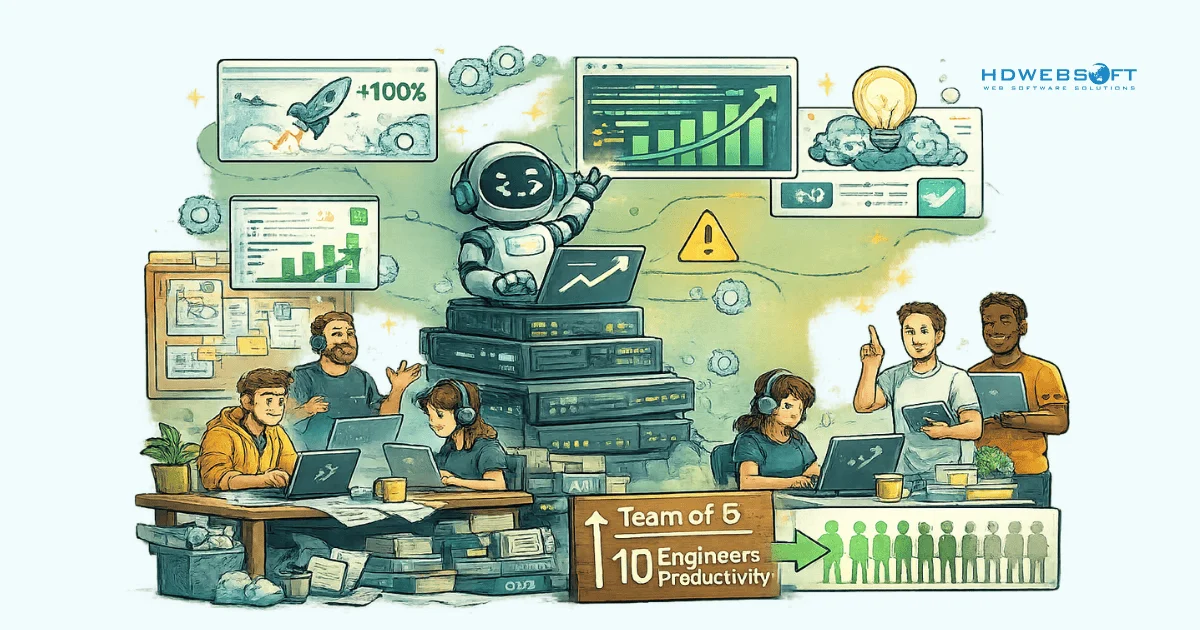
Smaller engineering teams, often responsible for internal platforms that support much larger organizations, are some of the biggest beneficiaries of AI powered software engineering. With AI assistance, a team of five can maintain a codebase and a product surface area that previously required ten engineers.
This is not a cost-cutting story; it is a capacity story. The team does not shrink as it becomes capable of maintaining a fundamentally larger scope of work without burning out.
Regulated Industries: Automated Audit Trails
Healthcare and financial services organizations are leveraging AI augmented software development to generate compliance documentation automatically as part of the development process. Rather than reconstructing audit trails after the fact, documentation is produced in real time as code is written and reviewed.
This shifts compliance documentation from a painful retrospective exercise to a natural byproduct of good engineering practice. Audit readiness becomes the default state, not a project in itself.
Tools Landscape for AI Augmented Software Development
The tooling ecosystem for AI powered software engineering is evolving rapidly, almost faster than any fixed vendor list can stay current. Rather than recommending specific products, the following overview organizes the landscape by category, giving you a durable frame for evaluating options as the market matures.
Code Generation and Assistance
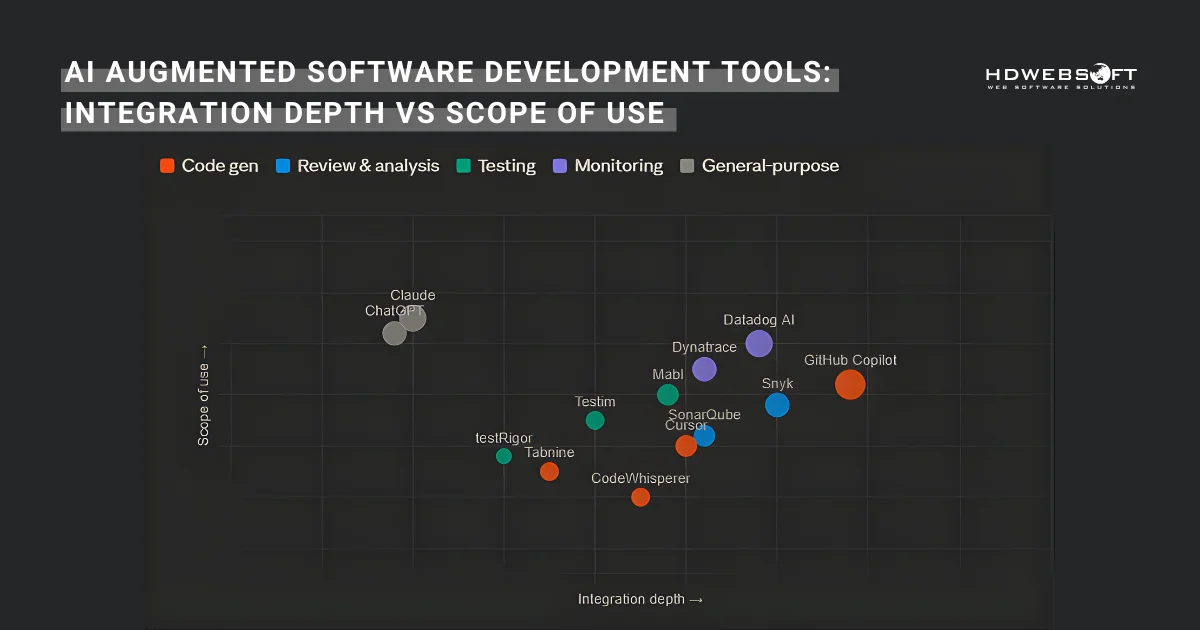
This is the most mature and widely adopted category in AI augmented software development tooling. Tools like GitHub Copilot, Cursor, Tabnine, and Amazon CodeWhisperer integrate directly into developer IDEs. They offer inline code generation, intelligent autocomplete, and natural language to code conversion across a wide range of programming languages.
| Tool | Primary Strength | Key Consideration |
|---|---|---|
| GitHub Copilot | Deep GitHub integration, broad language support | Subscription cost at scale; review data handling policy carefully |
| Cursor | Conversational AI editing within the IDE | Newer entrant; feature set is evolving rapidly |
| Tabnine | On-premises deployment option available | Better for teams with strict data residency requirements |
| Amazon CodeWhisperer | Native AWS ecosystem integration | Best value for teams already running on AWS infrastructure |
Code Review and Static Analysis
Beyond code generation, AI augmented development tooling includes a strong and growing category of code review and analysis tools. These integrate into CI pipelines to catch security issues, licensing problems, and code quality violations automatically before any human reviewer is involved. Snyk, SonarQube, and CodeClimate are the most widely adopted AI augmented software development tools in this space.
When evaluating options, the key factors are false positive rates, language coverage, and how naturally the tool integrates with your existing pull request workflow. A tool with a high false positive rate will quickly be ignored by the team, defeating the purpose of automated review entirely.
Testing Tools
The testing tooling category in AI powered software engineering covers both test generation and test execution. Mabl, Testim, testRigor, and Appvance each offer different approaches, ranging from self-healing UI tests to AI-generated unit test suites. The right choice depends heavily on your testing strategy, tech stack, and the ratio of UI to unit and integration testing in your pipeline.
When evaluating testing tools, prioritize self-healing capability and flakiness reduction above raw feature count. A testing tool that requires constant manual maintenance to stay current defeats the primary purpose of automation in AI augmented development.
Monitoring and Operations
AI augmented software development does not stop at the point of deployment. Monitoring platforms like Datadog, Dynatrace, and Splunk have embedded AI features that analyze logs, predict anomalies, and surface root causes automatically.
When evaluating these tools, alert quality and integration with existing incident response workflows are the primary considerations. A monitoring tool that generates more noise than signal will be turned down or ignored. It’s worse than having no AI-assisted monitoring at all.
General-Purpose AI Assistants
Tools like Claude, ChatGPT, and Gemini do not integrate directly into IDEs, but are nonetheless widely used in AI powered software engineering workflows. Engineers use them for ad hoc debugging, code explanation, documentation drafting, and exploring architectural options in a conversational format.
Their flexibility makes them a useful complement to more specialized tooling. They’re particularly useful for tasks that fall outside what IDE-integrated tools handle well.
Evaluating Any AI Tool for Your Stack
Regardless of category, the same evaluation criteria apply when selecting tools for AI augmented software development. Use these as a consistent checklist before committing to any new tool.
- Security posture: How does the vendor handle your code and data? Is an on-premises option available?
- Integration depth: Does it fit naturally into your existing IDE, CI/CD pipeline, and repository setup?
- Cost at scale: How does pricing behave as your team and usage grows?
- False positive rate: For review and testing tools, how much noise does it generate relative to genuine signals?
- Vendor stability: Is this a well-funded product with a credible roadmap, or a tool at risk of being discontinued?
Here’s a visual chart for you to have a clearer idea of what each kind of tool should be used for each type of development stage.
When Businesses Need an AI Development Partner
Some organisations can adopt AI augmented development organically, with existing teams leading the transition. Others benefit significantly from working with an experienced external partner. Knowing which situation you are in can save considerable time and money.
Signs You May Need External Help
Several clear indicators suggest that an organisation needs more than internal experimentation to get AI augmented software development right.
| Situation | Why It Warrants a Partner |
|---|---|
| Tool sprawl without strategy | Teams adopting AI tools ad hoc, with inconsistent usage and no governance framework in place |
| Engineering team at capacity | No bandwidth to evaluate, integrate, and govern new tooling alongside existing delivery commitments |
| Legacy modernisation projects | High-stakes migrations where AI can accelerate work, but missteps are costly and hard to reverse |
| Rapid team scaling | Growing quickly and need AI-first development practices embedded from day one |
| Audit or compliance pressure | Need AI-assisted documentation and compliance workflows that meet specific regulatory standards |
What to Look for in an AI Development Partner
Not every technology partner that mentions AI actually practices AI powered software engineering in a meaningful way. When evaluating partners, the following qualities separate genuine capability from marketing language.
A Demonstrated AI Practice
Look for partners who can show you how AI augmented software development is embedded in their actual delivery process, not just listed on a capabilities page. Ask to see examples of AI-assisted code review, test generation, or documentation workflows from real client engagements. If a partner cannot describe their own AI practice in concrete terms, they are unlikely to build one effectively for you.
Strong Security and Governance Standards
Any partner working in AI powered software engineering at a professional level should have clear, documented policies around data handling, prompt security, and code ownership. If they cannot explain their governance framework clearly and specifically, that is a significant red flag. Don’t consider it a minor gap to overlook.
A Collaborative, Capability-Building Approach
The best AI development partners build your team’s internal capability rather than creating long-term dependency. They transfer knowledge, establish engineering standards, and leave your engineers better equipped than before the engagement began.
Make note to avoid partners whose model requires you to stay reliant on them indefinitely. The goal is to make your engineering team stronger, not to replace it with an external one.
Looking Forward
AI augmented software development is a durable shift in how software gets built. It’s not a trend to watch, but a capability to build now. The core message is this: augmentation, not replacement. The AI augmented engineer is not a lesser engineer; they are a more leveraged one. They make better decisions faster, maintain higher code quality with less effort, and focus their energy on the work that genuinely requires human judgment.
If you are looking for a reliable AI development partner to help your team get this right, HDWEBSOFT brings proven experience in AI powered software engineering. Whether you are starting from scratch or scaling an existing practice, HDWEBSOFT helps engineering teams move faster, build better, and adopt AI augmented software development the right way. Contact us today for free consultation.