ISO 9001 myths continue to prevent countless software companies from achieving quality excellence. Many tech leaders dismiss this powerful quality management standard based on outdated assumptions. However, understanding what is ISO and separating fact from fiction can unlock significant competitive advantages. These misconceptions range from cost concerns to fears about bureaucracy and innovation constraints.
In reality, ISO 9001 offers a flexible framework that enhances rather than hinders modern software development. This article debunks seven prevalent common ISO 9001 misconceptions that hold businesses back. By the end, you’ll have a clear picture of what ISO 9001 truly entails.
Why These ISO 9001 Myths Persist in the Software Industry
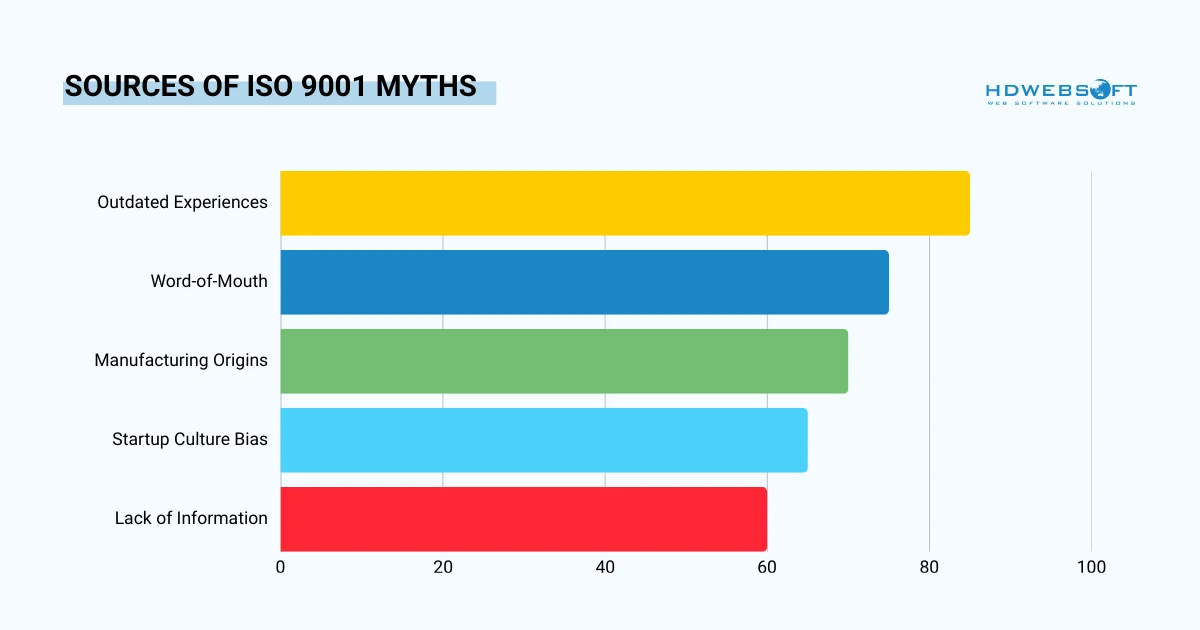
The tech sector has long harbored skepticism toward traditional quality management systems. Much of this stems from ISO’s historical roots in manufacturing environments. Additionally, startup culture often celebrates disruption over standardization, creating an anti-establishment bias.
Common ISO 9001 myths also spread through word-of-mouth without proper verification. Outdated experiences from decades ago continue to shape modern perceptions. Furthermore, the rapid pace of software development clashes with perceived “corporate” processes. As a result, these factors combine to create persistent myths that deserve thorough examination.
Debunking the 7 Common ISO 9001 Myths
Let’s tackle the most widespread common ISO 9001 misconceptions head-on with evidence-based reality checks. Each misconception below has been carefully analyzed against current ISO standards and real-world implementation.
Myth 1: ISO 9001 is Only for Manufacturing Companies
Many software leaders believe quality management standards apply exclusively to physical production facilities. This represents one of the most limiting common ISO 9001 misunderstanding points in the industry.
The Reality: ISO 9001 is Industry-Agnostic
In fact, ISO 9001 is designed to work across all sectors and organization types. The standard explicitly states its applicability to any organization, regardless of size or industry. Software companies, healthcare providers, financial services, and educational institutions all successfully implement rather it just remains ISO 9001 myths.
Moreover, as universal business concerns, the standard focuses on processes and customer satisfaction. Service-based organizations actually comprise a significant portion of ISO 9001 certified companies worldwide.
Software-Specific Applications
Cloud computing providers use ISO 9001 to ensure consistent service delivery and uptime guarantees. SaaS companies leverage it to standardize their development and deployment pipelines. Even agile startups benefit from the structured approach to customer feedback and continuous improvement. Therefore, dismissing ISO 9001 as “manufacturing-only” means missing valuable quality management opportunities.
Myth 2: ISO 9001 Creates Too Much Bureaucracy
Perhaps one of the most common ISO 9001 misconceptions is that certification will bury teams under mountains of paperwork. As the second of ISO 9001 myths**,** it often stems from outdated experiences or secondhand horror stories.
The Reality: Efficiency Over Paperwork
Contrary to popular belief, ISO 9001 emphasizes efficient processes, not excessive documentation. The 2015 revision specifically reduced prescriptive documentation requirements to allow organizational flexibility.
In particular, modern ISO implementation focuses on documenting only what adds value to your operations. Digital tools and automation have further streamlined compliance activities significantly. Consequently, well-implemented ISO systems actually reduce bureaucracy by eliminating redundant processes and clarifying responsibilities.
Lean Integration
Organizations can implement ISO 9001 using lean principles and minimal documentation approaches. The standard requires documented information only when it supports effective process operation. So, many successful software companies maintain their ISO compliance through existing project management tools. Thus, bureaucracy levels depend entirely on how you design your quality management system.
Myth 3: ISO 9001 is Too Expensive for Small and Medium Businesses
Cost concerns frequently deter smaller organizations from pursuing certification. However, this misunderstanding point in the seven ISO 9001 myths fails to consider the full financial picture.
The Reality: Scalable and Cost-Effective
Certification costs scale appropriately with organization size and complexity. Small businesses often spend between $5,000-$15,000 for initial certification, including consultant fees. Meanwhile, the return on investment typically manifests within the first year through improved efficiency.
Process improvements reduce waste, rework, and customer complaints; all generating measurable savings. Additionally, ISO certification opens doors to contracts requiring quality management system compliance.
Long-Term Financial Benefits
Consider these tangible financial advantages:
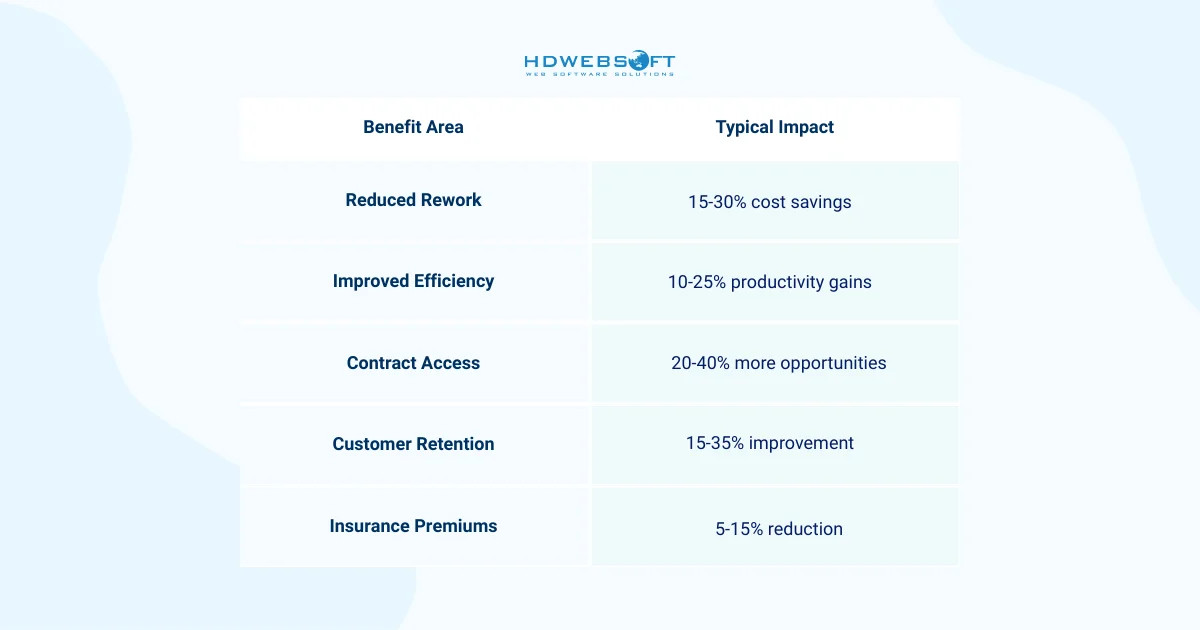
Furthermore, many organizations find that standardized processes reduce training time and onboarding costs significantly. Therefore, viewing certification purely as an expense misses the substantial value creation.
Myth 4: ISO 9001 Stifles Innovation and Agility
Tech companies often fear that standardization will constrain their creative problem-solving and rapid iteration cycles. This represents one of the most harmful ISO 9001 myths for software organizations.
The Reality: Structure Enables Innovation
Surprisingly, ISO 9001 actually creates conditions that foster sustainable innovation. The standard requires organizations to continually improve their processes and outcomes. Hence, risk-based thinking, a core ISO principle, encourages proactive identification of innovation opportunities. Moreover, documented processes provide a stable foundation from which teams can experiment safely.
Agile and DevOps Compatibility
ISO 9001 integrates seamlessly with modern software development methodologies when properly implemented. Agile sprints fit perfectly within the Plan-Do-Check-Act (PDCA) continuous improvement cycle. DevOps automation fulfills documentation and process control requirements more efficiently than manual approaches.
Moreover, sprint retrospectives directly support the ISO requirement for management review and improvement. Consequently, many agile organizations find ISO enhances rather than restricts their development velocity.
Myth 5: ISO 9001 is Just About Documentation
Another persistent misunderstanding in common ISO 9001 misconceptions reduces the entire standard to paperwork exercises. This oversimplification misses the fundamental purpose of quality management systems.
The Reality: Customer Satisfaction and Process Excellence
Despite persistent ISO 9001 myths suggesting otherwise, documentation serves as a tool, not the objective of the certification. The standard’s primary focus centers on customer satisfaction through consistent, high-quality deliverables. Process improvement drives everything as documentation merely captures knowledge and ensures repeatability.
Furthermore, ISO 9001 emphasizes understanding customer needs, measuring performance, and continuously enhancing operations. Therefore, organizations fixated on documentation compliance miss the transformative business benefits.
Digital-First Approaches
Modern implementation leverages existing digital tools rather than creating separate documentation systems. Project management platforms, wikis, and automated workflows fulfill documentation requirements naturally. In addition, version control systems, CI/CD pipelines, and monitoring dashboards provide objective evidence of process compliance. Thus, documentation becomes a byproduct of good process design rather than a burden.
Myth 6: Once Certified, You’re Done
Some organizations view certification as a destination rather than a journey. The sixth of ISO 9001 myths leads to complacency and eventual compliance failures.
The Reality: Continuous Improvement is Mandatory

ISO 9001 certification requires ongoing commitment and regular surveillance audits to maintain validity. This is because certification bodies conduct annual surveillance audits to verify continued compliance and improvement. Therefore, organizations must demonstrate that their quality management system remains effective and evolves with business needs.
Additionally, full recertification occurs every three years through comprehensive audits. Neglecting continuous improvement risks losing certification and the associated business benefits.
Living System Requirements
Your quality management system must adapt to changing customer needs, technologies, and market conditions. Regular management reviews identify opportunities for enhancement and address emerging risks. Meanwhile, employee feedback and performance metrics drive iterative refinements to processes and procedures. Consequently, ISO 9001 certification demands sustained organizational commitment rather than one-time achievement.
Myth 7: ISO 9001 Guarantees Perfect Quality
Unrealistic expectations about certification outcomes create another in problematic ISO 9001 myths. Some believe the certificate ensures flawless products and zero defects.
The Reality: A Framework for Managing Quality
ISO 9001 provides a systematic approach to quality management, not a guarantee of perfection. The standard helps organizations minimize errors through preventive measures and corrective actions.
However, it acknowledges that some level of variation and occasional issues remain inevitable. Contradiction to the common ISO 9001 misconceptions, certification demonstrates only your organization’s commitment to addressing quality issues systematically. Moreover, it shows you have processes to prevent recurrence and continuously improve outcomes.
Setting Realistic Expectations
Certification indicates your organization meets internationally recognized quality management standards consistently. It proves you have effective systems for identifying, addressing, and learning from quality issues.
More importantly, customers can trust that certified organizations take quality seriously and invest in systematic improvement. Nevertheless, certification doesn’t eliminate human error or unexpected technical challenges entirely.
Red Flags: How These Myths Cost Software Companies
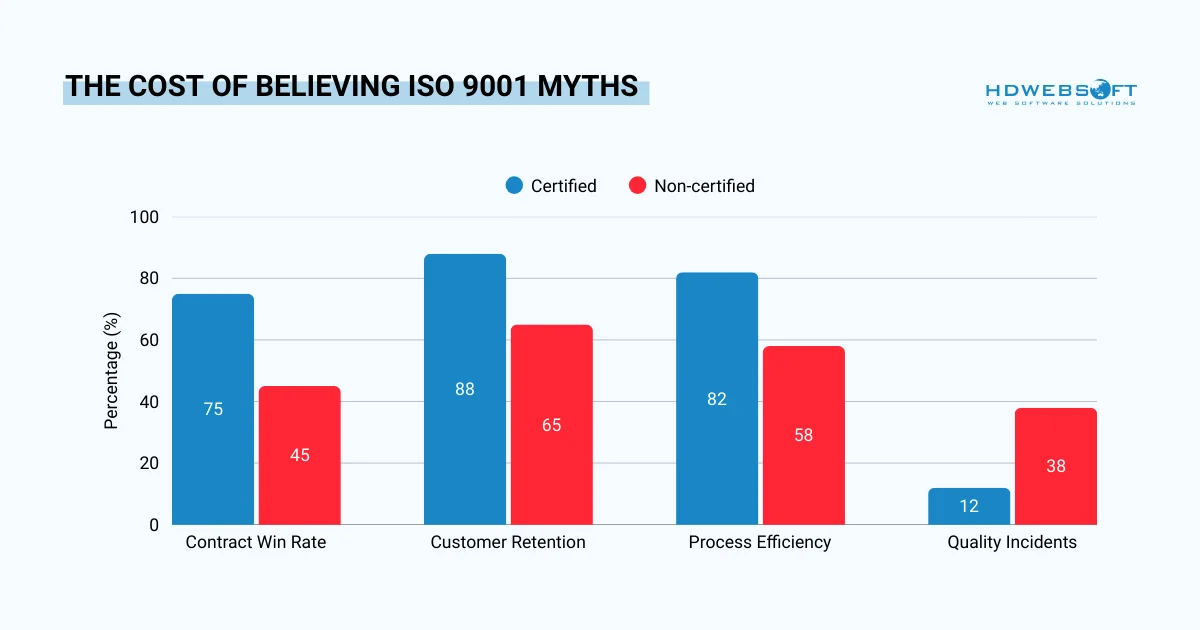
Believing these ISO 9001 myths creates tangible business disadvantages that accumulate over time. Let’s examine the real consequences of misconceptions about quality management systems.
But first, take a look at the cost rate of believing in the seven common ISO 9001 misconceptions.
Lost Contract Opportunities
Many enterprise clients and government contracts explicitly require ISO 9001 certification from vendors. Without certification, your company automatically gets excluded from lucrative opportunities regardless of technical capabilities.
In particular, competitors with certification gain preferential treatment in procurement processes and RFP evaluations. International markets particularly favor or mandate ISO-certified partners for business relationships.
Competitive Disadvantage
Organizations without systematic quality management often struggle with consistency and reliability issues. This leads to higher customer churn rates and negative reviews that damage reputation. Meanwhile, certified competitors market their quality commitment as a clear differentiator. The gap widens as certified organizations continuously improve while others remain stagnant.
Hidden Inefficiencies
Without standardized processes, teams waste time reinventing approaches and resolving preventable issues repeatedly. Knowledge remains siloed in individual employees rather than captured in organizational systems, a red flag often rooted in persistent ISO 9001 myths. Additionally, onboarding new team members takes longer due to unclear procedures and undocumented practices. These inefficiencies compound over time, significantly impacting profitability and scalability.
Missed Improvement Opportunities
Organizations lacking formal improvement mechanisms struggle to identify and address systemic problems effectively. Customer feedback gets lost or ignored without structured collection and analysis processes. Furthermore, innovation becomes random rather than systematic, leading to inconsistent results and wasted resources.
Quick Reality Check: Are You Believing These Myths?
Before moving forward, honestly assess whether these common ISO 9001 misconceptions influence your thinking. Take a moment to reflect on which statements you’ve previously believed or expressed.
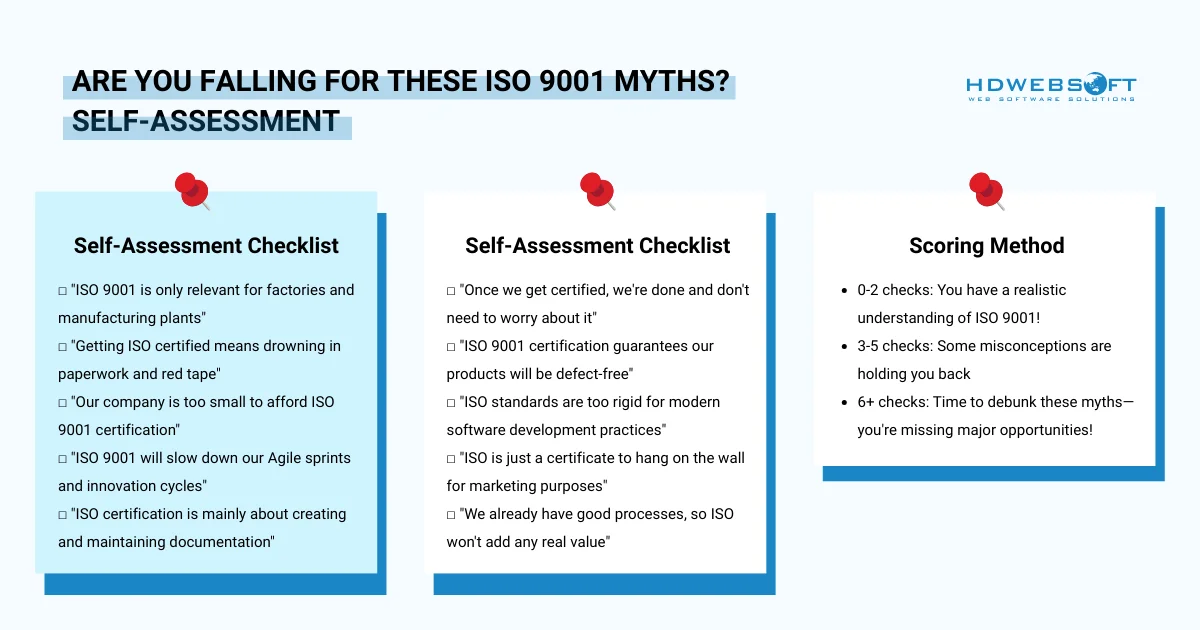
This quick exercise helps identify specific misconceptions that might be limiting your organization’s potential. Understanding where your knowledge gaps exist is the first step toward making informed decisions.
Getting Started: First Steps Toward ISO 9001
Ready to move beyond ISO 9001 myths and explore certification for your organization? Here’s a practical roadmap to begin your quality management journey.
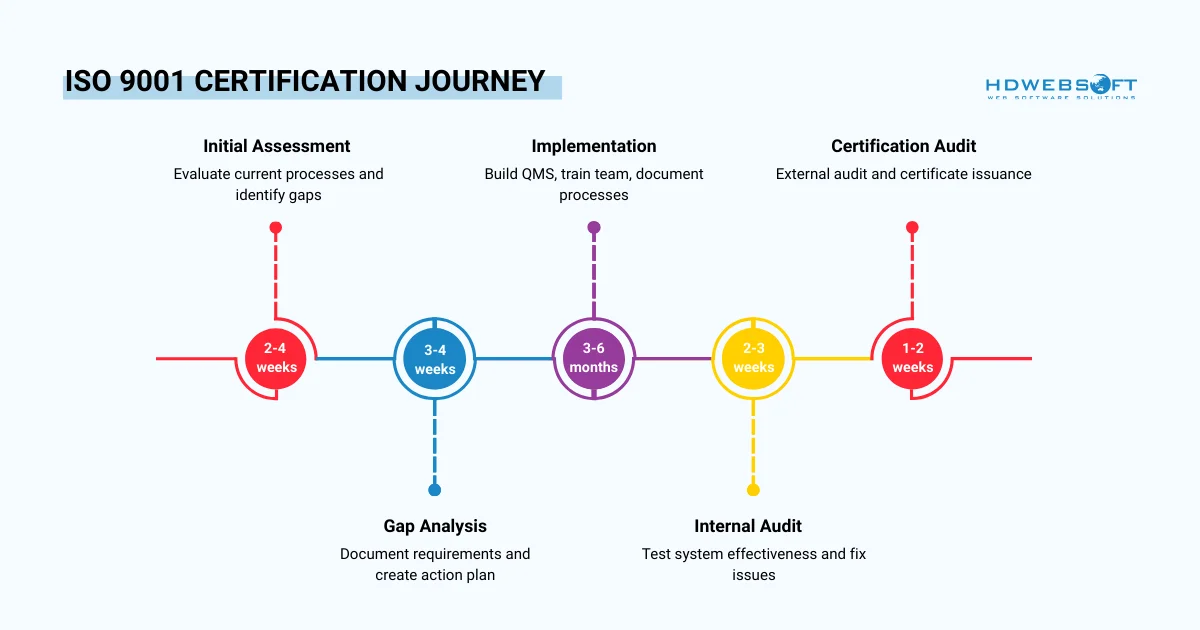
Initial Assessment and Gap Analysis
Start by evaluating your current processes against ISO 9001 requirements to identify existing gaps. Many organizations discover they already meet 40-60% of requirements through existing good practices.
Consequently, this assessment helps you understand the actual work needed rather than relying on assumptions. Consider engaging an experienced consultant for an objective evaluation and realistic timeline projection.
Building Your Implementation Plan
Develop a phased approach that aligns certification activities with your business priorities and resources. Make sure to focus first on high-impact processes that directly affect customer satisfaction and operational efficiency. Engage employees early and often to build buy-in and leverage their process expertise. Hence, set realistic timelines, as most organizations achieve certification within 6-12 months of dedicated effort.
Finding the Right Support
Research certification bodies accredited by recognized accreditation organizations for credibility and international recognition. Seek consultants with specific experience in software development and technology organizations when possible. Especially, join ISO user groups and professional networks to learn from others’ implementation experiences. HDWEBSOFT can help guide your ISO journey with industry-specific expertise and proven implementation strategies. Contact us today and start your journey.
Conclusion
ISO 9001 myths have prevented too many software companies from realizing quality management benefits. We’ve debunked seven persistent misconceptions that range from industry applicability to cost and bureaucracy concerns. The reality proves far more favorable than these myths suggest for modern software organizations. ISO 9001 offers a flexible, valuable framework that enhances rather than constrains business operations.
Don’t let outdated assumptions prevent your organization from achieving systematic quality excellence. Consider taking the first step toward certification by conducting an honest assessment of your current practices. The competitive advantages and operational improvements await organizations willing to look beyond these common ISO 9001 misconceptions.