What Is a Managed Security Service Provider? A Complete 2026 Guide
A managed security service provider (MSSP) is one of the most strategic investments a business can make today. Cyber threats are growing faster than most internal IT teams can handle. Meanwhile, compliance demands, talent shortages, and budget constraints are pulling resources in every direction. That is where managed cybersecurity services come in, offering businesses expert-level protection without the cost of building it all in-house.
In this guide, you will learn what an MSSP is, what services it offers, how it differs from an MSP, and how to choose the best provider for your needs. We also break down the top 10 providers of managed security services globally and in Vietnam so you can compare and decide with confidence.
- 1) Managed Security Service Provider Definition
- 2) Why MSSPs Matter More Than Ever
- 3) Core Services a Managed Security Service Provider Offers
- 4) MSSP vs. MSP: What Is the Difference?
- 5) Strategic Benefits of Partnering with an MSSP
- 6) How to Choose the Best Managed Security Service Provider
- 7) Top 10 Managed Security Service Providers: Global and Vietnam
- 8) Frequently Asked Questions About MSSPs
- 9) Conclusion
Managed Security Service Provider Definition
Before diving into services and comparisons, it helps to start with a clear foundation. Understanding the MSSP definition is the first step to knowing whether your business needs one.
Simply put, a managed security service provider is a third-party company that manages and monitors an organization’s cybersecurity systems. It operates remotely, using dedicated tools and expert teams to protect your IT environment around the clock.
Unlike a general IT vendor, an MSSP focuses exclusively on security. Its job is to detect threats, respond to incidents, and keep your systems compliant; all on your behalf.
The concept of the MSSP is not new. These providers first emerged in the late 1990s when internet service providers began managing firewall appliances for customers. Since then, the model has evolved dramatically. As of today, an MSSP can handle everything from endpoint detection to cloud security and regulatory compliance.
Why MSSPs Matter More Than Ever
The cybersecurity landscape has changed significantly in recent years. Understanding why businesses are turning to a managed security service provider is just as important as understanding what one does.
The Threat Environment Is Escalating
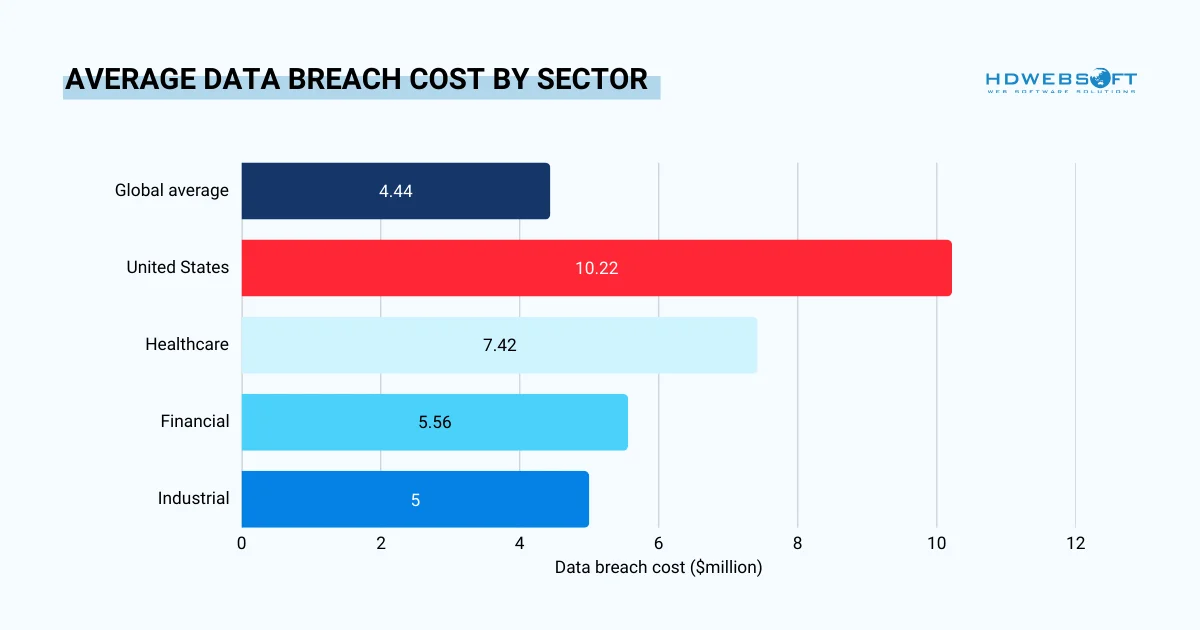
Cyberattacks are growing faster and smarter. According to IBM’s Report 2025, the global average breach cost now stands at $4.44 million. Furthermore, organizations take an average of 241 days to identify and contain a breach. That is a nine-year low but still nearly eight months of exposure.
Notably, 16% of all breaches now involve attackers using AI, most commonly through AI-generated phishing (37%) and deepfake impersonation attacks (35%).
The Skills Gap Is Getting Worse
At the same time, the global shortage of cybersecurity professionals is widening. Internal teams are overwhelmed. Alert fatigue is a growing problem, where analysts are buried under thousands of daily notifications. As a result, real threats often go undetected for too long. IBM also found that organizations with high security skills shortages faced average breach costs of $5.22 million. It’s 43% higher than those with sufficient staffing.
A managed security service provider solves these problems by bringing in dedicated experts, enterprise-grade tools, and continuous monitoring. They do it all without adding headcount to your payroll.
This Is a Business Continuity Issue
Importantly, cybersecurity is no longer just an IT problem. A breach can halt operations, damage reputation, trigger regulatory fines, and lead to customer churn. For decision-makers, partnering with a managed security service company is a business continuity decision, not just a technical one.
Core Services a Managed Security Service Provider Offers
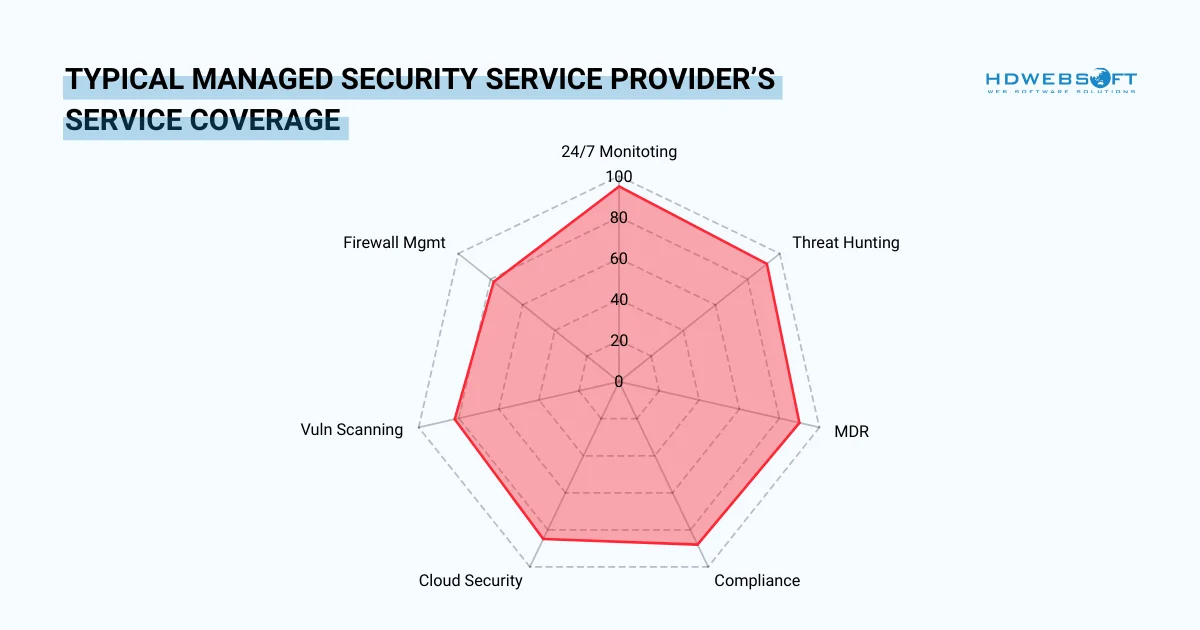
Not all MSSPs are the same. However, there is a core set of services that most reputable providers deliver. Here is what you can typically expect.
Most MSSPs offer overlapping but distinct capabilities. Knowing what each one covers helps you match a provider to your actual needs.
24/7 Security Monitoring
Continuous monitoring is the backbone of any MSSP offering. Analysts and automated systems watch your network, endpoints, and cloud environments at all hours. Threats are flagged and escalated immediately.
Managed Firewall
A managed firewall goes far beyond setup. Your managed security service provider handles ongoing configuration, tuning, and threat response. It is the equivalent of having a dedicated watchman reviewing network traffic in real time.
Intrusion Detection and Prevention
Modern intrusion detection does not just guard the perimeter. It monitors internal activity too. Your MSSP looks for suspicious behavior across all devices to catch lateral movement before it becomes a breach.
Vulnerability Scanning
Proactive scanning identifies weaknesses before attackers exploit them. A skilled MSSP maps vulnerabilities not just within your environment, but also those adjacent to it. They act as a cover for blind spots which your team might miss.
Managed Detection and Response (MDR)
MDR is a more advanced service. It combines tooling with human analysts to detect, investigate, and actively respond to threats. This goes beyond monitoring as your MSSP takes action, not just alerts.
Compliance and Reporting
Regulatory requirements like GDPR, HIPAA, and PCI DSS demand consistent documentation, audits, and reporting. A managed security service provider handles this automatically, reducing the compliance burden on your team.
Threat Hunting
Rather than waiting for alerts, threat hunters proactively search for signs of compromise. This is especially valuable against advanced persistent threats (APTs) that can remain undetected for months.
Cloud Security and Identity Management
Newer MSSP capabilities, and ones many competitors overlook, include cloud workload protection and identity/access monitoring. As businesses migrate to cloud environments, these services are increasingly critical.
MSSP vs. MSP: What Is the Difference?
These two terms are often confused. However, they serve different purposes.
A managed service provider (MSP) focuses on keeping your IT infrastructure running smoothly. A provider, on the other hand, focuses entirely on protecting that infrastructure from threats.
| Feature | MSP | MSSP |
| Primary focus | IT availability and operations | Cybersecurity and threat protection |
| Monitoring type | General uptime and performance | 24/7 threat detection and response |
| Toolset | Broad IT management tools | Purpose-built security platforms |
| Compliance support | Limited | Core to the offering |
| Best for | Operational efficiency | Risk management and regulatory compliance |
| Typical clients | SMBs needing IT support | Mid-to-large orgs with security needs |
There’s one nuance most articles miss: your business can use both. An MSP handles day-to-day IT operations, while a managed security service provider adds the security layer on top. These roles can complement rather than compete with each other.
Strategic Benefits of Partnering with an MSSP
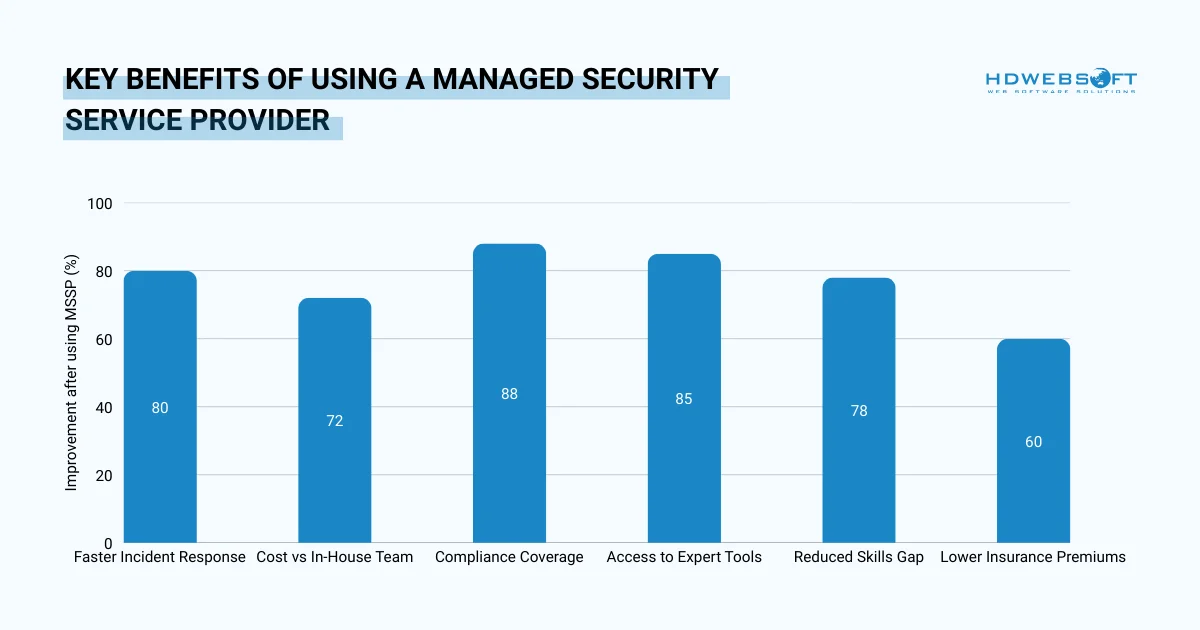
Choosing an MSSP brings tangible advantages, both technical and financial. Here is what organizations typically gain.
Why Businesses Choose to Outsource Security
The decision to work with a provider is rarely about one factor alone. Most organizations are driven by a combination of cost, expertise, and risk concerns.
- Cost efficiency: Building an in-house security team requires hiring, training, tooling, and ongoing management. MSSPs offer predictable subscription costs instead.
- Scalability: As your business grows, your MSSP scales with you. There is no need to hire additional headcount for each new environment.
- Faster incident response: Dedicated analysts respond faster than stretched internal teams. Reduced remediation time directly limits damage.
- Access to enterprise tools: Many advanced security platforms are prohibitively expensive for smaller organizations. A managed security service provider gives you access to these tools at a fraction of the cost.
- Hidden ROI: Two often-overlooked benefits are regulatory fine avoidance and cyber insurance premium reductions. Organizations with active MSSPs frequently qualify for lower premiums.
How to Choose the Best Managed Security Service Provider
Finding the best MSSP for your organization requires more than a Google search. There are specific criteria worth evaluating carefully.
What to Look for When Evaluating Providers
The right MSSP for a hospital will differ from the right MSSP for a fintech startup. That said, some evaluation standards apply universally.
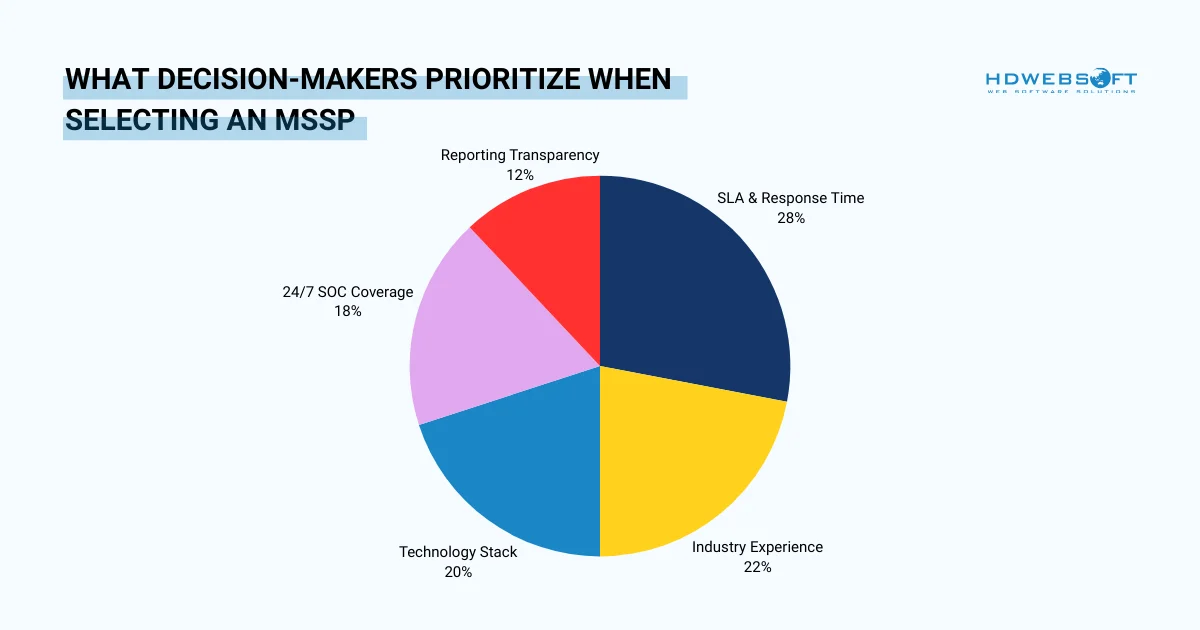
- Service Level Agreements (SLAs): Look for clearly defined response times and escalation paths. Typically, vague SLAs are a red flag.
- Technology stack: Does the provider use modern platforms? Ask about SIEM, EDR, SOAR, and threat intelligence feeds.
- Industry experience: An MSSP familiar with your sector understands your compliance requirements and threat profile.
- 24/7 SOC coverage: Threats do not work business hours. Confirm the managed security service provider runs a genuine around-the-clock operations center.
- Transparent reporting: You should receive regular, readable reports on threats detected, incidents resolved, and compliance status.
Questions to Ask During Vetting
Consider asking prospective providers the following:
- What is your mean time to detect (MTTD) and mean time to respond (MTTR)?
- How do you handle incidents outside business hours?
- Can you demonstrate compliance with the regulations relevant to our industry?
- What happens if a breach occurs on your watch?
Red Flags to Watch For
Avoid providers with vague SLAs, no dedicated SOC, limited reporting visibility, or a one-size-fits-all approach. The best MSSP will tailor their offering to your environment, not to force you into a generic package.
Also consider cultural and communication fit. The best managed security service provider is not always the biggest one. It is the one that understands your industry, communicates clearly, and aligns with how your team works.
Top 10 Managed Security Service Providers: Global and Vietnam
Selecting the right partner requires knowing who the leading players are. Below is a curated list of top 10 managed security service providers to help businesses compare options.
Note that the list below were selected based on service breadth, reputation, geographic reach, and suitability for different business sizes and industries.
| # | Provider | HQ | Key Services | Best For |
| 1 | IBM Security | USA | Threat intelligence, MDR, hybrid cloud security, compliance | Large enterprises with complex environments |
| 2 | LevelBlue (AT&T Cybersecurity + Trustwave) | USA | MDR, SOC, threat intelligence (SpiderLabs), FedRAMP-certified | Government, large enterprises |
| 3 | NTT Security | Japan | AI-powered threat detection, global SOC network, network visibility | Multinational enterprises |
| 4 | Secureworks | USA | Rapid threat detection, cloud-focused MDR, SMB-friendly pricing | SMBs and mid-market companies |
| 5 | Capgemini Cybersecurity | France | OT/IoT security, Cyber Defense Centers, NIS2 compliance | Manufacturing, energy, European orgs |
| 6 | Ensign InfoSecurity | Singapore | Agentic SOC, threat hunting, APAC threat intelligence | Asia-Pacific enterprises and government |
| 7 | Viettel Cyber Security (VCS) | Vietnam | Threat intelligence, managed SOC, penetration testing, endpoint protection | Vietnamese enterprises and government |
| 8 | CMC Cyber Security | Vietnam | Managed SOC, SIEM, PCI DSS and ISO 27001 compliance consulting | Mid-to-large Vietnamese enterprises |
| 9 | FPT Information System (FIS Security) | Vietnam | Cloud security, MDR, risk assessment, compliance | Multinational companies operating in Vietnam |
| 10 | HDWEBSOFT | Vietnam | Cybersecurity services, web application security, cloud security, compliance consulting | SMBs and growing businesses seeking cost-effective, flexible security solutions |
Frequently Asked Questions About MSSPs
These are the questions businesses most commonly ask when exploring a MSSP. Clear answers help cut through the noise.

What does a managed security service provider do?
A managed security service provider monitors, manages, and responds to cybersecurity threats on behalf of an organization. Their services typically include 24/7 SOC monitoring, threat detection, incident response, vulnerability management, and compliance reporting.
Is an MSSP the same as a SOC?
No. A SOC (Security Operations Center) is a team or facility focused on real-time monitoring and response. An MSSP is a company that provides SOC capabilities, along with many other security services, as an outsourced solution.
How much does an MSSP cost?
Pricing varies widely. Smaller businesses may pay a few hundred to a few thousand dollars per month. Enterprise agreements can run into six figures annually. Notably, most MSSPs offer subscription-based models that scale with your environment.
What is the difference between MSSP and MDR?
MDR (Managed Detection and Response) is a specific service within the MSSP umbrella. It focuses on active threat detection and real-time response. A managed security service provider typically offers MDR alongside a broader range of services such as compliance, vulnerability management, and firewall monitoring.
When should a company hire a managed security service provider?
If your internal team is stretched thin, if you are facing compliance requirements, or if you have experienced a recent security incident, those are strong signals. However, the best time to engage an MSSP is before a breach occurs, not after.
Conclusion
Cyber threats are not slowing down, internal teams are already stretched, and compliance requirements are only growing stricter. In this environment, a managed security service provider is no longer a luxury but a strategic necessity.
Whether you are a growing SMB or a large enterprise, the right MSSP gives you round-the-clock protection, expert-level expertise, and the confidence to focus on what your business does best. Use the comparison table above as your starting point, define your requirements clearly, and vet providers against the criteria outlined in this guide.
Ready to take the next step? Partner with HDWEBSOFT, a trusted MSSP delivering flexible, end-to-end cybersecurity services tailored to your business needs. From threat monitoring to compliance support, we can help you stay protected without the overhead.