
ISO certification for software development has become a critical factor in determining business success and client trust. In today’s competitive landscape, companies without proper certifications often find themselves excluded from lucrative contracts and partnerships. Moreover, they demonstrate a commitment to quality, security, and operational excellence that clients increasingly demand.
Understanding what is ISO and its standards provides the foundation for recognizing why certification matters. ISO (International Organization for Standardization) creates globally recognized frameworks that ensure consistent quality and security practices. For software companies, these standards translate into better processes, reduced risks, and enhanced credibility.
This article explores the compelling reasons why having ISO certifications is essential for software development organizations. Additionally, we’ll examine practical applications, key benefits, and actionable steps toward achieving certification. Whether you’re a startup or an established enterprise, understanding ISO’s value can transform your business trajectory.
What is ISO Certification for Software Development?
Achieving ISO certification for software development means your organization has implemented and maintains internationally recognized standards for quality and security. These standards provide systematic frameworks that guide every aspect of software development operations. Consequently, certified companies demonstrate measurable commitment to excellence that differentiates them in the marketplace.
Before diving into the specific certifications, it’s important to understand the financial investment and returns. While initial costs are significant, the long-term ROI strongly justifies the effort.

Primary ISO Standards for Software Companies
Several ISO standards directly impact software development organizations. Each serves distinct purposes while complementing overall operational excellence.
- ISO 27001 focuses on information security management systems (ISMS). This standard helps organizations protect sensitive data through comprehensive security controls. Furthermore, it addresses cybersecurity threats, data breaches, and confidentiality requirements that are crucial for software companies.
- ISO 9001 establishes quality management system requirements applicable across industries. For software developers, it ensures consistent delivery of products that meet customer and regulatory requirements. Additionally, this standard promotes continuous improvement through systematic process optimization.
- ISO/IEC 12207 specifically addresses software lifecycle processes. This standard covers everything from concept through retirement, providing detailed guidance for development activities. However, it’s less commonly pursued than ISO 27001 or 9001 for certification purposes.
The Certification Journey
Organizations must undergo rigorous assessment to achieve ISO certification for software development. Initially, companies conduct gap analyses to identify areas requiring improvement. Then, they implement necessary changes to align with standard requirements.
External auditors from accredited certification bodies evaluate the implemented systems. These audits verify that documented procedures are followed consistently. Subsequently, successful organizations receive the certification valid for three years, subject to annual surveillance audits.
Maintaining certification requires ongoing commitment to the standards. Regular internal audits and management reviews ensure continued compliance. Thus, certification represents sustained excellence rather than a one-time achievement.
Key Benefits of ISO Certification in Software Development
Pursuing ISO in software development delivers tangible advantages that impact multiple business dimensions. These benefits extend beyond mere compliance, creating competitive advantages and operational improvements.
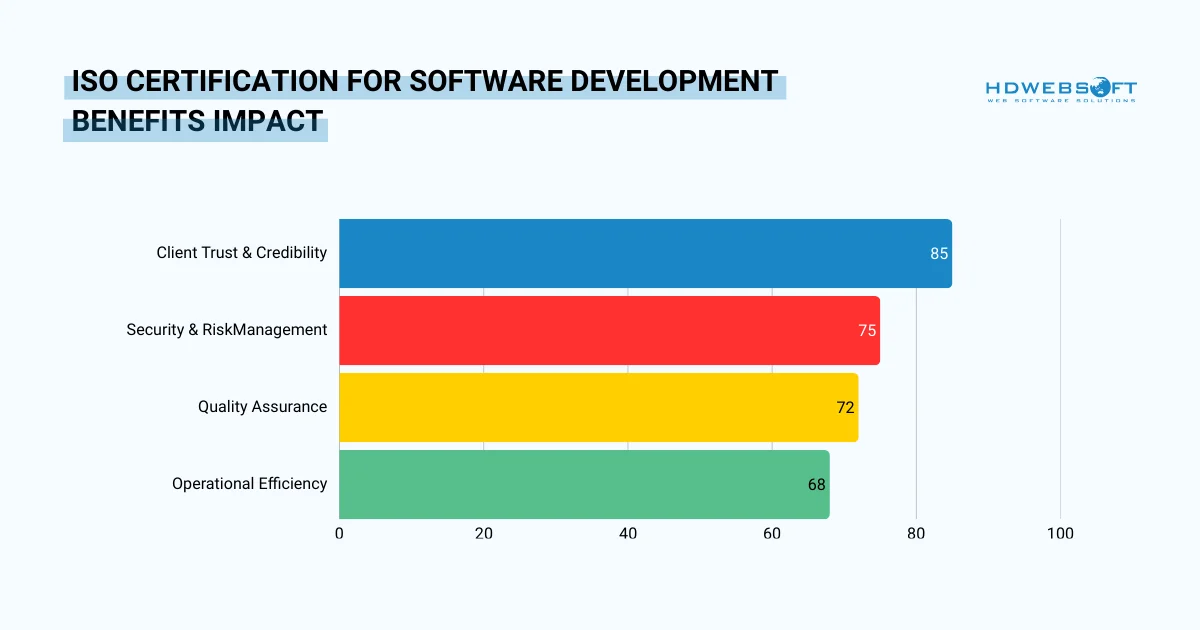
Enhanced Client Trust and Market Credibility
Certification serves as powerful proof of your organization’s reliability and professionalism. Potential clients recognize ISO standards as credible indicators of quality and security. Therefore, certified companies enjoy significant advantages when competing for new business opportunities.
Many enterprise clients and government agencies require ISO certification for software development in their vendor selection criteria. Without certification, your proposals may be automatically disqualified regardless of technical capabilities. Conversely, holding certification opens doors to contracts previously inaccessible.
In particular, international markets value ISO standards since they provide universal benchmarks. Global expansion becomes more feasible when your certifications are recognized worldwide. Furthermore, certification demonstrates cultural commitment to quality that transcends geographical boundaries.
Improved Security and Risk Management
ISO in software development transforms how organizations approach security and risk mitigation. Systematic frameworks identify vulnerabilities before they become costly incidents. Additionally, standardized processes ensure consistent application of security controls across all projects.
Data breaches can destroy reputations and trigger severe financial penalties. With global cybercrime costs projected at $10.5 trillion annually by 2025, businesses can’t afford any chances. ISO 27001 implementation, as an efficient method, significantly reduces these risks through comprehensive security management. Moreover, documented controls provide evidence of due diligence in case of security incidents.
Furthermore, as ISO certification for software development requires, regular risk assessments become embedded into operational routines. Teams should proactively identify threats rather than reactively addressing problems. Consequently, organizations develop resilient systems capable of withstanding evolving security challenges.
Better Quality Assurance and Processes
Standardized development workflows eliminate inconsistencies that lead to defects and rework. Every team member follows documented procedures, ensuring predictable outcomes. As a result, product quality improves while development time decreases.
Continuous improvement becomes ingrained in organizational culture through ISO frameworks. Metrics and monitoring identify opportunities for optimization. Subsequently, processes evolve based on data rather than assumptions or individual preferences.
Knowledge management improves significantly when procedures are well-documented. New team members onboard faster with clear guidance. Additionally, organizational knowledge persists even when experienced personnel depart.
Operational Efficiency and Cost Reduction
Streamlined processes eliminate redundant activities that waste time and resources. Clear documentation reduces confusion and the need for constant clarification. Therefore, with ISO certification for software development, teams spend more time creating value and less time navigating unclear procedures.
Resource allocation becomes more strategic when backed by standardized planning processes. Project managers make informed decisions based on consistent data and metrics. Furthermore, predictable processes enable more accurate estimation and scheduling.
Long-term cost savings often exceed initial certification investment. Reduced defects mean less rework and fewer support incidents. Moreover, improved efficiency allows organizations to deliver more with existing resources.
How ISO Standards Are Used in Software Development Projects
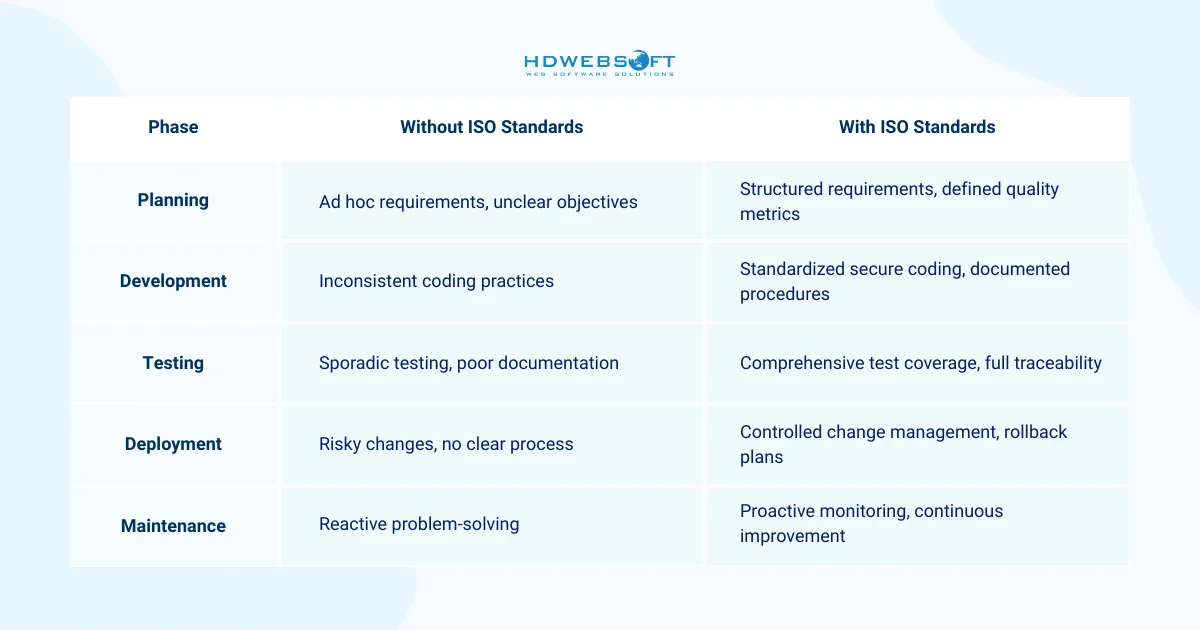
Implementing ISO in software development fundamentally changes how projects are executed from inception through completion. Standards provide structured approaches that enhance every project phase while maintaining flexibility for different methodologies.
Project Planning and Initiation Phase
Requirements gathering becomes more systematic when following ISO frameworks. Teams use standardized templates and checklists to ensure nothing is overlooked. Consequently, projects start with solid foundations that reduce downstream problems.

Risk Assessment and Quality Objectives
Risk assessment occurs early. So, ISO certification for software development requires identifying potential obstacles before they impact timelines, and documented risk registers track mitigation strategies and ownership. Additionally, quality objectives are established with measurable criteria for success.
Stakeholder Communication Protocols
Stakeholder communication follows defined protocols ensuring consistent information flow. Regular touchpoints are scheduled rather than happening ad hoc. Thus, alignment is maintained throughout project execution.
Development and Implementation Phase
Coding standards aligned with ISO requirements ensure maintainable, secure code. Developers follow documented best practices rather than individual preferences. Furthermore, code reviews verify adherence to established standards before integration.
Version Control and Configuration Management
As a matter of fact, version control and configuration management prevent code conflicts and enable rollback capabilities. Standardized branching strategies support parallel development without chaos since every change is traceable to specific requirements or issues.
Security Integration During Development
From ISO 27001, security considerations are integrated into development activities while threat modeling identifies potential vulnerabilities during design. Subsequently, secure coding practices, required in ISO certification for software development, address these threats proactively.
Testing and Quality Validation Phase
Structured testing protocols ensure comprehensive coverage of functionality and security. Meanwhile, test plans document scope, approach, and acceptance criteria before execution begins. Additionally, various testing types (unit, integration, system, UAT) follow defined sequences.
Defect Tracking and Resolution
To begin, defect tracking systems capture issues with complete context and priority assignments; resolution workflows ensure timely fixes and verification. Furthermore, metrics track defect trends to identify systemic quality issues.
Documentation and Traceability
Beyond code, documentation requirements extend to include test results and validation evidence. Traceability matrices link requirements to test cases and results. Consequently, stakeholders can verify that all requirements have been adequately tested.
Deployment and Maintenance Phase
Change management procedures control how updates move from development to production environments. Approval workflows prevent unauthorized changes that could introduce instability. Moreover, rollback plans minimize downtime if issues arise post-deployment.
Incident Response and Continuous Monitoring
As ISO certification for software development has acknowledged, incident response protocols enable rapid identification and resolution of production issues. Escalation procedures ensure appropriate resources are engaged based on severity. Additionally, post-incident reviews identify root causes and preventive measures.
Continuous monitoring tracks system performance and security metrics while automated alerts notify teams of anomalies requiring investigation. Thus, problems are addressed proactively rather than waiting for user complaints.
Real-World Application Comparison
ISO in Software Development: Industry Applications
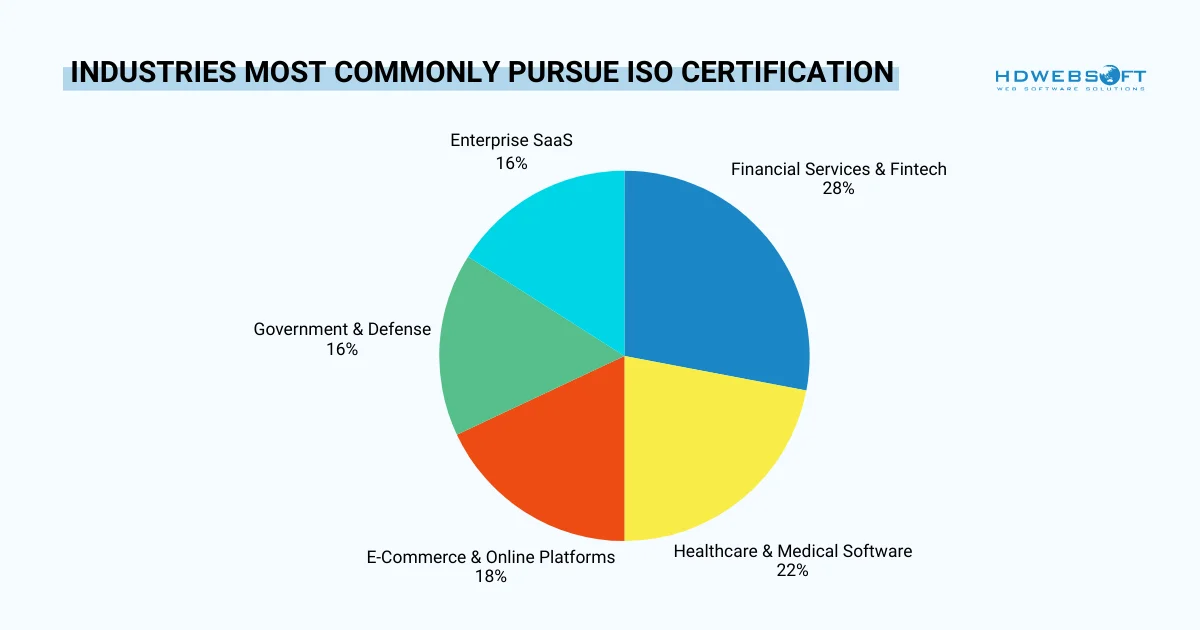
Different sectors leverage ISO standards to address their unique regulatory and operational requirements. Understanding industry-specific applications helps organizations recognize relevant use cases and the importance of ISO in software development.
Financial Services and Fintech Applications
Banking and financial technology companies face stringent regulatory requirements regarding data security and operational reliability. ISO 27001 certification demonstrates compliance with security standards demanded by regulators. Additionally, ISO 9001 ensures consistent quality in mission-critical financial systems.
Payment processing systems require robust security controls to protect sensitive financial data. ISO certification for software development provides frameworks for encryption, access controls, and audit trails. Furthermore, certification facilitates partnerships with banks and payment networks requiring verified security practices.
Medical and Healthcare Software Development
Healthcare organizations must protect patient data under regulations like HIPAA in the United States. ISO in software development helps demonstrate compliance through comprehensive security management. Moreover, quality standards ensure medical software functions reliably in critical care situations.
Plus, electronic health records systems require strict access controls and audit capabilities. ISO frameworks guide implementation of role-based access and activity logging. Consequently, patient privacy is protected while enabling necessary clinical workflows.
E-Commerce and Online Platforms
Online retailers handle vast amounts of customer personal and payment information. Due to that reason, security breaches can devastate customer trust and brand reputation. Therefore, ISO 27001 certification reassures customers that their data is properly protected.
High-traffic platforms require reliable architecture and performance. Quality management standards ensure consistent user experiences even during peak loads. Additionally, documented procedures support rapid scaling as business grows.
Government and Defense Contractors
Government contracts typically mandate specific security and quality certifications. ISO certification for software development often fulfills baseline requirements for vendor eligibility. Furthermore, classified projects may require additional security controls built upon ISO 27001 foundations.
Defense software must meet exacting reliability and security standards. Lives may depend on system performance in critical situations. Consequently, comprehensive quality management becomes non-negotiable rather than merely beneficial.
Enterprise SaaS Companies
Software-as-a-Service providers serve multiple clients from shared infrastructure. Security isolation between tenants is critical for maintaining trust. ISO 27001 implementation demonstrates commitment to protecting every client’s data.
Enterprise clients conduct thorough vendor assessments before committing to long-term SaaS contracts. Certification simplifies these evaluations by providing standardized evidence of security and quality practices. Moreover, it signals organizational maturity that enterprise buyers value.
Getting Started: Your Path to ISO Certification for Software Development
Beginning the journey to gain ISO certifications in software development requires strategic planning and organizational commitment. Understanding the process helps set realistic expectations and allocate appropriate resources.

Conducting Gap Analysis and Readiness Assessment
The first step in achieving ISO certification for software development is that organizations should first evaluate current practices against ISO requirements. Gap analyses identify areas requiring improvement before formal certification pursuit. Hence, implementation efforts focus on actual needs rather than reinventing functioning processes.
It’s worth noting that external consultants can provide objective assessments and industry benchmarking. They bring experience from multiple certification projects across different organizations. However, internal teams must ultimately own and sustain the implemented systems.
Assessment findings should be prioritized based on risk and resource availability. Critical gaps affecting security or quality receive immediate attention. Subsequently, lower-priority items are addressed as resources permit.
Selecting Appropriate ISO Standards
ISO in software development may involve multiple standards depending on organizational needs and client requirements. ISO 27001 addresses security concerns paramount for most software companies. Meanwhile, ISO 9001 provides quality management frameworks applicable across business functions.
Smaller organizations might start with single ISO certification for software development before expanding to additional standards. This phased approach spreads investment over time while delivering incremental benefits. Furthermore, experience from first certification simplifies subsequent standard implementations.
Client requirements and market expectations should guide standard selection. Research which certifications competitors hold and which clients demand. In addition, consider future business directions when making certification decisions.
Implementation and Team Preparation
Successful implementation requires cross-functional involvement beyond IT or quality departments. Leadership must visibly support the initiative and allocate necessary resources. Moreover, employees at all levels need training on new processes and their responsibilities.
Documentation Development
This practice consumes significant effort during implementation. Policies, procedures, and work instructions must be created or updated. However, documentation should remain practical and usable rather than merely satisfying auditors.

Internal Audits and Preparation
Internal audits before certification audits identify remaining gaps and prepare teams for external scrutiny. Mock audits help employees become comfortable with audit processes. Subsequently, actual ISO certification for software development audits proceed more smoothly with fewer surprises.
Choosing Certification Bodies and Timeline Expectations
Accredited certification bodies conduct independent assessments verifying ISO compliance. Organizations should research certifiers’ experience with software development companies. Additionally, consider certifier reputation and client references before making selections.
Stage 1 audits review documentation readiness before detailed implementation assessment. Stage 2 audits examine actual implementation and effectiveness of documented systems. Typically, several months separate these stages allowing correction of identified issues.
From project initiation to ISO certification for software development typically requires 6-12 months depending on organization size and current maturity. Rushing implementation often results in superficial systems requiring extensive rework. Therefore, realistic timelines ensure sustainable systems rather than checkbox compliance.
Overcoming Common Implementation Challenges
Resistance to change represents the most frequent obstacle to successful certification. Employees may view new procedures as bureaucratic overhead without understanding benefits. Hence, clear communication about reasons for ISO certification for software development and individual roles helps overcome resistance.
Resource constraints are another challenge for smaller organizations with limited personnel and budgets. Phased implementation approaches spread effort over time making certification more manageable. Furthermore, leveraging existing processes reduces work compared to complete system overhauls.
Finally, maintaining momentum throughout multi-month implementation requires sustained leadership attention. Regular steering committee meetings track progress and address obstacles. Additionally, celebrating milestones maintains team motivation through the challenging implementation period.
In a Nutshell
ISO certification for software development represents strategic investment rather than mere compliance obligation. Organizations that embrace certification gain competitive advantages through enhanced credibility, improved security, and operational excellence. While implementation requires effort and investment, returns typically exceed costs through risk reduction and new opportunities. Moreover, ISO certifications demonstrate organizational maturity that resonates with enterprise clients and partners.
HDWEBSOFT has already achieved ISO 9001 and 27001 certifications for software development this year and is applying them to our processes across all projects. Through rigorous implementation of ISO standards, we’ve strengthened our security protocols, enhanced quality assurance practices, and elevated our service delivery capabilities. This certification reinforces our commitment to providing clients with software solutions built on internationally recognized frameworks for quality and security. If you’re ready to work with a certified partner or pursue certification for your own organization, contact us to learn how ISO standards can transform your software development outcomes.