How much mobile app development costs is usually the first question founders, product managers, and business owners ask. It is also one of the hardest questions to answer with a single fixed number.
The short answer is simple: mobile app development cost in 2026 can range from $20,000 for a simple MVP to $1,000,000+ for an enterprise-grade product. The final cost depends on complexity, platform choice, backend scope, design, integrations, compliance requirements, and delivery model.
That is why any flat quote without context can be misleading. A booking app, a marketplace, and a healthcare platform may all be “mobile apps,” but they do not require the same architecture, team size, security model, or QA effort.
This guide breaks down realistic cost ranges by complexity, platform, team model, region, and maintenance. For the full product lifecycle, read our guide to mobile application design and development.
Mobile App Development Cost: Quick Summary Table
Before looking at each cost driver, here is a practical planning view by project type.
| App Complexity | Estimated Cost | Typical Timeline | Best For |
|---|---|---|---|
| Simple MVP / limited-feature app | $20,000–$60,000 | 2–4 months | Startup validation, internal tools, simple customer apps |
| Mid-complexity app | $60,000–$150,000 | 4–7 months | Growing products with custom UI, APIs, and admin features |
| Complex app | $150,000–$500,000+ | 7–12+ months | Marketplace, real-time apps, data-heavy platforms |
| Enterprise-grade app | $300,000–$1,000,000+ | 9–18+ months | Compliance-heavy, scalable, multi-platform systems |
Treat these as planning ranges, not fixed prices. The same feature can cost much more or less depending on logic. For example, “chat” can mean a basic messaging screen or a full real-time system with media sharing, moderation, search, encryption, and notifications.
How Much Does Mobile App Development Cost in 2026?
The best way to estimate mobile app development cost is to start with complexity. Complexity determines how many screens, user roles, workflows, integrations, and technical risks the team must handle.
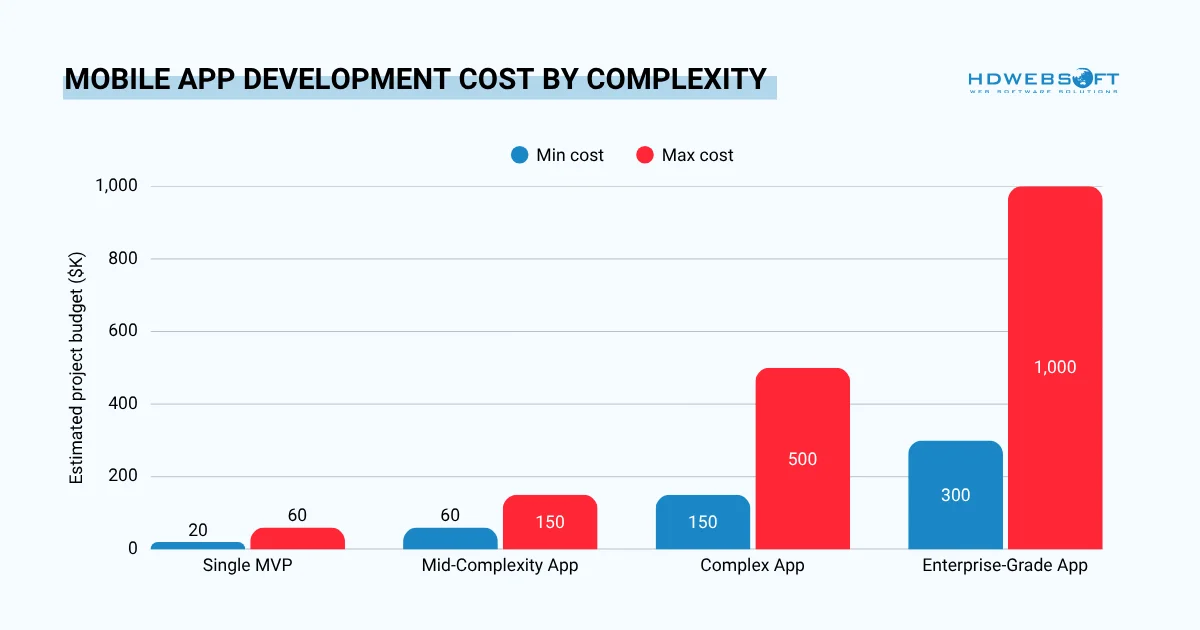
In general, the more user roles, backend logic, integrations, and compliance requirements an app has, the higher the total mobile app development cost becomes.
Simple App: MVP or Limited Features
A simple app usually costs $20,000–$60,000.
This range fits apps with a focused purpose, basic UI, authentication, one or two core features, and a simple backend. Examples include an appointment app, checklist app, content app, or early-stage MVP.
A simple app may include login, user profile, dashboard, one or two workflows, lightweight backend setup, analytics, and app store submission support. This range is suitable when the goal is to test demand quickly, not when the product needs complex logic or high traffic from the start.
Mid-Complexity App
A mid-complexity app usually costs $60,000–$150,000.
This range is common for apps with custom UI, three to five feature modules, API integrations, an admin dashboard, payment flow, notifications, and detailed testing. Many business apps fall into this category.
At this level, cost is no longer driven only by the number of screens. Backend logic, data structure, permissions, and workflows become major budget drivers.
Complex App
A complex app usually costs $150,000–$500,000+.
This range applies to apps with real-time features, custom backend architecture, advanced search, multiple integrations, high performance requirements, location tracking, chat, video, marketplace logic, or heavy data handling.
Examples include ride-hailing apps, delivery apps, social platforms, fintech products, and SaaS companion apps. The higher cost comes from engineering depth, not only feature count. A marketplace app, for example, must support buyers, sellers, admins, payments, disputes, notifications, ratings, and operational controls.
Enterprise-Grade App
An enterprise-grade app usually costs $300,000–$1,000,000+.
This range fits large-scale apps that require multi-platform delivery, strict compliance, high scalability, dedicated infrastructure, legacy system integration, and advanced security controls.
Enterprise apps may include SSO, complex permissions, ERP or CRM integration, audit logs, dedicated cloud infrastructure, and high-availability architecture. In this category, the budget covers much more than coding. It also includes discovery, architecture, compliance review, QA, deployment, and long-term maintenance.
What Factors Affect Mobile App Development Cost?
No serious estimate should start with “How many screens do you need?” alone. Screens matter, but they are only one part of the cost equation.
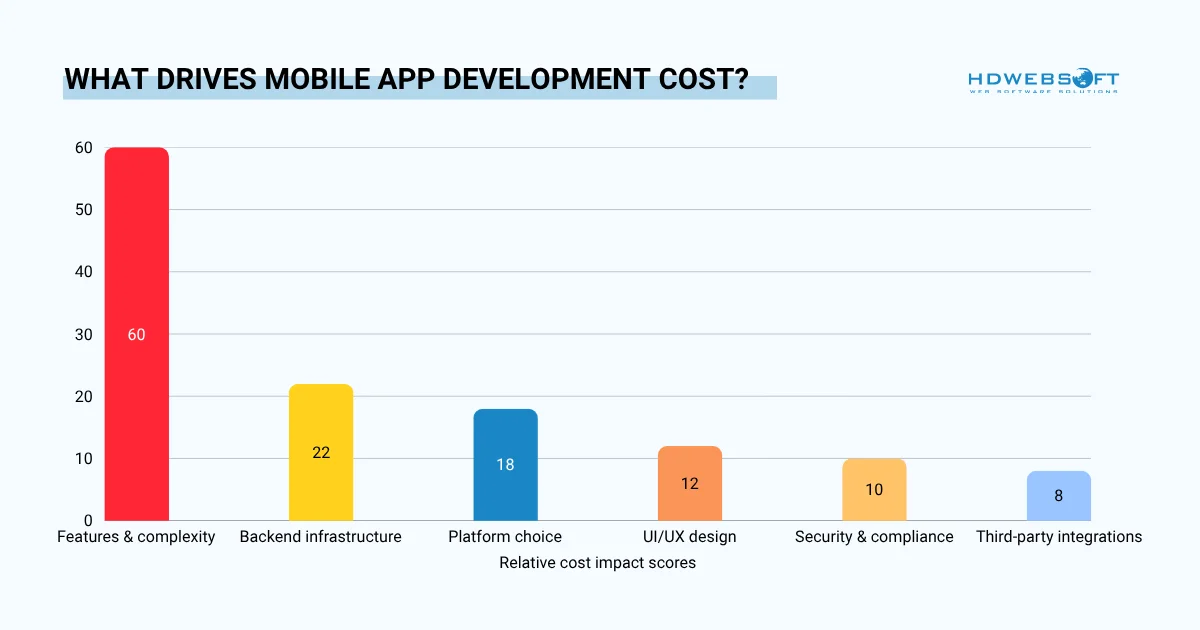
This chart highlights the main factors that affect mobile app development cost. While the scores are editorial estimates, they help explain why two apps with similar screen counts can have very different budgets.
App Complexity and Feature Set
The more complex the product logic, the higher the cost. A static content screen is simple. A screen that handles payments, permissions, real-time updates, user content, and error states is much harder.
Important cost drivers include:
- Number of screens and user roles
- Offline sync and real-time updates
- Search, filtering, and reporting
- Admin features
- Data import and export
- Notification logic
Every feature adds development, testing, documentation, and maintenance work. That is why a short feature list can still become expensive if each feature contains heavy business logic.
Platform Choice: Native vs. Cross-Platform
Platform choice can strongly affect mobile app development cost.
Native development means building separate apps for iOS and Android. An iOS app may use Swift, while an Android app may use Kotlin. Native development is often the best choice when the app needs deep device performance, platform-specific interactions, or highly customized native behavior.
Cross-platform development uses frameworks such as Flutter or React Native to build one shared codebase for both iOS and Android. This can reduce duplicated engineering work when the product requirements are largely the same across platforms.
Design Complexity
Design affects cost more than many businesses expect.
A clean app using standard UI components is faster to build. A highly branded app with custom animations, complex transitions, micro-interactions, illustrations, and bespoke components requires more design and frontend effort.
Design-related cost drivers include unique screens, animations, accessibility requirements, tablet layouts, and testing. Good design is not a luxury. Poor UX can increase support tickets and force expensive rework after launch.
Backend Infrastructure
The backend is where many hidden cost drivers appear.
A simple app may use Firebase, Supabase, or a lightweight backend. A more complex product may require a custom backend built with Node.js, Python, Java, .NET, or another stack. It may also require cloud hosting, database design, API development, authentication, storage, monitoring, and DevOps.
If the app must support heavy traffic or sensitive data, backend architecture should be planned early. Fixing poor architecture later is usually far more expensive than building the right foundation from the start.
Third-Party Integrations
Third-party integrations can reduce development time, but they still add cost. Each integration must be implemented, tested, monitored, and sometimes updated when the provider changes its API.
Common integrations include payment gateways, maps, chat, push notifications, analytics, crash reporting, CRM, ERP, social login, email, and SMS services. A payment integration, for example, is not just a checkout button. It often includes failed payment handling, refunds, receipts, payment status updates, and security review.
Security and Compliance Requirements
Security and compliance can increase mobile app development cost, especially in healthcare, fintech, insurance, logistics, and enterprise software.
Basic security may include HTTPS, secure authentication, encrypted data storage, input validation, and access control. Higher-risk products may need threat modeling, penetration testing, audit logs, secure coding review, and compliance support.
For mobile security planning, many teams refer to the OWASP Mobile Application Security Verification Standard, a widely used framework for assessing mobile app security.
Post-Launch Maintenance
A mobile app is not finished when it goes live. App stores, operating systems, APIs, and user expectations change constantly.
Many teams budget around 15–20% of the initial build cost per year for maintenance. This may cover bug fixes, OS updates, security patches, server monitoring, minor improvements, and compatibility testing.
How Does the Development Team Model Affect Cost?
The team model changes both price and delivery risk.
In-House Team
An in-house team gives the business the most direct control. It may be the right choice when mobile is core to the company’s long-term product strategy.
However, the real cost includes salaries, benefits, recruitment, management, tools, office overhead, training, and retention. For many startups and mid-sized businesses, building a full in-house mobile team before validating the product is too expensive.
Freelance Developers
Freelancers can reduce upfront cost, especially for small apps or isolated tasks. The trade-off is management effort.
A freelancer may be strong in one area, but a real product needs design, backend engineering, mobile development, QA, DevOps, and project management. Without strong coordination, a lower initial price can easily become a higher rework cost later.
Development Agency
A development agency provides a full team from day one. This often includes project management, designers, developers, QA engineers, and technical leads.
Agency pricing varies by location, seniority, process maturity, and project complexity. A good agency should challenge assumptions, clarify business goals, identify risks, and explain what actually affects cost.
Offshore or Outsourced Development
Offshore development is often used to control mobile app development cost while still getting access to a complete engineering team.
Typical hourly planning ranges by region are:
| Region | Typical Hourly Range |
|---|---|
| North America | $100–$150/hr |
| Western Europe | $80–$130/hr |
| Eastern Europe | $40–$70/hr |
| Southeast Asia, including Vietnam and the Philippines | $20–$50/hr |
Vietnam is often a strong option because it balances technical capability, cost efficiency, English communication, and time zone overlap with markets such as Australia and parts of Asia. HDWEBSOFT’s offshore software development services can support dedicated teams, project-based delivery, and long-term product development.
How Can You Reduce Mobile App Development Cost Without Sacrificing Quality?
Reducing cost should not mean cutting quality blindly. The better goal is to reduce waste.
Start With an MVP

An MVP helps the team build only the features needed to test the product idea. It should not be a broken version of the final product. It should be a focused version that solves one real problem well.
A strong MVP can reduce cost by avoiding unnecessary modules, complex automation, and premature scaling.
For more guidance, read our article on mobile app development for startups.
Choose Cross-Platform When It Makes Sense
Cross-platform development can reduce duplicated work when iOS and Android users need mostly the same features. It is useful for MVPs, internal tools, customer portals, e-commerce apps, and products where speed to market matters.
Native development may still be better for deep device integration, advanced graphics, or very platform-specific experiences. The right choice depends on the business goal, not only the budget.
Invest in Discovery
Discovery may feel like an extra cost, but it often saves money later. A good discovery phase defines users, workflows, technical risks, integrations, MVP scope, timeline, and architecture direction.
Spending around 10–15% of the budget on discovery can prevent expensive rework and help stakeholders align on what should be built first.
Use a Design System
A design system reduces repeated design and development work. Reusable components such as buttons, forms, cards, navigation patterns, and error states make the product easier to scale.
This is especially valuable when the app will grow over time. Without a design system, every new feature becomes slower and less consistent.
Prioritize Features Ruthlessly
A practical rule is simple: cut the first feature list in half, then question what remains.
Ask whether each feature supports the core user journey, validates the product, can be handled manually at first, can move to phase two, or can be removed without hurting launch quality.
Choose the Right Development Partner
The cheapest hourly rate does not always produce the lowest project cost. A team with weak communication, unclear process, or poor technical judgment can create delays and rework.
The right partner should explain cost drivers clearly, provide realistic trade-offs, document decisions, and protect product quality. Process maturity matters as much as coding ability.
What Are the Hidden Costs of Mobile App Development?
Hidden costs are not always huge, but they often surprise teams that budget only for design and coding.
Common hidden costs include app store accounts, third-party tools, cloud hosting, analytics, legal documentation, privacy policy and terms of service, app store optimization, marketing, customer support, maintenance, OS updates, and infrastructure scaling.
For app store accounts, the Apple Developer Program annual fee is currently listed as $99 per membership year. Meanwhile, the Google Play Console registration fee is listed as a US$25 one-time fee.
These fees are small compared with development, but they are still part of the real launch budget. Larger hidden costs usually come from cloud usage, marketing, compliance, and post-launch improvement.
How Much Does It Cost to Maintain a Mobile App After Launch?
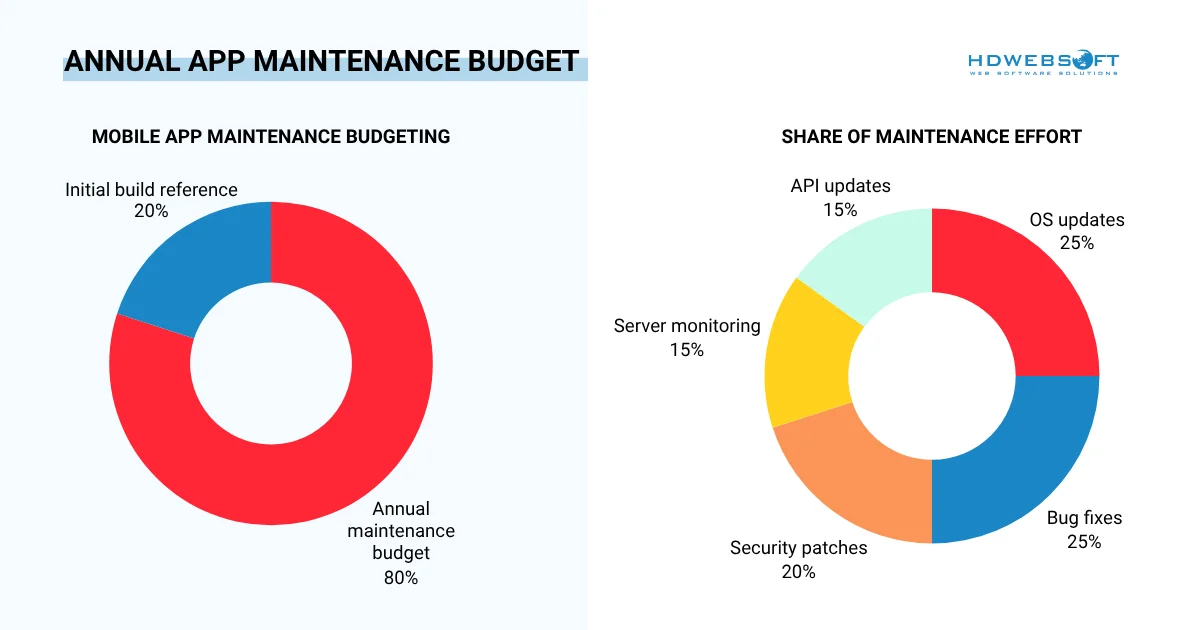
This chart explains how mobile app maintenance cost is often planned after launch.
A practical maintenance budget is usually 15–20% of the initial development budget per year. For more complex apps, the number can be higher.
Maintenance often covers iOS and Android compatibility updates, bug fixes, security patches, performance optimization, server monitoring, API updates, minor feature improvements, app store policy updates, and crash monitoring.
Maintenance cost increases when third-party APIs change, operating systems introduce breaking updates, the user base grows beyond the original architecture, or the business adds new features continuously.
This is why mobile app development cost should be planned as a lifecycle budget, not only a launch budget. A product that cannot be maintained will lose performance, security, and user trust over time.
How Do Mobile App Development Costs Compare by App Type?
Different app categories carry different technical requirements.
E-Commerce App
Typical range: $50,000–$200,000.
An e-commerce app may include a product catalog, search, cart, checkout, payment gateway, order history, discount logic, push notifications, and admin tools. Cost increases when the app needs multi-vendor management, loyalty programs, or complex inventory integration.
Social or Community App
Typical range: $60,000–$250,000.
A social app may include profiles, feeds, comments, reactions, messaging, media upload, moderation, and notifications. Cost rises with real-time features, recommendation logic, video processing, and user safety controls.
On-Demand or Marketplace App
Typical range: $80,000–$300,000.
Marketplace apps usually have multiple user roles, payments, ratings, order tracking, dispute flows, and admin operations. Real-time location tracking or dynamic pricing can increase cost significantly.
Enterprise or B2B App
Typical range: $100,000–$500,000+.
Enterprise apps often need role-based access, dashboards, reporting, approval workflows, system integrations, audit logs, and strict security. The cost depends heavily on integrations and stakeholder requirements.
Healthcare or Fintech App
Typical range: $150,000–$500,000+.
Healthcare and fintech apps cost more because they handle sensitive data and often require compliance planning, encryption, audit trails, secure infrastructure, and stronger testing. The additional cost protects users, the business, and long-term credibility.
Frequently Asked Questions About Mobile App Development Cost

How much does it cost to build a mobile app in 2026?
Mobile app development cost in 2026 usually ranges from $20,000 to $1,000,000+. A simple MVP may cost $20,000–$60,000, while an enterprise-grade app can exceed $300,000 depending on scope, security, and scalability needs.
How much does a simple app cost?
A simple app usually costs $20,000–$60,000. This range fits apps with basic UI, standard login, one or two core features, and a simple backend.
How much does it cost to build an app like Uber, Instagram, or Airbnb?
Apps like Uber, Instagram, or Airbnb are complex platforms, not simple apps. A realistic budget can range from $150,000 to $500,000+ for a serious first version, and much higher for full-scale product maturity.
Why is mobile app development so expensive?
Mobile app development is expensive because it includes product planning, UI/UX design, frontend development, backend development, integrations, QA, security, deployment, project management, and maintenance.
Can I build an app for $10,000?
Yes, but only in limited cases. A $10,000 budget may work for a prototype, template-based app, or very small internal tool. It is usually not enough for a polished, scalable, custom mobile app.
Is Flutter cheaper than native development?
Flutter can be more cost-efficient because it allows teams to build iOS and Android apps from a shared codebase. However, the savings depend on app complexity, native feature requirements, and long-term maintenance needs.
How much does it cost to outsource app development to Vietnam?
Outsourcing app development to Vietnam often falls within $20–$50 per hour, depending on seniority, scope, and engagement model. This can make Vietnam a cost-effective option compared with North America or Western Europe.
How long does it take to build a mobile app?
A simple MVP may take 2–4 months. A mid-complexity app may take 4–7 months. Complex and enterprise apps may take 7–18+ months depending on scope, integrations, compliance, and review cycles.
How much does app maintenance cost per year?
A common planning estimate is 15–20% of the initial mobile app development cost per year. Apps with high traffic, security requirements, or frequent feature updates may need a larger maintenance budget.
Does app complexity really affect cost that much?
Yes. Complexity affects planning, design, development, testing, security, backend architecture, and maintenance. A simple feature can become expensive when it includes multiple user roles, real-time data, integrations, or compliance requirements.
Conclusion
Mobile app development cost is not a mystery. It is a function of scope, platform, design complexity, backend requirements, compliance needs, team model, and long-term quality standards.
The most expensive mistake is not paying for development. It is building the wrong product, building too much too early, or choosing a team that cannot explain cost drivers.
A better approach is to start with discovery, define the MVP carefully, prioritize features ruthlessly, choose the right technology stack, and work with a partner who is transparent about trade-offs.
If you are planning a new app or improving an existing one, HDWEBSOFT’s mobile app development services can help you turn your idea into a realistic roadmap, estimate, and development plan based on actual requirements instead of a generic template.