Mobile app development for startups is unforgiving. According to a report, 43% of startups fail because they build something no one needs. Mobile apps are no exception. Most failed apps were not underfunded or poorly coded. They were poorly planned: wrong platform, bloated feature set, no launch strategy. As a startup, you rarely get a second chance to make a first impression in the App Store.
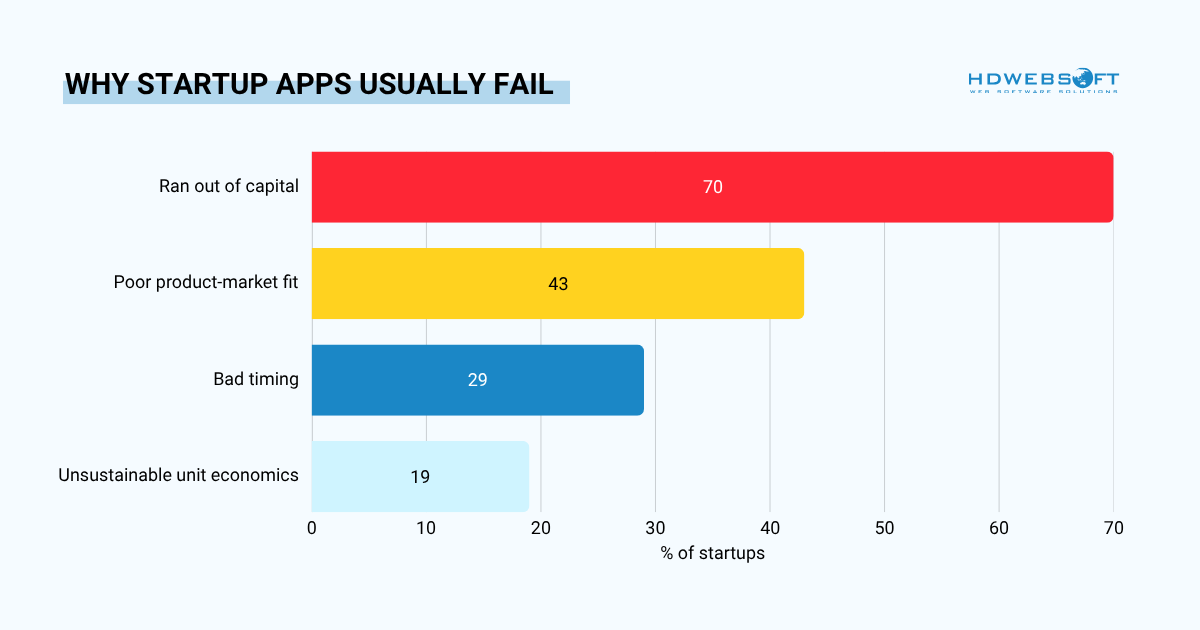
“Ran out of capital” is almost always the final cause of failure in mobile app development for startups. However, poor product-market fit is the root problem that drains the runway.
The good news is that failure is predictable and therefore avoidable. What separates successful startup apps from the graveyard is a disciplined approach to development, a ruthless focus on core user value, and a launch strategy built before a single line of code is written.
This guide covers the full journey: from why startup app development is a different discipline entirely, to choosing the right tech stack. In addition, we’ll move through the development process efficiently, and execute a launch that converts early users into loyal ones. For a broader look at the mobile landscape, see our complete guide to mobile application design and development.
Why Mobile App Development for Startups Is a Different Game
Mobile app development for startups operates under a fundamentally different set of rules than enterprise development. Speed, budget, and the margin for error are all compressed. Moreover, a playbook built for a 500-person product team will sink a 5-person startup.
The Startup Constraints That Change Everything
Startups building mobile apps typically work with budgets ranging from $10,000 to $150,000. Compare that to enterprise budgets exceeding $500,000 for a v1 product, and the stakes of every decision become clear.
Three constraints define mobile development for startups more than any others:
- Budget ceiling: Every feature decision is also a budget decision. Startups cannot afford to build everything, so they must be ruthless about what belongs in version one.
- Speed to market: The window to validate an idea before competitors or funding pressures close in is short. A startup that spends 18 months building a perfect app often finds the market has moved on.
- Team size: Most startup apps are built by small teams; sometimes a single developer or a lean outsourced crew. This limits the complexity that can be realistically maintained at launch.
Understanding these constraints in mobile app development for startups is not pessimistic. It is the first step toward making smarter architectural and product decisions.
Why Enterprise Development Playbooks Do Not Work for Startups
Enterprise mobile development prioritizes stability, compliance, and scale from day one. Hence, startups need to prioritize learning and iteration above all else.
The Discovery-First Trap
Large organizations invest months in discovery phases. Namely, stakeholder interviews, technical audits, compliance reviews. For a startup, this level of upfront planning often delays shipping past the point where feedback is available. Consequently, lean discovery (2–4 weeks) followed by fast iteration serves startups far better.
The Full-Feature Fallacy
Enterprise products launch with comprehensive feature sets because enterprise clients expect completeness. Startup users will forgive a sparse product if the core value is strong.
Furthermore, startups that try to match enterprise feature depth from day one routinely exhaust their budget before shipping. This is a primary driver behind the 70% of startups that run out of cash before product-market fit.
Start With an MVP. The Smartest Move in Startup App Development
An MVP (Minimum Viable Product) is a version of your app built with only the core features required to solve the primary user problem and gather real-world feedback. It is not a rough prototype but a focused product that does one thing well in mobile app development for startups.
What an MVP Actually Means in Mobile App Development for Startups
The term MVP is widely misunderstood. Many startup founders interpret it as “build it fast and cheap.” The better definition: build the smallest thing that can generate a signal from real users.
MVP vs. Prototype vs. Full Product
- Prototype: A design or demo used to validate UX decisions. Not functional for end users.
- MVP: A functional app with limited scope, released to real users to validate core assumptions.
- Full product: A complete feature set, built after the core value proposition has been validated through the MVP.
This distinction matters because it shapes budget allocation. Startup MVP budgets typically range from $10,000 to $60,000, making them accessible even for bootstrapped founders.
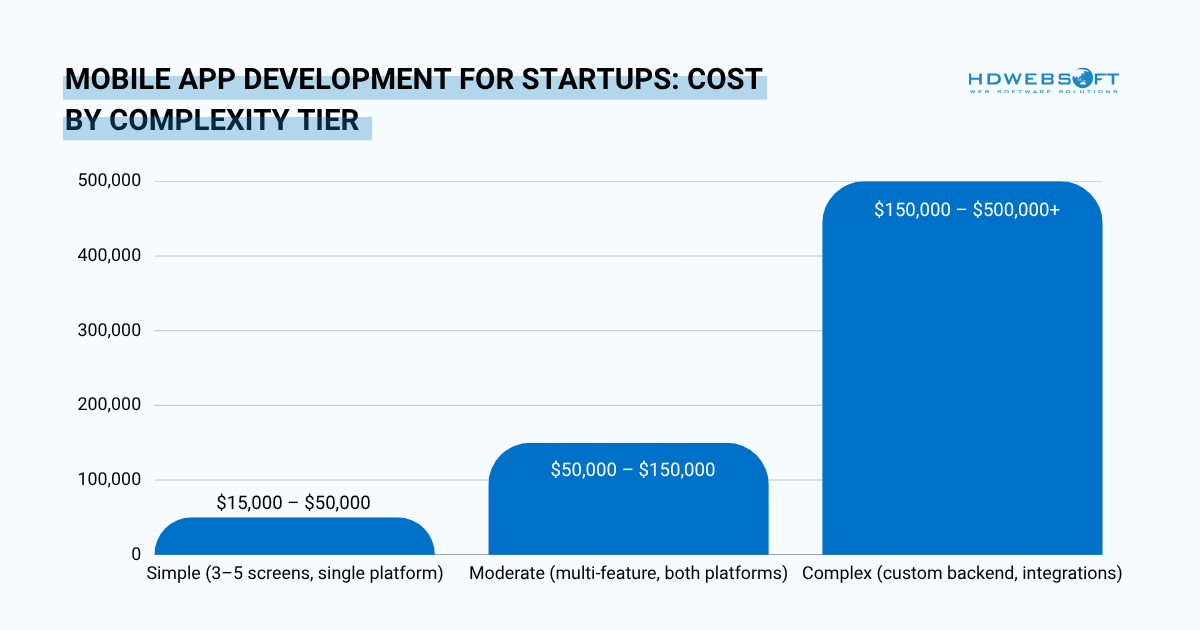
The cost of mobile app development for startups ranges from $15,000 for a simple MVP to over $500,000 for complex platforms. Knowing which tier fits your startup’s scope is the first step to building a realistic budget.
How to Decide Which Features Make the Cut
The most reliable framework for MVP feature selection for mobile app development for startups is the user job-to-be-done. In particular, what is the single most important thing a user needs your app to do? Every feature that does not serve that core job is a candidate for version two.
Here’s a practical filter for each proposed feature:
- Does this feature directly enable the user to complete the primary job?
- Would removing it make the product unsellable to early adopters?
- Can we gather equivalent data from a manual workaround instead?
Features that fail the first two questions belong on a roadmap, not in the MVP.
Real Signs Your Startup App MVP Is Ready to Ship
Many startups ship too late, polishing a product that users have not asked for. These are concrete signals your MVP is ready:
- The core user flow can be completed end-to-end without errors.
- You have run at least one round of usability testing with people outside your team.
- Crash-free rate is above 99% on target devices.
- You have a defined feedback mechanism in place — analytics, in-app prompts, or a direct user group.
Noteworthily, perfection is the enemy of launch. Ship when it is functional and safe, not when it is complete.
Choosing the Right Tech Stack for Your Startup App
The tech stack decision in mobile app development for startups is one of the highest-leverage choices you will make. This is because it affects development speed, ongoing cost, performance, and how easily you can scale or pivot.
Native vs. Cross-Platform Development for Startup Apps
Native development means building separate apps for iOS (using Swift) and Android (using Kotlin). Cross-platform development means writing one codebase that runs on both, using frameworks like Flutter or React Native.
For most startups, cross-platform development is the right starting point. React Native costs 25–50% less than building two separate native apps. Meanwhile, Flutter is the most widely used cross-platform framework globally, adopted by 46% of developers in 2023.
When Native Makes Sense for a Startup
Native development earns its premium in a narrow set of scenarios: apps requiring deep hardware integration (camera, AR, Bluetooth), apps where real-time performance is non-negotiable (gaming, live video), or apps targeting a single platform where revenue patterns justify the cost.
When Cross-Platform Is the Right Call
Cross-platform frameworks are the right default for most mobile app development for startups projects. For instance, marketplace apps, SaaS tools, e-commerce platforms, and consumer apps with standard UI requirements. Apps built with React Native and Flutter generated a combined $570 million in net revenue in Q4 2024 alone. Henceforth, it’s proven that cross-platform is not a second-class choice commercially.
How Your Tech Choice Affects Cost, Speed, and Scalability
A cross-platform approach typically delivers a finished MVP in 3–6 months, versus 5–9 months for dual-native development at equivalent scope. That timeline difference can be the gap between raising a seed round on traction versus pitching on assumptions.
On scalability: cross-platform apps can be refactored with native modules for specific features as the product matures. A startup logistics company using Flutter can add a native camera module for document scanning without rebuilding the entire codebase. The architecture is additive, not locked in.
When to Revisit Your Stack as Your Startup Grows
The right time to evaluate a stack change in mobile app development for startups is when cross-platform limitations are directly impacting user experience, not preemptively. Shopify rebuilt its main consumer app in React Native in 2024, achieving a blazing fast app and measurably over 99.9% fewer crashes. That is a data-driven stack evolution, not a theoretical one.
The Development Process: Startup App Development Phases Explained
Mobile development for startups moves through four phases: discovery, design, build, and test-and-deploy. Understanding what each phase delivers, and what goes wrong when it is rushed, is the difference between a successful launch and a costly rebuild.
Discovery and Planning: The Phase Most Startup Founders Skip
For starters, discovery is the work you do before writing code. Particularly, they’re defining the problem, scoping features, selecting the tech stack, and aligning the team on success metrics. It typically represents 10–15% of total project budget, the highest-ROI investment in the entire mobile app development for startups lifecycle.
Notably, skipping or shortening discovery is one of the most common and expensive mistakes in startup app development. Decisions made in discovery, platform choice, backend architecture, data model, are cheap to revise on paper and expensive to revise in production.
What Good Discovery Produces
Noteworthily, a well-run discovery phase for a startup app outputs:
- First, a validated problem statement with supporting user research
- Second, a prioritized feature list with clear MVP scope defined
- Third, a technical architecture document that the development team owns
- Finally, a project timeline with defined milestones, not just an end date
Design, Build, and Test: What to Expect at Each Stage in Your Mobile App Development Journey
Design Stage
This stage covers UX flows, wireframes, and UI mockups. It consumes roughly 20–25% of your total project budget. For startup apps, the design goal is not visual polish but its clarity. Every screen should have a single, obvious action for the user.
Build Stage
Development is the largest cost center, consuming 40–55% of the total budget. This is the mobile app development for startups phase where scope creep is most dangerous. Every feature added mid-sprint extends the timeline and budget in ways that are hard to predict. Hence, a well-scoped MVP with a change-request process in place protects against this.
Test and Deploy
Testing should be built into development, not bolted on at the end. Ongoing maintenance after launch typically costs 15–20% of initial development cost per year. Therefore, a budget line many startup founders forget to plan for.
How to Work With an Outsourced Development Team for Your Startup App
Outsourcing is one of the most cost-effective options for startups. Southeast Asian developer rates often range between $20–$50/hour, offering a significantly lower-cost. It’s an alternative to the U.S.-based developers, whose median annual compensation exceeds $130,000. As you can see, this is a meaningful difference at MVP budget levels.
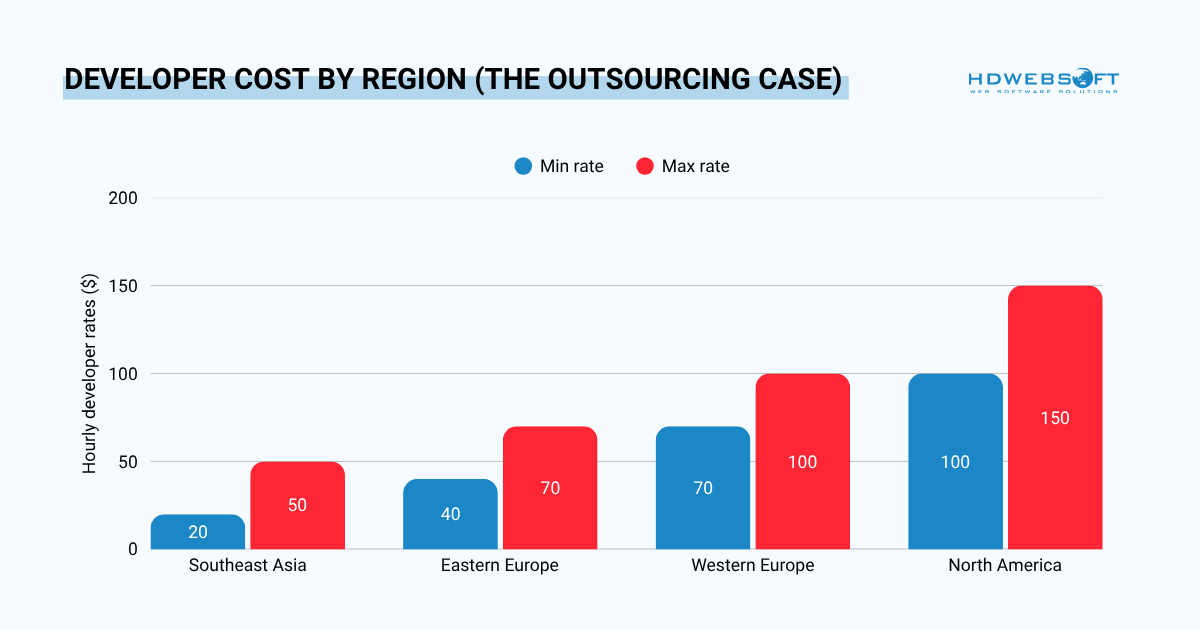
Hourly developer rates vary significantly by region, it’s a key cost lever for startups outsourcing mobile app development. Southeast Asian teams offer rates of $20–$50/hr compared to $100–$150/hr in North America, without compromising technical output.
The biggest risk with outsourcing is not technical; it is communication. Successful outsourcing relationships for mobile app development for startups share three practices:
- Weekly sprint reviews with a product owner present from the startup side
- A shared project management tool (Linear, Jira, or equivalent) where all tickets and decisions are documented
- A clearly defined acceptance criteria process — “done” means tested and approved, not just coded
Thus, you need to treat the outsourced team as a product team, not a coding service. Consequently, startups that maintain strong product ownership over outsourced development consistently ship better outcomes.
How to Launch Your Startup App Successfully
Building the app is only half the work. Mobile app development for startups fails not just in the build phase. CB Insights found that poor product-market fit and unfavorable market timing are among the leading causes of startup failure, contributing to 43% and 29% of cases respectively. Hence, a disciplined launch is as important as a disciplined build.
Pre-Launch Checklist for Startup App Development
Before submitting to the App Store or Google Play, these items must be in place:
- App Store Optimization (ASO): Title, description, screenshots, and keywords are fully optimized for search visibility.
- Analytics: An event tracking framework (Firebase, Mixpanel, or equivalent) is instrumented and tested.
- Crash reporting: A tool like Sentry or Crashlytics is active.
- Support channel: Users have a clear path to report issues such as in-app feedback, email, or a help desk.
- Legal: Privacy policy and terms of service are live and linked from both stores.
App store review times vary: Apple typically takes 1–3 days; Google Play can range from a few hours to a week. Thus, plan your submission at least two weeks before your public launch date.
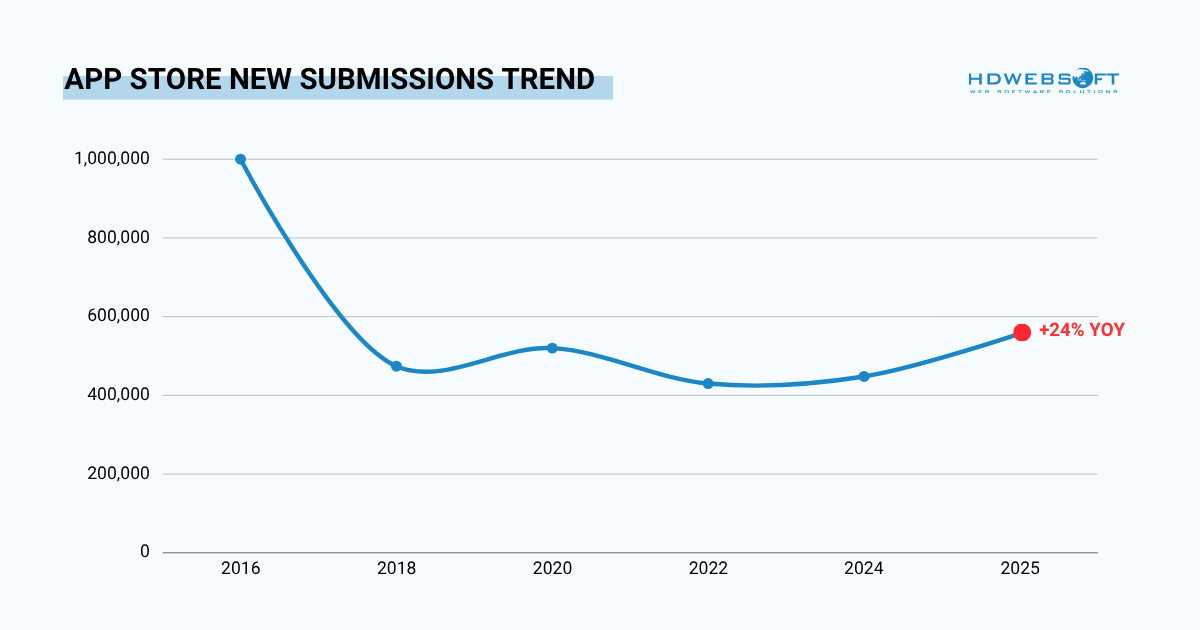
Competition in the App Store is intensifying: new app submissions jumped 24% in 2025 to 557,000, the steepest increase since 2016. For startups launching a mobile app, a strong ASO and launch strategy is no longer optional.
Mobile App Launch Strategy for Startup App Development
Beta Testing Before Public Launch
A closed beta with 50–200 real users before public launch is one of the highest-ROI activities in mobile app development for startups. Use TestFlight (iOS) or Google Play Internal Testing (Android). Ultimately, the goal is not to find bugs but to find the gaps between what you built and what users actually need.
App Store Optimization for Startup Apps
ASO is the organic channel most startup founders underinvest in. Your app title and the first 80 characters of your description carry the most weight for search ranking in both stores. Moreover, primary keywords should appear in the title, while secondary keywords in the subtitle and description.
Unlike web SEO, app store rankings factor in download velocity and ratings. So, a coordinated launch burst matters.
Early User Acquisition Channels
The channels that work best for early startup app traction depend on audience, but several are reliably high-signal for validation:
- Product Hunt: Best for B2B and productivity apps; can generate thousands of installs in 24 hours
- Niche communities: Reddit, Slack groups, and Discord servers where your target users are already active
- Press and PR: A single article in a relevant publication can move the needle disproportionately for consumer apps
- Referral loops: Build a sharing mechanism into the onboarding flow from day one, not as an afterthought
Post-Launch: What to Track in the First 30 Days of Your Startup App
The first 30 days post-launch generate the most actionable data in your product lifecycle. The metrics that matter most for mobile app development for startups at this stage:
- Day 1 / Day 7 / Day 30 retention: The industry benchmark for Day 1 retention in consumer apps is 25–40%. Below 20% signals a core onboarding or value problem.
- Core action completion rate: What percentage of new users complete the primary action your app was built for?
- Crash-free sessions: Should be above 99.5% post-launch.
- App store rating trajectory: Aim for a 4.0+ rating within the first 30 days; ratings below 3.8 suppress visibility in both stores.
Consequently, you can use this data to prioritize your first post-launch sprint. Retention problems take precedence over new features. It’s a leaky bucket that cannot be filled by acquiring more users.
Mobile App Development for Startups FAQs
How much does mobile app development for startups cost?
The mobile app development for startups budgets typically range from $10,000 to $150,000 depending on complexity and team location. A focused MVP built by an offshore team can be delivered for $10,000–$60,000. Meanwhile, a mid-complexity product with a custom backend typically falls in the $60,000–$150,000 range.
According to Netguru, custom mobile app development costs can range from $30,000 for an MVP to over $500,000 for enterprise-grade applications. However, startups taking an MVP-first approach can keep initial development costs significantly lower.
Should I build a native or cross-platform app for my startup?
For most startups, cross-platform development (Flutter or React Native) is the right starting point. It reduces cost by 25–50% compared to building two separate native apps and delivers comparable performance for the majority of app categories. Therefore, choose native only if your app requires deep hardware integration or real-time performance that cross-platform frameworks cannot match.
What is the difference between an MVP and a full product?
An MVP in mobile app development for startups is a functional app with the minimum feature set required to solve the core user problem and generate real feedback. On the contrary, a full product is a more complete feature set built after the MVP has validated core assumptions.
Most successful startup apps launch as MVPs and evolve based on user data. In fact, attempting to launch a full product first is a common cause of budget exhaustion before market fit.
How long does startup app development take?
A well-scoped MVP typically takes 3–6 months from kickoff to App Store submission using a cross-platform framework and a lean team. Native development at equivalent scope typically runs 5–9 months.
Prominently, the timeline is heavily influenced by the quality of the discovery phase. This is because teams that invest in clear scope definition before development begins consistently deliver faster.
When should a startup consider outsourcing mobile app development?
Outsourcing mobile app development for startups makes sense for most that do not have an in-house mobile engineering team and cannot afford to hire one in a high-cost market. The key is maintaining strong product ownership: the startup defines the what and why; the outsourced team owns the how.
Southeast Asian and Eastern European development teams offer affordable rates with strong technical skills. As a result, they become a practical choice for MVP-stage startup app development.
Build With Precision, Launch With Purpose
Mobile app development for startups is not about building the best app but about building the right app at the right scope, shipping it fast enough to learn, and iterating with the data. The startups that succeed do not guess their way to product-market fit. They plan and build lean, and launch with the same discipline they applied to the build itself.
If you are planning your startup’s first mobile app, or rebuilding one that needs a sharper foundation, HDWEBSOFT’s mobile app development services are built for exactly this stage. Our team specializes in helping startups move from idea to a functional, market-ready app efficiently, with deep expertise across Flutter, React Native, and native iOS and Android. Whether you need end-to-end development or a technical partner to work alongside your team, every phase covered in this guide is something HDWEBSOFT handles daily.