Enterprise AI data infrastructure is the system of pipelines, stores, indexes, and governance controls that turns fragmented operational data into a foundation AI systems can query reliably — data that is fresh, consistent, permissioned, and relationship-aware. As models grow more capable, the limiting factor in enterprise AI is shifting from model quality to data foundation quality: an AI system is only as trustworthy as the freshness of its indexes and the integrity of its access controls.
This article is the engineering deep dive for the Enterprise Data & Knowledge layer of the enterprise superintelligence architecture blueprint. That post defined a six-layer reference model; this one details how the data layer is actually built — how operational systems feed vector stores and knowledge graphs in near real time, how access permissions propagate into derived indexes, and how pipelines recover when they fail. One clarification up front: “SI-ready” is an architectural orientation — infrastructure designed to absorb increasingly capable AI — not an established technical standard, and not evidence that superintelligence exists.
Key Takeaways
- SI-ready data infrastructure is an architectural orientation — governed, fresh, interoperable data prepared for increasingly capable AI — not a certified standard or evidence that ASI exists.
- The gap between traditional data architecture and AI-ready infrastructure is operational: freshness, permission propagation, and relationship modeling — not storage capacity.
- Vector stores and knowledge graphs solve different retrieval problems; most enterprises need both behind a single governed retrieval interface.
- Change data capture is the default backbone for AI-facing pipelines; stale indexes silently degrade every downstream AI system.
- Build incrementally: one data domain, standardized ingestion, verified freshness and access controls — then expand.
What Is SI-Ready Data Infrastructure?
AI-ready data infrastructure is built for AI workloads as first-class consumers — not just analysts and dashboards. “SI-ready” adds a planning horizon: the same engineering, with enough headroom that the foundation survives capability jumps in the models above it without redesign. Four properties define it:
- Freshness. Derived indexes update as sources change — minutes for hot domains, not overnight. An index is a copy, and copies decay.
- Interoperability. One ingestion fabric feeds the lakehouse, vector store, and knowledge graph — not a bespoke pipeline per use case.
- Discoverability. A metadata catalog makes datasets findable and carries lineage from source rows to indexed chunks.
- Governed access. Source permissions propagate into every derived copy, including embeddings — which are, legally and practically, copies of text.
SI-Ready vs. AI-Ready: A Working Distinction
| Dimension | Traditional | AI-ready | SI-ready orientation |
|---|---|---|---|
| Primary consumer | Reports and dashboards | ML models, RAG applications | More autonomous agents; future, more capable models |
| Freshness expectation | Nightly batch acceptable | Near-real-time for hot domains | Explicit freshness SLOs per domain |
| Access control | Per-system, manually reconciled | Propagated to indexes | Enforced at retrieval; revocation is audited |
| Data model | Tables and files | Tables plus embeddings | Plus explicit relationships and a semantic layer |
The honest caveat: nothing in the right-hand column is proven necessary for superintelligence — that capability does not exist. The direction is defensible because every property pays off for today’s AI systems regardless of what arrives later.
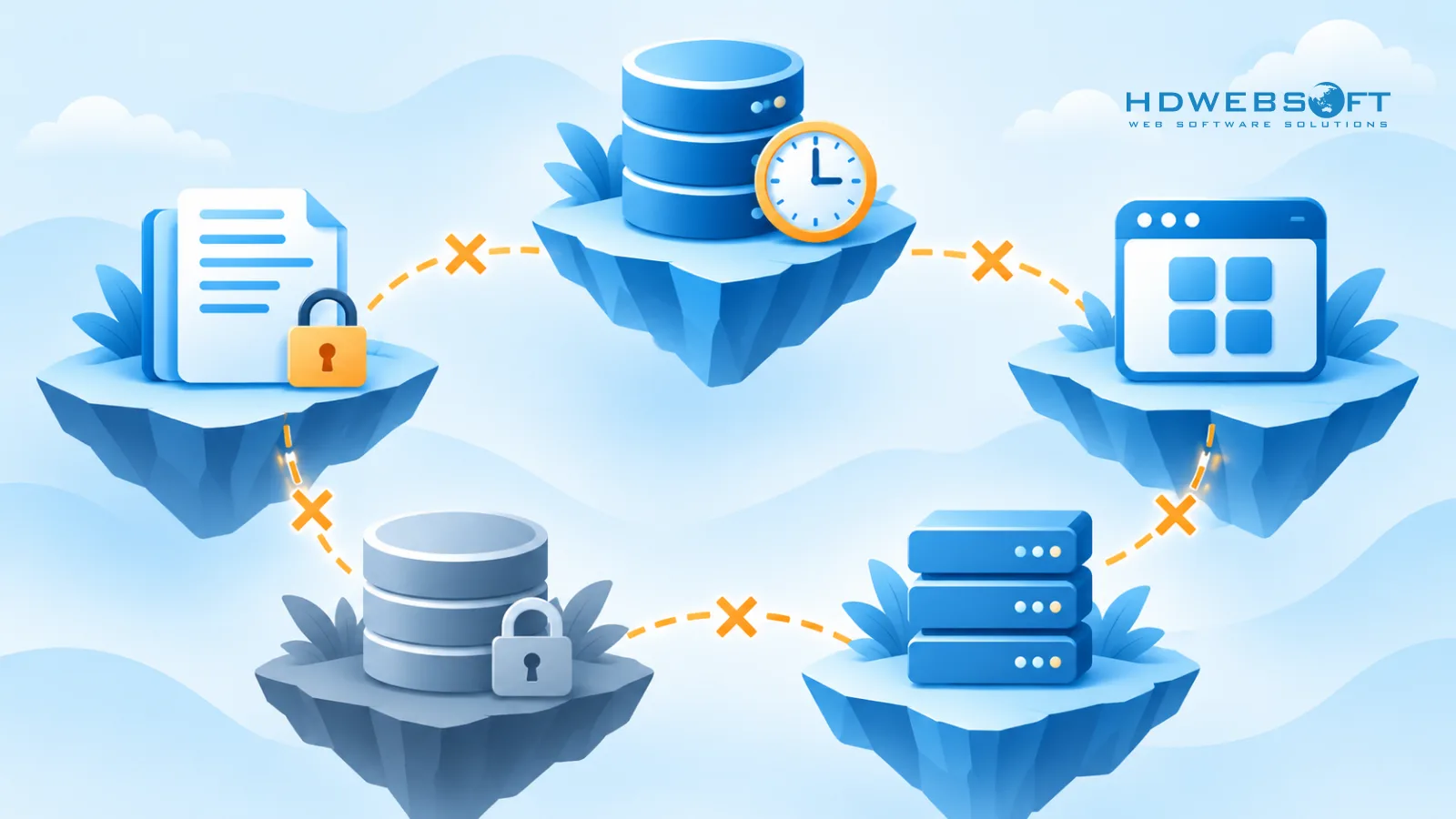
Why Traditional Enterprise Data Architecture Falls Short for AI
Enterprise data estates were built for a different consumer. Five failure modes show up repeatedly when AI becomes a first-class workload:
- Analytical freshness is not operational freshness. Nightly ETL produces a warehouse correct as of yesterday — fine for a Monday dashboard, wrong for an AI assistant answering operational questions at 3 p.m.
- Permissions do not propagate. Source systems carry row- and object-level ACLs; derived copies — including embeddings — typically inherit none of them, leaving an AI system able to retrieve content the requester is not entitled to see.
- Relationships are implicit. Relational stores record entities; the relationships that matter live in foreign keys never designed for traversal, or in people’s heads.
- One pipeline per consumer. Each new AI use case gets a bespoke extraction, and every copy of the same data diverges quietly from the others.
- No freshness contract. Nobody can state how stale a given index is — so nobody can fully trust an answer built on it.
Notice that these are implementation failures, not assessment questions. Whether your data estate is ready is a different problem — our guide to AI data readiness covers the evaluation side. This article assumes the assessment is done and covers what you build next.
Core Components of Enterprise AI Data Infrastructure
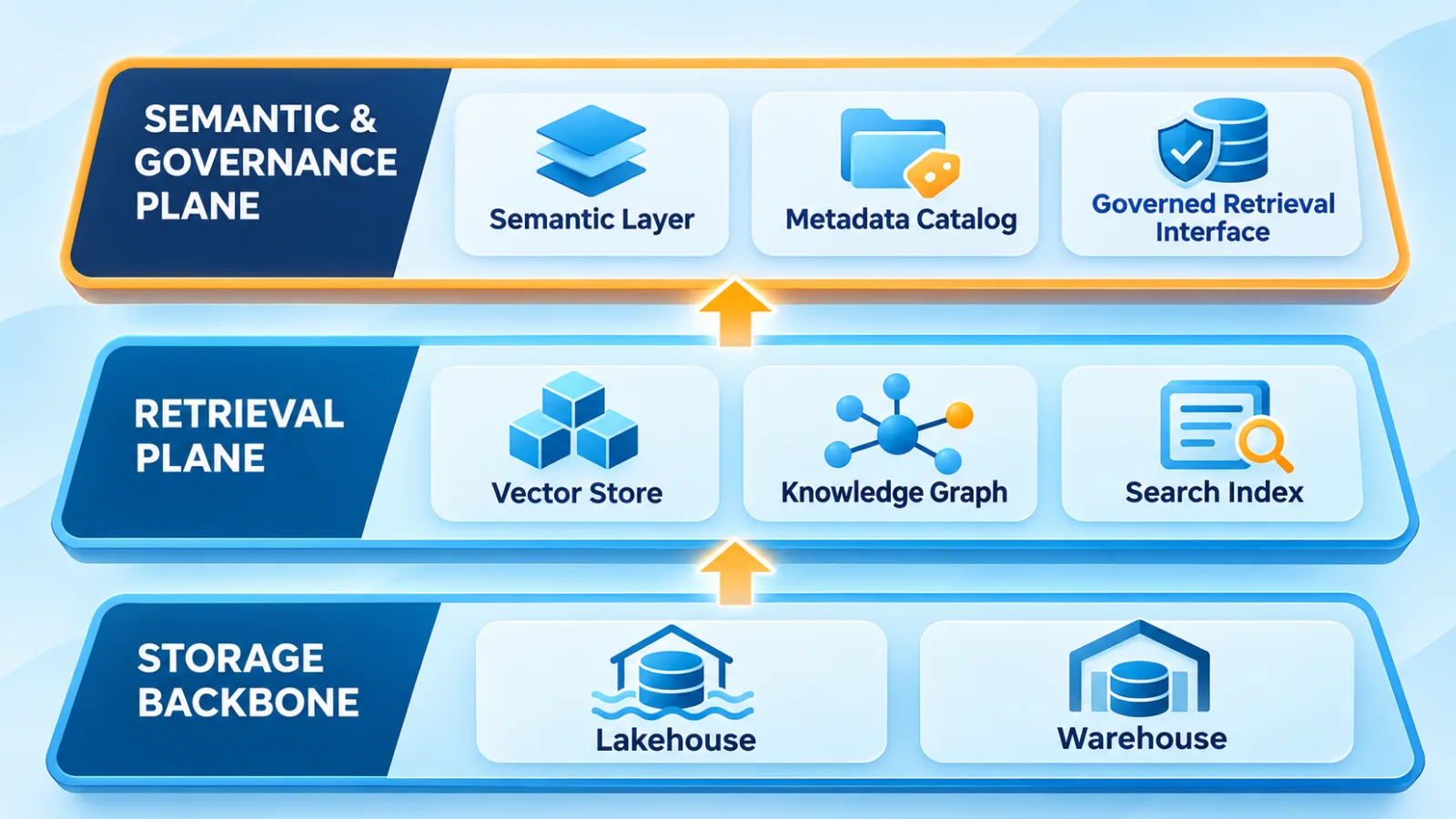
The Storage Backbone
The backbone is a lakehouse — open table formats on object storage — complemented by a warehouse for governed marts. Data lands raw, gets validated and cleaned, then conformed into domain models. Its defining property for AI is not capacity but recoverability: the backbone is the canonical state from which every derived store can be rebuilt. When an index is corrupted or an embedding model is replaced, the backbone makes recovery a replay rather than a rescue mission.
The Retrieval Plane
Three derived stores serve different query shapes:
- Vector store. Embeddings plus chunk references for semantic retrieval over unstructured content.
- Knowledge graph. Entities and typed relationships for traversal and multi-hop queries.
- Search index. Keyword and metadata retrieval, still the right tool for exact identifiers and structured filters.
The design rule that keeps the plane healthy: derived stores are disposable. They are never promoted to source of truth, never accumulate state that cannot be recomputed, and never receive writes that bypass the change feed.
The Semantic and Governance Plane
Above storage and retrieval sits the layer that makes the system coherent: a semantic layer carrying business definitions and metric logic, a metadata catalog for discovery and lineage, and the governed retrieval interface — the single API through which AI applications query. That interface authenticates the caller, applies permission filters, enforces freshness constraints, and logs every access. The interface is the only door — which is precisely what makes governance enforceable rather than aspirational.
Vector Databases vs. Knowledge Graphs: When to Use Each
These two stores are complementary, not competing. The confusion arises because both are marketed as “the memory layer for AI” — but they answer different questions.
| Dimension | Vector database | Knowledge graph |
|---|---|---|
| What it stores | Embeddings over content chunks, with references to source documents | Entities and typed relationships (edges) |
| Query style | Semantic similarity — “find things like this” | Traversal — “how are these things connected” |
| Strengths | Unstructured text; fuzzy semantic matching; approximate-nearest-neighbor retrieval at scale | Multi-hop reasoning; explainable paths; stable entity identity |
| Limitations | No explicit relationships; results are opaque; embeddings drift when models change | Upfront modeling effort; harder to keep synchronized; sparse graphs underperform |
| Update mechanics | Re-chunk and re-embed on source change; deletes propagate as tombstones | Incremental edge upserts; large topology changes replayed from events |
| Typical enterprise uses | Policies, tickets, documentation, knowledge bases | Supply chains, org structures, data lineage, dependency mapping |
Choose the vector store when the question is “find relevant content” — the dominant enterprise case, which is why vector indexes ship first. Choose the graph when the question is “trace the relationship” — dependency impact, organizational accountability, provenance chains. Many real questions are both: “find the incidents related to this supplier” needs semantic retrieval to find incidents and graph traversal to establish which relationships count as “related.”
That intersection is where hybrid patterns like GraphRAG operate — vector retrieval grounds the initial candidate set, then graph traversal expands it and makes the result explainable. The GraphRAG developer guide describes one implementation pattern; treat it as a technical reference, not a claim that any vendor suits every enterprise. And a boundary note: the orchestration logic deciding which store to query lives a layer above this article’s scope — our guide to agentic RAG architecture covers that retrieval and application layer.
Designing Real-Time Data Pipelines for AI
Freshness is a pipeline property, not a storage property. No vector store or graph engine can compensate for data that arrives stale — so the ingestion design determines everything downstream.
Batch vs. CDC vs. Event Streaming
| Pattern | Typical latency | Load on sources | Ordering and dedup | Best fit |
|---|---|---|---|---|
| Scheduled batch (ETL/ELT) | Hours | Periodic bulk reads | Simple | Cold and reference data; initial backfills |
| Change data capture (CDC) | Seconds to minutes | Low — reads commit logs | Per-key ordering | Systems of record: ERP, CRM, core databases |
| Event streaming | Sub-second to seconds | None after emission | Partition-ordered; at-least-once | Domains already emitting events; telemetry, activity |
CDC is the default backbone for AI-facing synchronization from systems of record. Log-based capture reads the database’s commit log and picks up inserts, updates, and — critically — deletes without modifying application code, carrying the delete semantics that naive polling misses entirely. Event streaming fits domains that already emit business events; batch still owns initial loads and cold data. For stream-processing mechanics — windowing, stateful joins, delivery guarantees — the documentation on stream processing with Apache Kafka is a solid technical reference.
Incremental Indexing and Embedding Refresh
The update loop for vector indexes: a change event arrives, the affected document is fetched, re-chunked, and only the changed chunks are re-embedded and upserted under stable document IDs. Two rules keep this honest. First, deletes must propagate as tombstones — a document removed from the source must leave the index inside the same lag window, or you are leaking access through stale vectors. Second, store the embedding model version with every vector, so model upgrades roll out as staged re-embeds rather than full-index rebuilds that freeze freshness for days.
Knowledge Graph Synchronization
The hard problem here is entity resolution: the same supplier appearing as “Acme Corp,” “ACME Corporation,” and ID 4471 across three systems needs canonical identity before edges mean anything. Resolve entities at ingestion, apply incremental edge upserts, version your relationship types, and — when topology changes are large — replay events rather than trying to diff graph state against tables.
Source-of-Truth Consistency
One writer per entity per domain; the lakehouse holds canonical state; derived stores are eventually consistent replicas by design. Because failures in this model are often silent — a connector that stops emitting looks exactly like a quiet system — reconciliation jobs compare record counts and checksums per time window to catch divergence early. Publish a per-domain lag budget so “fresh enough” is a number, not a feeling.
Retries, Replay, and Dead-Letter Queues
- Idempotent consumers. Upserts keyed by stable IDs make reprocessing safe — the foundation of every retry strategy.
- Backoff retries. Transient failures — embedding API rate limits, network faults — retry with exponential backoff before escalating.
- Dead-letter queues. Poison messages go to a DLQ with alerting; a loud failure beats a silent drop.
- Replay capability. Retain raw events and offsets so any derived store can be rebuilt without touching source systems — the property that makes derived stores safely disposable.
Monitoring Freshness and Indexing Latency
Track end-to-end lag (source commit to retrievable-in-index), per-stage lag, retry rates, DLQ depth, and embedding coverage — the share of indexed documents at the current model version. Alert when lag breaches the domain SLO: a dead pipeline is easy to detect, but a pipeline that is alive and eleven hours behind is the failure mode that actually hurts AI systems.
Reference Architecture: Connecting Enterprise Data to AI Systems
The diagram below assembles the components into a working reference flow, from operational sources to governed AI consumption.
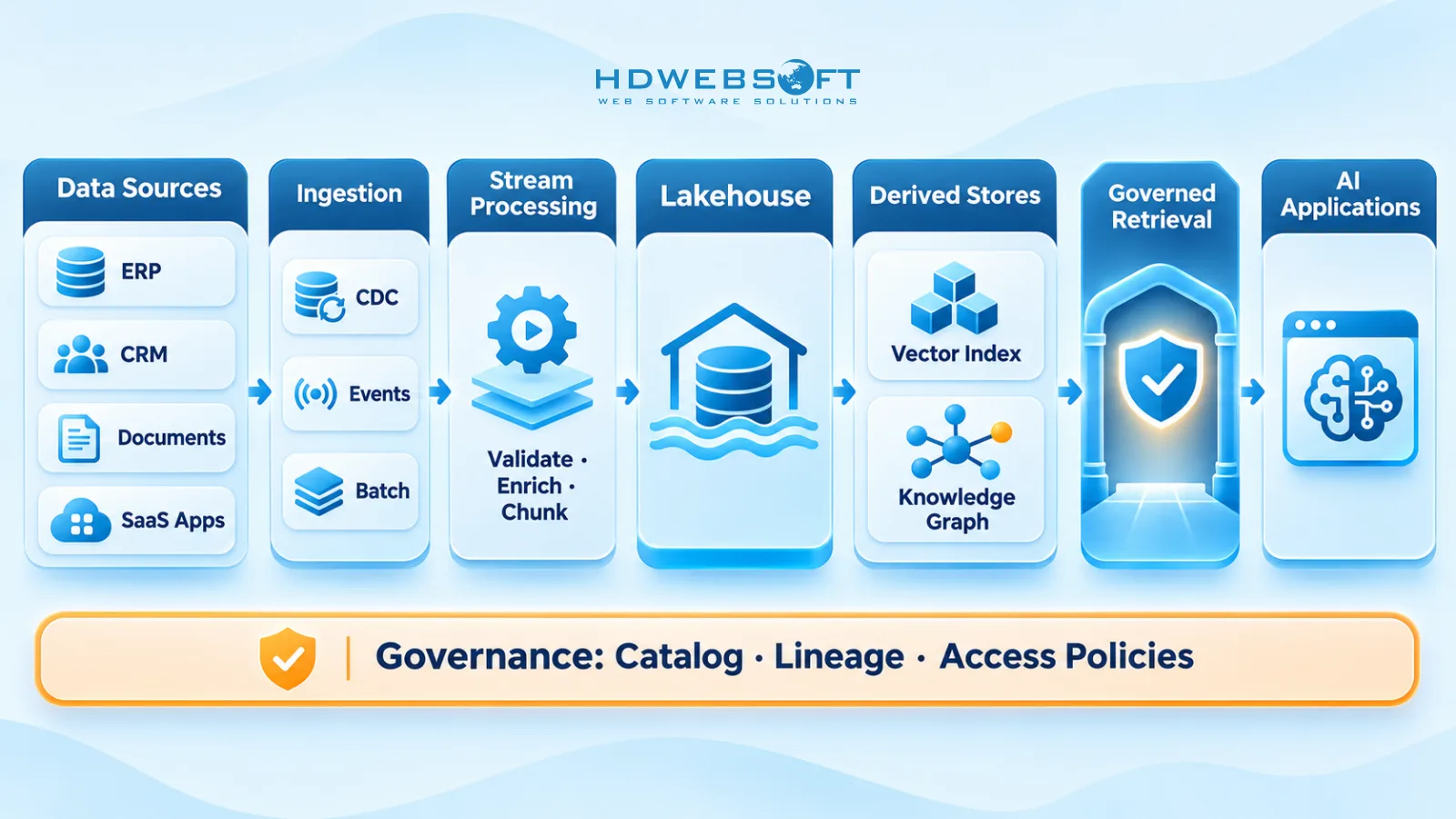
Reading it left to right:
- Sources. ERP, CRM, document management, SaaS applications, and the existing warehouse.
- Ingestion and change capture. CDC connectors on systems of record, event streams where domains emit them, batch loaders for backfill and cold data.
- Stream processing. Validation, enrichment, PII classification, chunking, and entity resolution — the stage where raw changes become AI-consumable records.
- Lakehouse. Raw, cleaned, and conformed zones holding canonical state — one writer per entity.
- Derived stores. The vector index and knowledge graph, updated incrementally from the same change feed rather than reloaded.
- Governance plane. Catalog, lineage, and access policies applied across every stage — a cross-cutting layer, not a bolt-on.
- Governed retrieval interface. The only door for AI applications: it authenticates callers, applies permission filters, enforces lag budgets on sensitive domains, and logs every query.
Three sync paths run through this architecture, and naming them honestly matters:
- Hot path: source to CDC to stream to derived stores — seconds to minutes, for domains where staleness corrupts decisions.
- Warm path: stream to lakehouse — minutes, keeping canonical state current.
- Cold path: batch to lakehouse to derived-store backfill — hours, for reference data and rebuilds.
The consistency boundary: derived stores are eventually consistent, and correctness comes from replay plus reconciliation — not from pretending lag is zero. The retrieval interface is where “how stale is too stale” gets enforced per domain, which is why it — not the index — is the control point.
Building AI systems on fragmented enterprise data? A reliable data foundation requires more than connecting databases. From real-time ingestion and knowledge synchronization to governed retrieval, HDWEBSOFT helps businesses design engineering solutions that connect enterprise systems with modern AI applications.
Data Governance, Lineage and Access Controls
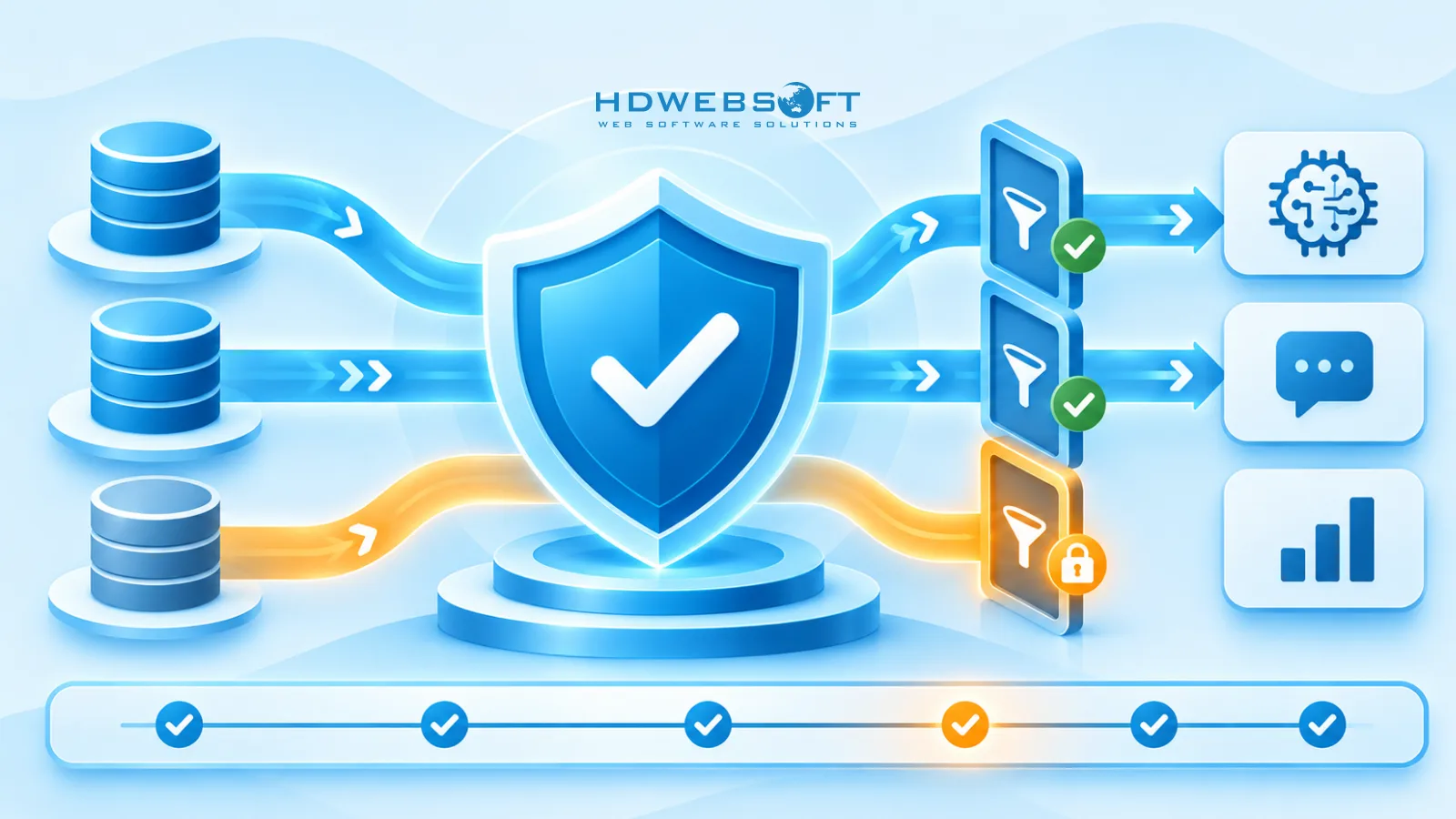
Governance at this layer is a set of implementation controls, not policy documents:
- Ownership and registration. Every domain has a named owner; every dataset entering the backbone is registered in the catalog with its freshness SLO.
- Permission propagation. Source ACLs travel with content as index metadata; retrieval-time filtering applies them before results are returned. Embeddings are copies of text — treat them as equally sensitive.
- PII handling. Classification happens at ingestion, inside stream processing, so masking or exclusion applies before content is ever embedded.
- Lineage. Capture which source rows produced which chunks and embeddings. Open event models — the OpenLineage documentation describes one — let pipeline jobs emit lineage consistently instead of reconstructing it later.
- Revocation. Access revocation propagates like data — delete and update events plus periodic ACL synchronization — and it gets tested with drills, not assumed.
- Audit. Every retrieval through the governed interface is logged with caller identity, applied filters, and corpus versions.
- Freshness as governance. Once an AI answer drives a decision, stale data is a compliance exposure — lag monitoring belongs on the governance dashboard, not just the ops board.
Practical Implementation Roadmap
The sequencing that works is deliberately unglamorous — one domain at a time:
- Pick one high-value domain. A support knowledge base, product catalog, or single operational system — bounded scope with visible payoff.
- Standardize its ingestion. CDC where the source supports it; this pipeline pattern becomes the template for everything after.
- Stand up the retrieval plane for that domain. Vector index first; add the graph only if relationship queries genuinely justify it.
- Verify before expanding. Freshness SLO measured against real traffic, permission propagation proven by a revocation drill, lineage captured end-to-end.
- Expand through the same fabric. Adjacent domains join the existing ingestion pattern — never a second bespoke pipeline.
Success metrics to hold each step to:
| Metric | Healthy signal |
|---|---|
| End-to-end freshness lag | Within the per-domain SLO — under five minutes for hot domains |
| Permission propagation lag | Revocation effective in minutes, verified by drill |
| Index coverage | Roughly 100% of in-scope documents at the current embedding version |
| Pipeline reliability | Transient failures auto-recovered; DLQ depth near zero |
| Retrieval quality | Owned at the application layer — outside this article’s scope |
Conclusion
The durable asset in enterprise AI is not the model — it is the data foundation underneath it. Models will be swapped many times over the life of this infrastructure; the ingestion fabric, the derived stores, and the governance plane are what persist. That is also what makes “SI-ready” a defensible posture rather than a speculative bet: every property described here — freshness, permission propagation, lineage, replayable pipelines — pays off for the AI you run today, regardless of what arrives in five years.
The practical path is incremental: one domain, one pipeline pattern, verified controls, then expansion. Enterprises that try to build the whole foundation before shipping any AI typically ship neither. HDWEBSOFT’s AI development services cover exactly this intersection — data engineering, system integration, and AI application delivery. If you are scoping the data foundation for your AI roadmap, contact our team for a technical consultation.
FAQ
What is SI-ready data infrastructure?
SI-ready data infrastructure is an architectural orientation: enterprise data infrastructure designed to serve increasingly capable AI systems. It is defined by freshness (indexes update as sources change), interoperability (one ingestion fabric feeding lakehouse, vector, and graph stores), discoverability (metadata catalog and lineage), and governed access (source permissions propagated into every derived copy). It is not an established technical standard, and it is not evidence that superintelligence exists.
What is the difference between a vector database and a knowledge graph for enterprise AI?
A vector database stores embeddings over content chunks and answers semantic-similarity questions — “find things like this.” A knowledge graph stores entities and typed relationships and answers traversal questions — “how are these things connected.” Most enterprises need both: vector stores handle unstructured text at scale, while graphs carry the explicit relationships that make multi-hop reasoning and explainable answers possible.
Should AI data pipelines use batch processing or change data capture?
Both, matched to domain temperature. Change data capture is the default for AI-facing synchronization from systems of record — it reads database commit logs, introduces near-zero source load, and propagates deletes correctly. Event streaming fits domains that already emit events. Batch remains right for initial backfills and genuinely cold data where hourly or nightly freshness is acceptable.
How do you keep vector embeddings fresh when source data changes?
Through incremental indexing driven by change events: when a source document changes, re-chunk that document, re-embed the changed chunks, and upsert them under stable document IDs. Deletes must propagate as tombstones — a document removed from the source must leave the index within the same lag window. Storing the embedding model version with each vector lets model upgrades roll out as staged re-embeds instead of big-bang rebuilds.
How do access permissions propagate to vector stores and knowledge graphs?
Source ACLs are carried with content as index metadata, then enforced at retrieval time — the governed retrieval interface authenticates the caller and applies permission filters before returning results. Revocation propagates like data: delete and update events plus periodic ACL synchronization, verified with drills. Embeddings are copies of text and must be treated as equally sensitive.
Where should an enterprise start building AI-ready data infrastructure?
With one high-value data domain. Standardize its ingestion — CDC where the source supports it — stand up a retrieval plane for that domain alone, and verify freshness, permission propagation, and end-to-end lineage before expanding to adjacent domains through the same fabric. Enterprises that try to build the whole foundation before shipping any AI typically ship neither.