Most teams start their AI journey with a single LLM provider — the fastest path from idea to prototype. But as traffic grows, that dependency becomes a liability. Pricing changes, rate limits, model retirements, and regional availability gaps turn a simple integration into a recurring engineering burden. The teams that scale successfully in 2026 introduce an abstraction layer early.
An LLM gateway is one of the production infrastructure layers that separates a working pilot from a resilient system. If your team is planning broader agentic AI in production, treating the model access layer as infrastructure — not a hard-coded integration — lets you swap providers, add fallbacks, and control costs without rewriting application code.
Key Takeaways
- An LLM gateway is an intermediary layer between applications and one or more LLM providers, exposing a unified API while centralizing routing, observability, cost control, and governance.
- Core benefits: reduced vendor lock-in, cost and latency optimization, centralized governance across teams.
- Common LLM routing strategies: cost-based, latency-based, capability-based, policy-based, semantic or intent-based, and hybrid.
- Build-vs-buy: self-host an open-source gateway for control and data residency, use a managed service for zero operations, or build custom when requirements are unique.
- Production readiness means observability, fallback, cost guardrails, and security — not just routing.
- A gateway reduces vendor lock-in but does not eliminate it; model-specific behaviors such as tool-calling formats and prompt sensitivity still require attention.
What Is an LLM Gateway?
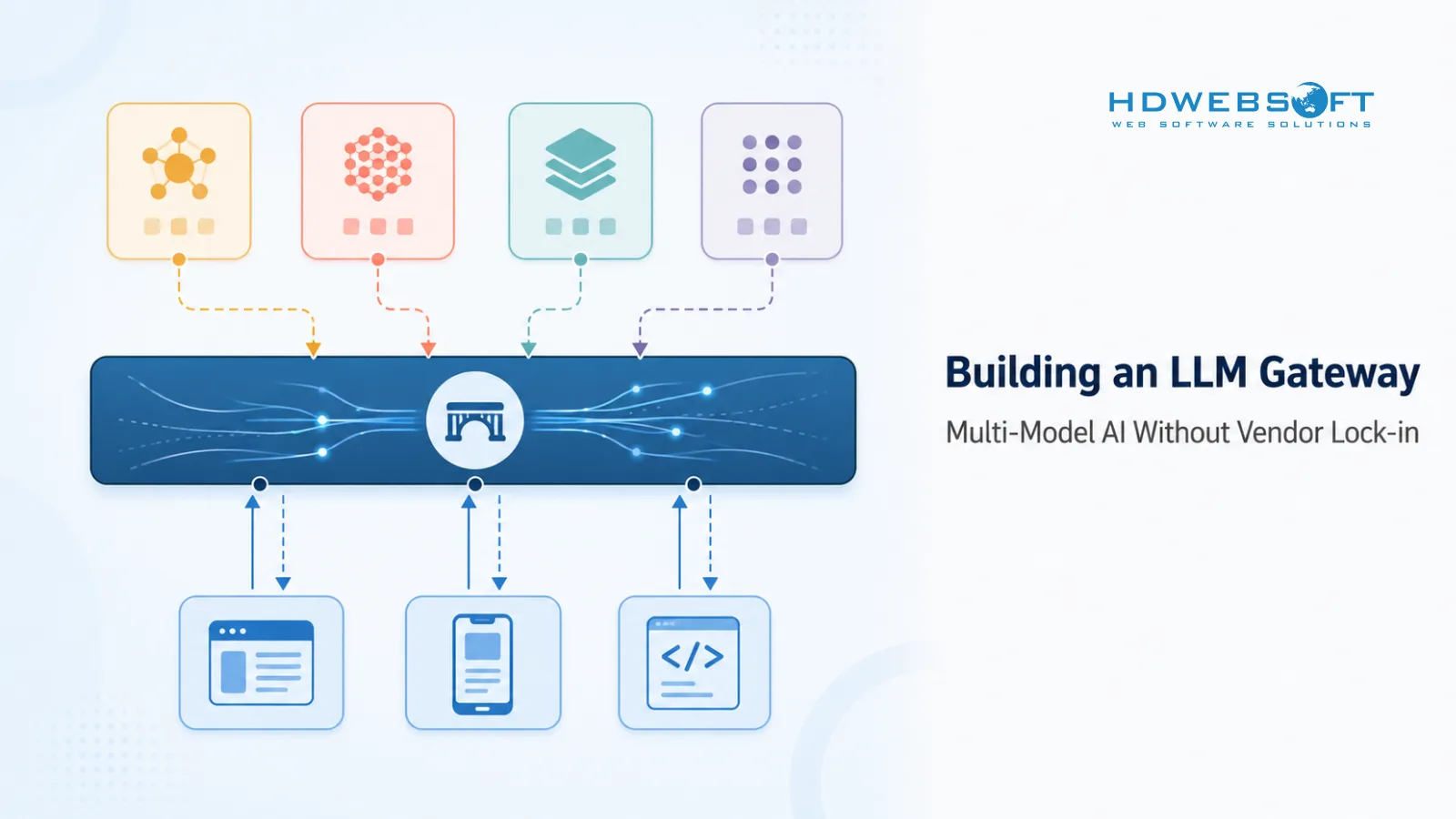
An LLM gateway is an intermediary layer between applications and one or more LLM providers, exposing a unified API while centralizing routing, observability, cost control, and governance. Instead of every service calling a provider directly, each service calls the gateway, which selects the model, applies policy and cost controls, and returns a normalized response.
LLM Gateway vs API Gateway vs AI Gateway
An API gateway handles generic HTTP concerns — routing, authentication, rate limiting — and is not model-aware. An AI gateway is a broader term covering LLM traffic, image generation, embeddings, and other AI inference. An LLM gateway focuses on LLM traffic: it is model-aware, token-aware, and prompt-aware. In 2026, “AI gateway” and “LLM gateway” are often used interchangeably — the distinction matters more in architecture discussions than in vendor selection.
Where It Sits in Your Stack
A typical 2026 AI stack: application → orchestration/agent framework (LangGraph, CrewAI, LlamaIndex) → LLM gateway → providers. The gateway does not replace the agent framework — it sits below it. The framework decides what to ask; the gateway decides which model to ask and how to enforce policy, cost, and observability.
Why Vendor Lock-in Is a 2026 Risk
How Lock-in Creeps In
Vendor lock-in accumulates through three patterns: hard-coded model names in application code (every deprecation requires a code change and QA cycle), prompt engineering tied to one model (prompts tuned for a specific model’s behavior may degrade on another), and business logic dependent on provider-specific formats (tool-calling schemas, structured output formats, and streaming event shapes vary between providers).
What Changes When a Provider Shifts
LLM providers change frequently: model retirement and deprecation, pricing changes, API behavior changes (response formats, tool-calling schemas, error codes), rate limits and capacity constraints, and regional availability gaps. Without a gateway, each is an application-level problem. With a gateway, most become a configuration change.
The Cost of Staying Single-Vendor
Beyond technical coupling, single-vendor dependence weakens your commercial position — you cannot arbitrage price, cannot benchmark alternatives, lose negotiation leverage, and have no fallback during outages.
[Cần kiểm chứng nguồn trước khi xuất bản] — nếu đưa số liệu cụ thể về tần suất outage, cần trích nguồn từ status page hoặc báo cáo ngành.
Core Capabilities of a Production LLM Gateway
- Unified API and provider normalization. A single OpenAI-compatible API surface that normalizes tool/function calling, structured outputs, streaming, errors, and provider-specific response formats.
- Model routing and fallback. Decides which model handles each request; falls back to a secondary provider on failure or rate-limiting.
- Token and cost accounting. Tracks input/output tokens and estimated cost per request, attributed to team, user, or tenant.
- Observability. Metrics for latency, error rate, token usage, and cost, plus traces from request entry to provider response.
- Caching and semantic caching. Exact-match and semantic caching to reduce redundant calls.
- Rate limiting and quota. Limits per user, team, model, or tenant.
- Security. API key vaulting, PII redaction, prompt logging controls, and audit trails.
What You Don’t Need on Day One
Semantic caching, A/B testing, and complex intent-based routing can be deferred. Start with unified API, basic routing, fallback, and logging.
LLM Gateway Architecture: A Reference Design
Logical Components
A reference LLM gateway consists of a client SDK (OpenAI-compatible), a gateway API (auth and rate limits), a router (model and provider selection), provider adapters (format translation), plus sidecars for cache, metrics/logging, policy engine, and secret store.
Request Flow
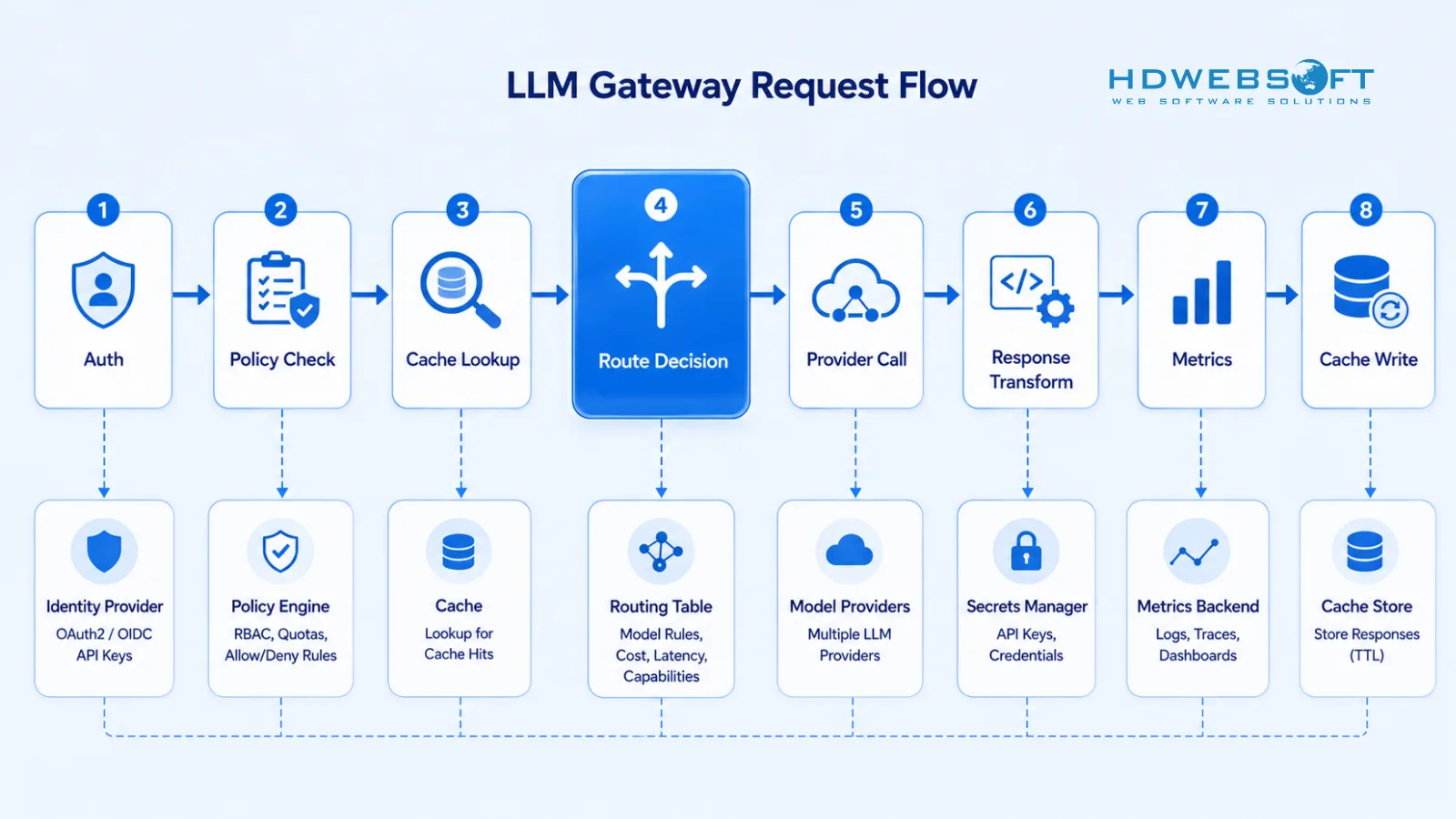
Authentication → policy check (eligible providers) → cache lookup → route decision → provider call → response transform → metrics emit → cache write.
Multi-Model LLM Architecture Patterns
- Primary plus fallback. One model handles traffic; if it fails or is rate-limited, the gateway routes to a fallback. The simplest pattern and the right starting point.
- Tiered. A cheaper model handles the first attempt; if the response is insufficient, the request escalates to a more capable model. Optimizes cost but adds latency for escalations.
- Parallel fan-out. The same prompt goes to multiple models simultaneously; responses are combined or selected. Used for ensemble reasoning. Increases cost and complexity — use selectively.
Deployment Topologies: Self-Hosted, Managed, and Hybrid
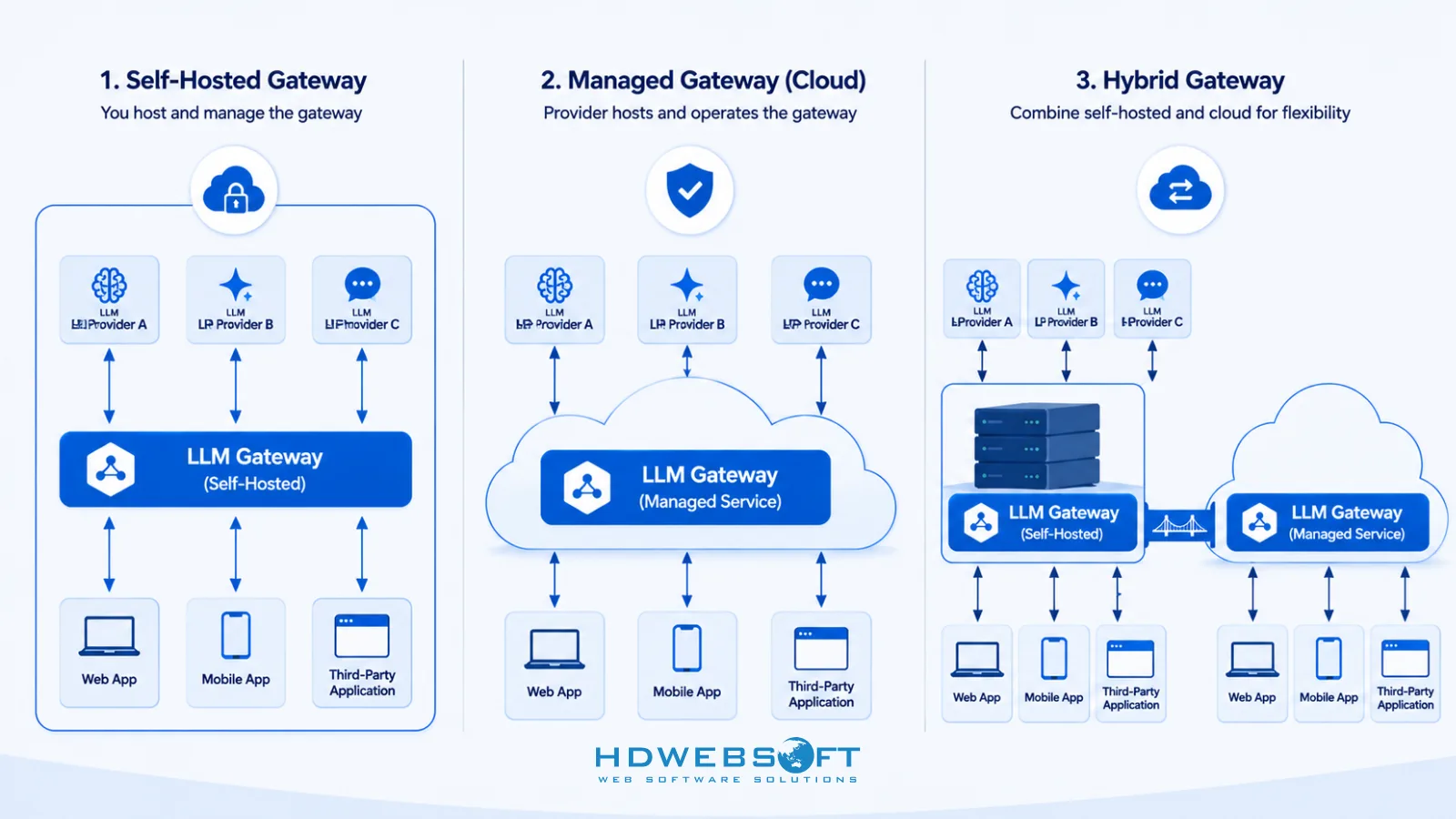
- Self-hosted. The entire gateway runs in your cloud or on-premises. Full control, strongest for data residency, but requires platform engineering capacity.
- Managed. A third party runs the gateway. Minimal ops burden, but request data passes through their infrastructure.
- Hybrid. Self-hosted data-handling proxy with a managed control plane. Useful when you need data residency but want to avoid building the full management layer.
The right topology depends on your data-residency requirements, team capacity, and tolerance for third-party data handling.
LLM Routing Strategies
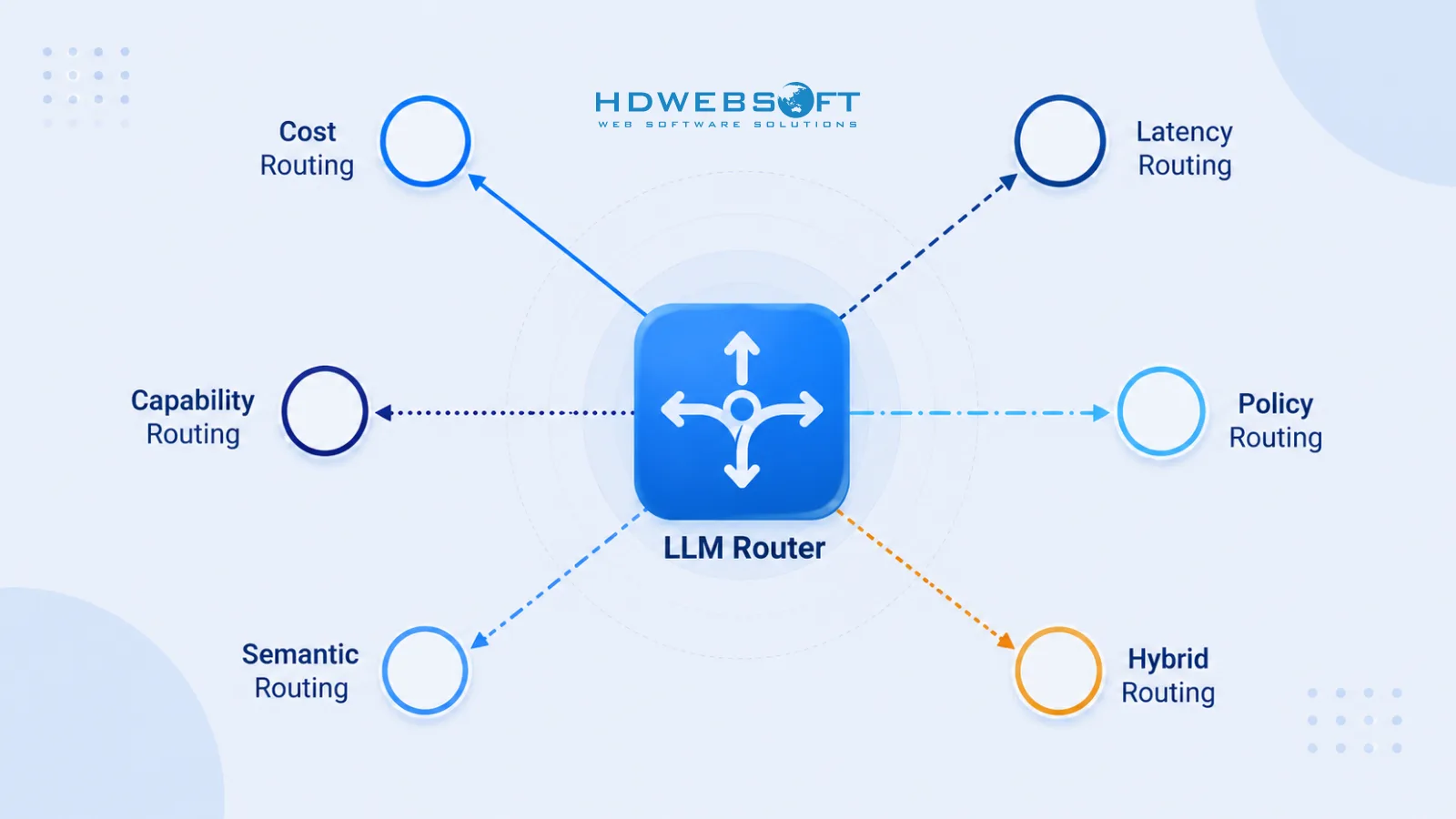
Routing is the core decision the gateway makes on every request. These strategies are not mutually exclusive — most production gateways combine several.
- Cost-based. Cheapest eligible model by per-token pricing, with optional budget caps. Suits high-volume, low-stakes workloads.
- Latency-based. Lowest observed latency (typically p95) with geographic affinity. Suits real-time, user-facing applications.
- Capability-based. Matches task — code gen, vision, long-context, multilingual — to the best-suited model. Maximizes quality, may increase cost.
- Policy-based. Applies organizational policy first: tenant rules, geography (EU data → EU providers), approved provider lists, data sensitivity (PII → zero-retention providers). Non-negotiable in regulated industries.
- Semantic or intent-based. A small classifier (SLM or rule-based) categorizes intent, then routes accordingly. The most advanced strategy, associated with “LLM router.” Validate for latency and accuracy before production.
- Hybrid. Most production gateways apply policy and capability filters first, then optimize for cost or latency within the safe set.
| Strategy | When to use | Trade-off |
|---|---|---|
| Cost-based | High-volume, low-stakes | May sacrifice quality |
| Latency-based | Real-time, user-facing | May cost more |
| Capability-based | Mixed task types | Higher cost |
| Policy-based | Regulated data, multi-tenant | Constrains optimization |
| Semantic / intent-based | Diverse intent at scale | Adds latency and complexity |
| Hybrid | Most production systems | Requires tuning |
Routing Pitfalls
- Stale metrics. Route on live data, not old benchmarks.
- Cold-start bias. Seed new providers with benchmark data.
- Ignoring context length. Filter by context-length before cost optimization.
- Ignoring tool-calling support. Route tool-calling requests only to compatible models.
Choosing an LLM Gateway: Self-Hosted, Managed, or Custom-Built
Self-Hosted / Open-Source Gateway
Open-source gateways you deploy yourself: LiteLLM (MIT-licensed, self-hosted, with a hosted enterprise tier), Portkey Gateway (MIT-licensed, fully open-sourced March 2026, with a managed cloud), and Kong AI Gateway (built on open-source Kong Gateway, Apache 2.0, with an enterprise tier). Full control — request data never leaves your network. Trade-off: you operate the proxy, spend-tracking database, cache, and monitoring stack.
Managed Gateway Service
Managed services run the gateway for you: OpenRouter (70+ providers, platform fee), Cloudflare AI Gateway (managed, free tier plus paid features, not open-source), Vercel AI Gateway (managed, zero token markup), and managed offerings from Portkey and LiteLLM. Minimal ops burden, but request data passes through their infrastructure — may not suit regulated data or strict data-residency requirements.
Custom-Built Gateway
Built in-house for unique requirements — internal identity integration, custom billing, proprietary model hosting. Maximum flexibility, sustained engineering investment. Chosen when the gap between off-the-shelf and your requirements justifies the build cost.
[Cần kiểm chứng trạng thái OSS/managed hiện tại của từng vendor trước khi publish] — thị trường AI gateway thay đổi nhanh. Verify lại trước khi publish.
Decision Framework
- Data must stay in your network? Lean toward self-hosted or custom.
- Routing logic standard or unique? Standard fits OSS/managed; unique may need custom.
- Platform engineering capacity? If no, managed is practical.
- Strict internal SLAs? Favor self-hosted or custom.
- High monthly token volume? Managed platform fees get expensive — self-hosted may be cheaper.
HDWEBSOFT frequently helps enterprise teams self-host open-source gateways or build custom layers when off-the-shelf options do not meet compliance or routing requirements.
Production Concerns Beyond Routing
Observability
A gateway without observability is a black box. Production gateways emit metrics (latency p50/p95/p99, error rate, token usage, cost per tenant/model), traces (request → route → provider), and opt-in PII-safe logs. Logging full prompts should be a deliberate choice. For deeper treatment, see LLM security for agentic AI.
Cost Guardrails
Per-tenant budgets with hard and soft cutoffs, alerting near thresholds, and graceful degradation — route to a cheaper model when a tenant exceeds a soft limit, instead of blocking outright.
Fallback and Resilience
Retry with backoff for transient errors, provider failover on 5xx or timeout, and circuit breakers. Retries are safe for idempotent text completion, but tool-calling requests with side effects may not be safely retryable — the gateway should distinguish between the two.
Security and Compliance
Key vaulting, PII redaction before logging, audit trails for routing decisions and provider calls, and data residency via policy-based routing. If your agents connect to external tools and MCP servers, MCP security covers the additional data-leak risks.
Versioning and Model Deprecation
Handle deprecation through provider-neutral model aliases: reasoning-primary, fast-default, vision-capable. When a provider deprecates a model, update the alias, run a canary test, and promote once quality is confirmed. Applications are unaffected.
A Pragmatic Implementation Roadmap
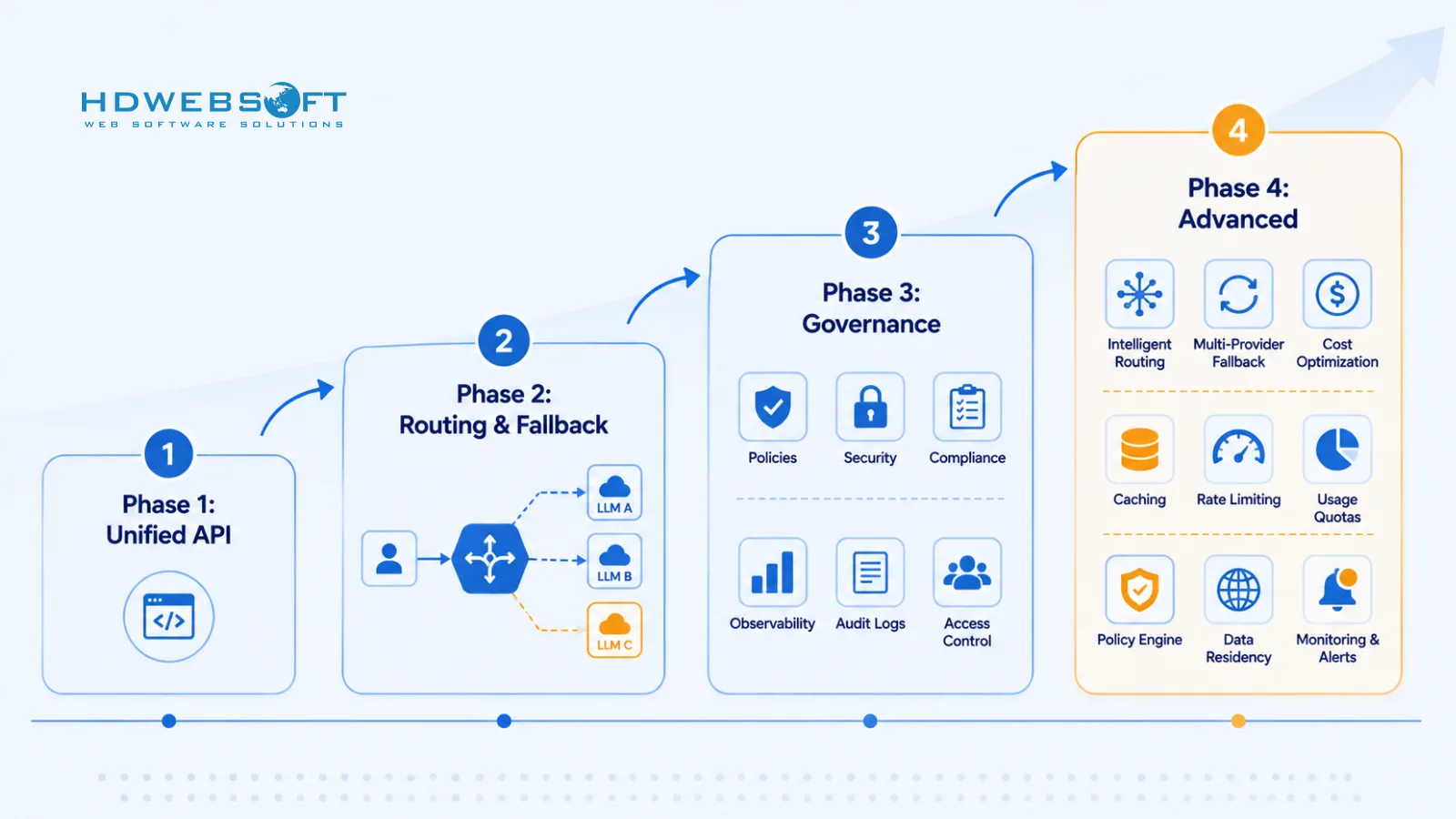
Building an LLM gateway is a maturity progression. These four phases are ordered by capability, not calendar time.
Phase 1 — Unified API and Two Providers
Stand up a gateway exposing an OpenAI-compatible endpoint, wrapping two providers, with basic logging. Goal: prove the abstraction — applications call the gateway, not the provider.
Phase 2 — Routing and Fallback
Add cost-based routing, primary-plus-fallback, and a metrics dashboard. The gateway can now fail over automatically and you can see latency, error rate, and cost per model.
Phase 3 — Governance
Add per-tenant quotas, budget alerts, PII redaction, and an audit trail. This makes the gateway safe for broader organizational use.
Phase 4 — Advanced
Add semantic caching, intent-based routing, canary model swaps, and A/B testing. These add value at scale but are not needed on day one.
Do not build Phase 4 on day one. Each phase delivers value on its own, and earlier phases inform what later phases actually need.
Common Mistakes When Building an LLM Gateway
- Hard-coding model names in business logic. Only the gateway should know which model is called; applications should see aliases.
- Logging full prompts without PII redaction. Make full-prompt logging an explicit, audited choice.
- Routing on static benchmarks. Provider performance changes — route on live metrics.
- No cost guardrails. Without budgets, a gateway can increase spend by making it easier to call more models.
- Forgetting tool-calling format differences. The gateway must normalize tool formats, or applications break on provider switches.
- Over-engineering semantic caching at low volume. It pays off at scale with repetitive prompts; at low volume, it is overhead.
- No plan for model deprecation. Without aliases and a canary process, every deprecation becomes an emergency.
Architectural Scenario: Enterprise Multi-Provider LLM Gateway Pattern
This section describes a common enterprise scenario, not a specific customer engagement. The pattern reflects the type of architecture challenge HDWEBSOFT frequently helps teams design and build.
Common Starting Point
A product or enterprise team has been running AI with one or two providers for several months. Provider names are hard-coded across services. Observability is limited to provider dashboards with no internal cost-per-tenant view. Prompts are tuned for one model. Throttling and cost variability are affecting reliability, and data-residency requirements are emerging as the team expands into new regions.
Reference Approach
A reference approach HDWEBSOFT can adapt for this scenario:
- Audit current AI call sites — map every direct provider call, including model names, prompt templates, and tool-calling usage.
- Introduce a unified API layer — deploy an open-source gateway or custom layer exposing an OpenAI-compatible endpoint. Migrate call sites incrementally, starting with the lowest-risk service.
- Add policy-based routing for data residency — requests from regulated regions route only to approved providers, before any cost or latency optimization.
- Roll out governance in phases — per-tenant quotas, budget alerts, and PII redaction as the gateway reaches broader use.
- Add centralized observability — dashboard showing latency, error rate, token usage, and cost per team, model, and tenant.
This is a reference architecture pattern, not a claim about a specific customer engagement. The exact sequence and tooling depend on the team’s existing stack and priorities.
Why This Pattern Works
The pattern reduces coupling incrementally — each step delivers value without a big-bang rewrite. Services move to the gateway one at a time, so the production system keeps running. By the time a second or third provider is added, the abstraction is in place, and the marginal cost is a configuration change, not a code change.
When to Bring in External Architects
Small teams with straightforward needs can self-host an open-source gateway quickly. External support becomes valuable when complexity signals accumulate:
- Multi-provider or planned migration with non-trivial routing and fallback logic.
- Multi-region deployment with different latency and data-residency constraints.
- Sensitive or regulated data, data-residency requirements, or compliance obligations such as HIPAA, ISO/IEC 27001, or SOC 2.
- Custom routing logic not covered by off-the-shelf gateways.
- Strict internal SLAs requiring guaranteed fallback and latency budgets.
- Centralized governance across many teams needing tenant isolation and chargeback.
- Complex agent or tool-calling workloads requiring deep provider normalization.
HDWEBSOFT has experience designing AI infrastructure for enterprise teams, including gateway layers, routing logic, and governance controls. If several signals apply, consult HDWEBSOFT’s AI architects to validate your approach or scope a build.
Conclusion
An LLM gateway is no longer optional for teams running AI at production scale in 2026. It makes multi-model AI practical, reduces single-vendor lock-in, and centralizes governance, observability, and cost control. The three pillars — routing, governance, and observability — work together. Start with two providers, a unified API, and basic fallback. Add policy routing, cost guardrails, and advanced strategies as your traffic grows.
If your team is planning to build or scale an LLM gateway, request a technical blueprint to discuss your architecture, constraints, and roadmap.
FAQ
What is an LLM gateway and how is it different from an API gateway?
An LLM gateway is an intermediary layer between applications and LLM providers that exposes a unified API while centralizing routing, observability, cost control, and governance. An API gateway handles generic HTTP routing, authentication, and rate limiting. An LLM gateway adds model-aware features: token accounting, prompt logging controls, provider normalization, and model fallback.
Do I need an LLM gateway if I only use one provider today?
Yes. Even with a single provider, a gateway centralizes observability, cost tracking, caching, and rate limiting. It also reduces the cost of adding a second provider later — which most teams eventually need for fallback, cost optimization, or capability coverage.
What is the difference between an LLM gateway, AI gateway, and LLM router?
An AI gateway is broader, covering LLM traffic plus image generation, embeddings, and other AI inference. An LLM gateway focuses on LLM traffic. In practice, the terms are often used interchangeably. An LLM router is the routing component inside a gateway that decides which model or provider handles each request.
Should I build an LLM gateway, self-host an open-source gateway, or use a managed service?
Self-host an open-source gateway (LiteLLM, Portkey) when data cannot leave your network. Use a managed service (OpenRouter, Cloudflare AI Gateway, Vercel AI Gateway) when you want zero operations and can accept traffic through a third party. Build custom when you have unique routing, compliance, or integration requirements.
How does LLM routing decide which model to call?
LLM routing uses strategies such as cost-based, latency-based, capability-based, policy-based, and semantic or intent-based routing. Most production gateways combine several, applying policy and capability filters first, then optimizing for cost or latency among the remaining candidates.
Can an LLM gateway completely eliminate AI vendor lock-in?
No. A gateway reduces lock-in by abstracting provider differences, but does not eliminate model-specific dependencies. Prompt sensitivity, tool-calling formats, response shapes, and context-length limits still vary between models. A gateway shrinks the lock-in surface area but does not remove it entirely.