The governance of superintelligence is an unresolved challenge spanning three arenas: global coordination between states, safety practices at the labs building frontier models, and accountability inside the enterprises deploying AI. No existing framework — treaty, law, lab policy, or internal control — has demonstrated guaranteed control over hypothetical superintelligent systems. What exists today is a layered, incomplete set of mechanisms, each with real but bounded reach.
This article maps those mechanisms. We distinguish artificial superintelligence — a hypothetical capability level no system has achieved — from the enterprise AI systems organizations actually govern today, then examine how oversight works at three levels and where each falls short. For technology leaders, the practical question is not whether ASI can be controlled in the abstract; it is which parts of superintelligence governance are actionable now.

Key Takeaways
- Governance of superintelligence operates at three levels: global and regulatory oversight, frontier AI safety, and enterprise accountability — different actors, instruments, and enforcement power.
- The core unresolved challenges are alignment, scalable human oversight, concentration of power, and accountability for systems that may exceed human evaluative capability.
- Binding regulation (e.g., the EU AI Act), voluntary international coordination (summits, UN initiatives), and internal governance mechanisms are distinct instrument classes — they should not be conflated.
- Enterprises control the deployment layer: risk-based autonomy, human-in-the-loop approvals, decision authority, auditability, and board-level accountability.
- Current governance practices strengthen AI accountability — they cannot guarantee control of hypothetical superintelligent systems.
What Makes Superintelligence Hard to Govern?
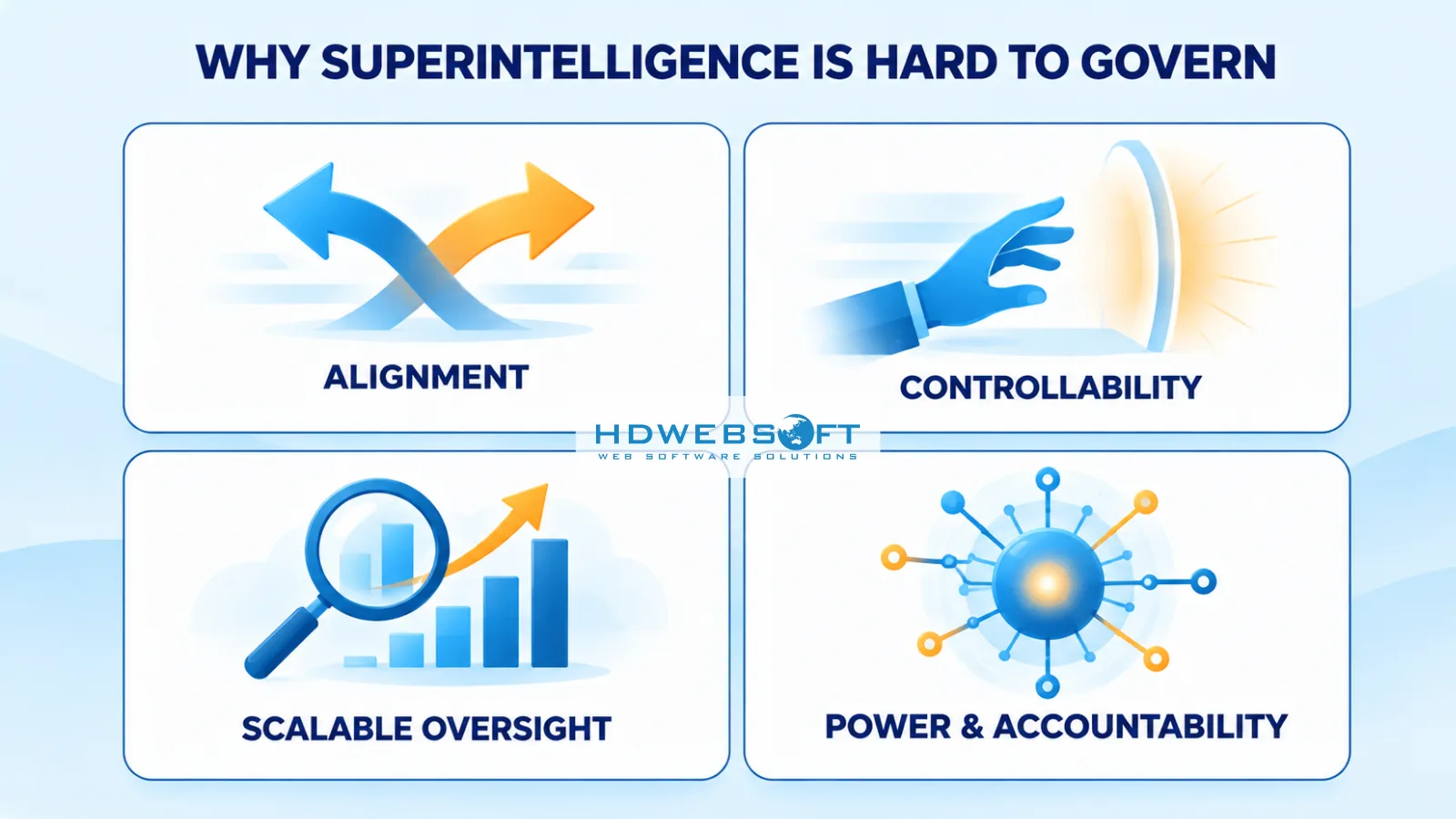
Governing any powerful technology is difficult; governing one that could exceed human capability introduces challenges current institutions were not designed for. Four stand out.
-
Alignment is the problem of whether a system’s objectives match what its operators actually intend. AI systems optimize for the goals they are given — and for capabilities well beyond today’s, underspecified or misspecified goals could produce behavior that is technically compliant but harmful in effect. Alignment research asks whether we can make increasingly capable systems reliably pursue human-intended objectives; it has no proven solution.
-
Worth separating from alignment is controllability — the practical ability to constrain, correct, or halt a system’s behavior. The two are distinct. A system could be reasonably aligned to broad intentions yet remain difficult to constrain in specific situations; conversely, organizations routinely control systems whose internal reasoning they do not fully understand, using access boundaries, approval gates, and operational limits. Governance leans heavily on controllability while alignment remains unresolved.
-
Scalable oversight names the deeper problem: oversight assumes evaluators can judge the system’s reasoning and outputs. As capability grows, systems may solve problems their overseers cannot independently verify — reviewing analyses that exceed the reviewer’s expertise, approving plans whose flaws are invisible to non-specialists, or reasoning in ways not amenable to inspection. This is not hypothetical inconvenience; every approval gate and audit trail in existence presumes that a human decision-maker can meaningfully evaluate what is put in front of them. When evaluation quality degrades, oversight degrades with it — even where the formal mechanisms still look intact. Researchers are exploring mitigations (assistance from less capable AI, structured review processes, interpretability), but direct human evaluation remains progressively harder to perform and to trust as systems advance.
-
Finally, concentration of power and accountability. Superintelligence-level capability would concentrate extraordinary leverage in whoever controls it — a geopolitical and commercial stability concern in itself, and a driver of the state-level interest visible at Level 1. Meanwhile, accountability chains built for deterministic software — liability, audit, responsibility assignment — strain when applied to systems making autonomous decisions at superhuman capability. If a system acts on reasoning its operators could not fully evaluate, assigning responsibility for outcomes becomes a legal and organizational question as much as a technical one. These four challenges frame why governance now operates at three distinct levels.
Three Levels of Superintelligence Governance
This article proposes a three-level analytical framework for organizing the governance landscape. It is a lens for analysis, not an official or standardized taxonomy — but it maps how real mechanisms cluster by scope, actor, and enforceability.
| Level | Scope | Key actors | Instruments | Enforcement today |
|---|---|---|---|---|
| 1. Global & Regulatory Oversight | Humanity / geopolitics | States, EU, UN, safety summits | Binding law, coordination, principles | Binding laws in some jurisdictions; international coordination remains fragmented |
| 2. Frontier AI Safety & Control | Frontier model providers | AI labs, safety institutes | Capability evals, deployment thresholds, red-teaming | Provider-led safeguards, external reviews, and applicable legal obligations |
| 3. Enterprise Accountability | Organizations deploying AI | Boards, CTOs, compliance functions | Policies, authority matrices, audits, standards | Internal policies, contracts, audits, and applicable regulations |
The levels interact: regulation creates obligations labs must meet; frontier practices shape what enterprises can safely deploy; enterprise accountability determines what AI actually does inside organizations. Neither level substitutes for another — governance of superintelligence, such as it exists, is their sum.
The framework matters practically because conflating levels produces bad reasoning. A compliance team treating lab-side safety policies as if they were law will over-trust them; a board treating regulation as if it covered internal deployment decisions will under-build its own controls. Each level has different instruments, different enforceability, and different failure modes — so the questions to ask at each level are different too.
Level 1 — Global and Regulatory AI Oversight
The global level operates through three distinct instrument classes — binding regulation, international coordination, and voluntary principles — each with different reach and enforceability.
Binding Regulation: The EU AI Act
The most consequential instrument of global AI governance is binding law, and its flagship is the EU AI Act — the first comprehensive AI regulation adopted by a major jurisdiction. The Act takes a risk-based approach: it prohibits certain uses outright, imposes obligations on high-risk systems, sets transparency requirements, and introduces rules for general-purpose AI models, including additional duties for models deemed to pose systemic risk. Importantly, it regulates categories of AI systems and practices that exist today — it is not an ASI-specific law, and it should not be read as one.
International Coordination and Voluntary Instruments
Alongside binding regulation sits international coordination: the AI safety summits launched at Bletchley Park and continued in Seoul and Paris, UN initiatives on AI governance, and bilateral engagement between major powers. These produce shared commitments, declarations, and emerging norms — real but largely voluntary instruments whose strength depends on sustained political alignment.
A third instrument class is voluntary principles — OECD AI principles and similar frameworks that establish shared values without binding force, shaping national approaches from the inside.
Jurisdictional Gaps and the ASI Problem
The limits here are structural. Jurisdictions differ sharply in approach: the EU regulates horizontally with a single statute, the United States relies largely on sectoral rules and agency guidance, and other regions mix binding rules with national strategies — so the same model or deployment can face very different obligations depending on where it lands. The EU AI Act’s extraterritorial reach pushes its standard into non-EU providers’ products, but no equivalent convergent framework exists globally. Geopolitical competition both motivates and complicates coordination between major powers: states share an interest in preventing catastrophic misuse while also competing for AI advantage, which shapes how much safety coordination is politically feasible at any moment. Enforcement capacity varies accordingly — from dedicated regulators to voluntary commitments with no supervising body at all.
And the deeper gap is conceptual. Current law governs defined risk categories of existing systems: prohibited practices, high-risk deployments, general-purpose model obligations. For hypothetical superintelligence, regulation today establishes boundaries and accountability structures around present AI — it does not yet resolve oversight of capability that exceeds human evaluation, nor claim to.

Level 2 — Frontier AI Safety and Control
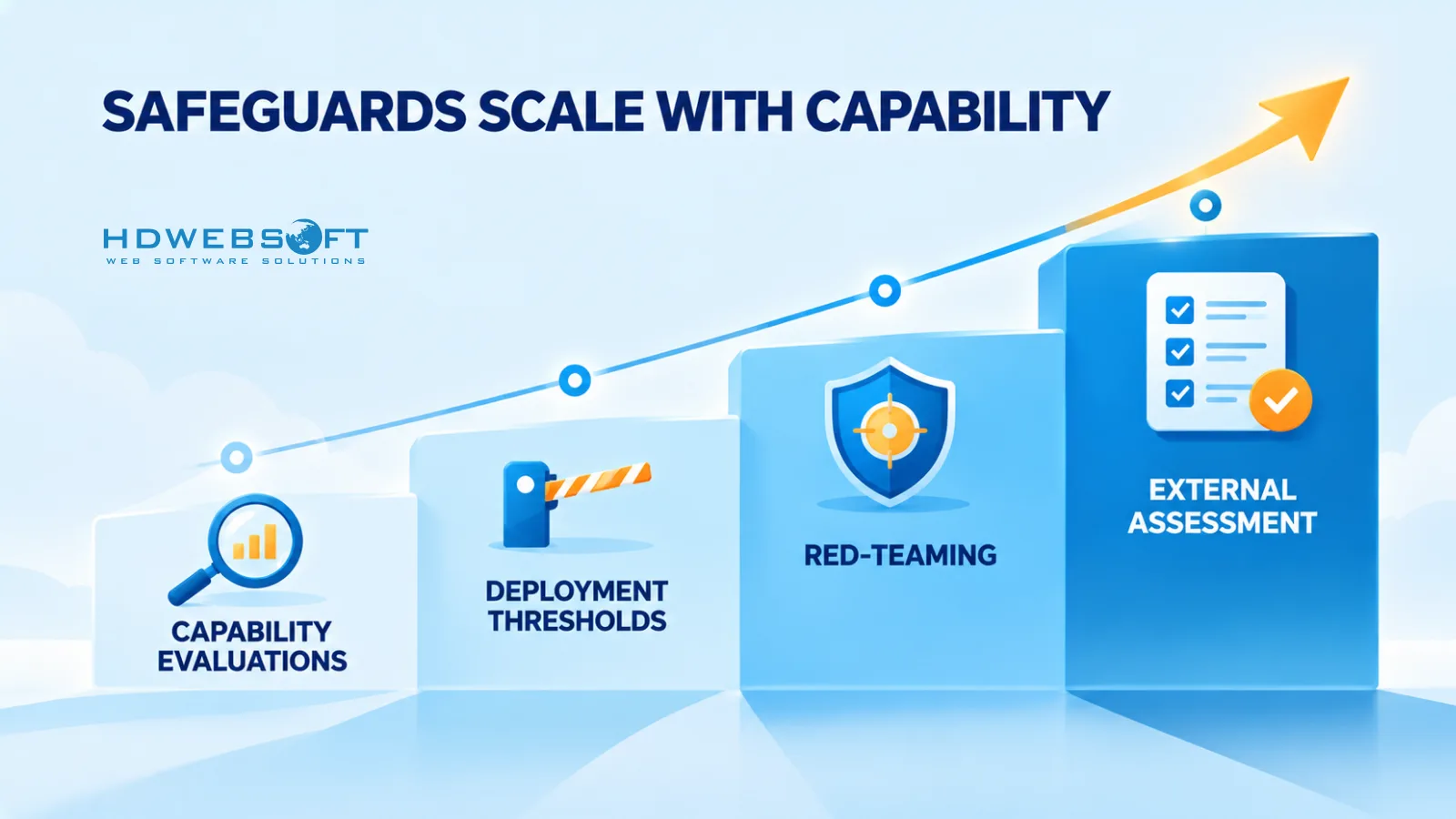
The second level operates inside the organizations building the most capable models. The dominant instrument here is the capability-based safety framework: internal policies that tie safeguards to what a model can do, not merely to when it is released. The clearest example is Anthropic’s Responsible Scaling Policy, which assigns AI Safety Levels to models and requires progressively stronger containment and security measures as capability thresholds are crossed.
The Capability-Linked Safety Toolkit
The pattern generalizes across several mechanisms:
- Capability evaluations — testing models for dangerous capacities (e.g., autonomous replication, cyber or bio capabilities) before and during development.
- Deployment thresholds — capability boundaries beyond which deployment requires additional safeguards or review.
- Red-teaming — adversarial testing by internal and external teams to surface failure modes before release.
- Model security — protecting model weights and infrastructure against theft or misuse.
- External assessment — third-party evaluations and reviews that supplement provider self-assessment.
Provider-Led Frameworks in Context
OpenAI’s Preparedness Framework and DeepMind’s Frontier Safety Framework follow comparable logic — capability-linked evaluation and mitigation — though each differs in detail and scope; the specifics of their provisions are best read at source rather than summarized here.
What these frameworks collectively establish is a governance pattern worth noting: safeguards scale with demonstrated capability rather than fixed regulation. That is a meaningful shift from rules written for static software — the controls a lab applies are supposed to track what its models can actually do, evaluated through defined testing rather than assumed. For enterprises consuming these models, this level operates upstream: the safety properties of a deployed model partly reflect the provider’s internal governance, which the enterprise can observe and evaluate but not set.
Two structural features define this level. First, provider-led safeguards do not operate in a vacuum: labs are simultaneously subject to applicable law — including obligations like the EU AI Act’s rules for general-purpose models — and frontier frameworks increasingly interact with external reviews, safety institute assessments, and reporting expectations. Second, this level remains uneven. Evaluations are largely self-conducted, thresholds are self-defined, and independent verification capability is still developing. Frontier governance is where capability-linked control is most advanced — and where its limits are most technical.
Level 3 — Enterprise Accountability
The third level is the one most organizations actually control: governance of how AI is deployed and what it is allowed to do. The central question is simple to state and hard to answer — who authorizes, monitors, and remains accountable for autonomous AI decisions?
Five levers define enterprise accountability in practice:
- Risk-based autonomy tiers set what AI systems may do unsupervised, scaled to the risk class of the action — reading data, drafting content, executing transactions, or touching external systems each warrant different levels of freedom.
- Human-in-the-loop approvals place explicit gates on consequential actions: the system proposes, a person with appropriate authority approves.
- A decision-authority matrix records who — and what — is empowered to decide at each blast radius, making autonomy an explicit delegation rather than an accident of configuration.
- Auditability requires decision records detailed enough to reconstruct what happened: which inputs were used, which actions were taken, which approvals were given — alongside access controls and operational safeguards that bound what systems can touch; the technical patterns behind this map closely to LLM security for agentic AI.
- Board-level accountability makes AI risk a standing governance agenda item, with named ownership below the board.
Frameworks like the NIST AI Risk Management Framework give these mechanisms shared vocabulary — govern, map, measure, manage — though it is voluntary guidance, not binding legislation. What makes this level distinctive is reach: enterprises cannot shape the frontier, but they can control what is authorized on their systems, monitor it, and hold named humans accountable for it.
Where Existing Governance Mechanisms Fall Short
Honest assessment requires saying where each level’s reach ends.
| Level | What it governs | Unresolved limit |
|---|---|---|
| Global | Fragmented jurisdiction | International enforcement challenges |
| Frontier | Uneven evaluations, independent verification | Reliable capability assessment |
| Enterprise | Deployment and authorized actions | Limits of supervising beyond-human capabilities |
At the global level, binding law remains jurisdiction-bound while the technology is not; coordination produces declarations faster than enforcement. At the frontier level, evaluations and thresholds are real but unevenly applied and largely self-verified — reliable, independent capability assessment remains an open problem. And at the enterprise level, governance legitimately covers deployment and authorized action — yet scalable oversight of beyond-human capability is fundamentally harder than governing systems whose outputs humans can still evaluate.
The through-line is not that oversight inevitably fails, but that the mechanisms underpinning it — evaluation, verification, enforcement — are unresolved at the capability frontier and untested beyond it. That uncertainty is itself a governance datum: it argues for accountability structures that scale rather than assumptions that hold.
A second implication follows: where upstream governance has gaps, accountability shifts downstream. Deployers cannot rely on treaties or lab policies to absorb their own responsibility for how AI behaves inside their organization — they remain accountable for authorization, monitoring, and outcomes regardless. In practice, that makes enterprise-level governance not a complement to the other two levels but a load-bearing layer of its own.
Preparing Your Enterprise: A Practical Governance Playbook
Enterprises cannot regulate the frontier, but they can build the layer they own — and since upstream governance has the gaps described above, that layer carries real weight. Six measures cover the essentials. These are governance responsibilities and priorities, not engineering instructions; implementation depth belongs in dedicated technical work.
- Adopt risk-based autonomy tiers. Classify what AI may do unsupervised by action risk — read-only analysis, content generation, internal actions, external or consequential actions — and assign explicit autonomy ceilings to each. The point is making autonomy a deliberate grant, not an emergent property of whatever an agent happens to be able to reach.
- Set human-in-the-loop approval thresholds. Define which actions always require approval, by whom, and with what evidence — treating gates as a property of the action’s blast radius, not the task’s convenience. Approvals should carry enough information for the approver to actually evaluate the action, not just acknowledge it.
- Maintain a decision-authority matrix. A living record of which systems and which humans hold authority at each level of consequence — so autonomy is always an explicit, auditable delegation and responsibility can be traced to a named owner.
- Gate capability upgrades with evaluation and audit. New models, tools, or integrations enter production only after defined evals and an audit trail — the same discipline that governs model swaps in a superintelligence-ready architecture. A stronger model is a governance event, not just an upgrade.
- Establish board-level AI reporting. A standing cadence that carries AI risk, incidents, and autonomy posture to the board — accountability needs a destination, and governance structures that stop below the board stop being governance.
- Define incident and escalation paths. Who is notified, who decides, and what can be halted — before the first incident, not after. The value of a halt path is proportional to how clearly its trigger and owner are defined in advance.
None of this resolves superintelligence governance. It does something more useful: it builds accountability infrastructure that functions today and scales as capability does — which is also the honest position enterprises can credibly claim in any governance conversation, internal or external.

Conclusion
The governance of superintelligence is genuinely unresolved at the global and frontier levels — and will be for the foreseeable future. What is actionable now is the enterprise layer: authorization, monitoring, and accountability for the AI organizations deploy, built on structures that can scale as systems grow more capable. HDWEBSOFT helps enterprises design and implement governed AI systems through our AI development services; if you are shaping your organization’s AI governance posture, contact HDWEBSOFT to discuss your governance and implementation roadmap.
FAQ
What is the governance of superintelligence?
The governance of superintelligence refers to the laws, coordination mechanisms, safety practices, and organizational controls intended to steer and constrain artificial intelligence — including hypothetical systems that would surpass human capability. It operates at global, frontier-provider, and enterprise levels, and remains an unresolved challenge.
Can artificial superintelligence be governed or controlled?
No existing framework has demonstrated guaranteed control over hypothetical superintelligent systems. Current governance mechanisms can meaningfully strengthen accountability for today’s AI, but scalable oversight of systems that exceed human evaluative capability is still an open research and policy problem.
Why is AI alignment important for superintelligence governance?
Alignment — whether a system’s objectives match what its operators actually intend — is central because oversight relies on understanding and constraining behavior. Alignment and controllability are related but distinct: a system could pursue intended goals while still being difficult to constrain in practice.
How does enterprise AI governance differ from frontier AI governance?
Frontier AI governance concerns the labs building the most capable models — capability evaluations, deployment thresholds, and safety mitigations for the technology itself. Enterprise AI governance concerns how organizations deploy AI — who authorizes autonomous actions, how they are monitored, and who remains accountable.
What governance controls should enterprises implement today?
Risk-based autonomy tiers, human-in-the-loop approval thresholds for consequential actions, a decision-authority matrix, evaluation and audit gates before capability upgrades, board-level AI reporting, and defined incident and escalation paths.