Enterprise superintelligence architecture is a proposed architectural approach for enterprise AI systems: a vendor-neutral way of organizing data, models, agents, applications, and governance so the system can absorb increasingly capable AI without being rebuilt each time the frontier moves. It is not an established industry standard — it is a reference model for enterprises that want architectural readiness rather than vendor dependency.
The term needs careful handling. “Enterprise superintelligence” as platforms use it today describes advanced, integrated enterprise AI — not actual artificial superintelligence, which remains hypothetical and unverified. This article gives you three things: a clear-eyed look at the platforms adopting the label, a six-layer reference architecture you can adapt, and a phased roadmap to implement it with the AI you already have.

Key Takeaways
- Enterprise superintelligence architecture is a proposed reference model — not a certified standard, and not evidence that ASI exists.
- Enterprise SI platforms like Matrix and ML6’s Unum are early market examples; judge them by their architecture, not their labels.
- A superintelligence-ready architecture has six layers — data, model abstraction, agent orchestration, application, infrastructure — plus governance as cross-cutting controls across all of them.
- Model independence, composability, and evaluation baselines are the design principles that keep the architecture durable as models improve.
- A four-phase roadmap — assessment, foundation, orchestration pilot, production hardening — gets you there incrementally.
What Does Enterprise Superintelligence Mean Today?
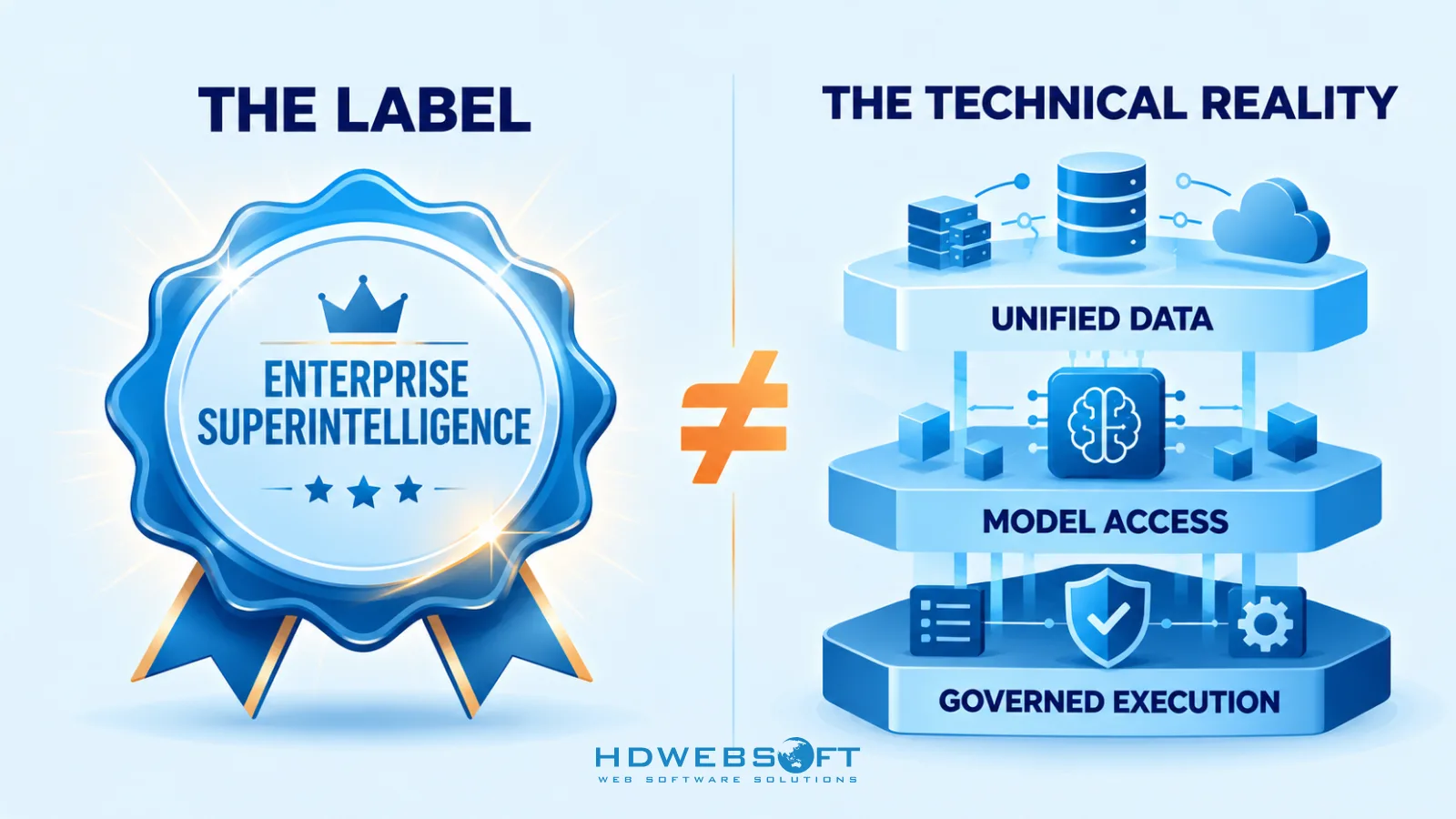
In current usage, “enterprise superintelligence” is a product-positioning term. Platforms adopt it to describe AI systems that go beyond answering questions — systems that connect to enterprise data, reason over it, plan work, and execute actions inside governed boundaries. It signals ambition: an AI layer that understands the whole business, not a single workflow.
Two clarifications keep the term honest. First, no enterprise SI platform delivers actual superintelligence — the capability bar for that, as our pillar article explains, has not been met by any system. Second, the label is not a technical specification. Two platforms can both claim “superintelligence” while having completely different architectures, data handling, and lock-in profiles. What matters for your planning is the architecture underneath the claim.
The Rise of Enterprise Superintelligence Platforms
A small but growing set of vendors now position products directly around enterprise superintelligence. Two illustrate the pattern — and both descriptions below reflect vendor positioning, not independently verified capability.
-
Matrix markets Matrix’s Enterprise Superintelligence Platform as a unified intelligence layer for leadership teams. Per its materials, the platform combines three capabilities: a “Brain” that answers business questions by querying data inside the customer’s own infrastructure, a “Copilot” that plans and generates content using external LLMs with explicit controls over what is shared, and “Agents” that execute approved work across connected systems. Its distinguishing architectural claim is that raw data never leaves the customer environment — a sovereignty-first design aimed at C-suite buyers in regulated contexts.
-
ML6, a European AI engineering firm, positions ML6’s Unum platform as “Unum Enterprise Superintelligence”: AI infrastructure that turns IT roadmap priorities into agent-led work. Its described loop — sense, think, act, learn — surfaces operational signals proactively, routes work through governed workflow templates (“Blueprints”), orchestrates agents to execute, and compounds memory so each workflow improves the next. Positioning targets the “AI-native enterprise,” with stated use cases in agentic program management and autonomous maintenance.
| Platform | Positioning | Capabilities (vendor-stated) | Architecture implications |
|---|---|---|---|
| Matrix | Enterprise Superintelligence Platform — “ask, know, do” loop for business leadership | In-infrastructure data querying; LLM-powered planning with controlled data sharing; agent execution across integrated systems | Data sovereignty as a first-class boundary; unified query-plan-execute loop over existing systems |
| ML6 Unum | Enterprise superintelligence as agentic operating infrastructure | Proactive signal surfacing; governed workflow blueprints; agent orchestration; compounding workflow memory | Orchestration and governance as the core product; workflows as reusable, auditable assets |
Read these platforms as market signals, not blueprints. The pattern they share — a unified data plane, an orchestration layer that executes, and governance wrapping both — is exactly what a vendor-neutral reference architecture codifies. The difference is who owns it: their platform, or your architecture.
Why Enterprises Need a Future-Ready AI Architecture
Four pressures make architectural flexibility urgent. First, model evolution velocity: capability jumps now arrive annually or faster, and today’s best model is routinely displaced. Second, vendor lock-in: business logic hard-wired to one provider’s API turns every model upgrade into a rebuild. Third, integration reality: enterprise AI only creates value when it touches ERP, CRM, and data platforms — and each of those integrations is where architectures break. Fourth, durable flexibility: the one asset that outlasts every model generation is an architecture built to swap components. The six layers below describe it.

Enterprise Superintelligence Reference Architecture: Six Core Layers
This reference architecture is vendor-neutral. Any conforming enterprise AI platform — bought or built — maps onto it, which makes it a useful evaluation instrument as well as a build guide. Six layers stack from infrastructure to experience, and governance is deliberately not a seventh layer: it is a set of controls that must exist inside every layer.
| Layer | Core responsibility | Key components |
|---|---|---|
| Enterprise Data & Knowledge | Trusted, governed data and retrieval for AI consumption | Lakehouse/warehouse, pipelines, vector stores, semantic layer, catalog & lineage |
| Model Abstraction & Routing | Model-agnostic access; right model per task | Model gateway, provider adapters, routing policy, model registry |
| Agent Orchestration & Tool Execution | Coordinate multi-step work, tools, and enterprise systems | Orchestrator, tool registry, execution sandbox, HITL checkpoints |
| Application & Experience | Deliver intelligence to users and business apps | Copilots, embedded AI features, internal APIs, action queues |
| Infrastructure & Operations | Run the stack reliably, affordably, at scale | Compute strategy, deployment patterns, observability, FinOps |
| Governance, Security & Observability | Cross-cutting controls across every layer | Identity & policy boundaries, audit trails, evals, monitoring |
Enterprise Data & Knowledge Layer
This layer supplies the trusted data substrate everything above it depends on. Responsibilities: ingestion and integration pipelines from enterprise sources (ERP, CRM, data warehouse, documents), quality controls, a semantic layer that gives business terms stable definitions, and retrieval interfaces — vector stores, indexes, and query APIs — that serve both analytics and RAG-style grounding. Components typically include a lakehouse or warehouse, transformation pipelines, a catalog with lineage, and retrieval services. The critical property is that data here is governed: every asset has an owner, a quality expectation, and documented provenance.
Weak data quality is the most common reason enterprise AI underperforms — our guide to AI data readiness covers the assessment in depth. Outputs of this layer are retrieval contracts and governed data products consumed by the layers above.
Model Abstraction & Routing Layer
This layer decouples your system from any single model. Responsibilities: expose a provider-neutral interface to consumers, route each request to the right model by capability, cost, latency, or policy, manage fallbacks, and normalize provider differences — tool-calling formats, streaming, structured outputs. Core components are a model gateway, per-provider adapters, routing policy, and a model registry with versioned aliases (reasoning-primary, fast-default) so applications never see a provider name. An LLM gateway architecture is the standard implementation pattern: a single control point for model selection, observability, cost, and policy — which turns a model upgrade into a configuration change. This layer is the enterprise’s main hedge against the moving frontier: when a stronger model ships, you evaluate it, update an alias, and promote — no rebuild.
Agent Orchestration & Tool Execution Layer
Above model access sits the layer that does work. Responsibilities: decompose goals into multi-step plans, coordinate agents and workflows, invoke tools and enterprise systems through governed adapters, enforce human-in-the-loop checkpoints on consequential actions, and record execution for audit and learning. Components include an orchestrator (workflow graphs or agent frameworks), a tool registry defining what actions are permitted, execution sandboxes with bounded permissions, and connectors to ERP/CRM/ticketing systems. Integration is where this layer earns or fails — agents that can only read are assistants; agents that can act need contracts, permissions, and rollback paths against real systems. Our guide to AI agent integration and interoperability details those integration patterns. The enterprise SI platforms above are, at their core, products built around this layer.
Application & Experience Layer
This layer delivers intelligence to humans and downstream software. It covers conversational copilots, embedded AI features inside business applications, internal APIs other teams build on, and interaction patterns like proactive signal feeds and approval queues — the “action required” surfaces that platforms like Unum make central. The architectural concern is separation: experience components consume the layers below through stable interfaces, so a new UI surface is a new client, not a new pipeline. This is also where most customization lives — the layers below are infrastructure; this one carries your workflows, your vocabulary, your users’ trust.
Infrastructure & Operations Layer
The foundation layer runs everything: compute strategy (cloud, on-premises, or hybrid), GPU economics, deployment patterns, environment management, and the operational telemetry that keeps the stack reliable. The architectural decisions here are sovereignty and placement — Matrix’s “raw data never leaves your infrastructure” positioning is an extreme expression of a real trade-off every enterprise makes: which layers run where, and who can touch what. Self-hosting maximizes control and data residency; managed services minimize operations. Most enterprises land hybrid — data plane in their own environment, control plane wherever it is efficient. Cost engineering belongs here too: model routing decisions above are only useful if this layer exposes the real cost of each path.
Governance, Security & Observability Layer
Governance is not a seventh layer — it is a cross-cutting control plane enforced at every layer. At the data layer: access policies, lineage, and residency. At the model layer: approved-provider lists, PII redaction, routing policies. At the orchestration layer: action permissions, human checkpoints, sandboxing. At the application layer: role-based surfaces and audit logs. Across all of it: evaluation pipelines that prove a model change is safe before promotion, behavioral monitoring in production, and audit trails that reconstruct what the system did and why. Frameworks like the NIST AI Risk Management Framework provide the risk-based structure these controls map to — govern, map, measure, manage — and give compliance teams a recognized vocabulary. The pattern to remember: governance bolted on afterward fails; governance as a control plane inside each layer scales.
How a Request Flows Through the Layers
A concrete example ties it together. A CFO asks: “Why did gross margin drop in Q3, and draft the corrective plan.” The Application layer receives the request and authenticates the user’s role. The Orchestration layer plans the work: retrieve margin data, decompose drivers, then draft a plan. The Model Abstraction layer routes analytical steps to a capable reasoning model and drafting steps to a cheaper one — under policy that forbids non-EU providers for this data class.
The Data & Knowledge layer supplies governed data products through retrieval contracts, with lineage intact. The Orchestration layer executes tool calls against the finance system in a sandbox, then queues the drafted plan for CFO approval — a human checkpoint before anything downstream. Infrastructure meters cost and latency at each step. Governance wraps it all: every data access logged, every action permissioned, every output traceable. That is what “one intelligence loop” looks like when you own the architecture instead of renting it.
Design Principles for Superintelligence-Ready Systems
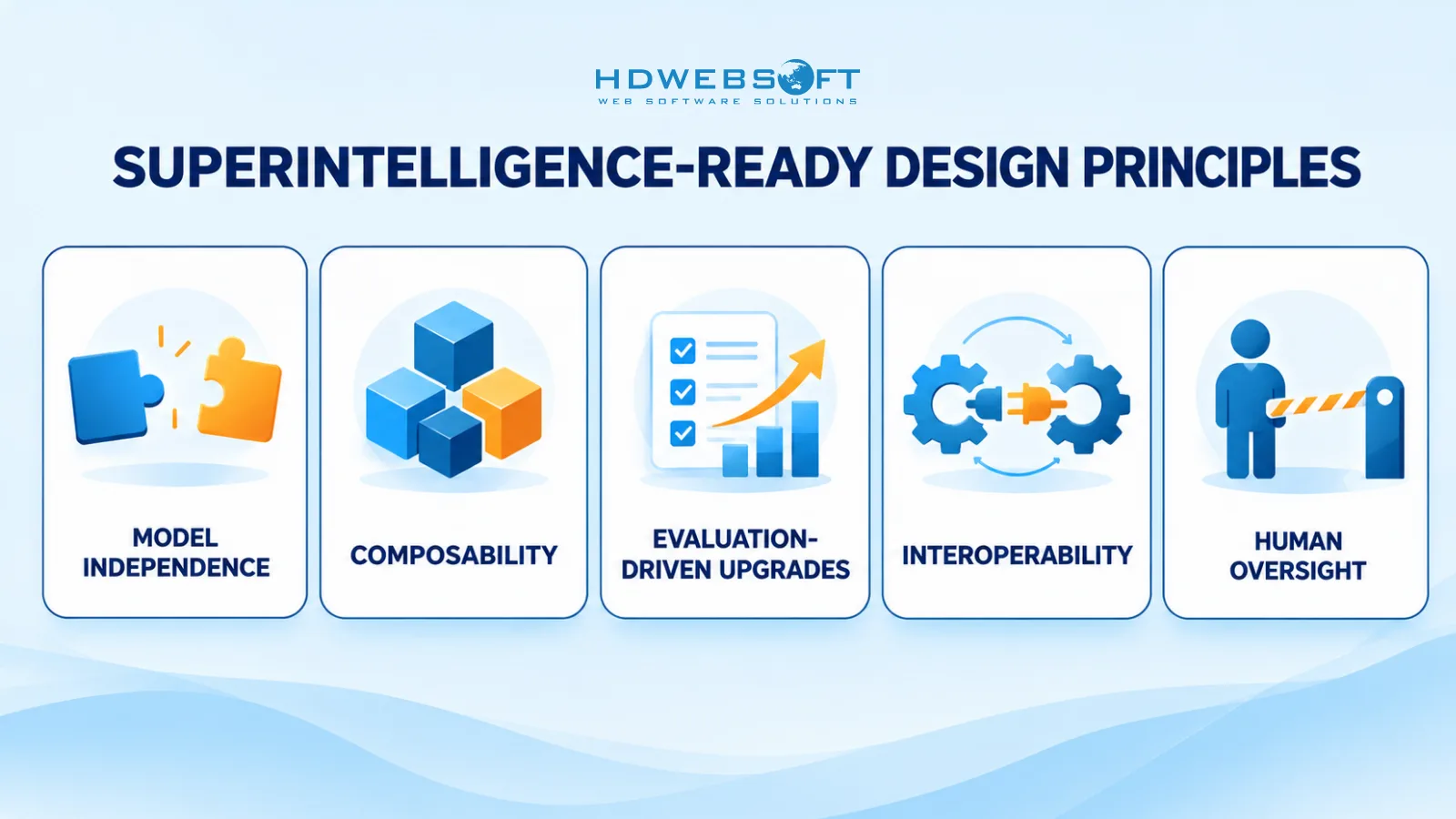
Five principles keep an enterprise superintelligence architecture durable as AI capability compounds:
- Model independence. No provider name, prompt quirk, or output format in business logic. Models are replaceable commodities behind aliases.
- Composability. Each layer exposes stable contracts, so any component — vector store, orchestrator, gateway — can be swapped without cascading changes.
- Evaluation-driven upgrades. Promotion of a new model or agent behavior requires passing an eval suite built on your real workloads, not vendor benchmarks.
- Interoperability. Open APIs and standard protocols between layers; no proprietary coupling that converts flexibility into lock-in.
- Human oversight by design. Approval gates and escalation paths are architectural features with defined thresholds — not UI settings to disable later.
Implementation Roadmap: From AI Agents to Future-Ready Architecture
Implementing an enterprise superintelligence architecture is a capability progression, not a calendar plan. Each phase delivers standalone value and has a concrete completion criterion.
| Phase | Deliverable | Done when |
|---|---|---|
| 1. Architecture & Data Assessment | Gap analysis: current AI touchpoints, data maturity, integration map, target-state architecture | Documented gaps with a prioritized target architecture signed off |
| 2. Foundation & Model Abstraction | Model gateway live with provider-neutral aliases; governed data access for priority domains | Two or more models routable through one interface; governed retrieval serving real queries |
| 3. Agent Orchestration Pilot | One production-grade agent workflow built on the new layers — bounded scope, real users | Pilot handles live traffic with human checkpoints and a working eval baseline |
| 4. Production Hardening & Scaling | Full six-layer stack in production; governance controls operational; runbooks and cost guardrails | Security and audit controls pass review; scaling thresholds and deprecation procedures defined |
Start where your current AI already touches production — an existing copilot or agent is the natural Phase 3 pilot. The most common failure mode is sequencing: teams attempt Phase 3 before Phase 2 exists, and the “orchestration pilot” collapses under unmetered model access and ungoverned data.
Common Architecture Mistakes to Avoid
- Vendor-label dependency. Buying a platform because it says “superintelligence” instead of evaluating its architecture against the six layers above. Labels are marketing; layers are engineering.
- Hard-coded model coupling. Model names, prompt assumptions, or provider-specific formats inside business logic — the lock-in that makes every upgrade a rebuild.
- Weak governance. Retrofitting controls after deployment. Governance that isn’t inside each layer’s data flow gets bypassed under delivery pressure.
- Missing evaluation baselines. No evals means no objective way to promote a stronger model — you end up either frozen on old capability or promoting on faith.

Conclusion
No vendor can sell you superintelligence — it does not exist. What exists is a rapidly improving frontier and a real architectural choice: build a system whose layers let you absorb that improvement, or stay coupled to whatever you integrated first. A superintelligence-ready architecture — governed data, abstracted models, orchestrated agents, observable infrastructure — is how enterprises stay ready without betting on a timeline. HDWEBSOFT designs and builds exactly this class of enterprise AI systems through our AI development services, and if you want to map this blueprint to your own stack, contact HDWEBSOFT to discuss your architecture roadmap.
FAQ
What is enterprise superintelligence architecture?
Enterprise superintelligence architecture is a proposed, vendor-neutral reference model for enterprise AI systems. It organizes data, model access, agent orchestration, applications, infrastructure, and cross-cutting governance into layers that can absorb stronger AI models without requiring a rebuild. It is an architectural approach, not a certified industry standard.
Do enterprise SI platforms like Matrix and Unum deliver actual superintelligence?
No. Artificial superintelligence does not exist today, and no vendor product is verified to deliver it. Platforms such as Matrix and ML6’s Unum use the term as positioning for integrated enterprise AI systems that unify data access, reasoning, and execution. Evaluate them on architecture and governance, not on the label.
What is the difference between a model abstraction layer and an agent orchestration layer?
A model abstraction layer normalizes access to multiple AI models through a single interface and decides which model handles each request. An agent orchestration layer sits above it and coordinates multi-step work: planning, tool calls, enterprise system integration, and human approval checkpoints.
How does governance work in a superintelligence-ready architecture?
Governance operates as cross-cutting controls across every layer rather than a separate module. It includes identity and access boundaries, policy enforcement at the model gateway, audit trails for agent actions, evaluation pipelines for model changes, and monitoring of system behavior in production.
How should enterprises phase the implementation of this architecture?
A practical sequence is: architecture and data assessment, foundation and model abstraction, an agent orchestration pilot, then production hardening and scaling. Each phase has a concrete deliverable and a completion criterion, so the architecture matures incrementally without a risky big-bang rebuild.