
Artificial superintelligence (ASI) is a hypothetical form of AI that would exceed human cognitive ability across virtually every domain that matters — scientific research, strategic planning, creativity, and even social judgment. Unlike today’s AI, which excels at specific tasks, ASI would outperform the best human minds at essentially all of them. No such system exists today, but the term is gaining traction as major labs publicly commit to pursuing it.
For enterprise leaders, the practical question is not whether ASI will arrive in 2035 or 2060. It is whether your organization has the data, architecture, and governance foundations to absorb whatever comes next. This guide explains what superintelligence actually means, how it differs from AGI, and what you should be doing right now.
Key Takeaways
- Artificial superintelligence is a hypothetical AI that would surpass human intelligence across nearly all economically valuable domains. It does not exist today.
- ASI presupposes AGI. Artificial general intelligence would match humans on all tasks; ASI would exceed them, with recursive self-improvement as a proposed — not required — pathway.
- Expert timelines for ASI range from the 2030s to never. No prediction is reliable enough to plan around, but every preparation step has value regardless of when — or if — ASI arrives.
- The foundations that matter (data quality, model-agnostic architecture, governance, real AI delivery experience) are the same ones enterprises need for today’s AI, and they pay off now.
What Is Artificial Superintelligence?
The concept of superintelligence entered mainstream discussion largely through Nick Bostrom’s Superintelligence, in which the Oxford philosopher frames it as an intellect that greatly exceeds human cognitive performance across virtually all domains of interest — not just chess or image recognition, but scientific reasoning, social insight, and general wisdom.
Two points in that framing matter for enterprises. First, ASI is defined by breadth of superiority, not raw speed. A system that merely computes faster is not superintelligent — humans already have machines that out-calculate us. ASI implies outperforming humans wherever intelligence creates value, including domains where we currently assume human judgment is irreplaceable.
Second, the frequently cited mechanism — recursive self-improvement — is a proposed pathway to superintelligence, not a defining requirement. It is the idea that an AI system could redesign itself into progressively smarter successors, but ASI could theoretically emerge from other routes. What defines it is the endpoint (capabilities beyond human reach), not the method that produced it. Treating self-improvement as the defining feature leads to confusion. Many real-world AI systems already optimize parts of their own pipelines without being remotely superintelligent.
Why Is Superintelligence Gaining Attention?
The term has moved from academic philosophy to boardroom vocabulary because the companies building frontier AI now say it openly. OpenAI frames its mission around AGI and beyond. Meta has reorganized its AI efforts under a Superintelligence Labs banner, and Mark Zuckerberg has published Meta’s vision for personal superintelligence as a product direction. Major investors, including SoftBank, have made superintelligence central to their theses.
It is important to read these signals correctly. They describe ambition and investment, not demonstrated capability. A lab announcing a superintelligence division is comparable to an airline announcing a supersonic program. It signals direction, funding, and confidence — not a vehicle on the runway. Enterprise leaders should treat public statements as indications of where the industry is spending, not as evidence that ASI is imminent.
AGI vs. ASI vs. Narrow AI: What’s the Difference?
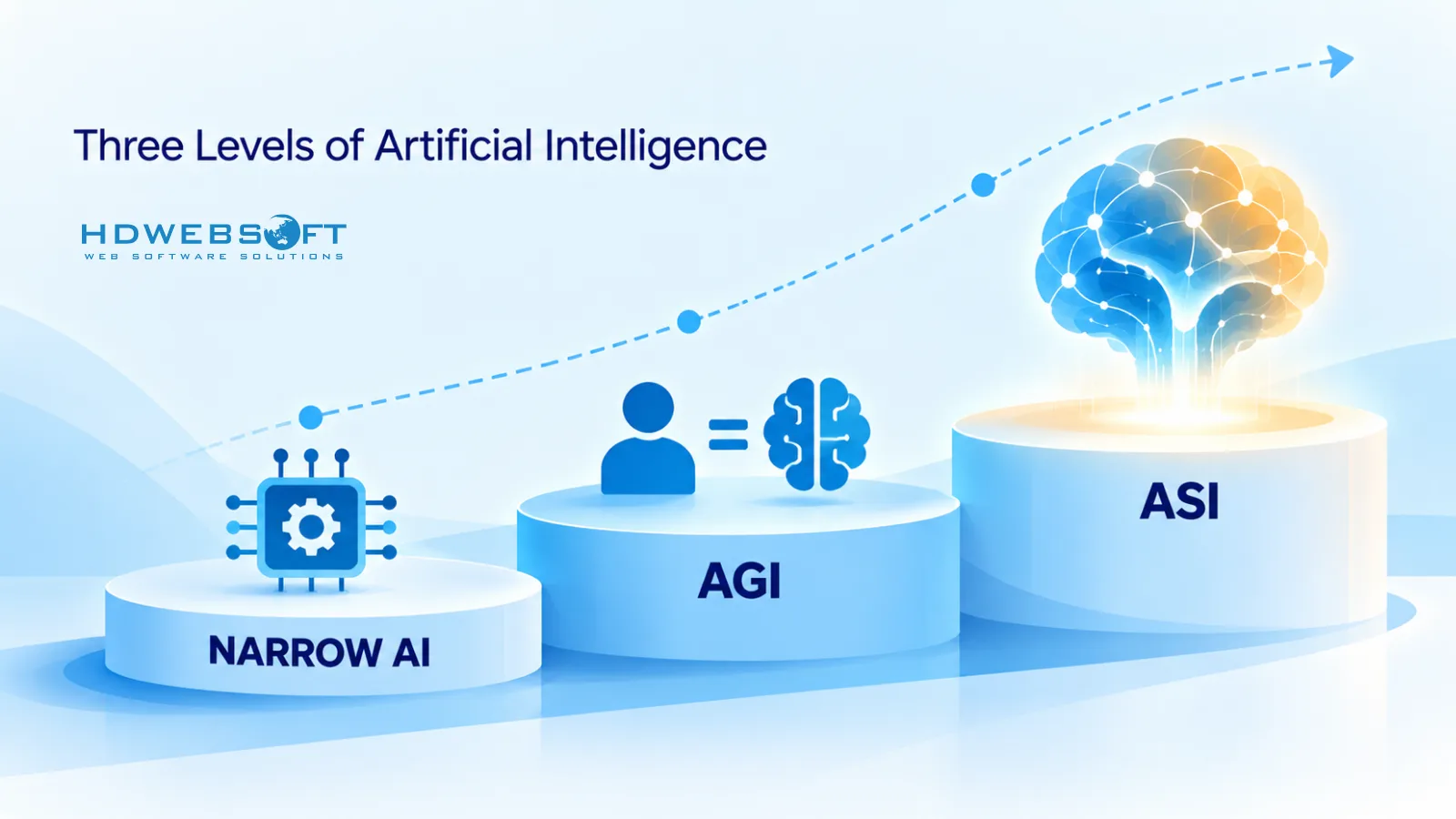
The AI landscape is conventionally divided into three levels. Understanding where each sits matters, because the terms are often used interchangeably in headlines — and the differences between them carry real implications for planning. (For a broader taxonomy, see our guide to the types of artificial intelligence.)
| Dimension | Narrow AI (ANI) | AGI | ASI |
|---|---|---|---|
| Capability scope | Excels at specific, bounded tasks | Matches humans across essentially all cognitive tasks | Exceeds humans across virtually all domains |
| Autonomy | Operates within human-designed constraints | Could pursue goals across domains independently | Could set and pursue goals beyond meaningful human oversight |
| Generalization | Limited; degrades outside training distribution | Transfers learning flexibly across novel domains | Improves and transfers at rates beyond human comprehension |
| Examples | Fraud detection, recommendation engines, coding copilots, LLMs | None verified to exist | None verified to exist |
| Current status | Deployed widely in production | Hypothetical; definitions vary | Hypothetical; presupposes AGI |
One complication: there is no universally standardized definition of AGI. OpenAI’s definition of AGI — “highly autonomous systems that outperform humans at most economically valuable work” — is influential but not binding, and other researchers draw the boundary differently. Because definitions differ, public claims that AGI is “close” are hard to evaluate. When you read a timeline prediction, the first question should always be: whose definition is being used?
How Is Superintelligence Different From AGI?
The distinction between AGI and ASI is best understood along four axes:
- Capability breadth. AGI matches human-level competence everywhere; ASI exceeds it. An AGI might be a peer to a strong research team. An ASI would be more like that entire field’s research output compressed into one system.
- Performance ceiling. AGI is bounded by human benchmarks. ASI is not — its capabilities would have no human comparison, which makes evaluation and quality assurance fundamentally harder.
- Generalization speed. AGI would learn new domains roughly as fast as a capable human. ASI is generally conceived as improving and transferring knowledge at speeds humans cannot follow.
- Oversight. Humans could plausibly supervise an AGI because its reasoning operates at human-comparable levels. Supervising an entity that reasons beyond your comprehension is an open research problem — this is the core of the AI alignment debate.
That said, the boundary is genuinely fuzzy. Today’s frontier models already display “spiky” intelligence — superhuman at protein folding or competition math, below average at tasks a child handles easily. Whether a future system counts as AGI or ASI will often be a judgment call, not a measurement. Enterprises should plan for capability trajectories, not precise labels.
Does Artificial Superintelligence Exist Today?
No. No publicly known or independently verified system meets the definition of artificial superintelligence, and no credible researcher claims otherwise. This matters because media coverage often collapses three separate things — today’s impressive-but-narrow AI, a possible future AGI, and a more speculative ASI — into a single narrative of imminent superintelligence.
It is equally important not to oversimplify in the other direction. Calling today’s frontier models “just narrow AI” understates how much they differ from the single-purpose systems of a decade ago. Modern LLMs generalize across tasks they were never explicitly trained for, which is exactly why the AGI debate exists. The honest position is that current AI sits in an unusual middle ground. It is far more general than classic narrow AI, far short of AGI, and nowhere near ASI.
What Can Today’s AI Actually Do?
The Stanford AI Index 2026 offers a grounded picture of the real frontier. Several leading models now meet or exceed human baselines on PhD-level science questions and competition mathematics — Google’s Gemini Deep Think earned a gold medal at the International Mathematical Olympiad. On SWE-bench Verified, a key coding benchmark, top performance climbed from 60% to nearly 100% in a single year, and organizational AI adoption reached 88%.
The same report documents the limits. That IMO gold-medal model reads analog clocks correctly only 50.1% of the time — an illustration of what researchers call the “jagged frontier” of AI, where superhuman and subhuman capabilities coexist in the same system. AI agents improved from 12% to roughly 66% task success on OSWorld, a benchmark for real computer use, yet they still fail about one in three attempts on structured tasks. Meanwhile, documented AI incidents rose to 362 in 2025, up from 233 the year before.
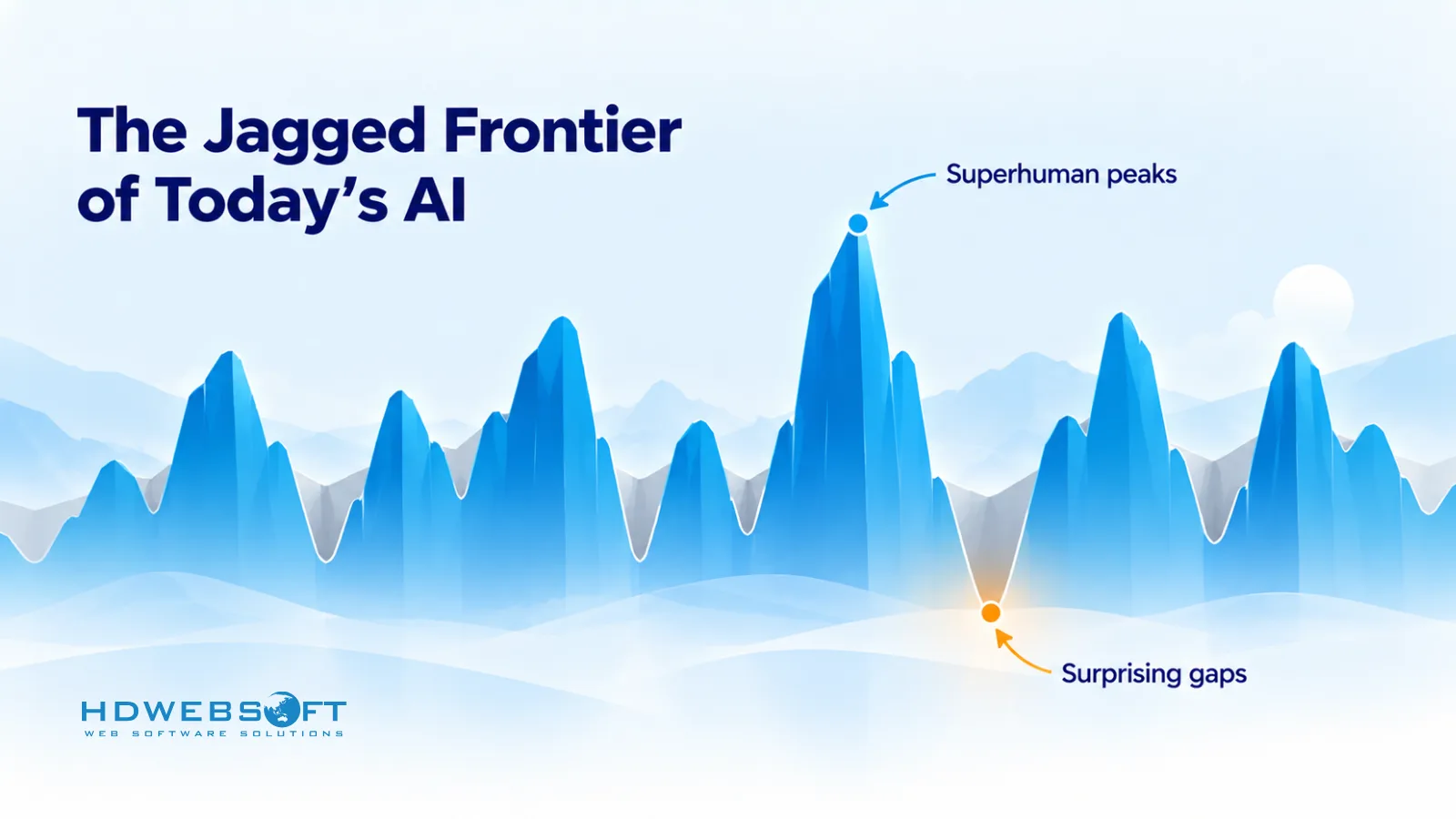
This profile — extraordinary in patches, unreliable at the edges — is precisely what makes current systems useful but not superintelligent. Even the most capable deployments of agentic AI in production today require human-designed goals, bounded permissions, and careful observability. An autonomous system that needs a human to define its objectives, review its outputs, and recover from its failures is a powerful tool. But it is categorically different from an entity that outthinks the humans overseeing it.
When Could Artificial Superintelligence Arrive?
Nobody knows — and that is not a hedge, it is the accurate answer. Published predictions span an enormous range. Some frontier lab leaders suggest advanced AI could arrive within years; SoftBank CEO Masayoshi Son has publicly predicted ASI by 2035, a claim covered by Reuters’ report on Masayoshi Son’s 2035 ASI prediction. Other equally credentialed researchers consider such timelines speculative or believe ASI may never be feasible.

Every one of these forecasts is an opinion shaped by definitional choices, assumptions about scaling, and — in some cases — commercial incentives. None is an established fact. The rational enterprise posture is not to bet on a date. It is to build the organizational capabilities that remain valuable across every plausible timeline.
How Could Artificial Superintelligence Affect Businesses?
Because ASI is hypothetical, everything in this section is a scenario rather than a prediction. The point of thinking through scenarios is not to forecast outcomes — it is to understand which organizational capabilities would matter in each case. Unsurprisingly, they turn out to be the same capabilities that drive AI value today.

Potential Opportunities for Enterprises
In a post-AGI world, the scenarios most often discussed include:
- Accelerated R&D. A system that outperforms human researchers could compress drug discovery, materials science, and engineering cycles from years to weeks. Enterprises with well-structured proprietary data would be positioned to direct such capability at their hardest problems.
- Complex problem-solving. Optimization across genuinely multi-variable domains — global supply chains, energy grids, portfolio risk under thousands of interacting constraints — could move from approximation to precision.
- Decision support at scale. Strategic analysis that currently requires months of consulting work could be generated continuously, shifting the bottleneck from producing insight to evaluating it.
- Deeper automation. Automation could extend beyond routine knowledge work into judgment-adjacent tasks that currently resist it — though with proportionally higher stakes when systems are wrong.
The recurring caveat: these benefits would accrue disproportionately to organizations that can specify what they want, supply trustworthy data, and verify what they get back. Capability without direction produces expensive noise — a pattern already visible with today’s far weaker systems.
Risks and Open Questions
A balanced view requires acknowledging the harder questions:
- Dependency. An organization that outsources core reasoning to systems it cannot audit accumulates a new class of concentrated operational risk.
- Alignment. Ensuring a system smarter than its operators pursues the goals they intend is an unsolved research problem — not a procurement checklist item.
- Oversight. How do you supervise reasoning you cannot fully follow? Governance frameworks will need to evolve from reviewing outputs to constraining and monitoring behavior.
- Concentration of power. If ASI emerges at a small number of labs or states, access may become a geopolitical and competitive fault line rather than a commodity.
- Regulatory uncertainty. Governments are still writing rules for today’s AI. Post-AGI regulation is unknown territory, and enterprises operating across jurisdictions will face shifting obligations.
None of this is a reason to freeze. It is a reason to build now: organizations with mature AI governance, clean data, and flexible architecture will absorb advanced capabilities — whenever they arrive — faster and more safely than those starting from zero. Readiness is not a bet on a timeline; it is an option on every timeline.
How Can Enterprises Prepare for Advanced AI Today?
Here is the reassuring part: the preparation stack for a post-AGI world is identical to the stack that makes today’s AI work. Every item below generates ROI with current-generation technology. There is no wasted effort — only compounding advantage.
1. Strengthen Your Data Foundations
Every generation of AI has increased the penalty for bad data. Frontier models amplify whatever you feed them — inconsistent definitions, siloed records, and poor lineage produce confidently wrong outputs at scale. Enterprises should treat data quality, accessibility, integration, lineage, and governance as infrastructure, not an analytics afterthought. This means unified data platforms, clear ownership, documented semantics, and pipelines that can serve both today’s LLM features and whatever comes next. Our guide to AI data readiness walks through the practical assessment steps.
2. Build Flexible, Model-Agnostic AI Architecture
When model capabilities jump, the worst position is being architecturally welded to one vendor or model. AI-ready architecture means API-first integration, replaceable model layers, and routing that can direct workloads to whichever model is best suited — and cheapest — for each task. An LLM gateway architecture is emerging as the standard pattern. It provides a single control point for model selection, observability, cost management, and policy enforcement — so upgrading a model becomes a configuration change rather than a rebuild. Interoperability and vendor independence are not anti-commitment — they are insurance against a moving frontier.
3. Establish AI Governance and Human Oversight
Governance is the slowest capability to mature and the hardest to retrofit — which is exactly why it should start while the stakes are manageable. Practical enterprise governance covers usage policies, risk-tiered deployment controls, accountability for AI-assisted decisions, auditability of inputs and outputs, and defined human-oversight checkpoints. Frameworks like the NIST AI Risk Management Framework provide a recognized, risk-based structure that regulators increasingly reference, and it scales from today’s LLM features to stronger future systems. Our AI readiness framework guide maps governance into a broader organizational readiness model.
4. Measure AI Readiness Continuously
Readiness is a moving target. Model capabilities, regulations, and your own deployments all change faster than annual planning cycles. Enterprises should assess regularly — technical maturity, data health, risk exposure, workforce skills, and actual business outcomes rather than pilot counts. An AI readiness assessment gives you a baseline and a repeatable instrument; running it on a fixed cadence turns “are we ready?” from an opinion into a metric you can manage.
5. Build Experience Through Real AI Deployments
The most important preparation is also the least theoretical: ship real AI systems. An organization that has taken AI from pilot to production has learned things no strategy document teaches: how its data behaves under load, where governance gaps surface, and what observability actually requires. It also learns how its own teams adopt — or resist — AI-assisted workflows. This institutional “AI muscle” is what would let you absorb a step-change in capability quickly. If your organization lacks the bandwidth or experience to move from pilots to production, working with an experienced partner for AI development services can compress the learning curve while keeping architecture and governance under your control.
Whichever sequence you follow, the checklist below summarizes what “ready” looks like:
| Readiness dimension | What “ready” looks like | First step |
|---|---|---|
| Data | Unified, quality-controlled, governed data with documented lineage | Audit data sources and ownership |
| Architecture | Model-agnostic, API-first, observable; models are swappable | Introduce an LLM gateway |
| Governance | Written policies, risk tiers, accountability, human oversight | Adopt a risk framework (e.g., NIST AI RMF) |
| Measurement | Regular readiness scoring tied to business outcomes | Baseline assessment this quarter |
| Delivery | At least one AI system running in production | Ship a bounded, measurable pilot |
Conclusion: ASI Is a Horizon, AI Readiness Is a Choice
Artificial superintelligence remains hypothetical. It may arrive in a decade, in half a century, or never — and no forecast, however confidently stated, changes that uncertainty. What is certain is that enterprises with strong data foundations, flexible architecture, mature governance, and real AI deployment experience will capture whatever advanced AI delivers, on whatever timeline it arrives. If you want to assess where your organization stands and build an AI roadmap that pays off today and compounds tomorrow, contact HDWEBSOFT to start the conversation.
FAQ
What is artificial superintelligence in simple terms?
Artificial superintelligence is a hypothetical AI that would be smarter than humans at virtually everything that matters — not just one skill like chess, but scientific research, strategy, creativity, and social judgment. It is a theoretical concept, not a product that exists today.
What is the difference between AGI and ASI?
AGI (artificial general intelligence) would match human ability across all cognitive tasks; ASI (artificial superintelligence) would exceed it. ASI presupposes AGI — a system cannot surpass humans everywhere until it can at least match them everywhere. Neither has been built or verified today.
Does artificial superintelligence exist today?
No. No publicly known or independently verified system qualifies as ASI. Today’s most advanced AI shows a “jagged” capability profile — superhuman on some benchmarks, unreliable on simple tasks — and still requires human-defined goals and oversight.
When will artificial superintelligence arrive?
No one knows. Predictions range from the 2030s to never, and every forecast depends on definitional assumptions and personal judgment. Treat timelines as informed opinion, not fact, and avoid betting your strategy on any single date.
How should businesses prepare for ASI?
Prepare the same way you would for any advanced AI: strengthen data quality and governance, build model-agnostic architecture, establish AI governance and human oversight, measure readiness regularly, and ship real AI projects to production. These steps pay off immediately — regardless of when or whether ASI arrives.
Will ASI replace human workers?
Unknown — and the honest answer requires humility in both directions. What is clear from today’s AI is that value shifts toward organizations and people who can specify problems, supply trusted data, and oversee intelligent systems. Building those capabilities is the most defensible hedge available.