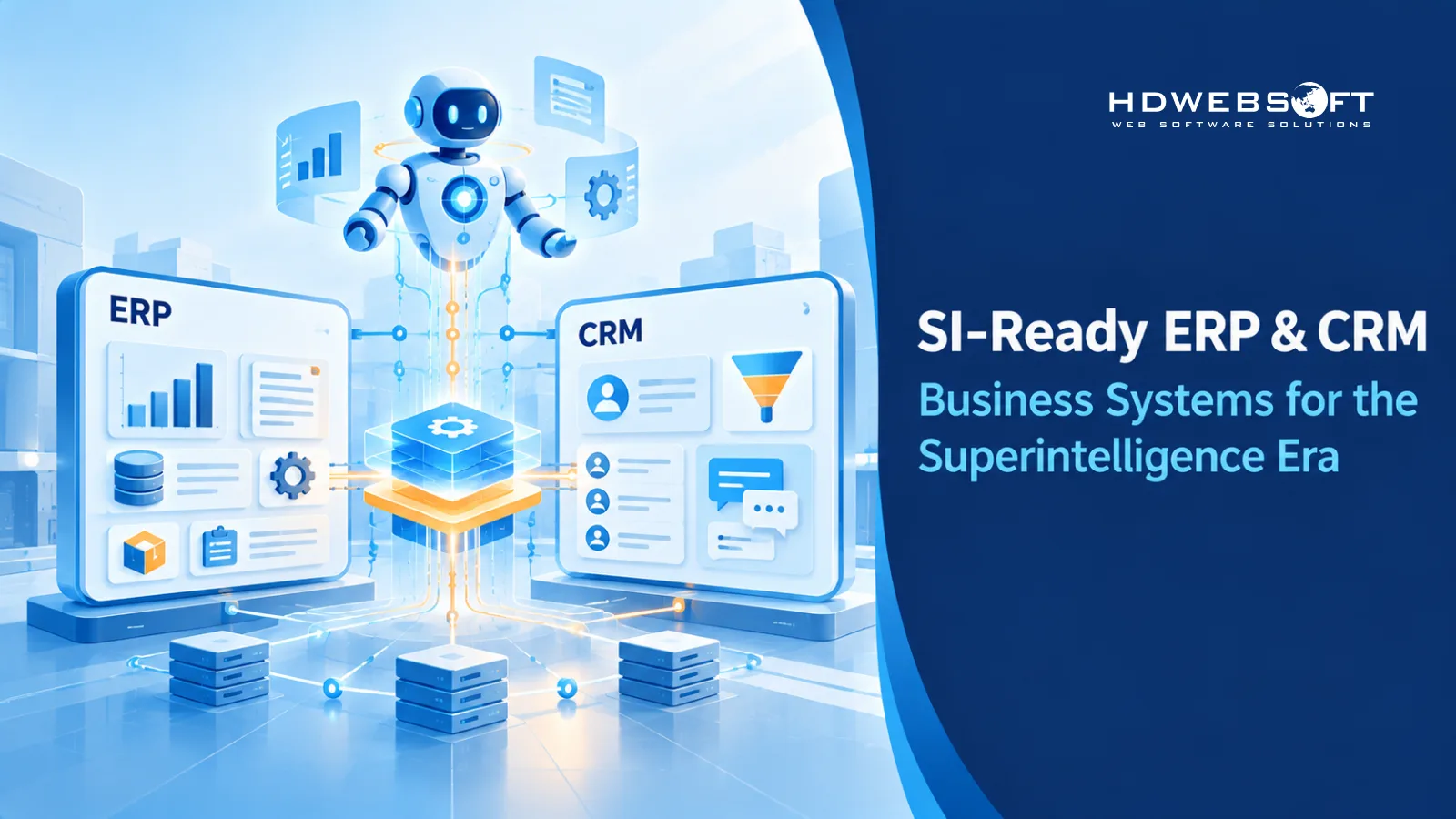
Today’s AI copilots assist people who work inside ERP and CRM systems. The next generation of AI will not assist — it will operate. As enterprises begin preparing for artificial superintelligence and the increasingly autonomous agents that precede it, the systems of record that run finance, sales, procurement, and customer relationships become the critical bottleneck. An AI agent that can reason perfectly is still useless if it cannot read your data, call your workflows, or leave a trail an auditor can trust.
SI-ready ERP and CRM is the architectural answer to that problem: business systems designed so that AI agents can function as first-class operational users — reading semantically clean data, acting through governed APIs, and leaving machine-readable evidence of everything they do. It is not a product category, a certification, or a vendor checkbox. It is a set of design decisions you make now, while the requirements are still cheap to meet.
This guide explains what SI-ready actually means for ERP and CRM, why legacy architectures block agents, the design principles that make systems agent-operable, and how to choose between modernizing, extending, or rebuilding.
Key Takeaways
- SI-ready means an ERP or CRM treats AI agents as first-class operational users — with machine-readable data, callable capabilities, and traceable actions — rather than bolting AI onto human-only interfaces.
- Legacy systems fail agents not because AI is missing, but because data is undocumented, business logic is buried in UIs, and actions leave no machine-readable trail.
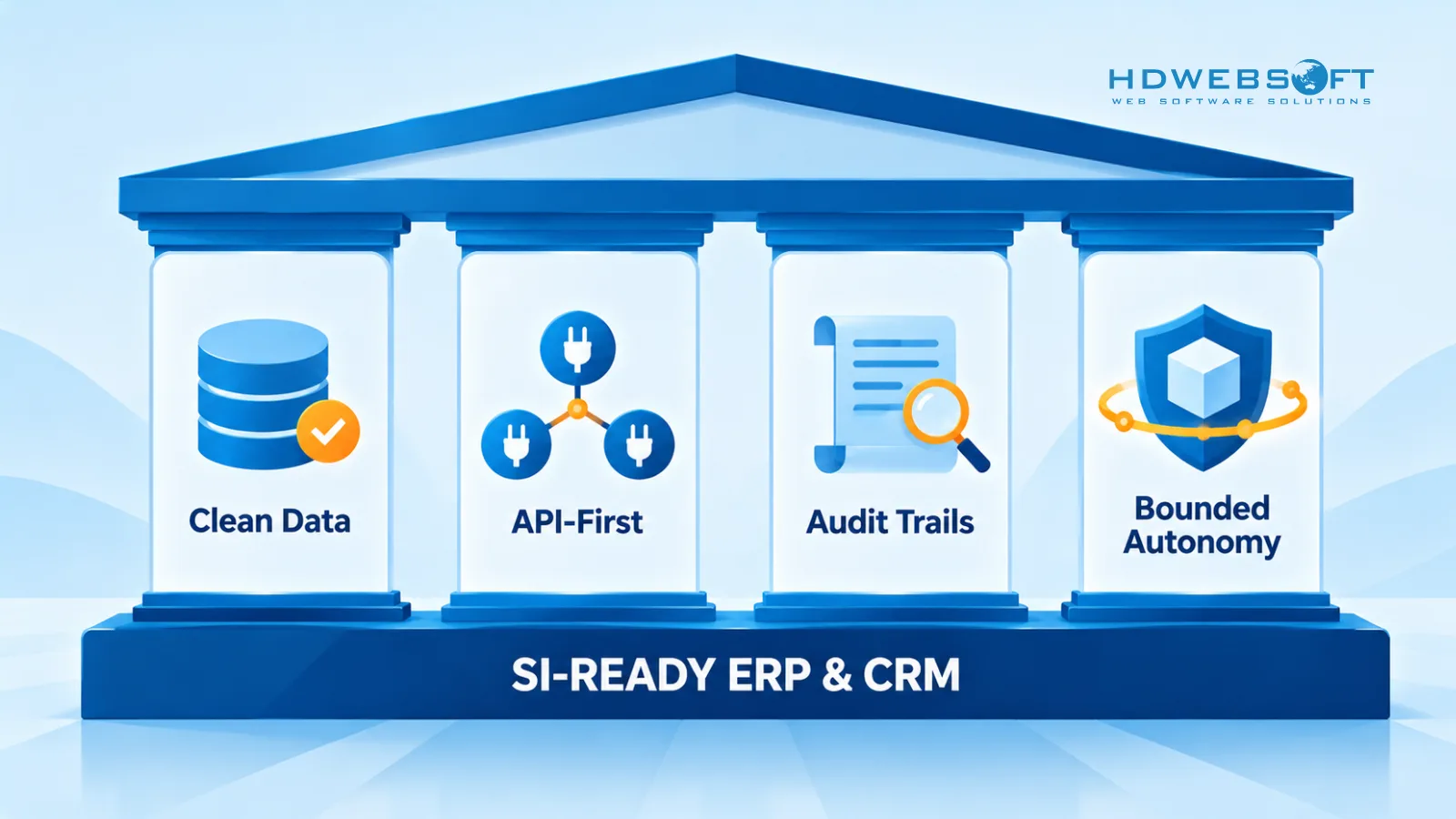
- The four design pillars are clean semantic data, API-first and event-driven integration, machine-readable audit trails, and bounded autonomy with human oversight.
- Modernize versus rebuild is a TCO-and-control decision, not a technology preference — custom development is strongest when your data model is a competitive asset, not a universal answer.
- Readiness is architectural, not futuristic: every step toward SI-readiness improves today’s AI integrations too.
What Does “SI-Ready” Mean for ERP and CRM Systems?
An SI-ready system is an enterprise system of record that treats AI agents as legitimate operational users — not as plugins reading a screen someone else was meant to see. Concretely, it means the system satisfies three conditions at once: agents can understand what the data means, act on the business through callable capabilities, and account for every change they make.
It helps to separate two ideas that are often blurred together. AI-ready describes what most vendors sell today: a system that supports copilots, predictive features, or embedded assistants — tools that advise humans who remain the real operators. SI-ready describes a further condition: the system remains operable, auditable, and safe as agents take on autonomous, multi-step work — and stays that way as agent capability compounds toward levels we cannot fully specify today.
One honest caveat applies: “SI-ready” is a forward-looking architectural approach, not an established technical standard or certification. No industry body defines it, and no vendor can sell you a certified SI-ready ERP — artificial superintelligence itself does not exist. What the term usefully captures is a design direction: build systems that will not need to be torn apart when agents ask to do real work.
Five traits define that direction in practice:
- Semantically modeled data — entities, fields, and relationships carry machine-readable meaning, not just storage formats.
- Callable capabilities — every business operation is exposed through APIs, not locked inside screens.
- Event-driven integration — the system emits what happens, when it happens, instead of batching truth into nightly syncs.
- Machine-readable audit trails — every state change records who acted, why, and on what data.
- Bounded autonomy — permission tiers and approval gates define what an agent may do without a human.
ERP and CRM sit at the application layer of a broader stack. If you are mapping how these systems fit alongside model gateways, orchestration layers, and enterprise data platforms, our enterprise superintelligence architecture blueprint covers the wider picture; this article stays focused on the two systems your business actually runs on.

Why Legacy ERP and CRM Architectures Block Advanced AI
Legacy ERP and CRM systems were designed around a single assumption: a human sits between the data and every decision. Interfaces present records for people to read; forms collect what people type; workflows encode the steps people follow. That assumption served well for two decades — and it is precisely what breaks when an agent tries to do the work instead.
Four structural bottlenecks appear in almost every legacy environment:
- Siloed and undocumented data. The same customer exists as five slightly different records across modules. Fields like
CUST_STAT_CDcarry tribal knowledge no documentation captures. Humans compensate with experience; agents cannot. - Business logic buried in UIs. The rule “orders over $50K need finance approval” lives in a form script or a stored procedure — not in a service an agent can invoke. The only way to execute the logic is to simulate a user clicking through screens.
- Point-to-point integration. Decades of bespoke connectors mean data arrives late, arrives differently, or does not arrive at all. An agent that needs current inventory, open orders, and customer status simultaneously hits three inconsistent snapshots.
- No machine-readable accountability. Audit logs, where they exist, record that a record changed — not who authorized the change, what reasoning preceded it, or which data informed it. They answer “what happened” for humans; they cannot answer “why did it happen” for anyone.
| Legacy pattern | Agent failure mode |
|---|---|
| Undocumented fields with tribal semantics | Agent misinterprets data and acts on a wrong premise — confidently |
| Business rules locked in form logic | Agent bypasses controls or must fake a human session to trigger them |
| Nightly batch sync between modules | Agent makes decisions on stale, inconsistent snapshots |
| Change logs without reasoning context | Audits fail: nobody can reconstruct why the agent did what it did |
| UI permissions as the only access control | Agent inherits broad human privileges — or is blocked entirely |
The pattern underneath all of these: the system’s knowledge and capabilities are accessible only through human-shaped interfaces. Agents do not fail here because they lack intelligence. They fail because nothing they need is machine-accessible.
Core Design Principles of SI-Ready ERP and CRM Architecture
Four design principles convert a record-keeping system into a system agents can genuinely operate. None requires waiting for smarter AI — each one pays off in today’s integrations as well.
Clean, Semantically Modeled Data
Agents consume meaning, not bytes. An SI-ready data layer gives every core entity — customer, order, invoice, contract, case — a single canonical definition shared across modules, with fields carrying explicit semantics: what the value means, which units it uses, what states are legal, and how it relates to other entities.
In practice this means maintaining a governed business glossary that lives with the data, not in a wiki nobody reads: field-level descriptions, enumerated status values with their business meanings, documented relationships, and lineage showing where each value originated. When an agent encounters status = PENDING_CREDIT, the system’s own metadata should tell it what pending credit means and which actions are valid in that state — otherwise the agent guesses, and guesses at enterprise scale become incidents.
This is also the least glamorous and most consequential principle. Every subsequent layer — APIs, audit trails, autonomy controls — assumes the data underneath is interpretable. Data cleanup is unglamorous precisely because it is foundational.
API-First, Event-Driven Integration
If data is what agents read, APIs are what they touch. SI-ready systems expose every meaningful business capability — create order, release hold, qualify lead, approve return — as a governed endpoint with explicit inputs, outputs, and permissions. A useful test: any operation a trained employee can perform should be performable through the API surface, without simulating a user interface.
Equally important is how changes propagate. Batch sync gives agents stale snapshots; an event-driven backbone — order created, payment received, case escalated, each published as it happens — gives agents the same real-time awareness a human gets from watching a screen. Agents subscribe to event streams rather than polling tables, which is both faster and dramatically cheaper on infrastructure.
Emerging standards are reducing the integration cost here. The Model Context Protocol (MCP), for example, defines a uniform way for agents to discover and invoke external tools and data sources. It is worth being precise about what MCP does and does not do: it standardizes the conversation between an agent and a system — tool discovery, capability description, invocation format. It does not replace your APIs, your authorization model, or your business validations. Those remain yours to design. MCP makes a well-designed API surface agent-consumable; it cannot rescue a system whose capabilities are not callable in the first place.
Machine-Readable Audit Trails
When an agent changes a record, “someone updated this field” is no longer a sufficient log entry. SI-ready audit trails capture the full evidence chain for every state change, in a form that machines — and auditors — can interrogate:
- Actor — which agent, service account, or human acted, and under whose authority
- Action — the operation performed, with its inputs and resulting state change
- Rationale — the triggering event, the policy or reasoning path that justified it, and any human approval obtained
- Data touched — which records were read to inform the decision, not only which were written
- Reversibility — how the action can be undone, and whether it already has been
This is not a novel invention — financial and healthcare systems have demanded equivalent evidence chains for decades. What changes is the actor: the trail must be structured so that oversight systems, not just human auditors, can evaluate agent behavior continuously. These audit mechanics connect directly to the wider accountability stack — policy enforcement, oversight levels, and incident response — that we cover in superintelligence governance.
Bounded Autonomy & Human Oversight
The final principle draws the line between what agents may do alone and what still requires a person. Bounded autonomy means permissions are expressed as tiers of consequence, not as a binary “agent access: yes/no”:
- Tier 0 — Read and recommend. Agents analyze, draft, and propose; humans execute. Appropriate for most deployments today.
- Tier 1 — Execute reversible, low-impact actions. Update non-financial fields, route cases, schedule — with instant rollback.
- Tier 2 — Execute bounded financial actions. Issue refunds up to a threshold, adjust orders within defined ranges — with approval above the limit.
- Tier 3 — Execute high-consequence actions with mandatory approval. Contract changes, payment releases, master-data modifications — an agent prepares, a human signs.
Each tier is enforced architecturally — in the API authorization layer, not in the agent’s instructions — so that expanding an agent’s scope is a deliberate governance decision, never an emergent behavior. The thresholds belong in configuration reviewed by the business, not buried in a prompt.
How AI Agents Will Operate Inside SI-Ready ERP and CRM
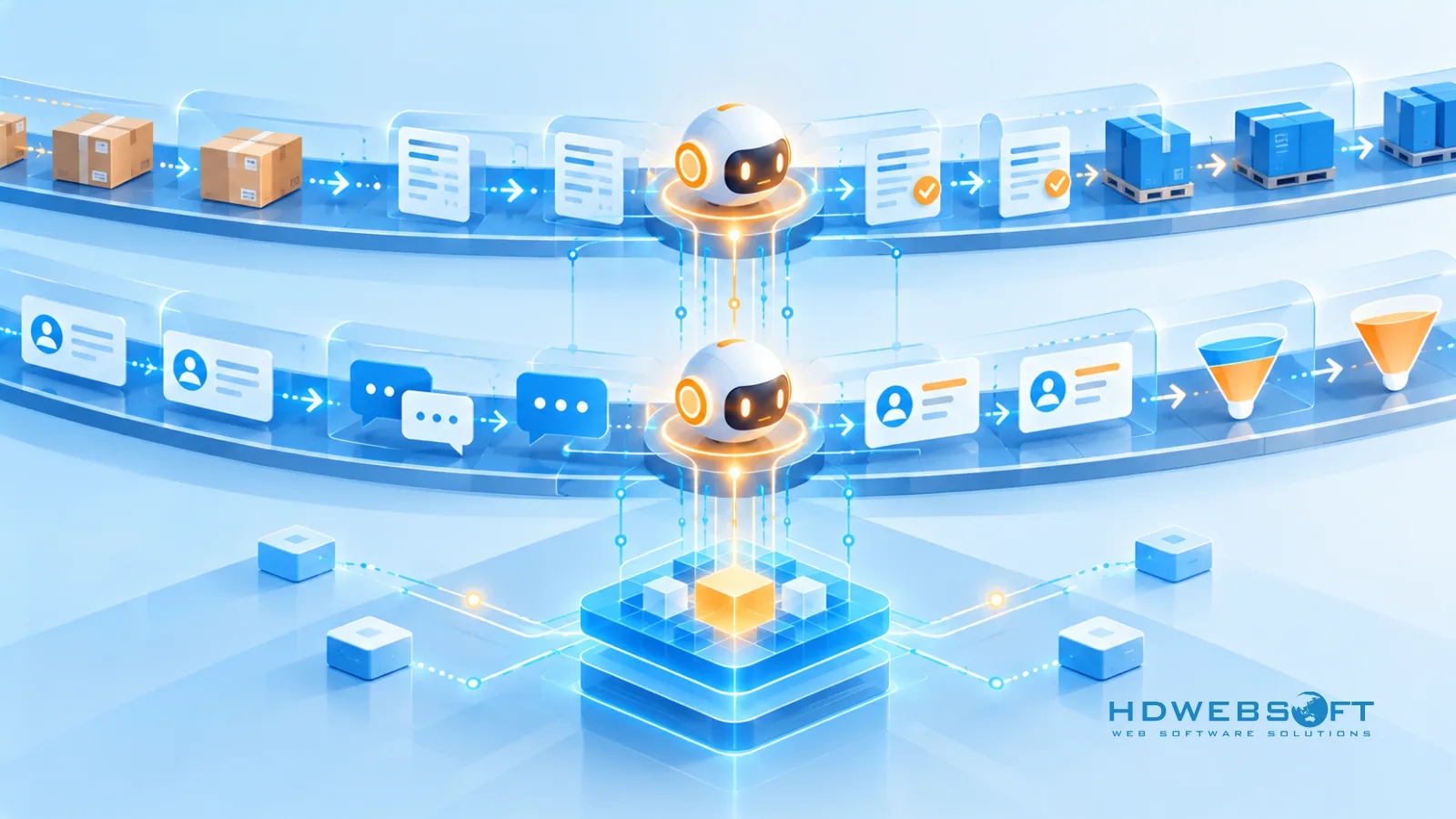
Abstract principles land harder in concrete workflows. On a well-designed SI-ready foundation, the operating pattern is consistent: an agent reads an event, reasons over clean data, acts through the API, leaves a machine-readable trail, and escalates whenever the action exceeds its tier. What differs is the domain.
On the ERP side, the highest-value early workloads are the ones drowning in cross-system reconciliation:
- Order-to-cash monitoring — an agent watches order events, detects mismatches between shipped, billed, and paid, and opens reconciliation cases with the evidence already attached.
- Inventory rebalancing — demand signals and stock events trigger proposed transfer orders; below the risk threshold they execute automatically, above it they queue for approval.
- Vendor reconciliation — agents continuously match invoices, receipts, and PO terms, flagging the exceptions that humans spend month-end hunting.
On the CRM side, the pattern shifts from reconciliation to progression — moving customer-facing work forward without waiting for a human to notice:
- Lead qualification and routing — engagement and firmographic events trigger scoring, enrichment, and assignment within seconds rather than days.
- Case triage — incoming cases are classified, deduplicated, and routed with context pre-assembled; the human receives a case, not a queue.
- Quote generation — agents draft quotes from pricing rules and deal context for rep approval, collapsing a half-day task into a review.
This is the direction major vendors are already moving: platforms like SAP Business AI now embed agents for service resolution, invoice matching, and supply-chain monitoring inside their suites. Vendor agents, however, operate inside the vendor’s data model and within the vendor’s boundaries. When your workflows, data semantics, or autonomy rules differ from the platform’s defaults — which they usually do — the gap becomes an argument for custom CRM development, where agent-permissible fields, actions, and approval tiers are designed around your processes rather than retrofitted around a vendor’s assumptions.
Modernize, Extend, or Rebuild? Choosing Your Path
Few enterprises can — or should — replace their ERP and CRM outright for the sake of agent-readiness. The realistic decision is a spectrum, and the right point on it depends on your data model, integration estate, and how much of your process logic is genuinely differentiating.
| Path | What it means | Best when | Watch out for |
|---|---|---|---|
| Retrofit | Wrap the legacy system with APIs, event emitters, and a logging layer | Data model is sound; budget and risk appetite are low | Shallow wrappers expose fields, not capabilities — the logic stays trapped |
| Extend | Keep the core; build SI-ready modules for agent-facing domains alongside it | Core is stable but specific domains need agent operation now | Two architectural styles to maintain; boundaries require discipline |
| Rebuild | Replace the core with a custom system designed agent-operable from day one | Your data model is a competitive asset; vendor limits block the autonomy you need | Highest cost and migration risk; only justified by durable differentiation |
Honest evaluation matters more than enthusiasm. Custom development is not automatically the best answer — it is the best answer under specific conditions: when your process semantics diverge from what suites model well, when you need direct control over the data model that agents will reason on, or when vendor roadmaps gate capabilities your strategy requires. The comparison criteria that actually decide this are total cost of ownership across 5–10 years, the depth of integration your agent use cases demand, migration risk to running operations, and the ceiling a vendor’s platform places on autonomy tiers.
For organizations on the rebuild path, custom ERP development offers one decisive advantage for SI-readiness: the data model, API surface, event backbone, and audit schema are designed as a coherent whole — not negotiated with a vendor’s architecture afterward. But the same honesty applies in reverse: if a suite already covers 90% of what you need, extending it is the smarter engineering decision.
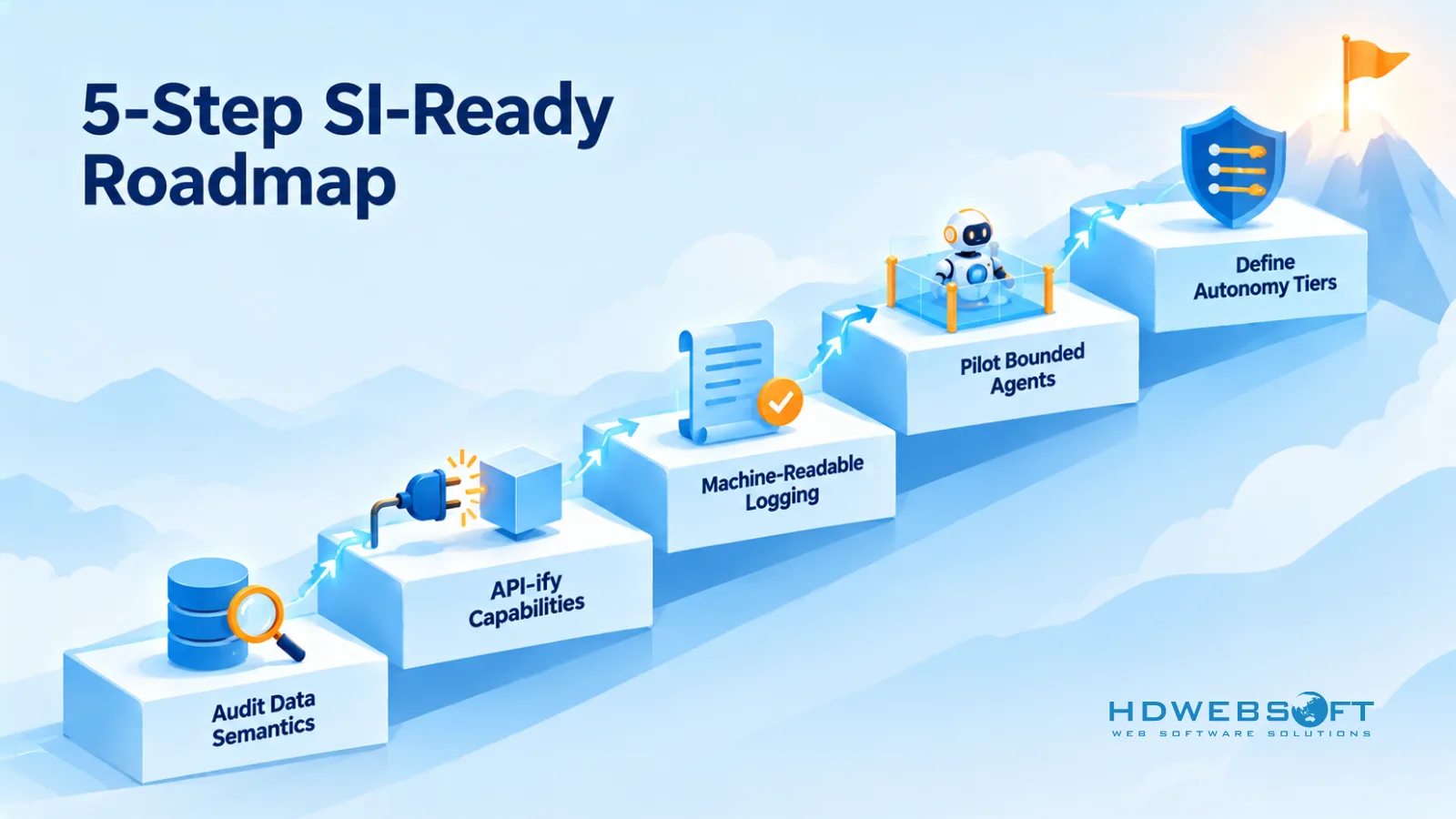
How to Prepare Your Business Systems for Autonomous AI: A 5-Step Roadmap
The gap between AI adoption and AI readiness is already measurable. McKinsey’s State of AI in 2025 finds that most organizations now use AI in at least one business function, yet the majority remain stuck piloting rather than scaling — and the blockers are overwhelmingly data, workflow, and governance foundations rather than model capability. The five steps below attack exactly those foundations, and each delivers value independent of when — or whether — superintelligence arrives.
- Audit your data semantics. Inventory your core entities — customer, order, product, case — and answer for each: is there a single definition? Are field meanings documented? Do parallel modules agree? The output is a gap list, and it usually explains why previous AI pilots stalled.
- API-ify critical capabilities. Pick the ten operations an agent would need first — the ones in your early use cases — and expose them as governed, documented endpoints. You do not need to wrap everything; you need the highest-value surface callable.
- Deploy machine-readable logging. Instrument the actor-action-rationale-data chain described above on the domains you API-ified first. If you cannot reconstruct why an action happened, it was not safe to automate.
- Pilot bounded agent use cases. Choose workflows that are high-volume, low-risk, and fully reversible — case triage, reconciliation flagging, draft generation. Tier-0 and Tier-1 autonomy only; measure against human baselines before expanding.
- Define autonomy tiers and governance. Formalize the permission tiers, approval thresholds, and escalation paths before agents push against them. Governance written under incident pressure is always worse than governance written in advance.
The sequence matters less than the ordering logic: semantics before APIs, APIs before agents, governance before autonomy. Teams that invert it — deploying agents on undocumented data with no audit chain — learn the same lessons as production incidents instead of as design reviews.
Conclusion: SI-Readiness Is a Decision, Not a Deadline
Nobody can tell you when — or whether — superintelligence arrives. What is knowable is narrower and more useful: the systems your business runs on were designed for human operators, and every month, more of the work inside them is delegated to software that acts on its own. SI-ready ERP and CRM is simply the decision to design for that operator now — clean data agents can interpret, APIs they can call, audit trails they must leave, and boundaries they cannot cross.
Each step toward that architecture pays off immediately: better integrations, cleaner migrations, safer automation, AI features that work on your data instead of demo data. The organizations that will absorb autonomous agents smoothly are not the ones that waited for certainty — they are the ones that made their systems legible while it was still cheap to do so.
HDWEBSOFT designs and builds custom business systems and integrations with agent-readiness engineered in from the start — through our AI development services, we help enterprises assess their current ERP and CRM landscape and build the foundations described here. If you are weighing modernize versus rebuild, that conversation is exactly where we start.
FAQ
What is an SI-ready ERP system?
An SI-ready ERP system is an enterprise resource planning platform designed so that autonomous AI agents can operate inside it safely: clean and semantically documented data, every capability callable through APIs, machine-readable audit trails for every change, and bounded autonomy with human oversight gates. It is a forward-looking architectural approach, not a certified standard.
Can existing ERP and CRM platforms become SI-ready?
Partially. Existing platforms can move toward SI-readiness by cleaning up data models, exposing capabilities through APIs and events, and adding machine-readable logging — but platforms built around UI-driven workflows and proprietary logic have structural limits. How far retrofitting goes depends on how much control you have over the data model and integration layer.
What is the difference between API-first and SI-ready architecture?
API-first means every system capability is exposed through a well-defined interface. SI-ready builds on API-first with three additional requirements: semantically modeled data that agents can interpret, machine-readable audit trails for every action, and bounded autonomy controls that define what agents may do without human approval.
Should we modernize or rebuild our ERP and CRM for AI agents?
It depends on your constraints. Retrofitting is cheaper and lower-risk when your data model is sound; extending with new SI-ready modules works when the core must stay stable; a custom rebuild makes sense when your data model is a competitive asset or vendor limits block the autonomy you need. Compare TCO, integration requirements, migration risk, and vendor roadmap limitations before deciding.
What audit trail requirements do autonomous AI agents need?
Agent audit trails must be machine-readable and capture, for every state change: which agent or human acted, what action was taken and why, what data was read and modified, which policy authorized it, and how the action can be reversed. This is the same evidence chain auditors already expect from financial systems — extended to non-human actors.