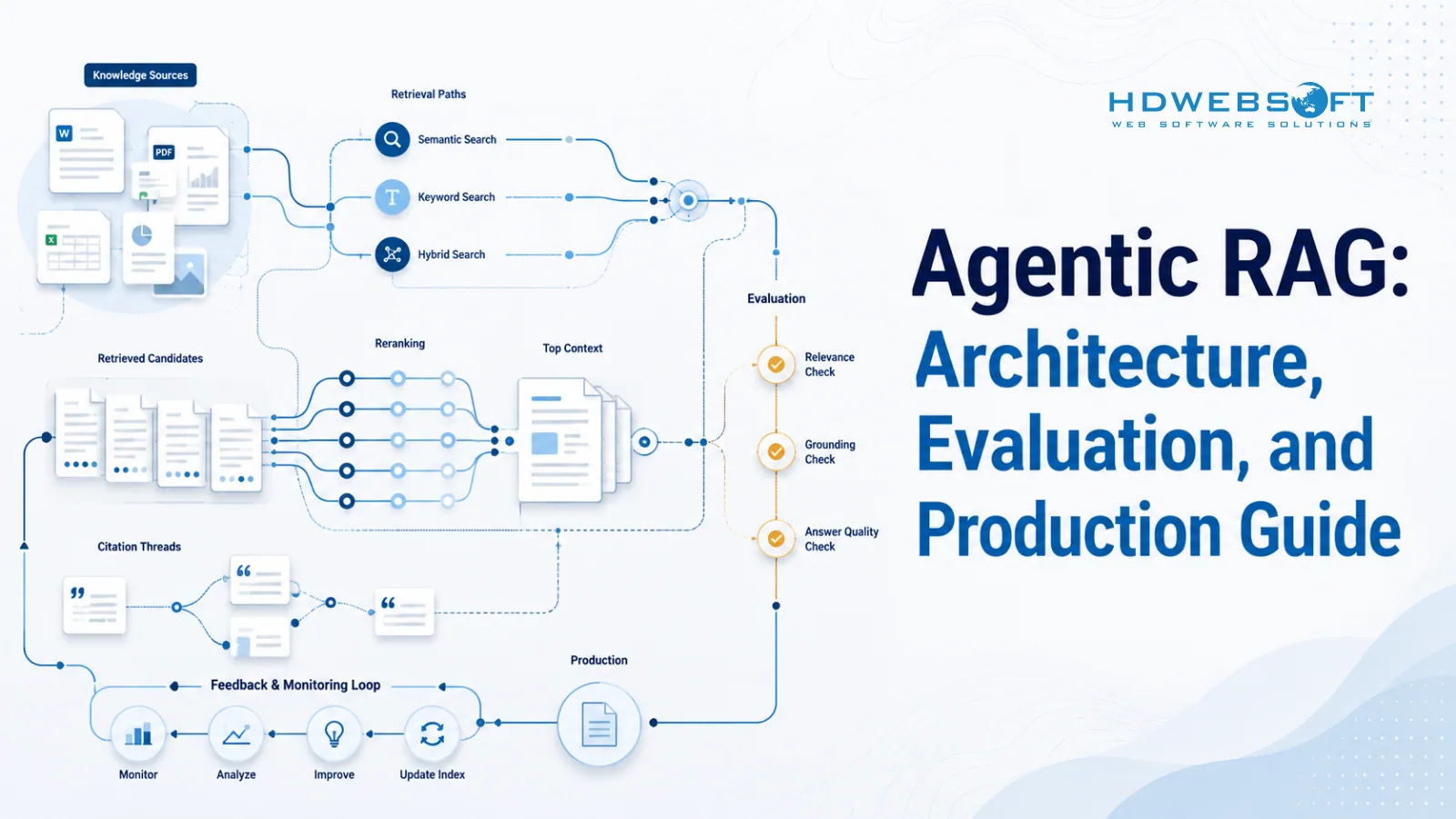
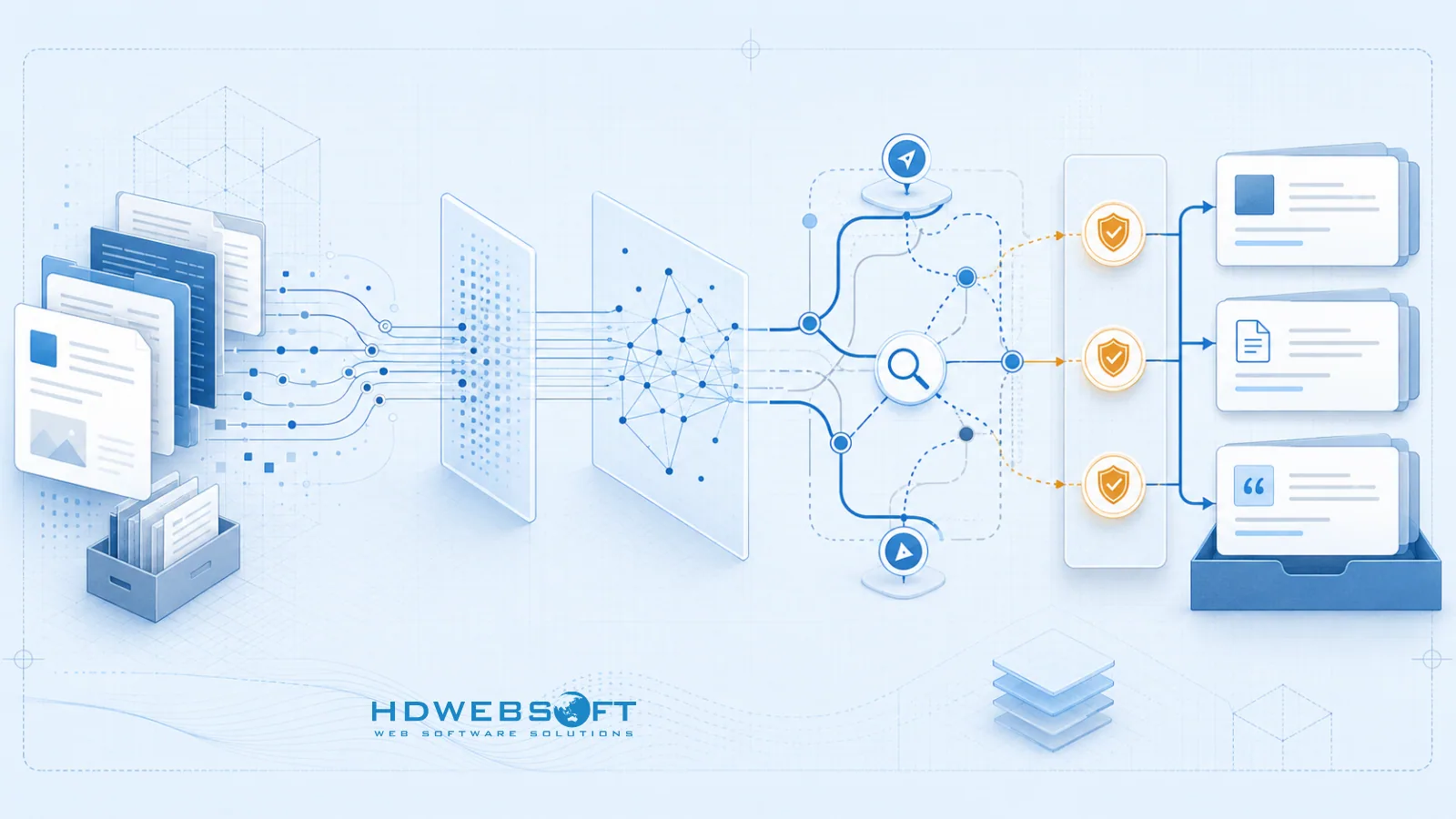
Agentic RAG is a retrieval-augmented generation architecture where an AI agent can plan retrieval steps, query knowledge sources, reason over retrieved context, use tools, and decide what to do next. Instead of sending one search result into one LLM prompt, an agentic RAG system can ask follow-up retrieval questions, validate whether sources are sufficient, cite evidence, call business systems, or escalate when the answer is not safe enough.
For teams exploring agentic AI in production, RAG is often the difference between a convincing demo and a useful enterprise workflow. That gap matters because enterprise adoption is moving quickly: McKinsey’s 2025 global survey reports that 88% of respondents say their organizations regularly use AI in at least one business function, while 23% are already scaling agentic AI systems and another 39% are experimenting with them. A model alone may know general patterns, but it does not automatically know your latest policies, product catalog, customer records, support tickets, engineering documentation, or compliance rules. Agentic RAG gives AI agents a controlled way to work with that changing knowledge.
Key Takeaways
- Agentic RAG combines retrieval, reasoning, orchestration, and tool use so AI agents can work with grounded context.
- RAG is usually better than fine-tuning for private, changing, source-sensitive enterprise knowledge.
- Fine-tuning is useful for behavior, tone, format, and repeatable domain-specific patterns.
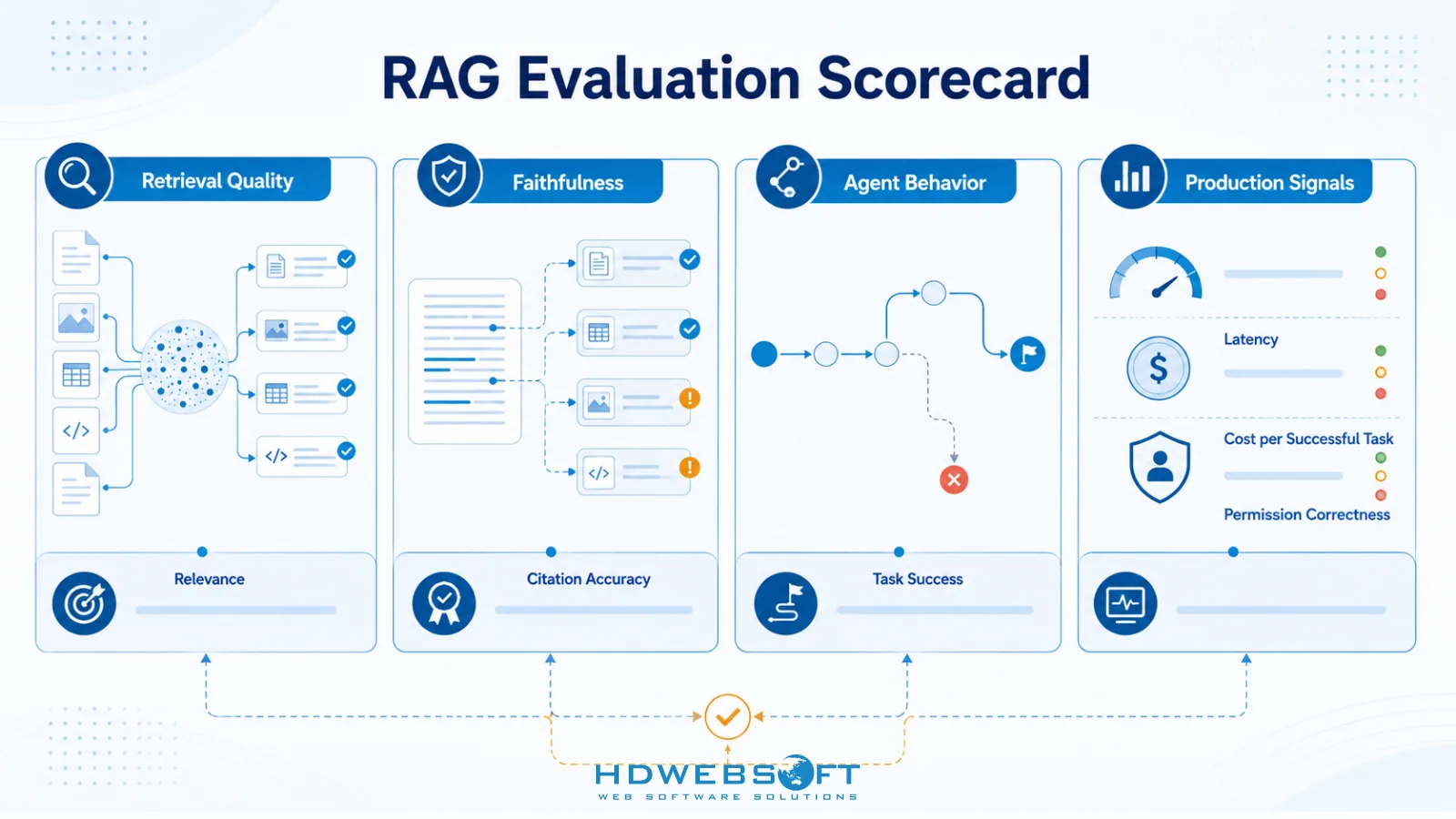
- RAG evaluation should measure retrieval relevance, faithfulness, citation accuracy, task success, permission correctness, latency, and cost.
- RAG in production requires secure ingestion, access control, monitoring, knowledge freshness, fallback handling, and continuous evaluation.
- The best agentic RAG systems are designed around enterprise workflows, not just vector databases.
What Is Agentic RAG?
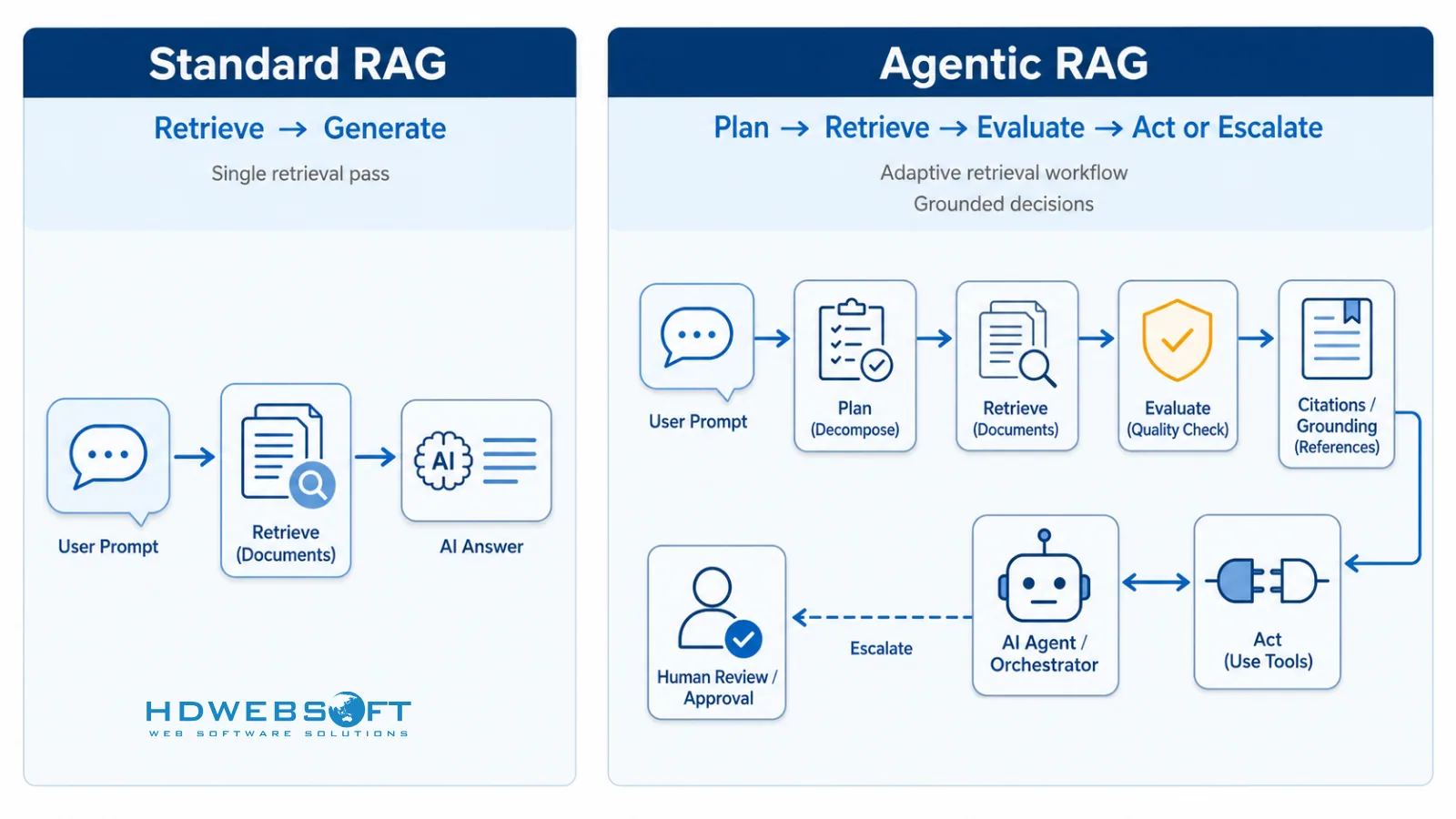
Agentic RAG extends standard retrieval-augmented generation by giving the AI system more control over how retrieval happens. A standard RAG pipeline usually follows a simple pattern: retrieve relevant chunks, place them into the prompt, and generate an answer. That pattern works for many knowledge-base questions, but it becomes limited when the question is broad, ambiguous, permission-sensitive, or connected to a real workflow.
Agentic RAG adds a planning layer. The agent can decide what information it needs, which source to query, whether the retrieved context is good enough, and whether a tool or human approval step is required before the workflow continues.
For example, a support agent using standard RAG might retrieve one help-center article and answer a customer. An agentic RAG system could inspect the customer’s product version, retrieve the matching documentation, check recent incident notes, draft a response with citations, and escalate if the issue involves a refund or service-level commitment.
How agentic RAG differs from standard RAG
The practical difference is control over the retrieval process.
| Capability | Standard RAG | Agentic RAG |
|---|---|---|
| Retrieval flow | Usually one retrieval pass | Multi-step, planned, and adaptive |
| Query handling | Best for direct questions | Better for ambiguous or multi-part tasks |
| Source use | Retrieves context for one answer | Can compare, validate, and retry sources |
| Tool use | Often separate from retrieval | Retrieval can inform tool decisions |
| Workflow fit | Knowledge Q&A | Knowledge-grounded action workflows |
This does not mean every RAG system needs to be agentic. If users ask simple questions against a stable FAQ, standard RAG may be enough. Agentic RAG becomes valuable when the system needs to reason across sources, preserve permissions, cite evidence, and decide the next step in a workflow.
Common use cases
Agentic RAG is useful when answers must be grounded in enterprise knowledge and connected to business context. Common examples include internal knowledge assistants, customer support agents, compliance Q&A tools, developer documentation assistants, sales enablement systems, research assistants, and workflow agents connected to CRM, ERP, ticketing, or document management systems. If your roadmap includes conversational support, our voice chatbot guide explains the customer-facing side of AI assistants, while our Flutter chatbot app case study shows how mobile chatbot delivery connects AI responses with CRM and app workflows.
The shared pattern is simple: the agent should not rely only on model memory. It should retrieve the right knowledge, use that knowledge correctly, and know when it does not have enough evidence to continue.
RAG vs Fine-Tuning for AI Agents
The RAG vs fine tuning decision is not about which technique is more advanced. It is about what problem you are trying to solve.
A useful rule of thumb is: use RAG for changing knowledge and fine-tuning for behavior. RAG helps an AI agent access current, private, source-specific information. Fine-tuning helps shape how a model responds, formats output, follows domain patterns, or performs repeatable tasks.
| Decision Factor | RAG | Fine-tuning |
|---|---|---|
| Best for | Private or changing knowledge | Style, format, behavior, domain response patterns |
| Data freshness | Easier to update | Requires retraining or additional tuning |
| Explainability | Easier with citations | Harder to trace to source |
| Security control | Can support document-level permissions | Harder if knowledge is embedded in model behavior |
| Agent use case fit | Strong for grounded, source-aware answers | Strong for repeatable task behavior |
When RAG is better
RAG is usually the better choice when the agent needs access to knowledge that changes often or must be traced back to a source. This includes product documentation, internal policies, customer support history, legal templates, onboarding documents, pricing rules, engineering runbooks, and industry-specific knowledge bases.
RAG is also stronger when permissions matter. If two users should see different documents, the retrieval layer can enforce those permissions before content reaches the model. That is difficult to guarantee if sensitive knowledge is baked into a fine-tuned model.
For AI agents, RAG is especially useful when the next action depends on source-backed context. A sales assistant should not recommend a pricing exception without checking current rules. A support agent should not propose a fix from outdated documentation. A compliance assistant should cite the policy it used.
When fine-tuning is better
Fine-tuning is useful when the model must repeatedly behave in a specific way. That may include producing a strict output format, using domain-specific terminology, following a specialized writing style, classifying requests in a predictable structure, or improving performance on a narrow task.
Fine-tuning does not replace knowledge retrieval when the answer depends on fresh enterprise data. It can reduce prompt complexity and improve consistency, but it should not be treated as a knowledge-management system.
When to combine both
Many production AI systems use both. RAG supplies current, source-grounded knowledge. Fine-tuning shapes behavior, output format, or domain-specific response patterns. Evaluation checks whether the system is accurate. Guardrails control what the agent can access or do.
That combination is often stronger than forcing one technique to solve every problem.
Agentic RAG Architecture
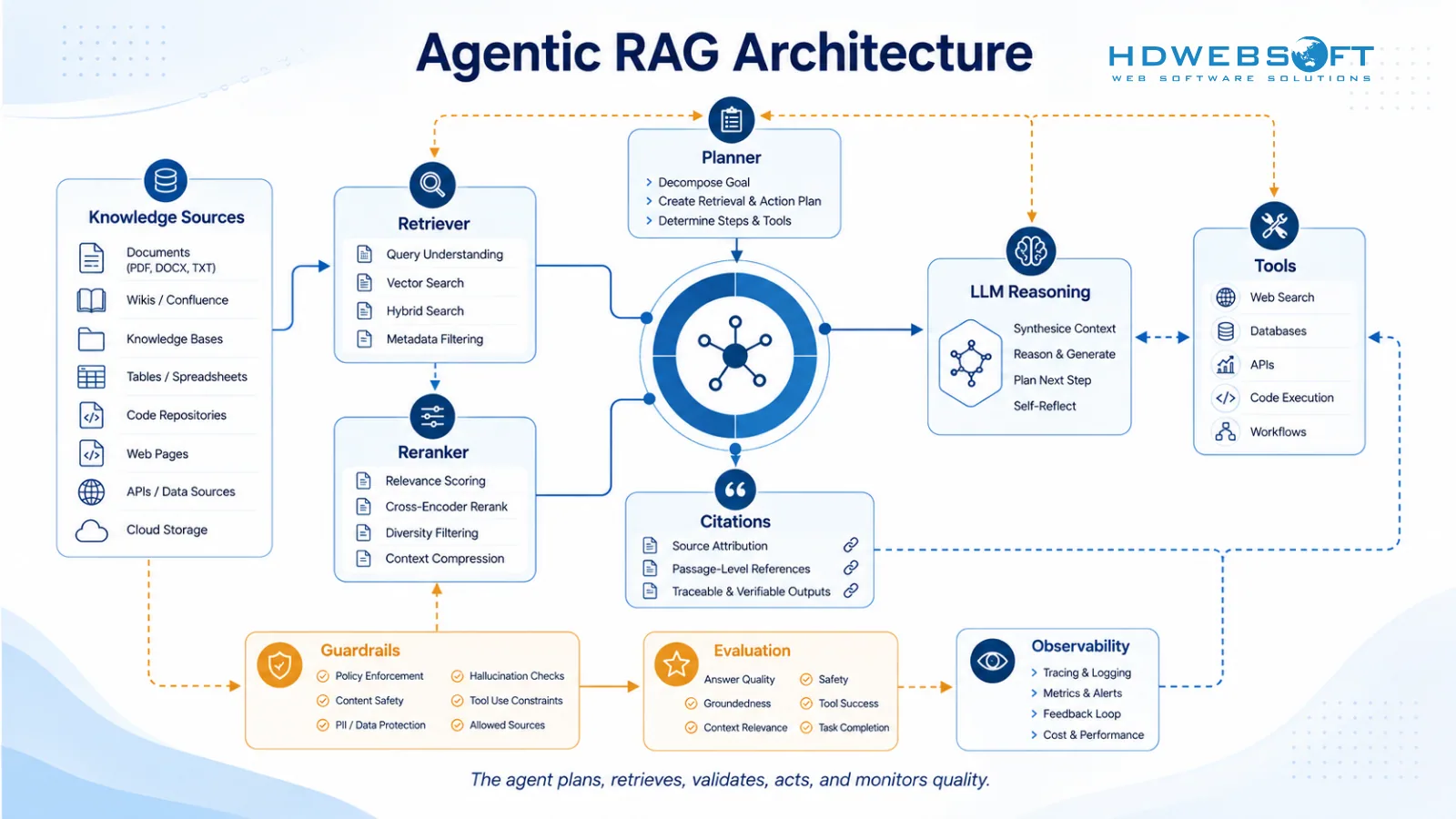
Agentic RAG architecture describes the components in the system and how they interact. The exact stack can vary, but the core responsibilities are consistent: understand intent, retrieve relevant context, reason over that context, use tools when appropriate, ground the answer, and observe quality over time.
Core components of an agentic RAG system
A practical agentic RAG architecture usually includes:
- A user interface or agent entry point
- A planner or orchestrator
- A retrieval layer
- An embedding model
- A vector database, search index, document store, or internal knowledge source
- A reranking layer for improving result order
- An LLM reasoning layer
- Memory and context management
- A tool-calling layer
- Citation and grounding logic
- Guardrails and access control
- Evaluation and observability components
These components should not be selected only because they are popular. They should map to the workflow, risk level, expected traffic, source complexity, and operating model.
Planner and orchestrator
The planner decides what the agent should do next. It may identify that a user question requires product documentation, then customer account data, then a final answer with citations. It may also decide that the available context is insufficient and ask a follow-up question instead of guessing.
The orchestrator manages this flow. It controls retrieval attempts, tool calls, stop conditions, fallback paths, and human approval points. In a simple system, orchestration may be a small workflow with a few deterministic steps. In a more complex system, it may involve dynamic planning and multiple tools, especially when the RAG layer needs to connect with the integration patterns covered in our AI agent integration and interoperability guide.
Retrieval layer
The retrieval layer is responsible for finding useful context. It may use embeddings, keyword search, hybrid search, metadata filters, or reranking. In enterprise systems, retrieval also needs to respect user roles, tenant boundaries, document states, and source freshness.
This is where agentic RAG architecture becomes different from a generic chatbot. The agent is not just asking, “What text is semantically similar?” It is asking, “What source is relevant, allowed, current, and sufficient for this task?”
Vector database and knowledge sources
A vector database is common in RAG systems, but it is not the only knowledge source. Enterprise RAG may also depend on search indexes, relational databases, document repositories, CRM systems, ticketing platforms, data warehouses, or internal APIs.
The architecture should make clear which sources are authoritative for each type of question. If product documentation and support tickets disagree, the agent needs a rule for which source wins or when to escalate.
Memory and context management
Memory helps the agent keep track of the conversation or task state. Retrieved context helps the agent answer a specific question. These are not the same thing.
A production system should distinguish between session memory, user preferences, retrieved documents, intermediate reasoning state, and long-term knowledge. Without that separation, the agent may rely on stale context, carry forward irrelevant details, or mix user-provided text with trusted source material.
Tool-calling layer
Tool calling allows the agent to interact with systems outside the model. In agentic RAG, tool use should be informed by retrieved context. For example, the agent may retrieve a warranty policy before deciding whether to create a return ticket, or retrieve an engineering runbook before drafting an incident response. The same principle appears in practical chatbot integration work, such as our AI chatbot integration for a digital marketplace case study, where AI responses needed to connect with real-time marketplace and campaign workflows.
Tools should be scoped, validated, and connected to clear business rules. The retrieval result should support the action; it should not silently authorize every action.
Citation and grounding layer
Grounding is the discipline of tying the agent’s answer back to retrieved evidence. Citations help users and reviewers understand where an answer came from. They also make failures easier to debug.
Citation quality matters. A citation is not useful if it points to a loosely related page while the answer depends on a different source. Strong agentic RAG systems track which retrieved chunks actually support which claims.
Guardrails, evaluation, and observability components
Guardrails, evaluation, and observability should be part of the architecture rather than late add-ons. In the architecture, guardrails define where access control and validation occur. Evaluation defines how quality is measured. Observability defines what the team can inspect when the agent fails. This aligns with the NIST AI Risk Management Framework, which encourages teams to design AI systems around trustworthiness characteristics such as validity, reliability, safety, security, transparency, explainability, privacy, and fairness.
This article focuses on RAG-specific controls. For broader controls around prompt injection, tool permissions, human-in-the-loop workflows, data residency, and audit logs, see our guide to LLM security for agentic AI.
How to Build an Agentic RAG System
Building an agentic RAG system should start with the workflow, not the model. If your team is asking how to build an agentic RAG system, the most reliable path starts with clear decisions about users, sources, permissions, actions, and success criteria before the first retrieval pipeline is built.
Step 1: Define the business workflow
Start by defining what the agent is supposed to help with. A vague goal such as “answer questions about our documents” is not enough. A stronger workflow definition might be: “Help support agents answer customer questions about product setup using approved documentation, recent release notes, and account-specific configuration.”
Clarify who will use the system, what sources it can access, what actions it can take, what it must never do, and what requires human approval. Also define measurable outcomes such as response accuracy, average handling time, escalation quality, or successful task completion.
Step 2: Prepare the knowledge base
Knowledge preparation is often the most underestimated part of RAG development. Teams need to identify approved source systems, remove duplicate or outdated documents, preserve document ownership, add metadata, and decide how permissions should flow from source systems into retrieval.
This step is also where freshness requirements become practical. A policy assistant may need daily updates. A product documentation assistant may need updates after every release. An internal HR assistant may require versioning so it does not answer from retired policies.
Step 3: Design chunking and retrieval
Chunking and retrieval decisions should reflect the content type and user task. Long policy documents, API references, support tickets, and product catalogs often require different chunking and metadata strategies.
Teams should decide whether vector search is enough or whether hybrid search is needed. They should also decide when reranking is worth the added cost and latency. If citations are important, chunks should preserve enough context for the answer to be understandable and auditable.
The goal is not to use every retrieval technique. The goal is to retrieve the smallest useful set of allowed, current, source-relevant context.
Step 4: Add agent orchestration
Once retrieval works for representative questions, add orchestration. The agent may need to rewrite a query, retrieve from a second source, ask a clarifying question, call a business tool, or stop because confidence is too low.
Good orchestration includes clear stop conditions. Without them, agents can loop through retrieval calls, increase cost, and still produce uncertain answers. Fallbacks should be designed early: ask the user for clarification, show source options, route to a human, or refuse when the system lacks enough evidence.
Step 5: Add RAG-specific guardrails
RAG-specific guardrails focus on retrieved content and source-connected workflows. Retrieved documents should be treated as data, not instructions. The system should validate sources, enforce permissions before retrieval results reach the model, and limit tool calls based on verified context.
The agent should also know what to do when sources are insufficient. In many enterprise workflows, a safe refusal or escalation is better than a confident answer with weak grounding.
Step 6: Prepare evaluation before launch
Before launch, prepare an evaluation dataset and release criteria. The dataset should include normal questions, edge cases, permission-sensitive cases, stale-document cases, ambiguous requests, and tool-connected workflows.
Do not wait until production to decide what “good” means. Define acceptable thresholds for retrieval relevance, answer faithfulness, citation quality, task success, latency, and cost before users depend on the system.
Concise implementation phase summary
| Phase | Main Focus |
|---|---|
| Discovery | Use case, data sources, risks, and success metrics |
| Prototype | Ingestion, retrieval, and source grounding |
| Orchestration | Planning, tool calls, fallbacks, and human approval |
| Hardening | Evaluation, security, permissions, and guardrails |
| Production | Monitoring, cost control, feedback, and maintenance |
RAG Evaluation: How to Know If It Works
RAG evaluation should answer a practical question: can this system retrieve the right context, produce a faithful answer, complete the task, and do so within acceptable cost, latency, and permission boundaries? Evaluation frameworks such as Ragas are useful references because they separate faithfulness, answer relevance, and context quality instead of treating “good answer” as one vague score.
That is broader than chatbot testing. A chatbot may be judged mainly on answer quality. An agentic RAG system must also be judged on retrieval quality, source grounding, tool behavior, workflow outcome, and operational reliability.
Why RAG evaluation is harder than chatbot testing
A RAG system can fail in several different ways. It may retrieve the wrong source. It may retrieve the right source but ignore it. It may cite a source that does not support the answer. It may answer correctly but violate permissions. It may complete the task but take too many tool calls or cost too much.
Separating these failure modes is important because each one requires a different fix. Better prompts will not solve a missing permission filter. A better vector database will not fix an agent that calls the wrong tool.
Retrieval metrics
Retrieval metrics show whether the system finds useful context before generation begins.
- Recall@K shows whether the right source appears somewhere in the top retrieved results. It matters because the model cannot use evidence that was never retrieved.
- Precision@K shows how much of the retrieved set is actually useful. It matters because noisy context can confuse the model and increase cost.
- MRR shows whether the best source appears near the top. It matters because top-ranked results often receive more attention in the final prompt or reranking flow.
- NDCG helps assess whether the ranking order is useful when some sources are more relevant than others. It matters for complex queries where several documents may partially help.
For enterprise implementation, these ranking metrics should be paired with practical checks: retrieval relevance, source coverage, freshness, and permission correctness. Permission correctness is especially important because a technically relevant document is still wrong if the user is not allowed to access it.
Generation and grounding metrics
Generation metrics show whether the model used retrieved context correctly.
- Faithfulness checks whether the answer is supported by the retrieved sources.
- Answer relevance checks whether the response actually addresses the user’s question.
- Citation accuracy checks whether cited sources support the claims attached to them.
- Hallucination rate tracks unsupported or invented claims.
- Completeness checks whether the answer covers the required parts of the task.
- Refusal correctness checks whether the system refuses or escalates when sources are insufficient.
For agentic RAG, citation accuracy is often more useful than a generic “good answer” score. Business users need to know not only whether the answer sounds correct, but whether it is grounded in the right source.
Agent behavior metrics
Agent behavior metrics evaluate whether the system completes the workflow, not just whether it writes a good paragraph.
Important metrics include task success rate, tool-call accuracy, escalation accuracy, human override rate, failure recovery rate, and average step count. Step count is not automatically good or bad, but it can reveal inefficient orchestration. If simple tasks require many retrieval and tool calls, the system may be too slow or expensive for production use.
Tool-call accuracy deserves special attention. A support agent that retrieves the right refund policy but opens the wrong ticket type is still failing the workflow.
Operational quality metrics
Operational metrics show whether the system is usable at scale. Track latency, cost per successful task, error rate, retrieval failure rate, user feedback, and regression failure rate.
Cost per successful task is more useful than raw token spend. A system that costs more per request may still be acceptable if it completes valuable workflows reliably. A cheaper system may be worse if it creates rework, escalations, or incorrect answers.
Evaluation dataset design
A useful evaluation dataset should reflect real enterprise use, not only ideal questions. For teams deciding how to evaluate a RAG system, the dataset should include golden question-answer pairs, realistic user queries, edge cases, ambiguous requests, permission-sensitive scenarios, stale-document cases, and adversarial retrieved content.
If the agent uses tools, include tool-connected workflow cases. For example, test whether the agent can retrieve a policy, decide that human approval is required, and avoid calling an action tool prematurely.
The dataset should evolve after launch. Production feedback, failed queries, human overrides, and support escalations should become new regression cases.
Human evaluation and automated evaluation
Automated evaluation is useful for regression testing and fast iteration. LLM-as-judge approaches can help review answer relevance or faithfulness, but they should not be the only quality gate for high-risk workflows.
Human review remains important when the answer affects customers, money, compliance, safety, or internal decisions. The practical approach is usually a layered one: automated checks for every change, sampled human review for quality, and deeper review for high-risk workflows.
Deploying RAG in Production
Deploying RAG in production is about operating a completed system reliably. If you are deciding how to deploy RAG in production, the main concerns are secure ingestion, monitoring, alerting, access control, knowledge freshness, cost, latency, and failure recovery.
Production architecture checklist
A production RAG environment should include:
- Secure ingestion and refresh pipelines
- Environment separation for development, staging, and production
- Access control enforcement in retrieval
- Vector index backup and recovery
- Monitoring and alerting
- Cost controls
- Fallback paths
- Human escalation
- Incident response
- Continuous evaluation
The goal is not to make the system complex. The goal is to make failure visible, recoverable, and controlled.
Secure ingestion and knowledge freshness
Knowledge freshness is a production responsibility. If the source document changes but the index does not, the agent may answer from outdated information. Production systems need scheduled refresh jobs, failed ingestion alerts, document versioning, and clear source ownership.
Permission sync matters as much as content sync. If a user loses access to a document in the source system, the retrieval layer should reflect that change quickly enough for the risk level of the workflow.
Monitoring and alerting
Monitoring should make RAG failures diagnosable. Teams should be able to inspect the user query, retrieved chunks, source metadata, citations, tool calls, latency, cost, and final response.
Useful alerts include retrieval empty-result spikes, citation failure increases, tool-call failures, ingestion job failures, unusual cost spikes, latency degradation, negative feedback trends, and quality drift signals.
Access control and governance in production
Access control must continue after launch. Production teams should monitor permission mismatches, tenant separation issues, sensitive document handling, and changes in source-system roles. IBM’s 2025 Cost of a Data Breach research reported that 13% of organizations experienced breaches of AI models or applications, and 97% of those lacked proper AI access controls, which makes retrieval permissions and tool authorization operational controls rather than optional safeguards.
This is especially important for multi-tenant SaaS, regulated industries, internal HR tools, legal knowledge bases, and customer-specific support systems. In these cases, the wrong retrieval result can become a data exposure issue, not just an answer-quality issue.
Cost and latency optimization
RAG systems can become expensive when they retrieve too much, rerank too often, use large models for simple routing, or allow agents to loop through unnecessary steps.
Practical optimizations include caching common retrieval results, using smaller models for routing, compressing context, tuning retrieval thresholds, batching embeddings, and applying reranking only when it improves quality enough to justify the cost.
Latency should be measured from the user’s perspective. A technically elegant architecture is not production-ready if users abandon it because every answer takes too long.
Failure handling and incident response
Common production failures include wrong-source retrieval, correct-source retrieval with an unsupported answer, missing citations, stale knowledge, permission mismatches, tool-call failures, and cost spikes.
Each failure mode needs a response path. The system may ask for clarification, refuse, escalate to a human, disable a tool, roll back an index update, or route traffic to a safer fallback. Teams should know who owns each type of incident before the system is business-critical.
Continuous evaluation
Production feedback should feed continuous evaluation. Sample real queries, review failed answers, add regression tests, and require quality checks before prompt, retrieval, model, or index changes are released.
The evaluation metrics do not need to be listed again in every production review. What matters is that the system has quality thresholds and that changes are measured against them.
Common Agentic RAG Mistakes
Agentic RAG projects usually fail for practical reasons: unclear workflows, weak source quality, missing permissions, poor evaluation, or uncontrolled tool use. These issues are avoidable if teams treat RAG as a production system rather than a search demo.
Treating RAG as just vector search
Vector search is only one part of the system. If the agent cannot understand the workflow, respect permissions, cite sources, or decide when to escalate, it will not behave like a reliable enterprise assistant.
The fix is to design around the business task first, then choose retrieval methods that support that task.
Skipping evaluation until after launch
Without evaluation, teams often discover retrieval gaps, hallucinations, and citation issues only after users start depending on the system.
The fix is to prepare evaluation cases and release criteria before launch, then expand them with production feedback.
Using one retrieval strategy for every question
A simple FAQ question, a compliance question, and a multi-step customer support workflow should not always use the same retrieval path. One strategy may be too expensive for simple cases and too shallow for complex ones.
The fix is to route by intent, document type, risk level, and source requirements.
Ignoring source permissions
A retrieved document can be relevant and still unsafe to use. If the user should not access it, the agent should not see it either.
The fix is to preserve permissions during ingestion, enforce them during retrieval, and monitor them in production.
Letting the agent act without boundaries
Tool-connected RAG workflows can fail when the agent takes action from weak context. A retrieved document may be outdated, incomplete, or unrelated to the requested action.
The fix is to validate tool inputs, require stronger evidence for high-risk actions, add fallbacks, and use human approval where appropriate.
Build In-House or Hire a Partner?
Some teams should build agentic RAG internally. Others will move faster and reduce risk by working with an experienced AI development partner.
Build in-house if you already have strong AI/ML engineers, platform engineers, security support, data governance ownership, and the capacity to operate the system after launch. This makes sense when agentic RAG is part of a long-term strategic AI platform.
Consider hiring a partner if you need faster production delivery, retrieval architecture experience, evaluation support, enterprise integration, or knowledge transfer for your internal team. Agentic RAG requires more than connecting an LLM to a vector database. It involves workflow design, ingestion, permissions, orchestration, evaluation, monitoring, and ongoing improvement.
HDWEBSOFT helps teams design, build, evaluate, and deploy agentic RAG systems for enterprise workflows. We can support retrieval architecture, knowledge ingestion, orchestration, tool integration, evaluation, production monitoring, and long-term maintenance through our AI development services, AI integration services, and AI chatbot development services.
Conclusion
Agentic RAG is more than adding vector search to an LLM. It is a practical architecture for giving AI agents grounded, permission-aware, source-backed knowledge and a controlled way to use that knowledge in business workflows.
RAG is usually the right foundation when knowledge is private, changing, and source-sensitive. Fine-tuning still has value when the system needs consistent behavior, format, or domain-specific response patterns. The strongest production systems often combine both, then validate quality through evaluation and maintain reliability through production operations.
If your organization is planning an agentic RAG system, start with the workflow, source quality, permissions, and success metrics. Then build the retrieval and orchestration layers around those requirements. When the system needs to support real users, real data, and real business actions, careful architecture and production discipline matter more than a fast demo.
If you want support designing or deploying an agentic RAG system, HDWEBSOFT can help you move from concept to production with practical engineering, evaluation, and integration support.
FAQ
What is agentic RAG?
Agentic RAG is a retrieval-augmented generation architecture where an AI agent can plan retrieval steps, query knowledge sources, use tools, reason over retrieved context, and decide whether to answer, retrieve again, or escalate.
How is agentic RAG different from standard RAG?
Standard RAG usually performs one retrieval pass before generating an answer. Agentic RAG can plan, retrieve iteratively, evaluate whether context is sufficient, call tools, and adapt its next step based on the workflow.
Is RAG better than fine-tuning for AI agents?
RAG is usually better for private, changing, source-sensitive knowledge. Fine-tuning is better for consistent behavior, tone, format, or domain response patterns. Many production systems use both.
How do you build an agentic RAG system?
Start with the business workflow, prepare the knowledge base, design chunking and retrieval, add orchestration, implement RAG-specific guardrails, and prepare evaluation criteria before launch.
How do you evaluate a RAG system?
Evaluate retrieval relevance, faithfulness, citation accuracy, task success rate, tool-call accuracy, permission correctness, latency, and cost per successful task using realistic enterprise test cases.
How do you deploy RAG in production?
Production RAG needs secure ingestion and refresh pipelines, monitoring, alerting, access control, knowledge freshness checks, backup and recovery, cost controls, fallback paths, and continuous evaluation.