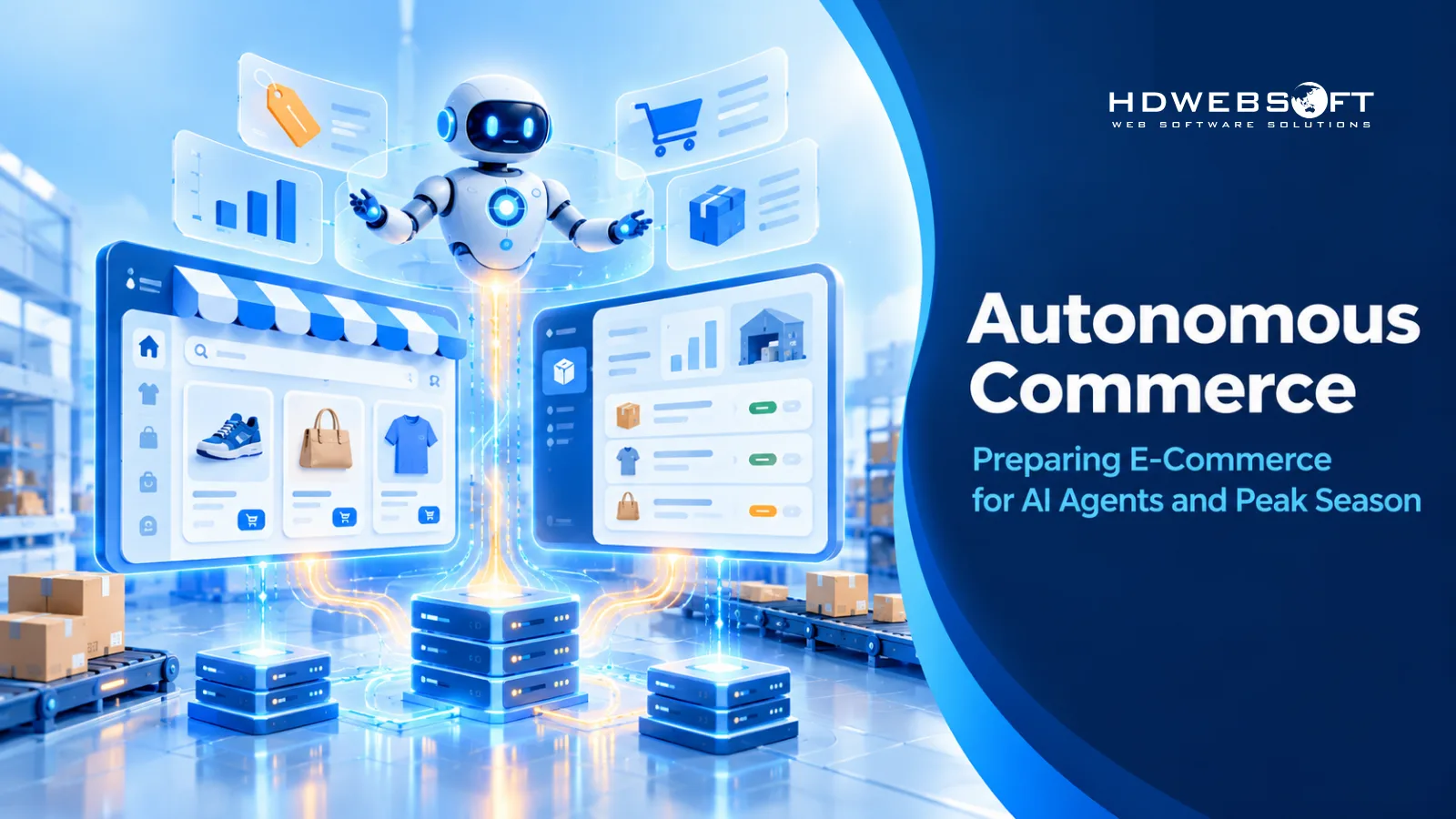
Autonomous commerce is the practice of letting AI agents run defined commerce operations — pricing, inventory, personalization, even parts of checkout — by making and executing decisions inside explicit guardrails, rather than waiting for a human to approve every action. It is not AI without oversight: agents operate within permissions, policies, and approval thresholds that humans set and can revoke at any time.
Two forces make this relevant now. On the selling side, retailers are delegating operational decisions to agents faster than manual workflows can scale. On the buying side, shoppers increasingly arrive through AI-mediated channels — assistants that research, compare, and sometimes purchase on their behalf. And while artificial superintelligence remains a hypothetical future, today’s agents already demand an e-commerce architecture built for machine-speed decisions — one that also survives peak season, when traffic and decision velocity spike together.
Key Takeaways
- Autonomous commerce means AI agents execute defined decisions inside guardrails — not unrestricted AI. Autonomy arrives in three levels: assisted, semi-autonomous, and bounded autonomous.
- Four core use cases: autonomous pricing, AI-driven inventory forecasting, personalization and merchandising, and readiness for buyer-side agents that purchase on a shopper’s behalf.
- Safe autonomy needs five prerequisites: real-time commerce data, agent-accessible APIs, transaction integrity, agent permissions and payment guardrails, and observability with human override.
- Peak-season readiness adds a second checklist beyond load testing — agent rate limits, execution quotas, kill switches, fallback workflows.
- Most businesses should augment or integrate AI capabilities rather than replatform.
What Is Autonomous Commerce?
Autonomous commerce is an operating model where software agents perceive commerce state — prices, stock levels, demand signals, customer behavior — decide what to do within a defined scope, and execute through your systems without a human in every loop. The human’s role shifts from operator to supervisor: setting objectives, constraints, and escalation rules.
Three terms get conflated here:
- Traditional ecommerce automation follows fixed rules a person wrote: “if stock falls below 10, reorder 500.” The rule never adapts; it just runs.
- Agentic commerce describes commerce mediated by AI agents — actors that pursue goals rather than follow a static script.
- Autonomous commerce is the high-autonomy end of that spectrum: agents not only decide but execute — repricing a SKU, reallocating inventory, launching a promotion — inside bounded authority.
All three describe the same trajectory: AI-powered ecommerce moving from rules to goals to bounded execution. Autonomy arrives in three levels, and mature deployments mix all three:
| Level | What the agent does | Human role |
|---|---|---|
| Assisted | Recommends actions; drafts decisions | Approves every action |
| Semi-autonomous | Executes within narrow bounds (e.g., price changes under 3%) | Approves exceptions; reviews logs |
| Bounded autonomous | Executes end-to-end inside hard limits (budgets, floors, ceilings) | Sets policy; audits; holds the kill switch |
The critical word is bounded. Every production-grade deployment defines which decisions an agent may take, on which data, within what limits, and with what escalation path. An agent that reprices within ±5% during off-peak hours is autonomous in a meaningful sense — and thoroughly governed.
On the buyer side, this is already visible. OpenAI and Stripe’s Agentic Commerce Protocol, announced in September 2025, lets shoppers complete purchases inside ChatGPT through an agent handling checkout on their behalf. It is an early protocol, not a universal standard — but it signals the direction: your next customers may be agents reading your catalog and purchasing programmatically.
Core Use Cases of Autonomous Commerce
The strongest case for autonomous commerce is specific operational decisions too fast, too numerous, or too data-heavy for human teams. Four use cases consistently justify the investment — each with a clear decision scope and a failure mode to engineer around.
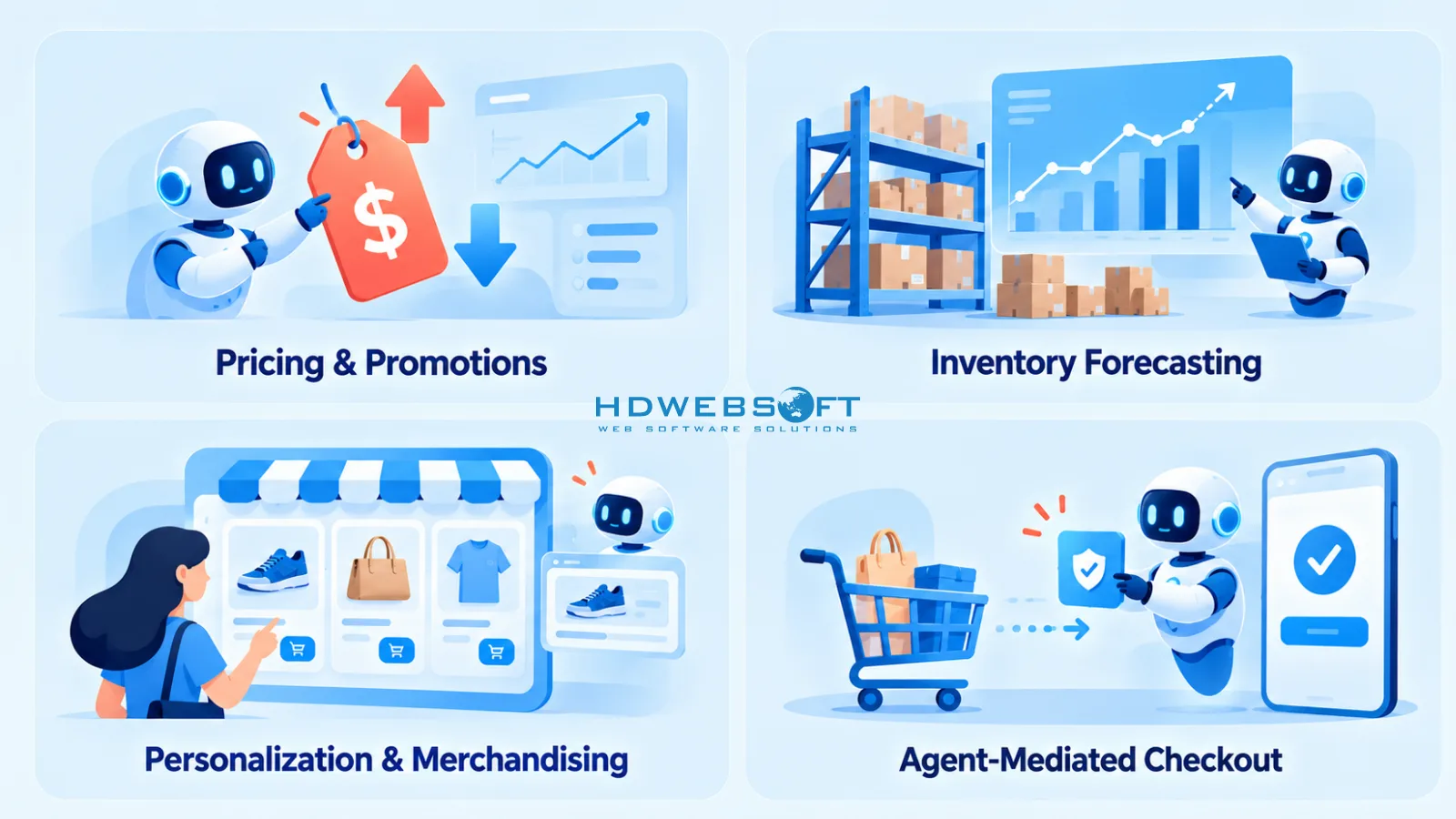
Autonomous Pricing & Promotion Agents
- Input data: Competitor prices, own margin floors, stock levels, demand velocity, promotion calendars.
- AI decision: Optimal price point or promotion depth for each SKU, within policy bounds.
- Authorized action: Publish price updates to the storefront and channels — typically capped by percentage movement and frequency limits.
- Business KPI: Margin per visit, sell-through rate, promotion ROI.
- Failure conditions and safeguards: Data feeds go stale; competitor scraping misreads bundles as like-for-like; agents race each other to the floor. Mitigate with hard price floors, movement caps, anomaly detection that suspends the agent on bad inputs, and scheduled human review.
AI-Driven Inventory Forecasting & Replenishment
- Input data: Sales history, seasonality, lead times, supplier reliability, marketing calendar, external demand signals.
- AI decision: Reorder points, quantities, and allocation across warehouses or channels.
- Authorized action: Raise purchase orders or transfer orders — often semi-autonomous, with auto-approval under a spend threshold.
- Business KPI: Stockout rate, inventory carrying cost, days of supply, forecast accuracy.
- Failure conditions and safeguards: Cold-start SKUs have no history; a viral spike looks like noise until it isn’t; a bad forecast compounds into overstock. Safeguards: confidence thresholds routing low-certainty calls to planners, spend ceilings, and dry-run mode logging recommendations before execution.
Personalization & Merchandising Agents
- Input data: Browsing and purchase history, segment membership, real-time session behavior, catalog attributes, inventory position.
- AI decision: Which products, content, and offers to surface for each visitor or segment.
- Authorized action: Update recommendations, homepage merchandising, search ranking, and triggered campaigns.
- Business KPI: Conversion rate, average order value, revenue per session, return rate.
- Failure conditions and safeguards: Agents can over-optimize for clicks over margin; feedback loops narrow the catalog customers see; stale segments misfire. Guardrails: business-rule overlays (margin weighting, strategic pushes), change-frequency caps, and periodic A/B audits against a control experience.
Buyer-Side Agents & Agent-Mediated Checkout
- Input data: Your product catalog, pricing, availability, policies — as read by a customer’s AI agent rather than a human browsing.
- AI decision: Whether your product matches the buyer agent’s criteria and constraints.
- Authorized action: The buyer agent initiates checkout, applies payment credentials it holds under its owner’s mandate, and completes the order.
- Business KPI: Agent-referred conversion rate, share of orders from AI-mediated channels, agent catalog-readability coverage.
- Failure conditions and safeguards: Fraudulent or spoofed agents, malformed programmatic orders, agent-unreadable catalogs that exclude you from consideration. Safeguards: agent authentication and attestation, programmatic-order validation identical to human checkout, and machine-readable product data as a discovery prerequisite.
Prioritization rule: pick the use case where decisions are frequent, measurable, and reversible — pricing and inventory qualify on all three, which is why they’re the usual first pilots.
Architecture & Readiness for Autonomous AI
Agents are only as safe as the platform they run on. Five capabilities determine whether an agent acts on current truth, executes transactions correctly, stays inside its authority, and can be stopped — with governance and security cutting across all five.
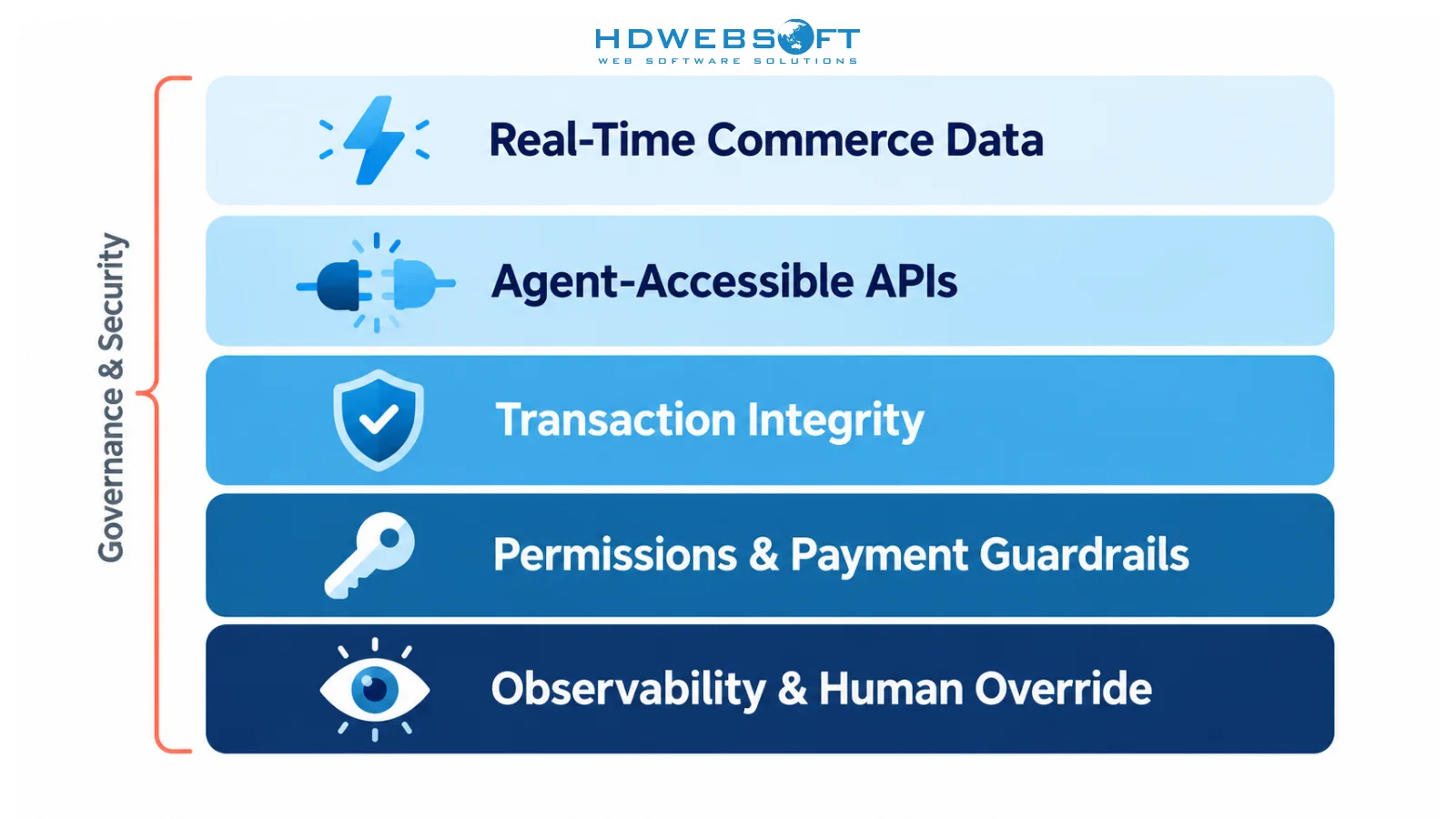
Real-Time Commerce Data & Event Integration
Agents deciding on stale data make confidently wrong choices: pricing agents need current competitor and inventory data, inventory agents need live sales velocity, personalization agents need session context in seconds.
The practical move is an event-driven backbone — inventory, pricing, order, and catalog changes flow as events agents subscribe to, rather than batch exports read on a schedule. Not everything needs real-time consistency: pricing and stock availability do — an agent selling the last unit twice is a transaction failure — while descriptions and reporting aggregates tolerate batch fine. The task is separating decision-relevant data from reference data that can lag.
Composable and Agent-Accessible Commerce APIs
An agent can only execute what it can call. If repricing means logging into an admin UI, autonomy is blocked regardless of how good the model is. Every operation an agent performs needs a well-defined API with authentication, authorization, and rate limits.
An API-first or headless ecommerce architecture makes this straightforward because commerce capabilities are already exposed as services — with the side benefit of making your catalog agent-readable for buyer-side agents. But headless migration is not a prerequisite: many platforms expose enough API surface for a bounded pilot, and middleware can wrap legacy systems with agent-callable interfaces. The narrower question: which operations must agents invoke, and are they programmatically reachable today?
Transaction Integrity & Inventory Consistency
An agent that double-books stock does it at machine speed, thousands of times, before anyone notices. The controls are classical but non-negotiable:
- Inventory reservations — stock held atomically at checkout initiation, not confirmed after the fact.
- Idempotency on every write path — a retried order must never create a duplicate.
- Price validation at transaction time — the quoted price is the charged price, or the transaction halts.
- Payment callback handling that treats payment state as the source of truth, with defined behavior for timeouts.
- Rollback mechanisms for every authorized action — a repricing run must be reversible as a unit.
Most mature platforms implement pieces of this; the readiness question is whether they hold under programmatic, high-frequency usage rather than human-paced traffic.
Agent Permissions, Payment Authorization & Guardrails
An autonomous agent is a new kind of actor: not a user, not a service account, but something holding delegated commercial authority. It needs an identity model to match — least-privilege access, spending limits, approval gates above defined thresholds, and transaction-level authorization so a standing permission doesn’t become unlimited power.
Payment is where this gets concrete. A buyer-side agent carrying a customer’s delegated mandate needs a verifiable way to prove its scope, limits, and expiry. Google’s Agent Payments Protocol (AP2), announced in September 2025, is one emerging approach: cryptographically signed mandates giving merchants proof of a user’s authorization. AP2 is an early protocol, not a mandatory standard — but the problem it solves, how does a merchant trust that this agent may spend this user’s money?, needs an answer wherever agent-mediated orders are accepted.
These permissions also scale beyond a single store — enterprises preparing multiple systems for agents face the same identity, audit, and bounded-authority problems at platform scale, the territory of an enterprise superintelligence architecture approach.
Observability, Evaluation & Human Override
The final capability is knowing what your agents did, why, and being able to stop them:
- Decision logs recording, for every action: inputs observed, policy applied, action taken, outcome — machine-readable and retained for audit.
- Evaluation and monitoring watching for policy violations, anomalous patterns (a pricing agent drifting to the floor, catalog diversity collapsing), and degraded inputs — not just uptime.
- Human override as a designed feature: instant kill switches, scoped pauses, fallback to last-known-good state, and escalation paths that reach the right person.
Teams that skip this layer discover its absence during the first incident — usually on the busiest day of the year.
Black Friday Readiness for Autonomous Commerce
Peak season is where autonomous commerce earns or loses its credibility. AI-mediated shopping is growing fast enough to matter for capacity planning: Adobe’s 2026 holiday shopping forecast projects roughly 130% year-over-year growth in AI-driven retail traffic this holiday season, building on observed growth of 127% in August 2026. Two cautions: the August figure is observed data and the holiday figure is a forecast, and AI referral traffic is still a minority of overall ecommerce traffic — total load won’t grow by the same percentage. But agent traffic behaves differently: it arrives in bursts, hits APIs rather than cached pages, and adds programmatic load on top of human peak. Your readiness plan needs to cover both.
The Peak-Season Checklist
Commerce reliability — the classic layer, still mandatory:
- Load test beyond last year’s peak — model traffic plus AI-referral growth, and test at multiples, not parity.
- Verify checkout capacity end-to-end — cart, tax, payment, and confirmation under concurrent load, not just page throughput.
- Stress inventory synchronization — confirm stock consistency across channels under burst ordering, especially last-unit scenarios.
- Confirm payment gateway limits — rate limits, fraud-screening throughput, and your escalation contact for the peak window.
- Audit caching and CDN behavior — know which responses stay cacheable when agents request structured endpoints rather than HTML pages.
- Rehearse failover — degraded-mode behavior (read-only catalog, queued checkout) tested and assigned an owner.
Autonomous agent safety — the new layer:
- Set agent rate limits and execution quotas — cap actions per hour per agent; peak season is not when an agent should discover it can reprice the whole catalog.
- Budget agent decision latency — agents consuming inventory or personalization APIs add load; measure their share under peak simulation.
- Arm and drill the kill switches — every agent needs a tested halt, plus fallback workflows that keep the store on manual rules if agents pause mid-peak.
- Verify audit logging under load — decision logs must survive peak volume without gaps; an unlogged autonomous action is an unexplainable one.
Treat items 7–10 as launch gates, not nice-to-haves: if you cannot pause an agent safely during your highest-revenue weekend, that agent should run in assisted mode until you can.

Modernize, Integrate, or Replatform?
The requirements above sound heavy, but autonomous commerce does not demand a rebuilt platform — it demands honest answers about which gaps block your first pilot. Three paths cover most situations:
| Augment existing platform | Integrate AI capabilities | Replatform / rebuild | |
|---|---|---|---|
| What it means | Keep the stack; add agent capabilities at the edges — recommendations, assisted pricing | Add an agent layer calling platform APIs directly — bounded autonomous execution on defined operations | Replace the commerce core with an API-first platform designed for agent actors |
| Makes sense when | APIs exist but are underused; data quality is acceptable; the pilot is narrow | Platform APIs cover the target operations; transaction controls are sound; you need execution, not advice | APIs are structurally missing or rate-limited; data model is fragmented; vendor roadmap can’t support agents; scalability is failing |
| Risks to watch | Pilot stalls as a dashboard nobody acts on | Integration layer becomes the bottleneck; guardrails bolted on rather than designed in | Cost, timeline, migration risk — solving tomorrow’s problem at today’s prices |
| Typical first move | Recommend-only agent, human-approved | One bounded autonomous loop (e.g., replenishment under spend cap) | Phased migration starting with catalog + pricing APIs |
The decision criteria that matter: does your platform expose the required operations via API, is your data clean enough to act on, do transaction controls survive programmatic use, does peak load scale, and how much of your fate sits in a vendor’s roadmap versus your own codebase.
For pilot selection, pick a use case that is frequent, measurable, and reversible — then define KPIs before launch: margin or conversion lift, decision accuracy, override rate, incident count. A realistic pre-peak sequence: fix the data the agent needs, expose the operations it will call, calibrate in assisted mode, then grant bounded autonomy — with a freeze window before Black Friday, not during it.
Where the honest answer is “our platform can’t expose these operations” or “our data layer can’t support real-time decisions,” that is a modernization conversation rather than an AI project — typically scoped alongside e-commerce software development services work sized to the actual blocker, not a boilerplate replatform.
Conclusion
Autonomous commerce arrives in bounded, governable steps — a series of decisions you delegate once the architecture can support them. The pragmatic path is consistent: start with one measurable use case where actions are frequent and reversible, establish guardrails, and validate that the system holds under peak load before trusting it with your highest-stakes days. The businesses that thrive when buyer-side agents become a real traffic source will be the ones whose platforms were already readable, callable, and safe to operate on. To assess your autonomous commerce readiness or plan a phased modernization, contact HDWEBSOFT to talk through the roadmap.

FAQ
What is the difference between agentic commerce and autonomous commerce?
Agentic commerce is the broader idea of commerce conducted or assisted by AI agents — including buyer-side agents that shop for consumers. Autonomous commerce is the high-autonomy end on the selling side: agents that execute decisions — repricing, reordering, merchandising — inside defined permissions, not just recommend them. The terms overlap heavily in practice.
Can autonomous commerce work with Shopify, Magento, or legacy ecommerce platforms?
Usually yes, up to a point. Shopify exposes real API surface for pricing, inventory, and orders — enough for bounded pilots; Magento and custom platforms offer more control but more integration debt. The constraint is rarely the platform label: it’s whether your pilot’s operations are programmatically reachable and whether your data is clean enough to act on.
How much does it cost to prepare an ecommerce platform for AI agents?
There is no honest fixed number — cost is driven by scope, not the “AI” label. A bounded pilot on existing APIs is a modest integration project; a full agent layer on legacy systems is substantial modernization. Size it by costing the specific gap: which operations need APIs, which data needs real-time movement, which controls need building.
When should businesses start preparing for Black Friday?
On two timelines. Platform changes — new APIs, data pipelines, agent infrastructure — need months plus a stabilization window, so start by mid-year and freeze before November. Checklist items — load tests, kill-switch drills, quota tuning — belong to the weeks before peak. Starting in October means hardening what exists, not launching new autonomy into your highest-risk window.
Are autonomous pricing agents safe without human approval?
Safe is defined by your guardrails, not the agent. A repricing agent with hard floors and ceilings, movement caps, anomaly detection, complete decision logs, and a tested kill switch can run bounded-autonomous with acceptable risk. Approval of every action isn’t required; human supervision — policy-setting, auditing, holding the kill switch — is not optional.