
Evaluating offshore software development quality comes down to verifying four measurable areas: code quality, process discipline, delivery outcomes, and communication reliability. The dependable way to do it is evidence-based. Audit real code, run a paid pilot sprint, and track agreed metrics instead of trusting sales presentations. This guide breaks each area into concrete checks you can run before signing and keep measuring during delivery.
Quality concerns are the main reason businesses hesitate before offshoring, and the hesitation is rational. Quality problems surface late, when they are most expensive to fix. The teams that avoid this outcome treat quality as something to verify continuously, not a promise made during the sales cycle — and the verification starts before signing, with the six capability dimensions in how to choose the best software development company.
What “Quality” Actually Means in Offshore Delivery
“Good quality” is not a feeling — it is observable behavior across four dimensions. When you can name them, you can measure them.

- Code quality covers how the codebase is written and maintained: consistent style, meaningful naming, review discipline on every change, and tests that protect the logic.
- Process quality covers how the team works: automated pipelines and a definition of done that includes testing. A change management process keeps scope and quality stable.
- Delivery outcomes cover what actually ships: defects that reach production, on-time delivery against agreed milestones, and how quickly the team recovers from failures.
- Communication quality covers responsiveness, transparency about problems, and documentation that lets decisions outlive the meeting where they were made.
If a vendor performs well on all four, offshore software development quality stops being a gamble and the cost savings become real. If any one collapses, the savings are usually consumed by rework, delays, and management overhead.
The Quality Scorecard: What to Measure and What Good Looks Like
Use this scorecard to evaluate offshore software development quality dimension by dimension — concrete, checkable signals instead of vague expectations. Agree on the targets before the engagement starts.
| Dimension | What to measure | What good looks like |
|---|---|---|
| Code quality | Code review coverage, static analysis findings, test coverage on core modules | Every merged change is reviewed by a second engineer; coverage trends upward (70%+ on core logic); no critical static analysis issues left open |
| Process quality | CI/CD pipeline health, definition of done, defect escape rate | Automated build and test run on every merge; most defects caught before release, not after |
| Delivery outcomes | On-time delivery rate, change failure rate, production incidents, recovery time | Sprint commitments met predictably; change failure rate trending down; incidents fixed within the agreed window |
| Communication | Response time, update cadence, documentation quality | Status updates arrive without chasing; decisions and trade-offs are written down |
Two practical notes on the scorecard. First, benchmarks only bite when they are contractual. Write the ones you care about into the agreement as service levels and acceptance criteria, as covered in an ultimate guide to software outsourcing contract. Second, track trends rather than snapshots: a team at 65% coverage that improves every sprint beats a team at 75% that is quietly sliding.
Verify Before You Sign: Evidence Over Claims
Pre-engagement evaluation is where most offshore software development quality problems can be caught cheaply. The rule is simple: evaluate artifacts and people, not presentations.
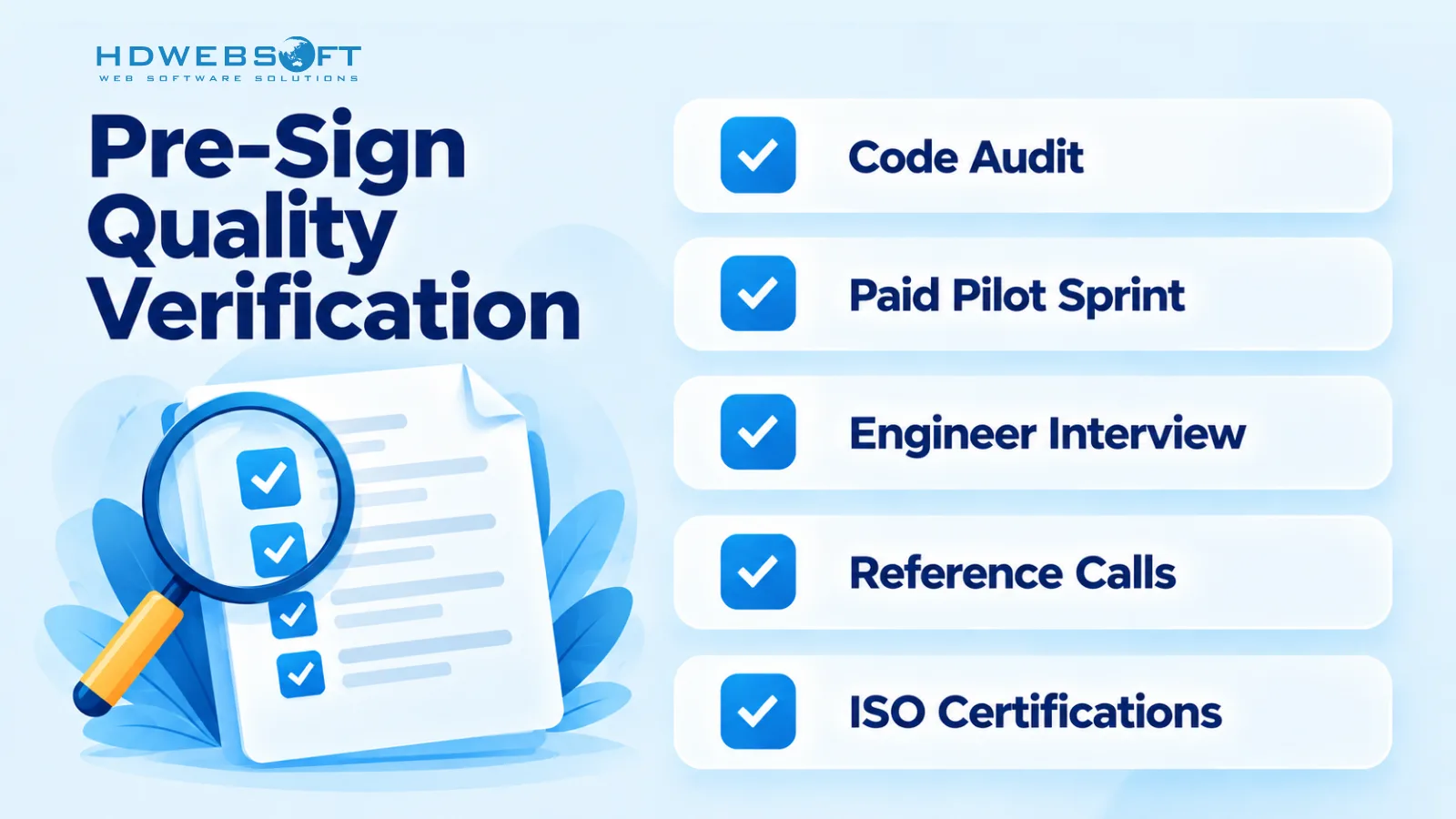
- Audit real code samples. Ask for code from a project of similar scale and complexity — not a polished demo. Look for naming consistency, test presence, and review history. If the vendor cannot show code under NDA, that itself is a signal.
- Run a paid pilot sprint. Two to four weeks of real backlog items shows you delivery rhythm, code quality, and communication under real conditions. Judge the output, not the pitch.
- Interview the engineers, not the account manager. The people who will write your code should be the people who answer your technical questions.
- Call references from similar engagements. Ask specifically about defect rates, deadline reliability, and how the vendor handled the first quality problem.
- Verify certifications. ISO 27001 covers information security management; ISO 9001 covers process quality. Certificates are easy to claim — ask for the current certificates and scope statements.
These checks overlap heavily with trust verification. For a deeper framework on separating verifiable signals from marketing claims, see how to trust an offshore service provider.
Measure During Delivery: The Operating Loop
Signing well is the start; quality is proven in the delivery loop. Five practices keep it visible.

- Sprint reviews with working software. Every sprint ends with a demo of what actually runs — not slides about what was done.
- Code review discipline. Every pull request gets a second pair of eyes, and no engineer merges their own code unreviewed. Review comments should show up in the history, not vanish.
- Automated testing in the pipeline. Unit and integration tests run on every merge, with coverage reported. Manual-only testing does not scale and hides regressions.
- Performance and acceptance testing before releases. Performance testing under realistic load catches issues that unit tests cannot; user acceptance testing with real users confirms the software meets their needs before it ships.
- A shared quality dashboard. Defect counts, coverage, and delivery metrics visible to both sides, reviewed monthly. Quality that is not visible cannot be managed.
For delivery performance benchmarks, the DORA research program is the industry reference — its four keys (deployment frequency, lead time for changes, change failure rate, and time to restore) give you public baselines for the delivery outcomes row of the scorecard.
When QA capacity sits with a separate specialist vendor rather than inside the development team, the same loop applies — the roles, reporting rhythm, and failure modes are covered in QA outsourcing in practice.
Quality Red Flags vs Green Flags
The signals below separate teams that will protect your quality from teams that will defend their invoice.
| Red flags | Green flags |
|---|---|
| No working software demonstrated at sprint reviews | Working demo every sprint, even when incomplete |
| No test coverage reporting, or tests written after the fact | Coverage dashboards shared openly, tests written with the code |
| Engineers merge their own code without review | Second-pair review on every change, visible in history |
| Defect backlog grows sprint over sprint | Defect backlog trending down; bugs triaged within agreed windows |
| ”We will fix it in the next phase” as a default answer | Problems raised proactively with options and trade-offs |
| Restricted access to repository, CI, or ticket board | Full visibility into repo, pipeline, and board for the client |
Most red flags are visible during the pilot sprint — which is exactly why the pilot exists. If you are still selecting a partner and want the fuller selection criteria, see how to choose the right software outsourcing company.
When Quality Drops: The Remediation Ladder
Even good teams have bad sprints. What separates a recoverable dip from a failing engagement is how early it is named and how the response escalates.
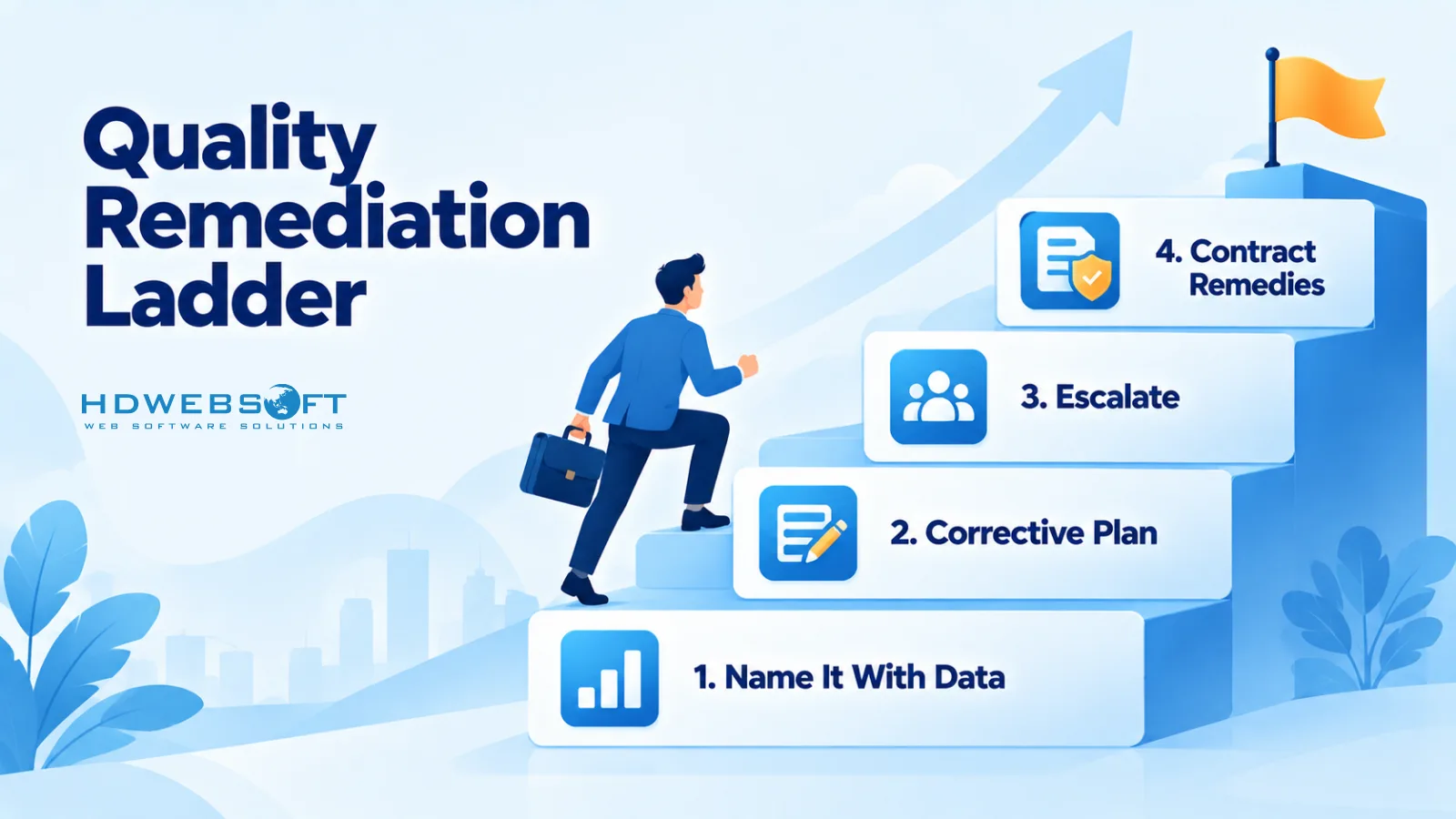
- Step 1 — Name it with data. Raise the specific metric in the sprint review: defect escape rate doubled, coverage dropped, delivery slipped. Vague complaints produce vague fixes.
- Step 2 — Agree on a corrective plan. One owner, one deadline, one measurable target. A corrective plan without a number is a postponement.
- Step 3 — Escalate if two sprints pass without improvement. Move the issue to the delivery manager level and run a structured review of root causes — process, staffing, or scope.
- Step 4 — Use the contract. If quality stays below the agreed service levels, the agreement you signed defines the remedies, from additional QA capacity to penalties or exit terms.
For the broader picture of keeping an engagement healthy over time — including the quarterly success audit — see successful outsourcing: a lifecycle framework for measurable results.
Why Choose HDWEBSOFT for Offshore Software Development
HDWEBSOFT is an ISO 9001 and ISO/IEC 27001 certified offshore software development company. Over 14+ years, we have delivered more than 750+ projects for businesses worldwide. Our quality system is built around the practices in this guide: dedicated QA capacity, mandatory code review, and automated pipelines. Clients can audit our transparent reporting at any time. Explore our offshore software development services, or contact us to discuss how we would prove quality on your project.
FAQ
What metrics should I use to evaluate offshore software development quality?
Track four dimensions: code quality (code review coverage, test coverage, static analysis findings), process discipline (CI/CD health, defect escape rate), delivery outcomes (on-time delivery, change failure rate, production incidents), and communication reliability (response time, update cadence, documentation quality).
How do I evaluate an offshore team before signing a contract?
Audit real code samples from a similar-scale project, run a paid pilot sprint with actual backlog items, interview the engineers who will work on your project, call references, and verify certifications such as ISO 27001 and ISO 9001.
Why does a pilot project matter for quality evaluation?
A paid pilot sprint shows how the team actually works — code quality, communication, and delivery rhythm — on real backlog items. It replaces sales claims with observable evidence at a fraction of the cost of a failed full engagement.
What are red flags in offshore software development quality?
No working software demonstrated at sprint reviews, no test coverage reporting, self-approved merges, a growing defect backlog, repeated promises to fix issues “in the next phase”, and restricted access to the repository or CI pipeline.
How often should I review offshore development quality?
Review quality signals at every sprint review, run a deeper metrics review monthly, and hold a quarterly audit across all four dimensions. If two consecutive sprints show no improvement after a corrective plan, escalate to delivery management.
Conclusion

Evaluating offshore software development quality is not about trusting a vendor’s reputation. It is about verifying four measurable dimensions with evidence — before signing and continuously during delivery. Teams that audit real code, run a pilot sprint, and track an agreed scorecard catch quality problems while they are still cheap to fix.
Ready to work with an offshore team that welcomes quality measurement? Contact HDWEBSOFT to discuss your project.