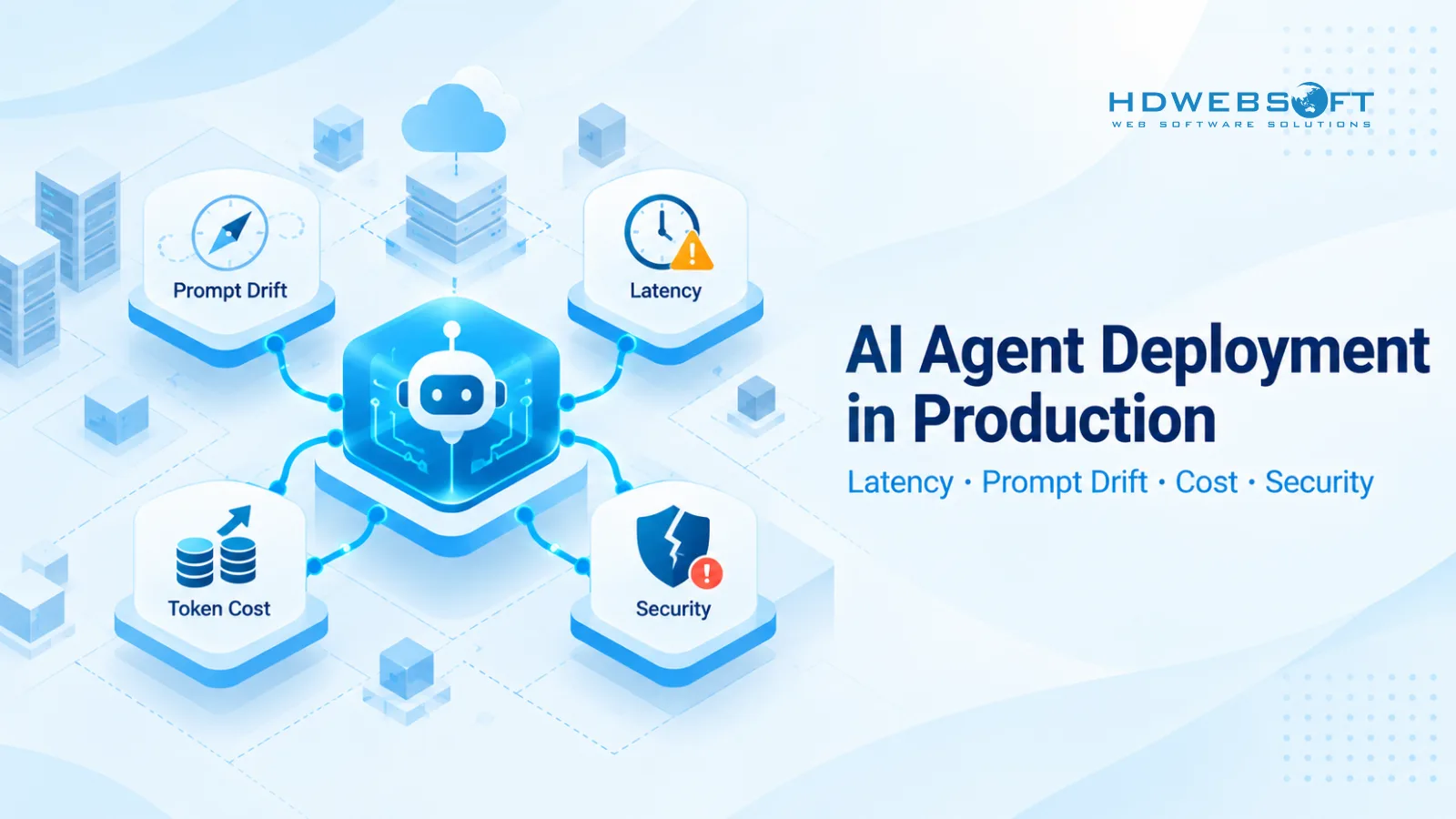
AI agent deployment is where most promising pilots break down. A demo that answers questions in a controlled environment rarely survives contact with real users, real data, and real budgets. Gartner predicts that more than 40% of agentic AI projects will be canceled by the end of 2027, with escalating costs and inadequate risk controls among the key reasons. The gap between pilot and agentic AI in production is not a technology problem alone — it is an engineering discipline problem that few teams anticipate before they hit production.
Pilots succeed because they run in controlled environments with few users, few edge cases, and no real cost pressure. Production exposes agents to traffic spikes, ambiguous inputs, adversarial content, and budget constraints that pilots never simulate. Without guardrails, observability, and cost controls designed for production from the start, agents drift, slow down, burn tokens, and leak data. This article breaks down the four technical bottlenecks that break AI agent deployment in production — prompt drift, API latency, token cost, and security gaps — and explains how layered guardrails, smart context caching, and structured observability help teams deploy AI agents in production reliably.
Key Takeaways
- Gartner predicts more than 40% of agentic AI projects will be canceled by end of 2027, with escalating costs and inadequate risk controls among the key reasons.
- Four technical bottlenecks break production deployments: prompt drift, API latency, token cost, and security gaps.
- Layered guardrails — combining deterministic rules, model-based checks, access control, and human approval — form the backbone of AI agent reliability.
- Multi-agent loops can drive token cost up quickly or superlinearly due to repeated context, retries, and branching; loop limits, model routing, and context caching are essential levers.
- A token cost forecast with budget thresholds and a stop or escalation policy is a prerequisite for production deployment, not an afterthought.
- Observability for AI agents requires redaction, data classification, and retention policy — never log full prompts or context when PII or secrets are present.
What AI Agent Deployment in Production Really Means
AI agent deployment in production is not simply running a model on a server. It is operating an autonomous system that reasons, calls tools, and takes actions under real load, with real users, and real consequences. Production means the system must stay reliable, safe, and cost-controlled when traffic spikes, inputs get messy, and budgets tighten.
Pilot vs Production: The Gap That Kills Projects
The gap between pilot and production is where most projects die. Pilots run in controlled environments with few users, few edge cases, and no real cost pressure. Production exposes agents to traffic spikes, ambiguous inputs, adversarial content, and budget constraints that pilots never simulate.
| Dimension | Pilot | Production |
|---|---|---|
| Users | Handful of testers | Thousands or more, unpredictable patterns |
| Edge cases | Curated, limited | Unbounded, adversarial |
| SLA | Best-effort | Contractual or user-expectation bound |
| Budget | Tolerant | Hard limits, cost alerts, escalation |
| Observability | Manual inspection | Real-time dashboards, alerts, audit trails |
| Rollback | Restart the demo | Controlled rollback, fail-safe defaults |
Teams that treat pilots as experiments rather than production prototypes rarely succeed in scaling. The most successful teams design for production from the start, building guardrails, observability, and cost controls as core requirements rather than afterthoughts.
The Four Technical Bottlenecks That Break Production Deployments
When agents move from pilot to production, four technical bottlenecks account for most AI agent deployment failures:
- Prompt drift — agents gradually lose adherence to original instructions as context grows and intermediate outputs accumulate.
- API latency — sequential calls across LLM inference, tool calls, and orchestration accumulate latency that breaks real-time workflows.
- Token cost — multi-agent loops, retries, and branching drive token usage up quickly or superlinearly.
- Security gaps — indirect prompt injection, unsafe tool calls, and data exfiltration risks that traditional AppSec does not fully cover.
Each bottleneck is predictable, diagnosable, and addressable — but only if teams design for them before production, not after. For enterprise AI agent deployment, these four issues account for the majority of production failures.
Bottleneck 1: Prompt Drift Erodes Agent Reliability
Prompt drift, also called context or instruction drift, is the gradual loss of instruction adherence as an agent processes longer conversations or multi-turn loops. The agent starts aligned with its original instructions, but as the interaction grows, its outputs increasingly diverge from the intended behavior.
What Causes Prompt Drift in Multi-Turn Agent Loops
Several mechanisms drive prompt drift in production AI agent deployment:
- Context growth: As a conversation or agent loop extends, the context window fills with intermediate outputs, tool call results, and user messages. The original system prompt and constraints occupy a shrinking share of the model’s attention.
- Truncation: When context exceeds the model’s window, older content — often including critical instructions — gets truncated or summarized, losing fidelity.
- Conflicting instructions: New instructions from tool outputs, user messages, or other agents can conflict with the original system prompt, and the model may follow the more recent instruction without explicit precedence rules.
- Stale memory: Information stored in memory or retrieval systems may become outdated, leading the agent to act on context that no longer reflects reality.
- Intermediate outputs: Outputs from earlier steps in a multi-agent chain influence reasoning in later steps. If an early output is subtly wrong, the error compounds downstream.
None of these mechanisms require the model to “prefer recent context” — they emerge from the practical realities of context management, truncation, and the sheer volume of intermediate content that production agents generate.
How Prompt Drift Degrades Output Quality Over Time
The consequences of drift compound over long sessions and multi-agent chains, undermining AI agent reliability. Agents begin to hallucinate, call the wrong tools, violate constraints, or lose track of the original goal. In multi-agent loops, drift is especially dangerous: agent A passes context to agent B, which passes to agent C, and each handoff introduces another opportunity for instruction loss.
In production logs, drift shows up as subtle quality degradation that is easy to miss. Outputs may still look plausible on the surface, but they no longer satisfy the original constraints — a customer support agent starts skipping required disclaimers, a data analysis agent begins omitting confidence intervals, or a coding agent stops following the team’s style guide. Without drift detection metrics, these regressions often go unnoticed until a user complains or an audit catches the gap.
Detecting and Containing Prompt Drift
Controlling drift requires both prevention and detection. Prevention techniques include:
- Periodic re-injection: Re-inject the system prompt and critical constraints at regular intervals, rather than relying on the original prompt staying visible throughout a long session.
- Context window management: Summarize or prune intermediate content to keep the original instructions prominent. Keep only what the next step needs.
- Deterministic checkpoints: Validate agent output at each turn against the original constraints, not only at the end of the session.
Detection requires multiple signals, not a single metric. Effective drift detection combines:
- Task success rate: Does the agent still complete its task correctly?
- Constraint violation rate: How often does the agent break explicit rules?
- Tool-call correctness: Are the right tools called with the right parameters?
- Regression evals: Run a fixed evaluation suite periodically to catch quality regressions against a known baseline.
- Semantic distance: Measure how far outputs have drifted from the intended behavior, as one signal among many.
No single metric catches all drift. Teams that rely only on semantic distance or only on task success rate will miss regressions that the other signals catch. A multi-signal approach is the only reliable way to detect drift in production AI agent deployment.
Bottleneck 2: API Latency Breaks Real-Time Agent Workflows
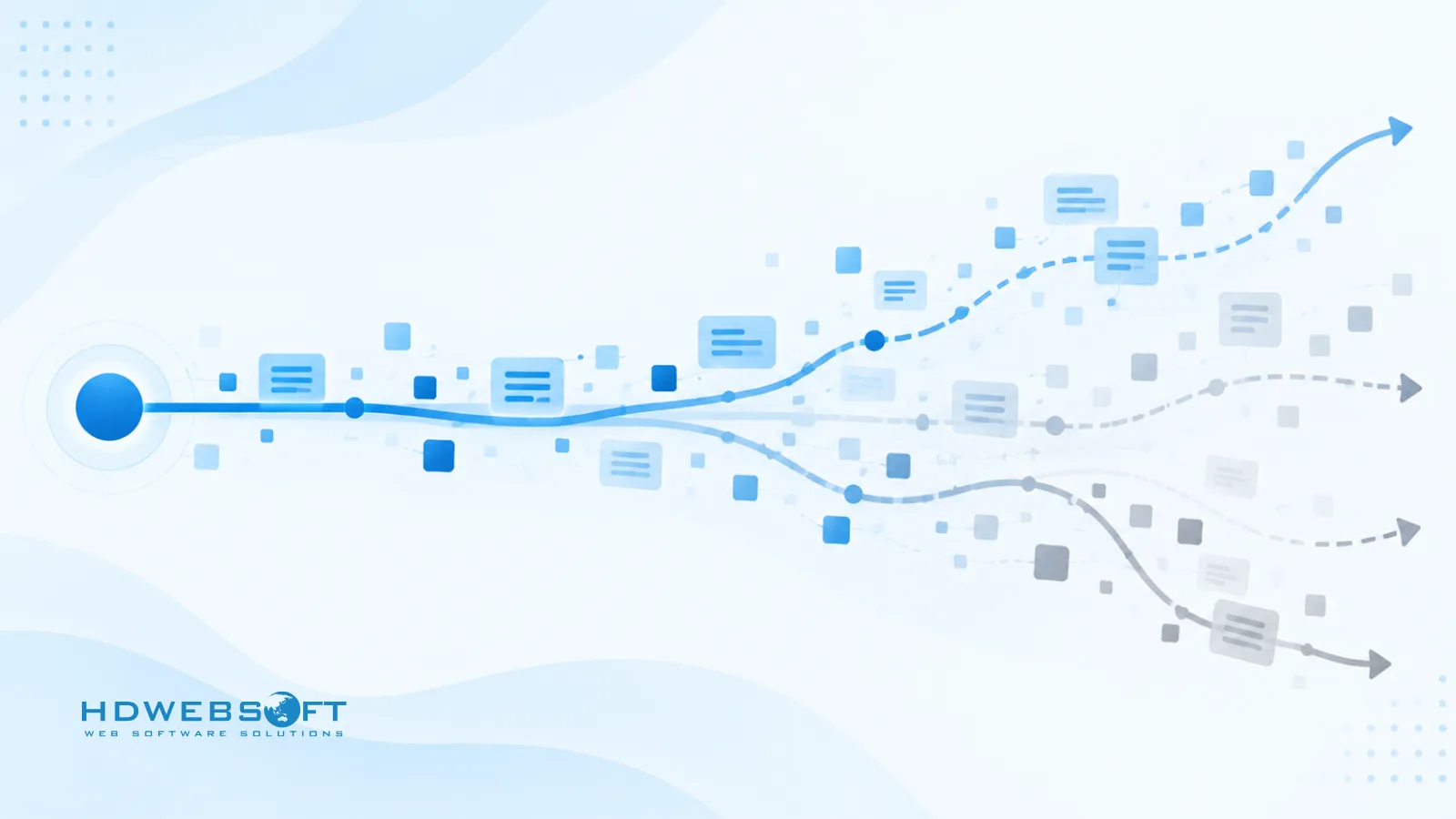
Latency is the second bottleneck that breaks production deployments. Agent workflows chain multiple calls — LLM inference, tool execution, retrieval, orchestration — and latency accumulates across each sequential step. When branching or retries enter the picture, total response time can increase sharply, making AI agent deployment in production harder to keep within acceptable response times.
Where Latency Hides in Agent Call Chains
Latency in AI agent deployment comes from several sources:
- LLM inference: The model’s own generation time, which scales with output length and model size.
- Tool call latency: External APIs, databases, and services that the agent calls, each adding round-trip time.
- RAG retrieval overhead: Retrieval, embedding, and ranking add time before the model even starts generating.
- Multi-agent orchestration: Coordination between agents — routing, handoffs, result aggregation — adds overhead on top of individual call latency.
- Serialization and deserialization: Converting between formats for each call adds small but cumulative delays.
In a multi-agent loop, latency accumulates across sequential calls. If each step takes a few seconds and the loop runs several steps, total response time can reach tens of seconds. Branching — where an agent tries multiple approaches — and retries — where an agent reattempts a failed step — can push total latency even higher. As an illustrative example, a single agent call might take 3 to 8 seconds, and a multi-agent chain of several steps might reach 30 to 60 seconds. These numbers are examples, not universal — actual latency depends on model choice, tool performance, and orchestration design.
Latency Budgets for Production AI Agents
A latency budget is the maximum acceptable response time for a given task, allocated across each step in the agent chain. Without a budget, teams have no way to decide when latency is acceptable or when the architecture needs to change.
Example latency budgets — these are illustrative, not universal SLAs:
- Real-time interactions (e.g., chat, live support): under 5 seconds
- Near-real-time tasks (e.g., data analysis, report generation): under 30 seconds
- Background tasks (e.g., batch processing, scheduled agents): under 5 minutes
Once a budget is set, allocate it across the steps in the agent chain. If the estimated total exceeds the budget, the architecture must change — parallelize tool calls, shorten reasoning, route simpler tasks to faster models, or move work to background processing.
Reducing Latency Without Sacrificing Reasoning Depth
Several techniques reduce latency without forcing the agent to reason less deeply:
- Streaming responses: Stream output to the user as it is generated, so the user sees progress instead of waiting for a complete response.
- Model routing: Route simple tasks to smaller, faster models and reserve large models for tasks that require deeper reasoning. Routing decisions should be based on task complexity, risk, and quality requirements — not a fixed ratio.
- Parallel tool calls: Execute independent tool calls in parallel rather than sequentially, cutting total wait time.
- Caching: Cache LLM outputs and tool results for similar inputs to avoid redundant calls.
- Speculative execution (optional, advanced): For steps with predictable patterns, execute likely-next steps before the current step completes.
Retrieval-augmented generation illustrates the latency trade-off well. RAG adds retrieval overhead, but good grounding can reduce the number of retries and reasoning loops an agent needs, which can lower total latency. The net effect depends on implementation — RAG does not always reduce latency, but well-designed retrieval can.
Bottleneck 3: Token Cost Explosion in Multi-Agent Loops
Token cost is the bottleneck that catches teams by surprise. Pilots run with few users and few edge cases, so token usage stays manageable. Production scales usage, and multi-agent loops amplify cost in ways that pilot data never revealed. Without a cost forecast, AI agent deployment in production can blow through budgets before anyone notices.
Why Multi-Agent Loops Burn Tokens Unpredictably
Multi-agent loops drive token cost up quickly or superlinearly in AI agent deployment due to several factors:
- Repeated context: Each turn in a loop resends context — system prompt, conversation history, tool results — to the model. As context grows, each turn costs more tokens than the last.
- Retries: When an agent produces invalid output, the loop retries, sending the full context again plus the error feedback.
- Branching: When an agent tries multiple approaches, each branch consumes tokens, and only one branch’s output may be used.
- Multi-agent exchanges: Agents communicating with each other consume tokens for every message, adding overhead that single-agent systems do not have.
As an illustrative example, a pilot session might use 5,000 tokens. At 1,000 sessions per day in production, that becomes 5 million tokens per day — and that is before accounting for retries, branching, and context growth that production traffic introduces. Cost can increase quickly or superlinearly, not linearly, when these factors compound.
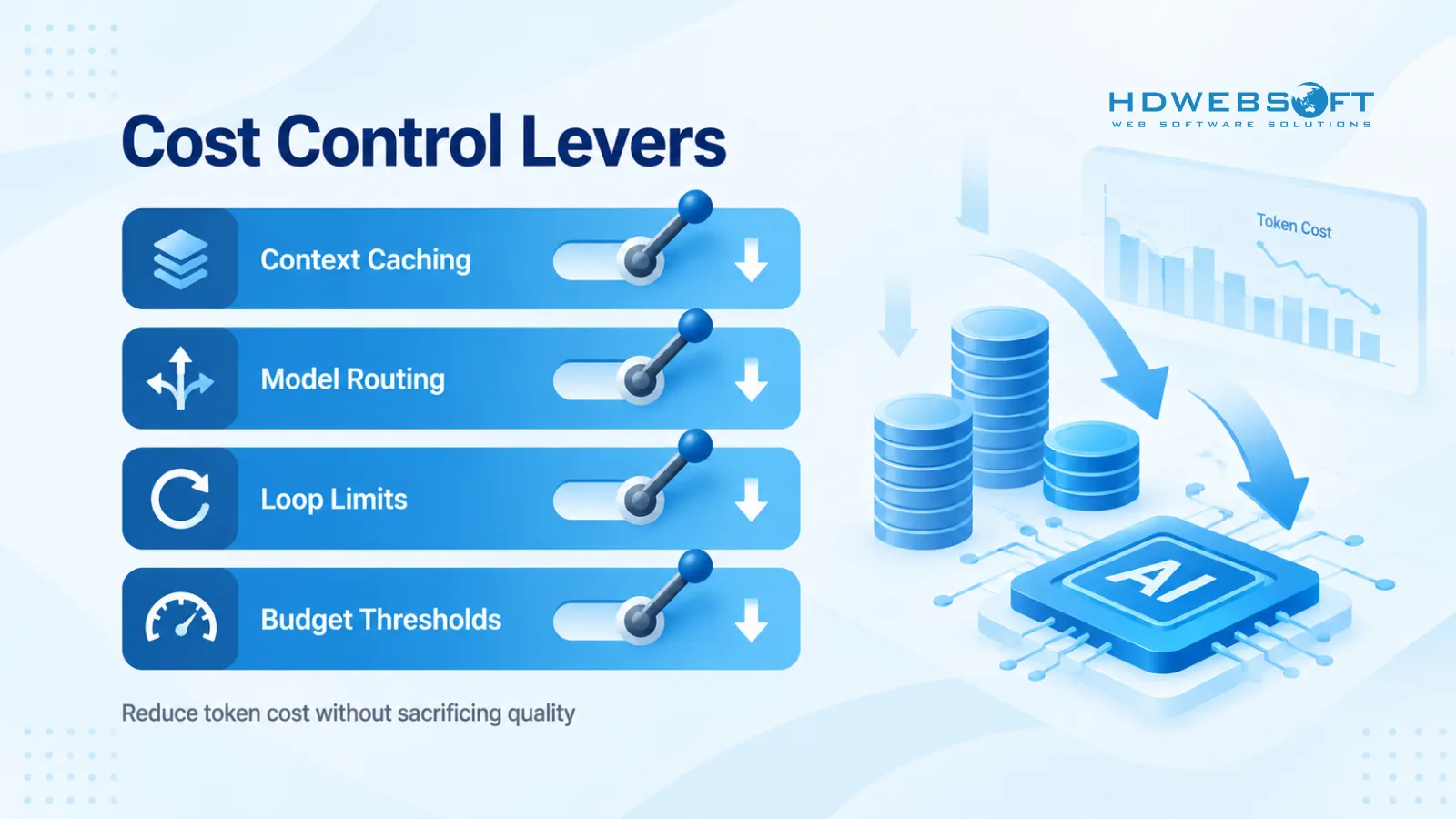
Cost Levers: Context Caching, Model Routing, Loop Limits
Several levers control token cost in production:
- Context caching: Cache prompt prefixes, tool results, and LLM outputs for similar inputs to avoid resending or regenerating the same content.
- Model routing: Route tasks to the smallest model that meets quality requirements. Routing decisions should be based on task complexity, risk, and quality requirements — not a fixed ratio like 80% small and 20% large.
- Loop limits: Set a maximum number of turns per session. When the limit is reached, terminate the loop and escalate to a human or a fallback path.
- Prompt compression: Summarize or compress context instead of resending full history each turn.
- Batch processing: Move non-real-time tasks to batch processing, where cost can be optimized without latency pressure.
Building a Token Cost Forecast Before You Deploy
A token cost forecast is a prerequisite for AI agent deployment in production, not an afterthought. Build the forecast before launch:
- Estimate average tokens per session: Include system prompt, context, tool results, and output. Account for retries and branching.
- Multiply by expected sessions per day: Use realistic production volume, not pilot volume.
- Apply model pricing: Calculate daily and monthly cost at current token prices.
- Add a buffer for variance: Production traffic is unpredictable; add a buffer for unexpected spikes.
- Separate fixed and variable costs: Fixed costs include system prompts and baseline context; variable costs scale with turns, tool calls, and retries.
Once the forecast is in place, set budget thresholds with a stop or escalation policy. When spending crosses a threshold, the system can stop the agent, escalate to a human, switch to a cheaper model, or alert the team — the policy depends on the use case. The key is having a policy before launch, not discovering the budget breach after the invoice arrives.
Bottleneck 4: Security Gaps and Uncontrolled Agent Outputs
Security is the fourth bottleneck, and it is the one that traditional application security teams are least prepared for. Agents do not just generate text — they call tools, access data, and take actions, which introduces threats that conventional AppSec controls were not designed to address. Deploying AI agents in production without agent-specific guardrails leaves organizations exposed to injection attacks, data exfiltration, and unsafe tool calls.
Indirect Prompt Injection & Unsafe Tool Calls
Indirect prompt injection is the primary security risk for production agents and a leading cause of AI agent deployment failure. Unlike direct prompt injection, where an attacker manipulates the prompt directly, indirect injection hides malicious instructions inside data the agent retrieves or processes — user-generated content, retrieved documents, tool outputs, or external web pages.
When an agent reads this content, it may follow the injected instructions as if they were legitimate. An agent reading a customer email that contains hidden instructions might leak data, call a sensitive tool, or modify a record it should not touch. Because the injection comes through data, not through the prompt itself, input validation alone does not catch it.
The risk is compounded when agents have tool-calling capabilities. An agent that can send emails, modify databases, or initiate payments carries far more risk than an agent that only generates text. Every tool call is a potential action with real consequences, and uncontrolled tool calls can cause damage before anyone notices.
Data Exfiltration Risks in Agent Workflows
Agents often have access to multiple data sources — databases, APIs, file stores — and that access creates exfiltration risk. An agent that can read sensitive data and send emails or call external APIs can exfiltrate that data through its outputs or tool calls.
Multi-agent systems amplify the risk. Agent A may have broad data access because its tasks require it, while agent B has a narrower scope. If agent B can request data from agent A, and agent B’s outputs flow to an external channel, data can move from a high-access agent to an external destination without either agent explicitly violating its own scope.
Mitigations include:
- Principle of least privilege: Give each agent the minimum data access its tasks require, scoped as tightly as possible.
- Output filtering: Validate agent outputs before they reach external channels, blocking content that contains sensitive data.
- Audit logging: Log every tool call, its parameters, and its outcome, so exfiltration attempts are traceable.
Why Traditional AppSec Is Necessary But Not Sufficient
Traditional application security remains necessary but is not sufficient for agent-specific risks. WAFs, input validation, authentication, and authorization still matter — they are the foundation. But they do not cover the threats that agents introduce:
- Prompt injection is not a traditional code injection. It exploits the model’s instruction-following behavior, not a code vulnerability, so WAF rules and input sanitization do not catch it.
- Agents decide which tools to call dynamically. There is no fixed route to filter — the agent’s own reasoning determines the action, and traditional security controls cannot predict or filter every possible tool call path.
- Agent outputs can contain sensitive data leaked through logs, emails, or external API calls, even when the underlying data store is properly secured.
Agent-specific guardrails are required on top of traditional AppSec: output validation, tool call allowlists, human approval for sensitive actions, and complete audit trails. For a deeper look at LLM-specific threat models and mitigations, see LLM security for agentic AI.
How to Deploy AI Agents in Production Reliably
Addressing the four bottlenecks requires a structured approach that combines guardrails, caching, and observability. Each component addresses one or more bottlenecks, and together they form the production foundation that pilots lack. For teams learning how to deploy AI agents in production, the following components are essential.
Layered Guardrails: The Backbone of Agent Reliability
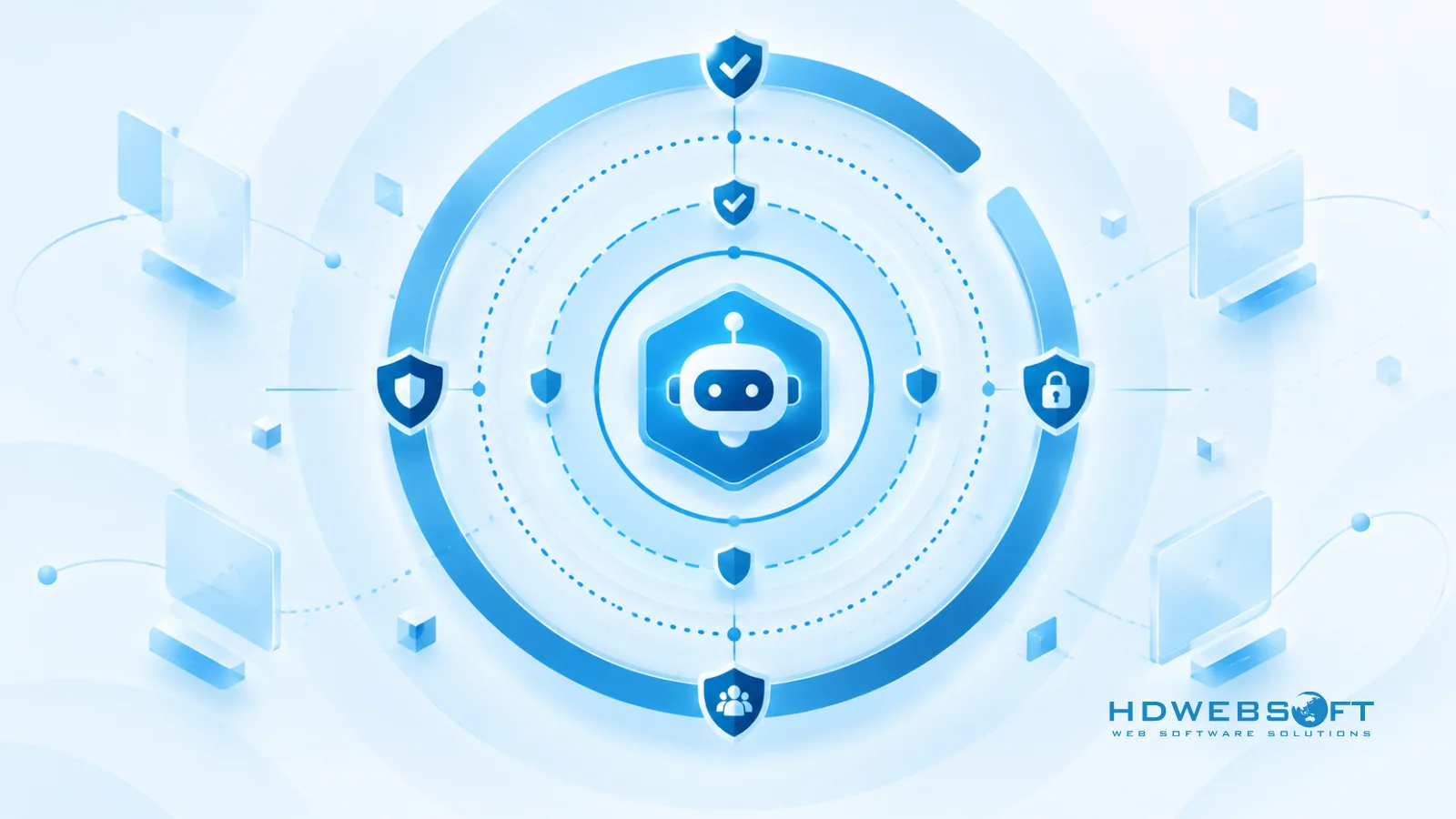
Layered guardrails combine multiple types of control, each addressing different failure modes:
- Deterministic controls: Schema validation for outputs, tool call allowlists, loop limits, and permission checks. These are rules that do not depend on the model — they enforce constraints regardless of what the agent generates, forming the first layer of AI agent reliability.
- Model-based or classifier-based checks: Content filters, hallucination detectors, and output classifiers that catch issues deterministic rules cannot. These use smaller models or classifiers to evaluate agent outputs before they reach users or tools.
- Access control: Principle of least privilege for every agent, scoped tool permissions, and data access limits tied to the agent’s role.
- Human approval: For sensitive actions — payments, data modifications, external communications — require explicit human approval before the agent executes the action.
No single layer is sufficient. Deterministic rules catch schema violations and unauthorized tool calls but miss subtle content issues. Model-based checks catch content problems but can themselves be vulnerable to adversarial inputs. Human approval catches high-risk actions but does not scale to every decision. The strength of layered guardrails is that each layer covers the gaps the others leave, making AI agent deployment in production far more reliable than any single control.
Smart Context Caching to Cut Latency and Cost Together
Context caching addresses latency and cost simultaneously by reducing redundant work:
- Cache system prompts and stable context: Avoid resending the same prompt prefix on every turn.
- Cache tool results: If multiple turns need the same tool output, cache it instead of calling the tool again.
- Semantic cache for LLM outputs: For similar inputs, return a cached output instead of regenerating.
Caching introduces its own risks that production teams must manage:
- Cache invalidation: When underlying data changes, cached results must be invalidated or refreshed. Stale cache leads to wrong answers.
- Tenant isolation: Never serve one tenant’s cached results to another. Cache keys must include tenant context.
- Data freshness: Set TTLs that match the data’s update frequency. A cache that is too stale is worse than no cache.
- Sensitive or high-risk outputs: Do not cache outputs that contain PII, financial decisions, medical advice, or other sensitive content unless the caching layer has equivalent security controls. When in doubt, do not cache.
Observability and Evaluation as Production Requirements
Observability for AI agents differs from traditional application observability. Agents make dynamic decisions, call external tools, and produce outputs that are hard to validate with simple pass/fail checks. Production AI agent deployment requires observability that covers:
- Tool decisions: Which tools were called, with what parameters, and what results came back.
- Routing decisions: Which model or branch was selected and why.
- Intermediate state: Output from each step in the agent chain, not the model’s hidden chain-of-thought.
- Model and tool metadata: Model version, tool version, and parameters used, so regressions can be traced to specific versions.
- Guardrail results: Whether each layer passed or failed, and the rejection reason when a guardrail blocks an action.
- Latency and cost traces: Breakdown of time and token cost per step, so bottlenecks are visible.
- Final outcome: The end result of the agent’s work, with success or failure status.
Redaction, data classification, and retention policy are mandatory. Never log full prompts or full context when PII or secrets may be present. Classify data before logging, redact sensitive fields, and enforce retention limits so logs do not become a liability. Do not attempt to log the model’s hidden chain-of-thought — it is not reliably available, and forcing it can degrade output quality.
Evaluation goes beyond testing the final output. Test each step in the agent chain, so regressions are caught at the step where they originate rather than only at the end. Set alerts for drift metrics, latency budget breaches, cost thresholds, and guardrail rejection rates, so problems surface before users do.
Grounding Retrieval to Reduce Drift and Cost
Retrieval-augmented generation, when implemented well, can reduce both drift and cost. Accurate grounding gives the agent relevant, current context, which reduces the number of reasoning turns it needs and the likelihood of hallucination. Fewer turns means fewer tokens and lower latency. Grounding also reinforces the original instructions by providing concrete, retrieved context that anchors the agent’s reasoning.
RAG is not a free win — it adds retrieval overhead and introduces its own failure modes if retrieval quality is poor. But well-designed retrieval can reduce retries and reasoning loops, producing a net benefit for drift, cost, and latency. For a deeper look at retrieval orchestration, evaluation, and grounding, see retrieval orchestration and grounding in agentic RAG.
How HDWEBSOFT De-risks AI Agent Production Launches
HDWEBSOFT helps teams move AI agents from pilot to production through a structured launch framework for well-scoped deployments. The framework is not a fixed-scope, fixed-timeline package — it is a phased approach that adapts to the complexity of the use case, the maturity of the existing agent logic, and the organization’s production readiness. For enterprise AI agent deployment, this structured approach helps teams avoid the four bottlenecks from day one.
What the Launch Framework Covers
The framework covers the components that AI agent deployment in production requires but pilots typically skip:
- Architecture design: Production-ready architecture that accounts for guardrails, observability, and cost controls from the start.
- Layered guardrails implementation: Deterministic controls, model-based checks, access control, and human approval gates tailored to the use case’s risk profile.
- Context caching setup: Caching strategy with invalidation, tenant isolation, and sensitive-output handling.
- Observability stack: Logging, alerting, and evaluation with redaction, data classification, and retention policy built in.
- Controlled rollout: Phased deployment that starts with a narrow scope and expands based on proven results.
The framework suits use cases with clear scope and existing or simple agent logic. It is not a build-from-zero sprint — it is a structured path to production for agents that have proven their value in pilot and need the engineering rigor to survive at scale.
A Phased Approach, Not a Fixed Timeline
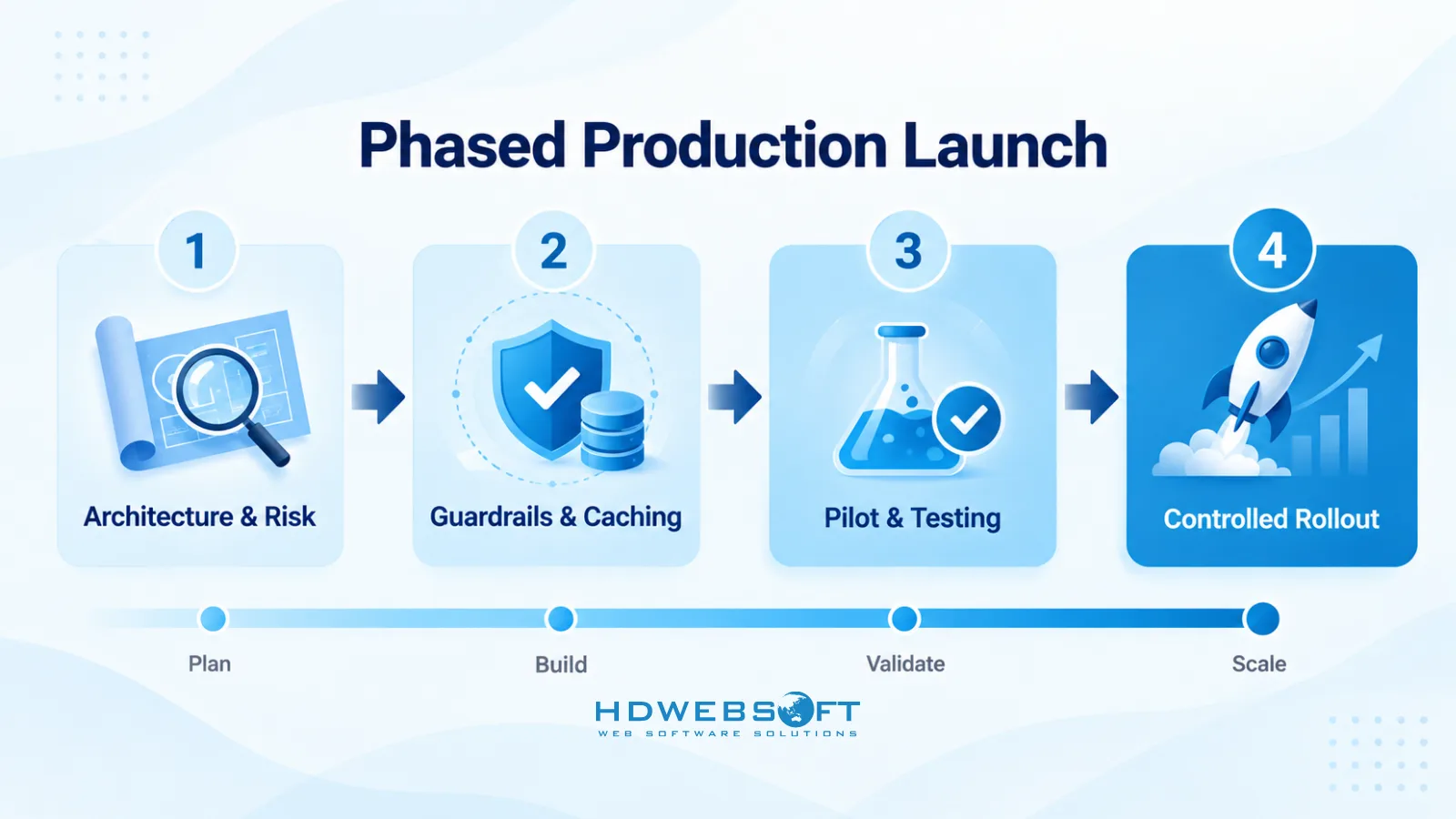
The launch follows a phased approach rather than a fixed timeline. The phases are:
- Architecture session and risk assessment: Define the use case, success metrics, risk profile, and production requirements. Identify which bottlenecks — drift, latency, cost, security — are most relevant to the deployment.
- Guardrails, caching, and observability implementation: Build the production foundation before the agent touches real traffic. Layered guardrails, caching with invalidation, and observability with redaction are set up in this phase.
- Pilot deployment and testing: Deploy the agent in a controlled environment that mirrors production, with full guardrails and observability active. Test against realistic load, edge cases, and failure modes.
- Controlled rollout and monitoring: Roll out gradually, monitor drift metrics, latency, cost, and guardrail results, and expand scope based on proven results.
The duration of each phase depends on the use case’s complexity, the maturity of the existing agent logic, and the organization’s production readiness. The framework provides structure and discipline, not a rigid schedule.
Why a Structured Launch De-risks Production Deployment
A structured launch de-risks AI agent deployment in production in several ways:
- Scope clarity: A well-scoped use case prevents scope creep, which is the most common reason production deployments overrun budget and timeline.
- Focus on one high-value use case: Rather than trying to deploy every agent at once, the framework focuses on one use case where success is most likely and value is highest.
- Guardrails and observability from the start: Production foundations are built before launch, not bolted on after the first incident.
- Baseline for scaling: A successful controlled rollout provides the baseline — metrics, guardrail thresholds, cost patterns — that future scaling decisions rely on.
For teams ready to move from pilot to production, the next step is a technical architecture session with our AI lead to map the use case, identify the relevant bottlenecks, and define the production requirements. Schedule a Technical Architecture Session with our AI Lead to start the conversation.
Conclusion
AI agent deployment in production is an engineering discipline, not a model capability. The four bottlenecks — prompt drift, API latency, token cost, and security gaps — are predictable, diagnosable, and addressable, but only when teams design for them before production rather than after the first incident. Successful AI agent deployment requires layered guardrails, smart context caching, and structured observability from the start.
Layered guardrails, smart context caching with proper invalidation and tenant isolation, and structured observability with redaction and retention policy form the production foundation that pilots lack. A token cost forecast with budget thresholds and a stop or escalation policy is a prerequisite, not an afterthought. And a structured launch framework — phased, not rigidly timed — gives teams the discipline to deploy one use case well before scaling to the next.
HDWEBSOFT helps teams navigate this transition with a phased launch framework that builds production foundations before the agent touches real traffic. For organizations ready to move forward, the next step is a technical architecture session to define the use case, identify the relevant bottlenecks, and plan the deployment.
FAQ
What is AI agent deployment in production?
AI agent deployment in production is the operation of an autonomous AI system that reasons, calls tools, and takes actions under real load, with real users, and real consequences. It requires layered guardrails, observability, cost controls, and rollback procedures that pilots typically lack. Successful AI agent deployment treats reliability, safety, and cost control as core engineering requirements.
Why do AI agent pilots fail when moving to production?
Pilots fail in production due to four technical bottlenecks: prompt drift, API latency, token cost, and security gaps. Teams underestimate these because pilots run in controlled environments with few users, few edge cases, and no real cost pressure. Without guardrails, observability, and cost forecasts designed for production, AI agent deployment fails when agents drift, slow down, burn tokens, and leak data.
What is prompt drift and how do you control it?
Prompt drift, also called context or instruction drift, is the gradual loss of instruction adherence as an agent processes longer sessions or multi-turn loops. It is caused by context growth, truncation, conflicting instructions, stale memory, and intermediate outputs. Control it by re-injecting constraints periodically, managing context windows, adding deterministic checkpoints, and detecting drift with multiple signals — task success rate, constraint violation rate, tool-call correctness, regression evals, and semantic distance.
How much does it cost to run AI agents in production?
Cost depends on average tokens per session, sessions per day, and model pricing. Multi-agent loops can drive cost up quickly or superlinearly due to repeated context, retries, and branching. Build a token cost forecast before launch and set budget thresholds with a stop or escalation policy so spending breaches are caught before the invoice arrives.
What are layered guardrails for AI agents?
Layered guardrails combine multiple types of control: deterministic rules (schema validation, tool call allowlists, loop limits, permission checks), model-based or classifier-based checks (content filters, hallucination detectors), access control (least privilege, scoped tool permissions), and human approval for sensitive actions. No single layer is sufficient — each covers gaps the others leave, and together they form the backbone of AI agent reliability in production.
How does the HDWEBSOFT AI agent launch framework work?
HDWEBSOFT’s launch framework is a phased approach for well-scoped deployments: architecture session and risk assessment, guardrails and caching and observability implementation, pilot deployment and testing, and controlled rollout and monitoring. The framework adapts to the use case’s complexity and the organization’s readiness, rather than following a fixed timeline. For enterprise AI agent deployment, this structured approach helps teams avoid the four bottlenecks from the start.