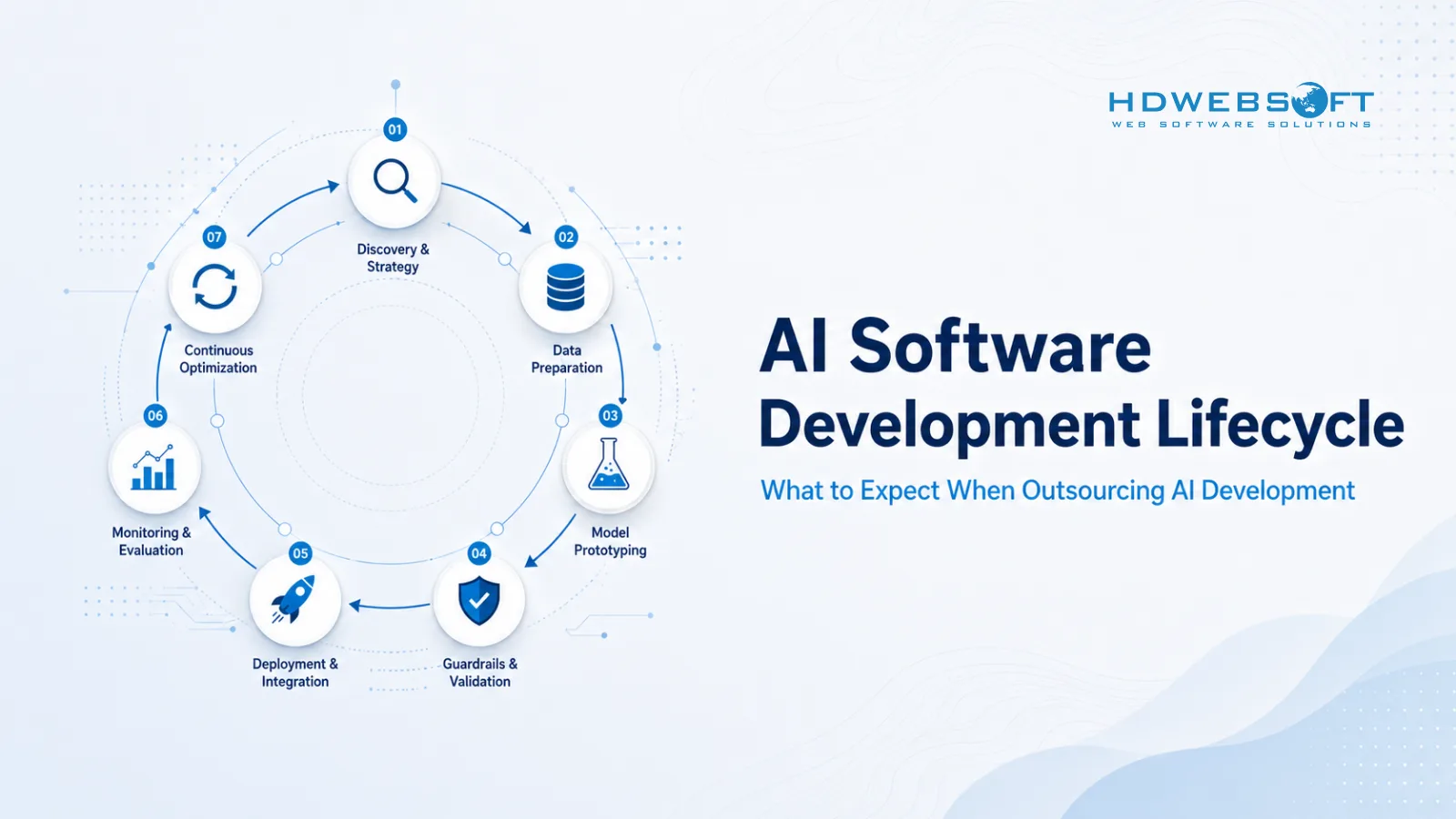
The AI software development lifecycle is the end-to-end process of building, deploying, and maintaining AI systems. Unlike traditional software development, it adds data readiness, model evaluation, guardrails, observability, and continuous retraining as core phases rather than optional extras. When you outsource AI development, understanding this lifecycle is the difference between a partner who delivers a production system and one who hands you a demo that never scales.
This guide walks through the seven phases of the AI software development lifecycle from an outsourcing perspective: what the partner does, what you need to provide, what deliverables to expect, and where you must make go/no-go decisions. It also covers ownership, AI acceptance criteria, handover, and how to match an engagement model to your project’s uncertainty. For the architecture side of guardrails and observability, see our pillar guide on agentic AI in production.
Key Takeaways
- The AI SDLC adds data readiness, model evaluation, guardrails, monitoring, and continuous optimization on top of traditional software delivery.
- Each phase needs concrete deliverables and an approval checkpoint. Clients do not delegate entirely; they stay involved in business decisions, data access, and production acceptance.
- AI acceptance is based on quality thresholds and acceptable failure boundaries, not perfect outputs. These must be defined with the partner before development starts.
- Ownership must be clear from day one: the client owns business, domain, and data decisions; the partner owns technical execution; scope, evaluation, and production acceptance require joint approval.
- The engagement model should match project uncertainty and internal capability: project-based for clear outcomes, dedicated team for R&D-heavy work, hybrid for partner-led delivery with a planned internal handover.
Why the AI SDLC Differs from Traditional Software Development
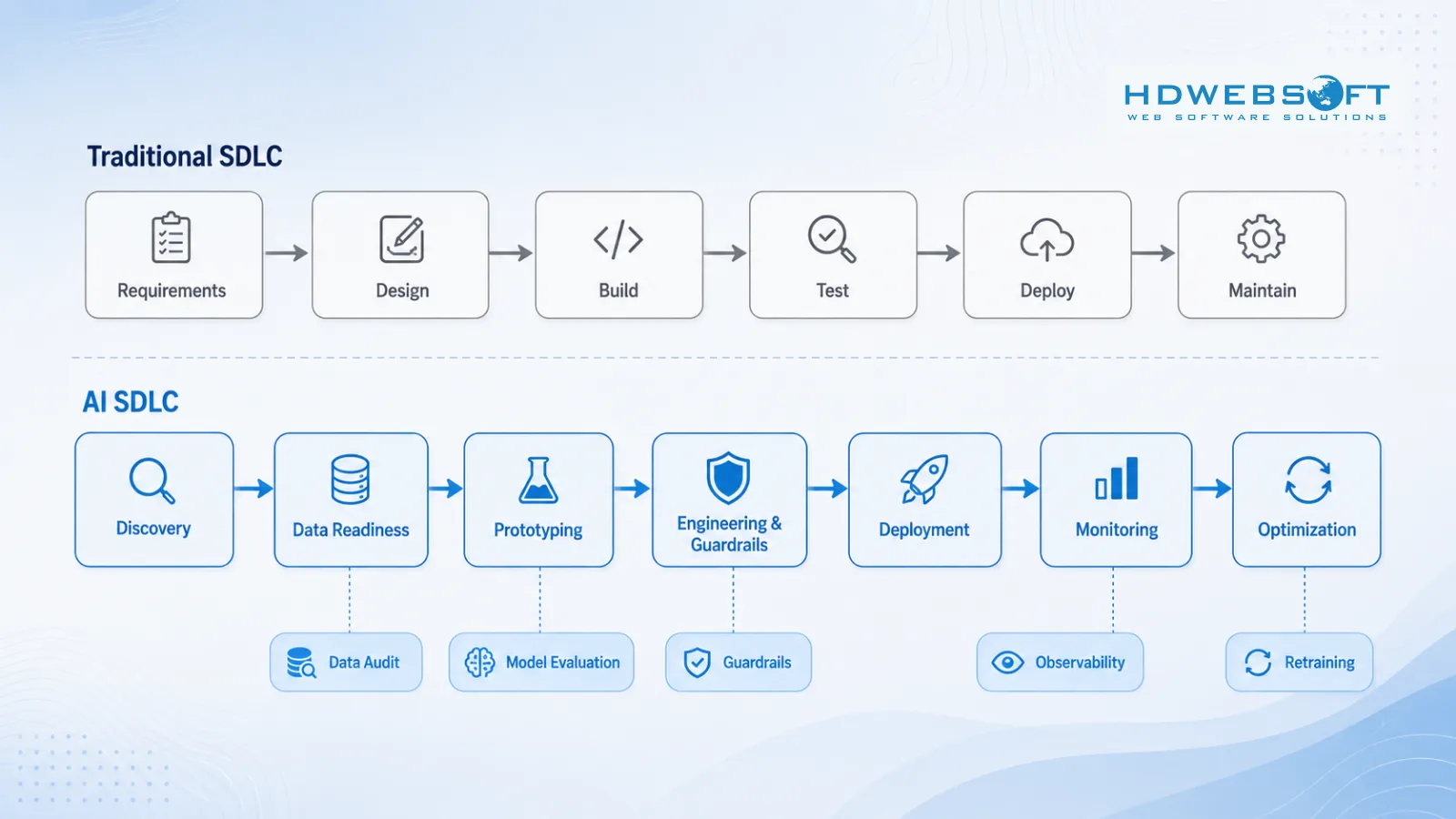
Traditional software development follows a familiar loop: requirements, design, build, test, deploy, maintain. Code is deterministic. A unit test either passes or fails. Once a feature works, it keeps working until something changes. The AI development process breaks this loop.
AI changes that model. Outputs are probabilistic. The same input can produce different results. A model that performs well in testing can degrade in production as data shifts. This is why the AI software development lifecycle adds phases and activities that traditional SDLC does not need, and why outsourcing AI requires a different set of expectations.
Data Dependency and Probabilistic Outputs
AI systems depend on data at every stage: training, evaluation, and production. A model is only as good as the data it learned from, and its outputs are probabilities, not certainties. There is no assertion-style test that proves a model is “correct.” Instead, teams build evaluation harnesses that measure performance across a representative dataset. The NIST AI Risk Management Framework provides authoritative guidance on managing these risks across the lifecycle.
This means the lifecycle must include a data readiness phase before any model work begins, and an evaluation phase that runs continuously, not just before launch.
Model Evaluation, Guardrails and Monitoring
Because AI outputs are probabilistic, evaluation never really stops. Teams need guardrails (human-in-the-loop checkpoints, fail-safe mechanisms, bias detection) to keep the system safe in production. They need monitoring that tracks both system health and model behavior, because a model can silently degrade without throwing a single error.
These are production requirements, not nice-to-haves. The gap between a successful pilot and a stable production system is almost always a gap in guardrails and observability, not model quality.
Data Drift, Model Degradation and Continuous Optimization
AI models degrade over time. The data they see in production shifts from what they were trained on (data drift), and the relationship between inputs and outputs changes (concept drift). A model that hit 95% accuracy at launch might drop to 80% six months later without any code change.
This is why the AI software development lifecycle does not end at deployment. Continuous optimization and retraining are built-in phases, not post-launch extras. Traditional software does not need retraining; AI does. That single difference reshapes timelines, costs, and ownership. Google’s MLOps practices describe this as a continuous pipeline rather than a one-time deployment.
What Must Be Agreed Before an Outsourced AI Project Starts
Before any phase of the lifecycle begins, the client and the outsourcing partner need to align on a set of fundamentals. Skipping this step is one of the most common reasons AI projects stall mid-flight: the partner builds something technically sound that does not match what the business actually needed.
Business Outcomes and Success Metrics
The project should start with a quantified business outcome, not a technology goal. “Reduce manual triage time by 30%” is a useful outcome. “Build an AI chatbot” is not. Success metrics should tie to business impact, not just technical metrics like accuracy or F1 score, because a model with high accuracy can still fail the business if it optimizes the wrong thing.
The client should also name an AI champion: someone with the authority to make trade-off decisions between scope, timeline, and quality. Without a single decision maker, approval cycles stretch and the project loses momentum.
Data, Access and Compliance Responsibilities
Both sides need to be explicit about data. What data exists today? Who owns it? What format is it in? Is it labeled? Does it contain PII? Who is responsible for collecting or labeling more if the partner finds gaps?
System access is equally important. The client must provide API credentials, sandbox environments, and a timeline for production environment access. Compliance requirements (GDPR, HIPAA, data residency, audit obligations) should be documented before the partner starts touching data.
Decision Rights and Client Involvement
Outsourcing AI does not mean outsourcing decisions. The agreement should specify who decides what at each phase. Technical decisions may sit with the partner; business and compliance decisions sit with the client. Scope changes, evaluation thresholds, and production acceptance need joint approval.
The agreement should also set a review cadence (weekly, biweekly, or phase-gate) and an escalation channel for when blockers arise.
Pilot and Production Acceptance Criteria
Two definitions matter before the project starts: what counts as pilot completion, and what counts as production readiness. Pilot completion is not “the demo works.” It means the prototype meets a defined performance threshold on a representative dataset. Production readiness is broader: performance threshold plus guardrail coverage plus observability plus an incident plan plus a cost ceiling.
The agreement should also state who signs off on the pilot-to-production transition and who owns post-launch operations. These are covered in detail later in this article.
The 7 Phases of the AI Software Development Lifecycle
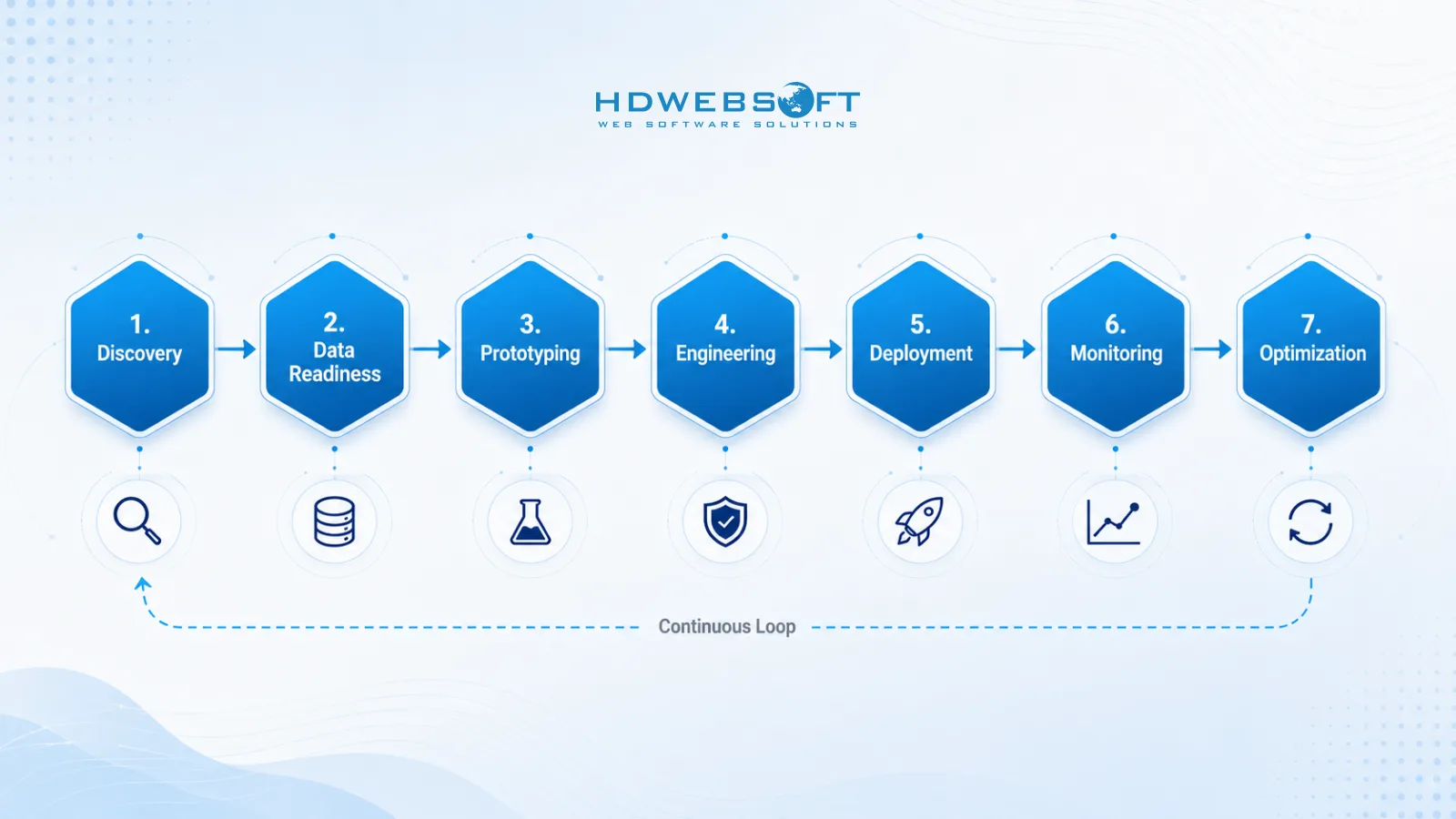
The seven phases below form the backbone of the AI software development lifecycle. Each phase follows the same structure: purpose, key activities, what the partner does, what the client provides, expected deliverables, and the approval checkpoint that marks the phase complete. Understanding these AI project phases is essential for setting realistic expectations when outsourcing AI development.
1. Discovery and Problem Framing
- Purpose: Determine whether the problem actually needs AI, or whether rule-based or traditional software would solve it more cheaply and reliably.
- Key activities: Problem framing, success criteria definition, feasibility check, ROI hypothesis.
- What the partner does: Challenges the use case, proposes alternatives, runs a discovery workshop, and gives a go/no-go recommendation.
- What the client provides: Business context, current workflow, pain points, summary of available data, and the success metrics that matter to the business.
- Expected deliverables: Discovery report, proposed success metrics, and a go/no-go recommendation.
- Approval checkpoint: The client signs off on scope and success metrics before any data work begins.
A partner who says yes to every AI request without challenging the use case is a red flag. Good partners will tell you when AI is not the right tool.
2. Data Readiness and Feasibility Assessment
- Purpose: Determine whether the available data is sufficient in volume, quality, and structure to build the AI system.
- Key activities: Data audit (volume, quality, labeling coverage, bias), pipeline assessment, compliance check.
- What the partner does: Runs the data audit, identifies gaps, proposes a data strategy, and delivers a feasibility verdict.
- What the client provides: Data access, domain knowledge about what the data means, and compliance constraints.
- Expected deliverables: Data readiness report, gap list, and data strategy.
- Approval checkpoint: A go/no-go decision based on data sufficiency. If data is missing or low quality, the project may pause to collect or label more before proceeding.
For the detailed framework behind data assessment, see AI data readiness.
3. Prototyping and Model Selection
- Purpose: Prove technical feasibility at low cost before committing to full engineering.
- Key activities: Model selection (build vs buy vs fine-tune), rapid prototyping, baseline evaluation against a representative dataset.
- What the partner does: Builds the prototype, runs the baseline evaluation, and recommends a model approach.
- What the client provides: Sample data, business feedback on prototype outputs, and acceptance or rejection of the baseline.
- Expected deliverables: Working prototype and evaluation baseline report.
- Approval checkpoint: A metric-based go/no-go decision. The question is not “does the demo look good?” but “does the baseline meet the threshold we agreed in discovery?”
Many pilots stop here and get called done. A prototype is a starting point, not a deliverable.
4. Engineering and Guardrails Build-Out
- Purpose: Turn the prototype into a production-grade system with safety infrastructure built in.
- Key activities: MLOps setup, guardrail design (human-in-the-loop, fail-safe, bias detection), automated evaluation harness, CI/CD for model updates.
- What the partner does: Designs the architecture, engineers the system, implements guardrails, and builds the evaluation harness.
- What the client provides: Business rules for guardrails (for example, when a human must review an AI decision), and UAT scenarios.
- Expected deliverables: Production-ready codebase, guardrail specification, and evaluation harness.
- Approval checkpoint: Review of guardrail coverage and evaluation harness pass rate before deployment is approved.
This is the phase where the pilot-to-production gap is usually ignored.
5. Integration and Production Deployment
- Purpose: Integrate the AI system into the client’s existing stack and deploy it in a controlled way.
- Key activities: API integration, canary or blue-green rollout, monitoring setup, incident response plan.
- What the partner does: Handles integration engineering, deployment orchestration, and monitoring configuration.
- What the client provides: Production system access, integration points, and sign-off on the production readiness checklist.
- Expected deliverables: Deployed system, deployment runbook, and monitoring dashboard.
- Approval checkpoint: Production readiness checklist sign-off plus a stable first canary cohort.
Deployment should be gradual, not a big-bang launch. Canary releases let you catch issues before they reach all users.
6. Evaluation, Monitoring and Observability
- Purpose: Ensure the model continues to perform correctly after it goes live.
- Key activities: Real-time monitoring, drift detection, audit logging, anomaly response, periodic evaluation.
- What the partner does: Sets up monitoring, configures alerting, and produces periodic evaluation reports.
- What the client provides: Business feedback on live outputs, an escalation contact, and agreement on SLOs.
- Expected deliverables: Observability dashboard, alerting configuration, and periodic evaluation report.
- Approval checkpoint: SLO and SLA review on a recurring schedule. This phase has no fixed exit; it is ongoing.
You cannot manage what you cannot measure. Without observability, production issues become impossible to diagnose.
7. Continuous Optimization and Retraining
- Purpose: Counteract model degradation over time through retraining, experimentation, and cost optimization.
- Key activities: Scheduled retraining, A/B testing of new model versions, cost optimization, feature enhancement.
- What the partner does: Builds the retraining pipeline, designs A/B tests, and produces an optimization roadmap.
- What the client provides: Business feedback, budget approval for retraining runs, and input on the roadmap.
- Expected deliverables: Retraining pipeline, optimization roadmap, and a version approval process.
- Approval checkpoint: Quarterly business review covering model performance and cost.
This is the biggest difference from traditional SDLC. Software does not need retraining. AI does. Planning for it from the start prevents a slow, invisible decline in system quality.
Who Owns What During the AI Software Development Lifecycle
Ambiguity about ownership is one of the most common causes of friction in outsourced AI projects. The split below is a practical baseline for the AI software development lifecycle. It can be adjusted, but it should be adjusted deliberately, not left to assumption.
What the Client Must Own
- Domain knowledge and business context: No one understands the business better than the client. This cannot be outsourced.
- Data and system access: The client controls who gets access, when, and under what conditions.
- Business metrics and success criteria: The client defines what success looks like in business terms.
- Risk tolerance and compliance decisions: The client decides what risks are acceptable and what compliance constraints apply.
- User acceptance testing: The client validates that the system works for real users in real conditions.
- Final production approval: The client signs off on going live.
- Post-launch business ownership: If the AI makes a wrong decision, the business owns the impact. This makes production acceptance a serious decision, not a rubber stamp.
What the Outsourcing Partner Must Own
- Technical feasibility assessment: The partner is responsible for honestly assessing what is technically achievable.
- Architecture and engineering: The partner designs and builds the system.
- Data and model pipelines: The partner builds and maintains the pipelines that feed and update the model.
- Evaluation process and harness: The partner defines how the model is evaluated and builds the tooling for it.
- Documentation: The partner delivers the documentation needed to operate, maintain, and eventually hand over the system.
- Deployment readiness: The partner is responsible for the system being ready to deploy, not just functional in a sandbox.
- Monitoring setup: The partner configures the monitoring and alerting that the system needs in production.
- Knowledge transfer plan: The partner is responsible for transferring knowledge to the internal team if that is part of the engagement.
What Requires Joint Approval
- Scope decisions and change requests: Neither side changes scope unilaterally.
- Evaluation criteria and thresholds: The partner proposes; the client approves, because thresholds are a business decision.
- Production acceptance: Both sides sign off that the system meets the agreed criteria.
- Incident escalation procedures: Both sides agree on who does what when something goes wrong.
- Post-launch roadmap and retraining cadence: Both sides agree on how the system will evolve after launch.
How Acceptance Criteria Work in AI Development
Acceptance criteria are where AI projects most often go wrong. Teams apply traditional software thinking (“the feature works, ship it”) to a system where “works” is a spectrum, not a binary. AI acceptance is about quality thresholds and failure boundaries, not perfect outputs. According to McKinsey’s State of AI, the gap between AI pilots and production remains a significant challenge, and unclear acceptance criteria are a leading cause.
Performance Thresholds Instead of Perfect Outputs
AI cannot be 100% correct. Acceptance means the system meets a defined performance threshold that is acceptable for the business context. A 95% accuracy model might be fine for triaging support tickets and unacceptable for medical diagnosis. The threshold is a business decision, not a technical one, and it should be set during discovery, not at the end of the project.
Evaluation Data and Human Review
Acceptance requires an evaluation dataset that is representative of production conditions, not the training data. Someone needs to define the ground truth, the sample size, and the human review protocol. Who reviews outputs, how often, and with what sample size are questions that should be answered before production acceptance, not during it.
Cost, Latency and Failure Boundaries
Performance is not the only acceptance dimension. The system also needs boundaries on cost, latency, and failure:
- Inference cost per request: What is the budget ceiling?
- Response latency: What is the SLO (for example, P95 under 2 seconds)?
- Failure boundaries: When should the AI refuse to answer? When should it escalate to a human? When should it trigger a rollback?
These boundaries are part of production readiness. A model that is accurate but too slow or too expensive to run has not met acceptance.
Defining When an AI System Is Ready for Production
Production readiness is not the same as pilot completion. A system is production-ready when it meets all of the following:
- Agreed performance threshold on the evaluation dataset
- Guardrail coverage for identified risks
- Observability and alerting in place
- Incident response plan documented and tested
- Cost ceiling defined and validated
Sign-off should come from both the client AI champion and the partner tech lead. For security and human-in-the-loop considerations that feed into readiness, see LLM security for agentic AI.
Model Updates and Version Approval
AI systems change after launch. New model versions need an approval process: who approves a new version before it deploys, what A/B test protocol applies, and what rollback criteria trigger a return to the previous version. Without this, silent degradations can reach production unnoticed.
What to Expect at Each Phase When You Outsource
The table below summarizes what the partner does, what the client provides, what deliverables to expect, and where approval happens at each phase. Deliverables are concrete artifacts, not vague descriptions.
| Lifecycle phase | What the partner does | Client input | Expected deliverables | Approval checkpoint |
|---|---|---|---|---|
| Discovery | Challenges use case, runs feasibility | Business context, data summary | Discovery report, success metrics | Scope and metrics sign-off |
| Data Readiness | Data audit, gap analysis | Data access, compliance constraints | Data readiness report, data strategy | Go/no-go on data sufficiency |
| Prototyping | Builds PoC, runs baseline eval | Sample data, business feedback | Prototype, evaluation baseline | Metric-based go/no-go |
| Engineering & Guardrails | Architecture, guardrails, eval harness | Business rules, UAT scenarios | Production codebase, guardrail spec, eval harness | Guardrail coverage review |
| Deployment | Integration, rollout, monitoring | Prod access, readiness checklist | Deployed system, runbook, monitoring dashboard | Production readiness sign-off |
| Monitoring | Monitoring, drift detection, periodic eval | Business feedback, SLO agreement | Observability dashboard, eval report | SLO/SLA periodic review |
| Optimization | Retraining, A/B testing, cost optimization | Budget, roadmap input | Retraining pipeline, optimization roadmap | Quarterly business review |
Lifecycle Delivery Red Flags
A few warning signs are specific to lifecycle delivery and worth watching for:
- No acceptance criteria defined for each phase
- No distinction between prototype completion and production readiness
- No clear statement of client responsibilities
- No post-launch ownership or monitoring plan
These are not general partner-selection red flags. They are specific to whether the partner is running the AI SDLC properly. For broader partner evaluation, see our guide on choosing an AI development partner.
Realistic Expectations for Timeline, Cost and Risk
Why AI Timelines Are Stage-Based
AI timelines are not linear. Each phase depends on the outcome of the one before it. If the data readiness phase reveals gaps, the project may pause to collect or label more data. If the prototype does not meet the baseline, the team may need to select a different model approach. This makes fixed timelines unreliable.
Estimates should be ranges, not single dates, and they should account for data readiness, integration complexity, compliance requirements, model evaluation results, scope changes, infrastructure, and vendor or model dependencies.
What Can Change the Original Estimate
Several factors can shift a timeline after the project starts:
- Data quality lower than expected: Additional data preparation or labeling is needed.
- Model evaluation misses the threshold: The team iterates or selects a new model approach.
- Integration complexity higher than expected: Legacy systems, security constraints, or API limitations add work.
- Scope change from the client: New requirements shift the work.
- New compliance requirements: Regulatory or security requirements emerge during development.
A mature partner surfaces these risks early and adjusts the plan, rather than hiding them until a deadline is missed.
One-Time and Recurring AI Cost Categories
AI costs split into one-time and recurring. Understanding both is essential for budgeting.
One-time costs:
- Discovery and feasibility
- Data preparation and labeling
- Development and engineering
- Guardrail and evaluation harness build
- Deployment setup
Recurring costs:
- Model or API usage (inference)
- Cloud and infrastructure
- Evaluation and monitoring
- Maintenance and optimization
- Retraining or model replacement
AI has higher recurring costs than traditional software. Inference and retraining do not stop after deployment. When evaluating a partner’s proposal, ask for a clear breakdown of one-time versus recurring costs.
How Mature Teams Manage Technical Uncertainty
Mature teams do not pretend AI is predictable. They manage uncertainty with:
- Stage-gate funding: Commit budget per phase, not all upfront.
- Evaluation-driven decisions: Move forward based on results, not calendar dates.
- Phased engagement: Treat discovery, pilot, and production as separate commitments.
- Risk register: Update risks at each phase and mitigate proactively.
This approach costs more in planning but far less in failed builds.
Choosing the Right Engagement Model for Your AI Project
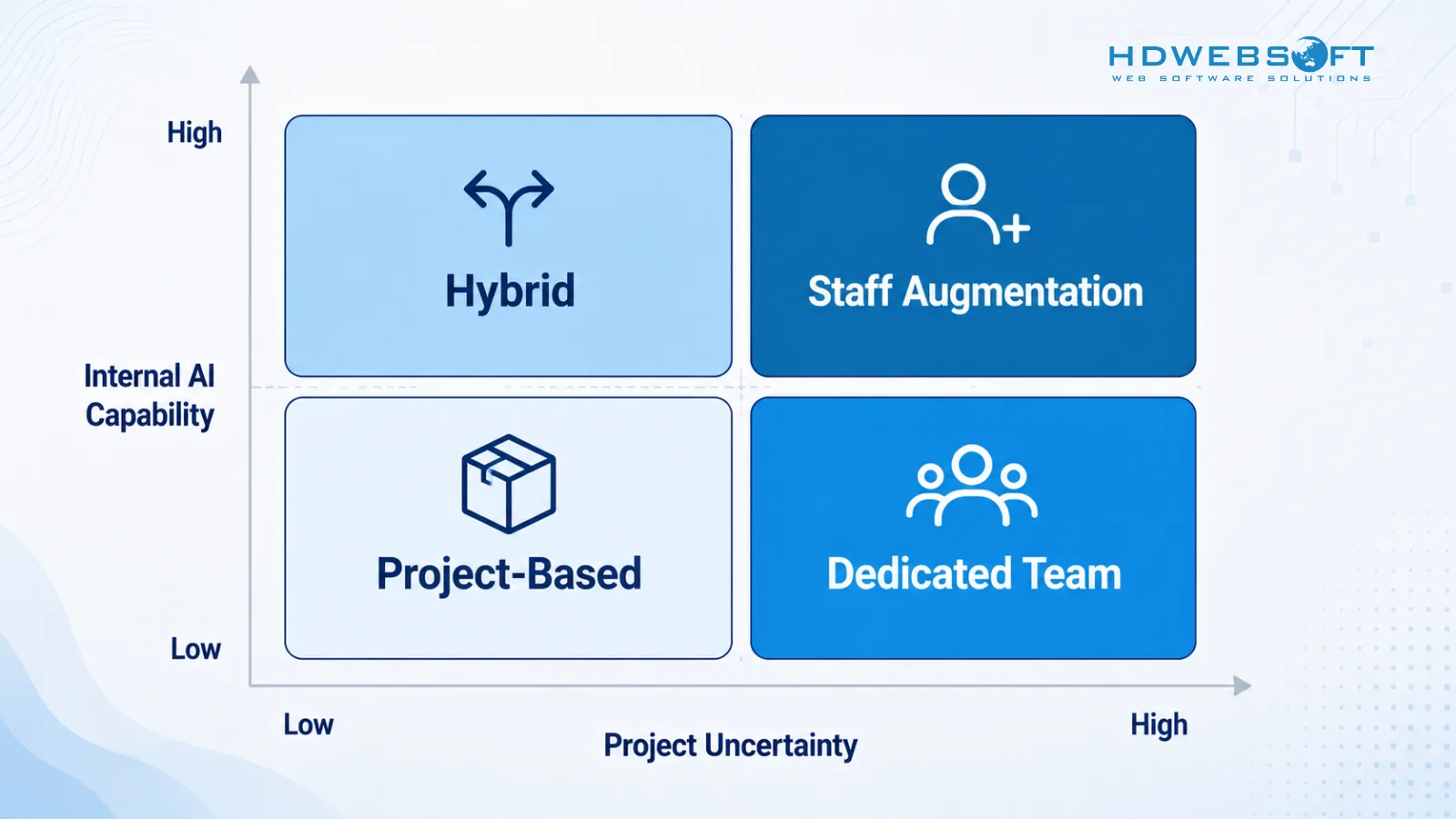
The engagement model should match the uncertainty of the AI project and the client’s internal capability. The same model does not fit every project. AI engagement models range from fixed-scope delivery to dedicated teams and hybrid arrangements, each suited to a different level of uncertainty.
Project-Based Delivery for Defined Outcomes
Project-based delivery fits when the outcome and acceptance criteria are relatively clear, the data is available, and the scope is stable. A RAG chatbot built on an existing knowledge base is a good example.
The client has high control over scope and budget. The partner owns full delivery from discovery to deployment. The trade-off is flexibility: if model behavior changes mid-project, a fixed scope can be hard to adjust.
Dedicated AI Team for Evolving Products
A dedicated AI team fits products that need experimentation and iteration. Agentic AI, multi-agent systems, and products where scope evolves based on what the model can actually do are good examples.
The client manages product direction. The partner provides the team and technical execution. This model needs more active management from the client but handles uncertainty better than a fixed scope.
Staff Augmentation for Existing Internal AI Teams
Staff augmentation fits when the client already has an internal AI team and needs specific expertise, such as an MLOps engineer or an ML researcher. The client keeps full control. The partner provides talent, not delivery ownership.
This model works only if the client has the internal capability to manage the augmented team.
Hybrid and Phased Engagements
Hybrid engagements are common in AI. The partner leads discovery through production deployment, then transfers responsibility to the internal team for monitoring and optimization. This works well when the client wants to build internal capability over time.
The key is a knowledge-transfer plan built into the engagement from the start, not added at the end.
Matching Engagement Model to Project Uncertainty
| Project situation | Recommended model | Client control | Partner responsibility |
|---|---|---|---|
| Outcome clear, data ready, scope stable | Project-based | High on scope | Full delivery |
| R&D-heavy, scope evolving | Dedicated team | Medium | Team and execution |
| Internal AI team, need expertise | Staff augmentation | High overall | Talent provision |
| Partner-led then internal takeover | Hybrid / phased | Increasing over time | Decreasing with knowledge transfer |
To explore the engagement models in detail, see our engagement models page.
What Good Handover and Post-Launch Support Look Like
A common outsourcing failure is a handover that delivers source code and nothing else. For AI systems, code is a small part of what the internal team needs to operate and maintain the system.
Technical and Operational Documentation
The handover should include:
- Architecture documentation
- Data and model documentation
- Model and API dependency documentation
- Deployment instructions
- Runbooks and incident procedures
Access to Evaluation and Monitoring Assets
The internal team needs access to the tools that keep the system healthy:
- Evaluation datasets or the evaluation methodology used
- Monitoring dashboard access
- Alerting configuration access
- Audit log access
Knowledge Transfer to the Internal Team
Knowledge transfer should be structured, not informal:
- Recorded knowledge-transfer sessions
- Code walkthroughs
- Model behavior explanation
- Q&A sessions with the engineering team
Ongoing Monitoring, Optimization and Retraining
The handover should make post-launch ownership explicit:
- Who is responsible for monitoring after handover (client, partner, or hybrid)
- Retraining cadence and who owns it
- Optimization roadmap handover
- SLA for post-launch support if the partner continues to maintain the system
Without this clarity, the system degrades silently and no one notices until a business metric drops.
Conclusion
The AI software development lifecycle is not traditional SDLC with a model bolted on. It adds data readiness, model evaluation, guardrails, observability, and continuous retraining as core phases, and it treats production as the start of an optimization loop, not the end of the project. When you outsource AI development, the lifecycle gives you a framework for setting expectations and holding both sides accountable.
Each phase should produce concrete deliverables and hit a defined approval checkpoint. Ownership should be clear: the client owns business, domain, and data decisions; the partner owns technical execution; scope, evaluation, and production acceptance require joint approval. Acceptance criteria should be defined before development starts, based on quality thresholds and failure boundaries rather than perfect outputs.
If you are planning an AI project and want to talk through which engagement model fits your situation, contact HDWEBSOFT or explore our AI development services and AI consulting services. The right conversation before the project starts saves far more than the right fix after it goes wrong.
FAQ
What is the AI software development lifecycle?
The AI software development lifecycle is the end-to-end process of building, deploying, and maintaining AI systems. It spans discovery, data readiness, prototyping, engineering, deployment, monitoring, and continuous optimization. Unlike traditional SDLC, it includes data preparation, model evaluation, guardrails, observability, and retraining as core phases.
How is the AI software development lifecycle different from traditional SDLC?
AI SDLC differs because AI outputs are probabilistic, not deterministic. The lifecycle adds data readiness assessment, model evaluation, guardrails, monitoring for data drift, and continuous retraining. Traditional SDLC ends at deployment, while AI SDLC treats production as the start of an ongoing optimization loop.
What should be agreed before outsourcing an AI development project?
Before starting, the client and partner should agree on business outcomes, success metrics, available data, data ownership, system access, compliance requirements, the client decision maker, pilot completion criteria, production readiness criteria, and who owns post-launch operations.
What deliverables should an AI outsourcing partner provide?
Expected deliverables include a discovery report, data readiness report, working prototype, evaluation baseline, production codebase, guardrail specification, deployment runbook, monitoring dashboard, periodic evaluation report, retraining pipeline, and knowledge-transfer documentation.
How involved should the client be during AI development?
The client should stay involved at every phase gate. The client owns business context, data access, success metrics, risk tolerance, compliance decisions, user acceptance testing, and final production approval. The partner owns technical execution, architecture, evaluation, and documentation. Scope, evaluation criteria, and production acceptance require joint approval.
How are AI systems tested and accepted before production?
AI acceptance is based on performance thresholds, acceptable error rates, evaluation datasets, human review protocols, cost and latency boundaries, failure escalation rules, and safety guardrails. A system is production-ready when it meets agreed quality thresholds, has guardrail coverage, observability, an incident plan, and a cost ceiling.
Which engagement model is best for an AI project with changing requirements?
For AI projects with evolving scope and high uncertainty, a dedicated AI team or hybrid engagement is usually best. Project-based delivery fits when outcomes and acceptance criteria are clear. Staff augmentation fits when the client already has an internal AI team and needs specific expertise.
Who is responsible for monitoring and retraining after launch?
Post-launch ownership should be agreed before the project starts. The client owns business outcomes and data decisions. The partner may own monitoring, retraining, and optimization under a support SLA, or responsibility may transfer to the internal team through a hybrid engagement with a knowledge-transfer plan.