Telehealth security is the set of technologies, practices, and regulatory controls that protect patient data across virtual care — video consultations, remote monitoring, patient portals, and the systems connecting them. As healthcare delivery moves online, every one of those touchpoints becomes a potential exposure point for protected health information (PHI).
This guide explains why telehealth security matters, the risks virtual care introduces, the safeguards that address them, the regulations that apply, and how to tell whether a telehealth platform is genuinely secure.
Why Telehealth Security Matters
The shift to virtual care is a structural change in how medical services are delivered, not a passing trend. That change brings a sharper focus on how patient data is protected at every step of the interaction.
Increased Use of Digital Healthcare
Virtual consultations and remote patient monitoring have pushed the volume of digital health interactions far beyond pre-2020 levels. Patients connect with clinicians from home, and providers extend their reach to underserved populations. Each interaction transmits and stores sensitive data — so the larger the volume, the larger the attack surface telehealth security has to cover.
Handling of Sensitive Patient Data
Every healthcare interaction revolves around protected health information (PHI) — medical histories, diagnoses, treatment plans, billing details, personal identifiers, and even genetic data. Its confidentiality and integrity are paramount, because a compromise can lead to identity theft, financial fraud, and discrimination. The mechanisms that handle PHI in digital health environments therefore need to be secure by design, not by assumption.
Cyber Threats Targeting Healthcare Providers
Healthcare is one of the most attractive targets for cybercriminals because of the resale value of health records. By the end of 2024, 259 million Americans’ health records had been stolen or compromised in part or in full — a record far beyond previous years.
The consequences go well beyond regulatory fines. Breaches bring reputational damage, operational disruption, personal distress for patients, and in the worst cases compromised patient safety. That is why security posture is now a board-level concern for any organization delivering virtual care.
Common Telehealth Security Risks
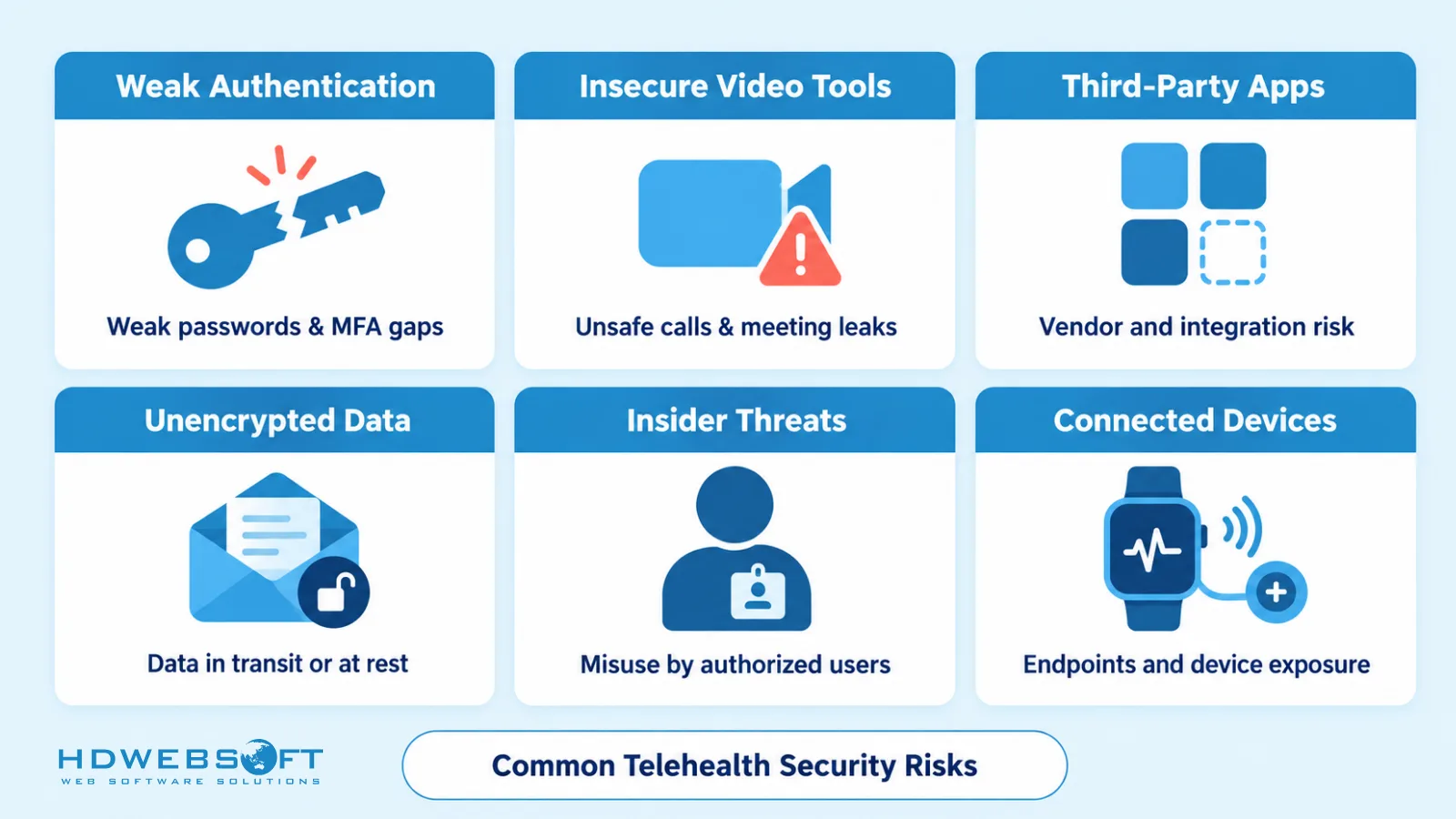
Virtual care inherits the vulnerabilities of every system it touches. Understanding where telehealth security typically fails is the first step toward building a resilient defense.
Weak Authentication and Access Control
If a platform does not verify user identities with strong, multi-layered checks, unauthorized individuals can reach sensitive patient records. The risk extends beyond external attackers — internal actors can exploit lax controls, whether intentionally or through negligence. Without robust identity verification, the rest of the security stack is built on sand.
Insecure Video Conferencing Tools
The tools that enable virtual care can themselves be the weakest link. Generic video conferencing products may lack end-to-end encryption, healthcare-specific access controls, or the willingness to sign a Business Associate Agreement. That leaves consultations exposed to eavesdropping, unauthorized recording, and data interception. Building conferencing on healthcare-grade infrastructure is a solvable problem — our web and mobile conference call platform case study shows what a purpose-built implementation looks like.
Third-Party Apps and Devices
Third-party applications and devices integrated into virtual care workflows add attack vectors the provider does not fully control. External vendors ship their own vulnerabilities, and a weak integration can become a backdoor into patient data. Healthcare organizations need rigorous vendor vetting so every component’s security posture matches the requirements of patient data protection.
Unencrypted Communication
Encryption is a foundational principle of telehealth security. Data transmitted without strong encryption is readable by anyone who intercepts it, and patient data moves constantly — between devices, servers, applications, and networks. Unencrypted channels turn routine traffic into a standing breach risk.
Insider Threats
Insider risk is easy to underestimate. Staff negligence — sharing sensitive information carelessly, skipping security protocols, falling for phishing — causes real breaches. So does malicious intent, where employees abuse legitimate access to steal or alter patient data. Both scenarios demand human-centric controls alongside technical ones: training, least-privilege access, and monitoring.
Connected Devices and Remote Patient Monitoring
Remote patient monitoring extends telehealth security beyond the clinic and the video call. Wearables, home diagnostic kits, and connected medical sensors stream PHI continuously over home networks — networks the provider does not control and often cannot see. Each device is an endpoint that can be unpatched, misconfigured, or intercepted, so this layer needs device authentication, encrypted transmission, and clear data-handling rules. It is also where the field is heading: connected care is one of the defining medical software development trends reshaping healthcare delivery.
Key Components of Telehealth Security
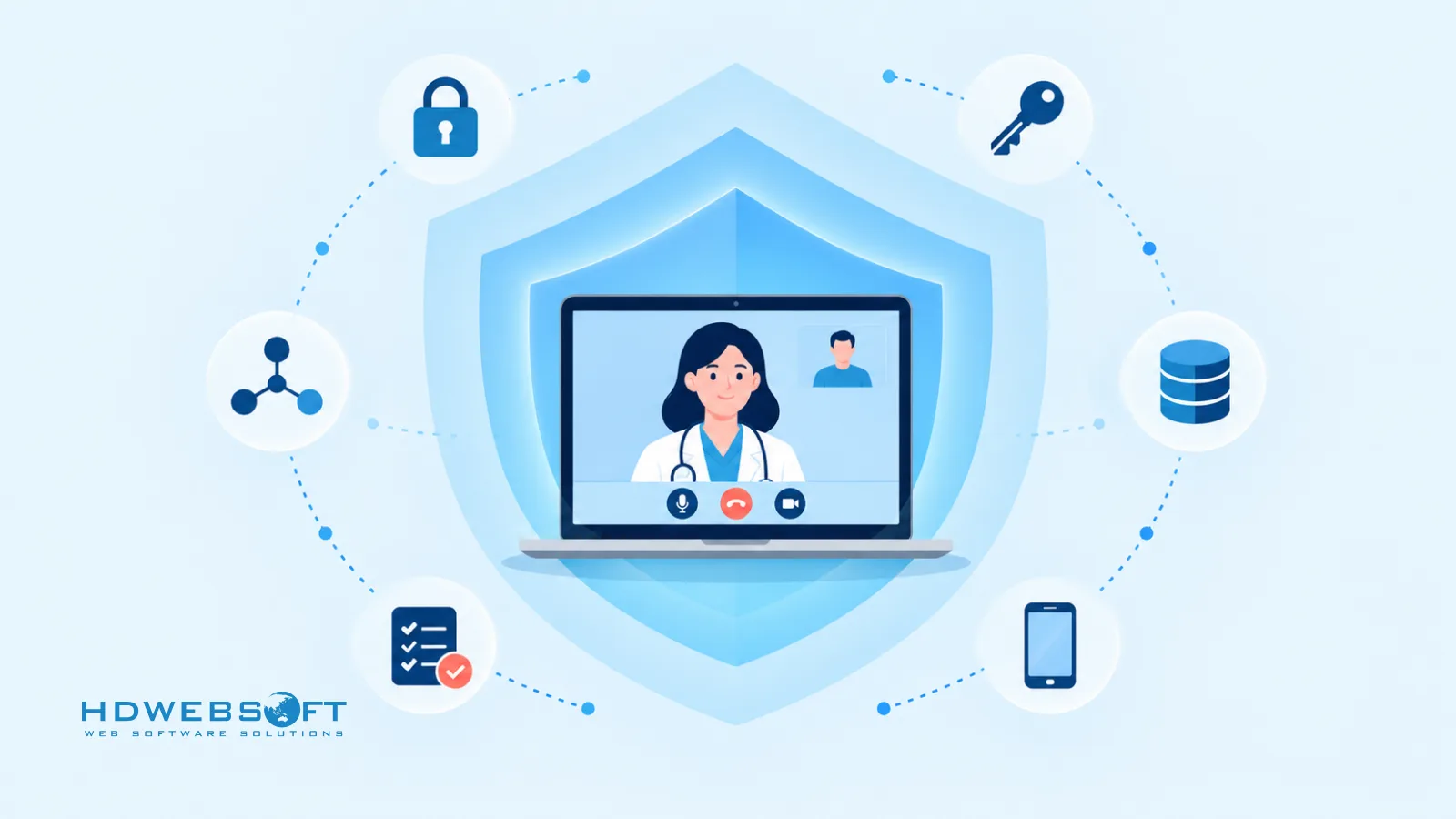
Mitigating these risks takes a layered approach — no single control covers the whole attack surface. These are the components a secure telehealth environment is built from.
Encryption
Encryption protects patient data in transit and at rest — on the wire during a video visit, and in the cloud, servers, databases, and devices where records live. Strong, current cryptographic standards ensure that even intercepted or exfiltrated data stays unreadable and unusable.
Authentication and Authorization
Multi-factor authentication (MFA) requires users to prove identity through at least two distinct factors — for example, a password plus a code from a mobile app or a biometric scan. Role-based access control (RBAC) then limits each authenticated user to the data and functions their job actually requires. This least-privilege principle caps the damage a compromised account can do.
Secure Networks
Virtual private networks (VPNs) create encrypted tunnels for data transmission, and they matter most when staff access telehealth systems from public or home networks. Firewalls monitor and control traffic against defined security rules, blocking unauthorized access and malicious intrusions before they reach patient data.
Data Storage and Backup
Patient data should live on HIPAA-compliant, cloud-native infrastructure that undergoes regular independent audits and offers clear data residency and privacy policies. Equally important is a tested disaster recovery plan — procedures that keep services running and data available through system failures, cyberattacks, and natural disasters, and that restore access quickly when prevention fails.
Audit Logging and Monitoring
Encryption and access control decide who can reach data; audit logging records who actually did. Tamper-resistant logs of every access, change, and disclosure of patient records enable breach detection, forensic investigation, and the reporting obligations regulations like HIPAA impose. Continuous monitoring turns those logs from a compliance artifact into an early-warning system, because unusual access patterns are often the first visible sign of a breach in progress. Organizations without mature in-house monitoring often pair these controls with dedicated cybersecurity services for threat detection and response.
Device Security
Security has to extend to the endpoints on both sides of the call. Providers need managed devices with current antivirus, strong unique passwords, and timely patches. Patients need basic guidance on securing their own devices and home networks, because a weak link on the patient’s end exposes data just as surely as one on the provider’s. Mobile endpoints deserve particular attention — see our guide on ways to enhance mobile app security.
Regulatory and Compliance Standards
Telehealth security sits inside a dense regulatory landscape. These frameworks define the legal floor for protecting patient data — and they increasingly overlap for platforms serving international users.
HIPAA
In the United States, HIPAA is the cornerstone of patient data protection. The Privacy Rule governs how PHI can be used and disclosed, while the Security Rule mandates administrative, technical, and physical safeguards for electronic PHI (ePHI). Telehealth providers must ensure their platforms and practices satisfy both. Our deep dive on HIPAA compliance software covers what the Security Rule demands from the software itself.
GDPR
For telehealth services touching European users, the General Data Protection Regulation adds strict requirements on how personal data is collected, processed, and stored. Its reach is broad: an ECJ ruling in October 2024 confirmed that even order data for pharmacy-only medicines counts as health data under GDPR, requiring explicit consent. Global telehealth platforms generally need to satisfy HIPAA and GDPR simultaneously — the penalties for getting either wrong are significant.
HITECH Act
The HITECH Act strengthens HIPAA’s enforcement teeth — it raised civil and criminal penalties for violations, promoted healthcare IT adoption, and imposed breach notification requirements that matter directly to telehealth providers. The stakes are concrete: testimony before the House Committee on Energy and Commerce in April 2025 stressed the urgency of addressing healthcare cybersecurity vulnerabilities, and non-compliance can carry fines of up to $1.5 million per violation category per year.
ISO/IEC Standards
International standards such as ISO/IEC 27001 provide a framework for establishing, implementing, and continually improving an information security management system (ISMS). The standard is not healthcare-specific, but it is highly relevant: certification shows an organization manages sensitive data under audited, repeatable processes, and it supports compliance with healthcare-specific regulation.
Who Is Responsible for Telehealth Security?
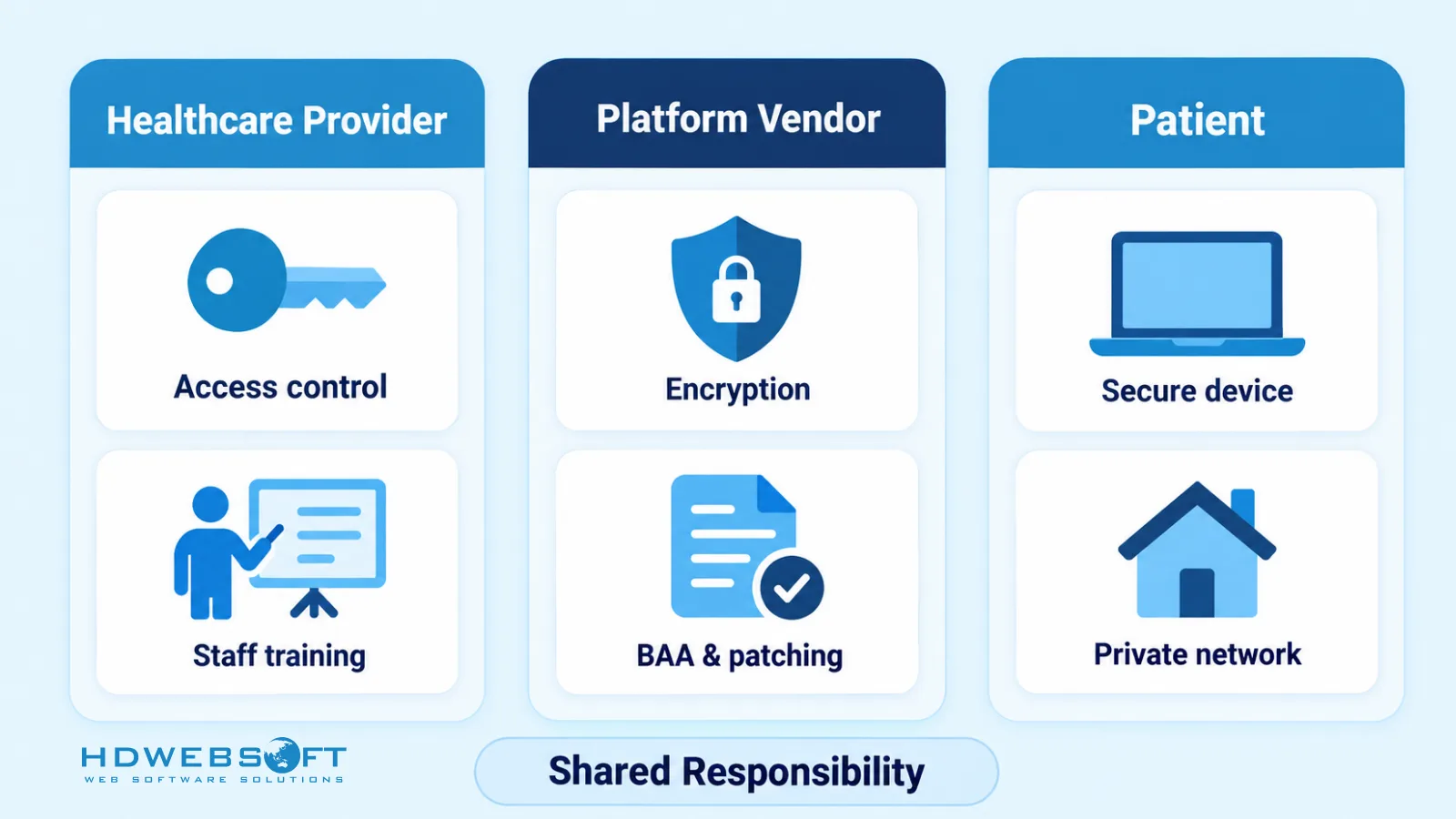
Telehealth security is a shared responsibility, and breaches often happen in the gaps between parties who each assumed someone else owned the problem. Three groups share the work:
| Party | Core responsibilities |
|---|---|
| Healthcare provider | Selects compliant platforms, configures access controls, trains staff, obtains patient consent, vets vendors, runs risk assessments |
| Platform and software vendor | Builds in encryption, MFA, RBAC, audit logs, and secure storage; signs BAAs; patches vulnerabilities; documents its security posture |
| Patient | Secures personal devices and home network, uses official apps and links, keeps credentials private |
The provider owns governance, the vendor owns the platform’s safeguards, and the patient owns their endpoint. A telehealth security program that ignores any one of the three has a hole in it.
How to Evaluate a Secure Telehealth Platform
Every product page claims to be secure. These questions separate platforms that are secure in practice:
- Will the vendor sign a BAA? A refusal is an immediate disqualifier for any platform handling PHI under HIPAA.
- Is video and messaging end-to-end encrypted? Encryption should cover data at rest as well as data in transit.
- Does it support MFA and role-based access? Both are baseline controls for protecting patient and staff accounts.
- Are audit logs complete and exportable? You cannot investigate or report what you cannot see.
- Where is data stored, and who can access it? Data residency, subprocessors, and retention policies should be documented, not implied.
- How is the platform tested? Look for a stated penetration-testing cadence, vulnerability management, and certifications such as ISO/IEC 27001 or SOC 2.
- What happens after a breach? Incident response commitments and notification timelines belong in the contract, not in a press release.
Organizations building a custom platform rather than buying one face the same checklist from the other side — our guide to custom healthcare software development covers how these requirements shape architecture decisions from day one.
Best Practices for Strengthening Telehealth Security and Privacy

Beyond platform selection and compliance, durable telehealth security is an ongoing practice. A few habits carry most of the weight.
Train Providers Continuously
Technology evolves, and so do attack methods. Regular, engaging training keeps clinicians and staff current on phishing recognition, password hygiene, and safe data handling across digital channels. Trained staff are the first line of defense — and often the most effective one.
Obtain Informed Patient Consent
Patients should know how their data will be collected, stored, used, and shared during virtual interactions. Consent forms need to be clear, concise, and readable, outlining risks, benefits, and patient rights. The teach-back method — asking patients to explain what they understood in their own words — confirms comprehension and builds the trust secure digital care depends on.
Run Risk Assessments and Incident Response Drills
Comprehensive risk assessments identify vulnerabilities across systems, processes, and human factors — and they need repeating as the environment changes. A documented, rehearsed incident response plan is the other half: when a breach happens, defined steps, roles, and notification paths minimize damage and keep the organization inside regulatory deadlines.
Review Vendors and Integrations Regularly
Every integration is a standing trust decision. Keep an inventory of third-party tools that touch patient data, confirm each operates under a current BAA, and review their security posture on a schedule. Retire integrations that no longer justify their risk — vendor exposure grows quietly with every connector added and never re-examined.
Frequently Asked Questions
What is telehealth security?
Telehealth security is the combination of technologies, policies, and practices that protect patient data during virtual care — covering video consultations, remote monitoring, messaging, and the systems that connect them. Core controls include encryption, multi-factor authentication, role-based access, audit logging, and secure data storage.
What are the biggest telehealth security risks?
The most common risks are weak authentication and access control, insecure video conferencing tools, vulnerabilities in third-party apps and connected devices, unencrypted communications, and insider threats — both negligent and malicious. Remote patient monitoring adds further exposure through home networks and IoT devices the provider does not control.
Does telehealth have to be HIPAA compliant?
For U.S. covered entities, yes. Telehealth platforms that create, receive, maintain, or transmit electronic protected health information must meet the HIPAA Privacy and Security Rules, and the vendor must sign a Business Associate Agreement. There is no official HIPAA certification — compliance depends on how the platform is built and operated.
Is encryption required for telehealth?
In practice, yes. The HIPAA Security Rule currently lists encryption as an “addressable” safeguard — required unless a documented equivalent alternative exists — and the proposed Security Rule update published in late 2024 would make it mandatory. GDPR also expects state-of-the-art protection for health data.
Who is responsible for telehealth security?
Responsibility is shared across three parties. The healthcare provider owns governance — platform selection, access configuration, training, and consent. The platform vendor owns built-in safeguards such as encryption and audit logs. The patient owns their endpoint — a secure device, private network, and protected credentials.
How can patients protect their data during telehealth visits?
Patients should use updated devices with current security patches, connect over private home networks rather than public Wi-Fi, join visits only through official apps or verified links, and enable multi-factor authentication on patient portal accounts.
Conclusion
Telehealth made care more accessible — and made patient data more exposed. Closing that gap takes more than a compliant platform: it takes layered technical safeguards, trained people, clear patient communication, and vendors held to explicit security commitments.
Virtual care will keep expanding into homes, devices, and continuous monitoring, and each expansion widens the surface telehealth security must defend. Organizations that treat security as an ongoing practice rather than a launch checkbox are the ones that will earn — and keep — the patient trust virtual care depends on.
HDWEBSOFT is an ISO 9001 and ISO/IEC 27001 certified company with experience building secure, compliance-ready healthcare applications. If you are planning a telehealth platform or hardening an existing one, explore our healthcare software development services or contact us to discuss how we can help.