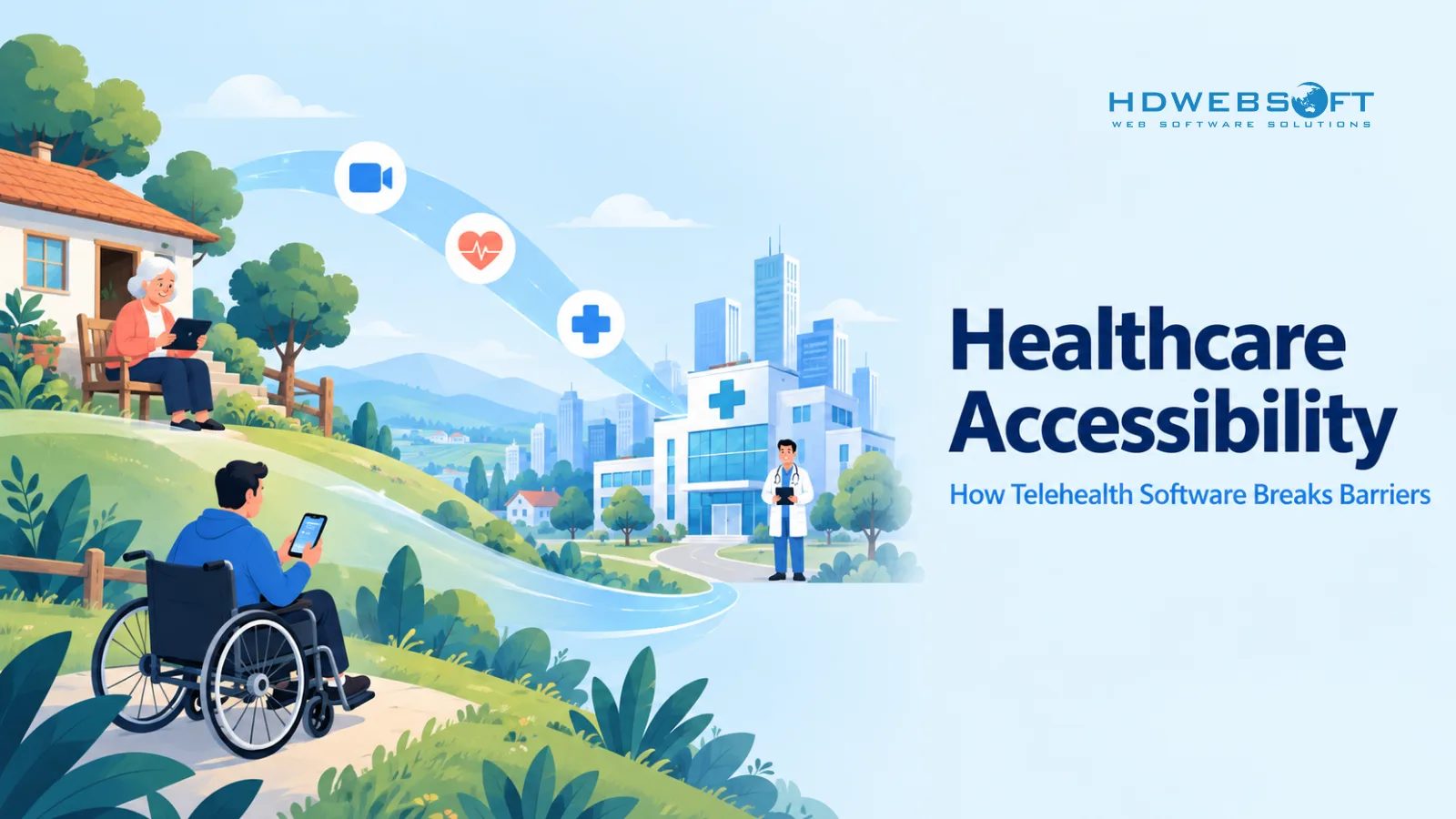
Telehealth software improves healthcare accessibility by removing the barriers that keep patients from care — distance, mobility limitations, cost, time, and specialist shortages. Through video consultations, remote monitoring, patient portals, and connected devices, it delivers medical services to people who would otherwise delay or forgo treatment.
This guide explains what telehealth software is, how it expands access for underserved populations, the technologies and features behind it, what a custom healthcare software solution costs, and where accessibility gaps still remain.
What Is Telehealth Software?
Telehealth software is a suite of health information technologies — video consultation platforms, mobile apps, patient portals, connected devices, and the cloud infrastructure that links them — that allows providers to deliver care remotely. It covers both the clinical side, such as diagnosis, treatment, and monitoring, and the operational side, such as scheduling, records, and billing.
In practice, these systems let physicians reach more patients without either party traveling. A patient consults from home on a phone or laptop, while the provider works from a platform that keeps medical records, prescriptions, and consultation history in one place. The result is a care delivery model where location matters far less than it used to.
How Telehealth Software Improves Healthcare Accessibility
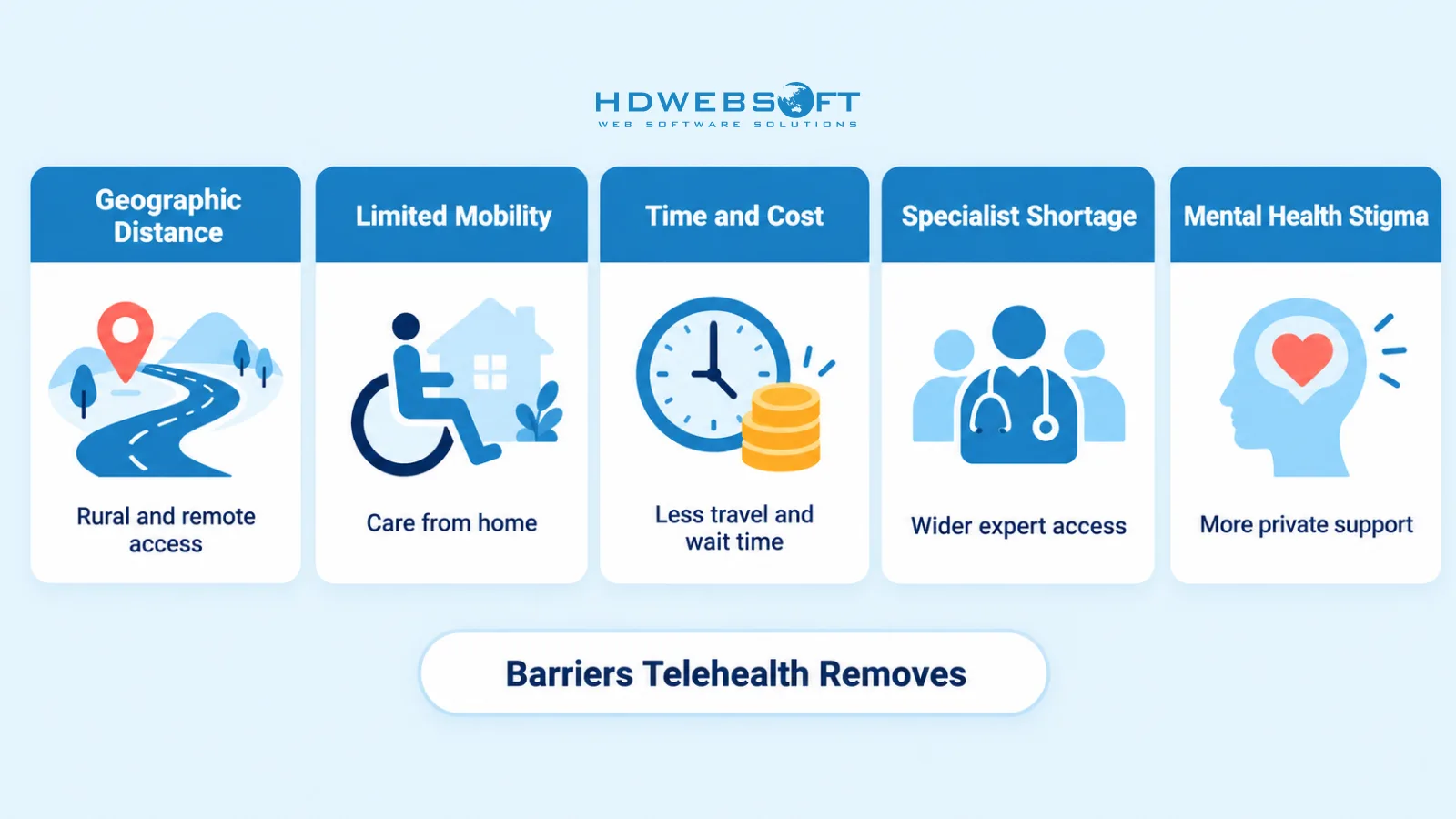
The accessibility gains from telehealth are not abstract — they map to specific barriers that have always kept people away from care. These are the ones telehealth software addresses most directly.
Removing Geographic Barriers
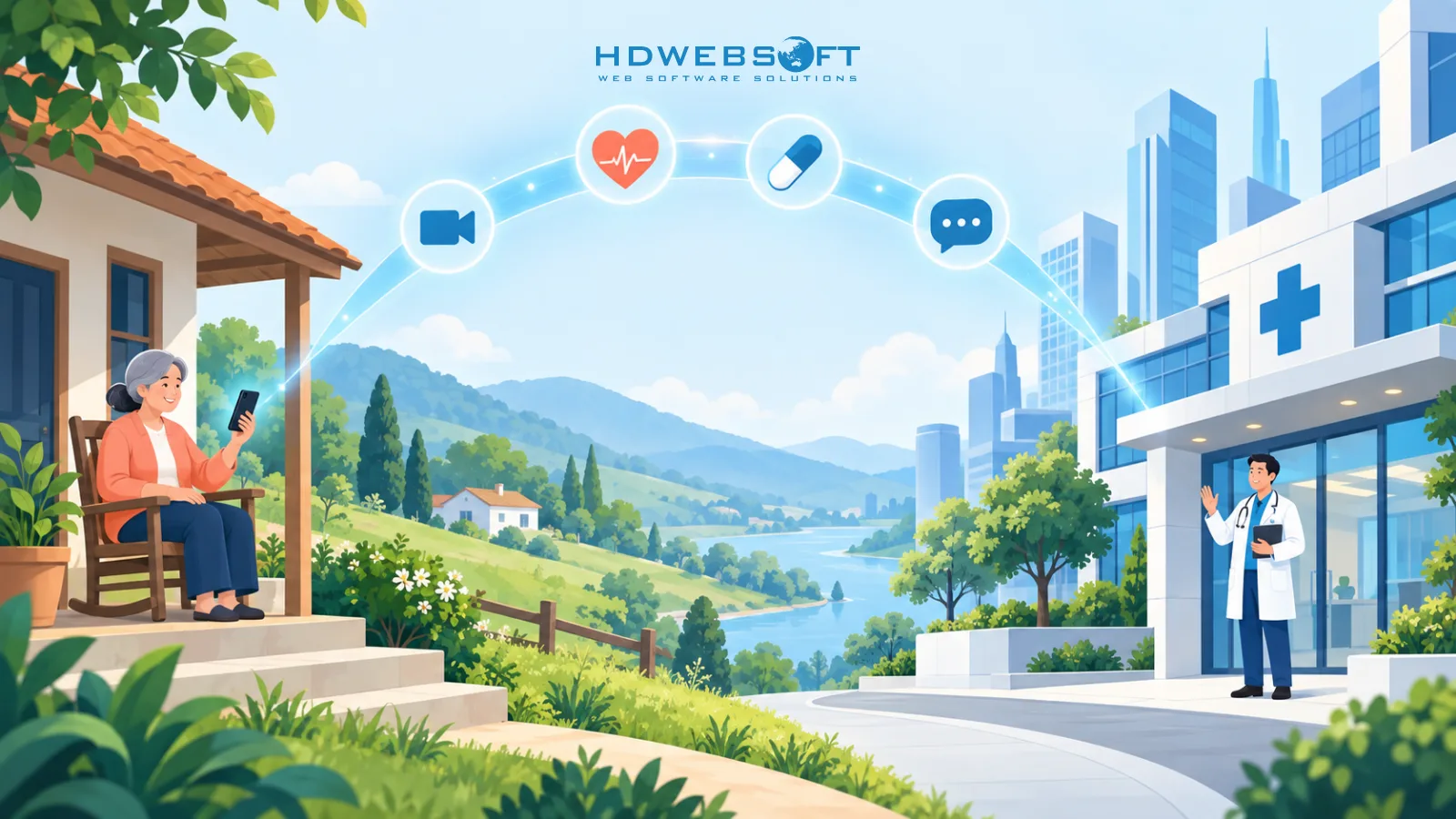
For rural and remote communities, the nearest clinic can be hours away and the nearest specialist further still. Telehealth software collapses that distance: a patient in a remote town can consult a specialist in a major city without leaving home. It also cushions the impact of rural hospital closures, which have steadily reduced local care options across many regions.
Reaching Patients with Mobility Limitations
For elderly patients, people with disabilities, post-surgical patients, and those with chronic conditions, travel is not just inconvenient — it can be a medical burden or a genuine impossibility. Virtual consultations and remote monitoring bring routine follow-ups, medication reviews, and check-ins to the patient, turning trips that required transport assistance into appointments that require only a device.
Reducing Time and Cost Barriers
The hidden costs of care — fuel, parking, time off work, childcare — push many patients to skip appointments entirely. Telehealth removes most of them: a consultation that once consumed half a day fits into a lunch break. Providers benefit too, because extended virtual hours and shorter visit overhead let them offer appointments outside the traditional nine-to-five window.
Easing Specialist Shortages
Specialists are unevenly distributed, concentrated in cities while rural regions wait weeks or months for appointments. Telehealth lets one specialist serve a much wider geography and lets primary care providers bring specialists into a consultation virtually. For patients, that translates into earlier diagnoses and treatment decisions that do not wait for a referral chain to play out.
Lowering Barriers to Mental Healthcare
Mental health is where telehealth’s accessibility gains are arguably strongest. Many patients avoid seeking help because of stigma, and others simply have no local provider. Home-based video or messaging sessions offer privacy and discretion that a clinic waiting room cannot, and they connect patients to licensed therapists regardless of local availability.
Telehealth vs. Telemedicine
The two terms are often used interchangeably, but there is a real distinction worth keeping.
Telemedicine refers to remote clinical services — consultations, diagnoses, and treatment delivered at a distance through video calls, lab report exchanges, and similar channels. Telehealth is the broader umbrella: it covers clinical care and the non-clinical services around it, such as provider training, health education sessions, and administrative workflows.
The distinction matters when scoping a platform. A product built only for video visits is telemedicine software; one that also handles education, coordination, and community engagement is telehealth software. Our healthcare knowledge platform case study is a good example of the broader model — it combines community, education, and care delivery in a single system rather than stopping at consultations.
Technologies That Make Virtual Care Accessible
Telehealth accessibility is not one feature — it is an ecosystem of technologies working together. These are the components doing the heavy lifting, several of which are also among the medical software development trends reshaping the industry.
Electronic Health Records
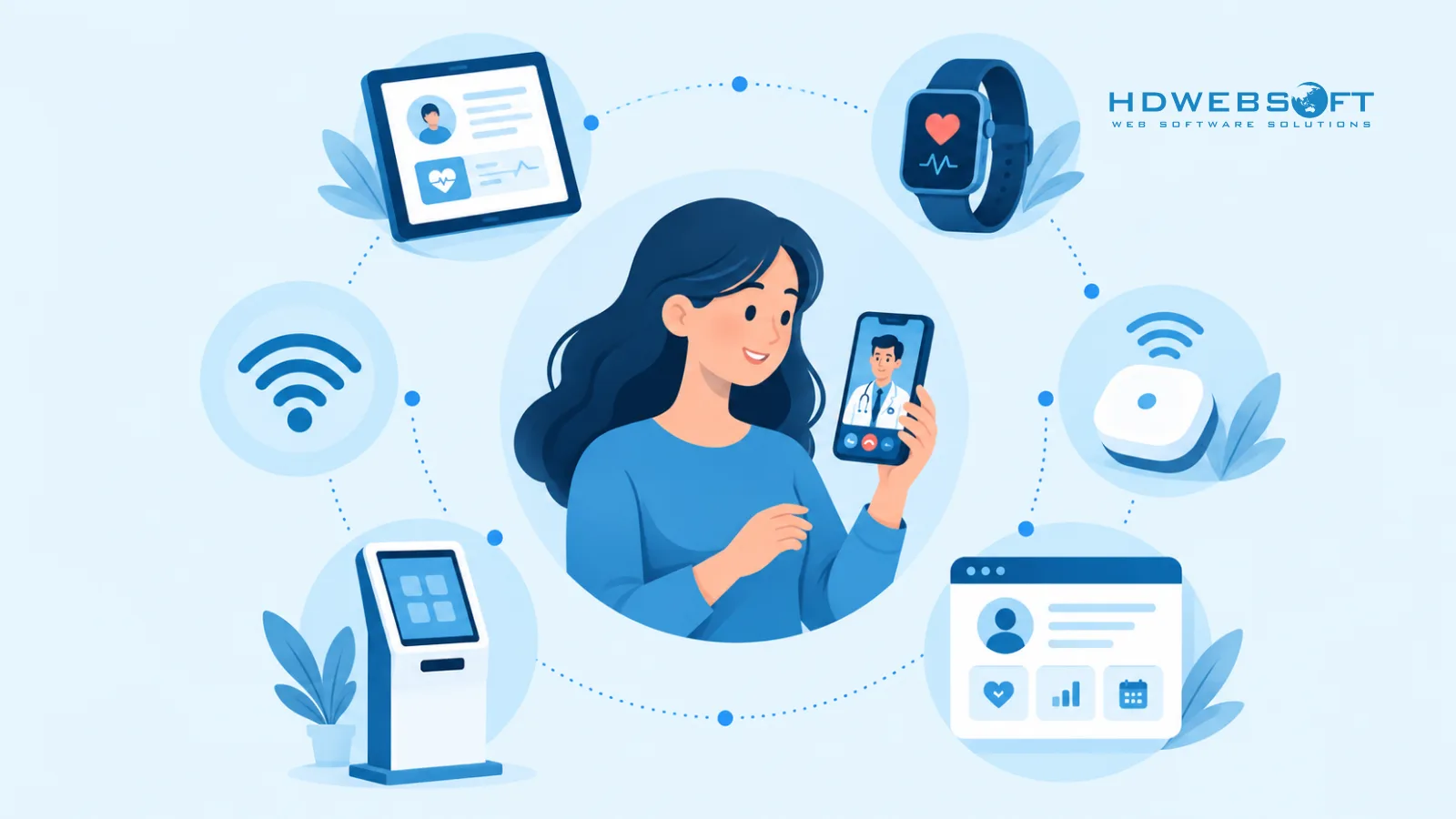
Electronic health records (EHRs) consolidate a patient’s history, test results, treatment plans, and prescriptions into a digital record accessible during virtual consultations. That continuity is an accessibility feature in itself: a patient seeing a provider for the first time remotely does not have to recount their history from memory, and the provider does not work blind. EHR integration also reduces redundant testing and administrative workload, which lowers the cost side of the accessibility equation.
Mobile Health
Mobile health (mHealth) applications turn the smartphone — the most widely owned connected device — into a care endpoint. Patients track fitness metrics, manage chronic conditions, and message providers from a device they already carry. A diabetic patient, for example, can log glucose readings in an app and share them during a virtual consultation, giving the clinician real data rather than recollection.
Patient Portals
Patient portals are web platforms where patients schedule appointments, view test results, and communicate securely with their care teams. Integrated with telehealth software, they create a single front door for both in-person and remote care — post-consultation notes, prescriptions, and follow-ups live in one place, so the patient does not navigate separate systems for each interaction.
Self-Service Kiosks
Self-service kiosks handle administrative tasks such as check-ins, insurance verification, and payments in clinics and hospitals. More relevant to accessibility, they also function as telehealth access points: a kiosk in a community clinic, pharmacy, or library lets patients without home internet or private space connect to remote specialists. That makes kiosks one of the practical answers to the digital divide discussed below.
Remote Patient Monitoring
Remote patient monitoring (RPM) uses medical devices to collect patient data — blood pressure, glucose, oxygen saturation — and transmit it to providers between visits. It replaces episodic check-ins with continuous oversight, which is especially valuable for chronic disease management. The RPM market’s projected growth to $6 billion by 2034 reflects how central this has become to accessible care.
Wearable Devices
Wearables such as fitness trackers and smartwatches stream real-time data on activity, sleep, and cardiovascular health. They extend RPM into daily life — a wearable ECG can flag an irregular heart rhythm before the patient feels a symptom, giving providers the chance to intervene early rather than after an emergency.
Wireless Connectivity
None of the above works without connectivity. Wi-Fi, Bluetooth, and cellular networks carry the data between devices, patients, and providers — uninterrupted video consultations, file transfers, and synchronized monitoring all depend on them. Expanding cellular coverage is also what makes telehealth viable in rural areas at all.
Key Features of Telehealth Software
Technology alone does not create accessible care — the features built on top of it determine whether patients can actually use the system. These are the capabilities an effective telehealth platform needs.
Patient and Doctor Dashboards
The dashboard is the central hub for both sides of the consultation. Patients see upcoming appointments, health history, and treatment plans; doctors get quick access to records, diagnostic tools, and communication options. A well-designed dashboard reduces friction for both parties, which matters because every point of friction is a potential reason a vulnerable patient gives up.
Appointment Scheduling and Reminders
Telehealth software lets patients book, reschedule, or cancel appointments from their devices, while providers set availability and manage time slots without phone tag. Automated reminders via SMS, email, or push notification then keep patients informed and cut no-show rates — a small feature with an outsized effect on continuity of care.
High-Quality Video Consultations
HD video is the clinical core of telehealth: it carries the visual assessments and the human rapport that make remote care credible. Equally important is graceful degradation — the ability to fall back to lower quality or audio-only when a patient’s connection cannot sustain video, so a weak signal does not mean a cancelled appointment.
Session Recording
Recording lets providers revisit consultations for accuracy, training, and compliance, and lets patients replay instructions they may have missed the first time. It also provides a record when medical advice needs to be clarified or disputed later.
Multi-User Communication
Care rarely involves just two people. Multi-user chat and conferencing let a patient, their specialists, nurses, and family caregivers share one channel, keeping everyone informed about the treatment plan without relaying messages through the patient.
Reports and Analytics
Analytics tools let providers track patient outcomes, spot trends across populations, and evaluate whether treatments are working. For organizations serving underserved communities, this data also demonstrates where accessibility programs are succeeding and where gaps remain.
E-Prescriptions and Medication Tracking
Integrated prescription management lets doctors issue e-prescriptions and monitor adherence, while patients receive dosage instructions, refill reminders, and ordering from the same platform. Closing the loop between consultation and medication removes one more trip from the care journey.
Multiple Payment Methods
A range of payment options — credit cards, digital wallets, direct insurance billing — keeps payment from becoming its own accessibility barrier. Flexible, secure billing is part of making virtual care usable for patients across income levels.
Accessibility-First Design
The features above only reach everyone if the interface does too. Accessibility-first telehealth design means WCAG-conformant interfaces, live captions and transcription for deaf and hard-of-hearing patients, interpreter integration and multilingual interfaces, screen-reader compatibility, and low-bandwidth modes for weak connections. Platforms that skip these are accessible in name only — they serve exactly the patients who already had easy access to care.
The Digital Divide: Where Telehealth Still Falls Short
Telehealth’s accessibility story has an honest limitation: it shifts care onto infrastructure that not everyone has. Broadband coverage gaps, device ownership, and digital literacy all skew against the same populations — rural, elderly, and low-income — that telehealth promises to serve best.
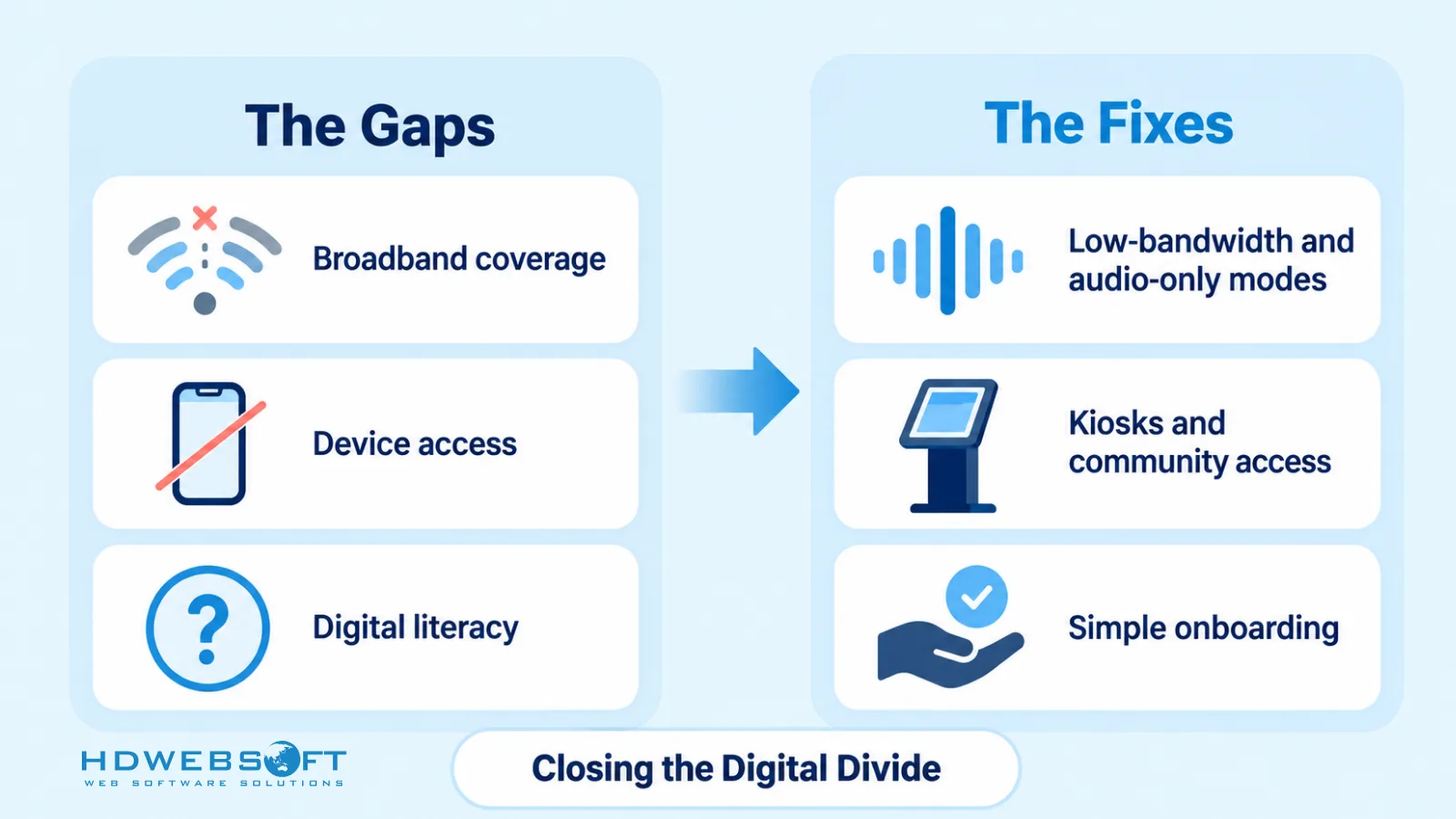
The practical mitigations are design and deployment choices rather than new technology. Low-bandwidth and audio-only modes keep visits viable on weak connections. Kiosks and community access points give patients without home internet a place to connect. Simple interfaces and onboarding support lower the literacy barrier, and policies that reimburse audio-only visits keep phone-based care affordable. Organizations that treat these as first-class requirements — not afterthoughts — are the ones that actually expand access.
Security and Compliance Considerations
Accessibility only counts if patients can trust the platform with their data. Telehealth software handles protected health information on every visit, so encryption, access control, and audit logging are baseline requirements rather than optional extras — we cover the full picture in our guide to telehealth security. For U.S. providers, HIPAA compliance shapes both the architecture and the budget, and our article on HIPAA compliance software in healthcare explains what that entails.
The Cost of a Custom Telehealth Software Solution
Custom development is a worthwhile investment for providers whose needs outgrow off-the-shelf platforms. The belief that telehealth software is always expensive is a misconception — cost scales with scope, and a well-scoped product is often cheaper than a bloated one.
What Drives the Cost
- Features and functionality: Core capabilities like video consultations, scheduling, and e-prescriptions sit at the lower end; AI-driven analytics, multi-user workflows, and wearable integration push toward the higher end.
- Design complexity: An interface accessible to elderly patients and usable on weak connections takes more design and testing effort than a standard app.
- Compliance requirements: Building to HIPAA, GDPR, or regional health-data standards adds engineering and audit work to the budget.
- Platform coverage: Web-only, mobile-only, or multi-platform delivery each carry different development and maintenance costs.
- Ongoing operation: Maintenance, updates, hosting, and support continue after launch and should be budgeted from the start.
With the global telehealth market projected to grow at an 11.5% CAGR from 2026 to 2033, platforms built today need room to scale. It is one reason custom development can become valuable as workflows, integrations, and user volumes grow. Partnering with an experienced healthcare software development vendor keeps that growth path affordable.
Conclusion
Telehealth software improves healthcare accessibility in concrete, measurable ways — it removes distance for rural patients, travel for mobility-limited patients, cost and time for working patients, and stigma for mental health patients. Its remaining frontier is the digital divide, which is a design problem as much as an infrastructure one.
For healthcare organizations, the opportunity is to build platforms that treat accessibility as a core requirement rather than a feature checklist. If you are planning a telehealth product or want to extend an existing one, contact us for a free consultation.
Frequently Asked Questions
How does telehealth improve healthcare accessibility?
Telehealth improves healthcare accessibility by removing the barriers that keep patients from care — distance, mobility limitations, cost, time off work, and specialist shortages. Video consultations, remote patient monitoring, patient portals, and connected devices deliver medical services to people who would otherwise delay or forgo treatment.
What is the difference between telehealth and telemedicine?
Telemedicine refers specifically to remote clinical services — video consultations, diagnoses, and treatment delivered at a distance. Telehealth is the broader concept: it covers clinical care plus non-clinical services such as provider training, health education, and administrative workflows.
Who benefits most from telehealth software?
The groups that benefit most are rural and remote patients far from specialists, elderly and mobility-limited patients for whom travel is a medical burden, people managing chronic conditions that need frequent monitoring, patients without reliable transportation, and mental health patients who prefer the privacy of home-based sessions.
What features should telehealth software include?
Core features include HD video consultations, appointment scheduling and automated reminders, patient and doctor dashboards, e-prescriptions, multi-user messaging, reporting and analytics, and secure payment options. Accessibility-focused platforms also add live captions, interpreter integration, low-bandwidth modes, and WCAG-conformant interfaces.
How much does custom telehealth software cost?
Cost depends on features, design complexity, compliance requirements, and platform coverage. Basic software with video consultations and scheduling sits at the lower end, while solutions with AI analytics, multi-user support, and wearable integration cost more. Ongoing maintenance, updates, and hosting should also be budgeted.
What barriers does telehealth still face?
The main remaining barrier is the digital divide — gaps in broadband coverage, device ownership, and digital literacy that hit the same underserved populations telehealth aims to reach. Providers mitigate this with low-bandwidth and audio-only visit modes, community access points such as kiosks, and patient onboarding support.