
HIPAA-compliant offshore software development means outsourcing engineering work to a team outside the US while still meeting the HIPAA privacy, security, and business-associate requirements that apply to that work. The operative phrase is that apply: not every offshore vendor must sign a Business Associate Agreement or undergo an annual audit. Whether a BAA is required depends on what the vendor actually does — specifically, whether their activities involve creating, receiving, maintaining, or transmitting protected health information (PHI) on behalf of your organization.
That distinction is where most compliance mistakes start: either assuming offshore automatically disqualifies a vendor, or assuming a signed BAA alone makes an engagement compliant. The truth sits between them — offshore raises the complexity of compliance (contracts across jurisdictions, remote access to PHI, vendors you cannot walk into) without changing its fundamentals. For US healthcare organizations considering offshore delivery — including healthcare software outsourcing in Vietnam — the real work is matching the vendor’s access to PHI with the right agreements, architecture, and evidence.
Key Takeaways
- A vendor becomes a business associate based on its activities and relationship to PHI, not based on whether it signs paperwork or sits offshore.
- Separate legal requirements (BAAs where applicable, Security Rule safeguards) from recommended contractual protections (breach SLAs, audit rights) and operational practices (VDI, de-identified data).
- HIPAA does not impose a general requirement that ePHI stay inside the United States — but PHI accessed or stored offshore must remain appropriately protected.
- Business associates carry direct HIPAA obligations; accountability is shared, not held exclusively by the covered entity.
- Vendor evaluation should run on evidence: scope-checked certifications, implementation details, and remediation track records — not attestation.
What Does HIPAA-Compliant Offshore Software Development Require?
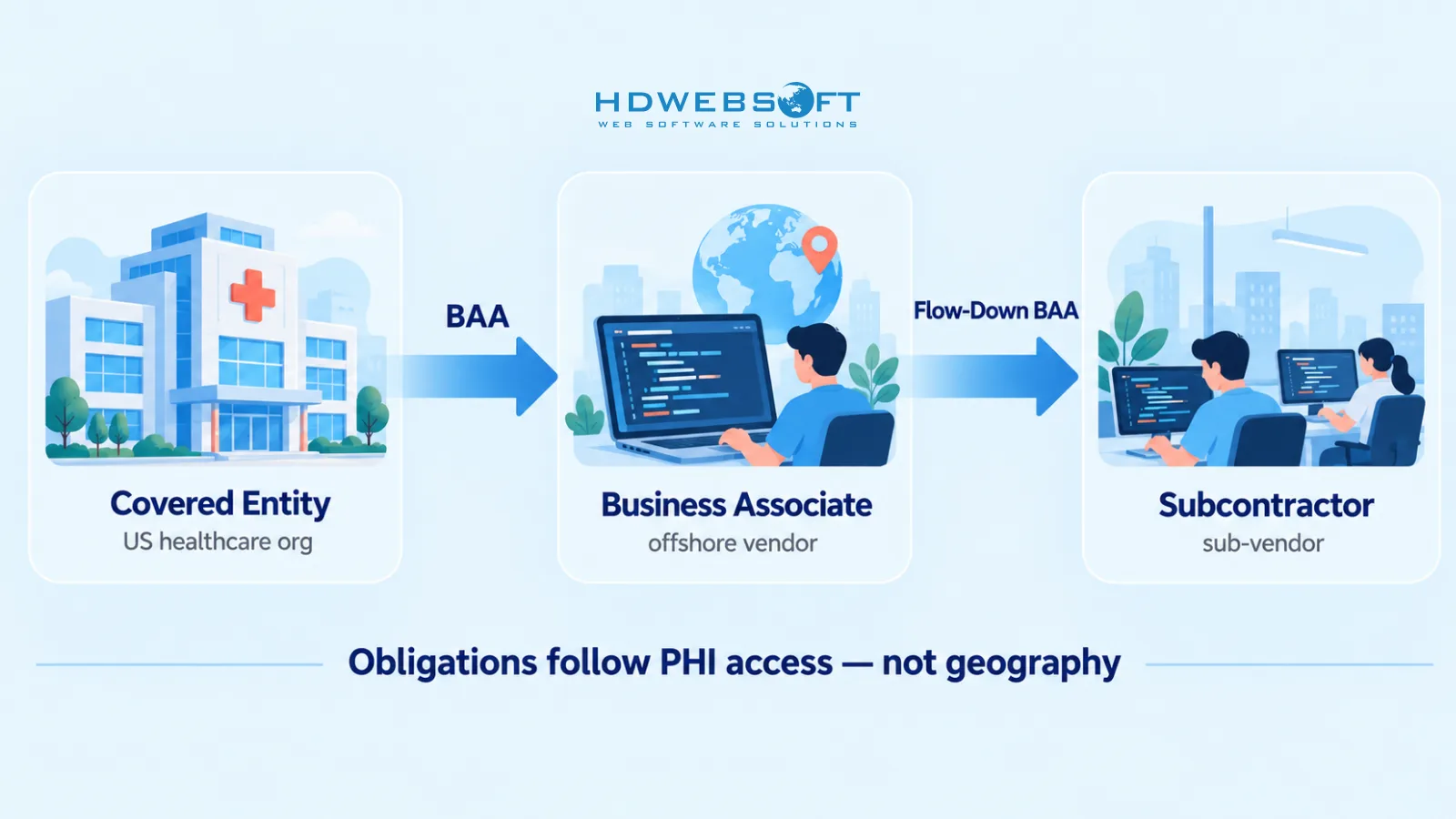
HIPAA assigns obligations by role. A covered entity — the provider, health plan, or clearinghouse — owns the relationship with patients. A business associate is a person or entity that performs functions involving PHI on the covered entity’s behalf: an offshore development team maintaining a patient portal, running EHR integrations, or doing production support all plausibly qualify. A subcontractor business associate is a vendor’s own sub-vendor, which inherits equivalent obligations through flow-down requirements.
Two points matter here. First, offshore location alone does not determine business-associate status — the vendor’s functions and PHI touchpoints do. A team writing billing code against synthetic data may never become a business associate; the same team doing production support on live patient records almost certainly is. Second, generic HIPAA software safeguards are only half the answer. Our guide to HIPAA compliance for healthcare software covers baseline administrative, physical, and technical safeguards established by the HIPAA Security Rule. What this article adds is the offshore-specific layer: cross-border contracts, remote-access architecture, and vendor due diligence — because a compliant application can still be operated by a non-compliant vendor relationship.
HIPAA Business Associate Agreements for Offshore Vendors
A BAA is required when a vendor performs activities involving PHI on behalf of a covered entity or another business associate. Where a BAA applies, it must be executed before PHI is disclosed for that service — signing after data has already flowed is a retroactive violation, not a fix. The HHS’s sample Business Associate Agreement provisions spell out the mandatory content: permitted and required uses of PHI, safeguards against impermissible use, breach reporting, and return or destruction of PHI at termination.
Offshore engagements benefit from separating two layers inside that contract:
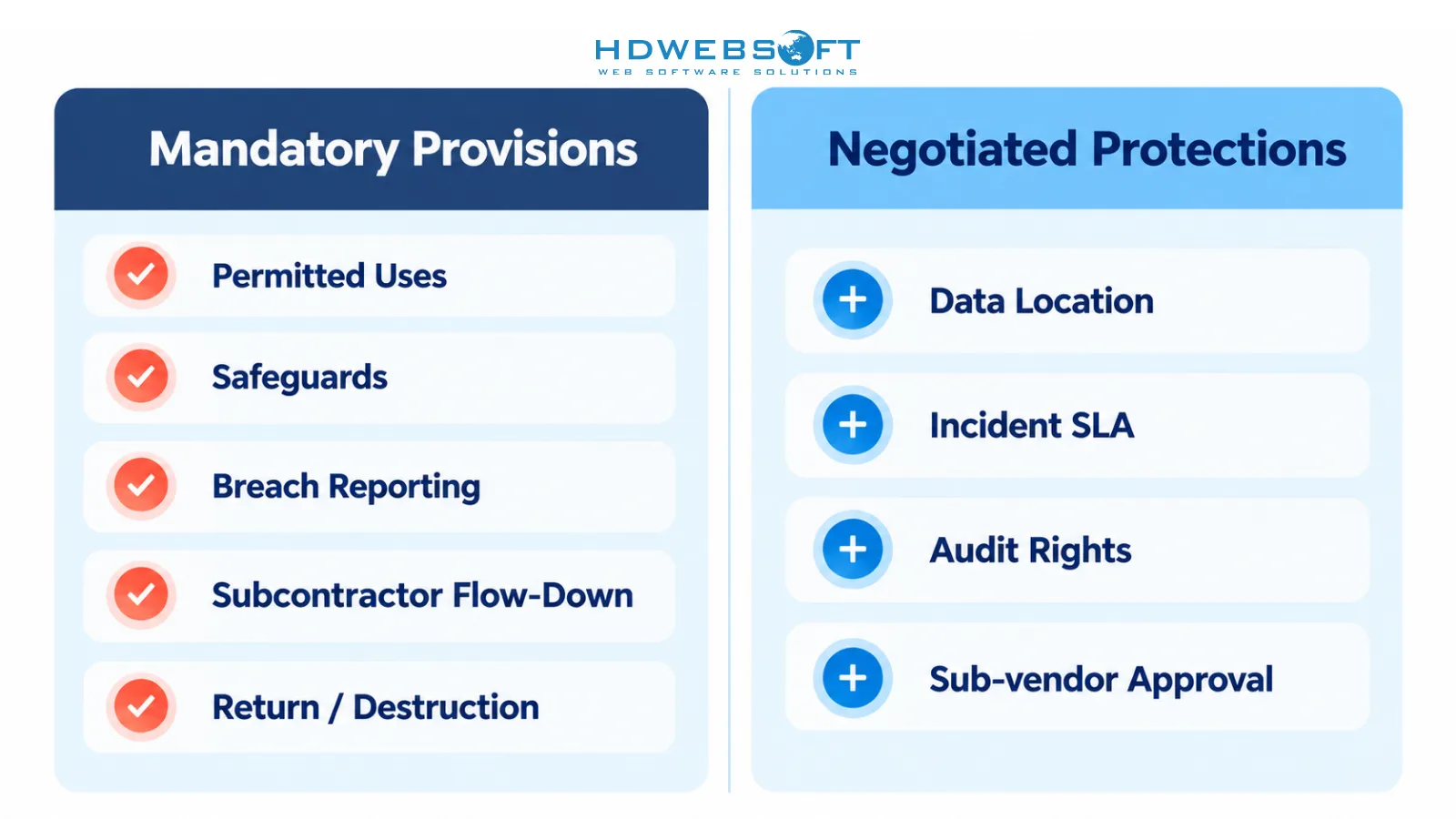
- Mandatory provisions — permitted uses and disclosures; safeguards; reporting of breaches, security incidents, and impermissible uses; subcontractor flow-down (every sub-vendor touching PHI signs equivalent terms); termination rights; and PHI return or destruction where feasible. The permitted-uses clause deserves particular attention offshore: define the specific services covered and explicitly prohibit uses beyond them — especially secondary uses like model training, analytics on your data, or disclosure to any third party not covered by a signed subcontractor agreement.
- Additional contractual protections — items HIPAA does not mandate but that buyers should negotiate: explicit data-location disclosure (which jurisdictions host or access PHI), incident notification on a defined SLA (24–48 hours is a reasonable contractual target, though it is not a HIPAA statutory deadline — the Breach Notification Rule’s own timelines are longer and apply at the covered-entity level), right-to-audit clauses, subcontractor change approval, and defined PHI handling at each contract milestone, not only at termination.
One legal nuance worth knowing: business associates have direct HIPAA obligations, not merely contractual duties to the covered entity. Since the HITECH Act and the 2013 Omnibus Rule, business associates can be directly liable for Security Rule violations and certain Privacy and Breach Notification Rule breaches. A BAA allocates responsibility — it does not move all accountability onto the vendor.
A final caveat: cross-border enforcement is harder than domestic enforcement. OCR action against a US business associate is realistic; against an offshore entity, practical remedies shrink to contract damages, termination, and whatever leverage you hold through the commercial relationship. If your only protection against an offshore vendor’s mishandling of PHI is a contract clause, your protection is thin. The BAA must sit on top of technical controls that make violations architecturally difficult — which is the next section.
HIPAA Data Residency, Remote PHI Access & Offshore Architecture
A common misconception: HIPAA requires patient data to stay in the United States. It does not. HHS guidance on offshore ePHI storage confirms that covered entities and business associates may use cloud providers storing ePHI on servers outside the US — provided the required safeguards apply. Two nuances: that guidance addresses cloud storage scenarios, which are not the same as offshore developer access; and PHI that is US-hosted can still be accessed by offshore personnel — that access must remain protected regardless of where the engineer sits.
Three delivery patterns cover most real engagements. The trade-off is always the same: how much PHI exposure does the work genuinely require, versus how much your architecture permits?
| Pattern | Where PHI lives | What offshore staff touch | When it fits |
|---|---|---|---|
| US-hosted PHI + controlled remote access | US cloud/data center | PHI via VDI or bastion — no local copies | Production support, live-data integrations |
| De-identified or synthetic data offshore | US | Code, schemas, masked or synthetic datasets | Feature development, QA, analytics |
| Hybrid environment separation | US prod | Code and test artifacts offshore; PHI ops onshore | Larger engagements split by environment |
A critical technical distinction: masked data is not automatically de-identified data. Format-preserving masking (swapping names for plausible fakes) can be reversible and may still count as PHI. HIPAA de-identification requires meeting the Safe Harbor removal of identifiers or an Expert Determination — a higher bar than scrambling columns. If your “test data” is masked rather than de-identified, treat it as PHI.
Whichever pattern you choose, the controls that matter are consistent:
- Access channel — VDI or bastion-hosted sessions with local storage, printing, and clipboard disabled; no PHI paths that end on an offshore laptop.
- Permissions — least-privilege IAM with named per-user accounts, MFA, and access scoped to the systems the role requires.
- Export restrictions — technical blocks on bulk export, screenshots where feasible, and egress monitoring.
- Environment isolation — offshore development and staging environments must not reach production PHI; the only path to real data goes through the controlled channel.
- Logging — every PHI access logged with user, timestamp, and object touched, retained long enough to support audit and incident reconstruction.
- Documented risk assessment — the chosen model gets its own risk analysis: what can go wrong, what the exposure is, and what mitigations close the gap.
Decision box — does the offshore team actually need identifiable PHI? Most development, QA, and analytics work does not. If the honest answer is no, de-identified or synthetic data is the lowest-risk path — and it shrinks or removes the BAA question entirely.
This matters most for integration-heavy work. Teams building EHR/EMR software development interfaces typically need patient-data structures — HL7 messages, FHIR resources, field mappings — far more than they need real PHI, which is why de-identified datasets plus a small US-side integration team is a common practical split.
Vendor Security Audit Checklist
This is where due diligence either produces evidence or exposes gaps. A vendor audit is not asking “are you HIPAA compliant?” — no certificate answers that. It is asking the vendor to prove, control by control, that the safeguards your engagement requires actually exist and actually run. Evaluate vendors across ten control areas — as control area → buyer question → evidence to request:
| Control area | Buyer question | Evidence to request |
|---|---|---|
| Certifications | Do you hold SOC 2 Type II or ISO 27001? What is the certificate scope? | Certificate + scope document; verify it covers the services you will buy, not just the corporate entity |
| Risk assessment | Is there a documented, recent HIPAA-relevant risk analysis? | Redacted risk register or assessment summary with dates and methodology |
| IAM | How are accounts provisioned for staff touching PHI? | MFA policy, least-privilege model, joiner/mover/leaver procedure |
| Encryption | What is encrypted, where, and who manages keys? | Encryption standard, key-management description |
| Physical security | How are offices and devices controlled? | Access controls, device management (MDM), BYOD policy |
| PHI access logs | Who can see production PHI, and is it logged? | Sample log schema, retention period, review cadence |
| Incident response | What happens when something goes wrong? | Documented IR plan, escalation path, last exercise date |
| Workforce training | Are the people touching PHI trained? | Training curriculum, completion records, refresh frequency |
| Subcontractor management | Who else touches our work? | Sub-vendor list, flow-down agreement samples |
| Breach history | Have you had security incidents before? | Honest disclosure — a “no” that turns out false later is worse than a disclosed incident |
Three assessment principles. First, certification scope beats certification existence — a SOC 2 covering a vendor’s SaaS product may exclude the engineering team serving you. Second, implementation beats attestation — policies that exist in a PDF but not in practice are discovered in how quickly the vendor produces real artifacts (log samples, procedure documents), not slide decks. Third, remediation beats perfection — a vendor with documented findings and a tracked fix history is safer than one claiming a spotless record.
Practical sequencing: run pre-contract verification as a condition of signing — not after onboarding when leverage is gone — then set ongoing review cadence by risk. PHI-touching engagements deserve tighter review loops than de-identified development, and a review triggered by a vendor incident or a subcontractor change matters more than a review triggered by the calendar. Neither SOC 2 nor ISO 27001 is a mandatory HIPAA certification, and HIPAA does not impose a universal annual-audit requirement; your review frequency should follow the risk profile and the contract terms you negotiate.
Score each control area on the same simple scale — verified, partially verified, unsupported claim — and treat “unsupported claim” as a cost line: either the vendor invests to close it, or the engagement carries a documented residual risk your security and legal teams accept consciously rather than discover later.
Contracts, SLAs & Ongoing Governance
A signed BAA starts the relationship; governance sustains it — healthcare outsourcing compliance is ultimately an oversight discipline, not a document. Post-contract oversight that works in practice:
- Periodic security reviews — cadence set by risk and contract terms, not a universal annual default.
- Subcontractor change control — new sub-vendors touching PHI require approval before engagement, not notification after.
- Remediation tracking — audit findings go into a tracked list with owners and deadlines, revisited in the next review.
- Incident exercises — tabletop drills for breach scenarios, including who calls whom on the offshore side overnight.
- Escalation procedures — a named security contact and a tested path that works across time zones.
- Termination readiness — the return/destruction clause must be executable: data inventory, deletion certification, verified completion.
Red flags during evaluation: compliance claims without evidence (“we are HIPAA compliant” as a sentence, not a portfolio), refusal to disclose relevant subcontractors, reluctance to share reasonable security documentation, or insistence on their own watered-down BAA language without negotiation. Each is a signal about how the vendor will behave when something goes wrong — which is when it matters. None of these terms is universal: audit rights, review frequency, incident SLAs, and additional security exhibits all scale with the risk of the engagement and what you negotiate into the contract, not a HIPAA-imposed baseline.
When the evaluation points toward a partner rather than a problem, the differentiator is delivery record, not promises: a vendor that can show healthcare engineering work, named security practices, and prior audit experience is far easier to verify than one starting from zero. That is the profile HDWEBSOFT’s healthcare software development services are built to satisfy — with the caveat every vendor should accept: compliance is demonstrated in evidence, not guaranteed in marketing.

Conclusion
HIPAA-compliant offshore software development is a sequence, not a status: determine whether a BAA applies to the vendor’s role → select the PHI access and data architecture that fits the work → evaluate the vendor’s security evidence → establish ongoing governance. Skip a step and the others weaken — a perfect architecture cannot rescue a vendor without a BAA where one is needed, and a signed BAA cannot rescue an architecture that hands PHI to an unaudited team. Offshore delivery and HIPAA are compatible when the applicable obligations are identified and the safeguards are real rather than paper-deep. To discuss offshore development requirements or vendor security expectations for a healthcare engagement, contact HDWEBSOFT — we are happy to walk through how we approach compliance-heavy delivery.

FAQ
Can an offshore vendor sign a HIPAA Business Associate Agreement?
Yes — nothing in HIPAA restricts BAA signatories by geography. Any entity performing qualifying functions involving PHI can execute a BAA, wherever it is located. The practical questions are whether a BAA is required for the specific services (it is, if the vendor creates, receives, maintains, or transmits PHI on your behalf) and whether the obligations are enforceable and controllable across borders — which is why contractual terms should pair with technical access controls.
Does HIPAA require patient data to stay in the US?
No — HIPAA does not impose a general US-only data-residency requirement. HHS guidance confirms that ePHI may be stored on servers outside the United States, provided the HIPAA Rules’ protections are applied. Residency is a risk decision, not a legal mandate: keeping PHI US-hosted while restricting offshore access to controlled remote sessions, or limiting offshore work to de-identified data, are common ways to reduce cross-border exposure.
What should a HIPAA vendor security audit checklist include?
Cover the Security Rule’s administrative, physical, and technical dimensions as they apply to your engagement: certification scope and currency, documented risk assessment, access control and MFA, encryption, physical and device security, PHI access logging, incident response, workforce training, subcontractor management, and breach history. For each area, define the buyer question and the evidence to request — and assess actual implementation, not just policy documents.
How do you ensure HIPAA compliance when outsourcing software development?
In sequence: determine whether the vendor’s activities make it a business associate and, if so, execute a BAA before any PHI is disclosed; select an architecture matching the access need (US-hosted with controlled remote access, de-identified/synthetic data, or separated environments); run the audit checklist against evidence; and maintain governance — subcontractor approval, periodic reviews, remediation tracking, and tested escalation. There is no single certification or document that makes an engagement compliant; it is the combination of applicable agreements, technical controls, and ongoing oversight.
Is the covered entity still liable if an offshore vendor breaches PHI?
Liability is shared, not transferred. Business associates carry direct HIPAA obligations and can be directly liable for violations — a breach by your offshore vendor does not automatically put all fault on you. But covered entities remain responsible for their own compliance decisions, including vendor selection and, where required, breach notification to individuals and HHS. The practical consequence: choose vendors on evidence, document your due diligence, and ensure the BAA plus governance give you visibility and recourse — because “the vendor did it” is an explanation, not a defense, when your patients’ data is what was exposed.