Healthcare app development cost in 2027 typically lands between $40,000 for a scoped telemedicine MVP and $300,000+ for a full EHR system — and the honest answer to “how much does it cost to develop a healthcare app” is that the range is decided less by the app and more by what it must connect to, what data it touches, and which regulations apply to it.
Two builds with identical feature lists can price months apart. A telehealth app that stores no PHI is a different project from one that reads from a hospital’s Epic instance; a patient portal wired to a clearinghouse is a different project from a standalone booking tool. Application type, feature depth, integration surface, and compliance requirements are the variables that move the number. Where you build matters too, which is why the delivery side of the equation gets its own guide on healthcare software outsourcing in Vietnam. This article stays on the budget side: what the money actually buys, where it hides, and how to estimate your build before you ask a vendor for a quote.
Key Takeaways
- Healthcare app development cost ranges from ~$40K (telemedicine MVP) to $500K+ (payer-side platforms); application type and integration surface set the band.
- HIPAA is a cost driver, not a line item — access controls, audit logging, secure SDLC, and BAA obligations distribute effort across the whole build.
- The costs buyers miss are recurring: cloud compliance hosting, third-party services, maintenance, and integration rework.
- Offshore delivery saves money through scope discipline and team design — not just a lower hourly rate.
- A credible estimate starts with a breakdown by workstream, not a single number.
Healthcare App Development Cost at a Glance
Before the details, here is the frame most buyers actually need — how healthcare app development cost breaks down by application type. Two of these ranges come from our own published service baselines; the rest are illustrative planning figures based on scope assumptions, not verified 2027 market rates:
| App type | Illustrative range (USD) | Basis |
|---|---|---|
| Telemedicine platform | $40K–$80K | HDWEBSOFT service baseline |
| Full EHR/EMR (HL7 FHIR) | $100K–$300K+ | HDWEBSOFT service baseline |
| Patient portal / web app | $60K–$180K | Illustrative — assumes EHR read access, scheduling, secure messaging |
| Remote patient monitoring (RPM) | $80K–$350K | Illustrative — assumes device integration, alerting, clinician dashboards |
| Medical billing / RCM | $100K–$300K | Illustrative — assumes claims logic, clearinghouse and payer feeds |
| Payer-side custom software | $150K–$500K+ | Illustrative — assumes adjudication workflows, compliance surface |
Treat every figure outside the first two rows as a planning frame, not a quote. A telemedicine app at $40K assumes video, scheduling, and intake forms on compliant infrastructure — add e-prescribing, EHR integration, or native mobile apps and the number moves. The sections below unpack what drives each band.
Cost by App Type — What You’re Actually Paying For
The ranges above only make sense against scope. Here is what sits inside each bracket.
Telemedicine App Development Cost
-
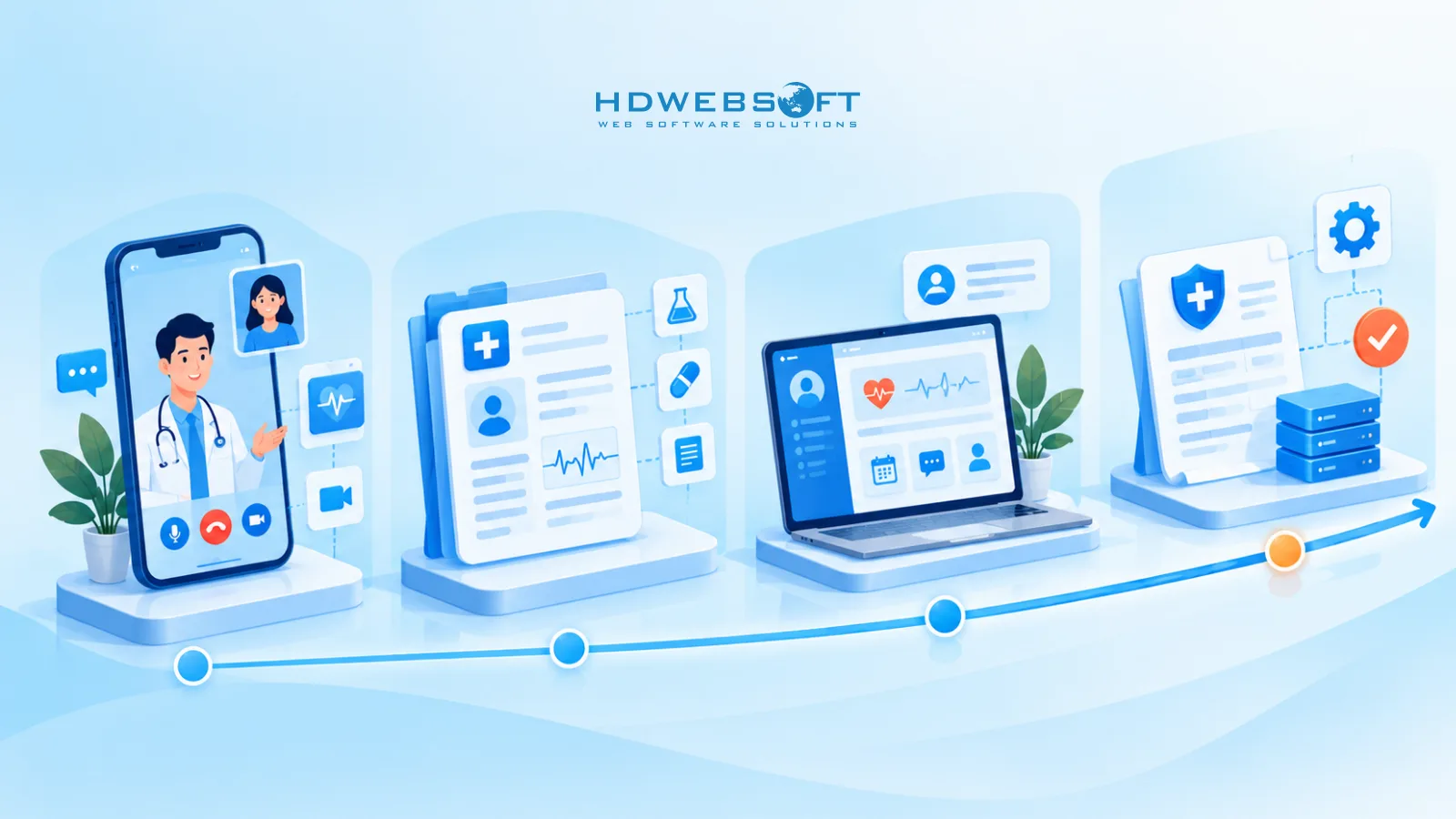
MVP scope ($40K–$80K): video visits on a mature SDK (Twilio, Vonage, or Amazon Chime), provider scheduling, patient intake, and basic notifications. This is the cheapest credible entry point in healthcare because the hard problems — video transport, encryption in transit — are solved by the vendor SDK, and clinical workflows stay thin.
-
Production scope ($80K–$150K+): adds e-prescribing (EPCS where applicable), asynchronous visits, payment handling, EHR read/write, and native iOS/Android apps. Each addition carries its own integration and compliance weight — e-prescribing alone brings controlled-substance workflows and pharmacy-network certification.
The cost driver most buyers underestimate is the last mile: a video call that works is a weekend demo; a telemedicine platform that survives clinical onboarding, consent capture, and payer documentation is a real build.
EHR Software Development Cost
EHR software development cost sits at the top of every pricing table because the system’s core job — being the legal record of care — removes every shortcut. The data model must represent clinical reality faithfully (problems, encounters, orders, results), the audit trail must record every access and change, and interoperability is assumed, not optional.
The integration layer alone is a discipline. The HL7 FHIR specification defines the resource model modern systems exchange — Patient, Observation, Encounter, Claim — but mapping your domain onto FHIR resources is only step one. Each vendor EHR implements different subsets and imposes its own auth behavior, so integration testing means contract tests against mocked endpoints and replay fixtures from real (de-identified) message samples.
-
MVP scope ($100K–$150K): a bounded clinical module — charting plus one integration — rather than a full system.
-
Full scope ($150K–$300K+): multi-module charting, e-prescribing, scheduling, patient portal, billing feeds, and two or more live EHR integrations.
This is squarely the territory of dedicated EHR/EMR software development services, where the data model and integration surface are designed as a system rather than assembled feature by feature.
Healthcare Web & Patient App Development Cost
Healthcare website application development cost covers the patient-facing surface: portals, appointment booking, intake and consent forms, symptom checkers, and results delivery.
-
MVP scope ($60K–$100K): a secure portal with scheduling, intake forms, and document delivery — most effort goes into auth, session security, and workflow fit rather than UI novelty.
-
Production scope ($100K–$180K): adds EHR read/write for results and records, secure messaging, payment flows, and accessibility compliance (WCAG is not optional in healthcare UX).
The trap in this bracket is assuming the web layer is “just frontend.” A patient portal is a read/write interface to clinical systems, which means it inherits the security posture of everything behind it.
Payer & Claims Software Development Cost
Cost-effective custom software development for healthcare payers targets the least visible and most logic-dense part of the market: eligibility verification, claims adjudication, prior authorization, and payment integrity.
-
MVP scope ($150K–$250K): one workflow automated end to end — say, eligibility checks against clearinghouse feeds — with an auditable decision trail.
-
Production scope ($250K–$500K+): multi-line adjudication, provider data management, and integrations across payer systems that were never designed to interoperate.
The cost here concentrates in correctness, not screens. A claim that adjudicates 99% right is a compliance incident at scale, so the QA and rules-validation effort routinely exceeds the build effort.
How HIPAA and Security Requirements Affect Healthcare App Development Costs
First, a correction to the usual framing: not every healthcare application is automatically subject to HIPAA. Obligations attach to roles and data flows, not to the word “healthcare.” HIPAA applies when your app creates, receives, maintains, or transmits PHI on behalf of a covered entity — or when you operate as a business associate under contract. A wellness app holding user-entered data with no provider relationship may sit outside HIPAA entirely; a billing tool touching remittance files is inside it.
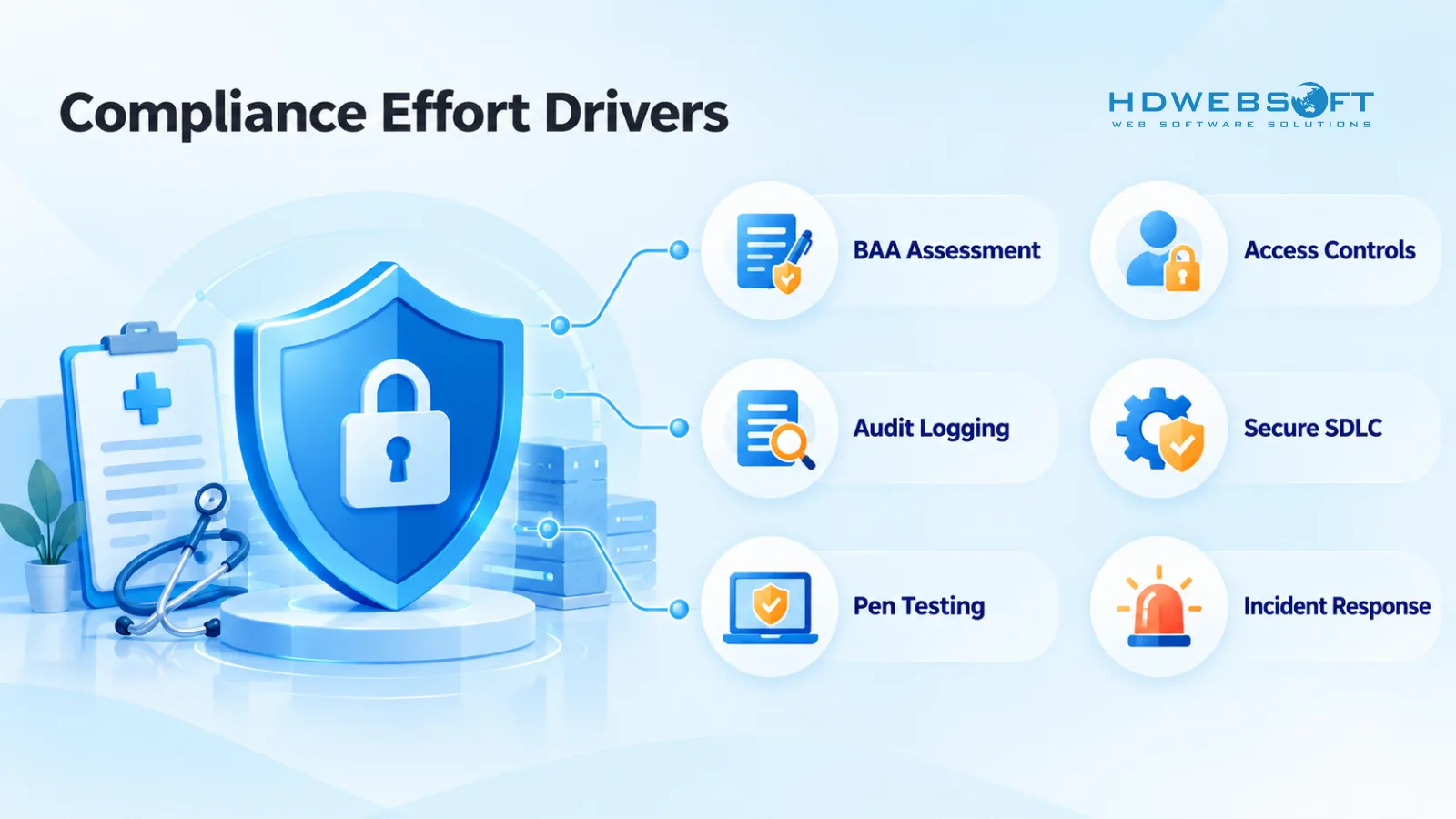
When HIPAA does apply, it works as a multiplier across the build rather than a feature you add. The effort lands in specific places:
- BAA assessment and contractual scope — determining which vendors and subcontractors need agreements, and under what terms. The HHS guidance on business associate agreements publishes the sample provisions counsel expects to see.
- Access controls — role-based permissions, least-privilege defaults, named accounts, MFA, and documented access-review cycles.
- Audit logging — every PHI read and write recorded with actor, timestamp, and justification, retained and reviewable.
- Secure SDLC — threat modeling for PHI-touching features, SAST and dependency scanning in CI, secrets management, security review as a Definition-of-Done item.
- Security testing — penetration testing and vulnerability management beyond standard QA.
- Incident response — a rehearsed runbook defining breach detection, notification windows, and evidence preservation.
Vendor estimates across the industry commonly put this compliance-related effort at roughly 15–30% of a build budget — treat that as a directional figure, since it depends heavily on how much PHI surface the app actually touches. The deeper architecture behind these controls is covered in our guide to HIPAA compliance software.
The practical consequence for budgeting: an app engineered to never touch PHI (fully synthetic data, no provider relationship) can legitimately skip most of this overhead. An app that will eventually integrate with a hospital system cannot — and retrofitting security into a finished build is the expensive way to buy it.
The Costs Buyers Forget
The quote stage prices the build. The years after it price everything else — and that is where the real healthcare app development cost gets decided.
One-time costs that rarely make the first estimate
- Onboarding and knowledge transfer — 2–4 weeks of reduced productivity while the team absorbs your domain, data model, and constraints.
- Integration rework — interfaces that behave differently in production than in the sandbox; each EHR or payer variant tends to need its own adapter adjustments.
- Security and pen-test cycles — initial testing plus the remediations it inevitably finds.
Recurring costs that outlive the build
- Cloud infrastructure — BAA-eligible hosting, isolated environments, logging and backup retention.
- Third-party services — video SDKs, e-prescribing networks, clearinghouse fees, monitoring and audit tooling.
- Maintenance and operations — dependency updates, security patches, and the steady cost of keeping integrations alive as external systems change. Industry convention commonly budgets annual maintenance as a meaningful fraction of build cost — plan for it as a recurring line rather than a fixed number.
- Compliance upkeep — periodic risk assessments, access reviews, BAA renewals as your subprocessor list changes, and incident-response exercises.
There is also the rework premium: teams that pick the cheapest credible quote often pay the difference later, when a vendor’s “HIPAA-ready” claim turns out to mean “we encrypted the database” rather than a governed access model and an auditable delivery process. Rework on a regulated codebase is priced at senior rates and arrives with the worst possible timing — after an audit finding or a failed hospital security review. That is why due-diligence artifacts matter more than the rate card when comparing proposals.
The honest budgeting move is to ask vendors to price both columns — build and operate. A $120K build with $40K/year of hidden operating cost is a different decision than it looks in the proposal.
Cutting Cost Without Cutting Corners — The Offshore Lever
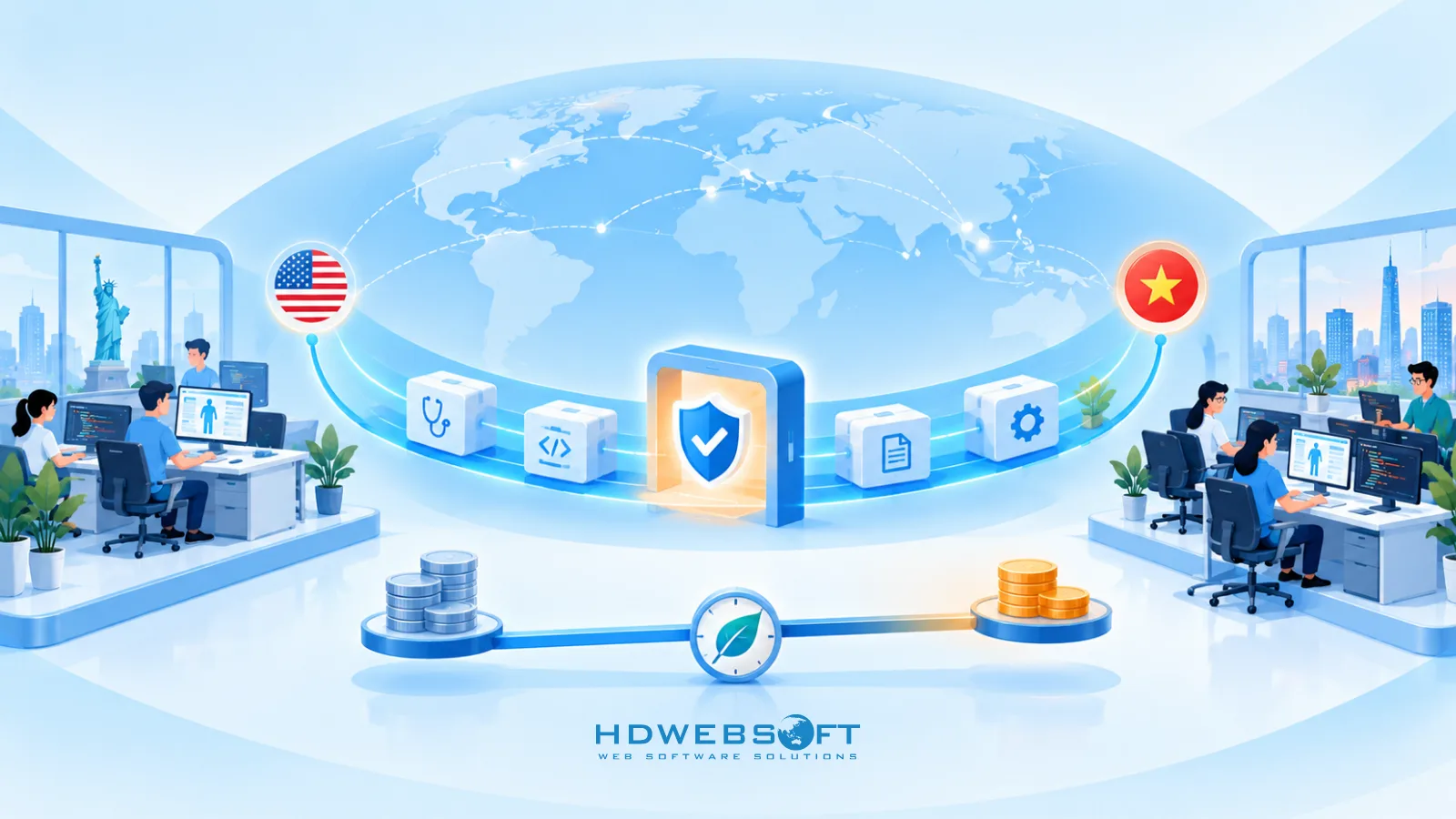
Offshore delivery reduces cost through delivery design, not just a cheaper rate card. As an illustrative frame, experienced healthcare engineering roles in Vietnam commonly price in the $25–$45/hour range versus $90–$150+ for comparable US onshore roles — but the rate delta is the least reliable part of the savings. What actually holds the budget down:
- Focused MVP scope — shipping the smallest version that produces real clinical or operational value, instead of pricing a full platform before usage data exists. A $40K telemedicine MVP that proves demand is better economics than a $150K platform built on assumptions.
- Reusable components — video, auth, notification, and audit infrastructure assembled from proven modules rather than rebuilt per project.
- Efficient integration sequencing — contract-testing external interfaces early, while the cost of discovering an EHR’s quirks is still low.
- Right-sized team composition — a BA, tech lead, 4–6 developers, and QA spine scaled to the work, rather than a bench you pay for regardless of utilization.
- Timezone-asynchronous QA cycles — the overlap window between Vietnam and US/EU working hours lets defects filed at your end-of-day get reproduced and fixed before your next morning, which compresses calendar time without adding headcount.
None of this works if the compliance posture is treated as a place to economize — the PHI boundary, audit trails, and access controls are exactly where “cheaper” vendors produce expensive failures. Teams that deliver healthcare software development services from Vietnam at scale compete on engineered delivery: compliance built into the process, integration depth proven by artifacts, and governance you can audit — which is where the real cost advantage lives.
How to Estimate Your Healthcare App Budget
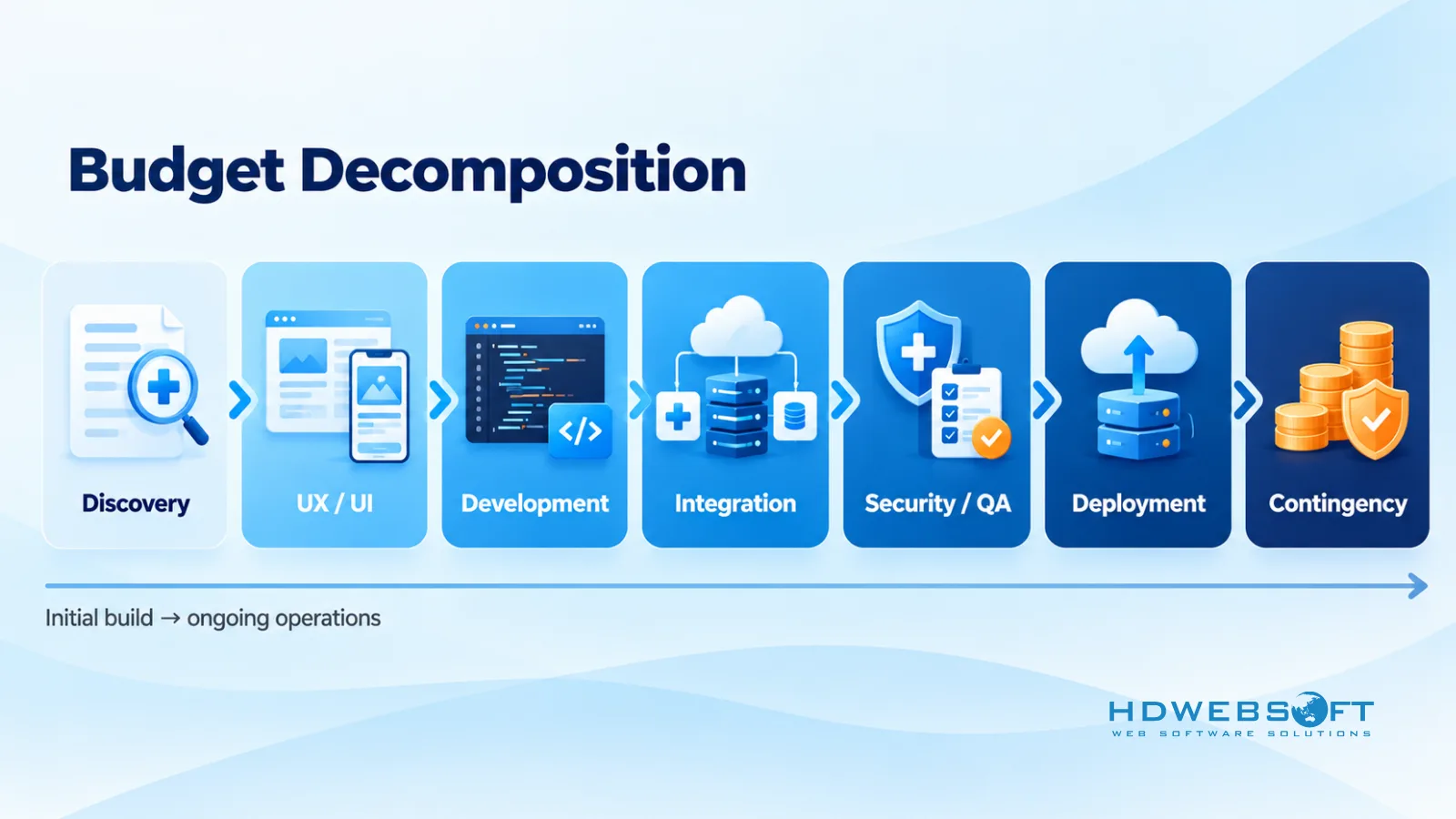
Before asking vendors for numbers, build the frame the numbers will hang on. A defensible budget decomposes into seven workstreams:
- Discovery — requirements, workflow mapping, compliance scope assessment. Typically 5–10% of build effort, and the cheapest place to kill bad assumptions.
- UX/UI design — clinical and patient-facing flows, accessibility, prototype validation.
- Development — the core build, decomposed by module so you can see where the money concentrates.
- Integration — EHR, payer, pharmacy, device, and clearinghouse connections, priced per interface, not per app.
- Security and QA — functional plus security testing, compliance checks, clinical workflow validation.
- Deployment — environments, CI/CD, monitoring, go-live support.
- Contingency — a buffer for integration surprises and scope corrections; 10–15% is a common planning allowance.
Then separate the initial project cost from ongoing operations — hosting, third-party fees, maintenance, compliance upkeep — so the budget reflects total ownership, not just launch day.
Five questions do most of the qualification work before you request quotes:
- Does the app touch PHI — and where? Determines whether HIPAA engineering is in scope at all.
- What must it integrate with? Each external system is its own adapter, test layer, and maintenance line.
- Does it involve devices or real-time data? RPM and video infrastructure carry dedicated cost profiles.
- Is the scope an MVP or a platform? The single biggest lever on the final number.
- Which delivery model fits? Fixed-scope, dedicated team, or ODC each price the same work differently.
Bring these answers to a vendor and you stop comparing pitch decks — you start comparing estimates against the same scope.
FAQ
How much does it cost to develop a healthcare app?
Between roughly $40K for a scoped telemedicine MVP and $300K+ for a full EHR system, with payer-side platforms reaching $500K+. The number is set by application type, integration surface, and compliance requirements — not by a market average, because there isn’t a meaningful one.
How much does telemedicine app development cost?
A credible MVP — video visits, scheduling, intake — typically runs $40K–$80K. Production scope with e-prescribing, EHR integration, and native mobile apps moves it toward $150K. The biggest variable is what the platform must connect to.
Why does EHR software development cost so much?
Because the system’s job is being the legal record of care. Faithful clinical data models, complete audit trails, and interoperability across vendor-specific EHR implementations remove every shortcut — and integration testing against real system variants is where much of the budget goes.
What’s the cheapest safe way to build a healthcare app?
Scope a genuine MVP, keep the PHI boundary as small as honestly possible, use proven components for video/auth/audit, and work with an experienced offshore team — while treating compliance infrastructure as non-negotiable rather than a place to save.
What should a healthcare app development quote include?
A workstream breakdown (discovery, design, development, integration, security/QA, deployment), assumptions per line, compliance scope, a recurring-cost estimate for hosting and maintenance, and contract terms covering IP, SLAs, and exit. A single number without the decomposition is a pitch, not a quote.
Conclusion
Healthcare app development cost becomes predictable once it is decomposed: the application type sets the band, the integration surface sets the effort, and the compliance requirements set the multiplier. Buyers who budget by workstream — and who price the recurring costs alongside the build — get quotes they can actually compare.
If you are scoping a healthcare build and want a cost estimate grounded in your specific scope, contact HDWEBSOFT to talk through it.