
Healthcare software development outsourcing to Vietnam works when three foundations are designed before the first line of code: the delivery model that fits your product’s life stage, the compliance posture that defines how patient data can be handled, and the collaboration cadence that keeps a team twelve time zones away inside your release loop.
Most articles on this topic stop at the decision — cheaper rates, large talent pool, time zone coverage. This guide picks up after that decision. It is a delivery playbook for CTOs, VPs of Engineering, and procurement leads who need to select a Vietnamese partner, structure the engagement, run a HIPAA-aware development lifecycle, integrate with EHR/EMR ecosystems, and govern cost — without learning the failure modes from a production incident.
Key Takeaways
- Outsourcing success is determined by delivery design, not by the decision to outsource. The same vendor pool produces both failed pilots and decade-long partnerships.
- Dedicated teams and ODCs overlap: the first describes who does the work, the second describes where and under whose controls. They are not mutually exclusive choices.
- HIPAA awareness must be built into delivery from Sprint 0 — BAA scope, PHI access boundaries, audit trails. Offshore development does not automatically provide compliance.
- Vendor evaluation works best as a five-pillar checklist with evidence you can request — policies, artifacts, and references — not as a comparison of pitch decks.
- Compare pricing through total delivery cost: onboarding, QA, security tooling, integrations, and maintenance — not headline hourly rates.
Why Vietnam for Healthcare Software Outsourcing in 2027
Vietnam’s role in software outsourcing has matured past the labor-arbitrage narrative. The ecosystem that matters for healthcare buyers is the engineering layer: universities producing consistent CS graduate volume, a decade of delivery for US, EU, Japanese, and Australian clients, and a service sector that has already absorbed Western expectations around documentation, reporting, and IP protection.
For healthcare work specifically, three capabilities carry the most weight. First, integration-heavy delivery experience — Vietnamese teams routinely build against REST, HL7 v2 feeds, and FHIR APIs for US and EU healthtech clients, which is closer to hospital-system reality than greenfield app work. Second, QA discipline — offshore QA talent is a structural strength of the market, and regulated software lives or dies on test coverage. Third, communication maturity — the vendor base has spent years running English-language standups, sprint reviews, and incident bridges with Western buyers.
None of this means every vendor is equal. The practical evaluation factors are covered in the checklist section below. And if you are still earlier in the decision — weighing whether outsourcing fits your situation at all — the pros and cons of healthcare software outsourcing is the right starting point; this guide assumes that question is settled and focuses on execution.

Choosing a Delivery Model: Dedicated Team, ODC or Fixed-Scope
The engagement structure you sign determines everything downstream: who controls priorities, who owns the compliance surface, how costs behave, and how painful a future transition is. Three models dominate healthcare outsourcing to Vietnam:
| Model | Control | Responsibilities | Compliance considerations | Cost structure | Best-fit projects |
|---|---|---|---|---|---|
| Fixed-scope | Vendor manages delivery against a spec | Vendor owns delivery plan; you own acceptance | Easiest to bound — no production PHI if data is stubbed; contract defines obligations | Predictable; change requests priced | Bounded deliverables: a patient portal MVP, an integration adapter, a migration tool |
| Dedicated team | You direct priorities; vendor supplies and retains the team | Shared: you own backlog, vendor owns team capacity | You control PHI boundaries; vendor must enforce your access policies inside their environment | Monthly per-seat; scales with team size | Long-running products with evolving roadmaps — the common pattern for healthtech platforms |
| ODC | Vendor runs operations under your governance | Vendor owns facility, security, retention; you own product direction | Strongest isolation option — segregated infra, named staff, vendor-managed controls | Team + infrastructure premium | Regulated scopes needing dedicated environments and documented controls |
Two clarifications matter more than the table. Dedicated team and ODC overlap rather than compete: a dedicated team describes who does the work; an ODC describes where the work happens and under whose operational controls. Many engagements are effectively “a dedicated team inside an ODC” — distinguish them by asking who manages the physical and network security, who controls device access, and where credentials live, not by treating the labels as opposing choices. Fixed-scope fails softly in healthcare only when the scope is genuinely bounded; compliance-heavy work with unclear data flows resists fixed pricing and punishes both sides through change requests.
For long-horizon healthcare products — the usual shape once a platform survives its pilot — a dedicated software development team gives you backlog control and team continuity without building a legal entity abroad. A representative starting structure for a mid-size healthcare product:
- 1 product-facing BA — translates clinical and operational requirements into stories
- 1 tech lead — architecture ownership, code review authority, security gatekeeper
- 4–6 developers — backend-heavy if the work is EHR integration; balanced if patient-facing
- 2 QA engineers — one manual, one automation; healthcare work needs both
- 0.5 DevOps — environment management, deployment pipelines, secrets handling
- Security liaison (part-time, can be vendor-side) — owns access reviews and audit log hygiene
Scale the dev seats, not the scaffolding — the BA, lead, and QA spine should survive team growth unchanged.
Building HIPAA-Aware Delivery From Sprint 0
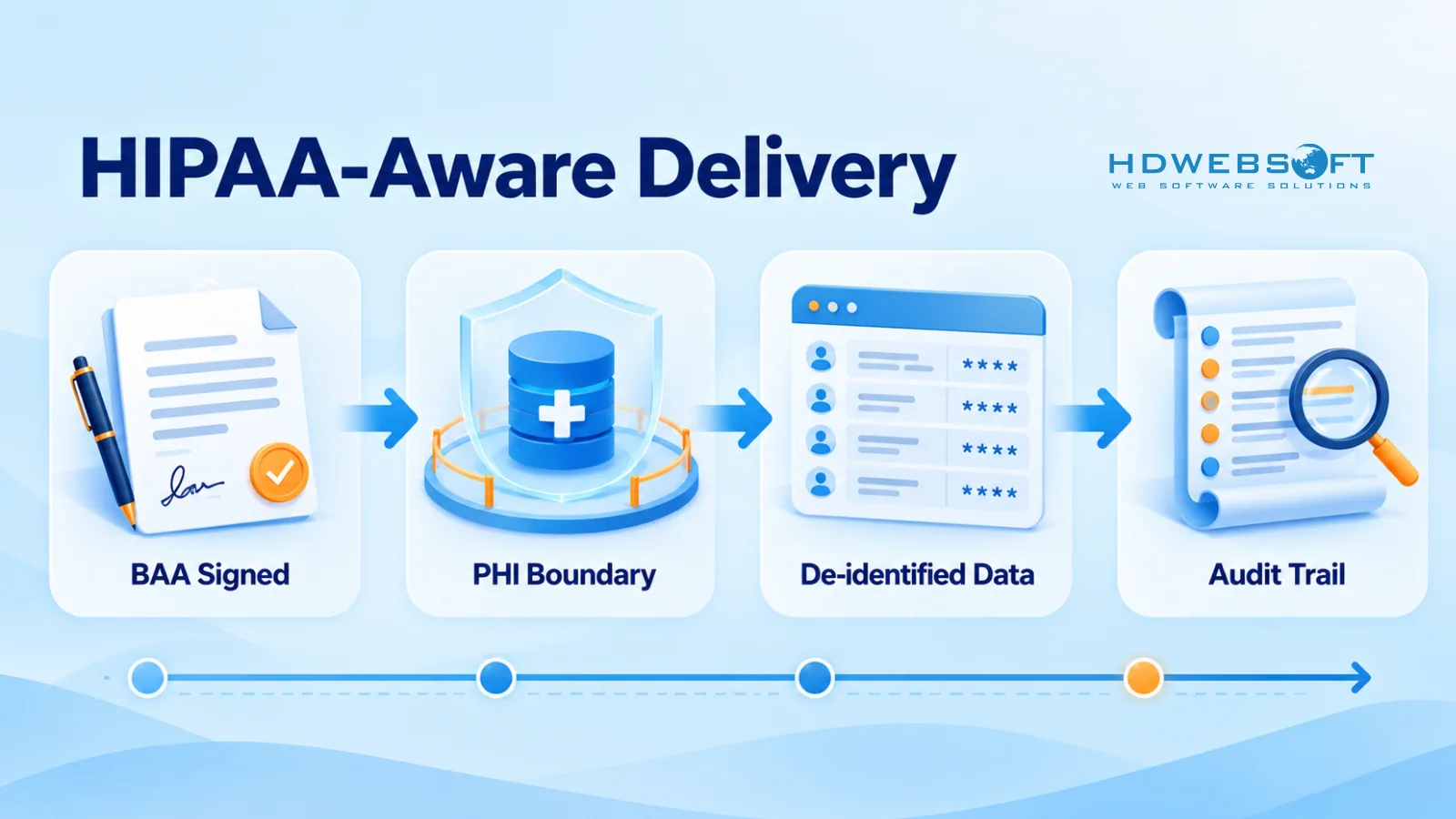
HIPAA applies to arrangements, not zip codes. Offshore development is neither compliant nor non-compliant by itself — what matters is whether the delivery system is engineered so that PHI exposure is scoped, logged, and contractually governed. That engineering starts at Sprint 0, not at the first audit.
BAA, Vendor Responsibilities & Contractual Requirements
A Business Associate Agreement becomes relevant when a vendor creates, receives, maintains, or transmits PHI on behalf of a covered entity — and it can apply even if the offshore team only touches PHI indirectly, such as through production logs or support access. The trigger is data contact, not job title. If your vendor will never see PHI — fully synthetic data, no production access, no support path into live systems — a BAA may not be required; if any access path exists, it is.
The contract layer carries four obligations that must be explicit before development begins: the scope of permitted PHI use and disclosure, the safeguard responsibilities (administrative, technical, physical), breach and security-incident notification duties including timelines, and the flow-down of equivalent obligations to any subcontractor. The HHS guidance on business associate agreements publishes sample BAA provisions that make a solid baseline for what counsel should expect to see — if a vendor resists these clauses, that is a signal about the vendor, not about HIPAA.
One honest caveat: signing a BAA does not make delivery compliant. It assigns liability. The operational substance is in the next two subsections.
PHI Handling, Test Data & Access Controls
Before any development touches sensitive data, the engagement needs a written PHI boundary map: which environments may contain PHI, which roles may access them, and which data classes are permanently out of scope for the offshore team. Most successful Vietnam engagements answer this conservatively — production PHI never leaves the client environment, and the offshore team works exclusively on de-identified or synthetic datasets.
That answer forces real engineering work. De-identification is not “remove the name column”; realistic synthetic data needs to preserve the statistical shape of clinical data — value distributions, code frequencies, missingness patterns — or the team is building against fiction and integration defects surface only in production. Mature vendors maintain a dedicated data pipeline for generating and refreshing test fixtures, and they treat it as a deliverable, not an afterthought.
Access control follows the same least-privilege logic: named accounts per engineer, no shared credentials, role-based environment access, VPN or zero-trust entry to anything non-public, and quarterly access reviews documented in writing. For teams building the compliance-sensitive components themselves — consent management, audit logging, PHI-aware features — our deeper guide to HIPAA compliance software covers the architectural side of what these controls are protecting.
Secure Development, Audit Trails & Incident Response
HIPAA awareness inside the SDLC looks concrete, not aspirational:
- Secure development gates — threat modeling for PHI-touching features, SAST/dependency scanning in CI, secrets management, and security review as a Definition-of-Done item, not a phase.
- Audit trails everywhere — every environment access, every production-adjacent action, and every data export logged with actor, timestamp, and justification; logs retained and reviewable, including by the client’s compliance team.
- Incident response runbook — a shared, rehearsed document defining what counts as an incident, who notifies whom and within what window, what evidence is preserved, and how the vendor’s disclosure duties under the BAA actually execute.
The test of a vendor here is artifacts, not vocabulary. Ask to see a real incident log (sanitized), a redacted access-review record, and a sample security gate report from a past sprint. Vendors who run HIPAA-aware delivery produce these casually; vendors who don’t produce explanations instead.
EHR/EMR Development and Healthcare Interoperability
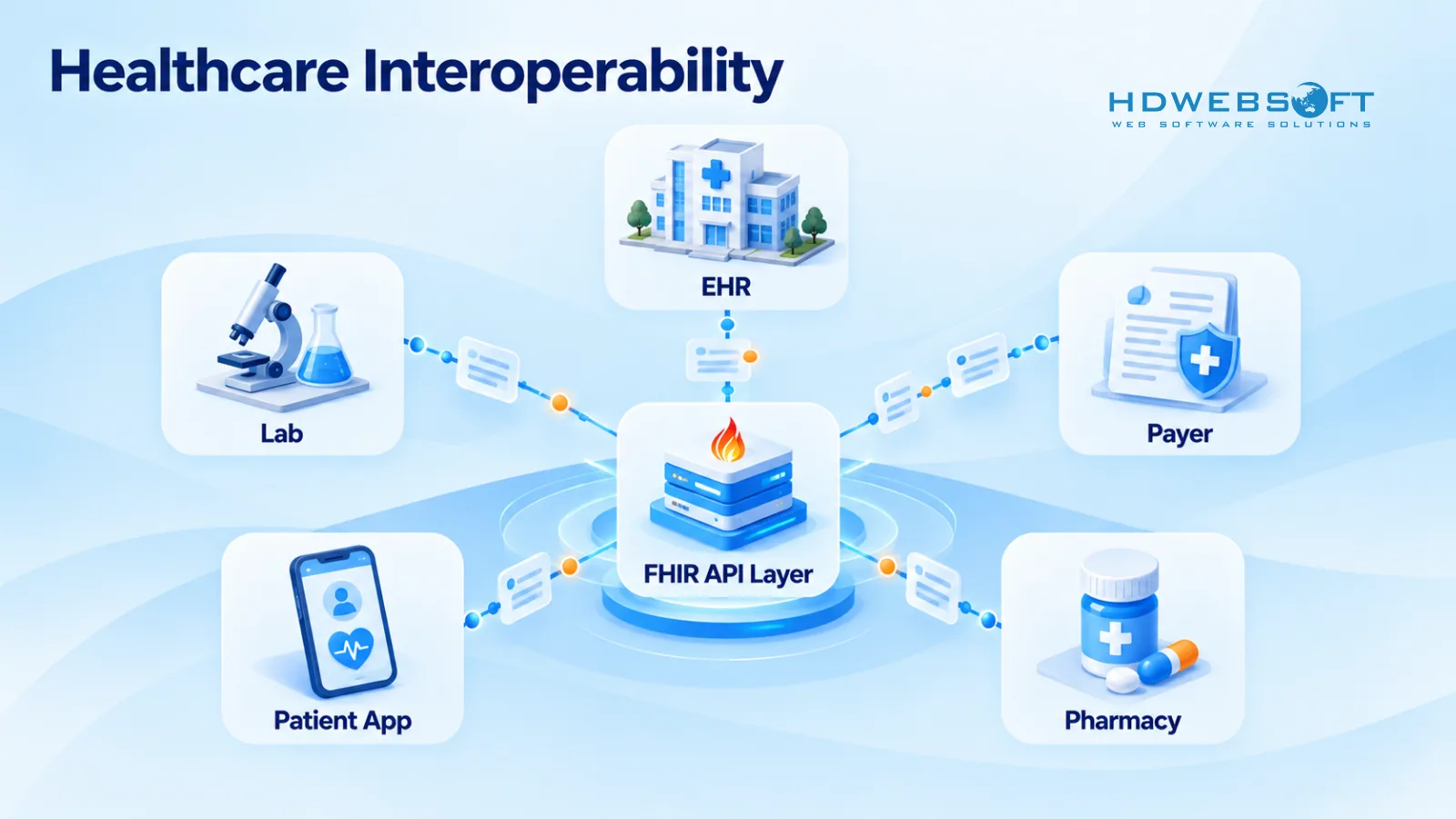
Most healthcare outsourcing engagements converge on the same hard problem: your software must exchange data with systems you do not control — hospital EHRs, lab systems, payer platforms, clearinghouses. The technical vocabulary of that exchange is standardized: the HL7 FHIR specification defines the resource model (Patient, Observation, Encounter, Claim, and a hundred more) and the REST-style API patterns through which modern health systems expose data.
FHIR Variance, Legacy Feeds, and Clinical Workflow Fit
What makes this difficult in practice is not FHIR itself but the variance around it. Real integration work means mapping your domain model onto FHIR resources, then handling the vendor-specific dialects — different EHRs populate different fields, implement different subsets, and impose their own auth and rate-limit behavior. Legacy systems add HL7 v2 feeds, flat-file exports, and occasionally direct database reads, each requiring its own adapter discipline. Clinical workflow compatibility matters just as much as data plumbing: a technically perfect integration that writes data where clinicians never look is a failed integration. And interoperability needs its own test layer — conformance checks against resource profiles, contract tests against mocked EHR endpoints, and replay fixtures built from real (de-identified) message samples.
Evaluating a Vendor’s Interoperability Track Record
When evaluating a vendor for this work, ask for artifacts: sample resource mappings, a conformance test report, and a reference for an integration that went to production. If your scope includes building or extending record systems themselves — custom clinical modules, data migration, workflow tools layered on top of an EHR — that is squarely the territory of dedicated EHR/EMR software development services, where the integration surface is designed around your clinical workflows rather than retrofitted to a product’s defaults.
Managing US/EU Timezone Overlap and Delivery Cadence
Vietnam runs on a single time zone (UTC+7) with no daylight saving — which simplifies the math but doesn’t eliminate it, because your side does shift. The practical overlap windows, assuming a vendor team working a shifted schedule:
| Your location | Your working window | Vietnam local time | Realistic overlap |
|---|---|---|---|
| US East (ET) | 8:00 AM – 12:00 PM | 7:00 – 11:00 PM (DST) / 8:00 PM – 12:00 AM (standard) | ~3–4 hours: your morning ↔ VN evening |
| US West (PT) | 7:00 – 10:00 AM | 10:00 PM – 1:00 AM (DST) / 11:00 PM – 2:00 AM (standard) | ~2–3 hours: your early morning ↔ VN late evening |
| Europe (CET) | 9:00 AM – 2:00 PM | 3:00 – 8:00 PM (standard) / 4:00 – 9:00 PM (DST) | ~4–5 hours: your morning/midday ↔ VN afternoon/evening |
Treat this table as illustrative — actual overlap depends on the vendor’s team schedule, and the right answer is negotiated, not assumed. What matters is that some daily window exists and is contractually protected for the rituals that need synchrony.
The cadence that works in healthcare delivery specifically:
- Async-first handoffs — end-of-day written handoff (what shipped, what’s blocked, what needs decision) so the onshore morning starts with answers, not questions.
- Daily sync inside the overlap — a short standup for blockers only; status belongs in the async channel.
- Escalation path with names and clocks — who to reach for a production issue outside overlap, with a defined response expectation. In healthcare, “the team will see it tomorrow” is not an escalation path.
- Release coordination — deploy windows scheduled in the overlap, with the offshore team present for cutover and the onshore side present for clinical validation. Never ship into a Friday void.
Healthcare Software Outsourcing Costs in Vietnam
Headline hourly rates are the least useful number in an outsourcing budget — but buyers need a starting frame, so here is an illustrative one. Ranges below reflect typical market behavior for experienced roles in Vietnam’s outsourcing sector as of this writing; they are reference ranges for planning, not verified market rates and not HDWEBSOFT pricing — actual quotes vary with seniority, engagement length, compliance overhead, and vendor margin.
| Role | Illustrative range (USD/hour) | Notes |
|---|---|---|
| Software developer | $25–45 | Seniority and specialization (e.g., healthcare integrations) move the rate |
| QA engineer | $20–35 | Automation-capable QA prices toward the upper end |
| Business analyst | $25–40 | Domain-fluent BAs (clinical workflows, payer logic) are scarcer |
| DevOps engineer | $30–50 | Part-time allocation is the norm on mid-size teams |
| Project manager | $30–45 | Often bundled into the engagement as delivery overhead |
Two honest observations. First, healthcare work prices above generic app development — compliance overhead, onboarding into your data model, and the cost of keeping a stable senior team all land in the rate. Second, the pricing model matters more than the rate card: per-seat monthly pricing on a dedicated team behaves very differently from fixed bids over a year of change requests.
The realistic cost model includes what the rate card hides:
- Onboarding and knowledge transfer — 2–4 weeks of reduced productivity while the team absorbs your domain, systems, and constraints; budget for it rather than pretending it doesn’t exist.
- QA and test infrastructure — automation coverage on regulated software is a cost line, not a nicety.
- Security and compliance tooling — isolated environments, credential management, audit tooling, periodic access reviews.
- Integration work — EHR/FHIR adapters, payer APIs, lab feeds: consistently the least predictable line item.
- Maintenance and handback — documentation upkeep and the cost of a future transition, whoever performs it.
The contract should make the invisible costs explicit: IP ownership assigned to you on creation (work-for-hire language covering deliverables and their dependencies), SLAs with named metrics and remedies, responsibility boundaries between vendor and client spelled out per activity — and exit clauses covering notice period, source-code escrow or continuous repo access, documentation completeness requirements, and knowledge handback support. The exit clause is the one you hope never to use, which is exactly why it must be written while both sides still like each other.
Rates set the engagement economics; project budgets still need their own decomposition. For build-cost ranges by application type — telemedicine, EHR, patient portals, payer-side systems — and the compliance and recurring costs behind each, see our guide to healthcare app development cost.
Common Delivery Risks and How to Reduce Them
Healthcare-specific risks deserve targeted mitigations rather than generic outsourcing anxiety:
- PHI exposure → Default to no-PHI access for the offshore team; synthetic data pipelines, least-privilege accounts, and access logs reviewed quarterly. If PHI access is genuinely required, bound it to named individuals inside an isolated environment.
- Integration failures → Contract-test every external interface from Sprint 1; maintain replay fixtures from de-identified production messages; treat each EHR/payer variant as its own adapter, never one generic connector.
- Compliance drift → Controls decay silently between audits. Schedule internal compliance reviews on a fixed cadence (quarterly works), keep the BAA and access map versioned alongside the code, and make “who changed what boundary” an answerable question.
- Knowledge loss / attrition → Continuity clauses in the contract, overlapping replacements with handover periods, and architecture decisions recorded in ADRs rather than living in one engineer’s head.
- Vendor dependency → You own the repos, the cloud accounts, and the credentials from day one. A vendor that operates inside your infrastructure is far easier to transition than one that hosts it.
Healthcare Software Outsourcing Vendor Evaluation Checklist
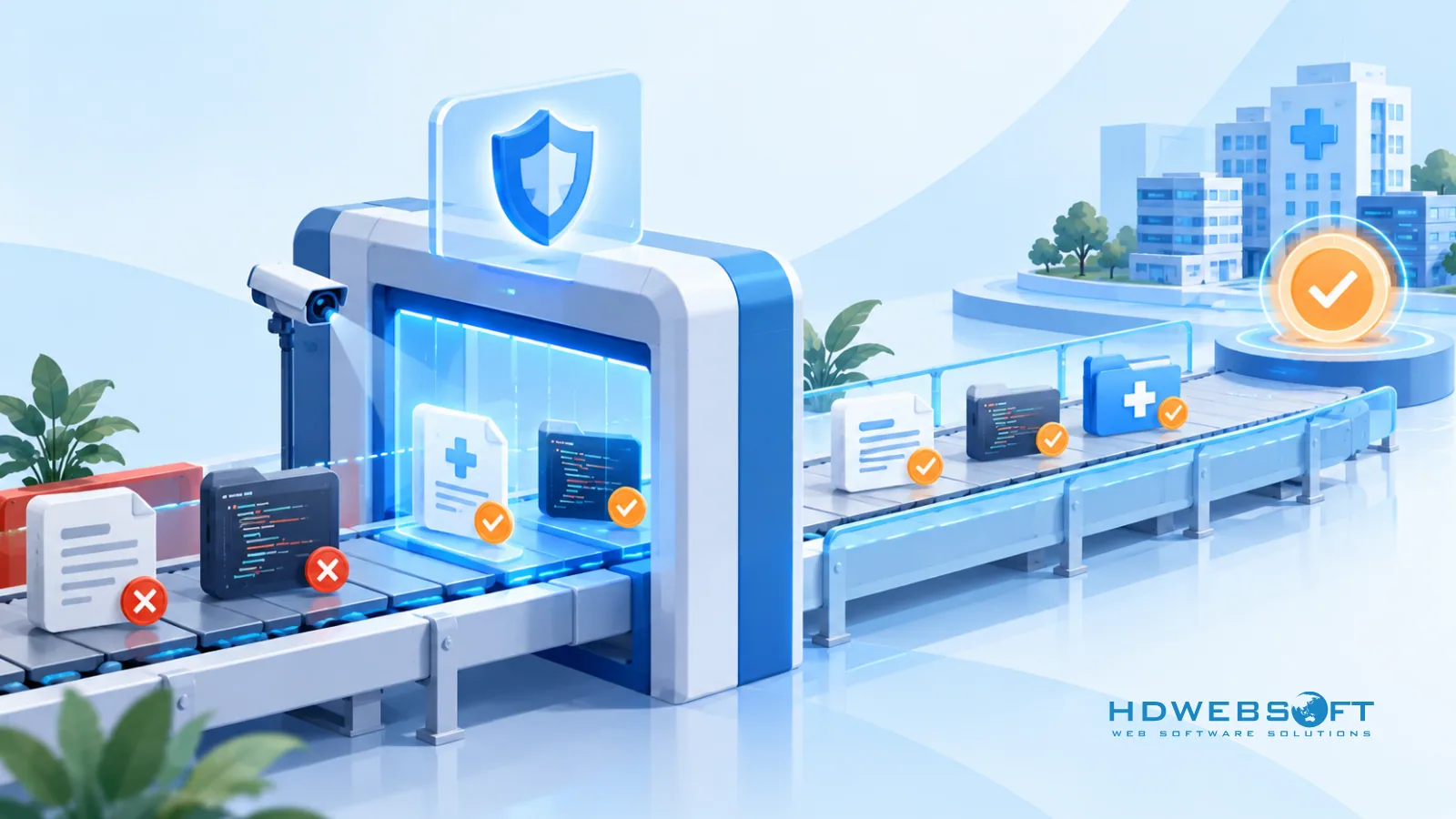
Evaluations fail when they compare vendor presentations. Comparing vendor evidence works better — and it is what this checklist is built for. Use it in interviews and RFPs: every criterion is phrased as a buyer question plus the artifact you can actually request.
Healthcare domain expertise
- “Show us a healthcare product your team shipped to production.” → Case studies with specifics, referenceable clients, and demo access or screenshots that show real clinical workflow depth — not marketing decks.
- “Who on the proposed team has worked on regulated software before?” → Named CVs with project histories; a team composition that persists after the pitch, not senior faces that rotate out in week two.
Security and compliance maturity
- “Are you BAA-ready, and what does your PHI handling look like by default?” → A standard BAA posture, a written PHI access policy, environment isolation architecture, and incident-response runbooks.
- “What do your access reviews produce?” → A sanitized access-review record or audit log excerpt from a real engagement — the single most revealing artifact you can request.
Technical and interoperability capabilities
- “Walk us through a FHIR or HL7 v2 integration you delivered.” → Sample resource mappings, conformance test reports, and a reference for an integration that survived production.
- “How do you test against external systems you don’t control?” → A contract-testing approach with mocked endpoints and replay fixtures, not “we test in the client’s staging.”
Delivery governance
- “What does a sprint look like on your side?” → Sprint artifacts: sample boards, Definition of Done, velocity reports, and how blockers get escalated across time zones.
- “How do you handle scope change?” → A written change-request process with pricing mechanics — the answer reveals whether governance is a system or an improvisation.
Team stability and commercial transparency
- “What’s your engineering attrition, and what happens when my lead leaves?” → Tenure data for the proposed roles and a contractual replacement/handovers clause.
- “What’s in the rate, and what isn’t?” → A rate card with explicit inclusions (management overhead, tooling, environments) and exclusions, plus IP, SLA, and exit terms in draft form.
A vendor that answers these with artifacts rather than adjectives has done this before. That pattern-match — evidence over claims — is the whole checklist.
Conclusion
Healthcare software development outsourcing to Vietnam succeeds on the strength of its delivery design: the right engagement model, HIPAA awareness engineered from Sprint 0, interoperability treated as a first-class workstream, a collaboration cadence built around real overlap, and a vendor selected by evidence rather than pitch. Get those five right and the geography becomes an implementation detail.
HDWEBSOFT delivers healthcare software development services from Vietnam for US and EU healthtech teams — dedicated engineering capacity built around compliant delivery, integration depth, and transparent governance. If you are scoping a build or evaluating vendors for one, contact HDWEBSOFT to talk through your delivery model.
FAQ
Is it safe to outsource healthcare software development to Vietnam?
Yes, when safety is engineered rather than assumed. A reliable engagement combines a signed BAA where PHI is in scope, de-identified test data, least-privilege access, auditable delivery artifacts, and contract clauses covering IP, SLAs, and exit. Vietnam’s mature outsourcing ecosystem supplies the engineering capacity; your governance model supplies the safety.
What does a HIPAA-aware development process look like?
It starts before code: scope PHI access at Sprint 0, sign the BAA, provision isolated environments, and define which roles may see production data. During delivery it means secure-SDLC gates, audit logging on every environment, de-identified test data, and a shared incident-response runbook. Compliance lives in the delivery process, not in a final audit.
How much does healthcare software development outsourcing cost in Vietnam?
Illustrative blended rates commonly fall in the $25–$45/hour range per engineering role, varying with seniority, compliance overhead, and engagement model. The honest comparison metric is total delivery cost: onboarding, QA automation, security tooling, integration work, and maintenance — not the headline hourly rate.
Dedicated team vs ODC — which model fits healthcare projects?
They overlap rather than compete. A dedicated team describes who does the work; an ODC describes where and under whose operational controls the work happens. Long-running healthcare products typically suit a dedicated team; regulated scopes that need isolated infrastructure and vendor-managed operations suit an ODC setup; fixed-scope fits bounded, well-specified deliverables.
Can a Vietnamese team handle EHR/FHIR integrations?
Yes — provided the vendor demonstrates it, not just claims it. Ask for FHIR resource-mapping samples, conformance and contract test reports, and references for integration work against hospital systems or clearinghouses. Teams with real interoperability depth show artifacts, not adjectives.