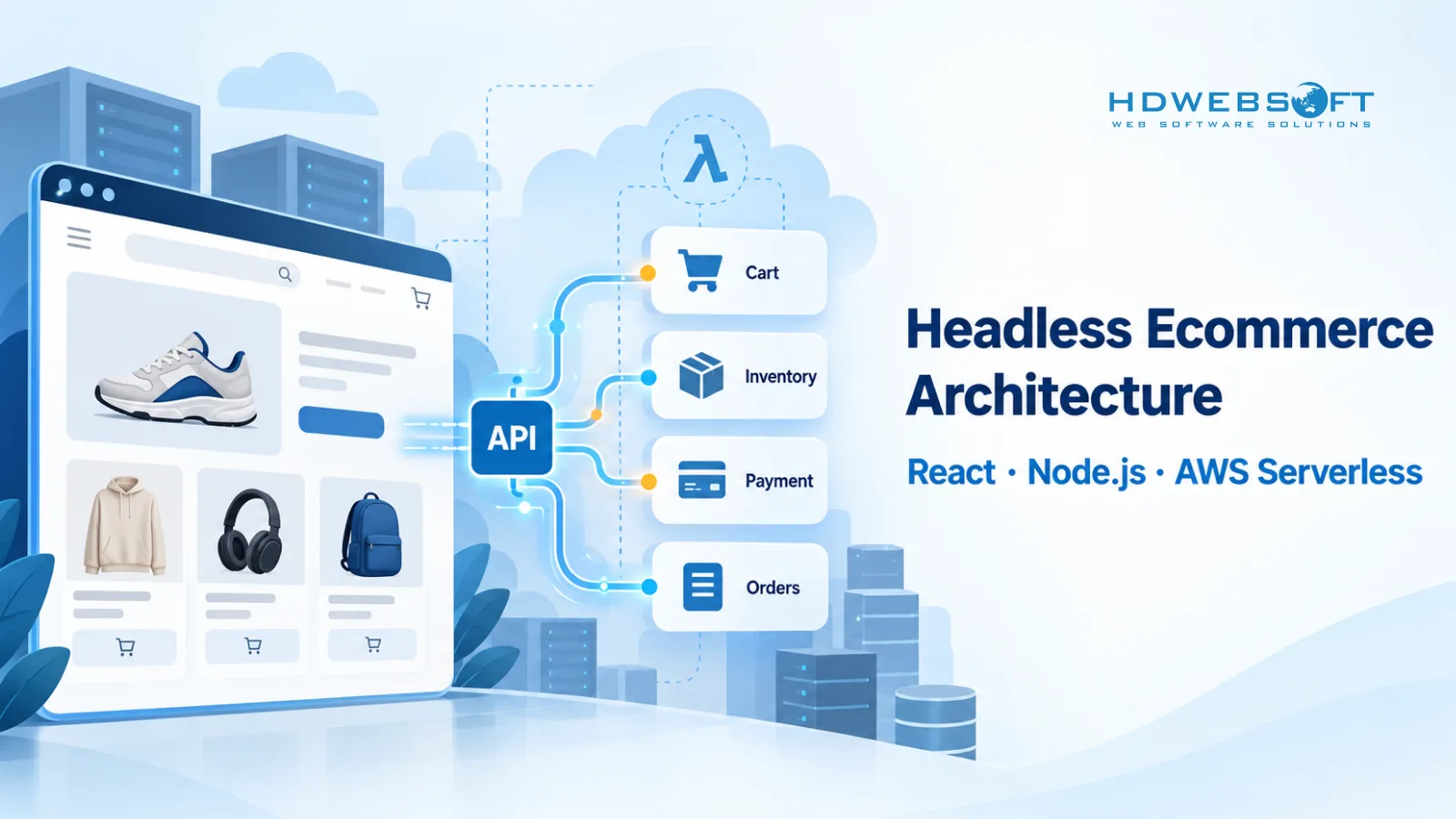
High-traffic ecommerce platforms rarely fail because one frontend framework is too slow. Problems usually appear when storefront rendering, catalog APIs, checkout, inventory, payment, personalization, and third-party integrations all compete for capacity during the same traffic spike.
A headless ecommerce architecture separates the customer-facing storefront from the commerce engine through APIs. This allows the presentation layer, backend services, integrations, and supporting workloads to scale and evolve more independently.
For brands preparing for flash sales, international expansion, omnichannel experiences, or highly personalized shopping journeys, that separation can create a stronger technical foundation. However, headless architecture does not automatically guarantee sub-second page loads or massive concurrency. Performance still depends on caching, API design, database capacity, asynchronous processing, observability, and realistic load testing.
For a broader view of architecture and UX in online retail, see our guide to ecommerce development services.
Key Takeaways
- Headless ecommerce separates the storefront from backend commerce capabilities, allowing each layer to scale and evolve more independently.
- A common reference stack combines React, a Node.js/GraphQL BFF, a commerce engine, and AWS serverless services for asynchronous workloads.
- Fast storefronts depend on rendering strategy, CDN caching, API design, and downstream performance—not React alone.
- Checkout should keep its synchronous path small while suitable post-order tasks move to event-driven processing.
- High-traffic commerce requires idempotency, queues, backpressure, inventory consistency, and capacity planning beyond simple auto-scaling.
- AI personalization should have a latency budget and fallback behavior so it never becomes a critical storefront dependency.
What High-Traffic Headless Ecommerce Architecture Must Solve
At its simplest, headless ecommerce separates the customer experience from the backend commerce platform.
In a traditional ecommerce system, presentation, catalog logic, checkout, plugins, and backend workflows may live inside the same application. This can work well until different parts of the system need to scale, release, or change independently.
With headless architecture, a React storefront, mobile app, marketplace interface, or other frontend communicates with commerce capabilities through APIs.
This creates clearer boundaries between:
- customer experience
- catalog and pricing
- cart and checkout
- order processing
- inventory
- search
- personalization
- third-party integrations
Headless and composable commerce are related, but they are not identical.
Headless commerce primarily separates the presentation layer from the backend. Composable commerce goes further by treating capabilities such as search, payment, promotions, content, and checkout as modular components that can be replaced or evolved independently.
The MACH Principles describe this broader approach around modularity, APIs, cloud-native delivery, and headless presentation.
For high-traffic brands, architecture should begin with workload requirements rather than a preferred technology stack.
Instead of saying: “The system must handle 100,000 concurrent users.”
Teams should translate that target into measurable characteristics:
- requests per second
- browsing-to-checkout ratio
- API calls per customer journey
- cache-hit rate
- geographic distribution
- peak duration
- downstream API limits
One hundred thousand people viewing cached catalog pages is very different from one hundred thousand customers attempting to reserve limited inventory and submit payment simultaneously.
Failure boundaries matter as well.
If the recommendation service fails, should customers still browse products? If CRM synchronization slows down, should checkout stop? If the email provider becomes unavailable, should an order fail?
A well-designed headless system prevents optional capabilities from taking down critical commerce flows.
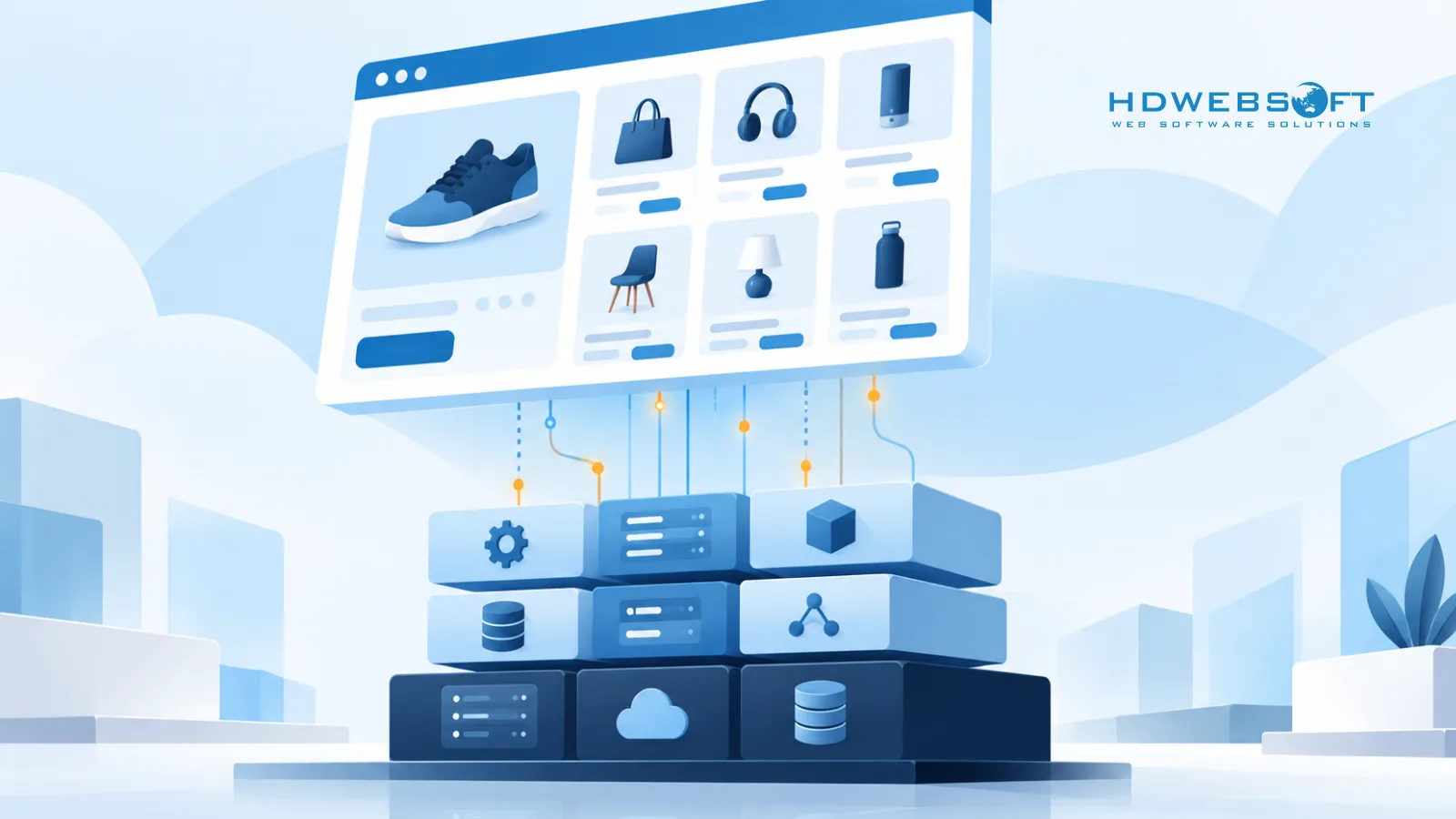
Reference Architecture: React, Node.js, GraphQL & AWS Serverless
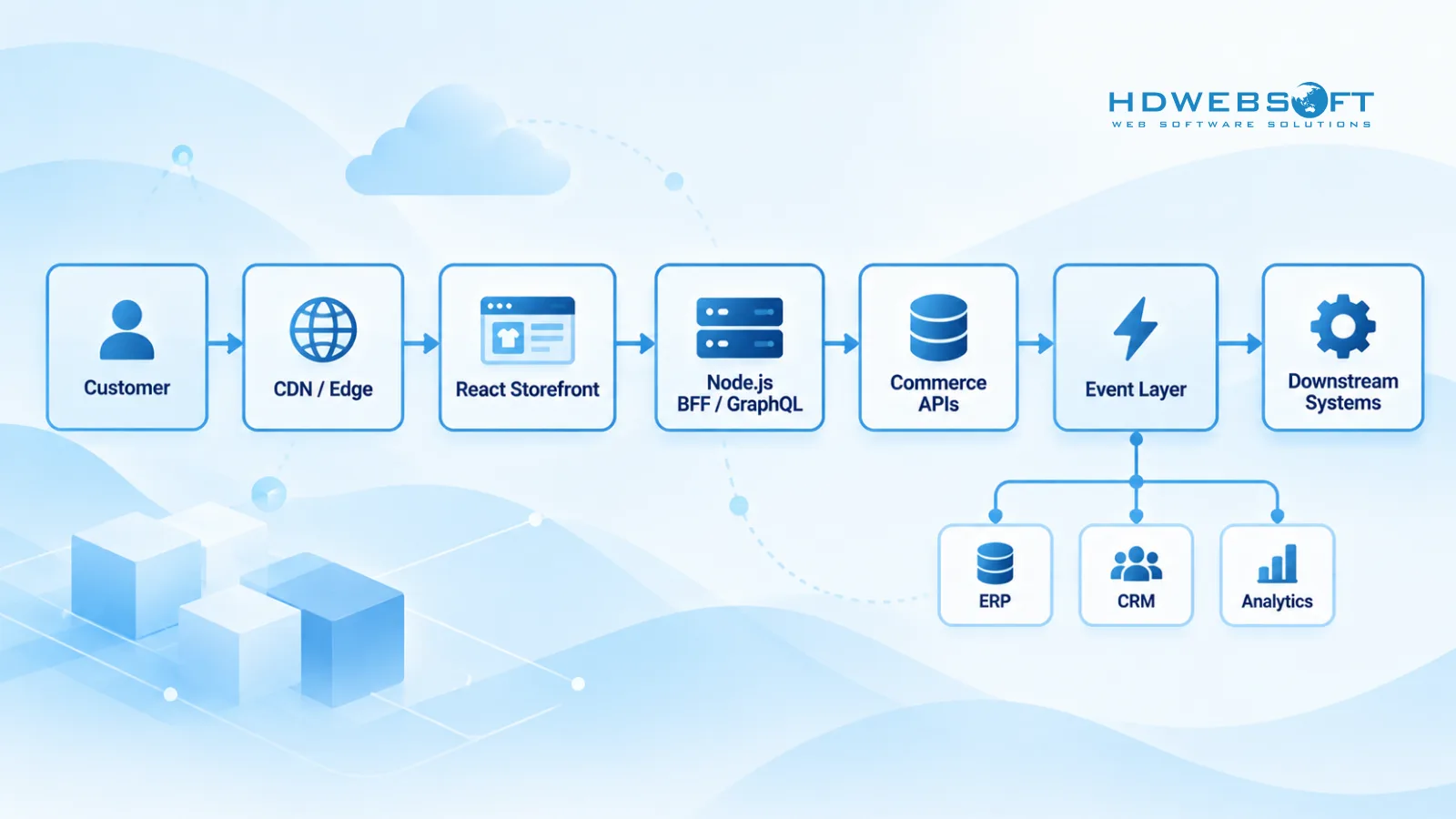
One practical headless ecommerce architecture can be represented as: Customer → CDN/Edge → React Storefront → Node.js BFF/GraphQL → Commerce APIs → Event Layer → Downstream Systems
This is a reference architecture, not a mandatory stack. GraphQL may be replaced by REST, Lambda by containers, or a custom backend by a commercial headless commerce platform.
The important part is establishing clear boundaries.
React Storefront and Edge Delivery
React provides flexibility for building product discovery, account, cart, and checkout experiences, but React itself does not make a storefront fast.
Different pages usually require different rendering strategies.
Product and category pages may benefit from SSR, static or incremental rendering, and CDN caching. Cart, account, and checkout pages depend more heavily on customer-specific data and therefore have lower shared-cache potential.
High-traffic storefronts should also consider:
- CDN and edge caching
- optimized images and static assets
- stale-while-revalidate patterns
- cache invalidation for catalog and pricing
- locale, currency, and regional cache keys
Personalization adds another challenge. If every response becomes completely unique, cache efficiency drops dramatically.
A better architecture often keeps the majority of the page cacheable while loading selected personalized components separately.
Node.js BFF and GraphQL
A storefront that connects directly to many backend services can quickly create an API waterfall.
One product page might require data from catalog, pricing, inventory, promotions, CMS, reviews, and recommendations.
A Backend-for-Frontend (BFF) creates a dedicated boundary for aggregating those services.
A Node.js BFF can handle:
- API aggregation
- authentication and sessions
- response transformation
- timeouts
- fallback behavior
- error normalization
GraphQL can provide a flexible contract between the storefront and BFF, but it must be carefully designed.
Poor resolver design can create N+1 requests or sequential backend calls. Production systems may therefore need batching, query complexity limits, caching, persisted queries, and strict timeout budgets.
The BFF should also prevent optional services from controlling total page latency. If a recommendation API is slow, the product page should usually continue without waiting indefinitely.
Commerce Engine and Event Layer
The commerce engine remains responsible for authoritative business rules such as:
- catalog
- pricing
- promotions
- cart
- checkout
- inventory
- orders
The storefront can optimize presentation, but business-critical rules should remain behind controlled APIs.
For asynchronous workflows, AWS services can provide another layer of decoupling.
A typical flow might be: OrderCreated → EventBridge / SQS → Lambda → ERP / CRM / Fulfillment / Analytics
EventBridge can route one business event to multiple consumers, while SQS can buffer workloads when consumers cannot process events at the same rate they are produced.
This architecture aligns with broader cloud-native infrastructure principles by allowing components to scale based on their own workload.
Organizations building heavily on Amazon infrastructure can also explore HDWEBSOFT’s AWS development services for cloud architecture, serverless development, migration, and DevOps.
Serverless is not automatically the right choice for every component. Sustained high-throughput workloads or services with complex connection requirements may still benefit from containers or hybrid architectures.
Real-Time Checkout and Order Processing at Scale
High traffic creates the greatest risk where speed and transaction correctness meet.
Browsing pages can often tolerate caching or slightly stale data. Checkout cannot tolerate duplicate charges, duplicate orders, or overselling limited inventory.
The synchronous checkout path should therefore stay focused.
A typical critical path may include: Validate cart → confirm current pricing → reserve inventory → authorize payment → create order
Once the durable order exists, many other workflows can happen asynchronously:
- confirmation email
- CRM synchronization
- ERP updates
- analytics
- loyalty updates
- marketing events
- recommendation feedback
This prevents non-critical integrations from extending customer checkout time.
The AWS guidance for integrating microservices with serverless services provides patterns for asynchronous communication, event routing, and queue-based processing.
Idempotency and Retry Safety
Retries are normal in distributed ecommerce systems. A customer may click checkout twice. A network timeout may cause a browser to retry. Payment providers may resend webhooks. Queue consumers may receive the same event more than once. The application should therefore be designed so that repeating the same request does not repeat the business action. An idempotency key can associate multiple identical checkout submissions with one existing transaction instead of creating multiple orders.
The same principle applies to background workers. Retries should also be controlled. Temporary failures may justify retry with backoff, while invalid data should not be retried indefinitely. Failed events can eventually be moved to a dead-letter queue for investigation.
Backpressure and Downstream Limits
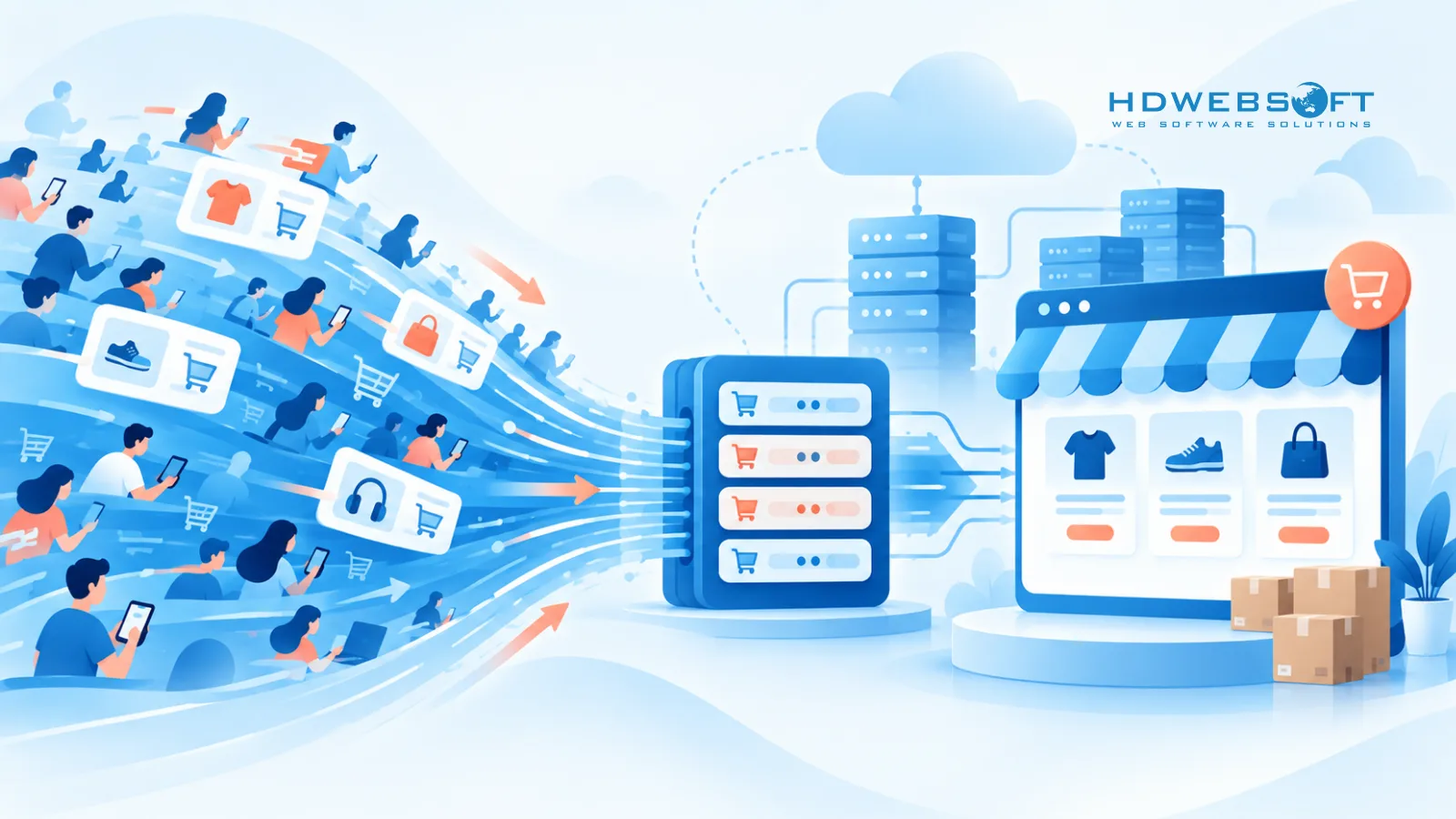
Auto-scaling every service aggressively does not guarantee stability. Imagine a flash sale generating thousands of order events while an ERP integration can process only a limited number of requests per second. If every order immediately triggers an ERP call, the downstream system becomes the bottleneck. A queue absorbs the spike and lets the consumer process work at a sustainable rate. This is backpressure: protecting slower systems instead of allowing upstream scalability to overwhelm them.
Inventory Consistency
Inventory is another high-traffic challenge. If one product remains and 20 customers attempt checkout at the same time, each request must not independently read “1 available” and successfully purchase it. The authoritative inventory system may require atomic reservations, conditional updates, or optimistic concurrency controls. Reservations can also expire when payment fails or checkout is abandoned. The exact consistency model depends on the business. Limited-edition products require stricter controls than inventory that can easily be replenished.
Performance & Scalability Engineering for Flash Sales
Headless architecture creates useful scaling boundaries, but those boundaries still need to be engineered and tested.
Large retail demand peaks make this particularly important.
Adobe reported that U.S. consumers spent $257.8 billion online during the 2025 holiday season, with 25 individual days exceeding $4 billion in online spending, compared with 18 such days the previous year. The analysis covered more than one trillion visits to U.S. retail sites. See the Adobe Analytics 2026 holiday ecommerce report.
The implication is not that every ecommerce platform needs the same capacity. It is that traffic peaks may occur repeatedly throughout a campaign or shopping season rather than during one isolated event.
Build a Latency Budget
Performance should be measured across the full request chain: CDN → React rendering → BFF → commerce APIs → optional personalization
Optimizing the frontend cannot compensate for a backend API waterfall adding several seconds.
Different customer journeys also require different performance expectations.
Product browsing is highly latency-sensitive and cache-friendly. Checkout may take longer because it must confirm payment and inventory. Background order processing can often tolerate seconds or minutes.
A latency budget helps teams allocate acceptable time to each layer instead of optimizing blindly.
Cache at the Right Layer
Headless commerce often uses several caches:
- CDN and page cache
- API cache
- catalog/search cache
- GraphQL or object cache
- recommendation cache
The key question is freshness.
Product descriptions can remain cached longer than promotional pricing. Inventory displayed during browsing may tolerate short staleness, while inventory at checkout must be verified against the authoritative source.
Correct cache policy reduces backend load without compromising transaction accuracy.
Scale the Entire Dependency Chain
Lambda may scale rapidly, but other dependencies may not.
Potential constraints include:
- database connections
- payment-provider quotas
- commerce-platform limits
- ERP throughput
- third-party APIs
- inventory systems
This means: auto-scaling compute does not automatically scale the system.
Concurrency limits, queueing, database connection management, and third-party rate limits all belong in capacity planning.
Production teams should also monitor p95 and p99 latency rather than only averages.
Useful high-traffic metrics include:
- TTFB / LCP
- BFF p95/p99 latency
- checkout completion time
- API error rate
- cache-hit ratio
- queue depth and queue age
- payment failures
- order-processing lag
These metrics connect infrastructure behavior with customer experience.
AI Personalization Without Slowing the Commerce Journey
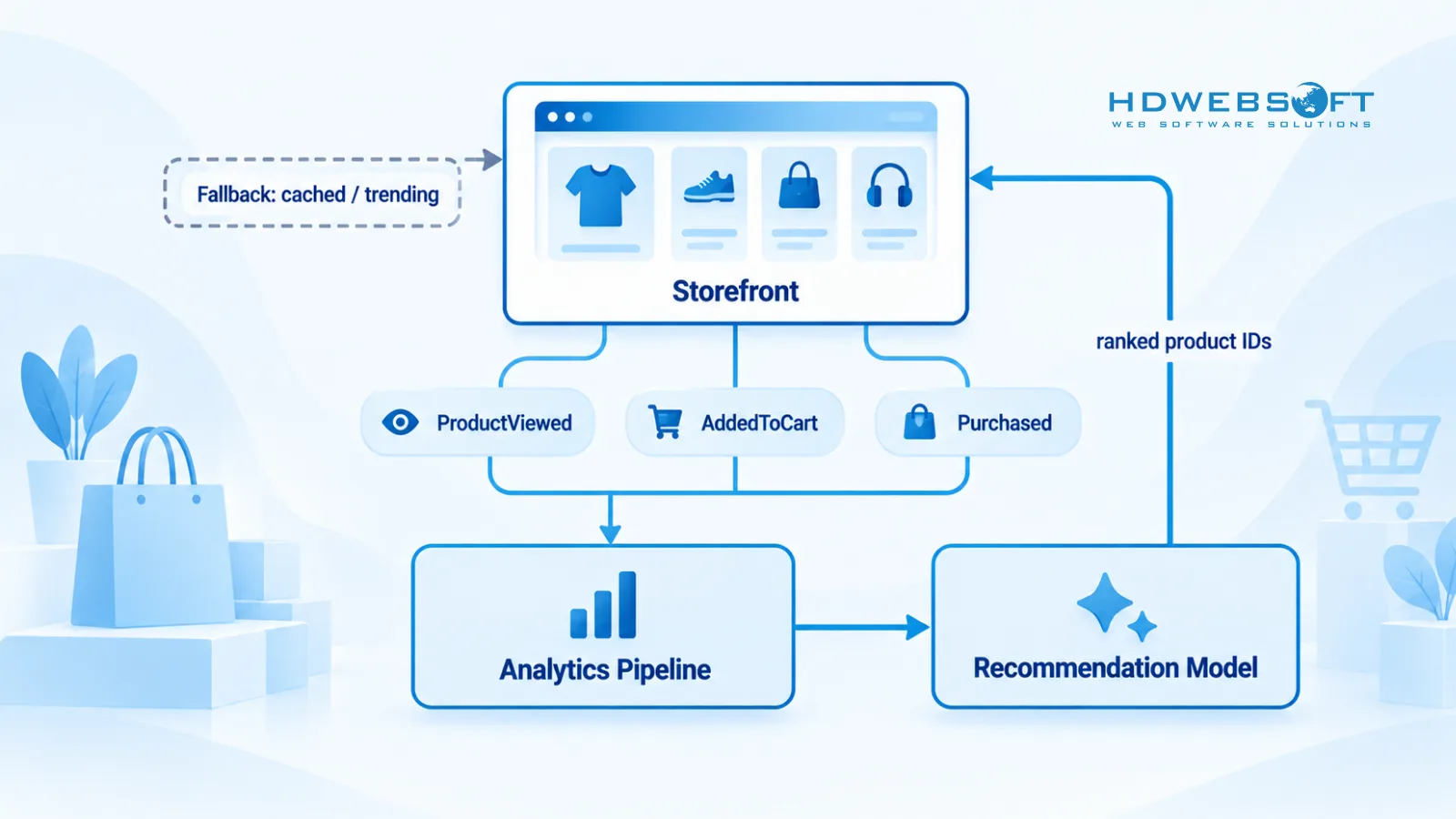
Headless architecture makes personalization easier to isolate from core commerce functionality.
Rather than embedding recommendation logic inside the storefront or commerce engine, businesses can expose recommendations as an independent service.
That service may use:
- browsing history
- purchase behavior
- catalog data
- customer preferences
- product relationships
- inventory signals
The output can simply be ranked product IDs or offers returned through an API.
The storefront does not need to know how the underlying model works.
Keep AI Outside the Critical Path
AI recommendations should enhance the shopping journey, not control whether the journey works.
If a recommendation API becomes slow, product pages should usually continue rendering.
The architecture can define a latency budget and fallback behavior such as:
- cached recommendations
- trending products
- category best sellers
- rule-based alternatives
Similarly, model failures or invalid recommendations should not interfere with checkout.
Commerce events such as ProductViewed, AddedToCart, SearchPerformed, and Purchased can feed analytics or model pipelines asynchronously.
This creates a feedback loop without putting AI training or heavy inference directly inside transactional flows.
For companies building custom storefronts, marketplaces, recommendation systems, and commerce integrations, HDWEBSOFT’s e-commerce software development services cover both core commerce platforms and AI-enabled functionality.
When Headless Commerce Is Worth the Complexity
Headless architecture creates flexibility, but flexibility introduces additional services, APIs, deployments, monitoring, and operational responsibilities.
It should therefore solve a real constraint.
| Dimension | Traditional Monolith | Headless | Composable |
|---|---|---|---|
| Frontend independence | Lower | High | High |
| Backend modularity | Lower | Varies | High |
| Independent scaling | Limited | Medium–High | High |
| Multi-channel support | Lower | High | High |
| Operational complexity | Lower | Medium | Higher |
| Engineering demand | Lower | Higher | Highest |
Headless tends to fit businesses that have:
- multiple storefronts or digital channels
- highly customized UX requirements
- complex integrations
- multiple regions or brands
- frequent frontend releases
- substantial performance or scaling constraints
It may be unnecessary when:
- the catalog is simple
- integrations are limited
- a SaaS storefront already meets requirements
- the engineering team is small
- customization requirements are low
The right question is not: “Is headless more modern?” It is: “Which business or architecture constraint does headless remove?”
How HDWEBSOFT Approaches Ecommerce Architecture
For existing ecommerce systems, modernization should begin with the current bottleneck rather than a predetermined stack.
A practical process may include:
- Architecture assessment — Review traffic patterns, integrations, performance bottlenecks, data flows, and failure points.
- Define boundaries — Determine which frontend, commerce, integration, or background workloads genuinely need independent scaling.
- Validate performance — Load-test critical customer journeys and downstream services.
- Roll out incrementally — Separate components where doing so creates measurable value instead of replacing the entire platform in one step.
HDWEBSOFT’s Salesforce Integration to an All-in-One Seller Workspace case study demonstrates the integration side of enterprise ecommerce. The project involved two-way synchronization between Lightspeed POS and Salesforce for inventory, customer, and order information.
The case does not represent the exact React–Node.js–AWS reference architecture described here. Its relevance is the broader integration challenge: enterprise ecommerce platforms rarely operate alone. Commerce data often needs to move reliably between POS, CRM, inventory, fulfillment, accounting, and other systems.
Conclusion
Headless ecommerce scalability is not about replacing one monolith with as many modern technologies as possible.
The goal is to create clear boundaries so the storefront, commerce transactions, asynchronous workloads, integrations, and optional services such as AI can scale and fail according to their own requirements.
React can provide frontend flexibility. Node.js and GraphQL can create a controlled storefront API layer. AWS serverless services can support event-driven workloads. But production success still depends on caching, latency budgets, idempotency, backpressure, inventory consistency, observability, and realistic load testing.
Planning a headless ecommerce platform or preparing an existing store for higher traffic? Contact HDWEBSOFT to discuss your architecture and scaling requirements.
Frequently Asked Questions
What is headless ecommerce architecture?
Headless ecommerce separates the customer-facing storefront from the backend commerce engine. The frontend communicates with catalog, pricing, cart, checkout, inventory, and other services through APIs.
How do React and Node.js fit into headless ecommerce?
React can power the storefront, while Node.js can provide a Backend-for-Frontend layer that aggregates commerce APIs, manages authentication, controls timeouts, and exposes REST or GraphQL interfaces optimized for the frontend.
Can headless ecommerce handle high-traffic flash sales?
Yes, but headless architecture alone does not guarantee scalability. Performance also depends on caching, API capacity, database limits, payment providers, inventory controls, queues, and downstream integrations.
What is the difference between headless and composable commerce?
Headless primarily separates frontend presentation from the backend. Composable commerce additionally breaks business capabilities into modular components that can be selected and evolved independently.
Why use AWS serverless services for ecommerce?
AWS Lambda, EventBridge, and SQS can support event-driven workloads, background processing, traffic buffering, and independent scaling. However, containers or hybrid infrastructure may be more appropriate for some sustained workloads.
How can AI personalization be added without slowing down the storefront?
Treat recommendations as an independent service with a latency budget and fallback behavior. If the AI service is slow or unavailable, the storefront can return cached, popular, or rule-based recommendations instead.