Enterprise AI spending is predictable in a pilot. A handful of users, a single model endpoint, a controlled set of prompts — the bill fits the forecast. Then usage grows, inference volume climbs, agent workflows multiply, and production requirements kick in. The same workload that cost hundreds a month suddenly consumes tens of thousands, and the CFO wants to know why.
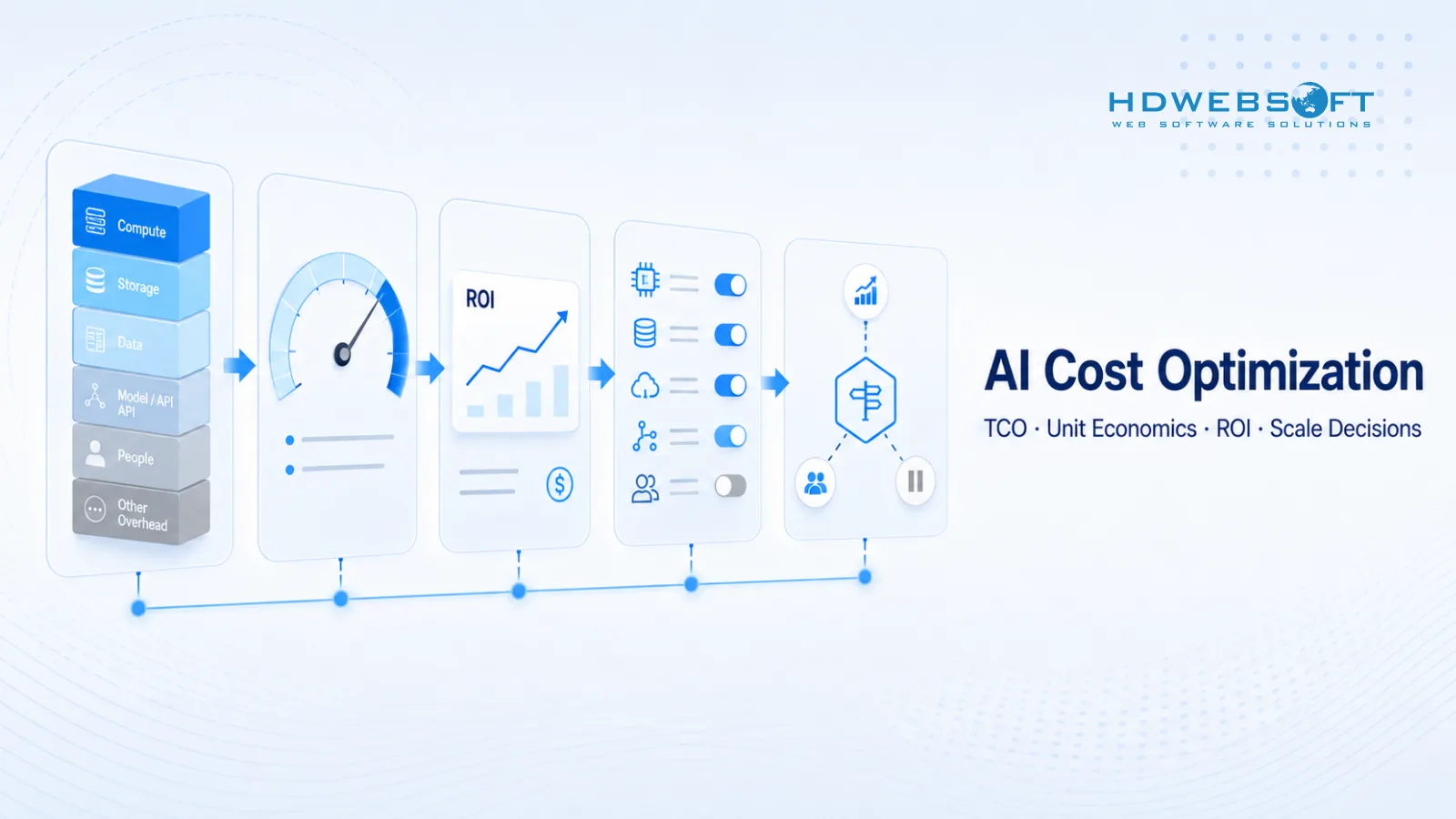
AI cost optimization is the process of controlling the entire economics of AI — not just model, API, or GPU pricing — by understanding total cost of ownership, measuring cost per successful outcome, connecting cost to business ROI, and optimizing architecture before scaling production workloads.
When enterprises move agentic AI in production, the economics become more complex. Multiple model calls, tool calls, retries, context growth, and observability overhead all compound — and none show up clearly in a pilot budget. This article covers the full picture: the cost problem, true TCO, unit economics, ROI, seven optimization levers, and a practical scale decision framework.
Key Takeaways
- Enterprise AI TCO includes far more than model, API, or GPU fees: integration, evaluation, observability, security, human review, governance, and operational overhead all shape the economics.
- Cost per successful outcome is more useful than total AI bill for evaluating whether a production workload can scale.
- AI adoption does not equal measurable ROI; cost must be connected to business outcomes before scaling.
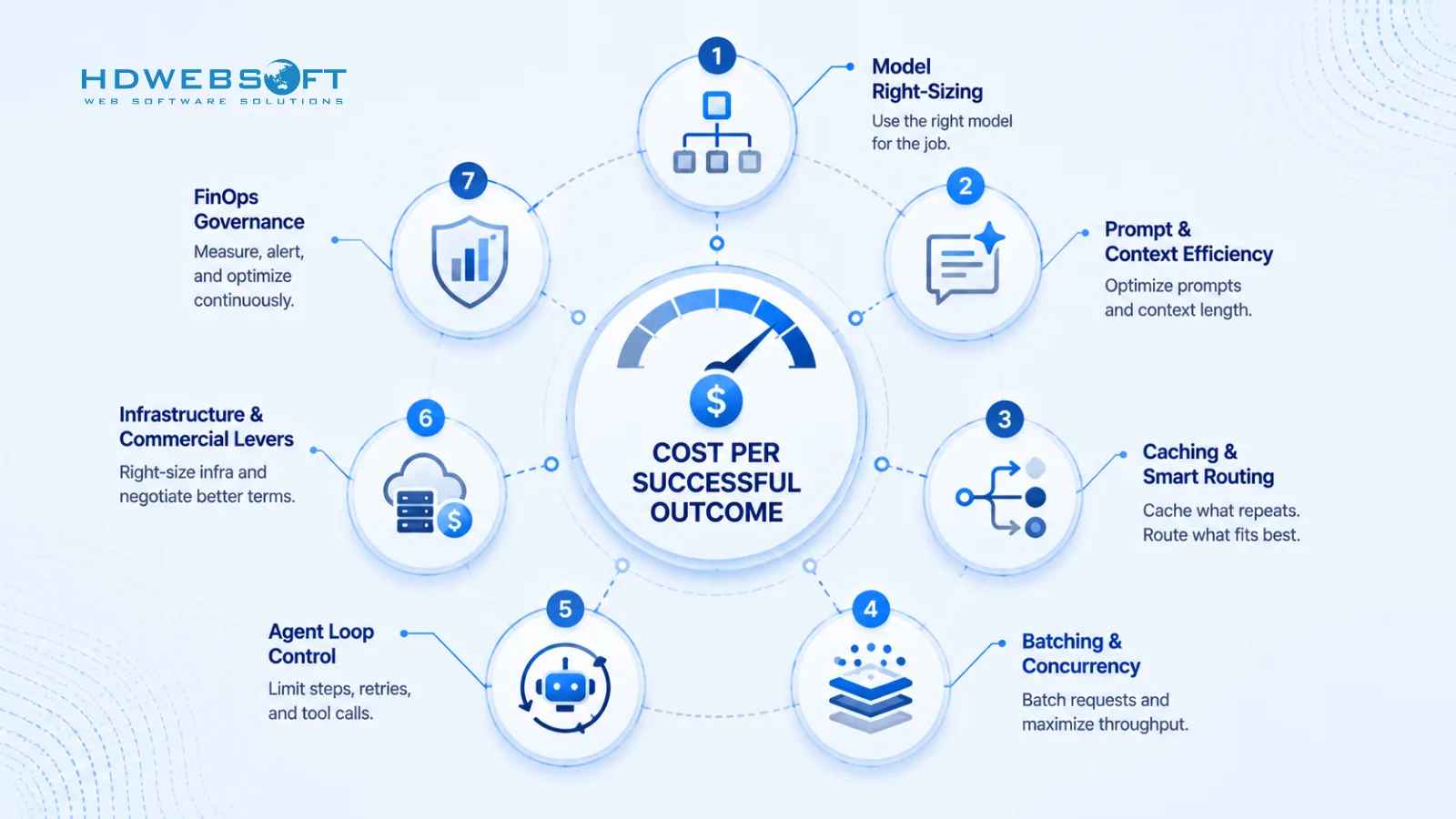
- Key optimization levers: model right-sizing, prompt and context efficiency, caching and routing, batching, agent-loop controls, infrastructure and commercial optimization, and AI FinOps governance.
- Scale decisions should be based on business-specific unit economics, quality, and demand thresholds — not pilot enthusiasm or arbitrary benchmarks.
The AI Cost Problem Enterprises Face in 2026
When a workload moves from experimentation to real users, several cost drivers expand simultaneously: inference volume scales with traffic, model selection defaults to the most capable (and most expensive) option, prompts and context windows grow, GPU utilization stays low without active tuning, and agent retries add hidden multiplier effects. Evaluation, observability, security, compliance, and human review each add cost layers absent in the pilot phase.
The core distinction: pilot cost is not production TCO. Pilots run with low traffic, limited concurrency, a small user population, and simplified architecture — rarely including full failover, evaluation pipelines, monitoring, compliance, or governance. A pilot proves a use case can work technically; it does not prove the economics work at scale.
Recent Evidence — McKinsey 2026
McKinsey’s May 2026 Enterprise AI FinOps survey found that 93% of respondents were exceeding their AI budgets, and AI spending increased nearly fourfold as organizations moved from isolated use cases toward enterprise-wide adoption. The survey covered 120 enterprise participants with 75 qualified respondents across five major industries; 62% had moved beyond experimentation into active deployment.
The transition from pilot to scaled adoption creates a fundamentally different cost-management problem — not because teams are careless, but because the cost structure changes.
The Hidden Cost Categories CFOs Miss
Beyond visible model and infrastructure bills, enterprises encounter costs that are harder to attribute:
- Integration and orchestration — connecting AI to existing systems, data pipelines, and workflows.
- Security and compliance — access controls, data governance, audit trails, regulatory alignment.
- Evaluation and observability — quality scoring, drift detection, latency monitoring, alerting.
- Human review — manual verification of AI outputs, especially in high-stakes or regulated domains.
- Production rework — fixing failed outputs, prompt regressions, agent failures.
- Training and change management — onboarding users, updating processes, maintaining adoption.
- Engineering support — ongoing maintenance, model updates, incident response.
- Switching and vendor dependency costs — effort to change models, providers, or architectures.
These don’t always appear as line items in an AI budget, but they consume engineering time and operational resources. Universal percentages aren’t offered — the split depends on organization, use case, and deployment model.
The True TCO of Enterprise AI
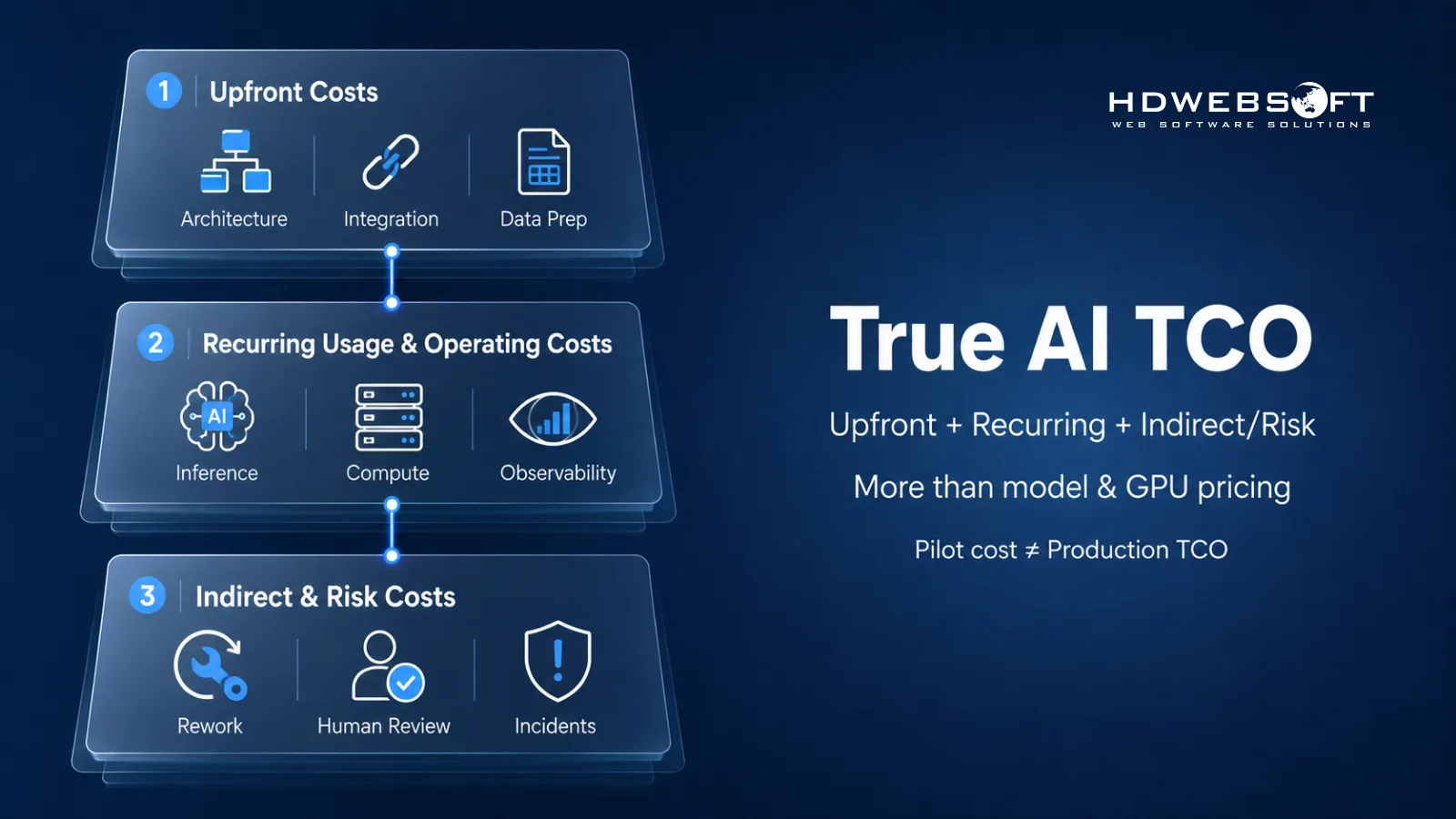
AI TCO = upfront implementation costs + recurring usage and operating costs + indirect and risk costs.
This avoids a rigid CapEx/OpEx classification because accounting treatment varies by organization and deployment model. The goal: capture every cost category that affects economics, regardless of finance labels.
Upfront Costs
Incurred before production: architecture and design, system integration, data preparation, evaluation setup, migration, initial model adaptation or fine-tuning, and security implementation. Often treated as one-time, but they recur whenever the architecture changes significantly — which in AI happens frequently.
Recurring Usage and Operating Costs
Scale with usage and time: model and API inference, GPU and compute, storage, vector and database operations, observability, evaluation, monitoring, support and maintenance, and ongoing model and prompt changes. The costs most teams track, but only part of the picture.
Indirect and Risk Costs
Costs that don’t appear on an invoice but consume real resources: engineering rework, human verification, incident response, compliance overhead, opportunity cost of delayed product work, and switching costs when models or providers change. Often absorbed by engineering teams without being attributed to the AI workload that caused them.
A Sample TCO Breakdown
An illustrative example for a representative enterprise AI workload — not an industry benchmark. Splits vary by use case, organization, and deployment.
| Cost Category | What It Includes | Cost Driver | Optimization Question |
|---|---|---|---|
| Model / API inference | Per-token or per-call charges from model providers | Request volume, token usage, model tier | Are we using the right model for each task? |
| Compute and infrastructure | GPU, CPU, storage, networking | Workload size, concurrency, redundancy | Is utilization high enough to justify self-hosting? |
| Integration and orchestration | Connecting AI to business systems and data pipelines | Number of integrations, data complexity | Can integrations be simplified or shared? |
| Observability and evaluation | Monitoring, logging, quality scoring, drift detection | Number of workloads, evaluation depth | Is observability proportional to risk? |
| Security and compliance | Access controls, audit, data governance | Regulatory requirements, data sensitivity | Are controls right-sized or overbuilt? |
| Human review and rework | Manual verification, fixing failed outputs | Output quality, failure rate | Would better model routing reduce rework? |
| Engineering support | Maintenance, updates, incident response | Architecture complexity, change frequency | Is the architecture more complex than needed? |
What “Hidden Cost” Actually Means
A hidden cost is not invisible — it’s absorbed by a team without being attributed to the AI workload. The model and API bill may sit within budget, but production AI can still be expensive if engineering spends time on failed outputs, manual QA, prompt regression, agent failures, and incidents. That time has a real cost, even if it never appears on an AI invoice.
Unit Economics: The Number That Decides Whether AI Scales
The core differentiator. Instead of asking “How much are we spending on AI?” CFOs and CIOs should ask “What does each successful business outcome cost?”
Unit cost = (AI usage cost + operational overhead + rework cost) / successful outcomes
Measured at different levels: cost per request, per workflow, per completed task, or per successful outcome.
Choosing the Right Unit Metric
Per request suits simple API or LLM interactions — easy to measure but can disconnect from business value.
Per task or workflow suits AI automation, where a unit of work involves multiple steps.
Per successful outcome is the most useful metric for complex and agentic systems, because a single outcome may require multiple model calls, retries, and tool interactions. Examples: a customer case resolved, a document processed, a qualified lead generated, an engineering task completed.
Why Total AI Spend Can Mislead
If the total bill rises but cost per successful outcome falls and demand grows, the economics may be healthy. Conversely, if the total bill drops but success rate decreases and rework increases, the economics may be getting worse. The number that matters is cost per successful outcome, tracked over time, under realistic load.
Benchmarking Before You Scale
A meaningful baseline must reflect representative production traffic, peak-load behavior, success rates, retries, context and token usage, human intervention, and quality requirements. Benchmarking with low-volume pilot data produces numbers that won’t hold at scale.
From AI Unit Economics to Enterprise ROI
This connects cost to value. It does not duplicate the detailed ROI methodology in ROI of AI in Software Development, which covers baselining, attribution, and measurement.
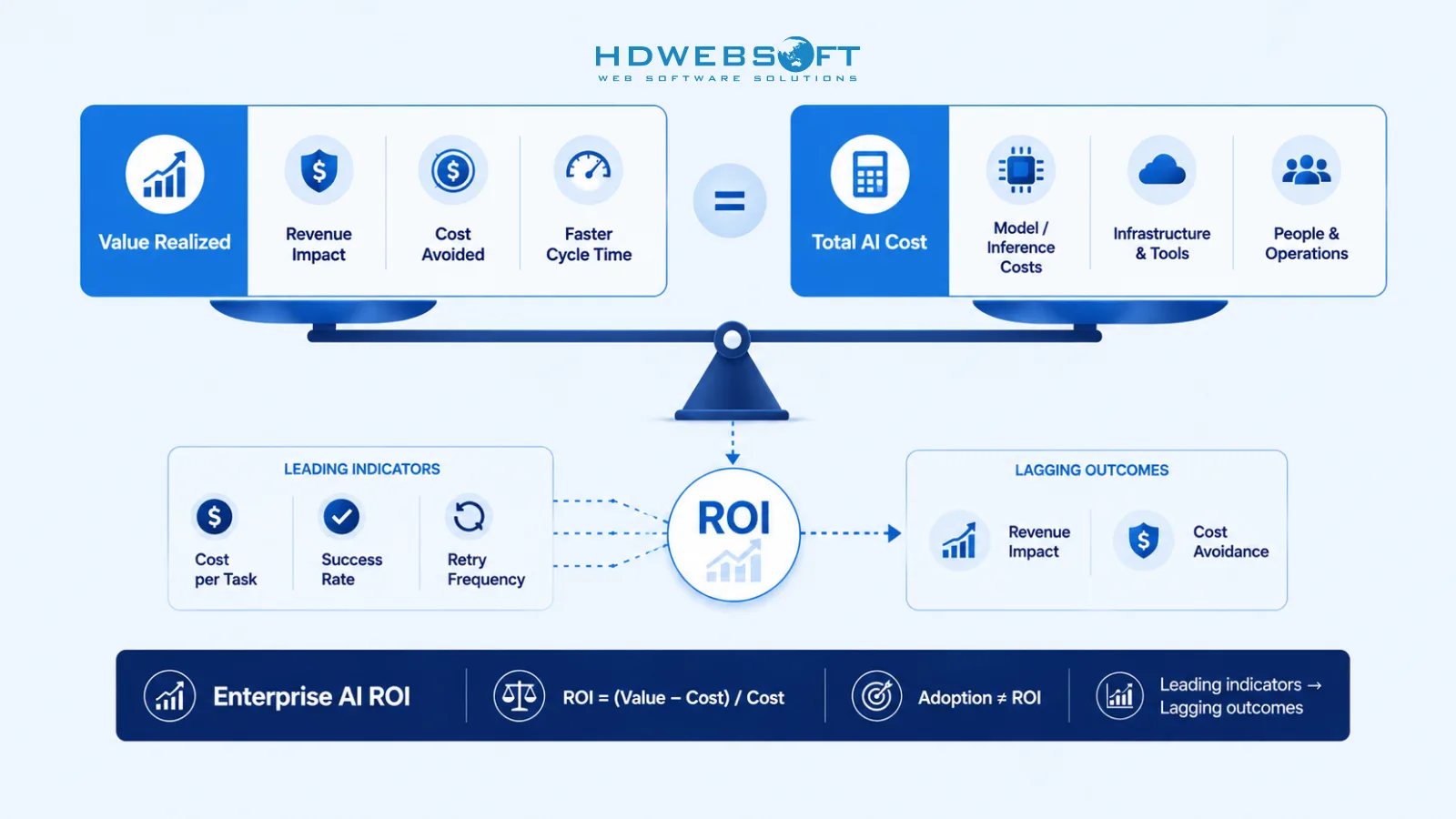
The core distinction: TCO = how much AI actually costs. Unit economics = how much each successful outcome costs. ROI = whether business value justifies the total cost.
ROI = (Value Realized − Total AI Cost) / Total AI Cost
Recent Evidence — Deloitte Finance Trends 2026
Deloitte’s Finance Trends 2026 research found that 63% of surveyed finance leaders had fully deployed and were actively using AI, yet only 21% reported clear, measurable ROI. The survey covered 1,323 finance leaders.
AI deployment is not the same as demonstrated economic value. Adoption tells you people are using AI. ROI tells you whether that usage is worth it.
Connecting Cost to Business Value
Cost should map to outcomes such as revenue created or enabled, labor or operating cost avoided, faster cycle time, improved throughput, reduced failure or rework, and improved customer or service outcomes. Avoid as ROI proxies — unless they connect to a business result — token count, number of AI users, prompts sent, model calls, and raw adoption.
Leading vs Lagging Economics
Leading indicators signal where economics are heading: cost per successful task, success and evaluation rate, retry frequency, human-review rate, model utilization. Lagging outcomes confirm where economics have landed: revenue impact, cost avoidance, time-to-market, throughput, customer or business outcomes. Both are needed — leading for course correction, lagging for board reporting.
Optimization Levers: How to Reduce AI Inference Costs
This section addresses how to reduce AI inference costs. Each lever describes what it changes, why it affects cost, and what trade-off to monitor. No universal savings are claimed — results depend on the workload.
1. Model Right-Sizing
Not every task needs a frontier model. Route simple, low-risk tasks to smaller or lower-cost models; reserve expensive models for high-complexity or high-value tasks. The target is quality-adjusted cost — the cheapest model that consistently meets quality thresholds — not just the cheapest by pricing.
2. Prompt and Context Optimization
Remove unnecessary context, summarize long conversation history, retrieve only relevant document sections, and eliminate duplicated system instructions. Track token consumption per successful outcome, not just per request. Especially important for RAG and long-running agents where context windows grow and inflate every subsequent call.
3. Caching and Intelligent Routing
Cache repeated or static results where appropriate. Use prefix and prompt caching where providers support it. Route similar requests to cached outputs or lower-cost models when quality requirements allow. Trade-off: stale cache entries can produce incorrect results, so invalidation strategy matters.
4. Batching and Concurrency Optimization
For self-hosted or infrastructure-heavy workloads: batching, request scheduling, concurrency tuning, and GPU utilization optimization improve throughput per compute unit and reduce idle capacity. Less relevant for API-only workloads but critical for teams running their own inference infrastructure.
Control Agent Loops and Tool Calls
Uncontrolled agent loops — unnecessary retries, excessive reasoning steps, repeated tool calls, oversized context accumulation, and using high-cost models for intermediate steps — can multiply costs several times over without improving outcomes. Track tool calls per successful task, model calls per successful task, and retries per completed outcome. Set limits on loop depth, retry counts, and context size.
6. Infrastructure and Commercial Optimization
Committed-use pricing, capacity planning, reserved or spot infrastructure where appropriate, multi-model or multi-provider architecture where economics justify the complexity, and renegotiating volume commitments. Multi-provider can reduce costs but adds operational complexity — savings must justify the overhead.
7. AI FinOps Governance
Workload-level budgets, cost attribution to specific teams and use cases, anomaly alerts for spend spikes, clear usage ownership, forecasting, and regular cost-and-performance reviews. The focus: optimize cost per business outcome, not just lower total spend. Cutting total spend while degrading quality is not optimization — it’s cost-shifting.
Tactical vs Structural Optimization
Tactical levers deliver faster results: model right-sizing, token and context reduction, caching, retry and tool-call controls. Structural levers require more investment but produce durable savings: routing architecture, workload redesign, capacity planning, cost attribution, governance, commercial strategy. The right sequence depends on the workload and team capacity.
What Not to Cut
Do not optimize by blindly cutting observability, evaluation, security, safety controls, or quality validation. Savings here often shift cost into rework, incidents, failed outcomes, and compliance risk — usually larger and harder to attribute.
Optimize Your AI Investment
Need to understand where your AI architecture is driving unnecessary cost? HDWEBSOFT can help assess model choices, production cost drivers, architecture, and optimization opportunities before you scale. Talk to our AI development services team for a structured cost review.
The Scale-or-Don’t-Scale Decision
The final question is not “Can we scale this AI workload?” but “Are the economics strong enough to justify more volume?” A scale decision should rest on four dimensions:
- Economics — unit cost is within a business-defined target range, and the cost-to-value relationship is acceptable.
- Quality — success and evaluation performance remain stable at representative production load.
- Demand — sufficient usage and business demand exist to justify scale.
- Operational readiness — monitoring, cost attribution, governance, failure handling, and capacity planning are in place.
Signals You’re Ready to Scale
- Cost per successful outcome sits within the agreed target range.
- Economics remain stable under representative and peak-load conditions.
- Quality thresholds remain stable as volume increases.
- Demand and use case have validated business value.
- Cost ownership and monitoring exist and are actively used.
Signals You Should Hold
- Economics are not yet stable or trending in the wrong direction.
- Architecture is undergoing significant changes.
- Excessive retries or rework are consuming engineering time.
- Workload ownership is unclear or cost attribution is incomplete.
- Demand has not been validated yet.
Signals You Should Not Scale Yet
- Cost per successful outcome deteriorates with volume.
- Quality drops under realistic load.
- No clear business-value attribution exists.
- Major spending remains untracked.
- The system depends on expensive manual intervention.
A Practical Scale Decision Framework
| Dimension | GO | HOLD | NO-GO |
|---|---|---|---|
| Unit economics | Within target | Trending toward target | Unsustainable |
| Quality | Stable | Variable | Fails requirements |
| Demand | Validated | Uncertain | Weak |
| Operations | Ready | Partial | Major gaps |
| Business value | Evidenced | Emerging | Unclear |
No universal threshold — such as “unit cost must decline for three months” or a fixed ROI percentage — is offered. Thresholds must be defined per workload.
Conclusion
Production AI economics include far more than GPU and model pricing. TCO reveals the total economic burden. Unit economics — cost per successful outcome — reveals whether a workload is sustainable at scale. ROI connects cost to measurable business value. Optimization must cover model selection, tokens and context, routing, infrastructure, agent behavior, and governance. The scale decision should rest on economics, quality, demand, and operational readiness — not pilot enthusiasm.
HDWEBSOFT can help enterprises assess AI architecture, production cost drivers, model choices, and optimization opportunities as they move from pilots toward scalable production. If you need an engineering partner for AI implementation and long-term optimization, explore our engagement models to find the right delivery structure.
FAQ
What is AI cost optimization?
AI cost optimization is controlling the full economics of AI — not just model, API, or GPU pricing — by understanding TCO, measuring cost per successful outcome, connecting cost to business ROI, and optimizing architecture before scaling production.
How do you calculate the true TCO of an AI project?
AI TCO equals upfront implementation costs (architecture, integration, data preparation, security) plus recurring usage and operating costs (inference, compute, storage, observability, maintenance) plus indirect and risk costs (engineering rework, human verification, incidents, compliance).
How can enterprises reduce AI inference costs?
Through seven levers: model right-sizing, prompt and context optimization, caching and intelligent routing, batching and concurrency optimization, controlling agent loops and tool calls, infrastructure and commercial optimization, and AI FinOps governance. Each should be evaluated against quality-adjusted cost, not raw pricing.
How do you measure ROI of enterprise AI?
ROI equals value realized minus total AI cost, divided by total AI cost. Value must map to business outcomes such as revenue created, labor cost avoided, faster cycle time, improved throughput, or reduced rework. Raw adoption metrics should not be used as ROI proxies unless they connect to a business result.
What is cost per successful outcome in AI?
A unit economics metric: total AI usage cost plus operational overhead plus rework cost, divided by successful business outcomes. More useful than total AI spend for evaluating whether a workload can scale sustainably.
When should an enterprise scale AI to production?
Only when unit economics are within an agreed target range, quality remains stable under representative and peak load, business demand is validated, and operational controls — monitoring, cost attribution, governance, capacity planning — are in place.
What is the difference between AI pilot cost and production cost?
Pilot cost reflects low traffic, limited concurrency, small user populations, and simplified architecture without full evaluation, monitoring, compliance, or governance. Production cost includes inference at scale, retries, agent loops, observability, security, human review, and operational overhead. Pilot spend should not be extrapolated into production economics.