Choosing the right AI development partner is one of the most critical decisions you’ll make for your AI initiative. The difference between a successful production system and a failed project often comes down to this choice. According to RAND Corporation research, more than 80% of AI projects fail to deliver their intended business value—roughly twice the failure rate of comparable IT projects without AI. Poor partner selection is a leading cause of these failures.
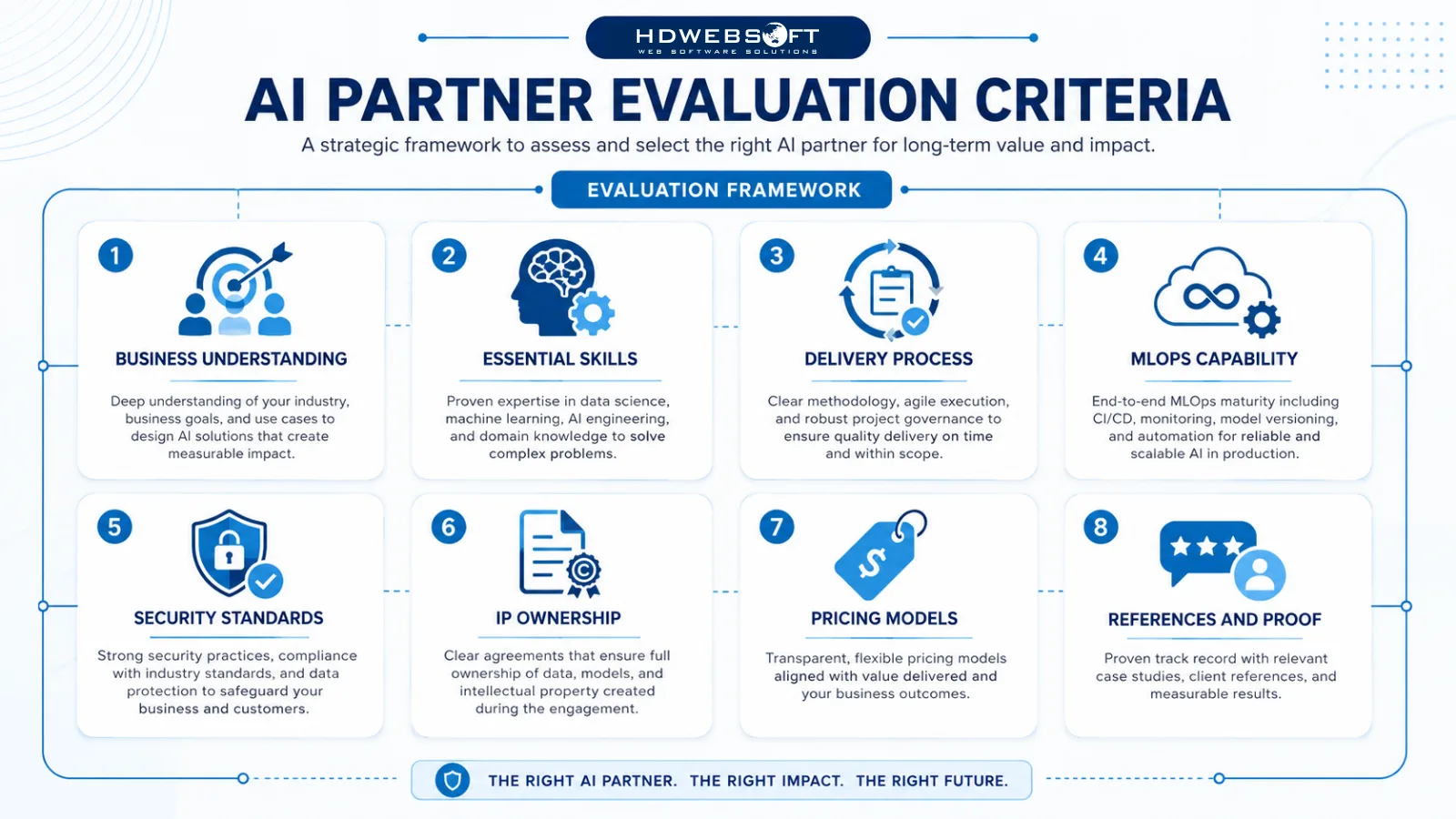
The key is to evaluate AI development partners based on proven production delivery capability, not polished demos or impressive prototypes. A demo might show what’s technically possible, but it doesn’t reveal whether a partner can actually deliver, deploy, and maintain an agentic AI in production. This guide provides a practical framework for evaluating AI development partners across the dimensions that matter most: business understanding, technical skills, delivery processes, MLOps capability, security, IP clarity, pricing, and verifiable references.
Why Demo-First Selection Fails in AI Development
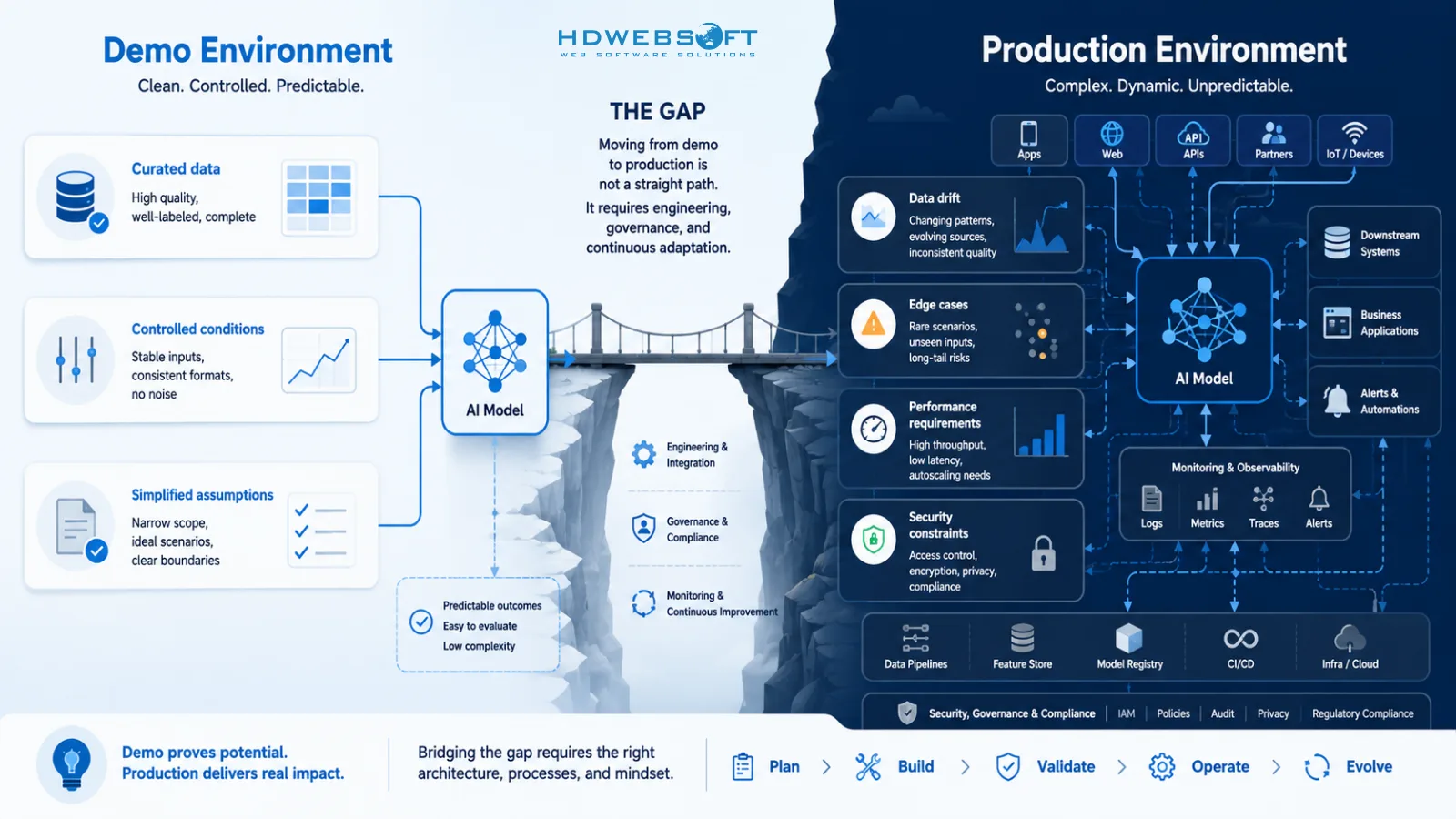
Choosing an AI development partner based on impressive demos is a common mistake that leads to failed projects and wasted budgets. A polished prototype can hide critical gaps in production capability, engineering discipline, and long-term support. The reality is that getting an AI model to work in a controlled demo environment is fundamentally different from deploying, maintaining, and scaling it in production.
The Gap Between Prototype and Production
Demos are typically built on curated datasets, controlled conditions, and simplified assumptions. They don’t account for real-world data drift, edge cases, performance requirements, security constraints, or integration complexity. A demo might show 90% accuracy on a sample dataset, but production systems must handle data quality issues, model degradation, scaling challenges, and continuous monitoring—none of which are visible in a demo.
Hidden Costs of Choosing Based on Demos Only
When you select a partner based on demo quality alone, you inherit hidden costs: rework when the prototype doesn’t scale, additional engineering to build missing infrastructure, extended timelines to address production issues, and often a complete partner switch when the original team cannot deliver beyond the demo stage. The total cost of a failed AI project far exceeds the initial development budget.
Business Understanding and AI Discovery Capability
A strong AI development partner must understand your business before writing a single line of code. Technical excellence without business context leads to solutions that solve the wrong problems or miss critical requirements. This is why AI consulting services emphasize discovery and business alignment.
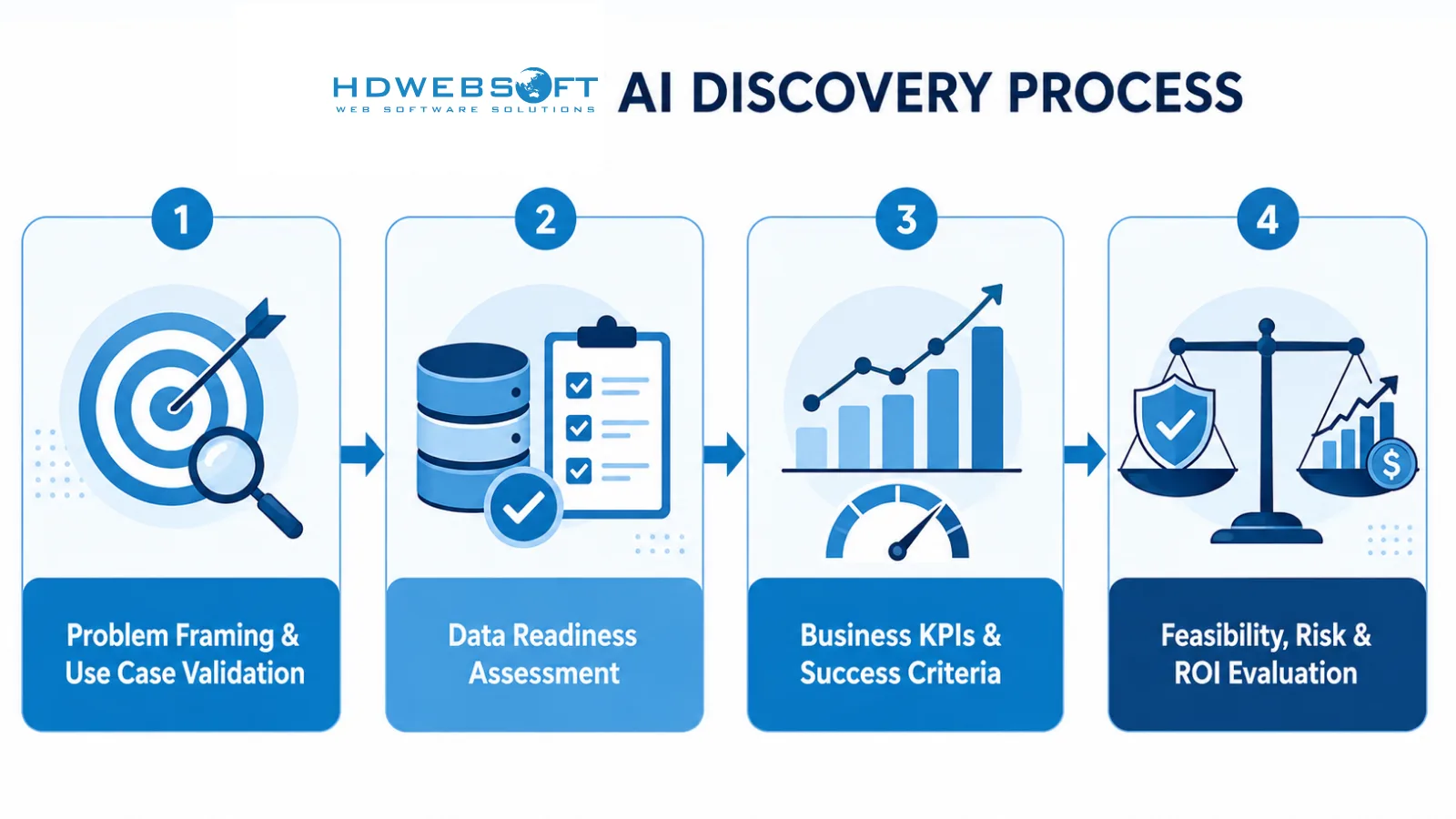
Problem Framing and Use Case Validation
The right partner will challenge your assumptions, validate use cases, and help frame problems correctly. They should ask: Is AI the right solution? What business problem are we solving? What does success look like? This upfront validation prevents wasted effort on unsuitable AI projects and ensures alignment between technical solutions and business objectives.
Data Readiness Assessment
Data is the foundation of any AI system. A competent partner will assess your data readiness: data quality, availability, accessibility, and suitability for the intended use case. They should identify gaps, recommend data collection strategies, and estimate the effort required for data preparation—not assume your data is ready for AI development.
Business KPIs and Success Criteria
Clear success criteria are essential. The partner should work with you to define measurable business KPIs: cost reduction, revenue impact, efficiency gains, or customer experience improvements. These metrics guide development decisions and provide objective measures of project success beyond technical accuracy.
Feasibility, Risk, and ROI Evaluation
Before development begins, the partner should evaluate technical feasibility, identify risks, and estimate ROI. This includes assessing data availability, model complexity, integration requirements, and potential blockers. A realistic feasibility study sets proper expectations and helps prioritize features based on business value.
Essential Skills to Evaluate in an AI Development Partner
Technical capability is non-negotiable, but it goes beyond AI/ML expertise alone. A production-ready AI development company combines deep AI knowledge with strong software engineering fundamentals.
Core AI/ML Technical Expertise
Look for proven expertise in relevant AI domains: machine learning, deep learning, natural language processing, computer vision, or generative AI, depending on your use case. The team should understand model selection, training techniques, evaluation metrics, and the trade-offs between different approaches. Ask about their experience with similar problems and the specific techniques they would apply to your use case.
Domain Knowledge and Industry Experience
Industry-specific knowledge accelerates development and improves solution quality. A partner who understands your domain can identify relevant features, anticipate edge cases, and design solutions that fit existing workflows. Domain expertise also helps in data preparation, feature engineering, and interpreting model outputs in business context. This is why machine learning development services with industry experience deliver better outcomes.
Engineering and Software Development Fundamentals
AI systems are software systems first. The partner must excel in software engineering: clean code, testing, version control, CI/CD, and system architecture. Weak engineering practices lead to unmaintainable code, integration nightmares, and security vulnerabilities. Evaluate their development practices, code quality standards, and approach to software architecture.
Team Structure and Seniority Level
A balanced team includes senior AI engineers, data engineers, software engineers, and project managers. Senior-level talent provides technical leadership and architectural guidance, while junior members handle implementation tasks. Ask about team composition, experience levels, and who will be working on your project directly—not just the sales team or leadership.
Delivery Process and Project Governance
Predictable delivery requires structured processes, clear governance, and effective collaboration. A strong AI development company has established methodologies for managing AI projects from discovery to deployment.
Discovery, Planning, and Technical Validation
A structured discovery phase validates technical assumptions, defines architecture, and identifies risks before full development begins. This phase should include data analysis, proof-of-concept development, and technical planning. The output is a clear roadmap with validated assumptions, not just a sales presentation.
Milestones, Deliverables, and Acceptance Criteria
Clear milestones and deliverables provide visibility and control. Each phase should have defined outputs: data analysis reports, model prototypes, integration plans, or production deployments. Acceptance criteria should be agreed upon upfront, so both parties know when deliverables meet requirements.
Communication and Reporting
Regular communication prevents misalignment and enables quick course correction. The partner should provide status updates, progress reports, and demo sessions at agreed intervals. Transparency about challenges, delays, and blockers builds trust and enables collaborative problem-solving.
Scope, Risk, and Change Management
AI projects are inherently uncertain. A robust process includes scope management, risk identification, and change control procedures. The partner should have a clear approach for handling scope changes, technical risks, and timeline adjustments—without surprise costs or timeline overruns.
Collaboration Between AI, Engineering, and Business Teams
Successful AI projects require close collaboration between technical and business stakeholders. The partner should facilitate this collaboration: translating technical concepts into business terms, gathering feedback from end users, and ensuring alignment between AI capabilities and business processes. Their process should explicitly include business validation and user feedback loops.
MLOps and AI Quality Management: The Make-or-Break Factor
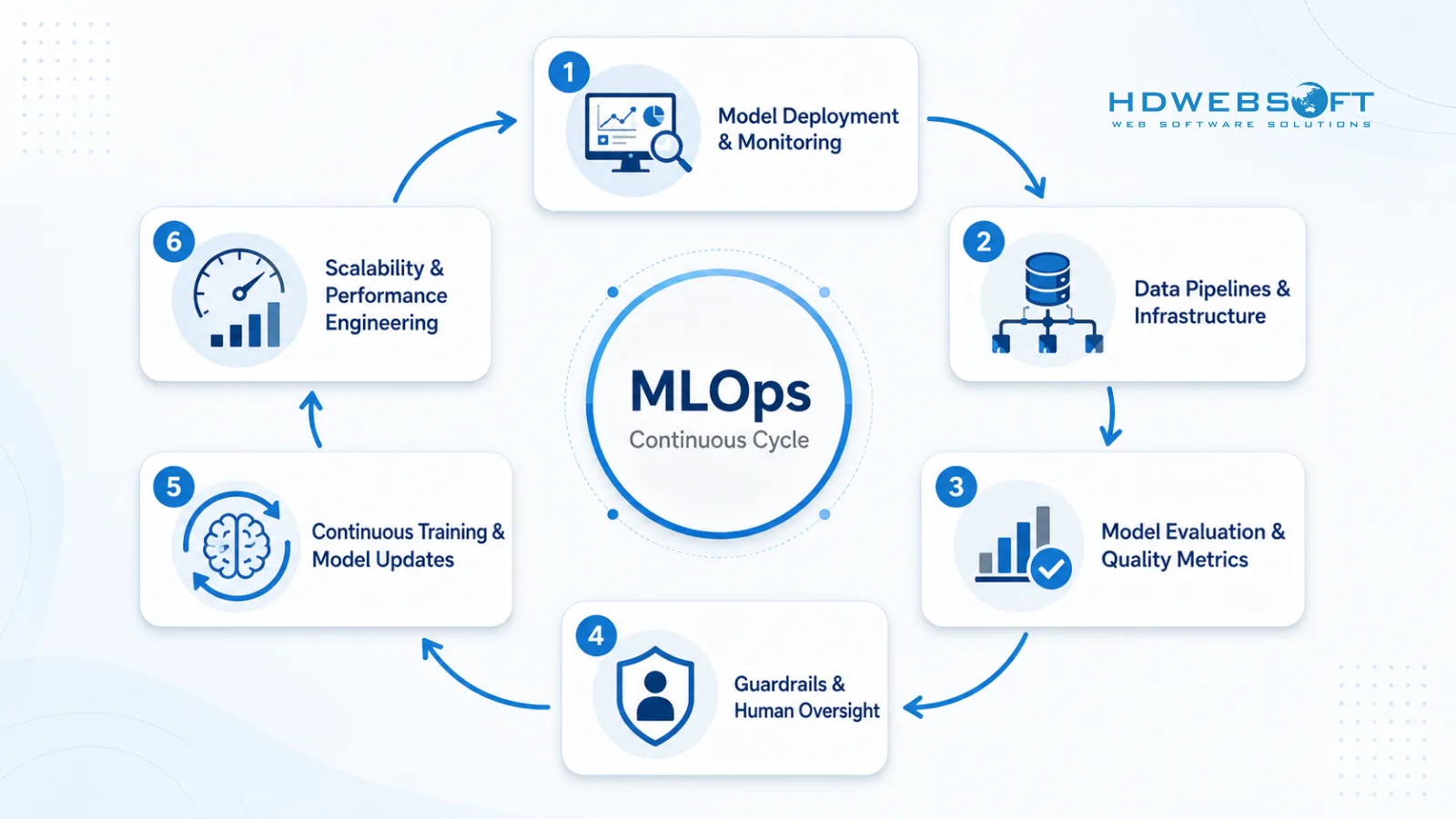
MLOps capability is what separates demo teams from production teams. Without robust MLOps, even the best models fail in production. This is often the most critical but overlooked evaluation criterion. Production-ready machine learning development services ensure models maintain performance and reliability over time.
Model Deployment and Monitoring
Production deployment requires infrastructure for serving models, monitoring performance, and detecting degradation. The partner should have experience with deployment platforms, model serving, and monitoring systems. Ask how they deploy models, what metrics they track, and how they detect when models need attention.
Data Pipelines and Infrastructure
AI systems depend on reliable data pipelines for training, validation, and inference. The partner should design and build scalable data infrastructure: data ingestion, preprocessing, feature storage, and pipeline orchestration. Weak data infrastructure leads to data quality issues, pipeline failures, and operational headaches.
Model Evaluation and Quality Metrics
Beyond accuracy, production AI systems require comprehensive quality metrics: precision, recall, F1-score, calibration, fairness, and robustness. The partner should define relevant evaluation metrics for your use case and implement automated evaluation pipelines. Continuous evaluation ensures models maintain quality over time.
Guardrails and Human Oversight
AI systems need guardrails to prevent harmful outputs, ensure safety, and maintain compliance. The partner should implement content filters, output validation, and human-in-the-loop processes where appropriate. Ask how they handle edge cases, adversarial inputs, and situations where model confidence is low.
Continuous Training and Model Updates
Models degrade over time due to data drift and changing conditions. The partner should have a strategy for continuous training, model updates, and performance monitoring. This includes retraining pipelines, A/B testing for new models, and rollback procedures. Without continuous improvement, model performance decays, and business value diminishes.
Scalability and Performance Engineering
Production systems must handle real-world load: concurrent users, large datasets, and low-latency requirements. The partner should design for scalability from the start, considering caching, batch processing, model optimization, and infrastructure scaling. Performance engineering ensures the system meets business requirements under real conditions.
Security and Compliance Standards
AI systems often handle sensitive data and make critical decisions, making security and compliance non-negotiable. A responsible AI development company takes security seriously from day one.
Data Privacy and Protection
The partner must implement robust data protection: encryption at rest and in transit, access controls, data minimization, and secure data handling practices. Ask about their data security practices, how they handle sensitive data, and what measures they take to prevent data breaches.
Regulatory Compliance (GDPR, HIPAA, etc.)
Depending on your industry and region, compliance with regulations like GDPR, HIPAA, or CCPA may be required. The partner should understand relevant regulations and implement compliant practices: data governance, consent management, right to erasure, and audit trails. Don’t assume compliance—ask specifically about regulatory experience.
Security Development Practices
Security should be integrated throughout development: secure coding practices, dependency management, vulnerability scanning, and penetration testing. The partner should have a security-first mindset, not treat security as an afterthought. Ask about their security practices and how they identify and address vulnerabilities.
Incident Response and Risk Management
Despite best efforts, security incidents can occur. The partner should have incident response procedures, escalation paths, and communication plans. Ask how they handle security incidents, what their response time is, and how they prevent recurrence. Risk management should be proactive, not reactive.
Intellectual Property and Code Ownership
Clear IP rights prevent future disputes and ensure you own what you pay for. Ambiguous IP terms can lead to vendor lock-in, unexpected costs, or loss of critical assets.
Clear IP Rights and Contracts
The contract should explicitly define IP ownership: who owns the code, models, data, and artifacts? Under what terms can the partner reuse components? Clear terms prevent disputes and ensure you have full rights to use and modify the deliverables. Don’t proceed until IP terms are unambiguous.
Code Quality and Documentation
You own the code, but can you actually use it? High-quality code with clear documentation is essential for long-term maintenance and knowledge transfer. The partner should follow coding standards, provide comprehensive documentation, and ensure code is maintainable by your team. Poor code quality creates dependency on the original vendor.
Knowledge Transfer and Handover
Eventually, you may need to maintain or extend the system without the original partner. Knowledge transfer should be part of the project plan: documentation, training sessions, and hands-on support during transition. A partner who resists knowledge transfer may be creating intentional dependency.
Avoiding Vendor Lock-in
Vendor lock-in creates long-term risk and cost. The partner should use standard technologies, avoid proprietary dependencies, and design systems that can be maintained by other teams. Evaluate their technology choices and ask about exit strategies: what happens if you need to switch vendors?
Pricing Models and Total Cost of Ownership
AI projects have unique cost structures beyond typical software development. Understanding the full cost landscape prevents budget surprises and ensures sustainable operations.
AI-Specific Cost Components: Cloud, APIs, Data, Integration
AI projects incur ongoing costs beyond development: cloud infrastructure for training and inference, model API fees, data storage and processing, monitoring tools, and integration effort. The partner should provide transparent estimates of these costs, not just development fees. Hidden infrastructure costs can dwarf initial development budgets.
Choosing a Pricing Model Based on Project Uncertainty
Different pricing models suit different project contexts. Fixed-price works for well-defined projects with clear requirements. Time-and-materials provides flexibility for exploratory projects where scope evolves. Hybrid models combine predictability with flexibility. The right choice depends on uncertainty level, requirements clarity, and your risk tolerance. The partner should recommend a model aligned with your project context, not push a one-size-fits-all approach.
Long-term Maintenance and Support Costs
AI systems require ongoing maintenance: monitoring, retraining, updates, and support. These costs continue after initial deployment. The partner should provide estimates for long-term maintenance, not just development costs. Budget for ongoing operations to avoid sustainability issues after launch.
References and Proof of Delivery
Past performance is the best predictor of future results. A strong AI development company has a track record of successful production deployments, not just impressive demos.
Case Studies with Measurable Outcomes
Look for detailed case studies with specific outcomes: cost savings, revenue impact, efficiency gains, or customer improvements. Vague claims like “improved efficiency” are less credible than specific metrics like “reduced processing time by 40%.” Case studies should describe the problem, solution, implementation challenges, and measurable results. Review HDWEBSOFT.*case studies for examples of production AI deployments with documented outcomes.
Client References and Validation
Speak with past clients, especially those with similar use cases or industries. Ask about their experience: communication quality, technical capability, problem-solving approach, and long-term support. Would they work with the partner again? What challenges did they face? How were those challenges resolved? Direct client feedback reveals what marketing materials cannot.
Production Deployments, Not Just POCs
Proof of delivery means production systems, not proof-of-concepts. A POC demonstrates technical feasibility but doesn’t prove production capability. Ask for examples of live systems in production, handling real users and real data. How long have these systems been running? What issues arose in production? How were they resolved? Production experience is irreplaceable.
Ongoing Support and Success Metrics
Long-term client relationships indicate sustained value. Ask about client retention rates, ongoing support engagements, and how they measure long-term success. A partner who maintains long-term relationships likely delivers consistent value and provides reliable support.
Red Flags to Avoid When Evaluating AI Partners
Certain warning signs indicate high risk. Recognizing these red flags early prevents costly mistakes.
Overpromising Without Technical Constraints
Partners who promise guaranteed results, unrealistic accuracy, or impossible timelines without acknowledging technical constraints are not credible. AI development involves uncertainty and trade-offs. A trustworthy partner sets realistic expectations, acknowledges risks, and explains technical limitations. Overpromising indicates either incompetence or dishonesty.
Inability to Explain Production Architecture and Trade-offs
If a partner cannot explain how they would deploy, monitor, and maintain the system in production, they likely lack production experience. Demos don’t require production architecture discussions. Ask specific questions about deployment infrastructure, monitoring, scaling, and failure handling. Vague answers or evasion are red flags.
Unclear Communication and Processes
Poor communication during evaluation predicts poor communication during the project. If the partner is unresponsive, vague, or disorganized during sales, imagine the challenges during development. Clear communication, structured processes, and transparency are essential for complex AI projects.
Resistance to IP Clarification
If the partner resists discussing IP terms, claims their standard contract is non-negotiable, or provides vague answers about ownership, proceed with caution. IP clarity is fundamental to any development engagement. Resistance suggests they may intend to create dependency or have something to hide.
Conclusion
Choosing the right AI development company requires looking beyond impressive demos to evaluate proven production capability. Focus on partners who demonstrate business understanding, technical excellence, robust MLOps practices, security consciousness, clear IP terms, and verifiable production experience. The right partner will help you navigate the complex journey from concept to production while minimizing risk and maximizing business value.
Whether you need custom software development services or specialized AI expertise, the evaluation framework remains the same: prioritize production delivery over demo quality.
Ready to evaluate AI development partners for your project? Contact HDWEBSOFT for a consultation to discuss your AI initiative and learn how our production-focused approach can help you succeed.
Questions to Ask Potential AI Development Partners
Business and Data Readiness
- How do you approach problem framing and use case validation?
- What is your process for assessing data readiness?
- How do you define business KPIs and success criteria?
- What does your feasibility and ROI evaluation include?
Technical and MLOps Capability
- What AI/ML techniques are relevant to our use case, and why?
- How do you approach model deployment and monitoring in production?
- What data infrastructure and pipelines do you implement?
- How do you handle model evaluation, quality metrics, and continuous training?
- What guardrails and human oversight mechanisms do you implement?
Security, IP, and Compliance
- What security practices do you follow throughout development?
- How do you ensure compliance with relevant regulations (GDPR, HIPAA, etc.)?
- What are your standard IP terms, and what do we own after the project?
- How do you handle knowledge transfer and avoid vendor lock-in?
Delivery, Pricing, and Support
- What does your delivery process look like from discovery to deployment?
- How do you manage scope, risks, and changes during the project?
- What AI-specific costs should we budget for beyond development fees?
- What pricing model do you recommend for our project context, and why?
- What ongoing maintenance and support do you provide after deployment?
Key Takeaways
- Choose AI development companies based on production delivery experience, not impressive demos
- Evaluate business understanding and discovery capability as critically as technical skills
- Assess delivery process and project governance to ensure predictable outcomes
- Prioritize MLOps and AI quality management for long-term success
- Verify security, compliance, and IP clarity before engagement
- Understand AI-specific total costs, including infrastructure and long-term maintenance
- Demand references from actual production deployments, not just POCs
- Ask specific questions about processes, team structure, and handover
FAQ
What should I prioritize when evaluating AI development companies?
Prioritize production delivery experience over demo quality. Evaluate business understanding, MLOps capability, delivery processes, security practices, and IP clarity. Look for proven production deployments, not just impressive prototypes.
How do I verify if an AI company has real production experience?
Ask for specific examples of live production systems, not just POCs. Request case studies with measurable outcomes. Speak with past clients about their experience. Inquire about deployment architecture, monitoring, and long-term maintenance—topics that don’t come up in demo-only engagements.
Why is business understanding and AI discovery capability important?
Technical excellence without business context leads to solutions that solve the wrong problems. A partner who understands your business can frame problems correctly, validate use cases, assess data readiness, and define meaningful success criteria—ensuring the AI solution delivers actual business value.
What are the red flags when choosing an AI development vendor?
Red flags include overpromising without technical constraints, inability to explain production architecture, unclear communication processes, and resistance to IP clarification. These indicate high risk of project failure, budget overruns, or vendor lock-in.
Why is MLOps capability important in partner selection?
MLOps capability is what separates demo teams from production teams. Without robust deployment, monitoring, data pipelines, and continuous improvement, even the best models fail in production. MLOps is often the most critical but overlooked evaluation criterion.
What AI-specific costs should I consider in total cost of ownership?
Beyond development fees, budget for cloud infrastructure, model API costs, data preparation and labeling, integration effort, monitoring tools, retraining pipelines, and long-term maintenance. These ongoing costs often exceed initial development budgets.
How do I ensure IP protection when working with AI partners?
Ensure contracts explicitly define IP ownership for code, models, data, and artifacts. Clarify what the partner can reuse. Demand high-quality code and documentation for maintainability. Plan for knowledge transfer to avoid vendor lock-in. Don’t proceed until IP terms are unambiguous.
What questions should I ask during the partner evaluation process?
Ask about business and data readiness, technical and MLOps capability, security and compliance, IP terms, delivery processes, pricing models, and long-term support. Specific questions about production architecture, monitoring, and handover reveal production experience that demos cannot hide.