An AI development contract is the legal framework governing how an AI system gets built, delivered, and paid for — and when development happens offshore, it becomes the primary risk-control mechanism for the entire engagement. After choosing an AI development partner, the contract is where evaluation findings become enforceable obligations: who owns the model, what the system must demonstrably do, where your data can go, and who pays when something fails.
Unlike a conventional software agreement, an AI development contract governs artifacts traditional development never produced — trained weights, fine-tuned models, evaluation sets, prompt pipelines — and obligations that cannot be verified by inspection alone. This guide covers the ten clauses that matter most, a responsibility matrix for allocating them, the red flags that signal contractual ambiguity, and a checklist to run before signing.
Key Takeaways
- An offshore AI development contract is a stack — MSA, SOW, DPA, security annexes — not a single document; most gaps live at the seams.
- AI-specific risk concentrates in four areas: IP and model ownership, data processing, acceptance criteria for probabilistic outputs, and liability for third-party model behavior.
- “Working software” is not an acceptance criterion — AI contracts need measurable benchmarks and a defined test protocol.
- Tie payment milestones to acceptance events, not calendar dates.
- Most contract failures are ambiguity failures: vague IP language, deemed acceptance, unbounded “reasonable efforts.”
What Is an AI Development Contract?
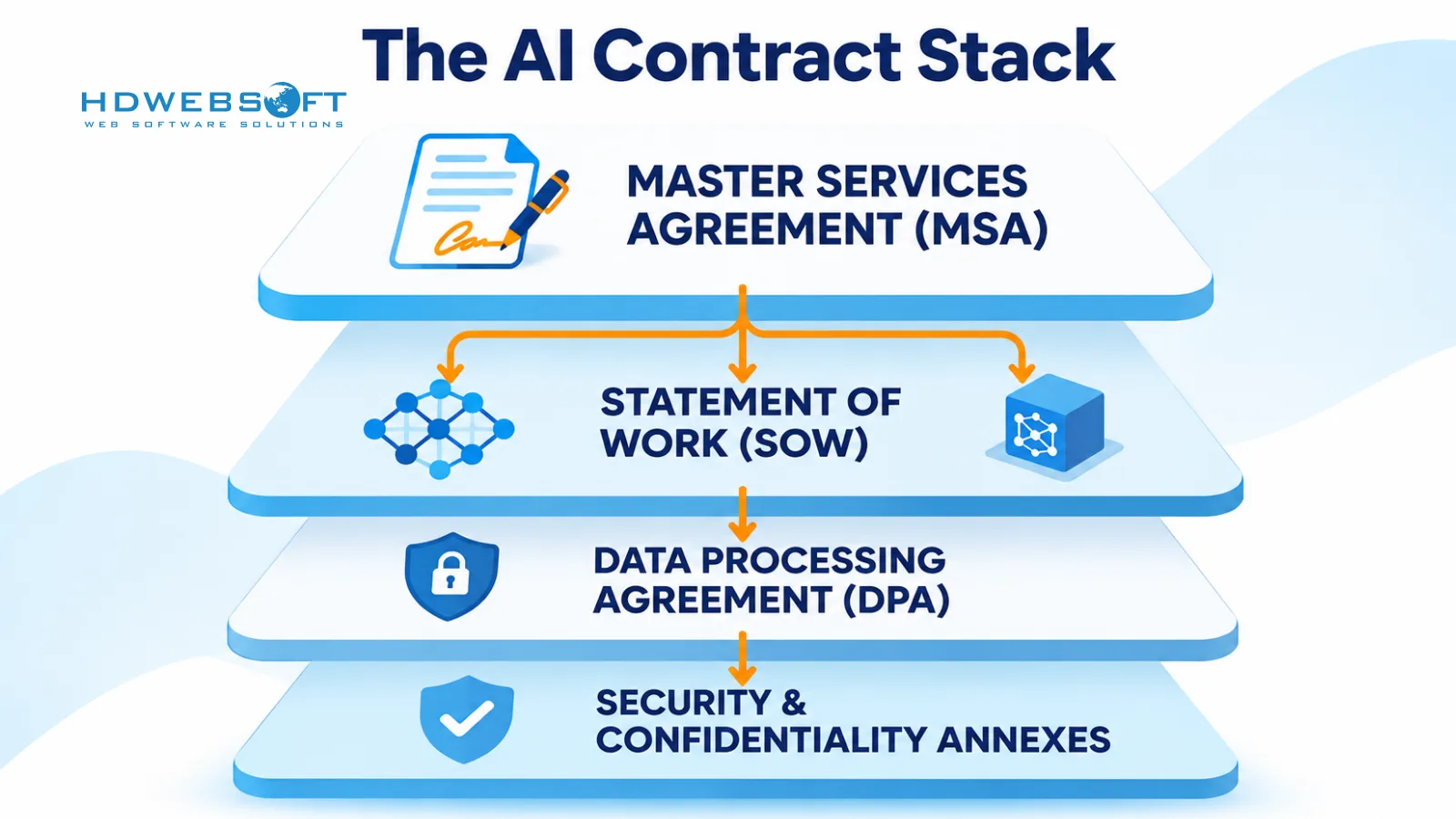
An AI development contract is a commercial agreement defining how an AI system — or the AI components of a larger one — is scoped, built, delivered, and paid for. It is rarely a single document: most engagements stack a master services agreement (MSA) for legal terms, statements of work for project scope, a data processing agreement (DPA) where personal or regulated data is involved, and security or confidentiality annexes.
Three properties separate an AI development agreement from a standard software contract. Deliverables include artifacts conventional contracts never contemplated — trained weights, fine-tuned variants, evaluation datasets, prompt pipelines. Performance is probabilistic — a model that impresses in a demo can still fail your data distribution, so “it works” cannot be an acceptance standard. And the system depends on third-party foundations — foundation models, APIs, pre-trained components — whose licensing and behavior sit partly outside both parties’ control.
One distinction keeps the contract clean: it governs what is delivered and who bears which risk, while the AI software development lifecycle governs how the work executes. Government procurement guidance takes the same view — the Australian Government Solicitor’s overview of AI model contract clauses argues that AI agreements need clauses specifically addressing data, IP, accountability, and regulatory exposure.
Why Offshore AI Development Requires Additional Contractual Safeguards
Every risk in an AI contract exists domestically too. Offshore delivery doesn’t create new risk categories — it amplifies four existing ones:
- Enforceability. A judgment from your home courts may be difficult to execute against a vendor whose assets sit elsewhere — why governing law and dispute resolution carry extra weight offshore.
- Data residency and remote access. Your data crosses borders the moment an offshore engineer opens a dataset — and “viewing” data from abroad counts as a transfer in most regimes. The contract must say where data lives, who can reach it, and through which legal mechanism.
- IP regime differences. A clause that cleanly transfers rights under your law may work differently under the vendor’s — especially the chain moving rights from engineers to vendor to you.
- Subcontractor visibility. Offshore vendors routinely involve sub-processors you will never meet; without a contractual approval right, your supply chain grows invisibly.
None of this makes offshore AI development unsafe — it means the contract is often your only enforceable control once data and code cross borders. These safeguards are standard practice in mature offshore software development services engagements; what AI changes is the asset being protected — models, data, derived IP — and the failure modes that come with it.
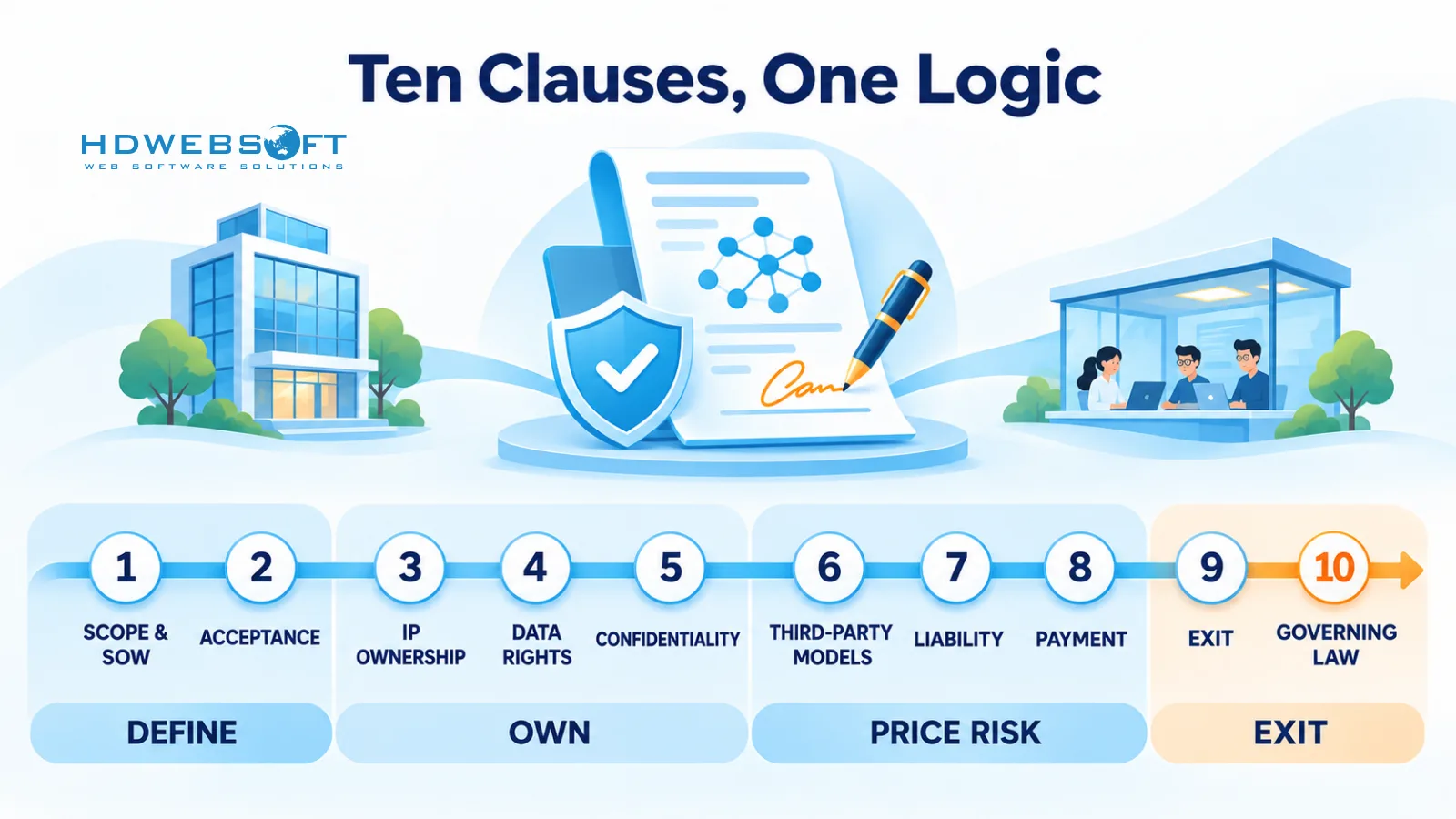
10 Essential Clauses in an Offshore AI Development Contract
The clauses follow the order most contracts use: scope, then acceptance and ownership, then risk allocation, then exit.
1. Scope, Deliverables & the Statement of Work
Every offshore AI development contract lives or dies in its statement of work. The MSA sets the legal context; the SOW defines the transaction — and in AI projects, the deliverable list is where ambiguity hides. A well-drafted AI development statement of work enumerates artifacts, not activities: source code, training and fine-tuning pipelines, model weights and checkpoints, evaluation harnesses and datasets, documentation, and deployment definitions. It also states what is out of scope — production monitoring, retraining, annotation — so both parties price the same engagement. Offshore adds two points: fix the working language of deliverables, and specify the acceptance environment — whose infrastructure, whose data — because “delivered” means different things across borders.
2. Acceptance Criteria & Evaluation Benchmarks
For deterministic software, acceptance can be a feature checklist. AI project acceptance criteria must instead define measurable tests: accuracy or task-success thresholds on an agreed evaluation set, latency under specified load, quality bounds for generative outputs (rubric-scored or sampled human review), and behavior on enumerated edge cases. The clause should fix the eval set itself — who provides it, whether it is frozen, and what happens when the data distribution shifts after acceptance. Negotiation note: cap remediation rounds and define the exit if acceptance is never reached — partial refund, termination right, or time-and-materials conversion. Without it, acceptance failure becomes an infinite obligation for both sides.
3. Intellectual Property Ownership
AI development IP ownership splits into three layers, and the contract should name each. Pre-existing IP — each party’s libraries, tools, and internal models — is retained and licensed only as needed. Foreground IP — the code, trained weights, fine-tunes, prompts, eval sets, and documentation created for you — is typically assigned to the client on payment. Embedded third-party IP — open-source components and foundation models — is governed by its own licenses (clause 6). Offshore adds a wrinkle: the assignment must be effective under the vendor’s local law, and employment terms must move rights from engineers to vendor to you — the IP “chain of title.” Watch license-back clauses too: reuse of “general skills and know-how” is reasonable; rights to your trained model or your data are not.
4. Data Rights & Cross-Border Data Processing
This clause answers four questions: what data the vendor may process, for what purposes, where, and through whom. For personal data, fix controller/processor roles and execute a DPA. It should cover scope, security measures, subprocessor consent, breach notification within a defined window (24–72 hours is a common contractual range), and return-or-deletion at each milestone — not only at termination. Cross-border AI data processing adds the transfer layer. Name the mechanism — standard contractual clauses for GDPR-covered data — disclose the jurisdictions hosting training and inference, and treat remote access explicitly: offshore engineers viewing EU or US data is still a transfer in most regimes. The UK ICO’s guidance on AI contracts and third-party data responsibilities is a practical reference for allocating these responsibilities. One cheap addition: prohibit the vendor from using your data to train models for other customers.
5. Confidentiality, Security & Access Controls
Generic NDA language undersells AI engagements because the secrets are unusual — training data, model weights, eval sets, prompt logic — assets whose leak cannot be “returned.” Enumerate them as confidential materials explicitly. On security, incorporate an annex covering environment isolation (vendor environments cannot reach production data), named-account least-privilege access with MFA, access logging — who touched what, retained how long, reviewable by whom — and breach-notification mechanics matching clause 4. For offshore delivery, add background-screening standards, a named key-personnel list, and restrictions on subcontracting without consent.
6. Third-Party AI Models, Licensing & Performance Commitments
Almost no production AI system is built from scratch — it stands on foundation models, APIs, and pre-trained components whose terms flow into your contract whether or not anyone writes them down. This clause makes the flow explicit. Name the third-party models and providers the solution uses. Decide who holds the provider relationship and API accounts — client-held accounts preserve portability. State how provider terms bind both parties (usage restrictions, data-use policies, output-use limitations), and set out open-source or open-weights license obligations, which range from permissive to non-commercial. Then cover change: providers deprecate versions on their own schedule, so define who tracks the roadmap, who pays for migration, and within what window. Performance commitments belong here too: for proprietary components a vendor can commit only to a band — documented benchmarks plus vendor-run eval results — and the clause should say which standard applies to which component.
7. Liability, Indemnification & Risk Allocation
This is where the parties price the risks the earlier clauses identified. Warranty scope first: standard non-infringement warranties plus an AI-appropriate performance warranty — a bounded commitment that the system meets the clause-2 benchmarks, with a remediation obligation. Probabilistic systems cannot honestly warrant perfect output. For liability, a cap tied to fees paid is standard — negotiate carve-outs for IP infringement, data breach, and misuse of confidential information. Indemnification should cover third-party claims from training-data infringement or license violations in vendor-selected components.
The harder edge is autonomy — Mayer Brown’s analysis of contractual risks in agentic AI implementation details where indemnity structures strain as AI shifts from producing outputs to taking actions. If your system acts on the world — agentic workflows, automated decisions — raise that allocation explicitly in negotiation.
8. Pricing, Payment Milestones & Change Control
Structure payments around acceptance events, not calendar dates: kickoff, milestones tied to clause-2 acceptance, final payment on handover — aligning vendor incentive with demonstrable delivery. Change control matters as much: AI projects discover scope constantly, so require written change requests with cost and schedule impact, signed off before work begins — otherwise scope discovery becomes a billing dispute. Offshore specifics: currency and FX handling, withholding-tax allocation, and the rate card for post-acceptance work.
9. Term, Termination & Exit Assistance
Termination rights matter only if exit is executable. Cover termination for cause (material breach with a cure period) and for convenience (notice plus payment for accepted work); the exit package — all work product to date, including in-progress model weights, training code, eval sets, and documentation in usable form; a paid knowledge-transfer window; and survival of IP assignment, confidentiality, and data-deletion obligations. For high-dependency engagements, consider source-code and model escrow — or require that artifacts live in repositories you control from day one. The cheapest exit insurance is the vendor never holding sole custody of your assets.
10. Governing Law, Dispute Resolution & Regulatory Compliance
Cross-border enforceability is the offshore problem in one line: a judgment from your home courts may be unenforceable where the vendor’s assets sit. Choose governing law deliberately, and prefer arbitration (ICC, SIAC, or similar) where cross-border enforcement matters — arbitral awards travel under the New York Convention far more reliably than court judgments. Then the compliance layer: export-control exposure where applicable; allocation of obligations under emerging AI regulation — the EU AI Act, for instance, divides responsibilities between providers and deployers, so the contract should say which party is which; and a change-in-law clause for absorbing new requirements into scope.
Sample Offshore AI Contract Responsibility Matrix
The clauses define what the contract says; the matrix defines who does what. Cross-check your draft SOW — a row where both columns are blank is a gap, not a shared responsibility.
| Contract Area | Client Responsibility | Vendor Responsibility |
|---|---|---|
| Training & test data | Provide data and usage rights | Process per DPA; no secondary use |
| Evaluation set | Approve eval set; supply edge cases | Build harness; report results |
| Third-party model accounts | Hold provider accounts and API keys | Implement within provider terms |
| Security & access | Grant scoped access; review logs | Maintain isolation, logging, screening |
| IP assignment | Pay milestones (the assignment trigger) | Secure chain of title; execute assignment |
| Subprocessor changes | Approve or reject within window | Disclose subs; flow down terms |
| Incident notification | Provide response contacts | Notify within SLA |
| Model deprecation | Approve migration windows | Track roadmap; propose migration |
| Exit handover | Provide successor environment | Deliver artifacts plus knowledge transfer |
Common Contract Negotiation Red Flags
These are contractual signals, not vendor-evaluation judgments — each is language that shifts risk onto you through ambiguity rather than agreement.
- “IP transfers upon full payment” with no definition of IP. Does it cover weights, eval sets, documentation, prompts? If the engagement ends at 80% paid, does anything transfer at all?
- Deemed acceptance. “Deemed accepted if not rejected within N days” punishes the party least equipped to test quickly — dangerous when acceptance requires evaluation runs.
- “Commercially reasonable efforts” instead of measurable commitments. The vendor promises effort, never outcome — and effort is nearly impossible to dispute later.
- Liability caps below your data-exposure value. A cap of one month’s fees means little against a breach of your entire training corpus.
- No approval right over subprocessors. The entity handling your data may end up being one you’ve never assessed.
- Termination rights without handover obligations. You can leave the contract but can’t take your models, data, or documentation — a right that exists only on paper.
- Silent auto-renewal with escalators. The SOW renews and rates step up without any approval event, discovered at invoice time.

Offshore AI Development Contract Checklist Before Signing
Walk the draft against this checklist before signature. Every row should produce a document or clause reference — anything verified only by conversation is not yet in the contract.
| Contract Element | What to Verify | Evidence Required |
|---|---|---|
| SOW & deliverables | Model artifacts and out-of-scope items enumerated | Signed SOW annex |
| Acceptance criteria | Measurable thresholds, protocol, fixed eval set | Benchmark document |
| IP ownership | Foreground IP covers weights, fine-tunes, prompts | Assignment clause valid under vendor’s law |
| Data processing | Roles, transfer mechanism, breach SLA | Executed DPA plus subprocessor list |
| Third-party models | Provider terms flow down; update ownership | License or model annex |
| Security controls | Isolation, access logging, notice window | Security annex |
| Warranties & liability | Bounded warranty; breach/IP carve-outs | Liability clause |
| Payment milestones | Tied to acceptance events | Milestone schedule |
| Termination & exit | Exit package, knowledge transfer, survival | Exit-assistance clause |
| Governing law | Enforceable venue; arbitration | Dispute-resolution clause |
Conclusion
An offshore AI development contract is risk control written down before the risk exists. The ten clauses follow one logic: define the deliverables precisely, make acceptance measurable, keep IP and data ownership explicit, price the remaining risk honestly, and leave yourself an executable exit. Anything you can’t point to in the signed documents is an assumption, not an agreement.
That same discipline — defined acceptance, explicit ownership, controlled data handling — is how mature delivery teams structure the engagement itself. HDWEBSOFT’s AI development services are built around exactly these controls, from SOW-level deliverable definition to milestone-based acceptance. If you’re preparing an offshore AI engagement and want to discuss how a project like this gets scoped and delivered, Contact our team — we’re glad to walk through how we structure it.
FAQ
What should an AI development contract include?
At minimum: an MSA carrying the legal framework; an SOW defining deliverables — model artifacts, not just code; measurable acceptance criteria; IP ownership covering trained weights and fine-tunes; a DPA for cross-border data; security terms; third-party model licensing; liability and indemnification; milestone-based payments; and termination with executable exit assistance.
Who owns the AI model in an outsourced development project?
Whoever the contract says — there is no reliable default. The contract should separate pre-existing IP (retained by each party), foreground IP (code, trained weights, fine-tunes, and eval sets created for you — typically assigned to the client on payment), and third-party IP (foundation models and open-source components governed by their own licenses). Verify the assignment also works under the vendor’s local law.
What is an AI development statement of work?
The SOW is the project-level document under the master agreement defining the transaction: enumerated deliverables — source code, training pipelines, model weights, evaluation harnesses, documentation — plus acceptance benchmarks, timelines, pricing, and out-of-scope items. The most common drafting failure is listing activities (“model development”) instead of artifacts (“trained weights meeting the defined benchmark”).
How should cross-border data processing be handled in an offshore AI contract?
Through a data processing agreement that fixes controller/processor roles, defines permitted purposes, names the legal transfer mechanism — such as standard contractual clauses for GDPR-covered data — discloses hosting jurisdictions, requires subprocessor consent, sets a breach-notification window, and prohibits secondary use of your data.
What are the biggest contractual red flags when outsourcing AI development offshore?
Undefined IP transfer language, deemed-acceptance clauses that expire before you can realistically test, “commercially reasonable efforts” substituting for measurable warranties, liability caps below your data-exposure value, no subprocessor approval right, termination without executable handover, and silent auto-renewals with escalators. The fix is always the same: name the thing, set the number, and require the evidence.