
Computer science and software engineering get used interchangeably in everyday conversation — job postings, university catalogs, and even tech professionals mix them up. They’re related but not the same: computer science is the study of computation itself, while software engineering is the discipline of building software that works in the real world. The computer science vs software engineering confusion leads to real costs — students choosing the wrong degree, companies writing the wrong job descriptions, and teams expecting one skill set when they need the other.
This is a practical breakdown of what each field actually is, where they differ, and how to decide which one fits your goals.
Key Takeaways
- Computer science is the theory of computation — algorithms, data structures, and the mathematical foundations of what computers can do.
- Software engineering is the practice of building software — applying engineering principles to design, build, test, and maintain systems that real users depend on.
- The careers overlap but diverge — CS opens research, data science, and systems roles; SE leads to product teams, and both can become software engineers.
- Degrees aren’t the only route — bootcamps and self-study are established paths into software engineering; CS theory matters more for specialized roles.
- AI is shifting both fields — routine code generation is increasingly automated, raising the value of system design, judgment, and domain knowledge.
What is computer science?
Computer science is the study of computation: what problems can be solved with computers, how efficiently, and why. It’s a scientific and mathematical discipline concerned with algorithms, data structures, computability, and the design of systems from processors to networks. The field spans deep sub-specialties — artificial intelligence and machine learning, computer vision, robotics, distributed systems, cryptography, human-computer interaction, and theoretical computer science.
Computer scientists typically work in three broad modes:
- Designing and building software — taking on hard programming problems and architecting systems where correctness and efficiency are the core challenges
- Advancing what computers can do — pushing research frontiers in AI, graphics, networking, and human-computer interaction into practical reality
- Solving computational problems efficiently — finding the best ways to store, move, and process information, guided by theoretical analysis of what’s possible
The defining trait: computer science asks what is computable and how efficiently — it’s comfortable staying abstract, and its results often arrive years before products do.
What is software engineering?
Software engineering is the application of engineering principles to the design, development, testing, and maintenance of software systems. It emerged to solve a real problem: as software grew more complex, projects routinely ran over budget, past deadlines, and below quality expectations. Software engineering exists to make building software predictable — consistently correct, on time, and maintainable over years.
The discipline operates on several levels:
- Operational — how the software behaves in production: functionality, usability, reliability, security, and cost
- Transitional — how the software moves: portability across environments, scalability as load grows, and flexibility as requirements change
- Maintenance — how the software evolves: fixing defects, adapting to new platforms, and extending features without breaking what works
The defining trait: software engineering asks how do we build this reliably, repeatedly, and sustainably — it’s judged by working systems, not by proofs.
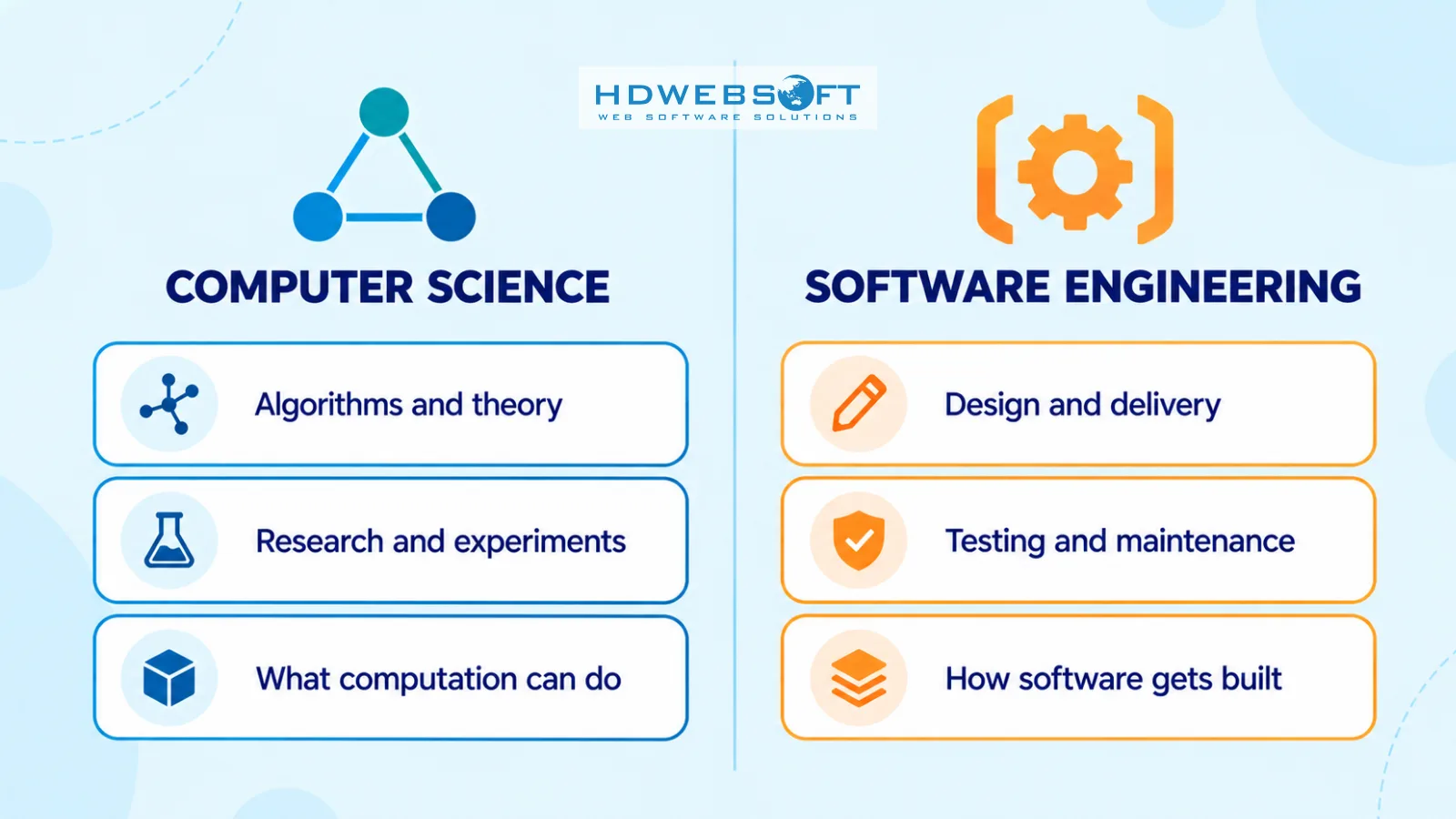
Computer science vs software engineering: the key differences
| Computer Science | Software Engineering | |
|---|---|---|
| Core question | What can be computed, and how efficiently? | How do we build reliable software at scale? |
| Nature | Scientific and mathematical discipline | Engineering discipline |
| Focus | Algorithms, theory, systems fundamentals | Design, delivery, testing, maintenance |
| Typical output | Research, algorithms, prototypes | Working products and systems |
| Education | CS degree; theory-heavy | CS or SE degree, bootcamps, self-study |
| Career paths | Research, data science, ML, systems | Product teams, QA, DevOps, architecture |
| Success measure | Novelty, correctness, efficiency | Reliability, delivery, user impact |
Focus — theory versus practice
Computer science is comfortable in the abstract: proving that an algorithm is optimal, exploring what’s computable, or inventing a new approach to a problem that has no product yet. Software engineering is grounded in shipping: taking known techniques and combining them into systems that work under real constraints — deadlines, legacy code, changing requirements, and imperfect information. CS tolerates open problems; SE has to close them.
Education — depth versus application
A computer science degree goes deep on fundamentals — discrete math, algorithms, operating systems, computation theory — because those fundamentals support every specialized branch. Software engineering education, whether a dedicated degree, a bootcamp, or self-study, trades some of that depth for immediate application: version control, testing, code review, frameworks, and the practices of working in a team — our software development models overview shows how those practices fit into real delivery processes. Neither is “harder” — they optimize for different destinations.
Day-to-day work
A computer scientist’s week might involve reading papers, running experiments, benchmarking algorithms, or prototyping a novel approach. A software engineer’s week centers on designing features, writing and reviewing code, debugging production issues, and coordinating with product and QA. The engineer ships weekly; the scientist may work on a problem for a year before it’s ready.
Career paths
Computer science opens the broadest doorset: research scientist, machine learning engineer, data scientist, systems engineer, and — the most common destination — software engineer. Software engineering careers progress from developer to senior engineer, tech lead, architect, or engineering manager. In practice, the majority of people with CS degrees work as software engineers; the reverse path (SE education into research) is rarer.
Outlook
The demand side is strong for both. Government labor statistics project software developer roles to grow much faster than the average occupation through the decade, with hundreds of thousands of openings each year — see the BLS software developer outlook for current figures. Specialized CS roles (AI/ML in particular) command premiums, while software engineering roles offer the largest volume of openings.

Where the two overlap
The boundary is real but porous — and in day-to-day work, the two fields borrow from each other constantly.
Software engineering leans on computer science every time an engineer makes a design decision with theoretical weight: choosing a hash map over a list because lookup cost matters, reasoning about whether a query scales, or picking a consensus approach for a distributed system. These are CS judgments made inside engineering work, and engineers who lack the theory tend to make them by habit or superstition instead. The same goes for debugging: a performance problem in production is often an algorithms problem in disguise, and complexity analysis is the tool that finds it.
Computer science, meanwhile, has become far more applied than its reputation suggests. Machine learning research ships in products within months; systems research becomes cloud infrastructure; cryptography research becomes the TLS that every website uses. The “results arrive years later” stereotype has inverted in the AI era — CS findings reach production faster than most engineering practices do.
In most companies, the two titles sit in the same org chart, use the same tools, attend the same standups, and move between the same roles over a career. A software engineer who goes deep on ML becomes a computer scientist in practice; a computer scientist who ships products weekly becomes an engineer. The distinction matters most at the edges: deep research positions want CS theory; large-scale delivery organizations want engineering discipline; and the middle — where most jobs live — wants both at a working level.
Which path should you choose?
Degree, bootcamp, or self-taught?
The honest answer: all three routes produce working software engineers, and employers increasingly hire on demonstrated ability.
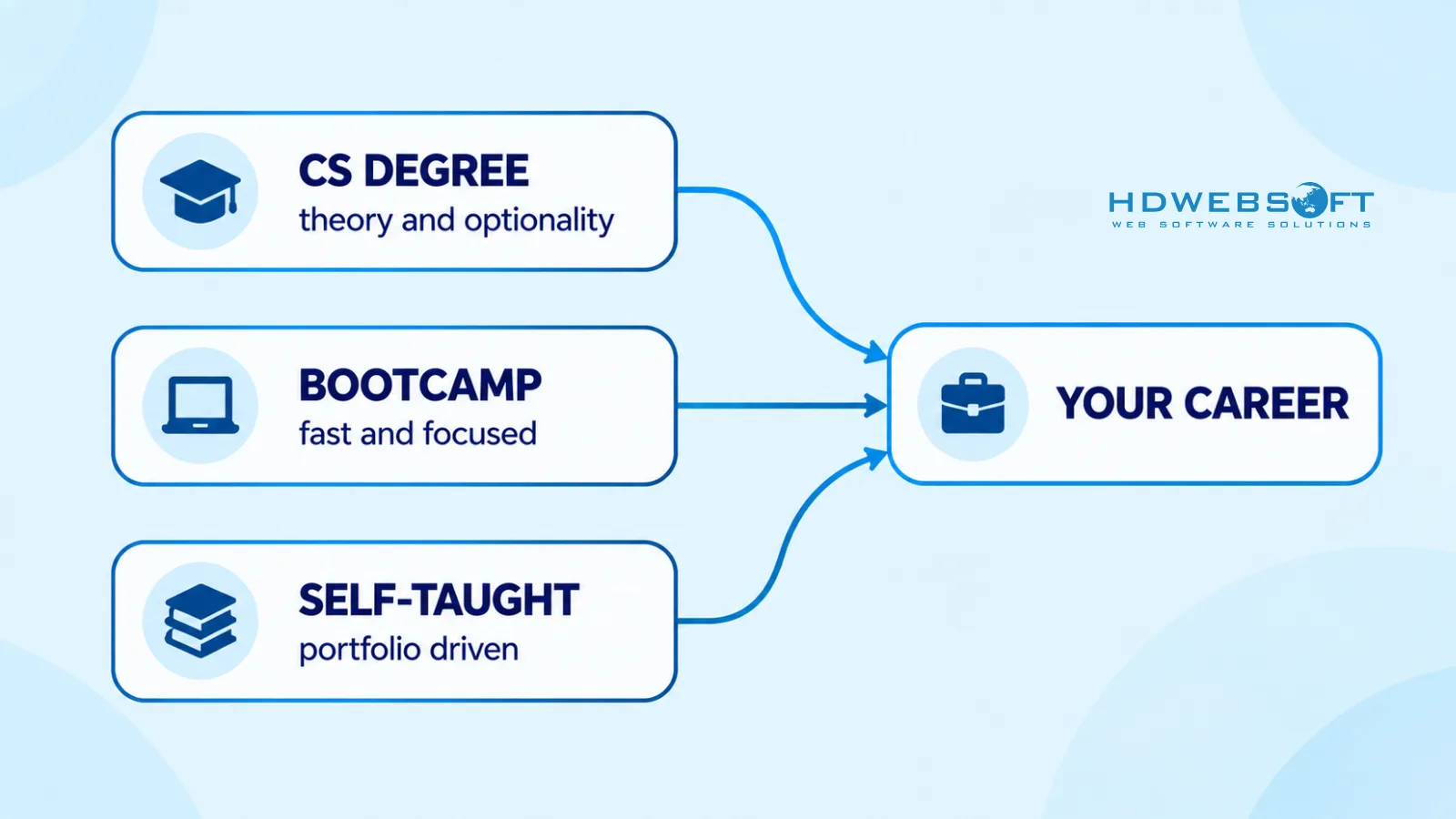
- CS degree — the broadest foundation and still the most respected credential. It’s the right choice if you want optionality (research, ML, systems), can invest four years, or target employers that filter by degree.
- Bootcamp — a fast, focused route into product engineering. It works best for career switchers who already have a degree in something else and can demonstrate skill through projects. It trades theoretical depth for speed.
- Self-taught — fully viable and increasingly common. The cost is structure: you have to assemble your own curriculum and prove yourself through a portfolio. What matters in hiring is the same regardless of route — working code, fundamentals, and collaboration.
Working in the AI era
AI coding tools have changed the calculus for both fields. Routine code generation is increasingly automated, which compresses the value of “writing code” as a skill and raises the value of what surrounds it: specifying systems precisely, reviewing AI-generated code, understanding architecture, and owning quality. For computer scientists, AI is both tool and subject — ML expertise is more valuable than ever. For software engineers, the craft is shifting from typing code to directing it. Our AI-augmented software development guide covers what that shift looks like in practice.
The practical consequence for choosing: don’t pick a path based on “which jobs will AI keep.” Pick based on which kind of thinking you enjoy — abstract problem discovery (CS) or building systems that work (SE) — because AI amplifies both.
What this means for hiring
For businesses, the CS/SE distinction is a staffing tool, not a pedigree contest. Product engineering teams need software engineering skills — delivery discipline, testing, collaboration — more than they need research backgrounds. Specialized problems (ML features, performance-critical systems, novel algorithms) need computer science depth. Most job descriptions should ask for engineering practice first and CS theory second; requiring a CS degree for routine product work filters out strong candidates without adding signal.
Team composition matters more than individual pedigree. A balanced team mixes engineers who ship with specialists who go deep — and for many companies, a dedicated development team model provides that mix without building it all in-house.

Frequently Asked Questions
Is computer science the same as software engineering?
No. Computer science is the study of computation — algorithms, data structures, and the theoretical foundations of computing. Software engineering is the application of engineering principles to building and maintaining software systems. Computer science asks what computation can do; software engineering asks how to build software reliably.
Which is better for getting a job: computer science or software engineering?
Both lead to strong employment. A computer science degree offers broader options — research, data science, systems, and software roles — while software engineering education is more directly targeted at building products. For most software jobs, employers hire based on demonstrated skills, and either background qualifies.
Can I become a software engineer without a computer science degree?
Yes. Bootcamps, self-study, and portfolio work are established routes into software engineering. What matters in hiring is demonstrated ability — working code, understanding of fundamentals, and collaboration skills. A CS degree helps but is not the only path.
Do software engineers need to know computer science theory?
Yes, at a working level. Data structures, algorithms, and complexity analysis are daily tools for making sound design decisions. Engineers don’t need to prove theorems, but they do need to understand why one approach scales and another doesn’t.
Is software engineering still a good career with AI coding tools?
Yes — the work is shifting rather than shrinking. AI tools automate routine code generation, which raises the value of engineers who can specify systems, review AI output, and own architecture and quality. The profession is moving toward design, judgment, and integration work.
What is the job outlook for software developers?
Strong. Government labor statistics project software developer roles to grow much faster than the average occupation through the decade, with hundreds of thousands of openings each year driven by digital transformation across industries.
Conclusion
Computer science and software engineering are two different disciplines joined at the root: one studies what computation can do, the other builds the software the world runs on. The distinction matters when you’re choosing a degree, writing a job description, or staffing a team — pick the theory-heavy path for research and specialized problems, the practice-heavy path for building products, and remember that in the AI era, both careers reward the same underlying skill: thinking clearly about systems.
If you’re building a software product and need engineering talent, our custom software development services team can help you scope, staff, and ship.