
Hiring an offshore software development team fails most often before the first line of code is written — not because the team is bad, but because the hiring process skipped steps. A checklist fixes that. This checklist to hire an offshore software development team breaks the process into four stages — define the engagement, evaluate candidates, lock the terms, set up the operating model — and every item produces a concrete output you can review before moving to the next stage.
The checklist below consolidates what we have learned across hundreds of offshore engagements. Work through it in order: each stage produces an artifact that the next stage depends on.
Stage 1 — Define the Engagement Before You Contact Anyone
Most hiring mistakes are made before the first vendor conversation. Six items to complete internally.

- Confirm why you are offshoring. Cost savings, talent access, faster time-to-market, or reduced management overhead — name the primary reason, because it shapes the engagement model you choose. Also check the practical filters: exchange rate, language, working-hour overlap, and team reliability. Not sure whether you are outsourcing, offshoring, or both? See our outsourcing vs offshoring guide.
- Identify the type of development you need. A mobile app, a custom enterprise system, and a legacy migration require different skills and different engagement models. All software development is not equivalent.
- Define the project goals. Tie the goals to outcomes — traffic, usability, revenue — not just deliverables. The goals shape the development method and the seniority you need.
- Define the scope of work. Distance amplifies ambiguity. Write down what is in scope, what is out, and what “done” means for each deliverable.
- Set a realistic budget range. A budget range eliminates mismatched candidates before the first call and speeds up every later decision. Include tooling, licenses, and management overhead in the range — not just the hourly rate.
- Identify the required skills upfront. List the must-have technical skills and the working traits you prioritize — responsiveness and clear written communication matter more offshore than in-house. For current technology and language demand, the Stack Overflow Developer Survey 2025 is a useful reference when defining the matrix.
Output of this stage: the first section of your checklist to hire an offshore software development team — a one-page engagement brief covering reason, type, goals, scope, budget range, and skills. Every candidate evaluation from here on checks against this document.
Match the Engagement Model to the Work
The brief determines which engagement model fits — and the model changes what you should verify during hiring. The three most common models:
| Model | Best for | What to verify during hiring |
|---|---|---|
| Staff augmentation | Adding capacity to an existing team under your management | Individual engineer skills, ramp-up time, how the vendor handles rotation |
| Dedicated team | Long-term product work that needs continuity and domain knowledge | Team composition, PM quality, knowledge documentation, scaling process |
| Project-based | Well-defined outcomes with clear acceptance criteria | Estimation accuracy, acceptance-criteria discipline, change-request handling |
Choosing the model before shortlisting prevents re-evaluating every candidate against the wrong criteria. For how the models compare in 2026 — including where AI-augmented teams fit — see our offshore outsourcing trends for 2026.
Stage 2 — Build and Evaluate Your Shortlist
With the brief in hand, evaluate candidates against evidence instead of marketing.
- Research beyond Google. Review portfolios, Clutch or similar directories, and the vendor’s own engineering content. Shortlist three to five candidates.
- Interview the actual engineers. The people who will write your code should answer your technical questions — not the account manager.
- Check technology stack expertise. Confirm the team has shipped with your specific stack, not just adjacent technologies.
- Check sector experience. A team that knows your business domain shortens onboarding and reduces context transfer. Ask for success stories in your sector and cross-check them.
- Run a trial period. A small paid pilot shows you how the candidate copes with real issues before you commit to larger tasks.
For the full evaluation framework — code audits, reference calls, and certifications — see our guide on how to trust an offshore service provider.
Lock the Engagement Terms Before Kickoff
The terms below prevent the disputes that kill offshore engagements later. Each one has a contract-level counterpart — this checklist makes sure none is missed.
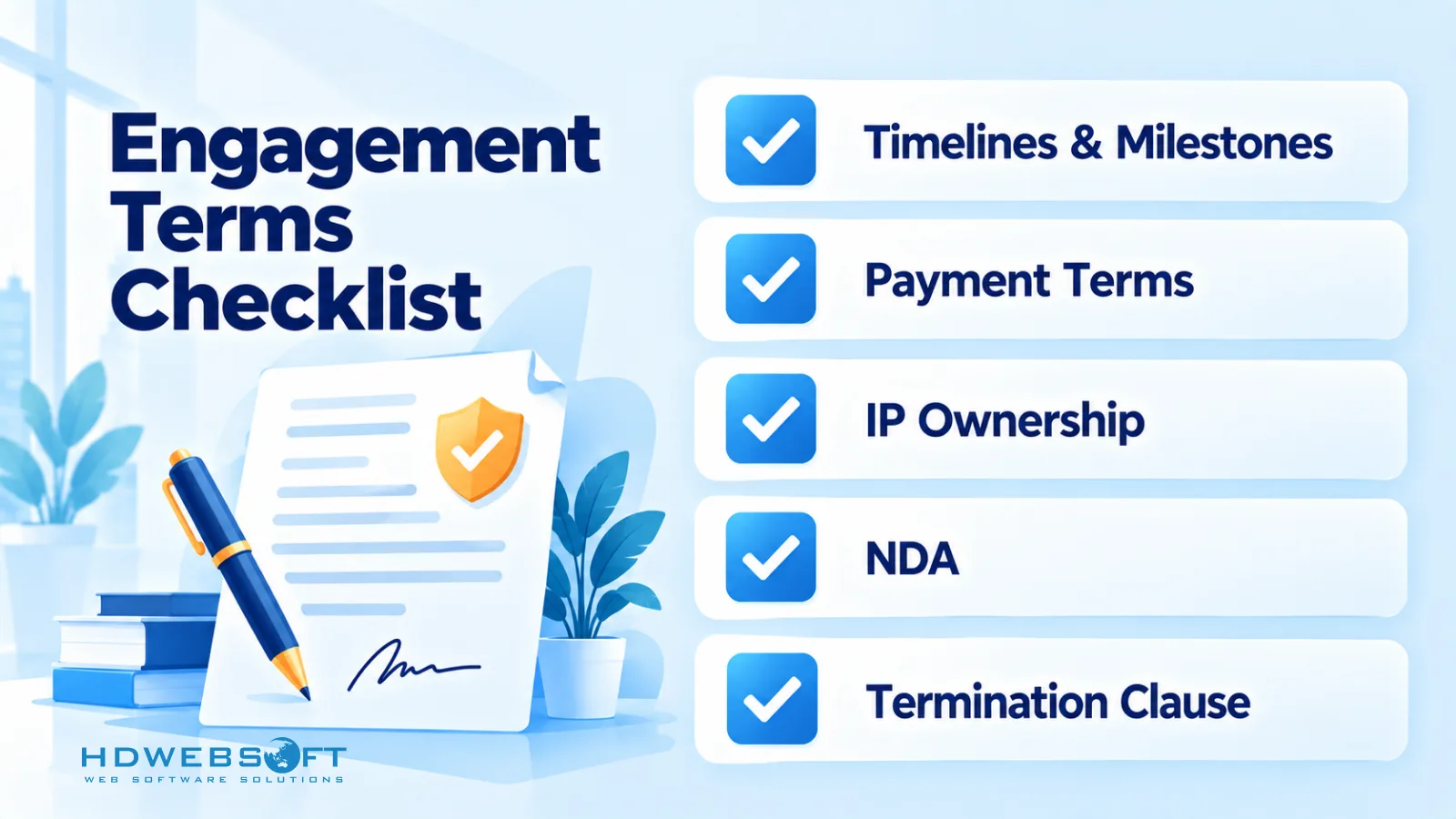
- Agree on timelines and milestones. Set deliverables with dates so progress is trackable and each stage is transparent.
- Understand payment requirements and methods. Clarify advance payments, invoicing cadence, and accepted methods before work starts.
- Be explicit about intellectual property rights. Define who owns the code, the designs, and the documentation — including any separate arrangements for reuse or resale.
- Sign a confidentiality agreement (NDA). An NDA protects both sides’ confidential information before any detailed scope is shared.
- Confirm a termination clause. Nobody plans for it, but a termination clause with defined conditions is never wasted — it protects both parties if terms are breached.
- Put every agreement in writing. Verbal and non-verbal agreements alike should be summarized in writing so no detail is lost between teams.
For how these terms translate into contract clauses — service levels, IP transfer, exit rights — see an ultimate guide to software outsourcing contract.
Set Up the Operating Model
The operating model is how the two organizations work together day to day. Define it before the first sprint, not after the first problem.

- Create a communication plan. Define the channels (email, messaging, video calls), the meeting frequency (daily reports, weekly reports, stage reviews), and the overlapping working hours between your time zone and the team’s.
- Require weekly written reports. A weekly report shows what was done, keeps the project supervised, and surfaces risks while they are small.
- Set the supervision level for day-to-day work. If the project type is new to you, supervise frequently at the start and back off as trust builds. The frequency should decrease as predictability increases.
- Define roles and responsibilities for everyone involved. Who writes the weekly report? Who presents at stage reviews? Clear roles reduce duplicated work and speed up the process.
- Confirm the technology stack and tooling access. Required equipment, protocols, and technical expertise should be agreed at the start — including direct access to the repository and project board.
For a working example of managing collaboration across time zones, see how HDWEBSOFT makes clients comfortable with time zone differences.
Red Flags During the Hiring Process
The hiring stage is where a checklist to hire an offshore software development team proves its value: the signals below predict how a candidate will behave after signing. The buyer-side concerns these flags map to — quality, IP, cost creep, visibility — are itemized with their contract mitigations in common IT outsourcing concerns.

| Red flag | What it predicts |
|---|---|
| The vendor agrees to every requirement without questions | Scope misunderstandings and missed context after kickoff |
| No code samples or portfolio items from similar projects | Thin or irrelevant delivery experience |
| The sales team answers technical questions instead of engineers | The people you met are not the people who will build |
| No verifiable references for similar-scale work | Overstated track record |
| Reluctance to sign an NDA or define IP ownership | Future disputes over code and data ownership |
| No trial or pilot option offered | Confidence based on sales process, not delivery evidence |
Most of these signals are visible in the first two conversations — if you know what to look for. For the quality-verification framework that goes deeper than hiring, see how to evaluate offshore software development quality.
The First 30 Days After Signing
The checklist to hire an offshore software development team does not end at the contract. The first month sets the trajectory, and the signals to watch are the same ones that define success in the foundation phase: the team asks clarifying questions before starting work, tooling and access are set up before the first sprint, and rework stays within the baseline agreed during hiring.
A simple 30-day structure to hold the team to: week 1 — access, tooling, and context transfer complete, and the team can explain the project back in their own words; week 2 — first real tasks in the backlog, with clarifying questions asked before work starts; weeks 3–4 — the first deliverable passes review with rework inside the agreed baseline, and the first weekly reports arrive without chasing. If any of these slips, raise it in the first monthly review rather than waiting for the quarter to end.
Once the foundation phase is running, the engagement moves into a lifecycle — first delivery, scale, strategic partnership, and eventually evolution or exit. Each phase has its own success criteria, mapped in successful outsourcing: a lifecycle framework for measurable results.
FAQ
What should I prepare before contacting an offshore software development company?
Prepare a one-page engagement brief: the reason for offshoring, the development type, project goals, scope boundaries, a realistic budget range, and the skills matrix for the team. It is the foundation of any checklist to hire an offshore software development team, and it shortens vendor selection before the first call.
How do I evaluate an offshore development team’s skills during hiring?
Combine three checks: a code review of samples from similar projects, an interview with the engineers who will actually work on your project, and a paid pilot sprint with real backlog items. Certifications and client references add context, but artifacts carry more weight than claims.
How long should a trial period with an offshore partner be?
Two to four weeks is enough for a paid pilot sprint on real backlog items. The goal is to observe delivery rhythm, code quality, and communication under real conditions — not to get free work.
What should an offshore communication plan include?
Three elements: the channels (email, messaging, video calls), the reporting frequency (daily updates, weekly reports, stage reviews), and the overlapping working hours between your time zone and the team’s. Write it down — the clearer the plan, the smoother the project.
Which contract terms should be locked before an offshore team starts?
Timelines with milestones, payment terms and schedule, intellectual property ownership, a signed NDA, and a termination clause with defined conditions. Every agreement made verbally should also be captured in writing.
What is the most common mistake when hiring an offshore development team?
Skipping the definition stage — starting vendor conversations before the goals, scope, and budget are written down. The second most common is skipping the paid pilot sprint and committing based on sales presentations instead of observed delivery.
How long does it take to hire an offshore software development team?
With the checklist worked in order, expect six to ten weeks from engagement brief to a fully onboarded team: one to two weeks to define the engagement, two to three weeks to build and evaluate the shortlist, two to four weeks for the pilot sprint, and one to two weeks to lock terms and set up the operating model. Rushing the pilot is the step most often skipped — and the most expensive to skip.
How do I evaluate communication skills before hiring?
Communication shows up in artifacts, not interviews alone. Check how the vendor writes proposals and status reports before you sign — clarity in writing predicts clarity during delivery. During the pilot, watch whether questions are asked before work starts, whether updates arrive without chasing, and whether bad news travels as fast as good news.
Conclusion

Hiring an offshore software development team is a sequence of decisions, not a single choice. Work through this checklist to hire an offshore software development team in four stages — define the engagement, evaluate candidates with evidence, lock the terms, and set up the operating model — and each stage produces an artifact that de-risks the next. The teams that skip stages pay for it after kickoff, when every fix costs more.
At HDWEBSOFT, we built our offshore delivery model around this checklist — clear scope before kickoff, engineers you interview directly, and reporting you can audit from day one. Explore our offshore software development services or contact us to run your first checklist review with us.