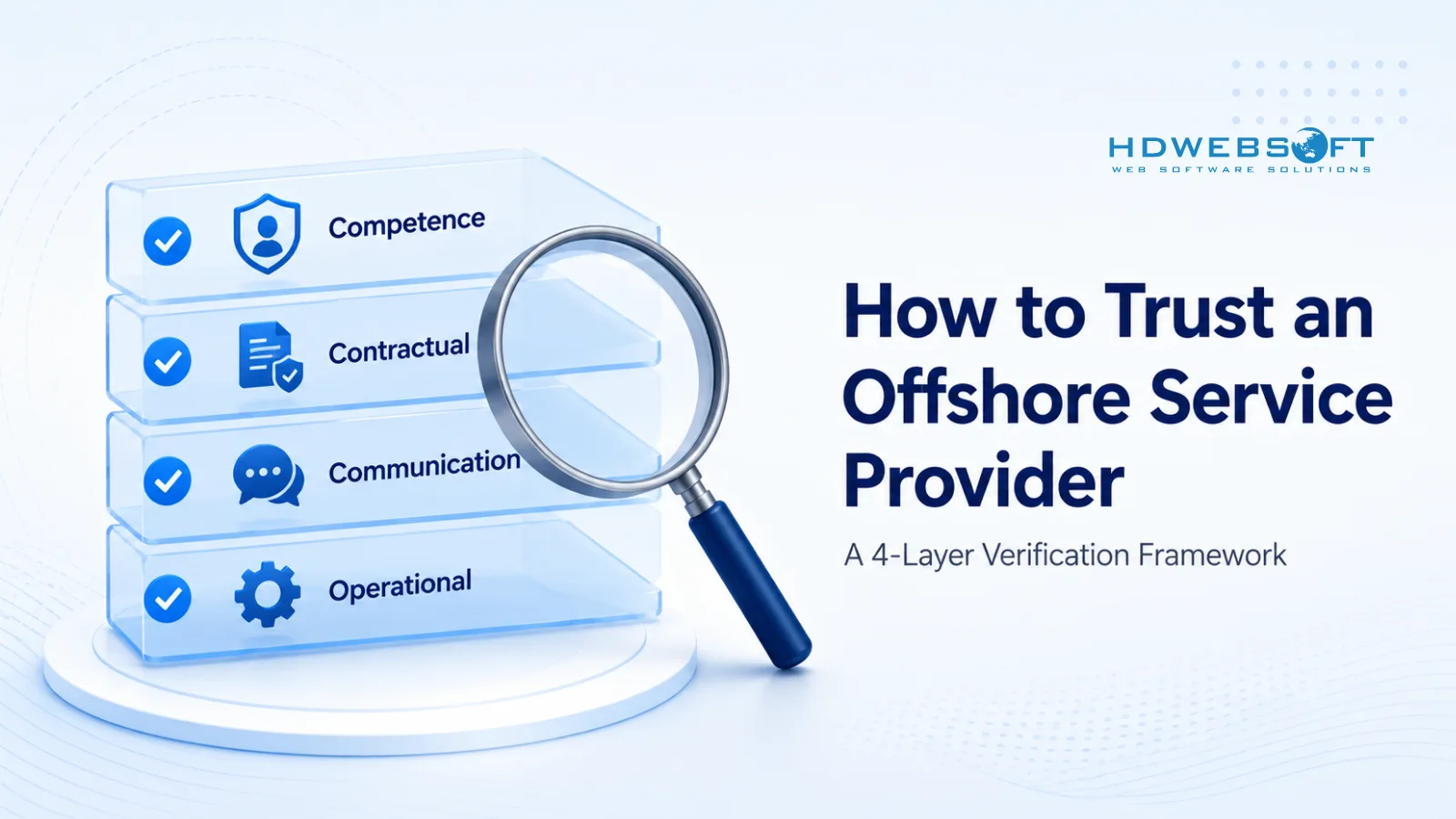
Most buyers start vetting an offshore service provider by comparing cost and talent. Those two filters are necessary, but they are table stakes — almost every credible vendor passes them. The real bottleneck appears later, when you have to decide whether to depend on this partner for months or years. That decision is about trust, and trust that rests on a gut feeling is the most expensive kind. This article gives you a four-layer verification framework that turns trust into something you can check with evidence, not intuition.
Why Trust Becomes the Bottleneck After Cost and Talent Are Qualified
Cost and talent get a vendor through the door. Trust decides whether the engagement survives the second quarter.
Once a provider clears the basic filters — reasonable rates, a CV that looks plausible, a portfolio that mentions your industry — the questions that actually determine success change. Can they deliver what they promised? Will they tell you when something goes wrong? Will the team you vetted still be the team you work with in six months? Can you leave without losing your codebase, your data, and your timeline?
These are trust questions, and they cannot be answered by a sales deck. They can only be answered by evidence the vendor cannot easily fake. The mistake many buyers make is treating trust as a feeling they develop during calls, instead of as a set of risks they verify independently. A verification framework does not eliminate risk, but it makes risk visible — and visible risk is manageable risk.
The hidden cost of misplaced trust
When trust is given too early and to the wrong provider, the damage compounds. Projects slip because issues were hidden until they became crises. Intellectual property leaks because no one checked who actually owned the work product. Vendor lock-in quietly builds because the client never received repository access, documentation, or credentials. When the relationship finally breaks, the buyer does not just lose money — they lose months of context that has to be rebuilt with the next partner.
The cost of misplaced trust is almost always higher than the cost of slow trust. A verification framework exists to slow you down in the right places.

The Trust Stack: Four Layers You Must Verify Independently
The Trust Stack is a four-layer model. Each layer targets a different category of risk, and each layer follows the same structure: Risk → Provider Claim → Evidence to Request → Verification Test → Pass/Fail Signal. The goal is not to verify everything — that is impossible — but to verify enough in each layer to make a defensible decision.
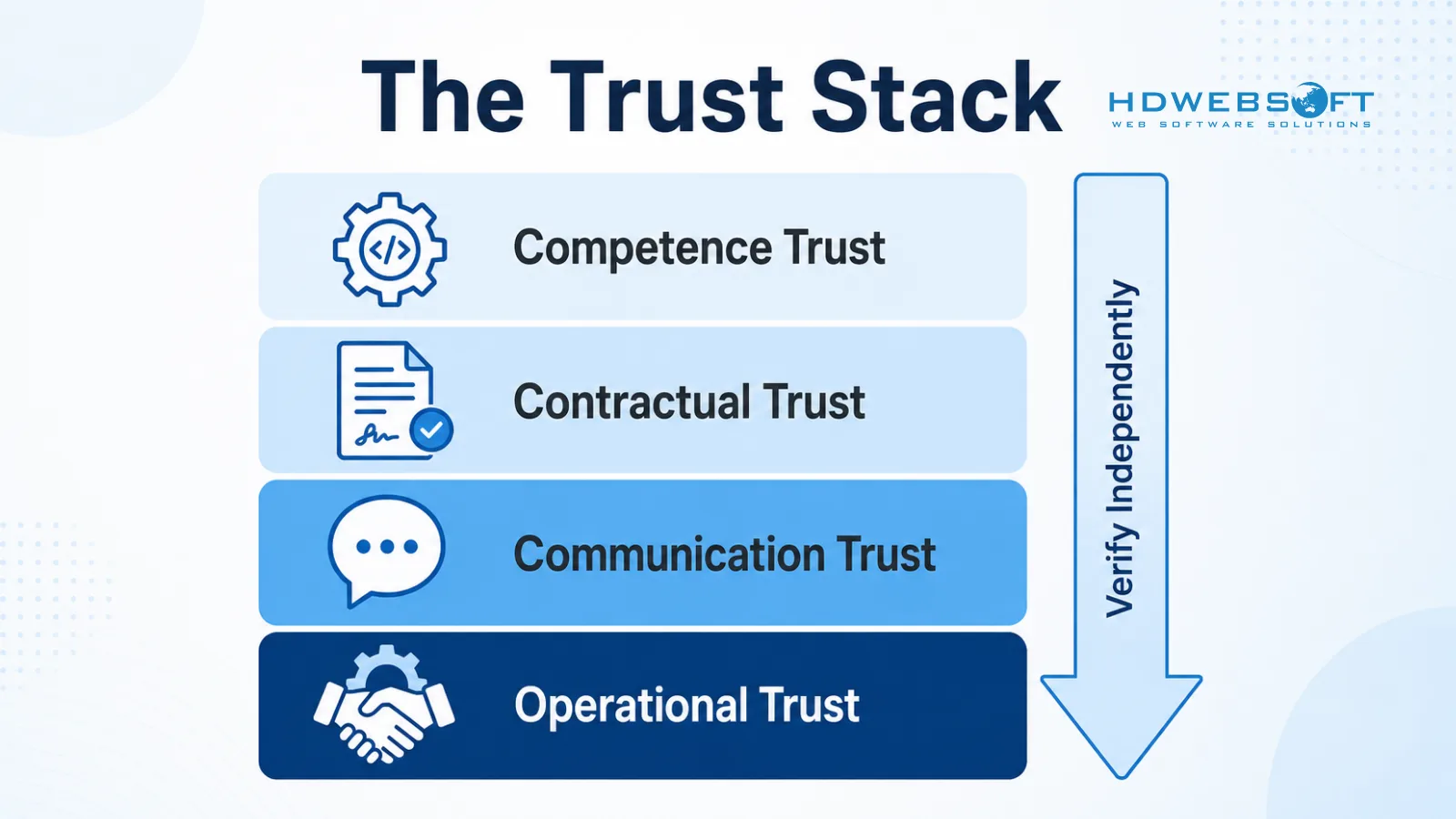
Layer 1 — Competence trust: can the assigned team actually do the work?
- Risk: The vendor markets a large engineering bench, but the team assigned to your project is different from the team you met during sales.
- Provider Claim: “We have experienced engineers” and “We have worked on similar projects.”
- Evidence to Request: The actual proposed team roster with names, roles, and seniority mix; the staffing and replacement process; references from clients with a similar tech stack.
- Verification Test: Run client-led technical interviews with the assigned engineers, not the sales architect. Ask for an architecture walkthrough of a system they already maintain. Review code or artifacts when feasible. Run a paid pilot on a real, scoped deliverable.
- Pass/Fail Signal: Engineers answer technical questions directly without routing through the PM. The architecture walkthrough has depth and trade-off discussion. Refusing to let you interview the assigned engineers is a clear fail.
A generic portfolio or a “we have 250+ engineers” claim does not verify competence. What verifies competence is whether the specific people who will work on your project can reason about the specific problems your project will face. For a deeper set of quality evaluation criteria beyond the interview and pilot, see our guide on how to evaluate offshore software development quality. A rescue scenario is one of the strongest competence tests: a vendor that can take over a troubled codebase, understand someone else’s architecture, and modernize it without disruption has demonstrated a deeper skill than one that only ships greenfield work.
In one engagement, HDWEBSOFT took over a healthcare knowledge platform that had been described internally as a disaster — over-designed architecture, poor implementation, and missing documentation — and modernized it without disrupting the live service, including a HIPAA-compliant migration to AWS Serverless.
Layer 2 — Contractual trust: do sales promises match the contract?
- Risk: The sales team says one thing during evaluation; the contract says another.
- Provider Claim: “We protect your IP” and “We offer flexible exit terms.”
- Evidence to Request: A clause-by-clause comparison between the sales deck and the contract, focused on IP ownership, termination rights, subcontracting consent, data ownership, knowledge transfer obligations, and exit rights.
- Verification Test: Ask the vendor to convert each material sales promise into a specific contract clause. If they hesitate or return vague language, that is the test result.
- Pass/Fail Signal: The vendor proactively drafts the clause that operationalizes the sales promise. Refusing to do so is a fail.
This layer is not about explaining what each contract clause does — that is a separate topic covered in our software outsourcing contract guide. Here the question is narrower and more dangerous: does the contract match what you were sold? A vendor that makes strong promises in calls but resists putting them in writing is telling you something important about how they will behave when the relationship gets difficult.
Layer 3 — Communication trust: will I know what’s really happening?
- Risk: The PM acts as a gateway, filtering what you see so that problems stay hidden until they are too big to hide.
- Provider Claim: “We send weekly reports” and “You get a dedicated PM.”
- Evidence to Request: Direct access to Jira, GitHub, or the equivalent tooling the team uses; visibility into blockers and work-in-progress; a direct communication channel to the engineers, not only to the PM.
- Verification Test: During the pilot, request direct tool access and watch whether the PM functions as a bridge (enabling client–engineer conversation) or a gateway (relaying only curated updates). Surface a real blocker and observe whether it is escalated promptly or softened.
- Pass/Fail Signal: You see issues in the tool before the PM reports them. The PM proactively escalates blockers. A PM who only relays good news is a fail.
Weekly reports and meeting cadence are not communication trust. Communication trust is information transparency — whether you can see the same reality the team sees, at the same time. A provider that gives you direct tool access is signaling that it has nothing to hide. A provider that insists all communication flow through a single PM is, intentionally or not, controlling the narrative.
Layer 4 — Operational trust: will friction kill the collaboration?
- Risk: “Cultural fit” is invoked as a warm phrase that no one measures, so operational incompatibility surfaces only after the contract is signed.
- Provider Claim: “We are a cultural match” and “We work agile.”
- Evidence to Request: Measurable operational compatibility — actual working-hour overlap with your team, decision latency, how the team handles disagreement, how it responds to scope ambiguity, escalation behavior, and team continuity data.
- Verification Test: During the pilot, introduce a difficult piece of feedback or a deliberately ambiguous scope item and observe how the team responds. Ask who has left the assigned team in the past six months and what the replacement process is.
- Pass/Fail Signal: The vendor handles disagreement openly and has a concrete replacement process. Unexpected team replacement without notice, or an inability to disclose team stability, is a fail.
Operational trust is not about whether the team is friendly. It is about whether the daily mechanics of working together will produce decisions and deliveries, or friction and silence. A team that cannot absorb a hard feedback message in week two of a pilot will not absorb one in month twelve of a live project.
Trust Signals vs Marketing Claims
The table below converts common marketing claims into the evidence you should request, the signal that confirms them, and the warning sign that contradicts them.
| Marketing Claim | Evidence to Request | Strong Signal | Warning Sign |
|---|---|---|---|
| ”We have 250+ engineers” | Actual proposed team roster, seniority mix, staffing process | Named team with clear roles and a documented replacement process | Refusal to disclose the assigned team |
| ”ISO 27001 certified” | Certificate scope and expiry date | Scope covers your project type and region | Generic certificate, expired scope, or no scope detail |
| ”Worked with Fortune 500 clients” | NDA-safe case study with architecture and challenge detail | Specific technical decisions and outcomes described | A logo wall with no narrative |
| ”We can do everything” | Specialty focus and depth in one or two domains | Demonstrable depth in a relevant domain | Broad claims with no depth anywhere |
| ”We follow an agile process” | Access to the sprint board or Jira project | Visible sprint cadence, backlog, and velocity | Only a PowerPoint describing agility |
| ”Long-term partnerships” | A reference client with a multi-year engagement | Reference call is granted and confirms duration | Only written testimonials, no live reference |
You do not need to verify the entire company. You need to verify the team that will actually be assigned to you, the process that will keep that team stable, and the evidence behind the specific claims that matter to your project.
The Trust Trajectory: How Trust Builds (or Erodes) Over Time
Trust is not a binary state that you establish once and keep. It has a trajectory, and the signals you should look for change at each stage.
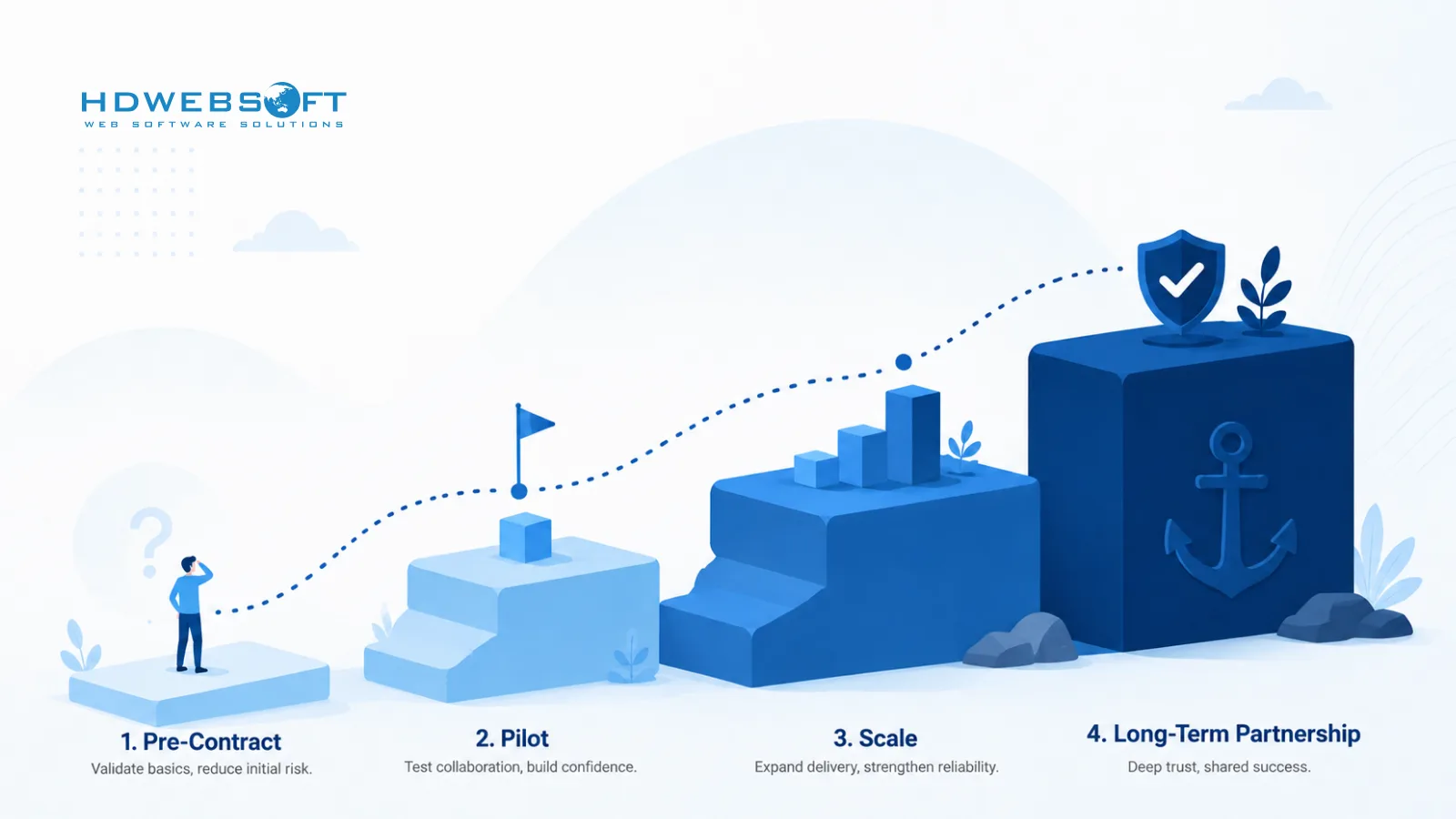
Pre-contract: trust by evidence
Before signing, use the Trust Stack to gather evidence. The goal is not to achieve complete trust — that is impossible before work begins. The goal is to reach enough trust to justify a pilot, with an exit path if the pilot fails. Pre-contract trust is trust by evidence; it is not trust by promise. If you are still earlier in the process and deciding which vendors to shortlist at all, our guide on how to choose the right software outsourcing company covers that stage.
Pilot: trust by behavior under realistic pressure
A pilot is not a technical test. You already verified technical competence in Layer 1. A pilot is a behavioral test: how does the team respond when a real deadline tightens, when a requirement changes mid-sprint, when you give direct feedback that is hard to hear? Use realistic pressure — the kind your actual project will produce — not artificial overtime or fabricated deadlines, which only test whether the vendor will say yes to abuse. A vendor that says yes to abusive conditions during a pilot will often say yes to unrealistic commitments later, and that is a different kind of failure. For the operational details that should be locked down before a pilot starts, our checklist to hire an offshore software development team is a useful complement.
Scale: trust by repeatability
When the team grows from three people to fifteen, trust has to move from individuals to systems. The question stops being “do I trust this engineer?” and becomes “do I trust the process that onboards, documents, and replaces engineers?” Many vendors pass the pilot and fail at scale because their quality depended on a few senior people rather than on a repeatable system. Look for documentation, onboarding ramps, and a process that survives personnel changes.
Long-term: trust by mutual investment
In a mature engagement, both sides invest. The vendor commits resources to your account and proactively brings ideas. You commit a pipeline and include the vendor in roadmap planning. Long-term trust is measured by whether the relationship has become strategic for both sides, or whether it is still transactional. A vendor that never proactively suggests improvements is signaling that the relationship is still a contract, not a partnership.
Exitability as a Trust Signal
One of the strongest trust signals is also the one buyers forget to check: exitability. A trustworthy provider makes it easy for you to leave. They give you ownership of and access to your repository, your cloud accounts, your documentation, your credentials, and a knowledge-transfer and transition support plan. A provider that creates vendor lock-in — by withholding access, by keeping documentation internal, by making the codebase impossible to maintain without them — is telling you that they expect retention to come from friction, not from value.
The test is simple. Ask the vendor: “If we end this engagement in six months, what exactly do we walk away with?” A clear, confident answer is a strong signal. An evasive answer is a warning sign. Exitability is a trust signal because a provider that is not afraid of losing you has nothing to hide.
When Trust Breaks: Repair or Exit?
Trust will be tested. Something will go wrong. The question is not whether an incident happens, but how the vendor responds, and whether the response pattern warrants repair or exit.
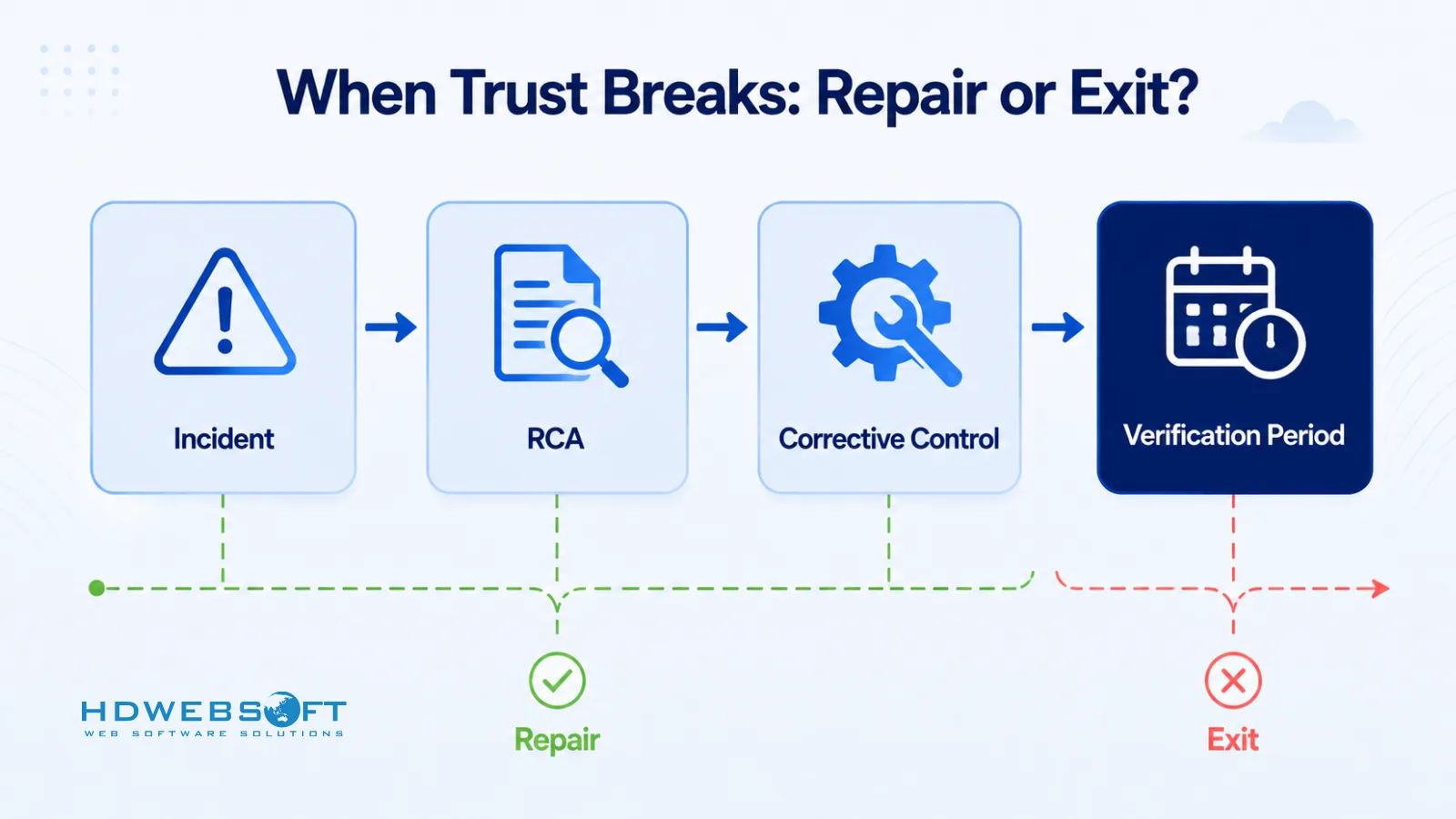
Use a four-step decision framework: Incident → RCA → Corrective Control → Verification Period.
- Incident. Identify what went wrong and isolate it. Was it a system failure (a broken process, a missing check) or a people failure (an individual mistake)? System failures are usually repairable. People failures are repairable if they are isolated.
- RCA. Require a written root cause analysis that does not blame individuals and does not dodge systemic causes. A vendor that says “we’ll do better” without a written RCA is not repairing; they are waiting for you to forget.
- Corrective Control. Demand a specific, concrete change — a new check, a new process step, a new tool — not a promise. “We will add a code review gate before every release” is a corrective control. “We will be more careful” is not.
- Verification Period. Set a defined window, typically 90 days, during which you measure whether the corrective control actually prevents recurrence. If it does, trust is repaired. If it does not, you have your answer.
When to repair
Repair trust when the failure is a single incident, the vendor is transparent about the root cause, commits to a specific corrective control, and accepts the verification period. One honest failure, handled well, can produce a stronger relationship than one that never happened.
When to exit
Exit when failures form a pattern, when the vendor hides problems instead of surfacing them, or when key people leave the assigned team without warning and without a replacement plan. The cost of walking away is real — transition time, knowledge transfer, a new vetting cycle — but the cost of staying in a relationship where trust has already broken is almost always higher, and it compounds the longer you wait. For a broader view of the risks that make exit necessary, our article on top offshore development risks maps the landscape.
Conclusion
Trusting an offshore service provider is not a feeling you develop during sales calls. It is a risk you quantify and verify across four layers — competence, contractual, communication, and operational — and across a trajectory that runs from pre-contract evidence, through pilot behavior, to scale repeatability and long-term mutual investment. Exitability is the trust signal most buyers forget to check, and it is often the one that reveals the most. When trust breaks, a structured repair-or-exit decision beats an emotional one.
If you are evaluating an offshore partner and want a provider that operates on transparency — direct tool access, reference calls, a pilot with a real exit clause, and a track record that includes taking over troubled projects and modernizing them without disruption — explore our offshore software development services or talk to our team. We would rather lose a deal during vetting than lose your trust after signing.
Key Takeaways
- Cost and talent are table stakes; trust is the bottleneck that decides whether the engagement survives.
- Use the Trust Stack — competence, contractual, communication, operational — and verify each layer independently with evidence, not claims.
- Trust has a trajectory: pre-contract evidence, pilot behavior under realistic pressure, scale repeatability, and long-term mutual investment.
- Exitability — repo, cloud, documentation, credentials, and knowledge transfer — is a trust signal; a provider that makes leaving easy has nothing to hide.
- Trust can be repaired after a single transparent incident with a corrective control and a verification period; a pattern of failures and concealment means it is time to exit.
FAQ
How do I verify an offshore service provider’s competence without trusting their marketing?
Request the actual proposed team roster with names, roles, and seniority mix. Interview the assigned engineers directly, not the sales architect. Ask for an architecture walkthrough of a system they already maintain. Run a paid pilot on a real deliverable. Refusing to let you interview the assigned engineers is a clear fail signal.
What evidence should I ask an offshore provider for before signing a contract?
Ask for evidence that maps each sales promise to a specific contract clause — IP ownership, termination rights, subcontracting consent, data ownership, knowledge transfer, and exit rights. The test is whether the vendor can convert a claim into a written clause. Hesitation is a warning sign.
How long should a pilot phase be before I trust an offshore team?
A pilot should be long enough to expose delivery behavior under realistic pressure, not artificial overtime. For most software projects, four to eight weeks on a real, scoped deliverable is enough to see how the team handles blockers, feedback, and scope ambiguity. A pilot is a behavioral test, not a technical one.
What are the most common red flags that an offshore provider cannot be trusted?
Refusing reference calls, blocking direct access to Jira or GitHub, assigning a PM who acts as a gateway instead of a bridge, unexpected team replacements without notice, inability to disclose team stability, and over-promising timelines. Any of these should pause or stop the vetting process.
Can trust be repaired after an offshore project goes wrong?
Yes, when the failure is a single incident, the vendor provides a transparent root cause analysis, commits to a specific corrective control, and accepts a verification period. No, when failures form a pattern, the vendor hides problems, or key people leave without warning.
How is trust different from due diligence in offshore outsourcing?
Due diligence is the pre-contract investigation you perform before signing. Trust is the ongoing, verifiable relationship you build and maintain across the entire engagement. Due diligence is a phase; trust is a trajectory that can grow or erode over time.