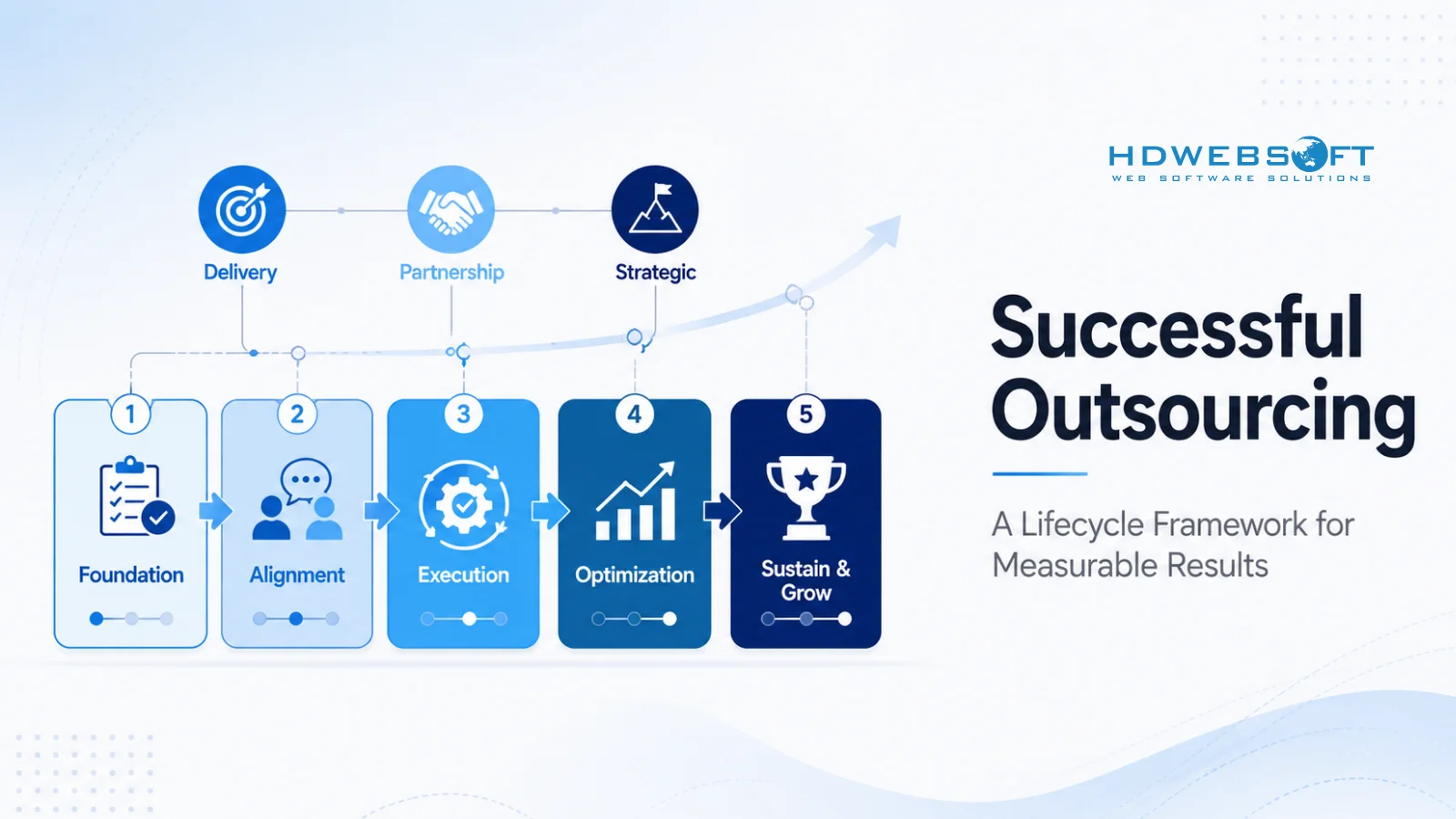
Most buyers can tell when an outsourcing engagement is failing. Deadlines slip, communication goes quiet, and rework piles up. But few can tell when an engagement is succeeding — not just avoiding failure, but producing measurable outcomes that justify the investment beyond cost savings. This article gives you a lifecycle framework for answering one question across the entire engagement: is the outsourcing engagement actually succeeding, and how do we keep it succeeding?
This is not a vendor selection guide, a contract checklist, or a list of generic outsourcing tips. (Need the fundamentals first? Start with what outsourcing is and how it works.) It assumes the contract is signed and the team is in place. The question is what comes next: how to define success, measure it, sustain it, and respond when it starts to erode.
What Does Successful Outsourcing Actually Look Like?
Outsourcing that “works” and outsourcing that “succeeds” are not the same thing. An engagement can deliver on time and on budget without producing strategic value. An engagement can be cheaper than in-house development without improving your time-to-market. Success is not the absence of failure — it is the presence of measurable outcomes across three dimensions.
- Delivery outcomes are the most visible layer. Is the team shipping predictably? Is quality improving or stable? Is rework within the agreed baseline? These are necessary but not sufficient. A team that ships reliably but never improves the product is operational, not successful.
- Partnership health is the second layer. Does the vendor surface blockers before you find them? Does the team respond to feedback within the agreed window? Does the vendor propose solutions, or only execute tasks? A healthy partnership produces fewer surprises and more alignment over time, not less.
- Strategic value is the third layer, and the one most buyers forget to measure. Is the engagement making your organization better — faster to market, more capable, more resilient? Or is it simply offloading work at a lower rate? Strategic value is the difference between an engagement that survives a budget cut and one that gets cut first.
The trap is treating “on time, on budget” as the finish line. Many engagements hit those targets and still produce no strategic value, because the targets were defined at the start and never revisited. Successful outsourcing is a trajectory, not a milestone — and the rest of this framework is about measuring that trajectory.

The Outsourcing Success Lifecycle: 5 Phases
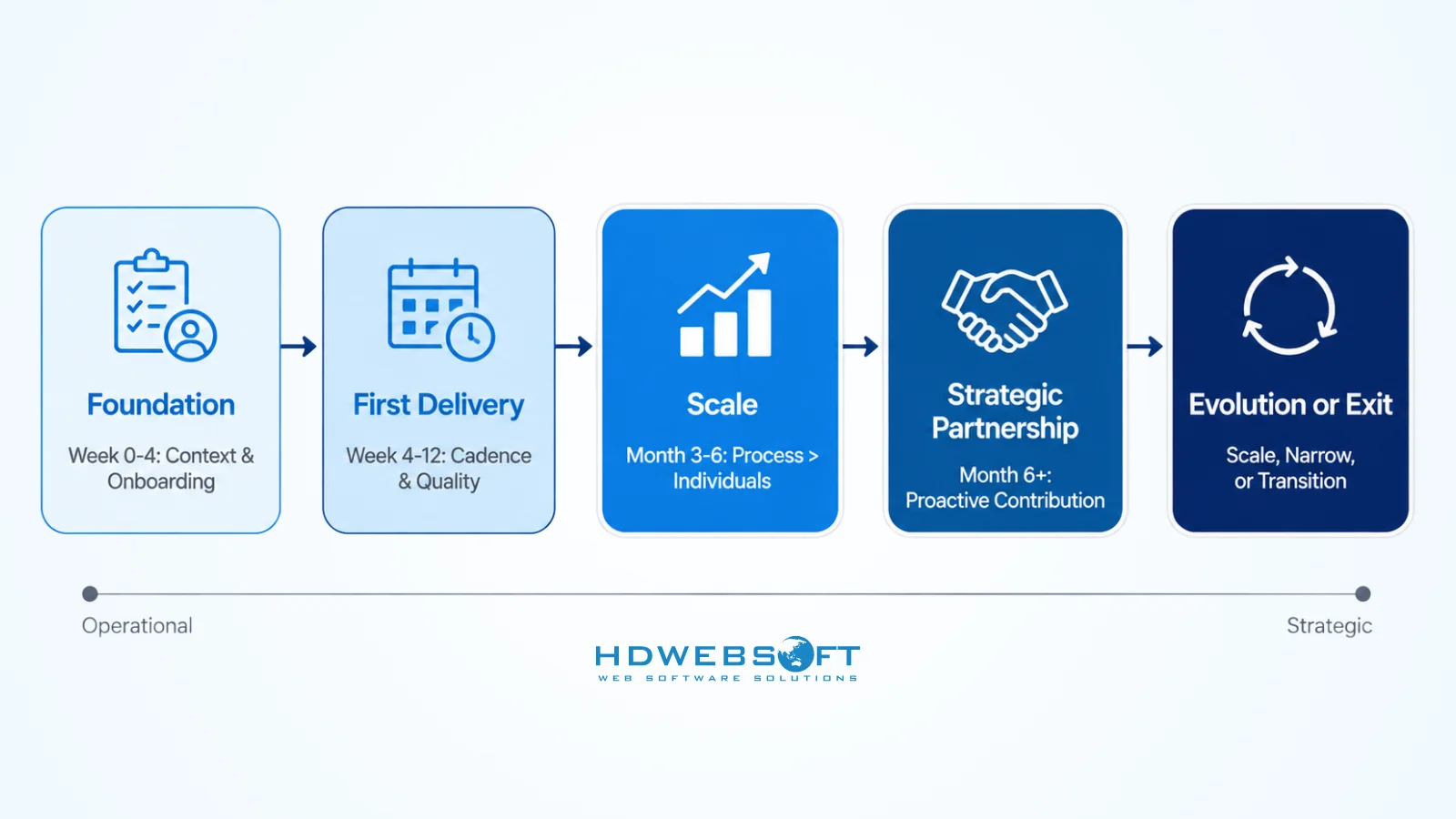
Every outsourcing engagement moves through phases, and the success criteria change at each one. What counts as “succeeding” in week 2 is different from what counts in month 9. The lifecycle below maps those phases, the signals that indicate success, and the warning signs that suggest the engagement is drifting.
Phase 1 — Foundation
The first phase is about context transfer, not delivery. The team needs to understand your product, your users, your constraints, and your definition of “done” before they can produce work that fits.
- Success criteria: The team asks clarifying questions before starting work. They can explain the project’s purpose back to you in their own words. Tooling, access, and communication channels are set up before the first sprint.
- Warning signs: The team accepts tasks without questions. They nod in meetings but produce work that misses context. You find yourself re-explaining the same thing in week 3 that you explained in week 1.
- Decision point: By the end of foundation, you should be able to answer “does this team understand what we are building and why?” If not, the problem is onboarding, not capability.
For a structured set of onboarding items to lock down before this phase starts, our checklist to hire an offshore software development team covers the operational details.
Phase 2 — First Delivery
The first real deliverable is the moment the engagement moves from setup to proof. This phase is not about perfection — it is about cadence and quality gates.
- Success criteria: The team delivers on a predictable cadence. Quality gates pass without escalation. Rework stays within the baseline you agreed at the start of the engagement. When something slips, the team tells you before the deadline, not after.
- Warning signs: Deadlines slip with no early warning. Rwork rate exceeds the agreed baseline. Quality gate failures are explained away rather than fixed. The team consistently delivers late but insists “next time will be different.”
- Decision point: After the first two or three deliverables, ask: “is delivery becoming more predictable, or less?” The trend matters more than any single sprint.
Phase 3 — Scale
When the team grows — whether from three to eight, or eight to twenty — success moves from individuals to systems. The question stops being “is this engineer good?” and becomes “is the process that onboards, documents, and replaces engineers good?”
- Success criteria: New team members reach productive contribution within the engagement-specific target you set. Documentation exists for critical decisions and architecture. The team’s quality does not drop when a senior member is on leave.
- Warning signs: Quality depends on one or two individuals. New hires take longer than the agreed ramp to contribute. Knowledge is tribal — when someone leaves, a chunk of context leaves with them.
- Decision point: If removing the most senior person from the team would break delivery, the engagement has not scaled. It has concentrated.
Phase 4 — Strategic Partnership
In a mature engagement, the vendor stops waiting for tasks and starts contributing to the roadmap. This is the phase where outsourcing shifts from operational to strategic.
- Success criteria: The vendor proactively proposes improvements with measurable impact. They flag risks before they become problems. They bring ideas from other engagements that apply to yours. The relationship feels like a partnership, not a contract.
- Warning signs: After a long time, the vendor still only executes. They never push back on scope or suggest alternatives. Roadmap planning happens without them. The engagement is still transactional.
- Decision point: Ask “when was the last time the vendor proposed something we hadn’t thought of?” If the answer is “never,” the engagement is operational, not strategic — and that may be fine, but it is not success.
Phase 5 — Evolution or Exit
Every engagement eventually reaches a decision point: scale further, narrow the scope, or transition out. Success at this phase is not about which choice you make — it is about whether you can choose.
- Success criteria: You have the documentation, access, and knowledge transfer needed to scale, narrow, or transition without losing continuity. The vendor supports the transition rather than resisting it.
- Warning signs: You cannot exit without significant disruption. Critical knowledge lives only in the vendor’s team. The vendor makes transition difficult — withholding documentation, slowing knowledge transfer, or creating friction around access.
- Decision point: If staying is your only option, the engagement has become a dependency. For the contract-level mechanics of exit rights and transition obligations, see our software outsourcing contract guide.
Success Metrics That Actually Matter
Most outsourcing dashboards track activity: hours billed, tickets closed, headcount allocated. These are vanity metrics. They measure input, not outcome. A team can bill 1,000 hours and produce less value than a team that bills 600. The metrics below measure results across three groups.
| Metric Group | Metric | What It Measures | How to Track |
|---|---|---|---|
| Delivery | Velocity stability | Whether output is predictable, not just high | Compare sprint-to-sprint variance, not absolute points |
| Delivery | Defect escape rate | Quality at delivery, not after patching | Count defects found post-release vs. pre-release |
| Delivery | Rework rate | How often work comes back | Track reworked items against the agreed baseline |
| Delivery | Cycle time | Speed from start to done | Measure per item, not per sprint |
| Partnership | Blocker escalation time | How fast problems surface | Track time from blocker occurrence to client visibility |
| Partnership | Feedback response time | How fast the team adapts | Measure time from feedback to implemented change |
| Partnership | Accepted proactive improvements | Vendor contribution with measurable impact | Count improvements proposed by vendor that were accepted and shipped |
| Strategic | Cost per accepted outcome | Cost efficiency against baseline, not absolute cost | Divide total engagement cost by accepted deliverables |
| Strategic | Time-to-market improvement | Whether the engagement is making you faster | Compare release cadence now vs. baseline |
| Strategic | Knowledge retention index | Whether critical knowledge is documented and accessible | Audit what percentage of critical decisions, architecture, and processes are documented and accessible to the client team |
The knowledge retention index deserves a clear definition: it is the percentage of critical knowledge — architecture decisions, business logic, operational procedures, and integration points — that is documented in a form the client team can access and use independently. You measure it by conducting a periodic audit: list the critical knowledge areas for the engagement, then check whether each is documented, current, and accessible. If 8 of 10 areas are documented and accessible, the index is 80%. A declining index is a leading indicator of vendor lock-in.
Set baselines at the start of the engagement — they should be engagement-specific, not borrowed from a template. Review metrics on a regular cadence, not ad hoc. The point is not to hit a universal benchmark; it is to see whether the trend is improving, stable, or declining relative to your own baseline.
The Quarterly Success Audit
Metrics give you data. The quarterly audit turns that data into a decision. Run it every quarter with five questions, and score each one green, yellow, or red.
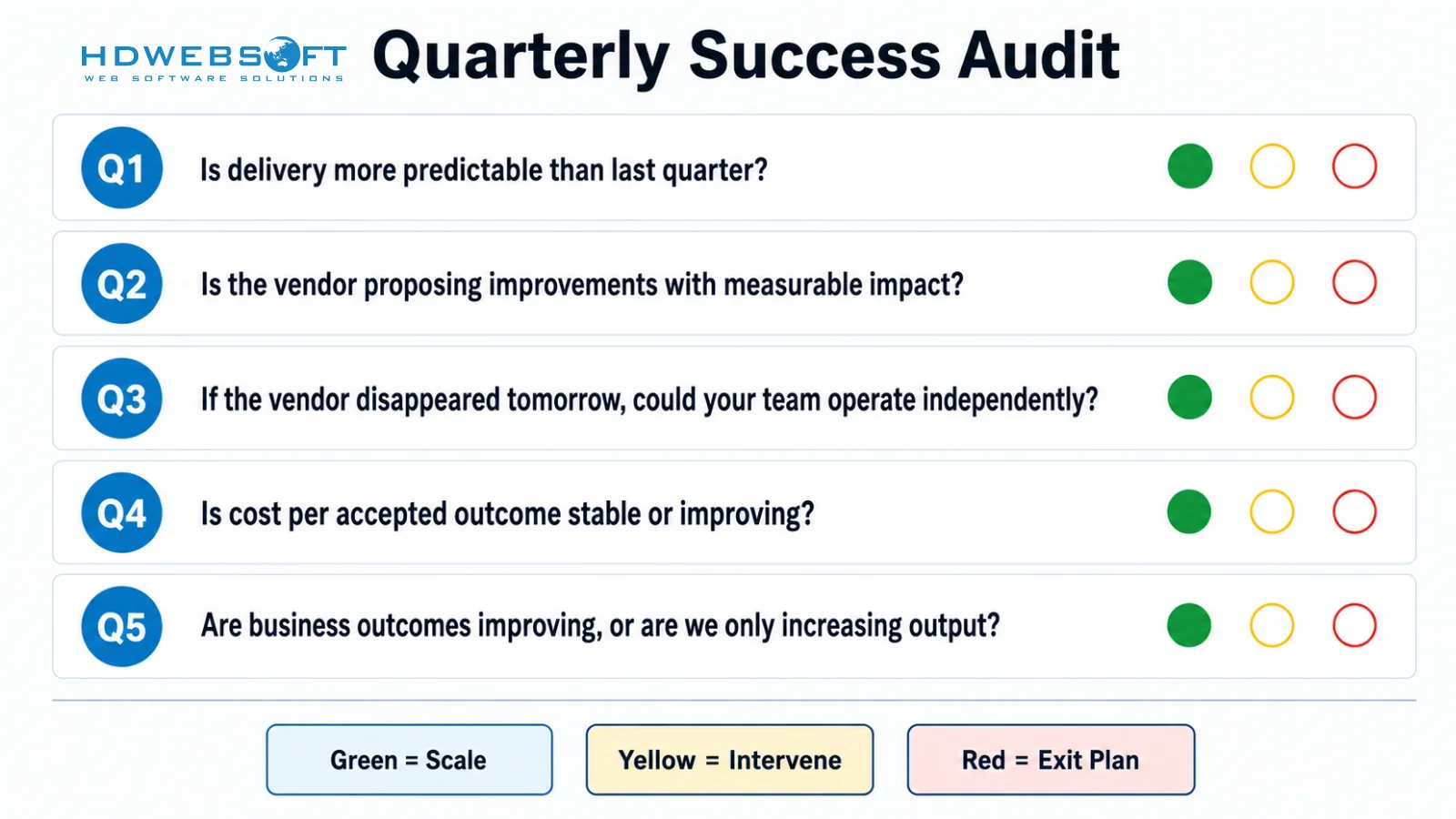
- Is delivery more predictable than last quarter? Look at velocity stability and cycle time trends. Green = variance shrinking. Yellow = stable but not improving. Red = variance increasing.
- Is the vendor proposing improvements with measurable impact, or only executing tasks? Green = regular accepted contributions. Yellow = occasional suggestions. Red = none.
- If the vendor disappeared tomorrow, could your team operate independently? Green = documentation and access are current. Yellow = partial coverage. Red = critical knowledge is tribal.
- Is cost per accepted outcome stable or improving against baseline? Green = trending down or stable. Yellow = flat with no improvement. Red = increasing.
- Are business outcomes improving, or are we only increasing output? This is the question that catches the most engagements. Green = the engagement is helping you ship faster, reach users sooner, or enter markets earlier. Yellow = output is up but business outcomes are flat. Red = output is up but business outcomes are declining — you are paying more for less.
Scoring and action:
- All green: the engagement is succeeding. Consider scaling.
- One or two yellow: intervene in the yellow areas. Re-align scope, re-baseline the struggling metric, and re-check next quarter.
- Two consecutive yellows in the same area: escalate. The intervention is not working.
- Any red: the engagement is in decline. Move to the decline-response playbook below, or begin exit planning.
When Outsourcing Performance Starts to Decline
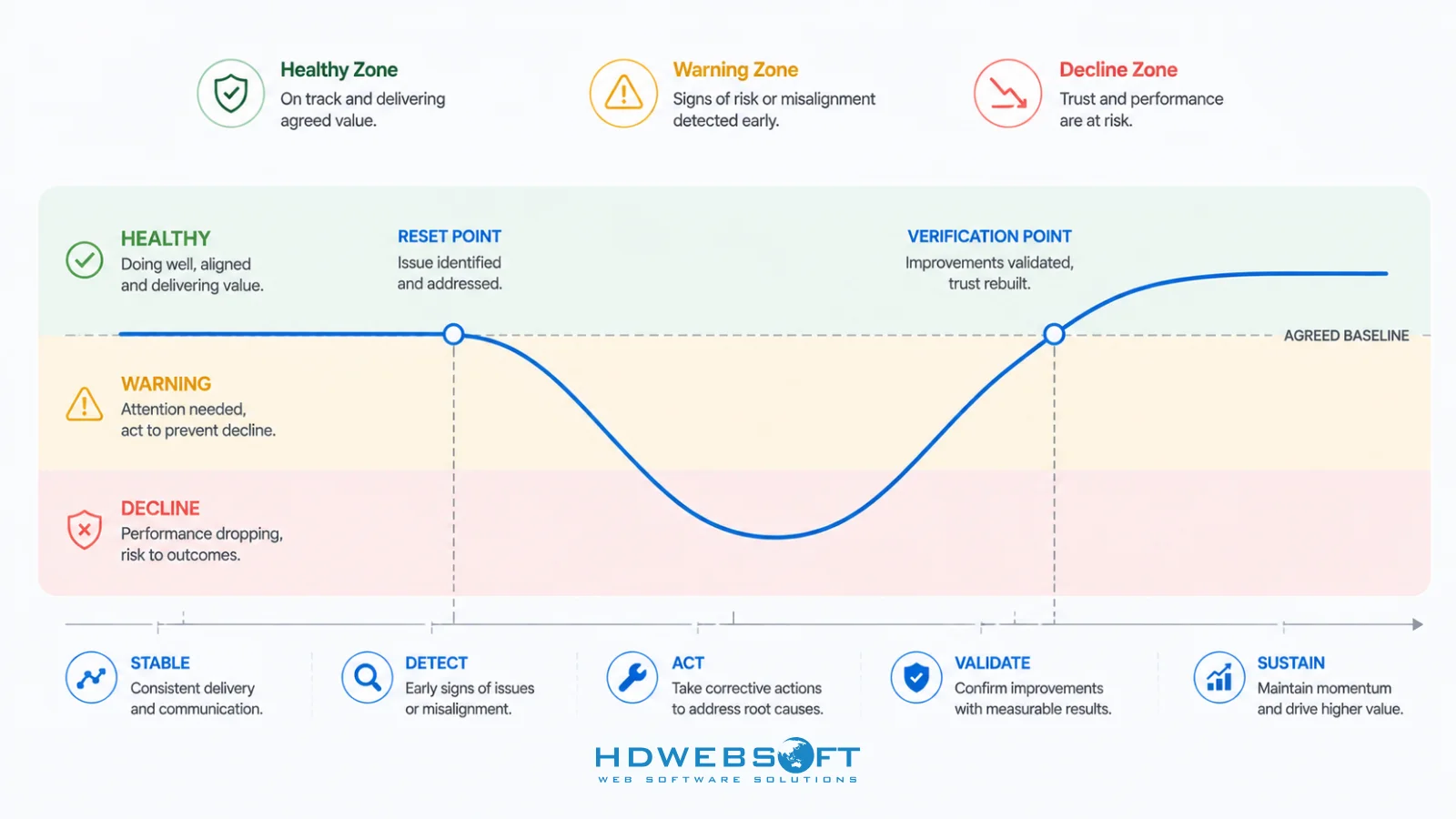
Performance decline is not the same as a trust breach. A team can be honest, transparent, and well-intentioned — and still produce deteriorating results because of scope drift, process gaps, or personnel changes. This section addresses performance decline. If the issue is concealment, lack of transparency, or a broken trust relationship, that is a different problem — see our framework for trusting an offshore service provider for the repair-or-exit decision model.
Diagnose: system, people, or scope?
Before intervening, identify the nature of the decline.
- System failure: A process gap — no code review gate, no QA checkpoint, no onboarding documentation. The team is capable, but the process is not catching problems. System failures are the most recoverable.
- People failure: A specific individual or small group is underperforming or has left, and the gap is not filled. People failures are recoverable if they are isolated and the vendor has a replacement process.
- Scope drift: The project’s scope has shifted — new requirements, changing priorities, expanded expectations — without adjusting the baseline. The team is not performing worse; the target has moved. Scope drift is recoverable if both sides acknowledge it and re-baseline.
For a deeper analysis of the root causes behind each type of failure, our article on why IT outsourcing projects fail maps the landscape.
Reset: re-align, re-baseline, re-establish
Once the cause is diagnosed, reset the engagement:
- Re-align scope. If scope drift is the cause, document the current scope explicitly and compare it to the original. Adjust timelines and expectations to match reality, not the original plan.
- Re-baseline metrics. If the decline is a system or people failure, reset the affected metrics to a realistic baseline and communicate the new targets. Do not keep measuring against a baseline the team can no longer hit — that creates frustration, not improvement.
- Re-establish cadence. If delivery has become unpredictable, re-establish the cadence with a shorter, tighter loop — smaller deliverables, more frequent check-ins — until predictability returns.
Verify: did the reset work?
Set a defined verification window — engagement-specific, not a universal number — and measure whether the reset produced improvement. If delivery predictability returns, rework drops to the new baseline, and the team is back on cadence, the decline was a phase, not a pattern. If the metrics do not improve after the reset, the decline is structural, and the engagement needs a different kind of decision.
For metrics and quality evaluation methods that complement this reset process, see our guide on how to evaluate offshore software development quality.
Conclusion
Successful outsourcing is not a feeling you develop during quarterly reviews. It is a set of measurable outcomes — delivery predictability, partnership health, and strategic value — tracked across a lifecycle from foundation to evolution. The quarterly audit turns those metrics into decisions, and the decline-response playbook gives you a structured way to intervene before performance becomes a crisis.
If you are running an outsourcing engagement and want a partner that operates on measurable outcomes — predictable delivery, proactive contributions, documentation that survives personnel changes, and a transition plan that keeps you in control — explore our software outsourcing services or talk to our team. We would rather show you the metrics than promise you the results.
Key Takeaways
- Successful outsourcing is not the absence of failure — it is measurable outcomes across delivery, partnership, and strategic value.
- The lifecycle moves through five phases: foundation, first delivery, scale, strategic partnership, and evolution or exit. Success criteria change at each phase.
- Track metrics that measure outcomes, not activity: velocity stability, defect escape rate, accepted proactive improvements, cost per accepted outcome, and knowledge retention index.
- Run a quarterly success audit with five questions. Two consecutive yellows in the same area warrant escalation; any red warrants intervention or exit planning.
- Performance decline is recoverable when diagnosed as system, people, or scope drift. Trust breaches and concealment are a different problem — evaluate them separately.
FAQ
How do you measure outsourcing success beyond cost savings?
Measure success across three groups: delivery metrics (velocity stability, defect escape rate, rework rate, cycle time), partnership metrics (blocker escalation time, feedback response time, accepted proactive improvements), and strategic metrics (cost per accepted outcome, time-to-market improvement, knowledge retention index). Cost savings measure input, not outcome.
What are the signs an outsourcing engagement is succeeding in the first 90 days?
Success signals include a predictable delivery cadence, the team asking clarifying questions before starting work, blockers surfaced before they become crises, and rework staying within the agreed baseline. The strongest early signal is that the team challenges scope or requirements when something is ambiguous, rather than silently building the wrong thing.
How often should you audit an outsourcing partnership?
Run a quarterly success audit with five core questions covering delivery predictability, proactive contribution, knowledge retention, cost efficiency, and whether business outcomes are improving or output is just increasing. Score each green, yellow, or red. Two consecutive yellow scores in the same area warrant an intervention; a red score warrants exit planning.
What metrics should you track for outsourced software development?
Track delivery metrics (velocity stability, defect escape rate, rework rate, cycle time), partnership metrics (blocker escalation time, feedback response time, accepted proactive improvements with measurable impact), and strategic metrics (cost per accepted outcome against baseline, time-to-market improvement, knowledge retention index). Avoid vanity metrics like headcount or hours billed, which measure activity, not results.
Can a struggling outsourcing relationship be turned around?
Yes, when the decline is a performance issue — predictability dropping, rework increasing, cost efficiency slipping. Diagnose whether the cause is a system failure, a people failure, or scope drift, then reset scope, re-baseline metrics, and verify over a defined window. If the cause is a trust breach or concealment, the relationship is harder to repair and should be evaluated separately.
What is the difference between a transactional vendor and a strategic partner?
A transactional vendor receives tasks and delivers them. A strategic partner proposes solutions, flags risks before they become problems, and contributes ideas with measurable impact on your roadmap. The shift from transactional to strategic is the strongest signal that an outsourcing engagement has moved from operational to successful.