The global outsourcing market crossed 525 billion US dollars in 2025 and continues to grow at 8 to 9 percent annually, driven by talent shortages, AI integration, and the shift toward multi-country operations. For engineering leaders evaluating offshore outsourcing software development trends 2026 brings, the decision framework has changed. Cost arbitrage is no longer the primary driver, AI agents have reshaped what gets outsourced, and proximity now matters as much as price.
This guide covers the offshore and outsourcing software development trends that matter in 2026, with verified data and practical takeaways for CTOs, founders, and engineering managers making sourcing decisions today.
Software Outsourcing and Offshore Software Development with Trending Technology in 2026
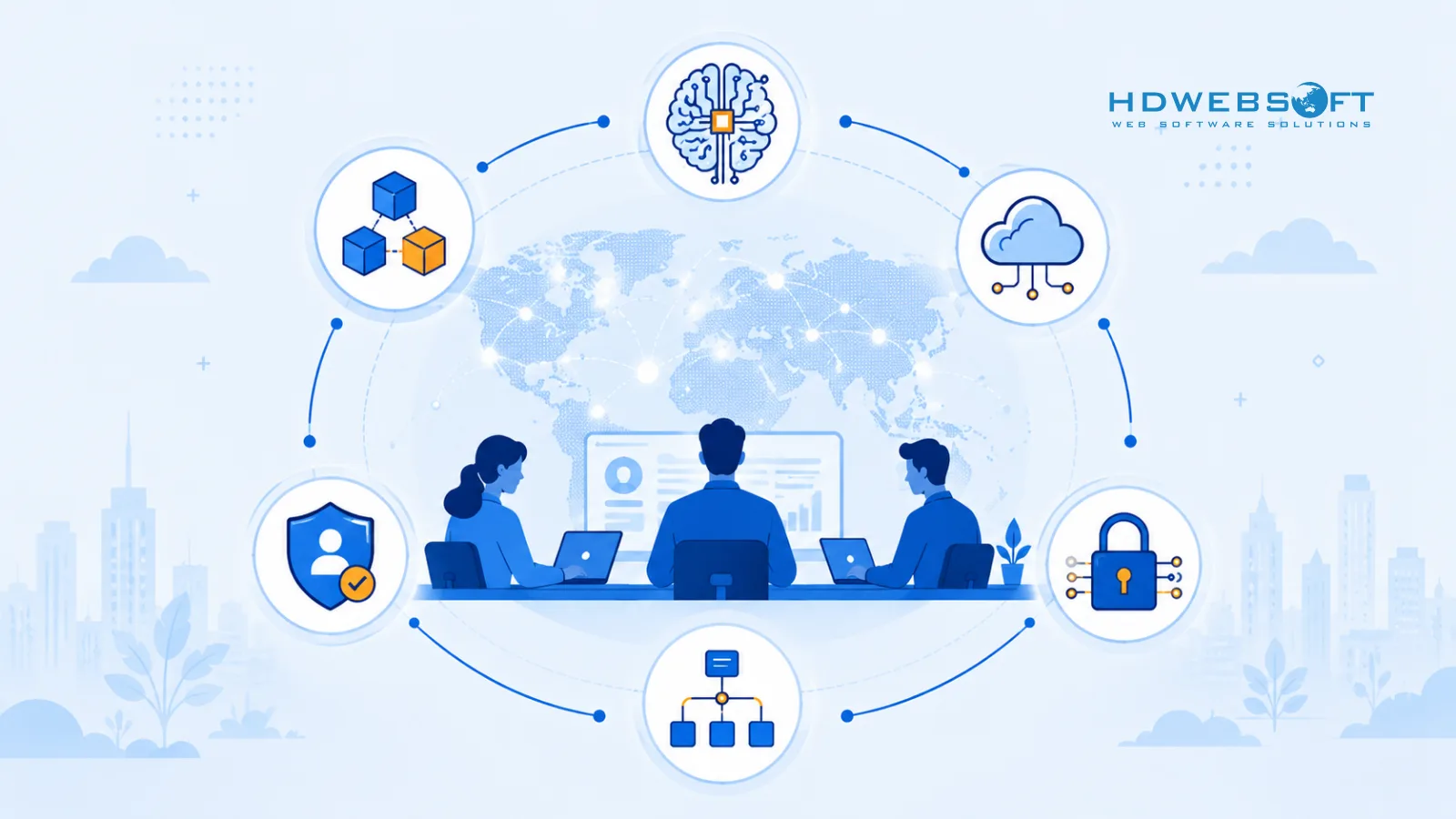 Offshore team with trending technology stack
Technology trends directly shape what companies outsource and how offshore teams deliver. In 2026, the technology stack expected from a competent offshore partner is broader than the 2022 list of edge computing and low-code. AI-augmented development, cloud-native architecture, composable applications, and zero-trust security are now table stakes, not differentiators.
Software Outsourcing Technology Trends in 2026
- AI-augmented development: 84 percent of developers use or plan to use AI tools, and 51 percent of professional developers use them daily, according to the 2025 Stack Overflow Developer Survey. Offshore partners without AI tooling maturity fall behind.
- Cloud-native architecture: Container orchestration, serverless, and event-driven design are expected for new builds, not sold as premium add-ons.
- Composable applications: Packaged business capabilities with modular frontends let teams swap features without rebuilding, which suits outsourced delivery where ownership changes.
- Edge computing: Latency-sensitive workloads push compute closer to users, and offshore teams with edge experience are scarce.
- Zero-trust architectures: Every request is authenticated and authorized, which matters when offshore engineers access production systems.
- AI-driven automation: Beyond code generation, AI handles test maintenance, incident triage, and observability summaries.
- Backward compatibility and services-based approaches: Legacy modernization outsourced work depends on API-first integration without breaking existing consumers.
- Cybersecurity and privacy: With cybercrime projected to cost 5 trillion US dollars annually, security is a non-negotiable selection criterion for offshore partners.
Offshore Software Development Trends in 2026
- Talent access over cost: Specialized talent is now the top driver, cited by 42 percent of executives in Deloitte’s 2024 Global Outsourcing Survey, while cost fell from 70 percent in 2020 to 34 percent.
- AI-augmented offshore teams: Offshore engineers using AI tools handle 40 to 50 percent more work than those without, creating a new category of AI-human hybrid roles.
- Nearshoring growth: Nearshore destinations in Latin America and Eastern Europe grow 15 to 20 percent annually as companies seek time zone alignment.
- Hybrid delivery models: Nearshore, offshore, and onshore combined in one engagement, anchored by AI and enabled by improved collaboration tooling.
- Outcome-based partnerships: Three out of four companies now want outsourcing partners to drive transformational outcomes, not just deliver hours.
- Cloud migration services: Demand continues for shifting self-hosted backends to cloud, especially for mobile and legacy web apps.
- Senior-led delivery over junior-heavy teams: AI agents commoditize junior code generation, so the value of a senior engineer who can verify AI output has risen.
Talent Access Has Overtaken Cost as the #1 Driver
The single biggest shift in offshore and outsourcing software development since 2022 is that cost is no longer the primary reason companies outsource. According to Deloitte’s 2024 Global Outsourcing Survey, 42 percent of executives now cite access to specialized talent as their top driver, while cost reduction dropped from 70 percent in 2020 to just 34 percent in 2024.
The implication is significant. The right question is no longer “how much do they charge per hour” but “do they have the depth we cannot hire locally”. Capability gaps in AI, cloud, cybersecurity, and data engineering are where companies feel the shortage most. A 2026 outsourcing decision is a capability decision first and a cost decision second.
For engineering leaders, this changes the evaluation. A partner with strong senior engineers in AI-augmented development, cloud-native architecture, or security may cost more per hour than a junior-heavy shop, but the total cost of ownership is lower when rework, missed deadlines, and security incidents are factored in.
AI-Augmented Offshore Teams and the Rise of Agent-Shoring
AI coding agents are the biggest shift hitting outsourced development in 2026. With 96 percent of enterprises already using AI agents in some capacity, well-implemented agentic workflows are shortening three-month development cycles to six weeks, according to industry reporting. The catch is that this only works with strong senior engineering oversight.
What AI agents commoditize
AI agents handle routine code generation, boilerplate, basic test coverage, and repetitive refactoring in minutes rather than hours. This eliminates the cost arbitrage that made junior-heavy offshore teams viable. A 20 US dollar per hour junior using traditional methods is now outperformed on output, quality, and total cost of ownership by a 35 to 55 US dollar per hour senior using AI-native workflows.
What AI agents do not replace
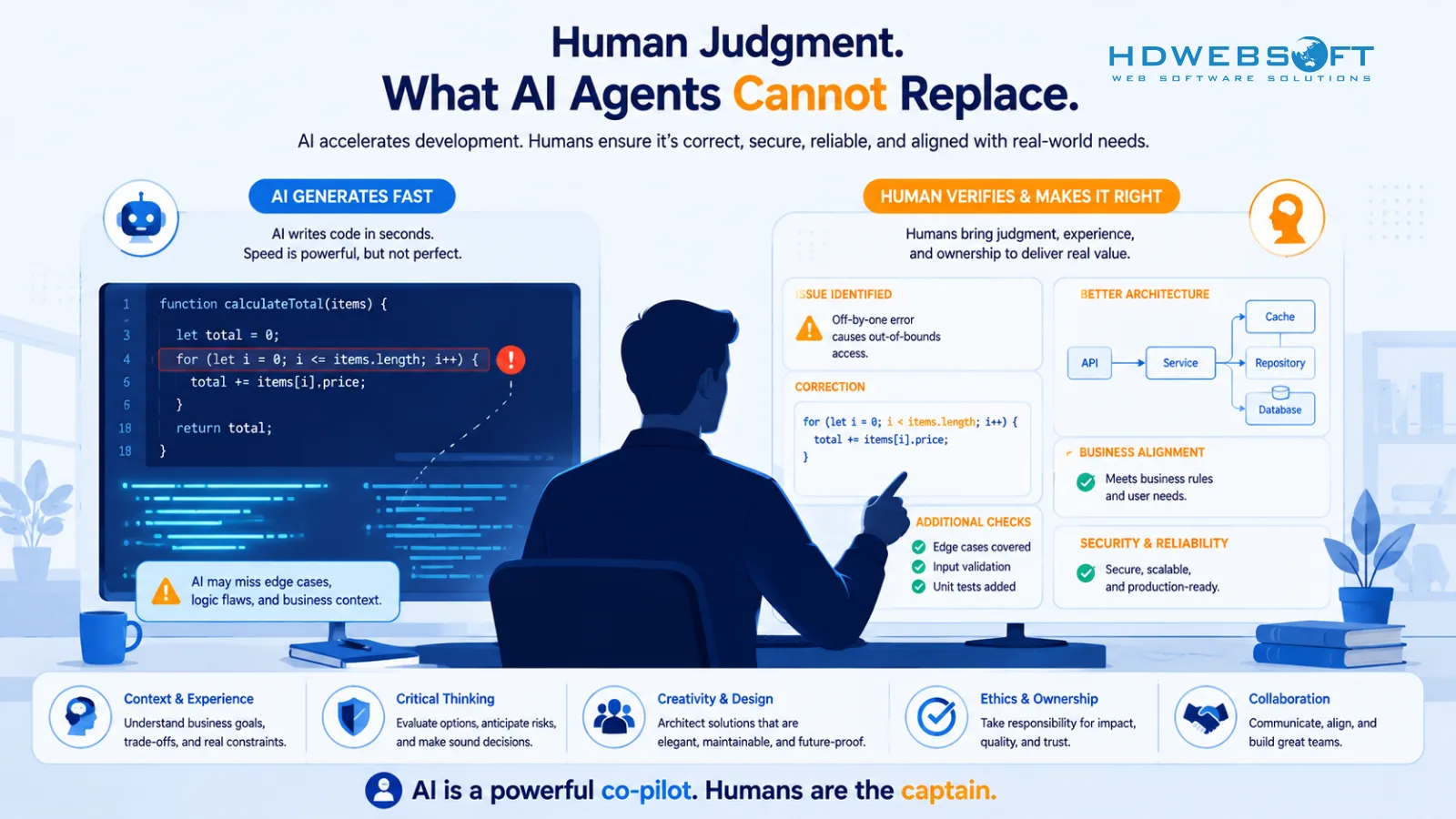 Senior engineer verifying AI output — what AI agents cannot replace
Trust in AI output among developers actually fell to 29 percent in 2025, down from 40 percent the year before, even as adoption rose. AI is confident, fast, and wrong often enough to hurt you. The value of a human sitting next to that output is no longer in the typing. It is in catching the mistake, knowing the question to ask, and understanding the product well enough to tell good output from garbage.
For complex work — architecture decisions, security review, product judgment, regulatory compliance, and stakeholder negotiation — a human-in-the-loop remains essential. KPMG’s 2026 Sourcing Trend Radar notes that AI adoption still requires a human in the loop at level 2, sometimes level 3, even when AI agents perform more complex tasks.
Agent-shoring: a new category, not a replacement
Agent-shoring is the emerging practice of using AI-first processes and agents to fulfill engineering needs instead of an offshore team. It is cheaper than traditional offshore for routine work, but it does not replace offshore development for judgment-intensive tasks. What it does is reshape the market: junior-heavy execution shops lose their value proposition, while senior-led, AI-augmented firms become stronger than ever.
Nearshore vs Offshore: The Proximity Shift
Offshore outsourcing to distant countries remains the most cost-efficient option on paper, but nearshore and onshore models are growing fast, particularly among companies that have experienced firsthand what offshore communication friction actually costs.
Nearshore destinations in Latin America and Eastern Europe are growing 15 to 20 percent annually. The trade-off is real and worth weighing deliberately.
| Factor | Nearshore | Offshore |
|---|---|---|
| Geographical proximity | Neighboring region | Distant region |
| Cost | Moderate | Lower |
| Time zone alignment | High | Low to moderate |
| Cultural closeness | Moderate to high | Varies |
| Communication friction | Lower | Higher |
| Talent pool size | Smaller per country | Larger |
The 2026 trend is not nearshore replacing offshore, but hybrid delivery models that combine both. A common pattern keeps product, architecture, and client-facing roles nearshore or onshore for real-time collaboration, while bulk engineering, QA, and operations stay offshore for cost and scale.
Cultural friction is a major factor when offshore engagements fail, alongside communication barriers and time zone gaps. Nearshoring addresses most of those risks, but it does not eliminate the need for diligence on technical depth, security, and delivery discipline.
Staff Augmentation vs Project Outsourcing: Which Model Fits 2026
The choice between staff augmentation and project outsourcing is often confused by vendors selling one model under the other’s label. A staff augmentation pitch that leads with milestones and deliverables is a project in a staff-augmentation costume.
Staff augmentation
Staff augmentation extends an in-house team with external engineers who work under the client’s management. Pricing is typically time and materials, with a notice period for resizing. The model suits companies that have product and engineering leadership in place and need continuity, not a one-off deliverable.
Read our guide on the outstaffing model and on outsourcing vs outstaffing to understand the contract and ownership differences in detail.
Project outsourcing
Project outsourcing hands a scoped statement of work to a vendor who delivers against milestones. It suits companies that lack in-house engineering capacity and want a turnkey outcome. The trade-off is less day-to-day control and a harder handover at the end.
A dedicated development team is a hybrid: a long-running vendor team that operates like staff augmentation but with vendor-side management of the engineers.
Outcome-based pricing
Some vendors now offer hybrid models tied to sprint velocity or service-level credits instead of a flat rate. For a scoped project, outcome pricing can work well. For staff augmentation, be cautious: the vendors pushing outcome-based staff augmentation as the future are usually the ones who do project outsourcing too, trying to sell the same pricing model under both names.
How to Choose an Offshore Partner in 2026
The framework for evaluating an offshore partner has shifted. The question is no longer “can we afford offshore” but “which offshore tier are we actually buying”.
Tier 1: Cheap execution
Junior-heavy teams selling low-cost labor for routine code tasks. Hourly rates of 10 to 25 US dollars. Management overhead sits with the client. Quality variance surfaces in production. This is the tier AI agents disrupt directly. The cost arbitrage is gone.
Tier 2: Senior-led, AI-augmented delivery
Engineering firms where 5 to 10-plus year developers use AI tools to accelerate delivery throughput without replacing technical judgment. This tier is not competing with AI agents. It is using them, and it is delivering on timelines that were not achievable before.
Selection checklist
- Seniority ratio: Ask for the engineer seniority breakdown. A partner where seniors are less than 30 percent of the team is a Tier 1 shop regardless of how it markets itself.
- AI tooling maturity: Ask which AI coding tools the team uses daily, how code review handles AI-generated output, and what the human-in-the-loop policy is.
- Security certifications: ISO/IEC 27001 is the baseline for any partner touching production systems or customer data.
- Quality management certifications: ISO 9001 certifies a repeatable delivery process, which matters for multi-quarter engagements.
- Delivery model flexibility: Can the partner scale up and down with a notice period, or does it lock you into a fixed headcount?
- Outcome transparency: Does the partner report on velocity, defect rates, and deployment frequency, or only on hours billed?
For a deeper walkthrough, read our checklist to hire an offshore software development team.
A Year of Bold Innovation
 Let’s recap a year full of bold innovation
HDWEBSOFT has spent more than a decade building offshore and outsourcing software development capabilities from Vietnam. The company has evolved from a small engineering team into an ISO 9001:2015 and ISO/IEC 27001:2022 certified delivery partner serving clients across North America, Europe, Asia, and Oceania. The certifications matter in 2026 because buyers now evaluate offshore partners on quality management and information security, not just rate cards.
A Brief List of Accomplishments
With over 14+ years of experience in software development, HDWEBSOFT has delivered more than 750+ successful projects for clients across 20 countries and 5 continents. The portfolio spans custom web application development, mobile app development, AI and generative AI delivery, cloud migration, and legacy modernization. Each engagement is governed by ISO 9001 quality management practices and ISO/IEC 27001 information security controls, which is what enterprise buyers now require from offshore partners.
The Expansion of the Organization
We are now a team of more than 250+ dedicated employees, with in-house engineers accounting for roughly 90 percent of the personnel. The company has deepened its focus on AI and generative AI delivery, with a dedicated pool of 50+ AI engineers supporting global clients on agentic workflows, RAG systems, and AI-augmented software development. This investment in senior, AI-capable talent is the foundation for the senior-led, AI-augmented delivery model that defines the winning offshore tier in 2026.
Our Business Partners
HDWEBSOFT is a reliable supplier and business partner to organizations across the globe, with active engagements in the USA, Canada, Australia, New Zealand, the Netherlands, Germany, Sweden, Spain, Switzerland, Ukraine, the United Kingdom, Hong Kong, Japan, Singapore, Malaysia, and Thailand. Long-term partnerships, rather than one-off projects, are the core of the business. The company continues to expand into new markets as companies seek alternatives to junior-heavy offshore shops and look for senior-led, AI-augmented delivery with certified quality and security.
Our Clients
HDWEBSOFT serves 45+ active clients worldwide, ranging from startups to large enterprises with notable reputations and global influence in their fields. Client retention is high, and new clients typically arrive through referrals and research rather than advertising, which reflects the delivery quality and partnership model. The client base has diversified across fintech, healthcare, adtech, logistics, real estate, and AI product companies, which mirrors the broadening technology surface that offshore partners are expected to cover in 2026.
Our Veteran IT Teams
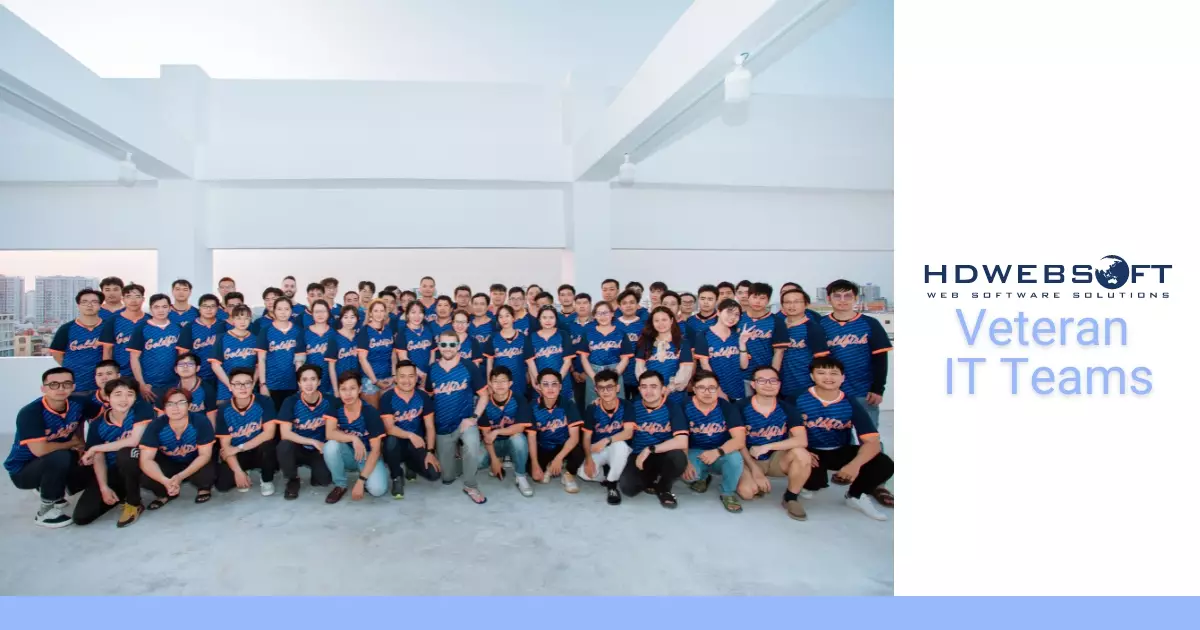 Our veteran IT staff
Our engineering team is the root of HDWEBSOFT’s success. Many engineers have been with the company since its early days and have contributed to research and development work across multiple technology stacks. The team has earned internal awards for outstanding performance and external recognition for software delivery quality. In 2026, the focus is on pairing that veteran experience with modern AI tooling, so senior engineers can accelerate output with AI agents while keeping human judgment for architecture, security, and product decisions.
Conclusion
The offshore outsourcing software development trends 2026 brings point to one conclusion: outsourcing is no longer about cost arbitrage. It is about capability, AI augmentation, and proximity. The market has matured, the technology stack has broadened, and the partners that win are senior-led, AI-augmented, and certified for quality and security. For a broader view of why companies outsource, see our guide on software outsourcing benefits.
If you are evaluating an offshore partner for 2026, HDWEBSOFT delivers software outsourcing services and offshore software development services from Vietnam, with ISO 9001 quality management and ISO/IEC 27001 information security certification, senior-led engineering teams, and AI-augmented delivery workflows.
FAQ
What are the top offshore software development trends for 2026?
The offshore outsourcing software development trends 2026 brings include AI-augmented offshore teams, the shift from cost arbitrage to talent access, nearshoring growth, staff augmentation over project outsourcing, composable applications, cloud-native architecture, zero-trust security, and outcome-based partnership models.
Is AI replacing offshore software development?
No. AI is reshaping offshore development rather than replacing it. AI coding agents commoditize junior-level code generation, so junior-heavy offshore teams lose their cost advantage. The winning model in 2026 is senior-led, AI-augmented delivery, where experienced engineers use AI tools to accelerate output while keeping human judgment for verification, architecture, and product decisions.
What is the difference between nearshore and offshore outsourcing?
Nearshore outsourcing partners with teams in neighboring or nearby countries with overlapping time zones, moderate cost savings, and easier communication. Offshore outsourcing partners with distant countries for lower cost but larger time zone and cultural gaps. In 2026, nearshoring is growing 15 to 20 percent annually as companies prioritize real-time collaboration alongside cost savings.
How much does offshore software development cost in 2026?
Offshore rates in 2026 range from 10 to 25 US dollars per hour for junior-heavy execution teams, 35 to 55 US dollars per hour for senior-led AI-augmented teams, and higher for specialized niches. Cost is no longer the primary driver; 42 percent of executives now cite talent access as the top reason to outsource, while cost fell from 70 percent in 2020 to 34 percent in 2024.
How do I choose an offshore software development partner in 2026?
Evaluate seniority ratio, AI tooling maturity, security certifications such as ISO 27001, quality management certifications such as ISO 9001, delivery model flexibility, and outcome transparency. Avoid junior-heavy teams selling low rates without senior oversight, and prefer partners that use AI-augmented workflows with clear human-in-the-loop verification.
What is agent-shoring and how does it affect outsourcing?
Agent-shoring is the emerging practice of using AI agents and AI-first processes to fulfill engineering tasks instead of an offshore team. It is cheaper than traditional offshore work for routine code generation, but it does not replace offshore development for complex, judgment-intensive work. Agent-shoring reshapes outsourcing by eliminating junior-heavy cost arbitrage and pushing offshore partners toward senior-led, AI-augmented delivery.