
The best software development company is not the biggest name or the lowest rate card — it is the one whose engineering capabilities match what your project actually demands. Choosing well means evaluating six capability dimensions and verifying each with evidence instead of marketing claims. The dimensions: technical and architecture, product discovery, development process, QA and engineering quality, team ownership, and post-launch support.
The stakes are asymmetric. A mismatched hire surfaces late, when the architecture is set and the team is embedded, and costs months of rework. Most selection guides stop at “check their portfolio and reviews”. This one goes into the engineering organization itself: what to ask, what to request, and what a good answer looks like across all six dimensions. That is how to choose the best software development company with a defensible decision instead of a persuasive pitch.
What “Best” Means for Your Project
“Best” is a fit question, not a ranking question. The best company for a regulated fintech backend is rarely the best company for a consumer MVP. The fintech project needs security engineering, audit trails, and integration discipline; the MVP needs discovery speed and iteration. Before comparing vendors, define which capabilities your project weights heaviest.
The cost of skipping this definition is predictable: companies that pick “the biggest name” discover the mismatch after kickoff, when the contract is signed and the team is staffed. The gap is measurable — ISG’s 2025 enterprise research found nearly 65% of organizations dissatisfied or only moderately satisfied with their providers’ ability to drive innovation, exactly what a capability-first evaluation prevents. The six dimensions below turn the vague word “best” into six checkable capability areas — each with its own questions, evidence, and red flags.
| Dimension | What it covers | Why it matters |
|---|---|---|
| Technical & architecture | Stack depth, architecture decisions, scalability, cloud/API, security | Determines whether the system survives growth |
| Product discovery | Requirements quality, assumption testing, scope definition | Determines whether you build the right thing |
| Development process | Agile discipline, code review, CI/CD, documentation | Determines delivery predictability |
| QA & engineering quality | Testing strategy, automation, code quality, tech debt | Determines defect cost over time |
| Team capability & ownership | Seniority, role structure, continuity, ownership mindset | Determines the ceiling of what the team can deliver |
| Post-launch capability | Maintenance, monitoring, scaling, modernization | Determines total cost after go-live |
This guide evaluates engineering capability in depth. For the broader outsourcing-market view — engagement models, provider landscape, and commercial risks — see our guide on choosing the right software outsourcing company.
Dimension 1 — Technical & Architecture Capability
This dimension decides whether the system survives your second year.

- Stack expertise. Depth in your stack beats breadth everywhere. Ask which frameworks they have shipped production systems with — not prototypes — and for how long. Evidence: engineers who answer framework-specific questions directly, without deferring to documentation.
- Architecture decisions. Ask who makes architecture decisions and how they are justified. A mature company documents trade-offs: what was chosen, what was rejected, and why. Strong probe: “walk me through an architecture decision you changed mid-project, and what triggered the change.”
- Scalability thinking. The team should speak concretely about load, data growth, and failure modes — not in adjectives. Ask for a system they scaled and what broke first.
- Cloud, API, and integration capability. Integrations are where projects die quietly. Probe their experience with third-party APIs, legacy system connections, and API design contracts.
- Security engineering. Certificates are the floor, not the proof. Ask how security enters the development lifecycle — dependency scanning, secrets management, secure code review — and how they would handle a critical vulnerability found in production.
What good looks like across this dimension: engineers who answer architecture questions without checking with a manager. Trade-offs are written down instead of improvised, and security lives inside the pipeline rather than in a certificate PDF.
Dimension 2 — Product Discovery Capability
The questions a company asks before quoting reveal how it will work for the next year.
- Business requirements. Order-takers ask “what do you want built?” Partners ask “what problem does this solve, for whom, and how will we know it worked?” The second question is the one that prevents expensive wrong builds.
- Challenging assumptions. A capable partner pushes back when scope conflicts with the stated goal — politely, with reasoning. A vendor that agrees with everything is optimizing for the signature, not the outcome.
- Discovery workshop. Look for a structured requirements process — stakeholder sessions, user flows, prioritized backlog — rather than a form and a quote.
- Technical feasibility. Risky parts of the scope should be flagged early, with options and cost implications, not discovered in sprint three.
- Scope definition. The deliverable of discovery is a written scope that states what is out of scope as clearly as what is in it.
Evidence to request: a redacted discovery artifact from a past project, and attention to the quality of their questions during your first two calls.
A useful test: bring an ambiguous requirement to the first call — something your own team disagrees about. A capable discovery process surfaces the ambiguity, proposes two interpretations, and asks which matches the business goal. An order-taker quotes both interpretations and lets you pick. The difference costs nothing on the call and everything after kickoff.
Dimension 3 — Software Development Process
Process is what makes delivery predictable instead of heroic.
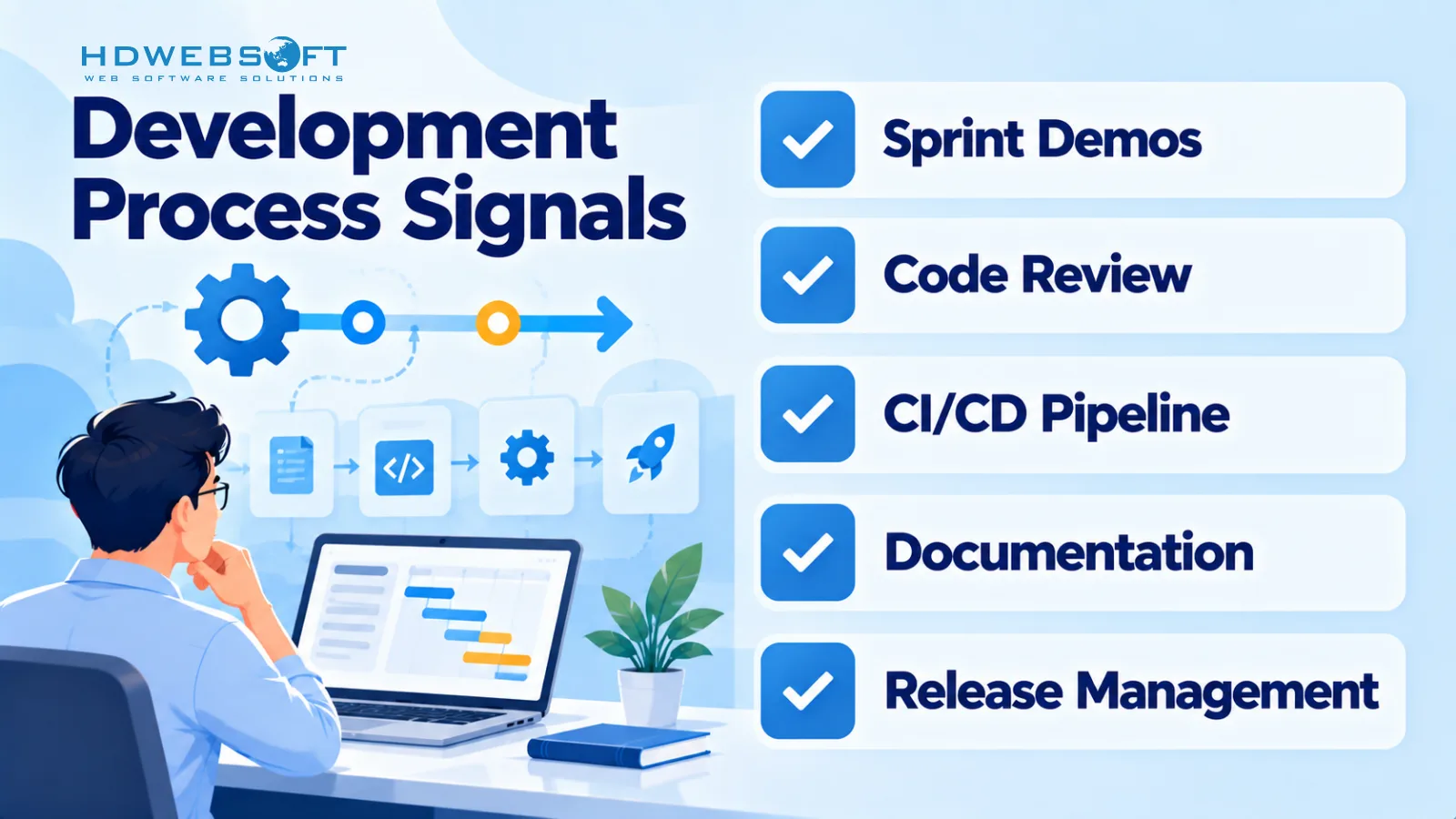
- Agile and sprint discipline. Every sprint ends with a demo of working software — not slides about activity. Ask what a typical sprint review looks like.
- Code review practice. Every change gets a second pair of eyes, and review comments live in the history. No engineer merges their own code unreviewed.
- CI/CD maturity. Automated build and test run on every merge; deployments are routine, not events. Ask for a pipeline walkthrough — the demo itself is the evidence.
- Documentation habits. Architecture decisions and operational procedures are written down and survive personnel changes. Ask to see a sample (under NDA).
- Release management. Versioning, release notes, and a rollback plan are standard practice, not improvisation.
Once the engagement is running, these signals become metrics you track continuously — the measurement framework is covered in how to evaluate offshore software development quality.
One verification shortcut works better than any questionnaire: ask for a live walkthrough of their actual pipeline — repository, CI runs, review history, deployment log. A mature process survives being watched; an assembled one does not.
Dimension 4 — QA & Engineering Quality
Quality capability shows up in how defects are prevented, not just how they are fixed.
- Testing strategy. Look for a layered approach — unit, integration, end-to-end — matched to risk. “We test manually at the end” is a disqualifying answer for anything beyond a prototype.
- QA involvement. Strong teams involve QA at requirements and sprint planning, so testability shapes the build. QA arriving after development “finishes” finds defects at their most expensive.
- Automated testing. Coverage is reported, tests run in the pipeline on every merge, and the regression suite is maintained — not written once and abandoned.
- Code quality gates. Static analysis runs in CI, critical findings block merges, and the team can show a dashboard rather than describe one.
- Technical debt management. Ask how they track debt and budget refactoring. A team that cannot name where it paid down debt is accumulating yours.
Evidence to request: a sample test report, coverage visibility, and their process for triaging a bug found in production.
The timing detail matters more than the tooling list. A QA engineer who joins sprint planning asks “how will we test this?” before a line of code exists. Ambiguous requirements get caught there, at the cost of a conversation. The same engineer joining after development finds the same ambiguity inside a built feature, at the cost of a rework cycle. Same headcount, opposite economics.
If you plan to outsource QA as a separate function rather than relying on the development vendor’s own testers, the calculation changes — the benefits and trade-offs of dedicated QA outsourcing are worth understanding first.
Dimension 5 — Team Capability & Ownership
This dimension sets the ceiling on everything else.

- Seniority. The people who impressed during sales are not always the people who deliver. Interview the actual engineers who will build your system, not the account manager.
- Role structure. Ask who owns requirements (BA/PM), technical decisions (Tech Lead), and quality (QA) on the proposed roster. Unowned gaps become your problem after kickoff.
- Team continuity. Ask about turnover and the replacement process. A team that rotates silently takes your context with it; a documented replacement process protects you.
- Ownership mindset. The strongest signal in the whole evaluation: does the team propose solutions and flag risks unprompted, or wait to receive tasks and code? Task-executors cap what your product can become.
Evidence to request: a named roster with roles and seniority mix, references speaking to team stability, and the story of how they handled a mid-project senior departure. Ownership is also what separates a transactional vendor from a strategic partner — the shift is mapped in successful outsourcing: a lifecycle framework for measurable results.
Continuity deserves its own probe because it fails quietly. Ask what happened the last time a senior engineer left a client project. How long was the gap, who absorbed the knowledge, and what did the client experience during the transition? A company with a real answer — documentation, overlap period, named successor — has a system. A company that answers “we haven’t had that problem” has not been in business long enough, or is not telling you.
Dimension 6 — Post-Launch Capability
Software does not end at go-live; this dimension determines your cost after launch.
- Maintenance. Ask for the fix SLA, the warranty period after delivery, and who is on call when production breaks.
- Monitoring. A capable partner sets up observability — logs, metrics, alerts — before handover. A blind handover makes every incident yours alone.
- Bug fixing. There should be a triage process with severity definitions and agreed fix windows, not ad-hoc heroics.
- Scaling. Ask for a system they grew after launch — team and architecture together.
- Modernization. Frameworks and dependencies age. A long-term partner plans upgrade paths instead of letting the stack fossilize.
- Long-term evolution. The strongest partners contribute roadmap input, not just ticket execution.
These commitments belong in the contract, not in a sales conversation — service levels, warranty scope, and support terms are covered in an ultimate guide to software outsourcing contract.
Modernization is the part buyers forget until it hurts. Every framework has a lifecycle, and a system built on a version that stops receiving security patches becomes a liability regardless of how well it was built. Ask what the vendor’s own products run on today, and how they handled the last major framework migration they performed — for a client or for themselves.
How to Run the Evaluation
Six dimensions produce a lot of signal — structure it into a decision.
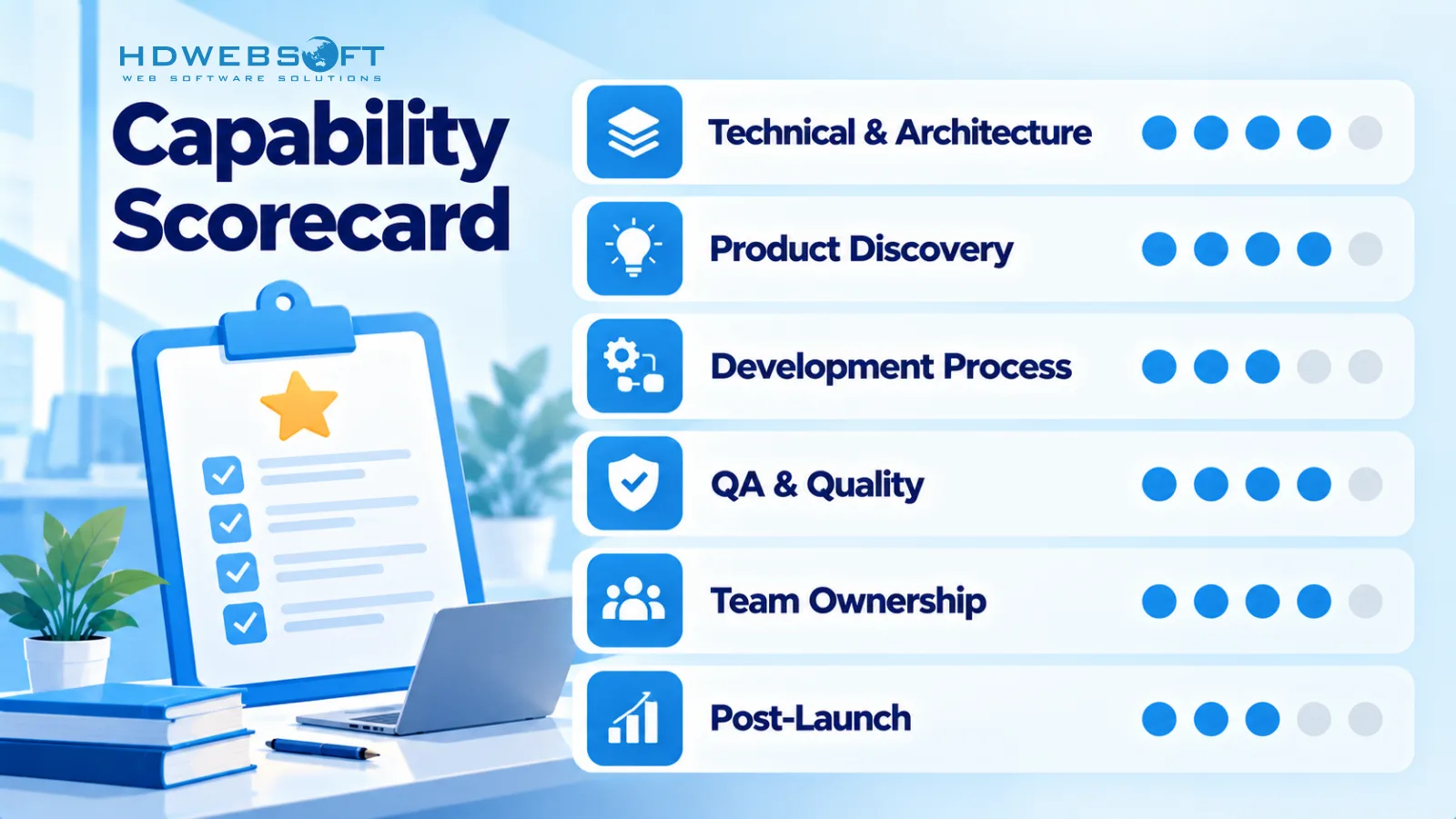
- Weight by project type. A regulated backend weights security and architecture heavily; a consumer MVP weights discovery and speed. Assign weights before scoring, or every vendor looks average.
- Verify with evidence. Code samples under NDA, a CI/CD pipeline walkthrough, interviews with the named engineers, and reference calls from similar-scale projects. Artifacts outweigh claims at every step.
- Score and compare. Rate each dimension one to five with a written justification, then compare shortlisted companies on the weighted total. A written score survives stakeholder disagreement; a gut feeling does not.
A worked example: for a regulated payments backend, weight security engineering and architecture at 25% each, QA and process at 15% each, discovery and post-launch at 10% each. A vendor scoring five on discovery but two on security loses to a vendor scoring four on both — and the weighted math shows it plainly. That transparency is the practical value of running the evaluation this way: it is how to choose the best software development company without the loudest pitch winning.
With a scored shortlist in hand, the stage-by-stage hiring process takes over — see our checklist to hire an offshore software development team.
Red Flags Across the Six Dimensions
| Dimension | Red flag |
|---|---|
| Technical & architecture | Cannot describe an architecture decision they changed and why |
| Product discovery | A quote arrives without questions about users or success metrics |
| Development process | No pipeline demo offered; testing described as a final phase |
| QA & engineering quality | No coverage reporting; defects “found by the client” |
| Team capability & ownership | Roster without named engineers; unexplained turnover |
| Post-launch capability | No maintenance SLA; “support — we’ll discuss later” |
Most of these signals surface in the first two conversations. A vendor that fails three or more dimensions in the red-flag table is not a candidate for a pilot — it is a candidate for the shortlist bin.
One caution cuts the other way: a single red flag is information, not a verdict. A strong answer elsewhere can outweigh one weak spot — a candid architecture story, a named roster, a real maintenance SLA. The key is whether the vendor acknowledges the weak spot and says how they would close it. The table exists to structure the conversation, not to end it.
Why Choose HDWEBSOFT
HDWEBSOFT is an ISO 9001 and ISO/IEC 27001 certified software company with 14+ years of experience and 750+ projects delivered worldwide. Our evaluation against the six dimensions is open for inspection: named engineers, documented architecture decisions, a reviewable development pipeline, and maintenance commitments written into every contract. Explore our software outsourcing services and offshore software development services to see how the model works in practice.
FAQ
What should I look for when choosing a software development company?
Evaluate six capability dimensions with evidence: technical and architecture capability, product discovery capability, development process, QA and engineering quality, team ownership, and post-launch support. For each dimension, ask specific questions and request proof — code samples, pipeline walkthroughs, named rosters — instead of trusting presentations.
How do I verify a software company’s technical capability?
Combine four checks: a code review of samples from similar projects, an architecture conversation with the engineers who will build your system, and a walkthrough of their CI/CD pipeline and testing setup. Then add a paid pilot sprint on real backlog items.
What questions should I ask a software development company before signing?
Ask per dimension: which architectures they changed and why (technical), what they ask about your users and success metrics (discovery), what runs on every merge (process), how defects are caught before release (QA), who owns decisions on the proposed roster (team), and what the maintenance SLA is (post-launch).
Should I choose a large software company or a small one?
Fit matters more than size. A large company brings process maturity and bench depth; a small one brings senior attention and speed. Evaluate the six capability dimensions against your project type — a regulated backend weights security and architecture heavily, while a consumer MVP weights discovery and speed.
What are red flags in a software development proposal?
Watch for quotes produced without questions about users or success metrics, a roster without named engineers, no demo of their development pipeline, testing described as a final phase only, no maintenance SLA, and reluctance to run a paid pilot.
How is choosing a software development company different from choosing an outsourcing vendor?
The evaluation overlaps, but the scope differs. An outsourcing-vendor comparison usually stops at portfolio, reviews, rates, and communication. Choosing the best software development company goes deeper into the engineering organization itself — architecture decisions, discovery capability, CI/CD maturity, QA involvement, ownership mindset, and post-launch commitments — because those capabilities determine the outcome long after the contract is signed.
How long should I evaluate a software development company before signing?
Two to four weeks is enough for a structured evaluation: one week for the capability review across the six dimensions, one to two weeks for a paid pilot sprint, and a few days to score the shortlist and check references. Rushing the pilot is the most expensive shortcut.
Conclusion

Choosing the best software development company is an engineering due-diligence exercise, not a vendor beauty contest. Evaluate the six capability dimensions — technical and architecture, discovery, process, QA quality, team ownership, and post-launch — with evidence at every step, weight them for your project type, and let a scored comparison make the decision your stakeholders can defend.
Ready to put a vendor through this evaluation? Contact HDWEBSOFT — we will walk you through our answers to every question in this guide, with the artifacts to prove them.