
Every outsourcing pitch hides the same uncomfortable question: what if this goes wrong? The concerns are legitimate — quality you can’t inspect, security you can’t verify, costs that drift, a team you can’t see. The good news: nearly every one of them is a contract and governance problem, not an outsourcing problem, which means they can be addressed before the first line of work is signed.
This article walks through the six concerns buyers raise most often, and the concrete mitigation for each — the things to write into the agreement, not hope for afterward.
Why Companies Hesitate Before Outsourcing
IT is the most outsourced business function there is. In Deloitte’s Global Outsourcing Survey, cost reduction has long been the top-cited objective — yet the same surveys consistently flag quality risk, loss of control, and security exposure as the top barriers to adoption. The hesitation is rational; the mistake is treating it as a veto instead of a checklist.
A buyer who names their concerns gets to negotiate mitigations. A buyer who skips them gets a surprise later — and at that point it’s no longer a concern, it’s a failure mode. (The post-mortem version of this list lives in Why IT Outsourcing Fails — ten root causes plus the early-warning signs.)

The 6 Concerns — and How to Address Each One
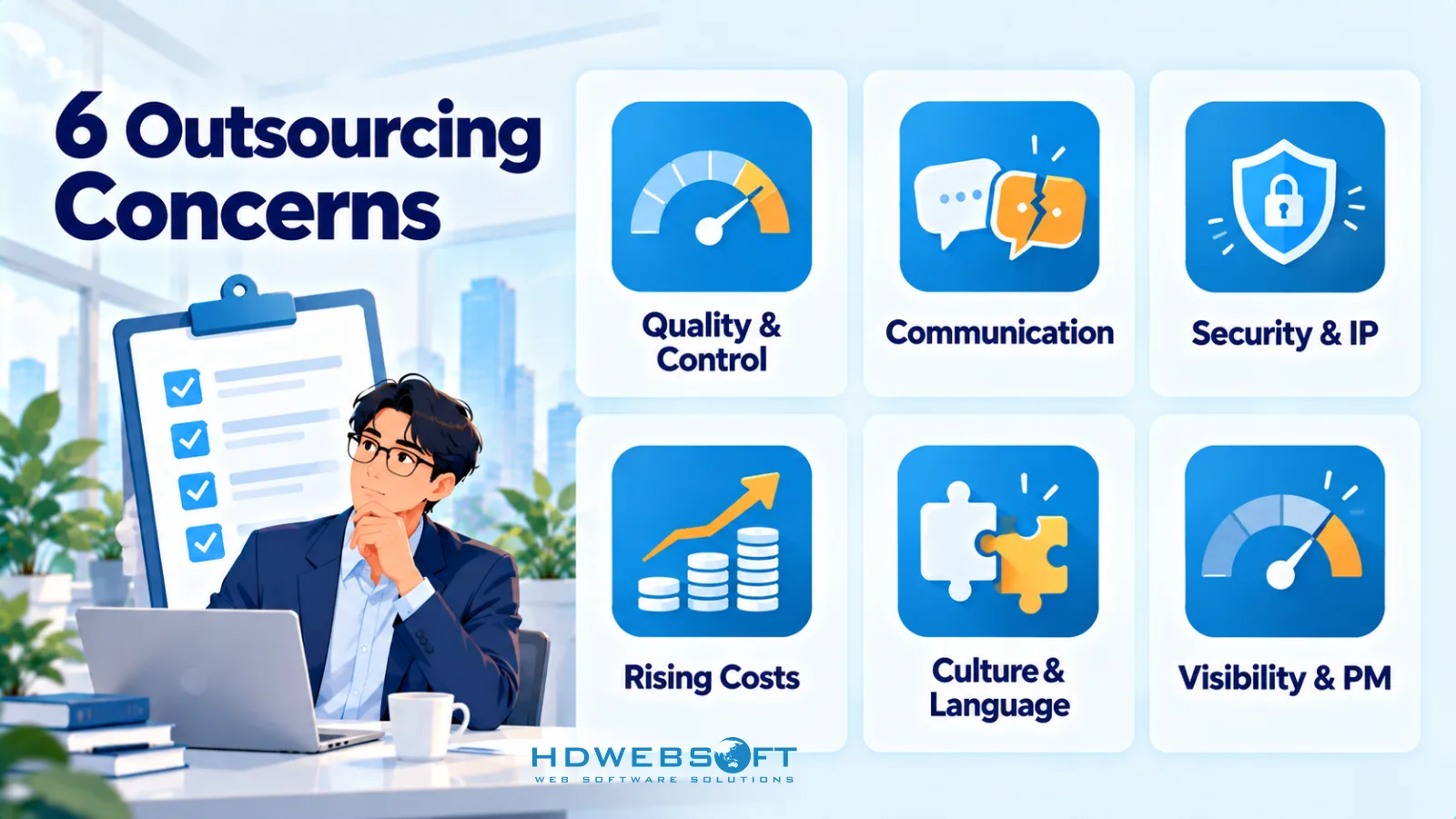
1. Quality and Loss of Control
The concern: A dispersed team uses different coding styles, testing habits, and documentation standards. Without someone in the room, you can’t see drift until a release embarrasses you.
Address it in the contract and setup:
- Specify coding standards, test coverage expectations, and documentation requirements in the agreement — not in a slide deck.
- Schedule recurring code reviews and periodic quality audits as deliverables, not favors.
- Run a shared issue tracker both sides can see in real time — a bug visible to you the moment it’s filed is a different risk than one that surfaces at handover.
2. Communication and Collaboration
The concern: Time zones, handoffs, and the “was that a yes or a polite no” problem. Work stalls not because people can’t code but because nobody clarified the requirement.
Address it:
- Contract a minimum overlap window per week — two to three shared hours is usually enough to keep decisions synchronous. (How far your vendor sits on the onshore–nearshore–offshore axis is a separate choice — the comparison is in outsourcing vs offshoring.)
- Make written-first updates the norm: decisions and blockers land in a shared channel, not in meetings that half the team slept through.
- Assign one named contact per side; single-threaded communication beats a ten-person group chat where nobody owns the answer.
3. Security and Confidentiality
The concern: Source code, customer data, and product roadmap leave your four walls — into a legal regime you don’t fully know, with people you’ll never meet.
Address it:
- IP assignment must be explicit and perpetual in the contract — every line of code belongs to you from the moment it’s written.
- NDAs for every team member, not just the vendor entity; defined data-handling rules (encryption, access control, storage location).
- Ask for the vendor’s security controls and certifications upfront — a provider with ISO/IEC 27001-grade discipline has already built the machinery you’re worried about. The clause-level detail is in our software outsourcing contract guide.
4. Costs That Outgrow the Quote
The concern: The estimate was lowball-friendly; the change requests are where the invoice actually lives. Or the fixed price was padded to cover the vagueness you both knew was there.
Address it:
- Tighten the scope document before pricing — vendors can only quote tightly when requirements are.
- Agree a change-order process with defined turnaround and rate treatment, so “a small adjustment” stops being a blank check.
- Compare total cost of engagement, not hourly rates: a cheap rate on a loose scope is more expensive than a fair rate on a tight one.
5. Cultural and Language Friction
The concern: Nuance lost in translation, unspoken disagreement, public holidays that don’t match yours, an “everything is fine” culture that hides blockers.
Address it:
- Screen for working-language proficiency during selection — not accent, but the ability to raise a problem clearly in writing.
- Set the norm that surfacing risk early is rewarded; the engagement fails on hidden bad news, not on bad English.
- Map holiday calendars into the delivery plan at kickoff, not after the first missed date.
6. Visibility and Project Management
The concern: You get a weekly status deck instead of seeing the actual state of work. Milestones pass, the green lights stay green, and then the release date moves.
Address it:
- Require transparent progress metrics — committed vs. delivered scope, defect trends, cycle time — in a shared dashboard, not a recap email.
- Agree a demo cadence where you see working software, not status descriptions of working software.
- Define escalation paths in the contract: who to escalate to, how fast they must respond, and what happens if the same issue escalates twice.
Concerns vs. Failures: Know Which Phase You’re In
A concern is a risk you name before signing; a failure is that same risk materializing because nobody built a mitigation.

The lists overlap almost exactly — vague scope, misaligned incentives, weak governance — which is the point: the work done at contract time is the best predictor of whether the engagement holds.
If you’re already mid-engagement and the warning signs are showing — missed small commitments, slide-level answers, a team you can’t name — read Why IT Outsourcing Fails for the diagnostic version of this list.
Choosing a Vendor That Answers Concerns Before You Ask
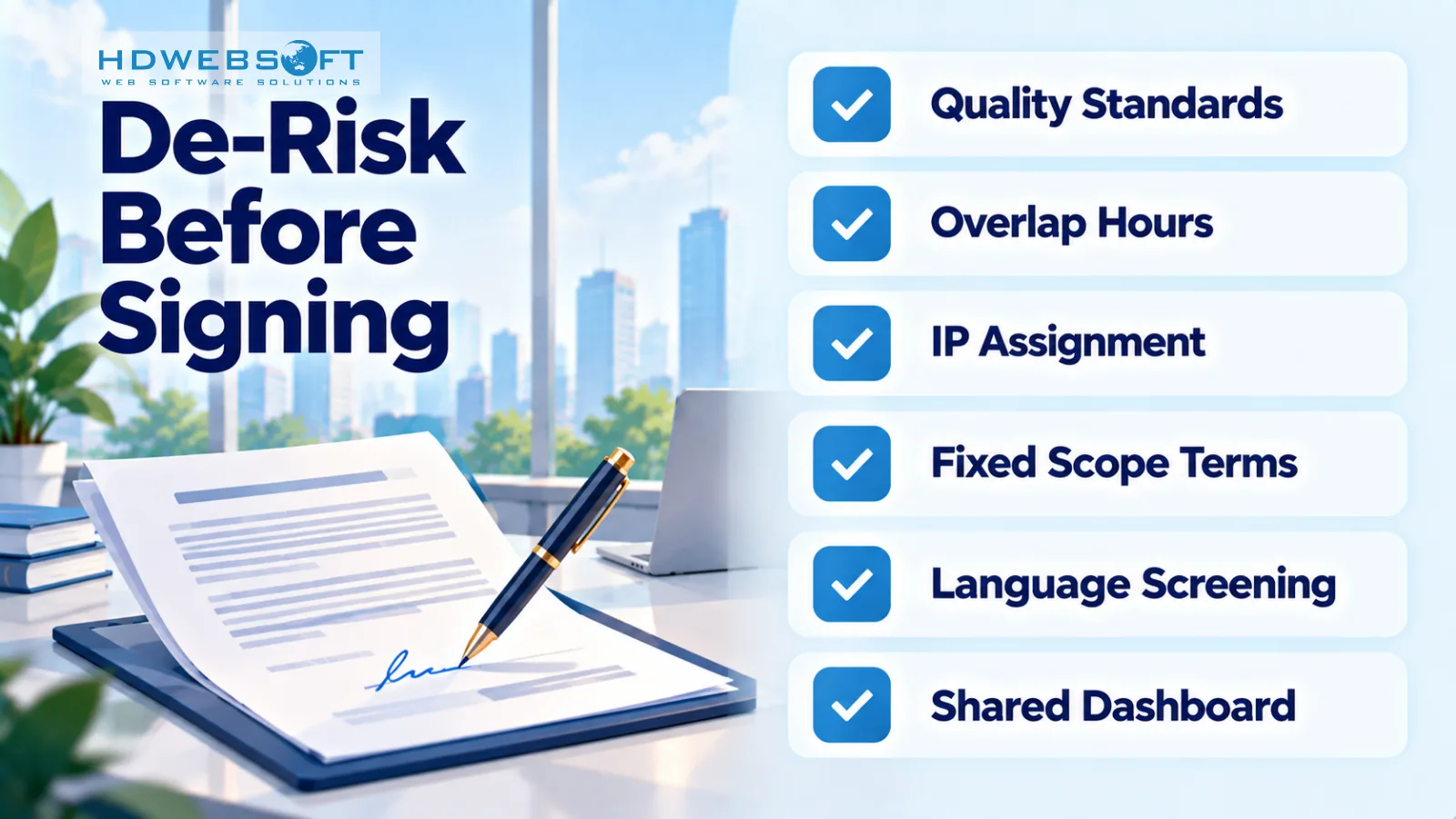
The strongest risk mitigation is picking a provider whose process is the answer. Look for transparent pricing models, defined roles per engagement, written handover discipline, and a portfolio you can verify — a vendor who surfaces these things unprompted has less to hide. Our guide on how to choose a software outsourcing company walks through the evaluation criteria in detail.
Why HDWEBSOFT
14 years across 750 projects is that discipline in practice: defined quality standards in the contract, named accountable leads, shared dashboards, written handover rules, and ISO-grade security controls applied to every engagement.
Our software outsourcing services cover the full lifecycle — scoping, delivery, QA, and post-release support — built so the six concerns above are handled by default, not by request.
Frequently Asked Questions
What are the biggest concerns with IT outsourcing?
The six concerns buyers raise most are inconsistent quality, communication gaps, security and IP exposure, unclear or escalating costs, cultural and language friction, and loss of visibility over the work. Almost all are mitigated at contract time — through written quality standards, service levels, IP clauses, transparent pricing, and an agreed reporting cadence.
How do you protect quality in an outsourced project?
Put quality in the contract, not in expectations: specify coding standards, testing procedures, and documentation requirements; schedule regular code reviews and periodic quality audits; and use a shared bug-tracking system so issues are visible to both sides the moment they appear.
Is my intellectual property safe when outsourcing?
It can be — if the contract does the work. Require explicit IP assignment, NDA coverage for every team member, defined data-handling rules, and security controls matching your compliance needs. Vague IP language is the actual risk, not the geography of the vendor.
Why does outsourcing end up costing more than expected?
Usually because scope was vague and change requests were priced ad hoc. Fixed-price quotes on loose requirements invite padding; time-and-materials on loose scope invites drift. Tighten the scope definition, agree on a change-order process, and compare vendors on total cost of engagement — not hourly rates.
Do language and culture differences actually matter in outsourcing?
They matter at the edges: meeting participation, requirement nuance, and how comfortable engineers are raising bad news. Mitigate with a working-language requirement at interview time, written-first communication norms, and a small set of overlap hours — not by demanding accent fluency.
How is an outsourcing concern different from an outsourcing failure?
A concern is a risk you anticipate before signing; a failure is that risk materializing because nobody built a mitigation for it. The same short list drives both — vague scope, misaligned incentives, weak governance — so the mitigation work done up front is the best predictor of whether the engagement will hold.
Conclusion

The concerns around IT outsourcing are real — and almost all of them are solvable at signing time, with the right clauses, cadences, and transparency mechanics written in. Vague scope, weak governance, and hidden incentives aren’t reasons to avoid outsourcing; they’re the checklist for doing it properly.
If you want a vendor whose default process already answers these six concerns, contact HDWEBSOFT to discuss your scope.