
Choosing the right software outsourcing company comes down to five checks: proven delivery in a domain like yours, verifiable client references, transparent total cost, a communication system that survives time zones, and a contract that protects your IP. Get those five right and most everything else falls into place.
The stakes are worth the effort. Worldwide IT outsourcing revenue is projected to reach about $618.36 billion in 2026, according to the Statista IT Outsourcing Outlook — and as the market grows, so does the gap between vendors who deliver and vendors who only sell. This guide walks through the evaluation criteria, engagement models, risks, and contract essentials you need before signing. For a broader view of the full engagement lifecycle, see our software development outsourcing guide.
Understanding Software Outsourcing
What is Software Outsourcing?
Software outsourcing means delegating part or all of your software development — design, build, testing, maintenance — to an external company instead of hiring that capacity in-house. The vendor supplies the engineers, the process, and usually the project management; you keep ownership of the product and the roadmap.
Why Businesses Outsource Software Development?
Companies outsource software development for four recurring reasons:
- Capacity — scale a team up in weeks instead of months of recruiting.
- Cost efficiency — access senior engineering talent at rates below local hiring costs.
- Speed to market — start delivery immediately with an already-formed team.
- Focus — keep internal staff on core product and customers while the vendor handles execution.

Considerations for Choosing a Software Outsourcing Company
This is the section that decides whether the engagement succeeds. Evaluate vendors in roughly this order — a weakness in the first two criteria cannot be compensated by a low price later.
Company’s Expertise and Credentials
Start with evidence the vendor can actually deliver your kind of project:
- Relevant portfolio: case studies in your industry or with a similar technical shape (e.g., real-time systems, integrations, regulated data).
- Certifications: ISO 9001 for quality management and ISO/IEC 27001 for information security are baseline signals of mature process.
- Team composition: ask for the proposed roster — names, roles, seniority mix — not just the sales deck. Team stability and low turnover matter more than headcount.
- Service scope: a vendor offering full-cycle software outsourcing services (discovery, development, QA, maintenance) is easier to govern than stitching together multiple providers.
Client Reviews and Testimonials
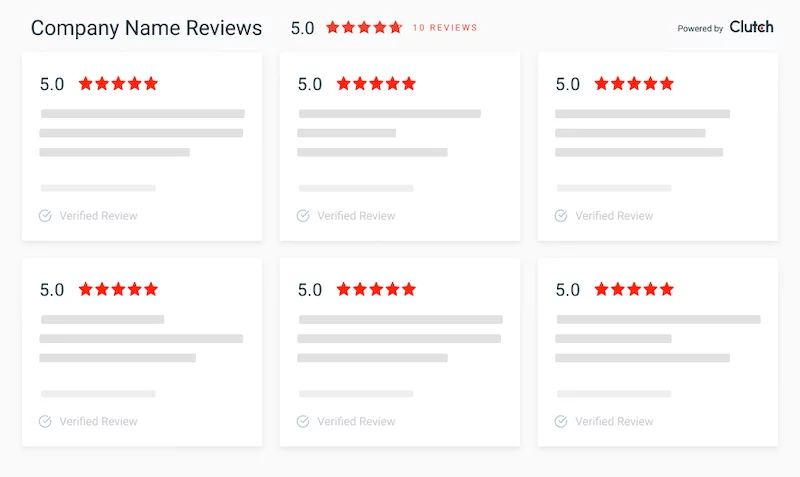
Do not rely on testimonials published on the vendor’s own site. Cross-check on independent platforms — for example, HDWEBSOFT’s verified Clutch profile shows client-verified reviews with project context. Then go one step further:
- Ask for two or three reference calls with past clients in a similar engagement model.
- Ask references not just “were you happy?” but “how did the vendor handle the hardest moment of the project?”
- Verify trust signals beyond marketing — claims are cheap; evidence mapped to contract clauses is not.
Cost-effectiveness and Value for Money
Compare total cost of ownership, not hourly rates. A cheaper team that produces rework, missed sprints, and management drag costs more than a senior team at a higher rate. As a benchmark, in the Deloitte 2025 Global Business Services Survey, roughly half of responding organizations reported more than 20% savings from their GBS operations — meaningful savings are realistic, but they come from operational maturity, not from picking the lowest bid.
When comparing quotes, ask each vendor to break down: rate card by role, assumed team size, estimated rework/bug-fix allowance, management overhead, and what is explicitly out of scope.
Communication and Cultural Compatibility
Delivery failures trace back to communication more often than to code. Check:
- Time zone overlap: is there a guaranteed daily window for meetings and unblocking?
- Async discipline: stand-up notes, shared boards, and written decisions — or does everything depend on calls?
- Escalation path: who do you reach when the PM cannot resolve an issue, and within what SLA?
- Working language: interview the engineers who will do the work, not only the sales team.
These considerations are the market-level view. For the deeper engineering evaluation — architecture capability, discovery process, CI/CD maturity, QA involvement, team ownership, and post-launch commitments — see how to choose the best software development company. For the buyer’s risk list these criteria are meant to address — quality, security, cost creep, visibility — see common IT outsourcing concerns.
Top Software Outsourcing Companies
Rather than a ranked list, here is a short shortlist of established vendors with different profiles — useful as reference points when you build your own candidate list. For a fuller ranked comparison with selection criteria, see our 2026 buyer guide to offshore software development companies in Vietnam.
HDWEBSOFT
HDWEBSOFT is a software outsourcing company headquartered in Ho Chi Minh City, Vietnam, with 250+ engineers and ISO 9001 and ISO/IEC 27001 certifications. We deliver custom web and mobile applications, SaaS products, and enterprise systems through project-based, dedicated team, and staff augmentation engagement models.
ScienceSoft
A US-headquartered vendor in software development since 1989, with a team of roughly 750 professionals covering consulting, custom development, testing, and DevOps. A fit for enterprises that need a large, process-heavy partner.
Saigon Technology
A Vietnam-based Agile software development company founded in 2012, focused on offshore delivery for clients in North America, Europe, and Asia-Pacific, with strengths in web and mobile development.
BairesDev
A large nearshore vendor drawing talent primarily from Latin America, serving US clients that want strong time zone alignment and a broad bench of engineers.
Software Outsourcing Models
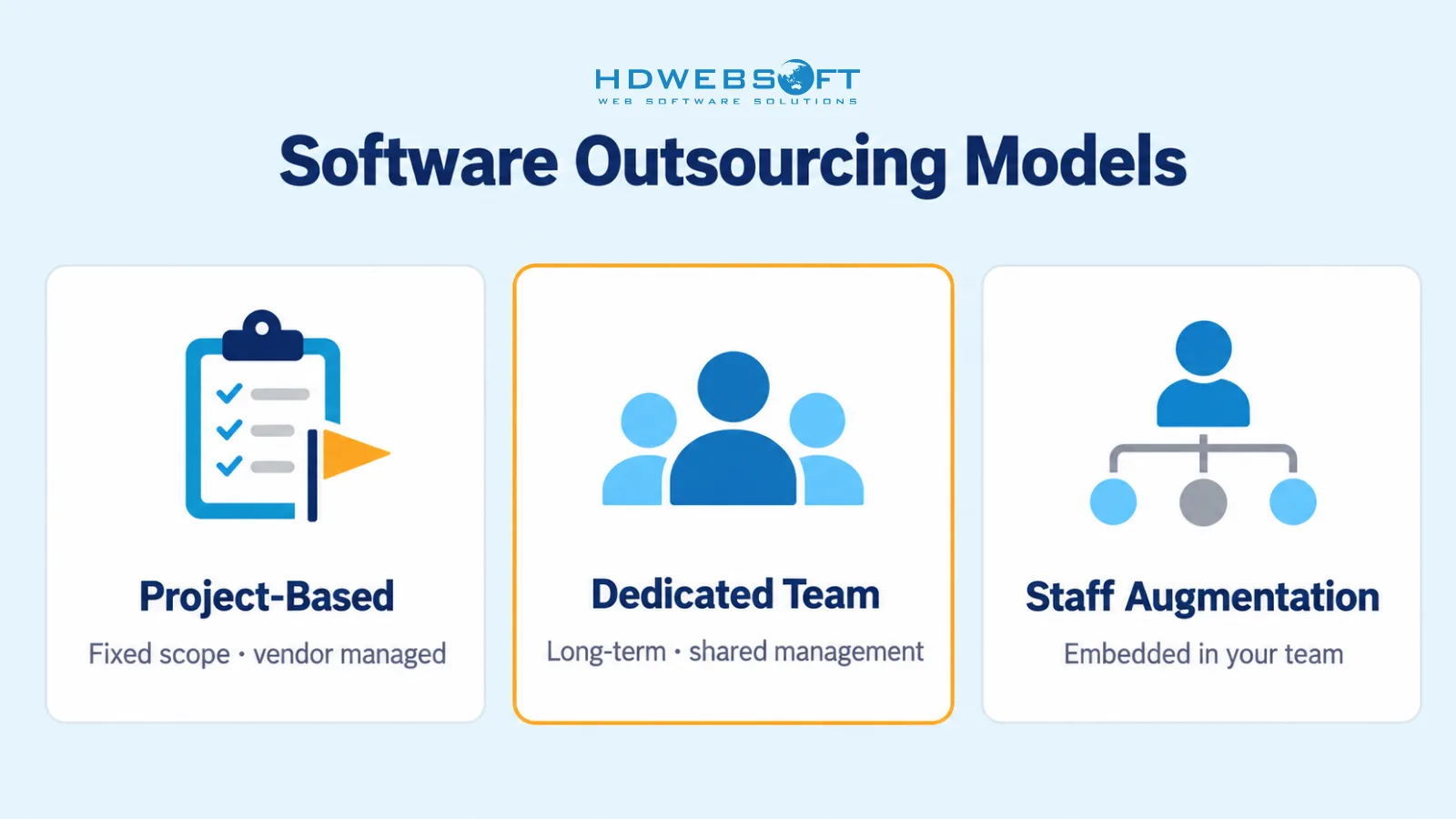
There are three core software development engagement models; “hybrid” is simply a combination of them rather than a fourth model.
| Model | What you get | Best for | Main trade-off |
|---|---|---|---|
| Project-based | Fixed scope, vendor manages delivery | Defined projects, limited internal capacity | Less flexibility when scope changes |
| Dedicated team | Stable full-time team, jointly managed | Long-term products, evolving scope | Requires your product ownership |
| Staff augmentation | Vendor engineers inside your team | Filling skill gaps, keeping control | You carry management overhead |
Project-Based Outsourcing
You hand the vendor a defined scope, timeline, and deliverables; they manage execution end to end. This works best when requirements are stable and you lack internal delivery capacity — but scope changes renegotiate cost and timeline, so invest in a solid specification first.
Dedicated Team Model
The vendor provides a stable team that works exclusively on your product over the long term, typically managed jointly. You keep product direction; the vendor handles recruitment, retention, and team health. It suits products with evolving roadmaps where continuity of knowledge matters.
Staff Augmentation
Vendor engineers embed directly into your existing team and processes, under your management. Maximum control and fastest scaling, but you own delivery management — it augments your capacity, not your process maturity.
Many companies combine these — for example, a dedicated core team plus staff augmentation for a temporary specialist — which is all “hybrid outsourcing” means in practice.
Benefits of Software Outsourcing

Access to Global Talent and Expertise
Working with an external team opens a hiring market far larger than any single city. You can reach specialists — cloud architects, AI engineers, security experts — that are scarce or unaffordable locally, without building permanent headcount.
Cost Savings
Lower rates in offshore and nearshore markets reduce build cost, but the bigger saving is avoiding recruitment, benefits, office, and tooling overhead for roles you may not need permanently. Realize the savings through total cost of ownership, not just rate arbitrage.
Focus on Core Business Activities
Delegating execution frees internal leadership and engineers for product strategy, customers, and differentiation — the work only your own team can do.
Risks Associated with Software Outsourcing
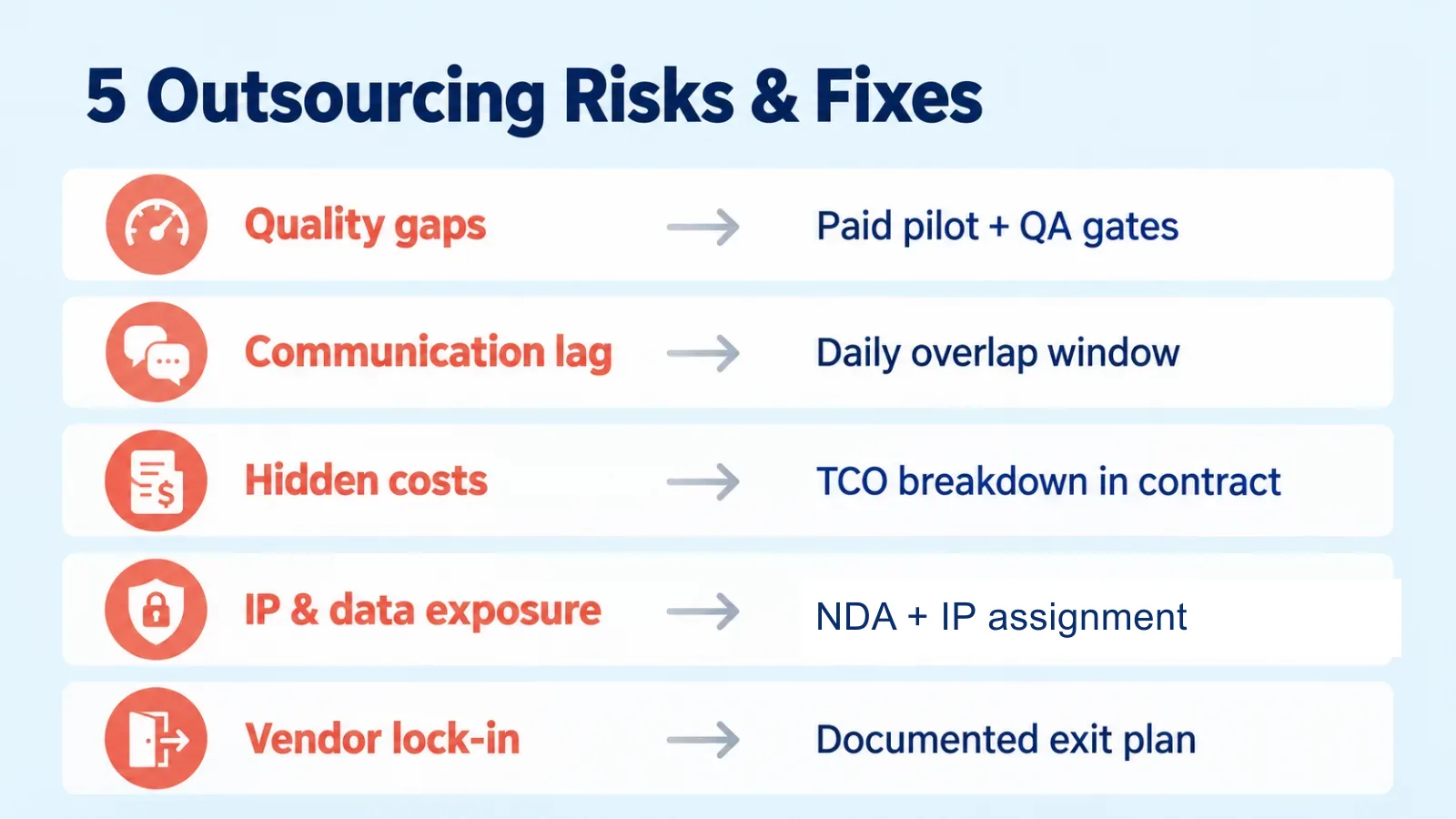
Five risks account for most failed engagements:
- Communication gaps — time zone distance plus weak async habits produce drift and duplicated work.
- Quality drift — without shared standards and review gates, delivered code diverges from expectations.
- Security and IP exposure — broad data access, unclear IP assignment, or weak vendor security practices.
- Hidden costs and scope creep — ambiguous specifications convert into change requests and overruns.
- Vendor dependency — undocumented knowledge concentrated in the vendor’s team makes switching painful.
How To Mitigate These Risks
Each risk has a specific control:
- Communication: agree a daily overlap window, async update standards, and a named escalation path — in the contract, not just verbally.
- Quality: define acceptance criteria, code review rights, and CI/quality gates up front; review real output weekly, not status slides.
- Security/IP: NDA before disclosure, IP assignment in the contract, role-based access, and check for certifications such as ISO/IEC 27001.
- Cost/scope: write a detailed specification, fix change-request pricing rules, and ask what the quote excludes.
- Dependency: require documentation, shared repo and cloud access under your ownership, and a knowledge-transfer clause for offboarding.
What to Expect from a Software Outsourcing Company?
Regular Updates and Transparent Communication
Expect a predictable rhythm: sprint demos, written weekly status, direct access to the issue tracker and repository, and honest reporting when something slips. Transparency you can verify beats optimism you cannot.
Quality Assurance and Testing
A credible vendor runs QA as a first-class discipline: test plans, automated coverage where it matters, defect triage, and release criteria. Use this framework to evaluate offshore software development quality before you sign — and keep reviewing it during delivery.
After-sales Support and Maintenance
Delivery does not end at launch. Expect a warranty period for defects, defined SLAs for incident response, and a maintenance option so the same team that built the system can keep it healthy.
How to Get Started with Software Outsourcing?
The path from decision to delivery runs through five steps: define requirements, shortlist vendors, run due diligence and a pilot, sign the contract, then kick off.

Defining Your Software Requirements
Document what you are building, for whom, and what “done” looks like: scope, must-have features, integrations, quality and security expectations, budget range, and timeline. Vendors price and plan from this document — vagueness here becomes overruns later.
Finding the Right Software Outsourcing Partner
Shortlist three to five vendors against the evaluation criteria above. Then move from claims to evidence: technical interviews with the proposed engineers, reference calls, and a paid pilot of four to eight weeks on a real deliverable. A pilot reveals how a team handles blockers and feedback in a way no proposal can.
Negotiating and Signing the Contract
The contract is where vetting becomes enforceable. Cover scope and deliverables, acceptance criteria, IP ownership, confidentiality, payment schedule, change-request pricing, termination and exit rights, and the knowledge-transfer obligation. Our guide to the software outsourcing contract covers each clause in detail. After signing, kick off with an onboarding plan: access provisioning, team introductions, communication cadence, and the first sprint goals.
How Does Software Outsourcing Impact Your Business Growth?
Done well, the partnership compounds: faster delivery shortens time to market, flexible capacity absorbs demand spikes without hiring cycles, and senior external experience raises the bar of your internal practices. Done poorly — chosen on price alone, governed loosely — it produces the opposite: rework, delays, and a codebase your own team does not understand. The difference is almost never the country or the rate; it is how rigorously you chose and how actively you govern.
Key Takeaways
- Choosing an outsourcing company is an evaluation exercise: portfolio relevance, verifiable references, TCO, communication system, and contract protection — in that order.
- There are three core engagement models — project-based, dedicated team, staff augmentation; hybrid is just a combination of them.
- Five risks cause most failures: communication gaps, quality drift, security/IP exposure, hidden costs, and vendor dependency — each has a specific mitigation.
- A four-to-eight-week paid pilot is the single most reliable vetting tool.
- Put governance in writing: overlap windows, escalation paths, acceptance criteria, and exit rights belong in the contract.
FAQ
How much does software outsourcing cost in 2026?
Rates range roughly from $20–$45 per hour in Vietnam and South Asia, $40–$80 in Eastern Europe, and $80–$150+ in the US and Western Europe. Total cost depends more on scope clarity, rework, and management overhead than on the hourly rate — compare total cost of ownership, not rate cards.
What is the difference between project-based outsourcing, a dedicated team, and staff augmentation?
The project-based model hands a defined scope to the vendor to deliver end to end. A dedicated team gives you a stable, long-running team managed jointly with the vendor. Staff augmentation embeds vendor engineers inside your own team under your management. Many engagements combine them into a hybrid arrangement.
How do I protect IP and data security when outsourcing software development?
Sign an NDA before sharing details, assign IP ownership in the contract, restrict repository and data access by role, verify security certifications such as ISO/IEC 27001, and require a documented knowledge-transfer and exit plan.
What are the red flags when evaluating a software outsourcing company?
Refusing reference calls, not letting you interview the engineers who will actually do the work, quoting far below market without explanation, vague answers about team stability, no clear escalation path, and reluctance to convert sales promises into contract clauses.
Should I run a pilot project before signing a long-term outsourcing contract?
Yes. A paid pilot of four to eight weeks on a real, scoped deliverable is the most reliable evaluation tool — it exposes how the team handles blockers, feedback, and ambiguity under realistic pressure, which proposals and sales calls cannot show.
How do time zone differences affect software outsourcing?
They are manageable when the vendor guarantees a daily overlap window, uses disciplined asynchronous updates, and defines an escalation path for urgent issues. They become a problem when communication depends on ad-hoc calls across a 10–12 hour gap with no overlap.
Is Vietnam still a good software outsourcing destination in 2026?
Yes — Vietnam remains competitive thanks to a large engineering talent pool, strong cost-to-quality ratio, and maturing delivery standards among established vendors. Vendor-level due diligence still matters more than country-level averages.
Conclusion
Choosing the right software outsourcing company is not about finding the cheapest bid or the biggest brand — it is about systematically verifying delivery capability, communication discipline, and contractual protection before you commit. Use the evaluation criteria, pick the engagement model that fits your scope, mitigate the five common risks, and let a pilot prove the fit.
Ready to evaluate a partner? Contact HDWEBSOFT — with 250+ engineers and ISO-certified delivery, we are happy to walk through your requirements and propose the right engagement model.