Cashback Platform: Case Study
All / Cashback / Fintech / Others / Shopping



Managing customer communication channels shouldn’t feel like solving a daily operational puzzle. As sales and service teams grew, our client noticed an urgent need. Traditional, disconnected methods—like manually logging calls and jumping between CRM and softphone applications—just couldn’t keep up. Slow response times, inaccurate data, and frustrated agents were becoming a real drain on productivity and compliance.
That’s when the idea was formed: an intelligent, centralized Computer Telephony Integration (CTI) solution designed to seamlessly merge their cloud contact center platform with Salesforce. Our goal was to deliver a unified, efficient, and data-driven experience that maximized agent efficiency and led to a successful Salesforce AppExchange Development and submission.
We set out to develop a robust CTI Adapter to bridge the functionality between the client’s contact center platform and Salesforce. The solution was designed to eliminate the friction and data silos typically associated with agents having to navigate multiple systems.
The core of the integration was built upon modern Salesforce technologies (Apex and LWC) and an event-driven architecture. Consequently, they ensure real-time performance and scalability necessary for high-volume call center operations while ensuring compliance with security standards.
The core agent interface is provided by an embedded softphone iframe contained within a modern Lightning Web Component (LWC). This approach was chosen to ensure UI/UX consistency and full adaptability across the Salesforce Lightning experience.
With the use of OAuth 2.0 Authentication, the integration is secured for a reliable, authorized connection between the two cloud systems. This critical foundational component allows agents to control all call functions and access customer data from a single screen. Ultimately, it directly supports improved lead conversion via faster outreach and reduced data entry.
This core productivity Salesforce call-center integration solution feature enables agents to initiate outbound calls directly from any Salesforce record. We leveraged LWC to build a responsive, intuitive softphone interface and used secure Apex code to handle the server-side requests. The dialing command is then passed to the telephony platform via Call-Center APIs, guaranteeing swift, error-free dialing.
This functionality is critical for sales teams performing outbound calls from lists and campaigns. As a result, it’ll lead to significantly higher call volumes and faster list penetration.
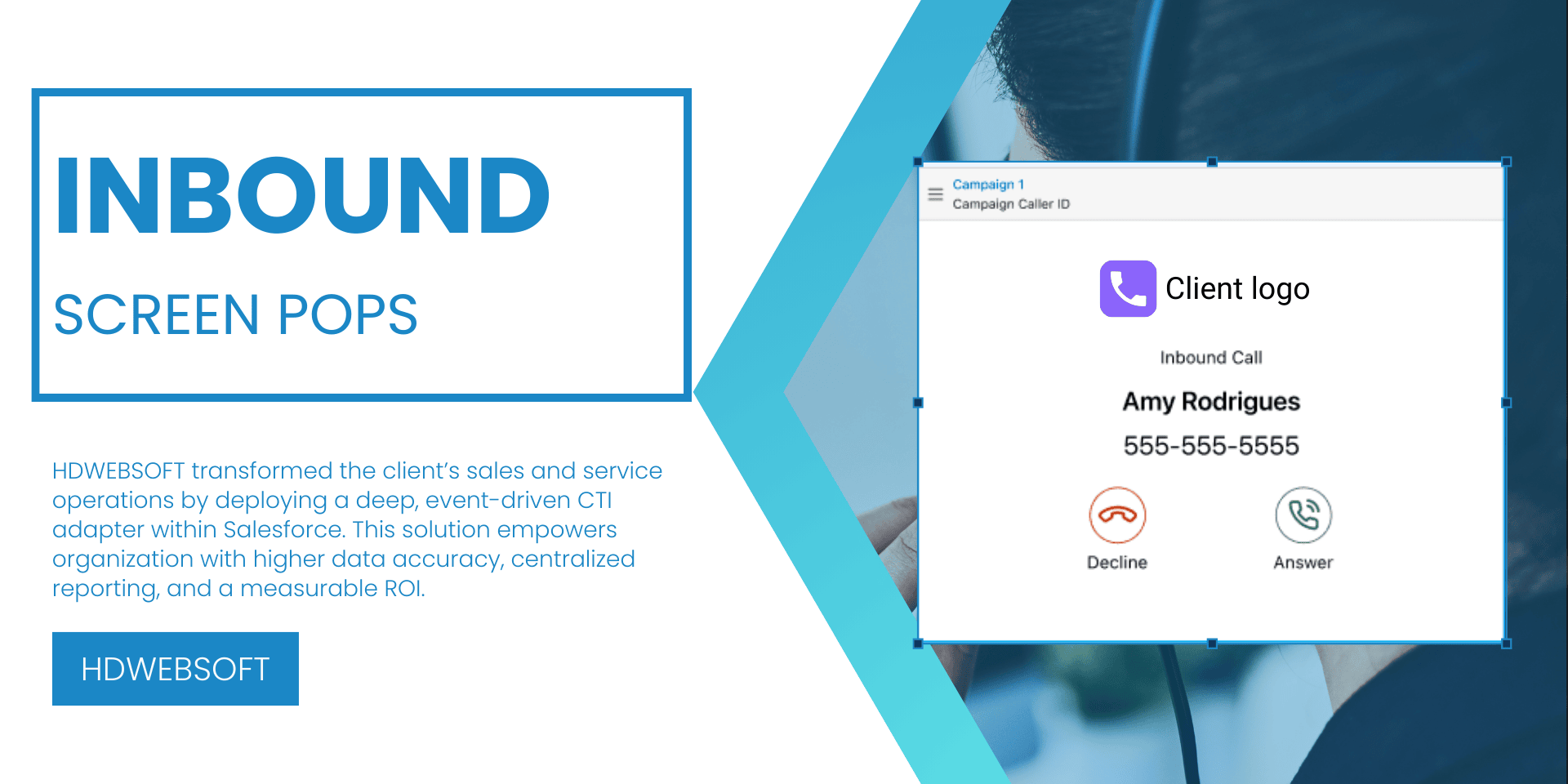
Utilizing the Salesforce CTI Toolkit and Open CTI APIs, we engineered the solution to automatically execute an “Inbound Screen Pop.” When a call is received, Apex logic swiftly performs a real-time lookup against the incoming phone number to find the corresponding Salesforce record (Lead, Contact, or Case).
This ensures Support agents handling inbound calls gain instant access to lead records and customer history. Full context will be provided before they answer, which is essential for improving first-call resolution rates.
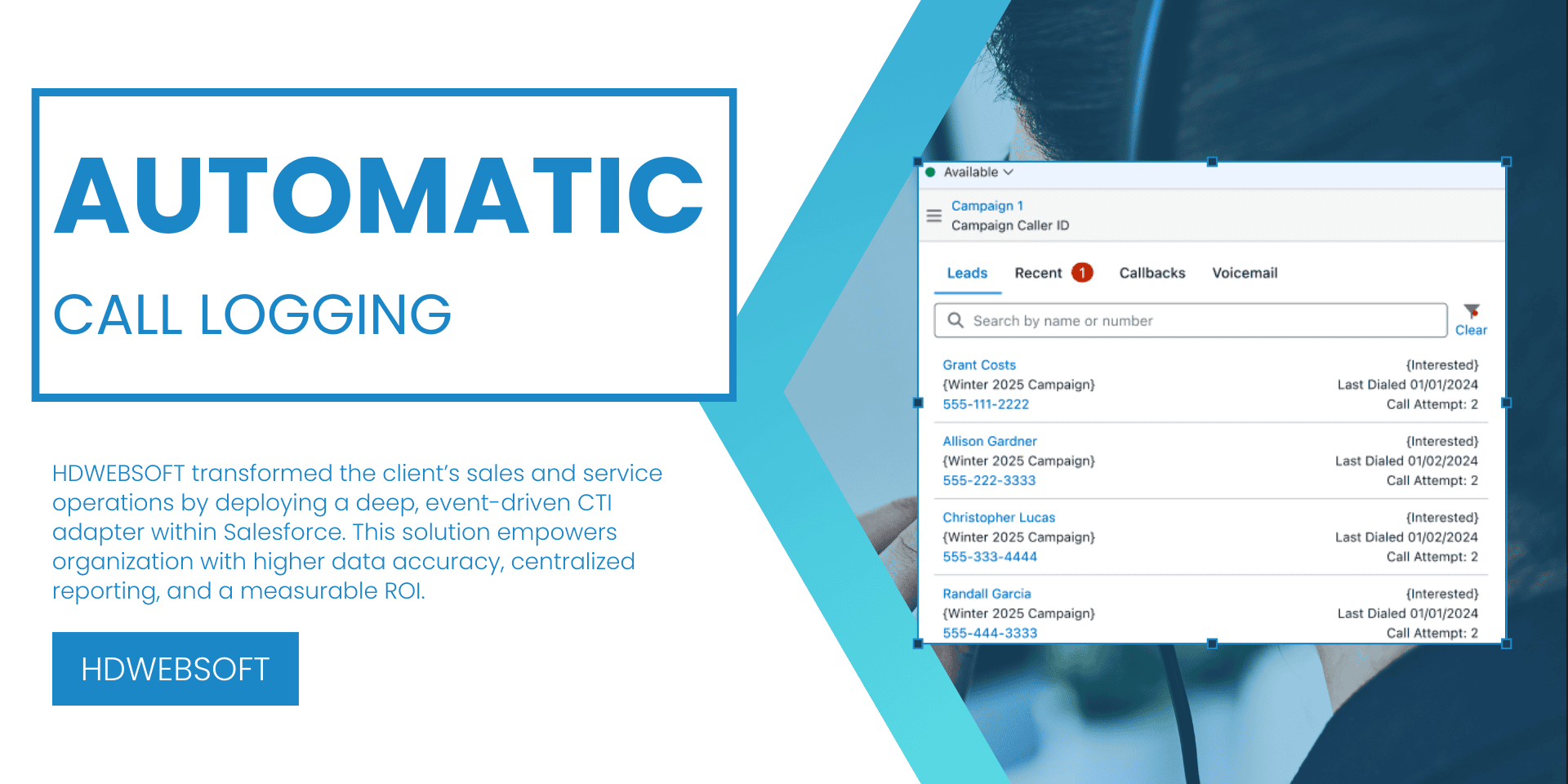
In order to eliminate manual data entry and ensure comprehensive compliance, every interaction is automatically recorded. We established an event-driven architecture that listens for call termination signals from the telephony platform via Call-Center APIs. Then, secure Apex code processes these events in real-time, creating detailed Salesforce Activity records that log call duration, type, and disposition.
Thereby, they facilitate automated activity tracking for compliance and performance metrics and achieving a significantly reduced manual workload.
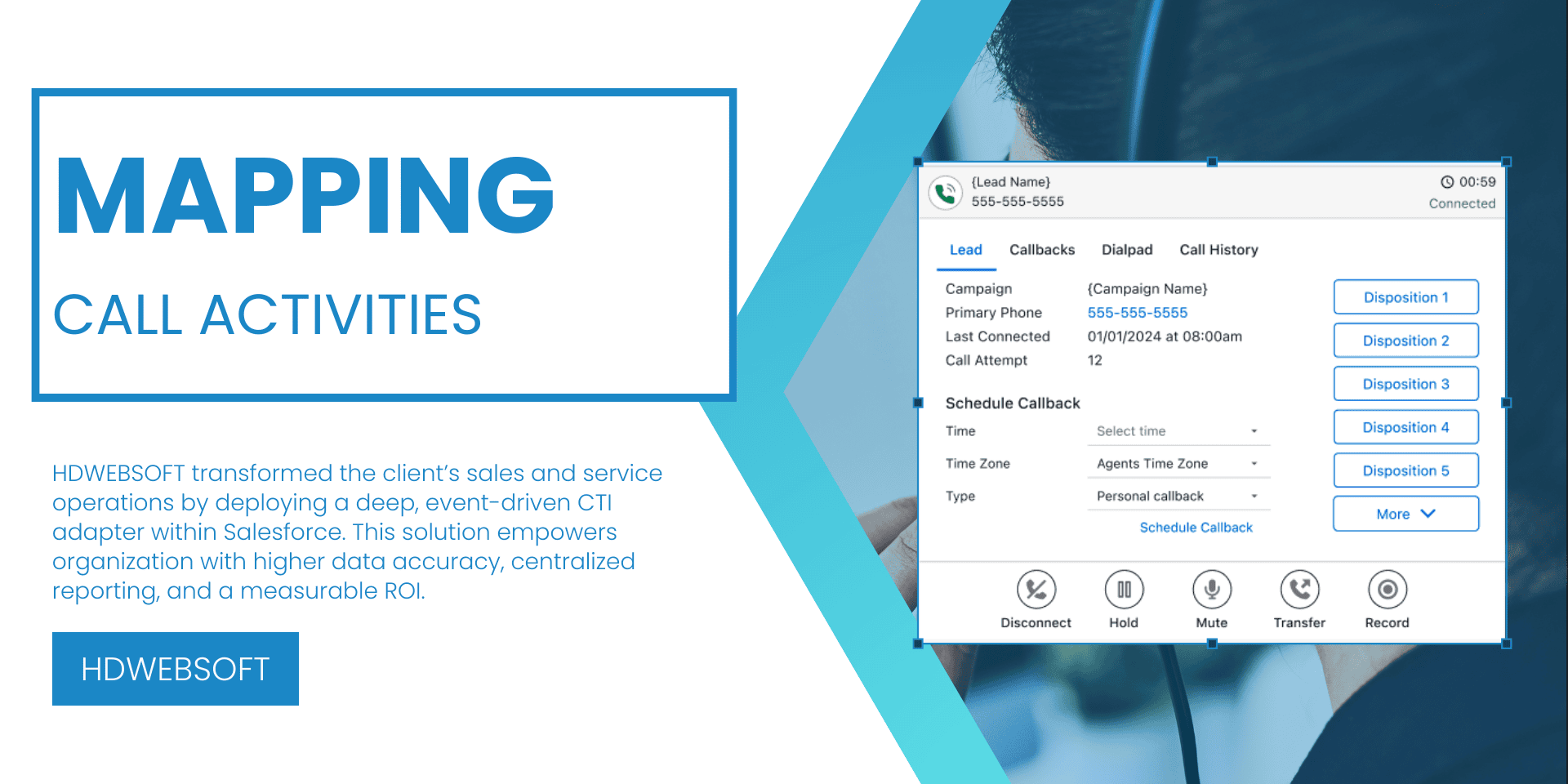
We implemented intelligent Apex logic for call activity mapping to ensure data integrity and facilitate actionable reporting in the Salesforce call-center integration. This system correctly associates the telephony events and metadata (like outcome codes) with the appropriate Salesforce objects (Tasks, Leads, Contacts, and Cases).
This rigorous, automated mapping ensures the successful synchronization of telephony data with CRM data. This is essential for comprehensive centralized reporting and achieving higher data accuracy and compliance.
Recognizing the need for business agility, we built a flexible configuration layer using LWC for the administrative interface and Apex for management logic. This layer allows non-technical users to manage and sync configurable disposition codes between the two systems without requiring any changes.
Accordingly, this feature abstracts the technical complexity and puts control into the hands of business users. It directly translates to reduced operational costs and allows for rapid adaptation of call outcome tracking based on evolving business needs.
For effective workforce management, accurate agent availability is crucial. We implemented a continuous, event-driven architecture to maintain real-time agent status sync. Status updates (e.g., ‘available’, ‘wrap-up’) are pushed from the telephony platform and consumed by Apex, which updates the status for display in LWC components.
This reliable synchronization helps ensure the organization has a scalable platform ready to support growth. In the long run, it becomes the key to optimized supervisory monitoring and resource allocation.
The integration of two complex, enterprise-level cloud platforms presented several significant technical and logistical hurdles. The successful resolution of these challenges was key to the project’s long-term stability and its ultimate AppExchange approval.
The most significant initial hurdle was the limited documentation from third-party telephony APIs, which required extensive reverse engineering.
Solution: We collaborated closely with the telephony platform provider to clarify undocumented API behaviors and understand the true nature of event payloads. Hence, the Salesforce call-center integration solution was built on accurate and reliable data exchange.
The complexity lay in real-time event handling, especially syncing call states across both platforms. For example: ringing, connecting, in progress, disconnected,…
Solution: Our Salesforce experts implemented a robust event handler with retry logic to guarantee accurate call state syncing. From then on, even transient network issues or API delays did not result in lost or inconsistent call data.
Processing a high volume of call events quickly became a challenge due to the constraints of Salesforce Governor Limits.
Solution: We created caching and queueing mechanisms to prevent event overload during peak traffic. Events were processed asynchronously in bulk, respecting the platform’s limits while ensuring no critical data was lost or delayed.
Deploying a Salesforce call-center integration solution that functions perfectly across multiple customer organizations, differing Salesforce editions, and various pre-existing customization levels posed a major compatibility challenge.
Solution: Our Salesforce experts adopted a strictly managed package approach and architected the solution to minimize reliance on non-standard configurations. This included:
A major design difficulty was ensuring UI/UX consistency for a softphone embedded within the standardized Salesforce environment.
Solution: We built a real-time softphone interface using LWC and Apex, leveraging the platform’s design language and UI frameworks. This provided a seamless, intuitive experience for the agents when using the Salesforce call-center integration solution.
The critical business challenge involved mapping data correctly between the third-party call attributes and standard Salesforce activities.
Solution: HDWEBSOFT designed a flexible configuration layer. Consequently, administration users can map dispositions and call results without necessitating code changes, abstracting the technical complexity.
Another persistent operational concern is maintaining system Reliability/Stability during inevitable network fluctuations or API delays.
Solution: We incorporated detailed monitoring and logging to ensure traceability and rapid issue resolution, allowing us to proactively identify and address bottlenecks.
The submission process required the application to meet the strict, non-negotiable standards of the Salesforce AppExchange Security Review. It includes comprehensive code scanning, vulnerability checks, and external API handling validation.
Solution: We implemented rigorous security protocols across the entire codebase and infrastructure of the Salesforce call-center integration:
WITH SECURITY_ENFORCED
or explicit
isAccessible/isUpdateable
) to ensure the running user had appropriate permissions, preventing privilege escalation.String.escapeSingleQuotes()
.The successful implementation and deployment of the CTI adapter brought about a transformation in the organization’s customer interaction processes. In the long run, they are moving toward a more efficient, compliant, and data-centric operational model.
The successful deployment of this advanced Salesforce call-center integration solution demonstrates HDWEBSOFT’s ability to create innovative and impactful platform solutions that drive business growth and deliver exceptional value to our clients. This project successfully delivered a stable, secure, and highly efficient CTI solution that achieved official validation with its submission to the AppExchange.
If your organization is struggling with disconnected systems or seeking to maximize productivity within the Salesforce ecosystem, we at HDWEBSOFT specialize in custom Salesforce development services, including CTI, LWC, and Apex solutions designed for scale and security.
All, Apex, Cloud Computing, CRM, Large-Scale, Marketing, Real Time, Salesforce