IT outsourcing fails more often than buyers admit. The reason is not that vendors are bad or that clients are unreasonable. The reason is that outsourcing failure is rarely a single event — it is a chain of root causes that compound until the engagement collapses. By the time the failure is visible, the chain has already completed, and the conversation shifts from “how do we fix this” to “how do we exit.”
This article is not a list of generic mistakes. It is a root-cause diagnosis framework. Each of the ten root causes below is analyzed by how it causes failure, the early warning signs that reveal it before it compounds, and the control that breaks the chain at that link. The goal is not to memorize ten risks — it is to recognize the chain before it completes.
This article does not cover vendor selection, contract clauses, trust verification, or success metrics. HDWEBSOFT has separate articles for those intents. This article covers what happens after the contract is signed and the team is in place: why engagements fail, how to detect the failure early, and where the ownership of each root cause actually lives.
The Chain of Failures: How Root Causes Compound
The most damaging belief about outsourcing failure is that it has a single cause. “We picked the wrong vendor.” “Communication was bad.” “The scope was unclear.” These explanations are symptoms, not root causes — and they are almost never independent.
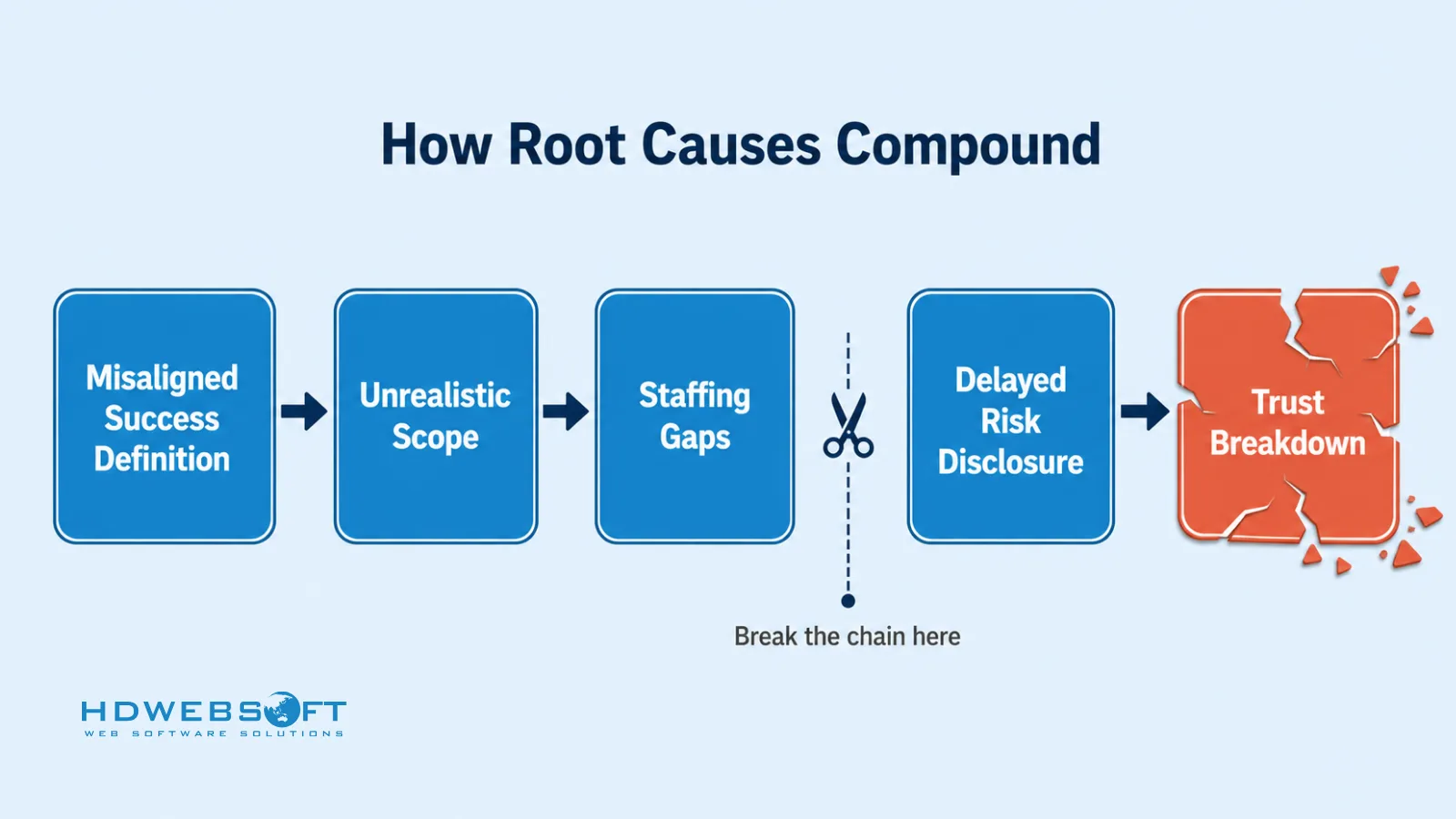
Outsourcing failure is a chain. One undetected root cause creates the conditions for the next, which creates the conditions for the next, until the engagement collapses. Consider a common chain:
- Misaligned success definition — the client defines success as “product shipped with quality,” the vendor defines it as “deliverables accepted and hours billed.” Neither party notices the gap.
- Unrealistic scope and timeline — because success is measured by deliverables, the timeline is set aggressively to maximize early acceptance. The vendor agrees because pushing back would risk the deal.
- Staffing gaps — the aggressive timeline forces the vendor to staff with available engineers, not the right engineers. Junior people are assigned to work that requires senior judgment.
- Delayed risk disclosure — the junior team hits problems it cannot solve, but reporting those problems upward means admitting the team is underqualified. Problems are hidden.
- Trust breakdown — by the time the client discovers the issues, the timeline has slipped, the quality is poor, and the vendor has been concealing problems for weeks. The engagement collapses.
Which root cause caused the failure? All of them. If the success definition had been aligned, the timeline would have been realistic. If the timeline had been realistic, the staffing would have been appropriate. If the staffing had been appropriate, the problems would have been solved, not hidden. If the problems had been disclosed, the client could have intervened before trust broke.
The chain can be broken at any link. That is the thesis of this article: failure is preventable not by avoiding a single mistake, but by detecting and breaking the chain before it completes. The ten root causes below are the links most commonly observed in failed IT outsourcing engagements. Each one includes the early warning signs that reveal it — because detection is the prerequisite for intervention. For the complementary perspective — how to define and sustain success once an engagement is running — see our lifecycle framework for successful outsourcing.
Why IT Outsourcing Fails: 10 Root Causes
ISG’s 2025 enterprise research found that nearly 65% of organizations were dissatisfied or only moderately satisfied with their providers’ ability to drive innovation in IT outsourcing services. The ten root causes below explain why that gap is so wide. Each root cause follows the same structure: what the root cause is, how it causes failure, the early warning signs that reveal it, and the control that prevents it from compounding into the next link.
RC1 — Misaligned Success Definition
- Root cause: The client and the vendor define “success” differently. The client thinks in terms of business outcomes — product shipped, users served, revenue generated. The vendor thinks in terms of contract deliverables — features built, hours billed, milestones signed off.
- How it causes failure: The vendor delivers exactly what was specified, the client accepts it because it matches the contract, and the product produces no business value. The engagement is “completed” but the outcome is failure. This root cause is the first link in many chains because it makes every downstream decision optimize for the wrong target.
- Early warning signs: The vendor measures success by output — tickets closed, hours billed, deliverables accepted — and never by outcome. There is no shared, documented definition of “done” that includes business outcomes. Sprint reviews focus on what was built, not on whether it achieved the intended user or business result.
- Prevention and control: Document the success definition at engagement kickoff, including business outcomes — not just deliverables. Review it each quarter: “are we measuring the same thing, and is the thing we are measuring the thing we actually want?”
RC2 — Information and Escalation Bottlenecks
- Root cause: Information must pass through multiple layers before reaching the person who can act on it. The vendor’s engineer reports to the vendor’s PM, who reports to the vendor’s account manager, who reports to the client’s stakeholder, who reports to the client’s decision-maker.
- How it causes failure: A blocker that could be resolved in hours takes days to reach the decision-maker. By the time the decision arrives, the blocker has grown into a crisis. The engagement accumulates crises faster than it resolves them.
- Early warning signs: The time from a blocker’s occurrence to the client’s awareness is longer than the agreed baseline. The PM relays good news more often than bad news. The client discovers issues during demos rather than through the escalation channel — meaning the channel is not working.
- Prevention and control: Give client stakeholders direct access to the team’s tooling — Jira, GitHub, or equivalent. Establish an escalation protocol with a defined SLA for each severity level. The PM must function as a bridge that enables client-engineer conversation, not a filter that controls what the client sees.
RC3 — Unrealistic Scope, Cost, or Timeline Expectations
- Root cause: Scope, cost, and timeline are committed before enough is known to commit accurately. Sales estimates are based on best-case assumptions. Discovery is skipped or compressed to win the deal.
- How it causes failure: The team is forced to deliver against a timeline that was never achievable. To meet it, they cut corners — skipping tests, reducing documentation, simplifying features without discussion. Quality drops. Rework increases. The timeline slips further. Pressure increases. More corners are cut. The loop compounds.
- Early warning signs: The vendor says yes to every deadline change without pushing back. Scope items are “simplified” without a discussion of what was lost. Sprint velocity declines steadily after the second or third sprint — a sign the team is burning out or the scope is larger than estimated.
- Prevention and control: Run a discovery phase before committing to a timeline. When scope changes, re-baseline the timeline — do not hold the original deadline against a changed scope. A vendor that never pushes back is not a good sign; it is a warning that the vendor is optimizing for agreement, not for delivery.
RC4 — Capability / Engagement Model Mismatch
- Root cause: The engagement model does not match the type of work. Staff augmentation is used for a project that needs end-to-end ownership. A fixed-price project model is used for work that requires continuous iteration and discovery.
- How it causes failure: The team does not have the authority or the context to deliver. Staff augmentation engineers wait for tasks. Project-based teams wait for specs. Work stalls at the handoff points between client and vendor, and no one owns the gap.
- Early warning signs: Work stalls at handoffs between client and vendor. The team frequently asks “who owns this decision?” Deliverables match the spec but do not integrate into a working product — because no one owned the integration.
- Prevention and control: Match the engagement model to the work type at kickoff. If the nature of the work changes during the engagement, re-evaluate the model. Document an ownership matrix: who decides, who delivers, who reviews, who is accountable for each category of work.
RC5 — Weak Governance and Ownership
- Root cause: No one is explicitly assigned as owner for decisions, risks, and issues. “Everyone is responsible” means no one is. Governance is treated as a meeting, not as a system.
- How it causes failure: Issues accumulate because they have no owner. Risks are not escalated because no one is accountable for escalating them. Decisions are delayed because it is unclear who has the authority to decide. The engagement drifts.
- Early warning signs: The same issue is discussed in three or more meetings without resolution. There is no risk register, or the register exists but is not updated. Decisions are reversed because “someone higher up disagreed” — but it is unclear who that someone is, or why they were not consulted earlier.
- Prevention and control: Create an ownership matrix at kickoff: each decision type, risk category, and issue class has one named owner. Run a weekly governance review with an explicit agenda — decisions needed, risks escalating, issues blocking — and track each item to closure.
RC6 — Staffing and Capability Gaps
- Root cause: The team assigned to delivery does not match the skill requirements of the project. The senior people who impressed during sales are not the people doing the work. Knowledge concentrates in one or two individuals.
- How it causes failure: Junior engineers struggle with complexity they were not ready for. Rework increases. Deadlines slip. A senior engineer is pulled in to fix things, becomes overloaded, and the quality of the entire team drops. The engagement becomes dependent on one or two people who cannot scale.
- Early warning signs: The same person reviews every pull request. Knowledge is concentrated in one or two individuals — when they are on leave, delivery stalls. New hires take longer than the agreed ramp to contribute. The team cannot answer technical questions without consulting one specific person.
- Prevention and control: Build a skill matrix at kickoff: required skills versus the assigned team’s demonstrated skills. Document the replacement process for key roles. Set a knowledge distribution target — no critical knowledge should live in only one person’s head.
RC7 — Poor Knowledge Transfer
- Root cause: Knowledge lives inside the vendor team and is not transferred to the client. Documentation is treated as an afterthought — something to do at the end, if there is time.
- How it causes failure: The client cannot operate or maintain the product after handover. The vendor becomes a dependency — the client cannot exit without losing months of context. The engagement continues not because it is succeeding, but because the cost of exit is too high.
- Early warning signs: The client team cannot demo the product without the vendor present. Documentation is outdated, missing, or exists only inside the vendor’s internal wiki. Onboarding a new client-side team member requires vendor support rather than client-side documentation.
- Prevention and control: Create a knowledge transfer plan from day one — not at the end of the project. Treat documentation as a deliverable that is reviewed each sprint. Run a periodic knowledge retention audit: what percentage of critical knowledge is documented and accessible to the client team independently?
RC8 — Misaligned Commercial Incentives
- Root cause: The vendor is incentivized by output — billable hours, deliverables accepted — rather than by outcome — business value created, quality achieved. The client wants outcomes. The vendor is paid for output.
- How it causes failure: The vendor optimizes for billable hours, not for product quality. Change requests become a revenue opportunity rather than a delivery concern. The vendor has no incentive to prevent issues, because issues create additional work — and additional work is additional revenue.
- Early warning signs: The vendor pushes change requests that have no clear business justification. Quality issues generate additional billing to fix them. The vendor never proposes efficiency improvements — because efficiency means fewer hours, and fewer hours mean less revenue.
- Prevention and control: Align the commercial model with outcomes where feasible — milestone-based, value-based, or outcome-linked pricing. Review the vendor’s incentives periodically: “does this vendor benefit more from our success or from our problems?” If the answer is the latter, the commercial model is working against the engagement.
RC9 — Operational Compatibility Gaps
- Root cause: The working mechanics of the two organizations do not match. Working-hour overlap is too small for real-time collaboration. Decision latency is too long for the sprint cadence. Feedback cycles do not match the delivery cadence.
- How it causes failure: Decisions are delayed because the overlap window is too short. Feedback is implemented one or two sprints late, meaning the team builds on top of work that is about to be rejected. The sprint cadence and the integration cadence drift apart, producing integration issues late in the cycle.
- Early warning signs: Simple decisions take longer than the agreed target. Feedback is implemented one or two sprints after it is given, not in the current sprint. Meeting cadence is not sufficient for genuine collaboration — it is just status reporting.
- Prevention and control: Document operational compatibility at kickoff: working-hour overlap, decision latency targets, feedback cycle targets. Measure these and review them periodically. If the gap is structural, adjust the cadence — do not pretend the gap does not exist.
RC10 — Low Transparency and Delayed Risk Disclosure
- Root cause: The vendor hides risks and issues because of fear — fear of blame, fear of contract penalties, fear of damaging the relationship. The client does not press for transparency because it does not want to create tension. Both sides collude in silence.
- How it causes failure: Risks accumulate silently. By the time a risk becomes an issue, it is too large to recover from. The client discovers the problem too late to intervene. The engagement collapses not because the problem was unsolvable, but because it was invisible until it was too late.
- Early warning signs: Status reports are always “green” or “on track.” The vendor does not volunteer risk information — the client has to ask. Issues only surface when they are too large to hide. The client learns about problems from the demo, not from the escalation channel.
- Prevention and control: Normalize risk disclosure. A risk reported early is a positive signal, not a negative one — it means the team is paying attention. Give the client direct access to tooling so that status can be verified, not just reported. Build a “bad news fast” culture. If the problem is intentional concealment or a trust breach, that is a different root cause — see our framework for trusting an offshore service provider for the repair-or-exit decision model.
Client-Side vs Vendor-Side vs Shared: Where the Root Cause Lives
One of the most common mistakes in diagnosing outsourcing failure is assuming the vendor is at fault. The ten root causes above do not belong to the vendor alone. They span client-owned, vendor-owned, and shared causes — and the ownership determines what the recovery action should be.
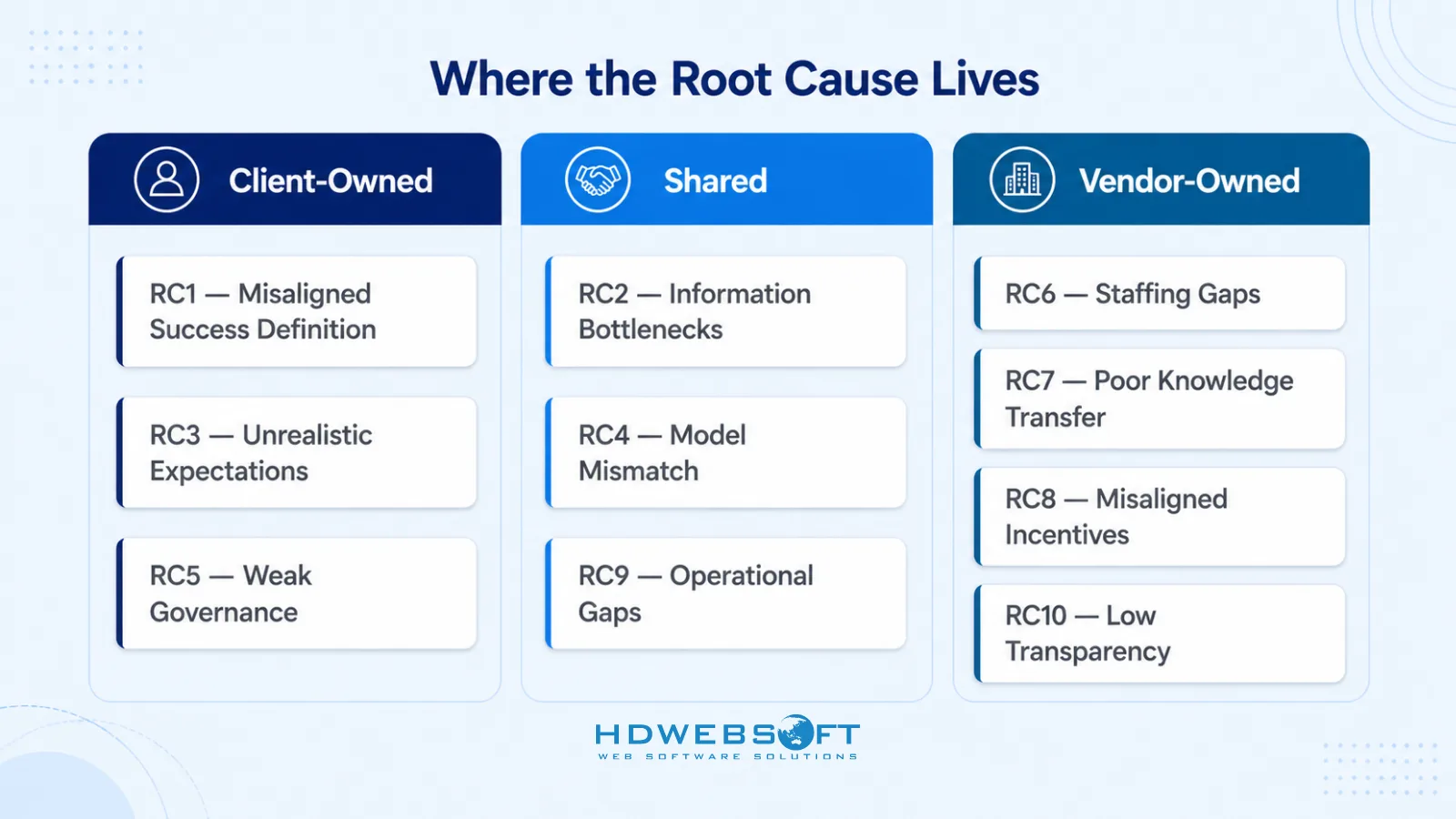
Client-owned root causes are the hardest to detect because clients rarely audit their own behavior. If the client owns the root cause but blames the vendor, the recovery will fail — because the intervention targets the wrong party.
- RC1 — Misaligned success definition: The client defines what success means. If the definition is missing or output-only, that is a client-side gap.
- RC3 — Unrealistic expectations: The client sets the scope, cost, and timeline. If they are unrealistic, the client owns the root cause — even if the vendor agreed to them.
- RC5 — Weak governance: Governance is the client’s responsibility. If there is no ownership matrix, no risk register, and no decision protocol, the client has not built the system the engagement needs.
Vendor-owned root causes require vendor accountability — but the client must detect them, because the vendor has no incentive to self-report.
- RC6 — Staffing gaps: The vendor assigns the team. If the team does not match the skill requirements, the vendor owns the gap.
- RC7 — Poor knowledge transfer: The vendor holds the knowledge. If it is not transferred, the vendor owns the deficiency.
- RC8 — Misaligned incentives: The vendor designs its commercial model. If the model rewards output over outcome, the vendor owns the misalignment.
- RC10 — Low transparency: The vendor controls what information is disclosed. If risks are hidden, the vendor owns the concealment.
Shared root causes require a joint reset — neither party can fix them alone.
- RC2 — Information bottlenecks: The escalation path spans both organizations. Both must agree to shorten it.
- RC4 — Capability/model mismatch: The model was chosen jointly. If it no longer fits, both must agree to re-evaluate.
- RC9 — Operational gaps: Working hours, cadence, and feedback cycles are constraints of both organizations. Both must adjust.
The ownership map is not about assigning blame. It is about directing the recovery action. A client-owned root cause requires the client to change its behavior. A vendor-owned root cause requires vendor accountability. A shared root cause requires a joint reset. Misdiagnosing the ownership is one of the most common reasons recovery efforts fail — the intervention targets the wrong party, and the chain continues.
Early Warning Signs Your Outsourcing Engagement Is Starting to Fail
The diagnostic table below maps observable warning signs to the likely root cause and the recommended action. Use it quarterly, or any time the engagement feels “off” — but do not wait for a feeling. The warning signs are observable patterns. Track them deliberately. If you are still evaluating vendors and want the pre-signing version of this list, common IT outsourcing concerns and their mitigations covers the six risks to de-risk at contract time.
| Warning Signal | Likely Root Cause | Recommended Action |
|---|---|---|
| Status reports are always “green” or “on track” | Low transparency (RC10) | Request direct tool access; compare actual data with reported status |
| The same issue is discussed in 3+ meetings without resolution | Weak governance (RC5) | Assign an explicit owner; set a decision deadline |
| The vendor says yes to every deadline change without pushback | Unrealistic expectations (RC3) | Require push-back or re-baseline scope and timeline together |
| The team cannot answer technical questions without one person | Staffing gap (RC6) | Review the skill matrix; build a knowledge distribution plan |
| The client cannot demo the product without the vendor present | Poor knowledge transfer (RC7) | Run a documentation audit; dedicate a sprint to knowledge transfer |
| Blockers surface after the deadline, not before | Information bottleneck (RC2) | Review the escalation protocol; open a direct PM-to-stakeholder channel |
| The vendor pushes change requests without business justification | Misaligned incentives (RC8) | Review the commercial model; tie payment to outcomes, not output |
| Deliverables match the spec but miss the intent | Misaligned success definition (RC1) | Re-define “done” with business outcomes; run a joint success review |
| Work stalls at handoff points between client and vendor | Capability/model mismatch (RC4) | Re-evaluate the engagement model; build an ownership matrix |
| Simple decisions take longer than the agreed target | Operational gap (RC9) | Document the actual overlap; shorten the feedback cycle |
Conclusion
IT outsourcing failure is a chain, not an event. Each root cause that goes undetected creates the conditions for the next, until the engagement collapses and the only question left is how to exit. The good news is that the chain can be broken at any link — if the warning signs are detected early enough.
The warning signs in the diagnostic table above are not feelings. They are observable patterns: status reports that are always green, the same issue discussed in three meetings without resolution, a vendor that never pushes back, a team that cannot answer a question without one person. Track them deliberately, not when the engagement already feels broken.
If you are evaluating an outsourcing partner and want one that operates on transparency — direct tool access, early risk disclosure, a skill matrix that matches your project, and a commercial model that does not reward your problems — explore our software outsourcing services or talk to our team. We would rather lose a deal during diagnosis than lose your trust after signing.
Key Takeaways
- IT outsourcing failure is a chain of compounding root causes, not a single event — each undetected cause enables the next, until the engagement collapses.
- The ten root causes span misaligned success definition, information bottlenecks, unrealistic expectations, model mismatch, weak governance, staffing gaps, poor knowledge transfer, misaligned incentives, operational gaps, and low transparency.
- Early warning signs are observable patterns, not feelings: status always green, same issue in 3+ meetings, vendor never pushes back, team cannot answer without one person, client cannot demo without vendor.
- Root causes have ownership — client-owned, vendor-owned, or shared. Recovery action must target the right owner; blaming the vendor for a client-owned root cause is a common reason recovery fails.
- The diagnostic table maps warning signals to likely root causes and recommended actions — use it quarterly or whenever the engagement feels off, but do not wait for a feeling to start checking.
FAQ
Why do IT outsourcing projects fail?
IT outsourcing projects fail because root causes compound into a chain: misaligned success definition leads to unrealistic scope, which creates staffing gaps, which triggers delayed risk disclosure, which ends in trust breakdown. Rarely is there a single cause. Diagnosing the chain — not just one link — is what allows early intervention.
What are the early warning signs of IT outsourcing failure?
Observable warning signs include status reports that are always green, the same issue discussed in three or more meetings without resolution, a vendor that says yes to every deadline change, a team that cannot answer technical questions without consulting one person, and a client that cannot demo the product without the vendor present. These are patterns, not feelings.
Can a failing IT outsourcing engagement be saved?
Yes, when the decline is a performance issue. Diagnose the root cause, reset scope and baselines, and verify improvement over a defined window. If the cause is a trust breach or intentional concealment, the engagement needs separate evaluation — performance recovery does not fix a trust failure.
Is IT outsourcing failure always the vendor’s fault?
No. Root causes span client, vendor, and shared ownership. Misaligned success definition is typically client-owned. Low transparency is typically vendor-owned. Information bottlenecks and operational gaps are shared. Blaming the vendor for a root cause the client owns is one of the most common reasons recovery fails.
How do you prevent IT outsourcing failures?
Prevent failures by addressing root causes before they compound: document a shared success definition with business outcomes, give stakeholders direct tool access, establish an escalation protocol with defined SLAs, maintain a skill matrix, require a knowledge transfer plan from day one, align commercial incentives with outcomes, and normalize early risk disclosure.
What is the difference between IT outsourcing failure and IT outsourcing decline?
Decline is performance deterioration — predictability dropping, rework increasing, cost efficiency slipping — and it is recoverable. Failure is the completed chain — the engagement collapses, requiring exit or restart. Decline that goes undetected becomes failure. The diagnostic table in this article maps warning signs to root causes so decline is caught before it completes the chain.