Software outsourcing offers significant advantages for businesses seeking cost efficiency, specialized talent, and faster development cycles. Companies can reduce development costs by 40-60% while accessing global expertise and accelerating time-to-market through established processes and dedicated teams. The key benefits include cost savings, access to specialized skills, scalability, and the ability to focus on core business functions.
What is Software Outsourcing?
Software outsourcing involves contracting external companies or developers to handle software development tasks instead of relying solely on in-house teams. This practice has evolved significantly over the past decade, moving from simple cost-cutting measures to strategic partnerships that drive innovation and competitive advantage. Modern software outsourcing encompasses various models including offshore development, nearshore collaboration, staff augmentation, and dedicated team structures.
The outsourcing landscape has matured with improved communication tools, project management methodologies, and quality assurance practices. Today’s outsourcing partners offer specialized expertise in cutting-edge technologies, from AI and machine learning to blockchain and cloud computing, enabling businesses to stay competitive without maintaining large internal teams across every technology stack.
Top Software Outsourcing Benefits
Cost Savings and ROI
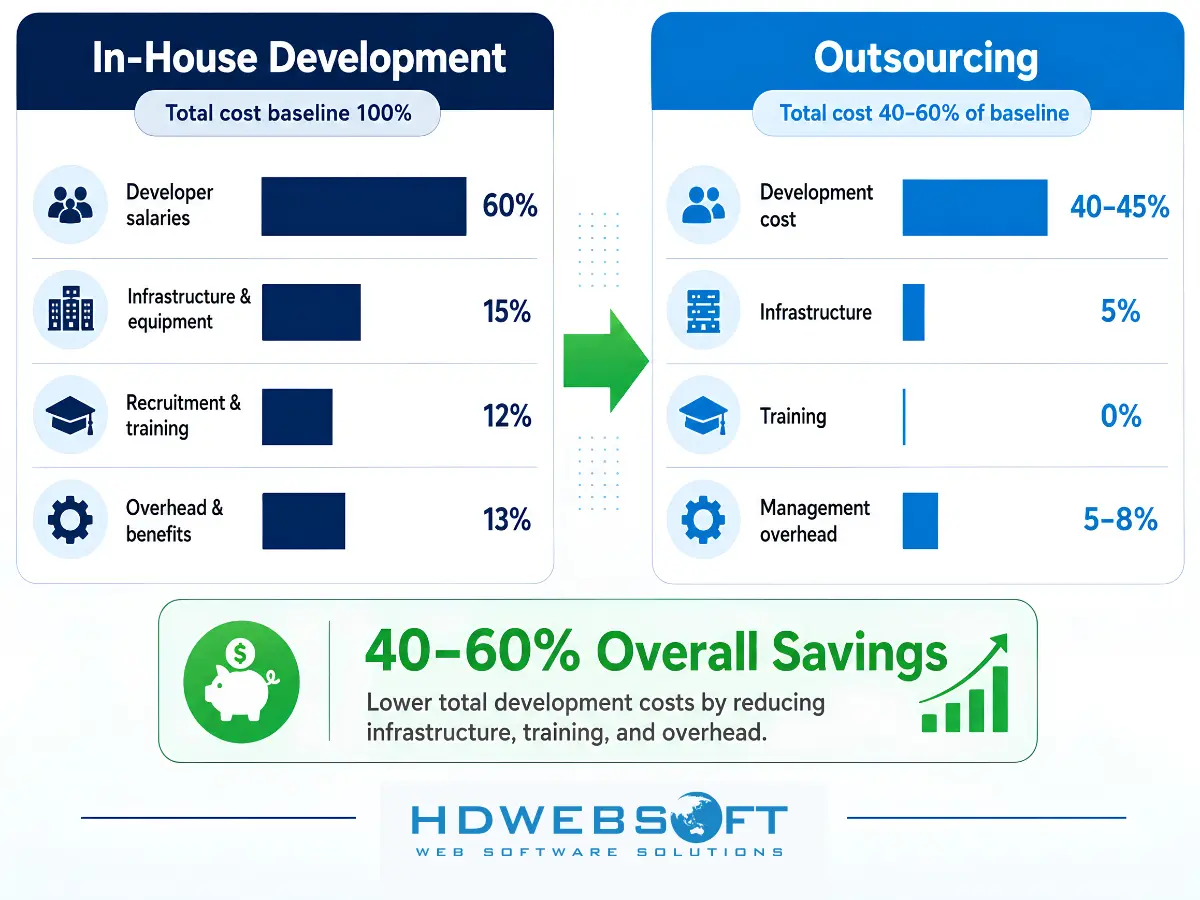
One of the most compelling software outsourcing benefits is the significant cost reduction potential. Companies typically save 40-60% on development costs compared to maintaining equivalent in-house teams. These savings come from lower labor costs in strategic locations, reduced infrastructure investments, and the elimination of recruitment and training expenses. For detailed cost analysis, see our guide on how much does it cost to build custom software.
Beyond direct cost savings, outsourcing improves ROI by converting fixed costs into variable costs. Businesses can scale development resources up or down based on project needs, paying only for the work actually performed. This flexibility is particularly valuable for startups and companies with fluctuating development requirements. Companies can leverage software outsourcing services to optimize their development costs while maintaining quality standards.
According to Deloitte’s Global Outsourcing Survey, companies that strategically outsource software development report significant improvements in project profitability due to optimized resource allocation and reduced overhead.
Access to Global Talent Pool
Software outsourcing provides access to a vast global talent pool that would be impossible to replicate through local hiring alone. This access is particularly crucial for specialized technologies and skills that are in short supply domestically. Outsourcing partners often have teams with expertise in emerging technologies, niche frameworks, and industry-specific knowledge that would take years to build internally.
The global nature of outsourcing also means businesses can work around the clock through distributed teams across different time zones. This “follow-the-sun” development model can accelerate project timelines significantly, as work progresses continuously across different geographical locations.
Faster Time-to-Market
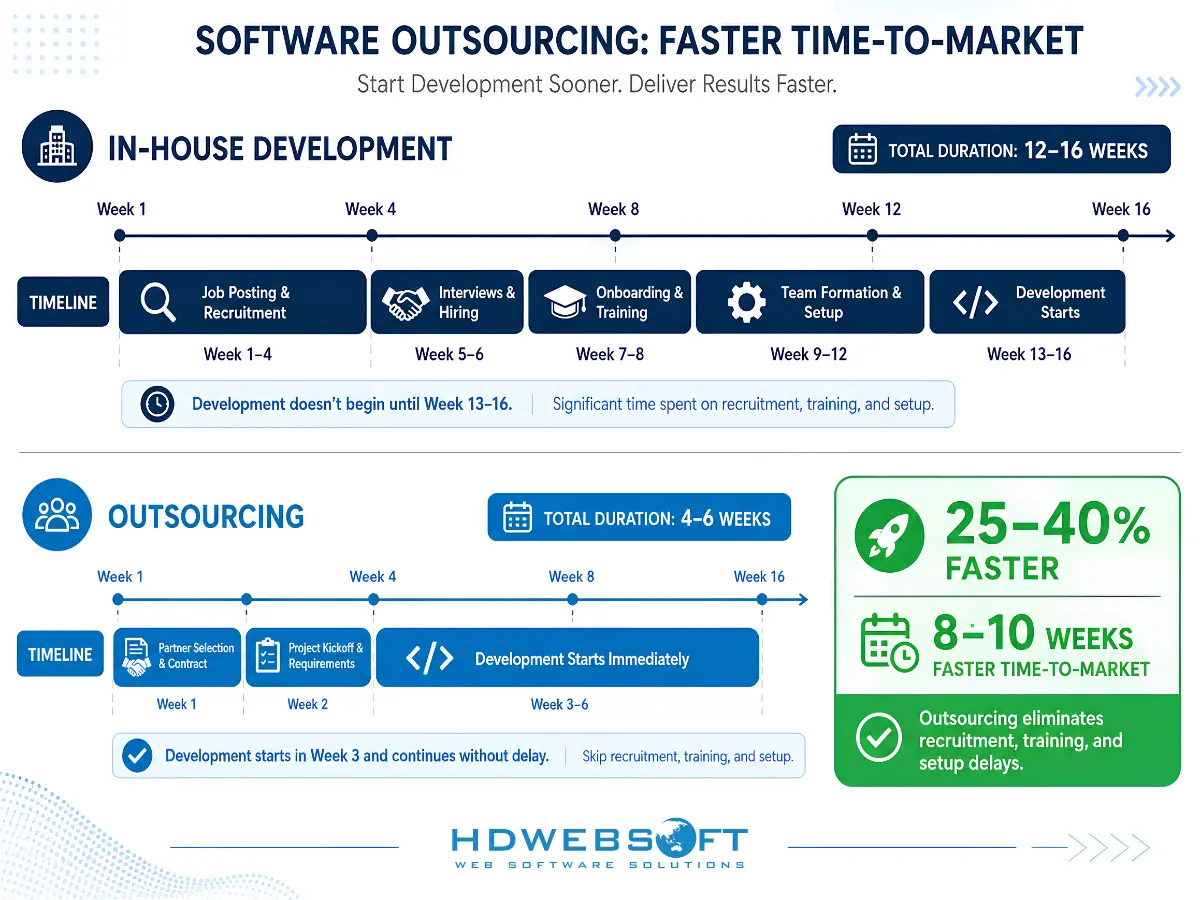
Speed is critical in today’s competitive software landscape. Outsourcing partners typically have established processes, mature development methodologies, and ready-to-deploy teams that can start projects immediately. This eliminates the lengthy recruitment, onboarding, and team formation phases that delay in-house projects.
Companies using software outsourcing typically report 25-40% faster time-to-market compared to purely in-house development, attributed to dedicated resources, parallel work streams, and optimized development processes.
Focus on Core Business Functions
By outsourcing non-core software development activities, companies can redirect internal resources toward strategic initiatives that drive competitive advantage. This focus allows leadership teams to concentrate on product strategy, customer relationships, and business growth rather than getting bogged down in technical implementation details.
The strategic allocation of resources enables companies to build stronger capabilities in areas that truly differentiate their business while leveraging external expertise for commodity technical tasks. This alignment of resources with strategic priorities is a key factor in long-term business success.
Scalability and Flexibility
Software outsourcing provides unparalleled scalability to match business needs. Companies can quickly scale development teams up or down based on project requirements, market conditions, or budget constraints. This flexibility is particularly valuable for startups experiencing rapid growth or enterprises with seasonal development demands.
The ability to scale without the long-term commitments and costs associated with hiring and training internal teams provides businesses with significant agility. Companies can respond to market opportunities and challenges more rapidly than competitors constrained by rigid internal structures.
Risk Mitigation
Outsourcing partners assume significant portions of development risk, including technical risks, timeline risks, and resource availability risks. Established outsourcing companies have mature risk management processes, contingency planning, and experience handling complex projects across various industries.
Software Outsourcing Models Comparison
In-House vs Outsourcing vs Hybrid
The choice between in-house development, complete outsourcing, or hybrid models depends on factors including project complexity, strategic importance, available budget, and timeline requirements. In-house development offers maximum control but at higher cost and limited scalability. Complete outsourcing provides cost efficiency and access to expertise but requires strong vendor management. Hybrid models combine the strengths of both approaches, keeping strategic elements in-house while outsourcing tactical or specialized components.
Hybrid models have gained popularity as companies seek to balance control with efficiency. This approach typically involves maintaining core architecture and strategic product management internally while outsourcing specific features, testing, or maintenance activities to external partners. A dedicated software development team can provide the right balance of control and expertise for hybrid approaches.
Offshore vs Nearshore vs Onshore
Geographic proximity significantly impacts outsourcing effectiveness. Offshore development (typically Asia, Eastern Europe) offers the lowest costs but may present challenges in time zone alignment and cultural differences. Nearshore development (geographically closer regions) provides better time zone overlap and cultural affinity while still offering cost advantages. Onshore development (same country) maximizes communication ease but provides minimal cost benefits.
Nearshore outsourcing has grown significantly in recent years as companies prioritize communication efficiency and cultural alignment alongside cost considerations. Companies considering offshore software development should weigh these factors carefully when choosing their outsourcing model.
Staff Augmentation vs Dedicated Teams
Staff augmentation involves adding individual developers to existing teams, providing flexibility but requiring significant management overhead. Dedicated teams function as autonomous units working on specific projects or features, offering more self-contained delivery but requiring clear scope definition and project management.
The choice between models depends on project structure, internal management capacity, and desired level of control. Staff augmentation works well for filling specific skill gaps in existing teams, while dedicated teams are better suited for well-defined projects or ongoing product development. IT outstaffing services can provide the flexibility needed for staff augmentation models. If your shortlist is focused on Vietnam, use this provider shortlist checklist to compare outstaffing partners before interviews.
Key Considerations Before Outsourcing
When to Outsource Software Development
Software outsourcing makes the most sense when companies face skill gaps, time constraints, budget limitations, or need for specialized expertise. It’s particularly valuable for startups needing to move quickly with limited resources, enterprises requiring specialized technical skills, or companies experiencing fluctuating development demands.
Companies should consider outsourcing when the cost of building and maintaining internal capabilities exceeds the value of those capabilities to the core business. This analysis should consider not just direct costs but also opportunity costs and strategic alignment.
Common Outsourcing Risks and How to Mitigate
While software outsourcing offers significant benefits, it also presents risks including quality concerns, communication challenges, intellectual property protection, and vendor dependency. These risks can be mitigated through careful partner selection, clear contracts and service level agreements, robust communication protocols, and regular quality assurance processes.
Poor communication and unclear requirements are among the leading causes of outsourcing failures rather than technical incompetence. Investing in thorough requirements definition and ongoing communication dramatically improves success rates.
Choosing the Right Outsourcing Partner
Partner selection should consider technical expertise, industry experience, cultural fit, communication capabilities, and proven track record. Companies should evaluate potential partners through detailed reference checks, technical assessments, and pilot projects before committing to long-term engagements.
The ideal partner combines technical excellence with strong project management capabilities and a deep understanding of the client’s business domain. Cultural alignment and communication style are equally important, as these factors significantly impact collaboration effectiveness.
Software Outsourcing Benefits by Industry
Startups and Small Businesses
For startups, software outsourcing provides access to enterprise-level development capabilities without the corresponding cost structure. This enables startups to compete with larger companies by leveraging specialized expertise and scalable resources. The flexibility to scale teams based on funding and business needs is particularly valuable for startups navigating uncertain market conditions.
Startups also benefit from the reduced time-to-market that outsourcing enables, allowing them to validate ideas and iterate products more rapidly. This speed can be the difference between market leadership and missed opportunities in fast-moving sectors.
Enterprise Companies
Enterprises leverage software outsourcing to access specialized skills, accelerate digital transformation initiatives, and optimize costs across their development portfolios. The ability to scale resources for major initiatives without permanent headcount increases provides significant flexibility for budget management and resource allocation.
For enterprises, outsourcing also enables geographic expansion by providing development teams with local market knowledge and regulatory understanding in target regions. This capability accelerates international growth while reducing the risks associated with entering new markets.
Fintech and Healthcare Sectors
Regulated industries like fintech and healthcare benefit from outsourcing partners with specialized domain expertise and compliance knowledge. These partners often have established processes for meeting regulatory requirements and industry standards, reducing the compliance burden on internal teams.
Fintech companies using specialized outsourcing partners often report faster compliance certification processes compared to building compliance capabilities internally.
Future of Software Outsourcing
AI and Automation Impact
Artificial intelligence and automation are transforming software outsourcing by enabling more efficient development processes, automated testing, and intelligent project management. These technologies are reducing the cost differential between in-house and outsourced development while increasing the value that outsourcing partners can deliver.
The integration of AI tools into outsourcing workflows is enabling more accurate project estimation, automated code review, and predictive quality assurance. These capabilities improve project outcomes while reducing the management overhead traditionally associated with outsourcing relationships.
Remote Work Trends
The normalization of remote work has reduced the perceived distinction between in-house and outsourced development. As companies become more comfortable managing distributed teams, the barriers to outsourcing have diminished, making it easier to integrate external teams seamlessly into internal workflows.
This trend is expanding the pool of potential outsourcing partners while also increasing competition among providers, ultimately benefiting clients through improved service quality and more competitive pricing.
Emerging Outsourcing Destinations
New outsourcing destinations are emerging beyond traditional locations, offering specialized expertise in specific technologies or industries. These emerging markets often provide competitive advantages in niche areas while challenging established outsourcing hubs to innovate and improve service offerings.
The diversification of outsourcing destinations provides companies with more options for finding partners that match their specific technical requirements, cultural preferences, and business objectives. For a forward-looking view of where the market is heading, see our analysis of offshore outsourcing software development trends for 2026.
HDWEBSOFT has been helping companies leverage software outsourcing benefits for over a decade, providing specialized expertise across various technologies and industries. Our teams combine technical excellence with strong project management to deliver successful outsourcing engagements that drive business results.
Key Takeaways
- Software outsourcing can reduce development costs by 40-60% while maintaining quality through access to global talent pools
- Faster time-to-market through dedicated teams and established processes, with companies reporting 25-40% acceleration
- Scalability allows businesses to adjust team size based on project needs without long-term hiring commitments
- Risk mitigation through shared responsibility and specialized expertise, reducing project failure rates by up to 50%
- Strategic outsourcing enables focus on core business functions while leveraging external expertise for technical implementation
- AI and automation are transforming outsourcing by improving efficiency and reducing management overhead
FAQ
What are the main benefits of software outsourcing?
The main benefits include cost savings (40-60% reduction), access to global talent and specialized expertise, faster time-to-market (25-40% acceleration), scalability and flexibility, risk mitigation, and the ability to focus on core business functions.
How much can companies save with software outsourcing?
Companies typically save 40-60% on development costs compared to maintaining equivalent in-house teams. These savings come from lower labor costs, reduced infrastructure investments, and elimination of recruitment and training expenses.
What is the difference between offshore and nearshore outsourcing?
Offshore outsourcing involves working with teams in distant locations (typically Asia, Eastern Europe) offering the lowest costs but potential time zone challenges. Nearshore outsourcing uses geographically closer regions, providing better time zone overlap and cultural alignment while still offering cost advantages.
When should a company choose software outsourcing over in-house development?
Companies should choose outsourcing when facing skill gaps, time constraints, budget limitations, or needing specialized expertise. It’s particularly valuable for startups needing speed with limited resources, enterprises requiring specialized skills, or companies with fluctuating development demands.
What are the risks of software outsourcing and how to mitigate them?
Key risks include quality concerns, communication challenges, intellectual property protection, and vendor dependency. Mitigation strategies include careful partner selection, clear contracts, robust communication protocols, regular quality assurance, and thorough requirements definition.
How do I choose the right software outsourcing partner?
Evaluate partners based on technical expertise, industry experience, cultural fit, communication capabilities, and proven track record. Conduct detailed reference checks, technical assessments, and consider pilot projects before long-term commitments. Look for partners that combine technical excellence with strong project management and business domain understanding.