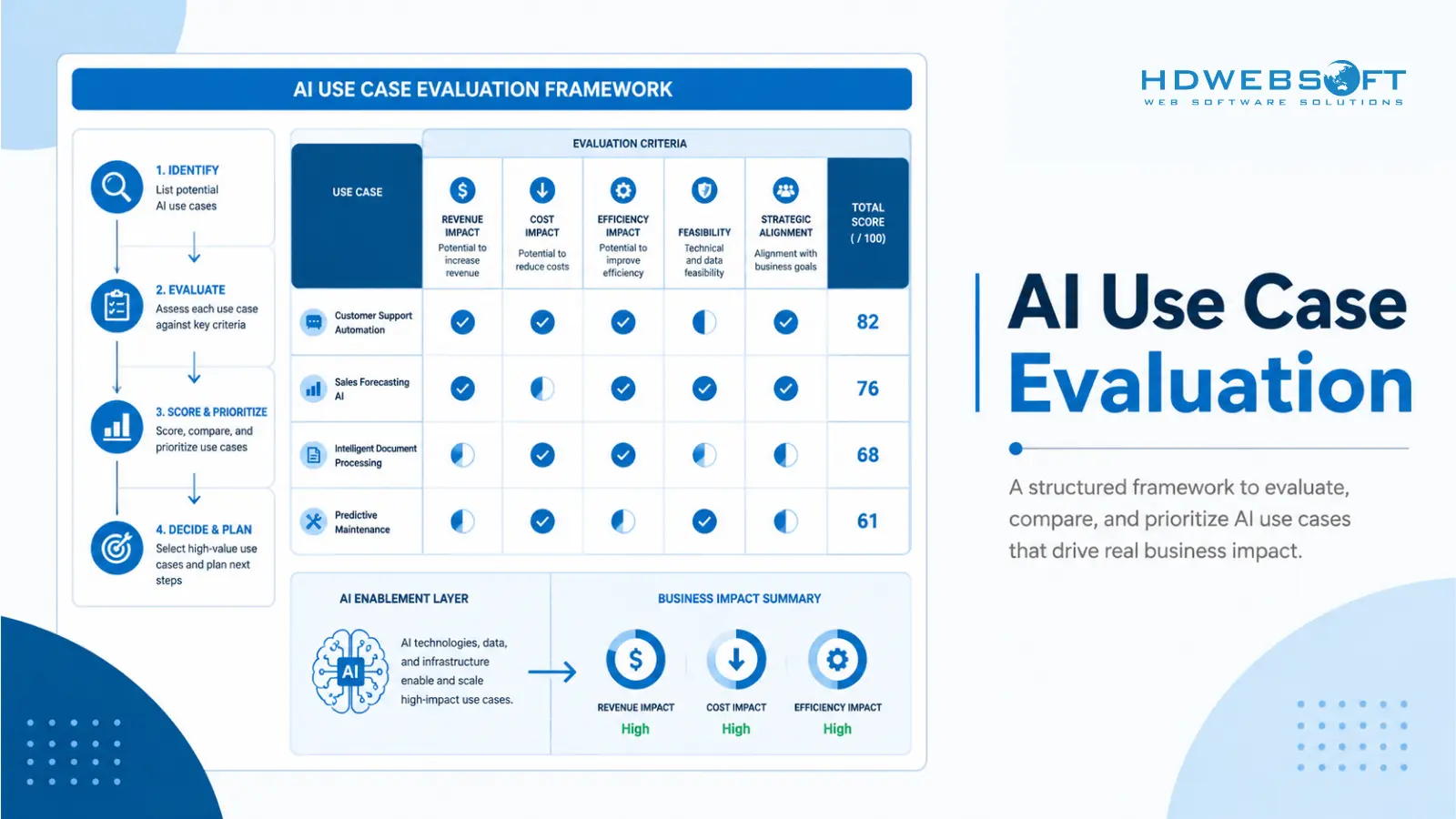
AI use case evaluation is the systematic process of assessing whether artificial intelligence is the right solution for a specific business problem. It helps organizations identify opportunities where AI can create meaningful value while avoiding costly projects that address unclear needs or could be solved more effectively with simpler approaches. Without proper evaluation, businesses risk investing in AI initiatives that fail to deliver expected results or drain resources without measurable business impact.
What is AI Use Case Evaluation?
AI use case evaluation involves analyzing business problems, assessing technical feasibility, estimating return on investment, and determining whether AI is the most appropriate solution. This process goes beyond technical assessment to include business alignment, organizational readiness, and strategic fit. A comprehensive evaluation considers both the potential benefits and the costs, risks, and implementation challenges.
According to industry research on AI implementation, organizations that systematically evaluate AI use cases before implementation are significantly more likely to achieve successful outcomes. The evaluation framework helps ensure that AI initiatives address genuine business needs rather than pursuing technology for its own sake.
Why Evaluation Matters Before AI Implementation
Most AI project failures stem from poor upfront evaluation rather than technical shortcomings. Organizations that skip thorough assessment often find themselves halfway through implementation before realizing the business problem wasn’t well-defined, the expected value doesn’t materialize, or a simpler solution would have been more effective. Proper evaluation prevents these costly mistakes by ensuring clarity on objectives, feasibility, and expected returns before significant resources are committed.
Building on the foundation of AI readiness assessment, use case evaluation represents the next critical step in the AI implementation journey. While readiness assesses organizational preparedness, use case evaluation focuses on selecting the right opportunities to pursue.
Is Your Business Problem Clear Enough for AI?
The foundation of successful AI implementation is a clearly defined business problem. Vague or poorly understood needs lead to equally vague solutions that fail to deliver measurable value. Before considering AI as a solution, organizations must articulate the specific problem they’re trying to solve, why it matters, and what success looks like.
Signs You Have a Well-Defined Problem
A well-defined business problem has specific characteristics:
- Clear articulation of current pain points or inefficiencies
- Measurable impact on operations, revenue, or costs
- Understanding of root causes rather than symptoms
- Defined scope and boundaries
- Alignment with strategic business objectives
- Stakeholder agreement on problem importance
For example, “Our customer service response times are too long” is vague. A well-defined version would be: “Current average customer service response time is 48 hours, leading to a 15% customer churn rate and $2M annual revenue loss. We need to reduce response time to under 4 hours to improve customer retention.”
Common Pitfalls in Problem Definition
Organizations often fall into several traps when defining business problems:
- Focusing on symptoms rather than root causes: Addressing surface-level issues without understanding underlying problems
- Scope creep: Trying to solve too many problems simultaneously
- Lack of metrics: Problems defined qualitatively without measurable baselines or targets
- Technology bias: Framing problems in ways that presuppose AI as the solution
- Insufficient stakeholder input: Problems defined by IT or technical teams without business perspective
Which AI Use Cases Create Real Business Value?
Not all AI use cases are created equal. Some generate significant returns while others consume resources without delivering meaningful impact. Understanding which use cases create genuine business value is essential for prioritization and resource allocation.
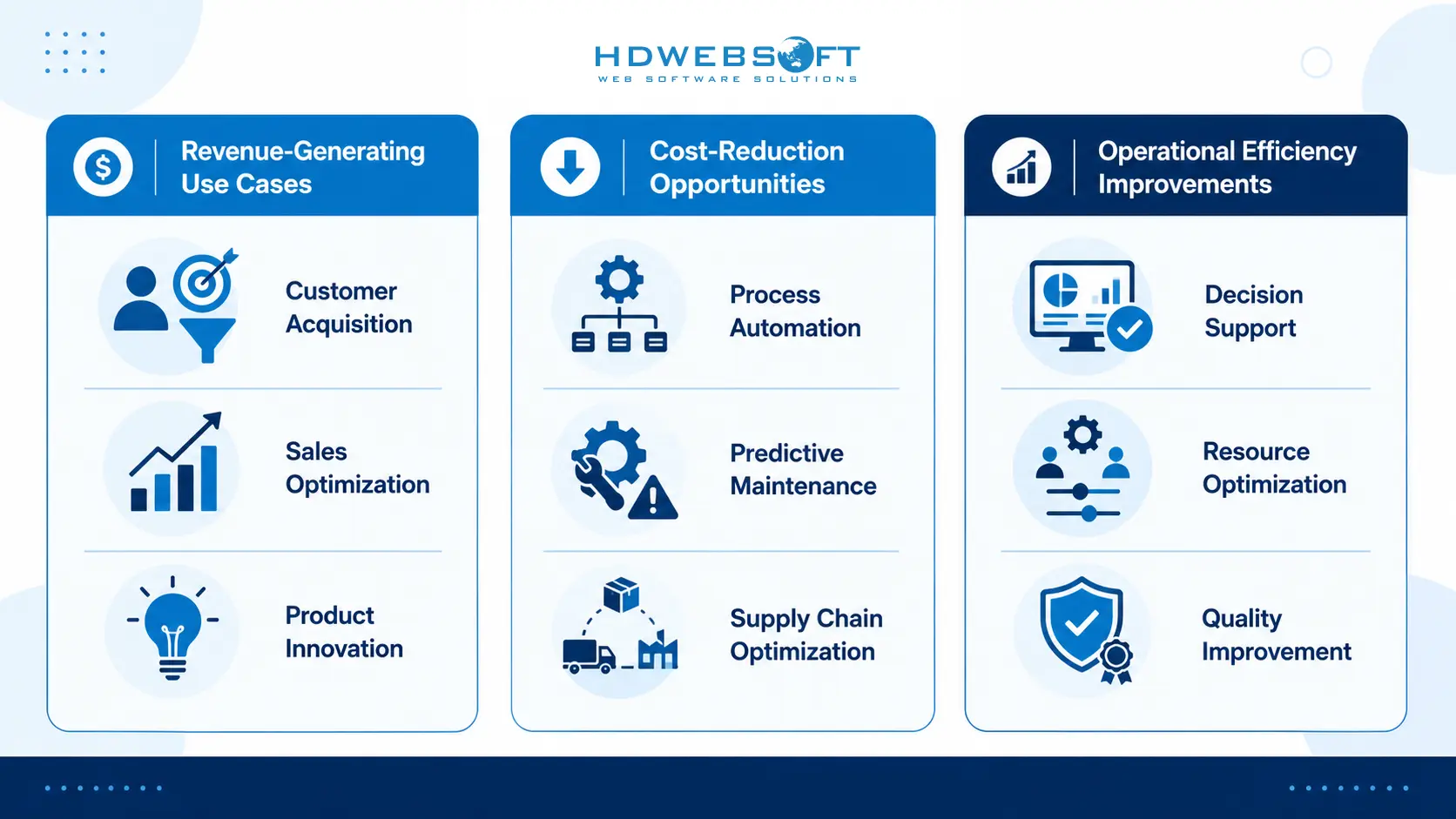
Revenue-Generating Use Cases
AI use cases that directly impact revenue typically involve:
- Customer acquisition and retention: AI-powered personalization, recommendation engines, and customer insights
- Sales optimization: Lead scoring, pricing optimization, and sales forecasting
- Product innovation: AI-driven R&D, feature development, and market analysis
Custom software development services can help implement these revenue-generating AI solutions with proper integration into your existing business systems. Additionally, data analytics services can provide the insights needed to measure AI impact accurately.
Deloitte’s AI research indicates that organizations focusing on revenue-generating AI use cases report higher ROI and faster payback periods compared to those prioritizing cost-reduction initiatives.
Cost-Reduction Opportunities
AI can deliver significant cost savings through:
- Process automation: Robotic process automation (RPA) and intelligent document processing
- Predictive maintenance: Reducing equipment downtime and maintenance costs
- Supply chain optimization: Inventory management, demand forecasting, and logistics optimization
- Fraud detection: Automated anomaly detection reducing financial losses
Operational Efficiency Improvements
Efficiency-focused use cases include:
- Decision support: AI-powered analytics for faster, more accurate decision-making
- Resource optimization: Better allocation of human, financial, and physical resources
- Quality improvement: Automated quality control and defect detection
- Compliance automation: Regulatory monitoring and reporting
Partnering with experienced AI development services providers can accelerate the implementation of these efficiency-focused use cases while ensuring proper governance and risk management. For organizations requiring machine learning development, specialized expertise can ensure models are properly trained and deployed.
Warning Signs: Starting from Technology Instead of Business Needs
One of the most common reasons for AI project failure is the technology-first approach—starting with AI capabilities rather than business needs. This “shiny object syndrome” leads organizations to implement AI solutions in search of problems rather than addressing genuine business challenges.
Technology-First vs. Problem-First Approach
Technology-first approach characteristics:
- Beginning with “How can we use AI?” rather than “What problem do we need to solve?”
- Selecting AI solutions based on technical capabilities rather than business fit
- Implementing AI because competitors are doing it
- Focusing on what’s technologically possible rather than what’s valuable
Problem-first approach characteristics:
- Starting with clear business problems or opportunities
- Evaluating multiple solution approaches, AI and non-AI
- Selecting solutions based on business impact and feasibility
- Measuring success against business outcomes
How to Avoid the “Shiny Object” Trap
To avoid technology-first thinking:
- Require business case justification: Every AI initiative must start with a documented business case
- Evaluate alternative solutions: Consider non-AI approaches alongside AI options
- Focus on outcomes, not outputs: Measure business impact rather than technical achievements
- Establish governance: Create review processes that evaluate business alignment before technical feasibility
Gartner’s research suggests that organizations with strong AI governance are more likely to pursue valuable use cases and avoid technology-driven initiatives.
When AI Is Not the Best Solution
Despite AI’s potential, it’s not always the optimal solution. Sometimes simpler, more cost-effective approaches can deliver better results with less complexity and risk.
Alternative Approaches to Consider
Before committing to AI, consider:
- Process improvements: Sometimes redesigning business processes can solve problems without technology
- Basic automation: Rule-based automation or simple scripts may suffice for structured tasks
- Data analytics: Traditional analytics and dashboards may provide needed insights without AI complexity
- Human expertise: Investing in training or hiring might be more effective than AI for certain tasks
Cost-Benefit Analysis for Non-AI Solutions
A thorough evaluation should compare AI solutions against alternatives:
- Implementation costs: AI often requires significant upfront investment in data, infrastructure, and expertise
- Time to value: Simple solutions may deliver value faster than complex AI implementations
- Maintenance overhead: AI systems require ongoing monitoring, retraining, and maintenance
- Risk profile: AI introduces additional risks around bias, explainability, and regulatory compliance
According to MIT Sloan Management Review, organizations that regularly evaluate non-AI alternatives make better investment decisions and achieve higher overall returns from their technology portfolios.
Linking Use Cases to Operational, Revenue, or Cost Objectives
Successful AI use cases must be explicitly linked to specific business objectives. Vague promises of “innovation” or “digital transformation” rarely justify significant investment. Instead, AI initiatives should connect to measurable operational, revenue, or cost goals.
Mapping Use Cases to KPIs
Every AI use case should map to specific key performance indicators:
- Revenue objectives: Customer acquisition cost, lifetime value, conversion rates, average order value
- Cost objectives: Operational costs, maintenance expenses, labor costs, error rates
- Operational objectives: Process cycle time, throughput, quality metrics, customer satisfaction scores
For example, an AI-powered customer service chatbot should link to specific metrics like:
- Reduce average response time from 48 hours to 4 hours
- Decrease customer service costs by 30%
- Improve customer satisfaction scores by 15%
- Reduce agent workload by 40%
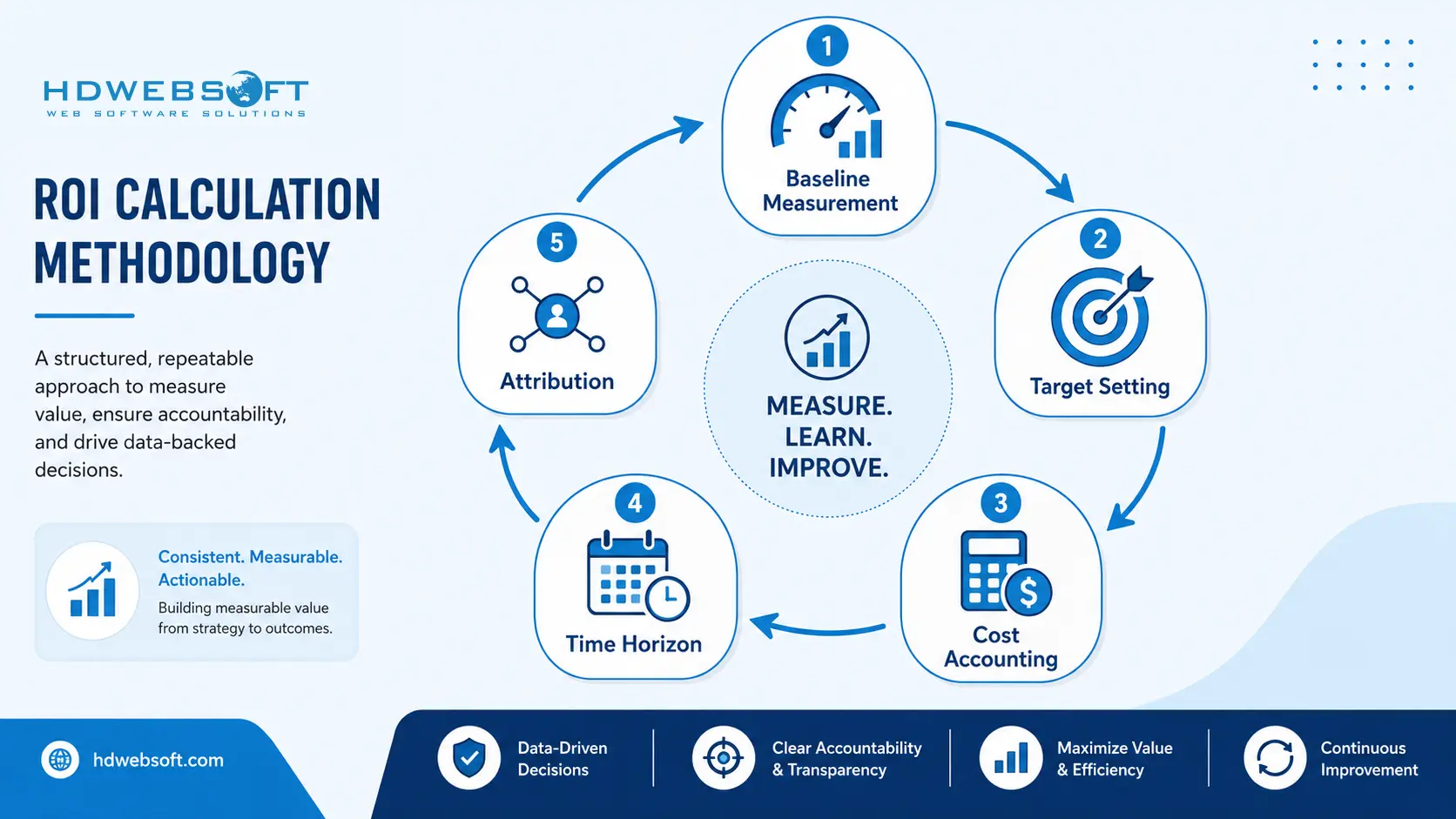
ROI Calculation Methods
Establish clear ROI methodology before implementation. Organizations should establish proper measurement frameworks and dashboards for tracking AI initiative performance.
- Baseline measurement: Document current performance metrics before AI implementation
- Target setting: Define specific, measurable improvement targets
- Cost accounting: Include all implementation, operational, and maintenance costs
- Time horizon: Establish realistic timelines for realizing benefits
- Attribution: Define how to attribute improvements to the AI initiative
Success Metrics and Timelines
Realistic expectations are crucial for AI success:
- Short-term metrics: Technical performance, user adoption, initial operational improvements
- Medium-term metrics: Business impact, cost savings, revenue effects
- Long-term metrics: Strategic value, competitive advantage, organizational capability building
Forrester’s AI research emphasizes that organizations with clear success metrics and realistic timelines achieve significantly better outcomes from AI investments.
AI Use Case Evaluation Framework
A structured framework helps ensure consistent, thorough evaluation of AI use cases. This systematic approach reduces bias, improves decision quality, and increases the likelihood of successful implementation.
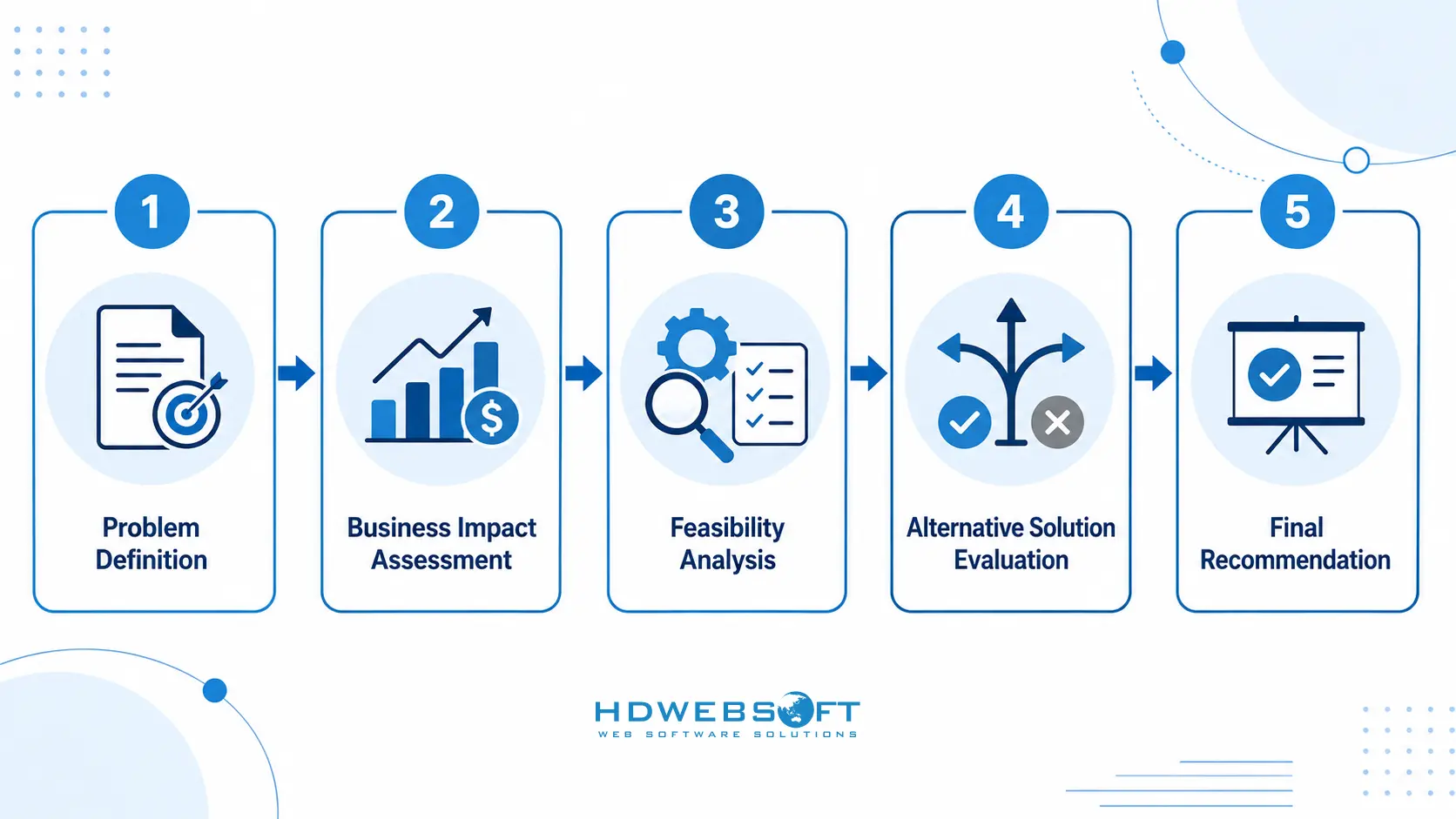
Step-by-Step Evaluation Process
Step 1: Problem Definition
- Clearly articulate the business problem
- Establish baseline metrics and current performance
- Identify root causes and scope boundaries
- Validate with key stakeholders
Step 2: Business Impact Assessment
- Quantify potential revenue, cost, or operational benefits
- Estimate implementation and operational costs
- Calculate preliminary ROI and payback period
- Assess strategic alignment and priority
Step 3: Feasibility Analysis
- Evaluate data availability and quality
- Assess technical requirements and capabilities
- Consider organizational readiness and skills
- Identify implementation challenges and risks
Step 4: Alternative Solution Evaluation
- Compare AI against non-AI alternatives
- Assess cost-benefit trade-offs
- Consider implementation complexity and time to value
- Evaluate risk profiles
Step 5: Final Recommendation
- Summarize findings and recommendations
- Outline implementation approach and timeline
- Define success metrics and monitoring requirements
- Secure stakeholder approval and resource commitment
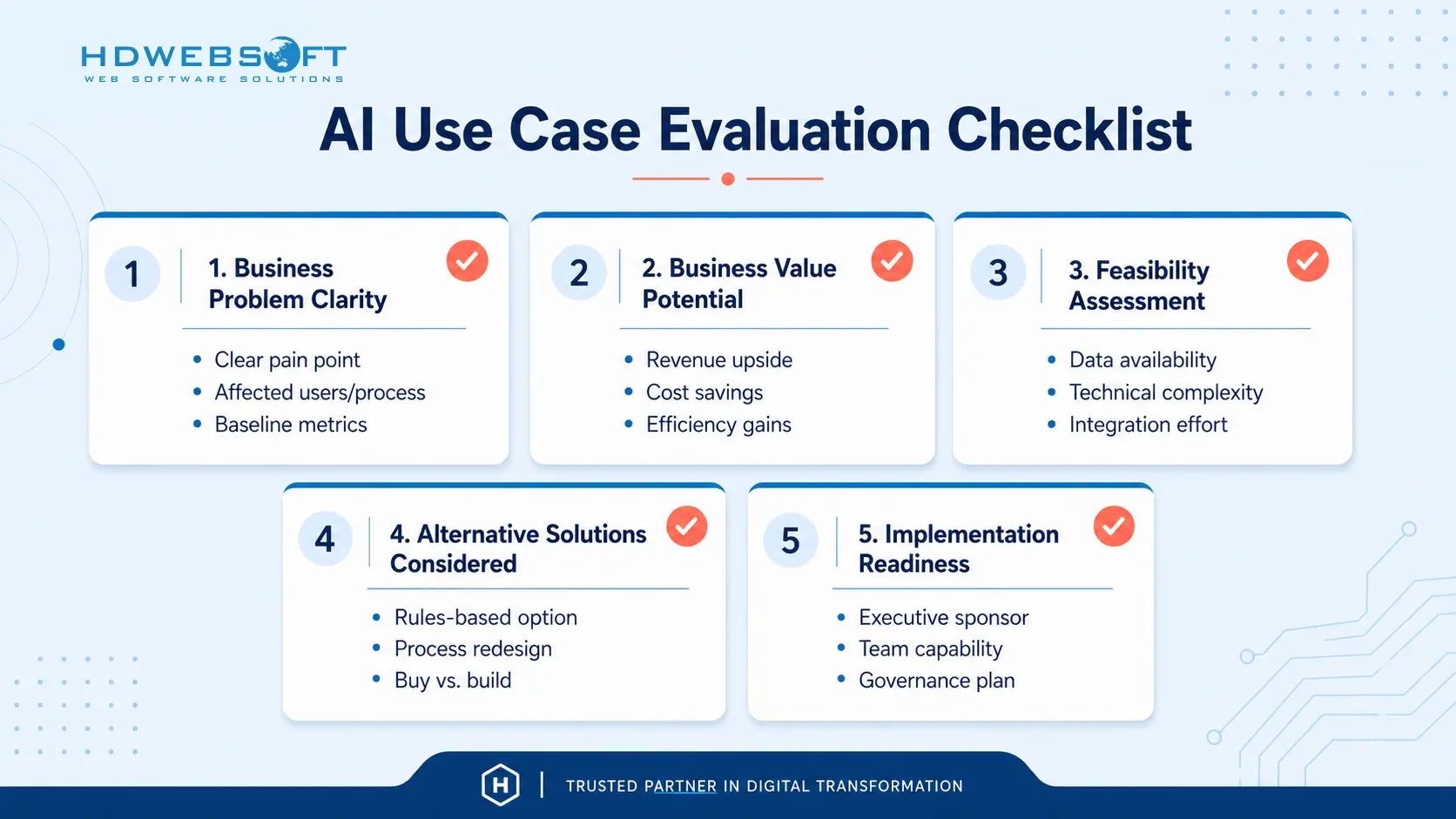
Evaluation Checklist
Use this comprehensive checklist to evaluate AI use cases:
Business Problem Clarity
- Problem clearly defined and quantified
- Root causes identified and understood
- Stakeholder agreement on problem importance
- Success criteria established
Business Value Potential
- Revenue impact quantified
- Cost savings estimated
- Operational benefits defined
- Strategic alignment assessed
Feasibility Assessment
- Data availability and quality evaluated
- Technical requirements understood
- Organizational capabilities assessed
- Implementation risks identified
Alternative Solutions Considered
- Non-AI options evaluated
- Cost-benefit analysis completed
- Time to value compared
- Risk profiles assessed
Implementation Readiness
- Executive sponsorship secured
- Resources allocated
- Timeline established
- Success metrics defined
Key Takeaways
- AI use case evaluation prevents failed projects by ensuring business problems are well-defined before committing resources
- Starting from business needs rather than technology leads to higher success rates and better ROI
- Not every problem requires AI - sometimes simpler solutions are more effective and cost-efficient
- Linking AI initiatives to specific KPIs ensures measurable business impact and justifies investment
- A structured evaluation framework helps prioritize high-value opportunities and avoid costly mistakes
- Regular reassessment of use cases ensures ongoing alignment with business objectives and market conditions
FAQ
What is the first step in AI use case evaluation?
The first step is clearly defining the business problem you’re trying to solve. This includes quantifying the current impact, understanding root causes, and establishing measurable success criteria. Without a well-defined problem, any solution evaluation will be flawed.
How do I know if my business problem is suitable for AI?
Assess whether the problem involves patterns that can be learned from data, has sufficient historical data available, and requires decisions at scale or speed beyond human capabilities. Also consider whether simpler, rule-based solutions could address the problem effectively.
What are the red flags that indicate we’re pursuing AI for the wrong reasons?
Warning signs include starting with “how can we use AI?” rather than “what problem do we need to solve?”, implementing AI because competitors are doing it, focusing on technical capabilities rather than business value, and lacking clear business cases or success metrics.
How can I measure the success of an AI use case?
Establish baseline metrics before implementation, define specific improvement targets, track both technical and business metrics, and attribute improvements to the AI initiative. Regular measurement against these metrics helps validate success and identify areas for improvement.
What are common mistakes in AI use case evaluation?
Common mistakes include poorly defined problems, insufficient data quality assessment, overestimating AI capabilities, underestimating implementation complexity, neglecting alternative solutions, and failing to establish clear success metrics and timelines.
When should I consider non-AI solutions instead?
Consider non-AI solutions when the problem can be addressed with process improvements, basic automation, traditional analytics, or human expertise. Also consider non-AI approaches when data is insufficient, implementation complexity is high, or when simpler solutions can deliver adequate results at lower cost.
Ready to evaluate your AI use cases but need expert guidance? Contact HDWEBSOFT today for a consultation. Our AI experts can help you assess your business problems, evaluate technical feasibility, and develop a roadmap for successful AI implementation that delivers measurable business value.
Don’t let unclear objectives or technology-first approaches derail your AI initiatives. Let us help you build a solid foundation for AI success with proven evaluation frameworks and industry best practices.