
AI Automation Solutions for Modern Business Operations
HDWEBSOFT delivers enterprise-grade AI automation solutions designed to streamline
complex workflows and modernize operational systems.
As organizations grow, manual processes and fragmented tools create inefficiencies that slow down productivity and decision-making.
By implementing AI business automation, companies transform routine tasks into intelligent, self-optimizing workflows as part of a broader
AI developmentstrategy — using machine learning, NLP, and predictive analytics to interpret data, automate decisions, and continuously improve performance.
Rather than replacing current platforms, we extend them with AI-driven capabilities that reduce manual workload and provide real-time operational insights. This complements our AI integration services for teams embedding AI across their full technology stack.

AI-Driven Workflow Intelligence
AI workflow automation analyzes operational data to route tasks, prioritize activities, and optimize processes — continuously improving over time.

Scalable Enterprise Automation
AI automation scales across enterprise systems, handling complex workflows without increasing operational overhead as your organization grows.

Cross-System Process Integration
Connect siloed tools and data sources into unified automated pipelines — from data ingestion and processing to decision output and reporting.
From Fragmented Tools to Custom AI Workflows
Many growing companies already rely on CRM platforms, ERP systems, identity providers, spreadsheets, chat tools, and internal databases. Each tool may solve one problem, but daily operations can still depend on manual handoffs, repeated data entry, complex configuration, and specialist support to keep workflows moving.
HDWEBSOFT designs custom AI workflow automation around the way your business actually works. Instead of forcing teams to adapt every process to a heavy platform, we map the real steps, data, approvals, and exceptions, then build focused automation that reduces configuration overhead and makes the workflow easier to use.
When AI-assisted prototyping is useful, we use it to explore workflow screens and business logic faster. Production software still goes through engineering review, security checks, testing, and controlled deployment before it becomes part of daily operations.
Simpler Internal Tools
Build focused workflow software for approvals, document handling, reporting, and task routing without unnecessary platform complexity.
Lower Maintenance Overhead
Reduce the number of manual rules, configuration steps, and operational workarounds needed to keep internal processes running.
Security-Controlled Automation
Plan data boundaries, access control, auditability, and AI-assisted security scans before automation is released to users.
What AI Business Automation Means for Enterprise Systems
With experience implementing AI business automation across complex software ecosystems, we design intelligent systems that integrate seamlessly with existing platforms and support long-term operational growth. For sensitive workflows, we define data access, security controls, and review checkpoints early so automation improves efficiency without weakening information protection.

Intelligent Business Workflow Automation
We design AI workflow automation systems that streamline complex operational processes across departments and teams. By combining machine learning with workflow orchestration, tasks such as approvals, data validation, and operational routing can be executed automatically while maintaining transparency and control over business processes.

Data Processing and Operational Intelligence
Our AI business automation software processes large volumes of structured and unstructured data to generate actionable insights. Automated data pipelines analyze operational information in real time, allowing organizations to improve decision accuracy, reduce manual analysis, and maintain consistent data quality across enterprise systems.
Enterprise System Integration with AI
Successful AI automation solutions depend on seamless integration with existing platforms. We connect AI models with enterprise systems such as CRM, ERP, analytics platforms, and internal databases, enabling automated workflows that operate across multiple applications without disrupting current infrastructure.

Scalable AI Process Automation
HDWEBSOFT’s AI process automation services help enterprises automate high-volume operations while maintaining scalability and reliability. As workflows grow more complex, AI-driven systems can adapt to increasing workloads, ensuring consistent performance and efficient operations across distributed business environments.
AI Workflow Automation Across Enterprise Processes
Modern enterprises rely on complex workflows that span multiple systems, teams, and data sources. Through AI workflow automation, organizations can streamline operational processes, reduce manual workload, and ensure tasks move efficiently across departments.
HDWEBSOFT enables intelligent workflows that adapt to business conditions while maintaining performance, transparency, and scalability.
Automating Repetitive Operational Workflows
Many business processes involve repetitive tasks such as data validation, document processing, and approval routing. With AI automation solutions, these activities can be executed automatically while maintaining accuracy and operational visibility.
By transforming manual steps into automated processes, organizations can significantly reduce processing time and improve overall workflow efficiency across departments.


Intelligent Workflow Routing with AI
Traditional workflow systems rely on static rules to assign tasks. In contrast, AI-driven automation analyzes operational data to determine the most efficient path for each task.
Work items can be prioritized, routed to the appropriate teams, and processed faster based on workload conditions, expertise requirements, and business priorities.
Cross-System Workflow Automation
Enterprise workflows often involve multiple software platforms such as CRM, ERP, analytics systems, and internal databases. Our AI workflow automation systems integrate these systems through intelligent orchestration layers, allowing workflows to operate seamlessly across applications. This approach eliminates manual data transfers and ensures consistent operations throughout the entire technology ecosystem.

AI-Driven Decision Automation
Beyond task automation, AI enables systems to support real-time operational decisions. Machine learning models analyze incoming data to identify patterns, detect anomalies, and trigger automated responses within workflows. This allows businesses to respond faster to operational events while maintaining accuracy and control over critical processes.
AI Process Automation Services We Provide
Organizations increasingly rely on AI automation solutions to streamline operations and reduce manual workload across complex systems. At HDWEBSOFT, our AI process automation services focus on transforming operational processes into intelligent workflows that improve efficiency, accuracy, and scalability.
Intelligent Process Automation
Intelligent Process Automation combines artificial intelligence with workflow automation to manage business processes that involve both structured and unstructured data. Through automation software solutions, organizations can automate complex operational tasks while maintaining transparency and control over their processes.
- Automated approval workflows and task routing
- Intelligent data validation across enterprise systems
- Operational monitoring and anomaly detection
- Automated reporting and analytics generation
Document Processing and Data Extraction
Many enterprise operations rely on processing documents such as invoices, forms, reports, and contracts. Our AI process automation services use machine learning and natural language processing to extract valuable information from these documents automatically.
- AI-based document classification and sorting
- Automated extraction of key data fields from forms and invoices
- Data validation against internal databases
- Integration with workflow systems for automated processing
AI-Powered Task Automation
With AI automation solutions, routine operational tasks can be executed automatically while maintaining high levels of accuracy and consistency. By embedding intelligence into workflows, organizations can reduce repetitive manual activities and allow teams to focus on higher-value work.
- Automated customer request categorization
- Intelligent ticket routing in support systems
- Automated scheduling and task prioritization
- Real-time operational alerts and monitoring
Predictive Workflow Automation
Predictive capabilities allow AI workflow automation systems to anticipate operational needs before issues occur. By analyzing historical and real-time data, automation systems can trigger proactive actions that improve operational resilience and efficiency.
- Forecasting supply chain disruptions
- Identifying operational anomalies in financial systems
- Predicting customer churn or service demand
- Initiating preventive maintenance workflows
Enterprise System Process Automation
Enterprise environments often involve multiple interconnected platforms. Our AI process automation systems integrate AI-driven workflows across systems such as CRM, ERP, analytics platforms, and internal databases to create unified automated processes.
- Automated order processing and fulfillment workflows
- Financial reconciliation and reporting automation
- Employee onboarding and HR workflow automation
- Compliance monitoring and operational auditing
Technologies Powering Our AI Automation Solutions
Our AI automation solutions are built on a robust technology stack spanning backend development, artificial intelligence, cloud infrastructure, and DevOps. On the AI side we build on production-grade open frameworks such as PyTorch and the Hugging Face model ecosystem. These technologies enable us to design, deploy, and scale intelligent workflows across enterprise environments.
 React.js
 We utilize ReactJS, a leading front-end framework, for SaaS and front-end intensive projects, capitalizing on its vast community and long-term supported libraries.
React Development Vue.js
 We use the power of Vue2 and Vue3 for projects demanding a reliable framework with solid performance, benefiting from their exceptional two-way binding capabilities for seamless interactivity.
VueJS Development Angular
 We have specialized in Angular since its inception in 2014, starting with the first version, AngularJS (Angular 1).
Angular Development JavaScript
 We utilize JavaScript for comprehensive front-end, back-end web development, and mobile app creation, ensuring seamless, interactive user experiences.
JavaScript Development Next.js
 We use Next.js as a full-stack React framework for SaaS products, portals, and SEO-critical web applications, combining SSR, SSG, ISR, API routes, and performance-focused architecture with 30+ capable developers.
Next.js Development Material UI
  Ant design
  D3
D3 We utilize D3, a JavaScript library, to create stunning SVG visualizations driven by data, enabling rich and interactive visual experiences.
Data Visualization HighCharts
  Chart.js
  NVD3.js
  Plotly
  ECharts
  Bootstrap
  jQuery
  HTML5
HTML5  CSS
CSS  SVG D3
 We utilize D3, a JavaScript library, to create stunning SVG visualizations driven by data, enabling rich and interactive visual experiences.
Data Visualization HighCharts Chart.js NVD3.js Plotly ECharts HTML5 SVG  Canvas
  Power BI
  Tableau
  Looker
  Apache Superset
  Elasticsearch
 It's widely used for log and full-text search, real-time analytics, and application monitoring.
 BigQuery
  Amazon Redshift
  Terraform
  Grafana Next.js
 We use Next.js as a full-stack React framework for SaaS products, portals, and SEO-critical web applications, combining SSR, SSG, ISR, API routes, and performance-focused architecture with 30+ capable developers.
Next.js Development Python
 We utilize Python for API development, CRM and ERP software, and advanced data processing. Python's flexibility and efficiency enable us to build robust, scalable solutions.
Python Development Java
Java We utilize Java for OOP-centric enterprise applications, following strict development models for government and enterprise clients, ensuring robust, reliable solutions.
Java Development Node.js
 We rely on Node.js for building high-performance APIs and real-time applications.
NodeJS Development .NET
.NET We utilize .NET for enterprise software development, as well as desktop app development, to create robust and efficient solutions for businesses of various sizes.
.NET Development PHP
PHP We utilize PHP for rapid web development, including CMS and web application development. Our success is evidenced by our satisfied clients.
PHP Development JavaScript We utilize JavaScript for comprehensive front-end, back-end web development, and mobile app creation, ensuring seamless, interactive user experiences.
JavaScript Development C#
C#  Ruby
Ruby We primarily utilize Ruby with its Rails framework (RoR) for building dynamic web applications, leveraging its efficiency and convention-over-configuration philosophy.
Ruby on Rails Development Golang
  Scala
Scala  Erlang
  Elixir
  Firebase
  MongoDB Realm
  Rust
Rust  WebAssembly
  iOS
iOS We specialize in developing applications for Mac OS, iPhone, iPad, and Apple Watch, ensuring our clients stay ahead of trends while optimizing costs and enhancing value.
iOS App Development Android
 We create secure, high-performance Android native apps that adhere to industry standards. Our focus on optimization ensures smooth user experiences.
Android App Development React Native
 We skillfully utilize React Native, customizing native modules to ensure quick response times and meet seemingly unachievable requirements.
React Native Development Flutter
 Flutter has impressive capabilities to write once and build across iOS, Android, Web, and Windows Mobile, streamlining development effortlessly.
Flutter App Development Xamarin
  Swift
Swift  Kotlin
  Ionic Framework
  Meteor
  PWA
PWA  Expo Firebase MongoDB Realm Next.js
 We use Next.js as a full-stack React framework for SaaS products, portals, and SEO-critical web applications, combining SSR, SSG, ISR, API routes, and performance-focused architecture with 30+ capable developers.
Next.js Development Laravel
 We harness the power of Laravel, the best PHP framework, to develop websites, web portals, and APIs for mobile applications.
Laravel Development Django
 Our company leverages Django's backend capabilities to rapidly develop APIs, CRM, ERP systems, and Warehouse Management Systems (WMS).
Django Development Express.js
 We leverage Express.js for web, API, reverse proxy, and real-time applications to build versatile and efficient solutions.
ExpressJS Development Spring
  Ruby on Rails
 We employ Ruby on Rails for projects requiring tightly structured data models, ensuring efficient, organized, and maintainable code.
Ruby on Rails Development Serverless
 We harness the power of the Serverless Framework to build cost-effective and scalable APIs, focusing on heavy data analysis.
Serverless Development CakePHP
  Vaadin
  Scala Play Rust WebAssembly
  Salesforce
 Customer Relationship Management (CRM) platform, offering a suite of enterprise applications focused on customer service, marketing automation, analytics, and application development.
Salesforce Development Power BI Tableau Looker Apache Superset  NetSuite
  Shopify
 Shopify, a leading e-commerce platform, offers user-friendly solutions to create, manage, and scale online stores quickly and efficiently.
Shopify Development Amazon Seller Central
  Microsoft Dynamics 365
  Adobe Commerce
 Adobe Commerce, also known as Magento, is one of the most powerful and versatile e-commerce platforms available today.
Magento Development Odoo CRM Salesforce
 Customer Relationship Management (CRM) platform, offering a suite of enterprise applications focused on customer service, marketing automation, analytics, and application development.
Salesforce Development Microsoft Dynamics 365 Odoo CRM  Oracle Cloud Infrastructure
  Suite CRM
  ORO CRM
  SugarCRM
  SAP
SAP  Cohere
  Qdrant
  Pinecone
  Chroma
  Txtai
Txtai  Haystack
  LlamaIndex
  LangChain
  AWS AI
  Weaviate
  Claude
  Mistral AI
  Qwen Chat
  Gemma
Gemma  Gemini
  Phi
Phi  Llama
Llama  OpenAI
  Ollama
  Giskard
  Google
  Voyage AI
  BGE
BGE  SBERT.net
  Nomic AI
  Together AI
  Groq
Groq  Ragas
Ragas  Hugging Face
  ExtractThinker
  Docling
  MegaParse
  ScrapeGraphAI
  Firecrawl
  Crawl4AI
  Milvus
  Magento
 We rely on Magento to develop robust e-commerce websites, ensuring seamless integration with accounting, CRM, WMS, inventory management, shipping systems, and payment gateways.
Magento Development WordPress
 As experts in WordPress, the world's leading CMS, we specialize in creating secure, highly customizable sites and skillfully navigating PHP challenges.
WordPress Development Shopify Shopify, a leading e-commerce platform, offers user-friendly solutions to create, manage, and scale online stores quickly and efficiently.
Shopify Development Drupal
  Joomla
  PrestaShop Firebase
  Amazon AWS
 As a leading cloud platform, we have AWS-certified developers who excel at building best-practice architectures on AWS for optimal performance and scalability.
AWS Consultation Google GCP
 GCP stands out as a cloud marketplace offering professional services, providing scalable solutions and expert support for diverse business cloud computing needs.
GCP Consultation Microsoft Azure
 Azure, the amazing cloud platform, is specifically designed to support .NET applications with its robust infrastructure and comprehensive set of services.
Azure Consultation Digital Ocean
  IBM Cloud
  Heroku Amazon AWS
 As a leading cloud platform, we have AWS-certified developers who excel at building best-practice architectures on AWS for optimal performance and scalability.
AWS Consultation Google GCP GCP stands out as a cloud marketplace offering professional services, providing scalable solutions and expert support for diverse business cloud computing needs.
GCP Consultation Microsoft Azure Azure, the amazing cloud platform, is specifically designed to support .NET applications with its robust infrastructure and comprehensive set of services.
Azure Consultation Heroku Elasticsearch It's widely used for log and full-text search, real-time analytics, and application monitoring.
BigQuery  Snowflake
  MongoDB
  Cassandra
  Infobright
  Redis
Redis  Solr Amazon Redshift MongoDB Realm Elasticsearch
 It's widely used for log and full-text search, real-time analytics, and application monitoring.
BigQuery Snowflake  PostgreSQL
  MySQL
MySQL  SQL Server
  Oracle MongoDB Cassandra Infobright Redis Solr
  Amazon RDS
  Google Cloud SQL
  Amazon S3 Amazon Redshift
  Azure CosmosDB
  Amazon Dynamo DB
  Azure DevOps
  Kubernetes
  Docker Terraform
  GitLab CI/CD
  Jenkins
  Datadog Grafana
  Prometheus
  AWS Developer Tools
  Ansible
  Chef
Chef  Google Developers
  Packer
  Puppet
  SaltStack
  TeamCity
  Selenium
 Automation framework for web browsers, enabling developers to write automated tests for web applications across different browsers and platforms.
Automation Testing Postman
  JMeter
  LoadRunner
 Performance testing tool used to simulate user activity and measure system behavior and performance under high traffic load.
 Cucumber
  Jest
Jest  JUnit
JUnit  Bugzilla
  Jira
Jira  TestRail
  Zephyr
  REST Assured
  RestSharp
  SoapUI
  SOC-2
SOC-2  HIPAA
HIPAA Protects patient health information privacy and mandates secure handling of medical records.
Healthcare Software Acunetix
  Vanta
Vanta  Snyk
Snyk  OWASP
OWASP  CloudFlare
  Azure WAF
  AWS WAF
  Aircrack-ng
  Burp Suite
  DBeaver
  HCL AppScan
  Metasploit
  Nessus
  Nmap Security Scanner Tool
  Wireshark
  Apiary
  RESTful API
  Keychain Services API
  GraphQL
  Google Pay
  Google Maps
  Fingerprint API
  Bluetooth Low Energy API
  Apple Pay
  Apple Map REST Assured RestSharp SoapUI Rust
  Solidity
  Vyper WebAssembly
  Embark
  Hardhat
  OpenZeppelin
  Truffle
  Whiteblock Solidity
  Tezos
Tezos  Terra Luna
  Stellar
  Solana
  Polkadot
  POA Network
  NEAR Protocol
  Hyperledger Fabric
  Fantom (FTM)
  Ethereum
  EOS
EOS  Bitcoin
  Avalanche
  Amazon Managed Blockchain
  IBM Blockchain
  Oracle Blockchain
  Adobe XD
  Balsamiq
  Canva
Canva  Figma
Figma  InVision
  Jotform
  Marvel
  Sketch
  Zeplin
 AI Automation for High-Impact Business Functions
AI automation is transforming how enterprises operate by embedding intelligence into everyday business activities. From operational processes to knowledge workflows, AI automation solutions enable organizations to reduce manual work, accelerate decision-making, and improve operational visibility across departments.
Operations Management
AI-powered automation helps monitor operational workflows, detect inefficiencies, and automatically trigger actions that improve productivity across logistics, operations, and internal coordination.
Customer Support
Intelligent AI chatbots, automated ticket routing, and AI-assisted responses help organizations resolve customer issues faster while maintaining consistent service quality.
Finance and Accounting
AI automation supports invoice processing, expense validation, reconciliation, and anomaly detection, allowing finance teams to maintain accuracy while reducing repetitive administrative work.
Data Processing and Analytics
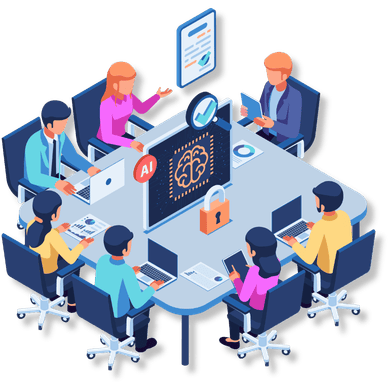
AI-driven automation collects, cleans, and processes large volumes of data across systems, enabling faster insights and more reliable business intelligence.
Document and Knowledge Workflows
AI systems can classify documents, extract structured information, and organize knowledge assets, helping teams access critical information without manual sorting or searching.
Human Resource Operations
AI automation streamlines recruitment screening, employee onboarding workflows, and internal HR documentation management while improving efficiency across HR operations.
Our Approach to Implementing AI Automation Solutions
Implementing AI automation software solutions requires more than deploying technology. HDWEBSOFT follows a structured implementation process designed to identify automation opportunities, integrate intelligent systems, and ensure long-term operational reliability across enterprise environments. For teams still evaluating where to start, our AI consulting services can help define the right automation strategy before build begins.
Automation Opportunity Assessment
Every automation initiative begins with understanding where intelligent automation can create the greatest operational value. Our specialists analyze business workflows, operational bottlenecks, and data availability to identify high-impact opportunities for AI automation solutions.
By prioritizing processes that involve repetitive work, large data volumes, or decision-heavy tasks, we ensure automation initiatives deliver measurable efficiency improvements.
Process Mapping and Workflow Design
Once opportunities are identified, we map existing workflows to understand how tasks move across systems, teams, and decision points. Based on this analysis, we design optimized automation architectures that align AI workflow automation with real business operations.
This step ensures that automation improves process efficiency without disrupting critical enterprise systems or existing operational structures.
AI Model Integration and Deployment
After designing the workflow architecture, our engineers integrate machine learning models, automation engines, and enterprise platforms. We connect AI business automation capabilities with existing systems such as CRM, ERP, data platforms, and internal applications.
The deployment phase focuses on scalability, consequently ensuring automated workflows can handle growing operational demands and evolving data environments.
Testing and Process Validation
Before automation workflows go live, we conduct extensive testing across different operational scenarios. This includes validating data accuracy, workflow reliability, and system interoperability.
By simulating real business conditions, we ensure AI automation solutions perform consistently while maintaining compliance with enterprise security and operational standards.
AI Automation Solutions' Performance Optimization
Once deployed, automation systems are continuously evaluated to identify performance improvements. Our team analyzes workflow execution speed, decision accuracy, and system responsiveness to refine models and automation logic.
This optimization phase ensures AI process automation solutions continue delivering operational efficiency as business processes evolve.
Continuous Monitoring and Improvement
Automation is not a one-time implementation. We establish monitoring systems that track workflow performance, detect anomalies, and provide insights for further improvement.
Through continuous optimization and model refinement, organizations can ensure their AI workflow automation systems remain effective, scalable, and aligned with changing business needs.
AI Automation Solutions Across Industries
We help organizations across industries automate repetitive processes, improve operational efficiency, and scale workflows with AI-powered solutions tailored to their business environments.

Healthcare
Automate administrative workflows, patient communication, and data-intensive processes while improving operational efficiency across healthcare systems.
- Patient scheduling automation
- Clinical document processing
- Internal workflow optimization

Financial Services
Streamline financial operations with AI automation for document handling, approvals, compliance workflows, and customer-facing service processes.
- Loan and claims processing
- Compliance workflow automation
- Customer service automation

Retail & E-commerce
Improve speed and consistency across retail operations by automating customer interactions, order workflows, and inventory-related processes.
- Order processing automation
- Customer support automation
- Inventory workflow optimization

Manufacturing
Increase operational efficiency by automating production support, supply chain coordination, and repetitive internal workflows across manufacturing environments.
- Workflow monitoring automation
- Supply chain process support
- Maintenance request routing

Logistics & Supply Chain
Use AI automation to streamline shipment coordination, exception handling, and operational workflows across logistics and supply chain networks.
- Shipment status automation
- Exception management workflows
- Dispatch process optimization

Education & eLearning
Automate academic and administrative processes to improve student support, content delivery workflows, and internal operational efficiency.
- Student support automation
- Enrollment workflow handling
- Content management assistance
Frequently Asked Questions
AI automation solutions use artificial intelligence technologies to automate business processes that traditionally require human decision-making.
Unlike traditional automation, which follows predefined rules, AI systems can analyze patterns, process unstructured data, and improve their performance over time. As a result, organizations can automate tasks like data processing, document handling, customer interactions, and operational decision-making.
AI automation helps organizations improve both operational efficiency and decision-making by introducing intelligent automation into everyday workflows.
- Process automation – reducing repetitive manual work
- Faster decision-making – AI-driven insights from large datasets
- Improved customer experience – personalization and intelligent support systems
- Operational efficiency – optimized resource allocation and workflow management
- Scalable innovation – enabling new AI-driven products and services
Traditional automation relies on fixed rules and scripts to perform repetitive tasks, while AI automation introduces intelligence into the process.
Key differences include:
- Adaptive decision-making: AI systems can adjust to new data and conditions.
- Data analysis capabilities: AI can process large datasets and extract insights automatically.
- Learning ability: Machine learning models improve performance through training and feedback.
- Handling complex tasks: AI can manage processes that involve variable inputs and decision points.
This makes AI business automation suitable for more complex enterprise workflows.
AI can automate a wide range of operational and knowledge-based processes across departments. Common examples include:
- Customer service automation using AI chatbots
- Document processing and information extraction
- Invoice and financial data processing
- Data classification and analytics workflows
- Workflow routing and decision automation
These use cases demonstrate how AI workflow automation can improve efficiency across multiple business functions.
Yes. While large enterprises were early adopters, AI automation solutions are increasingly accessible to small and mid-sized organizations.
Cloud infrastructure, scalable machine learning frameworks, and modern integration tools allow companies to implement AI process automation services without large upfront investments. Many businesses begin by automating a single workflow before expanding automation across multiple departments.
The implementation timeline depends on process complexity, data availability, and system integration requirements.
Typical timelines include:
- Simple automation workflows: 4–8 weeks
- Department-level AI automation: 2–4 months
- Enterprise-wide automation platforms: 4–8 months
A structured implementation approach ensures that AI automation software solutions integrate smoothly with existing systems and operational workflows.
Modern AI business automation systems combine several technologies:
- Machine learning models
- Natural language processing (NLP)
- Computer vision systems
- Robotic process automation (RPA)
- Data analytics platforms
- Cloud-based AI infrastructure
These technologies work together to enable intelligent decision-making and scalable automation across enterprise platforms.
Security is a critical consideration when implementing AI automation solutions. Enterprise-grade automation systems include multiple security mechanisms such as:
- Data encryption during processing and storage
- Role-based access control (RBAC)
- Audit logs and compliance tracking
- Secure integration with enterprise platforms
These measures ensure automated systems operate safely while protecting sensitive business data. For AI-specific governance, our practices align with ISO/IEC 42001, the international AI management system standard covering responsible development, transparency, and risk control.
Most organizations begin by identifying high-impact processes that involve repetitive work, large data volumes, or frequent manual decision-making.
A typical adoption process includes:
- Assessing automation opportunities
- Designing optimized workflows
- Integrating AI models and automation platforms
- Testing and validating automation processes
- Continuously optimizing performance
This structured approach helps businesses successfully deploy AI automation software solutions and scale automation across their operations.
AI Automation – Related Articles
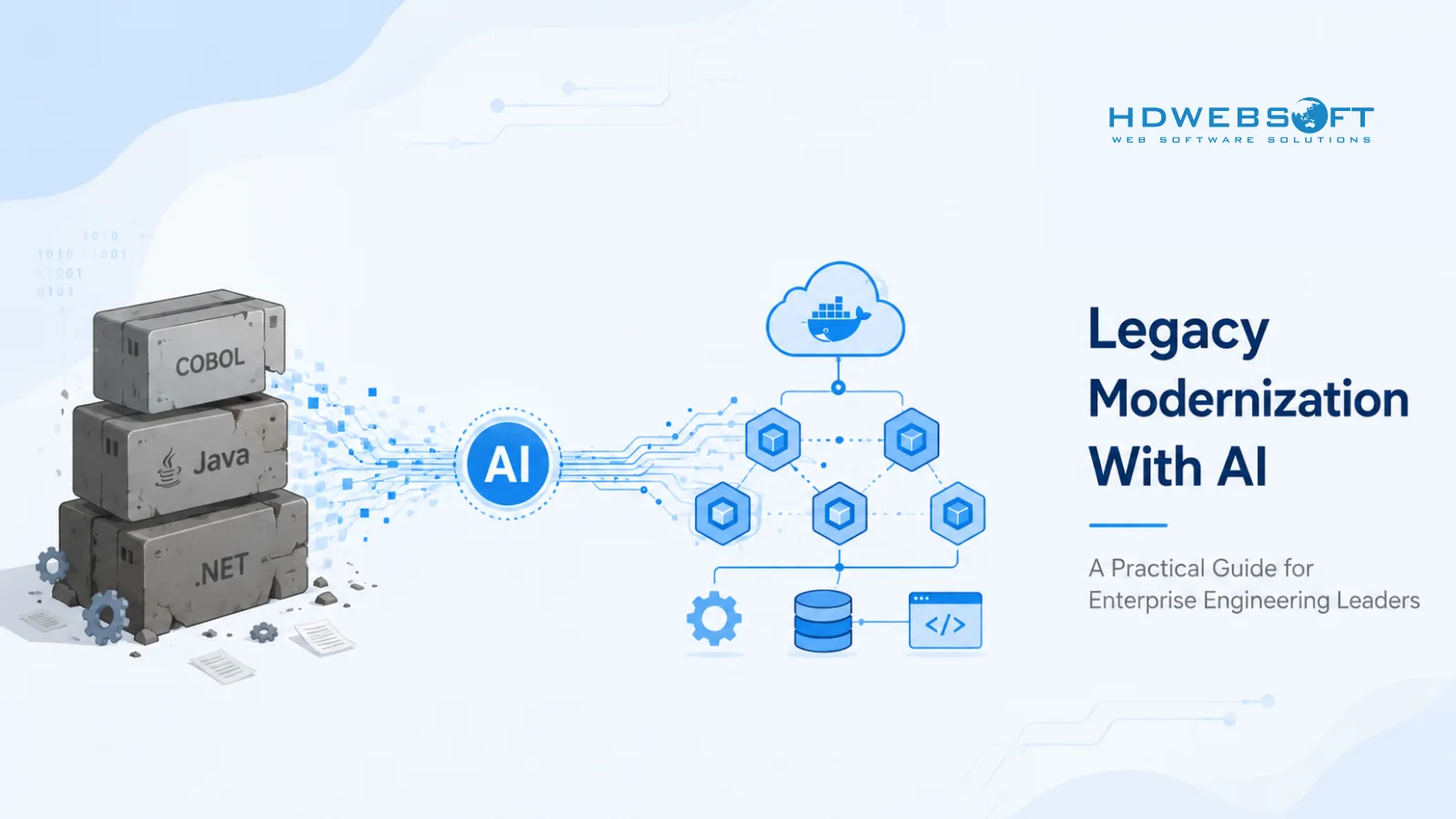
Legacy Modernization With AI: A Practical Guide for Enterprise Engineering Leaders
Legacy modernization with AI: refactoring strategies, risks, and how AI-augmented engineering cuts modernization time and cost for enterprises.
ROI of AI in Software Development: The Business Case Your CFO Will Actually Believe
A practical framework for measuring the ROI of AI in software development: full cost model, ROI formula by use case, KPI dashboard, false positives to avoid, and a 12-week pilot structure that produces a defensible business case.
How to Use AI in Coding: The Complete Developer Guide for 2026
A practical developer guide to using AI in coding: prompting principles, step-by-step workflow, best AI coding tools, level-specific advice, common mistakes, and FAQ.