Vue.js and React are the two dominant ways teams build interactive front ends — and the question of which to pick comes up on almost every greenfield web project. The honest answer hasn’t changed in a decade: there is no universal winner. What has changed is the context around the choice. Both tools have matured into stable platforms with very different ecosystems around them, and the decision now turns less on the libraries themselves and more on your team, your hiring market, and the shape of the product you’re building.
This is a practical comparison for people actually making the decision — not a feature checklist, but the trade-offs that matter when you have to commit.
Key Takeaways
- React is the larger ecosystem by every metric — jobs, downloads, enterprise adoption — and the safer default for large teams and companies that need hiring depth.
- Vue offers a gentler learning curve, batteries-included official tooling, and a developer experience many teams prefer — especially for small-to-medium products and gradual adoption.
- Technically, both can build the same things. The real differences are ecosystem gravity, mobile (React Native), meta-frameworks, and design philosophy.
- If you’re already invested in one, switching costs almost never pay off — pick the one that matches your team’s skills and your market, then commit.
Vue and React at a glance
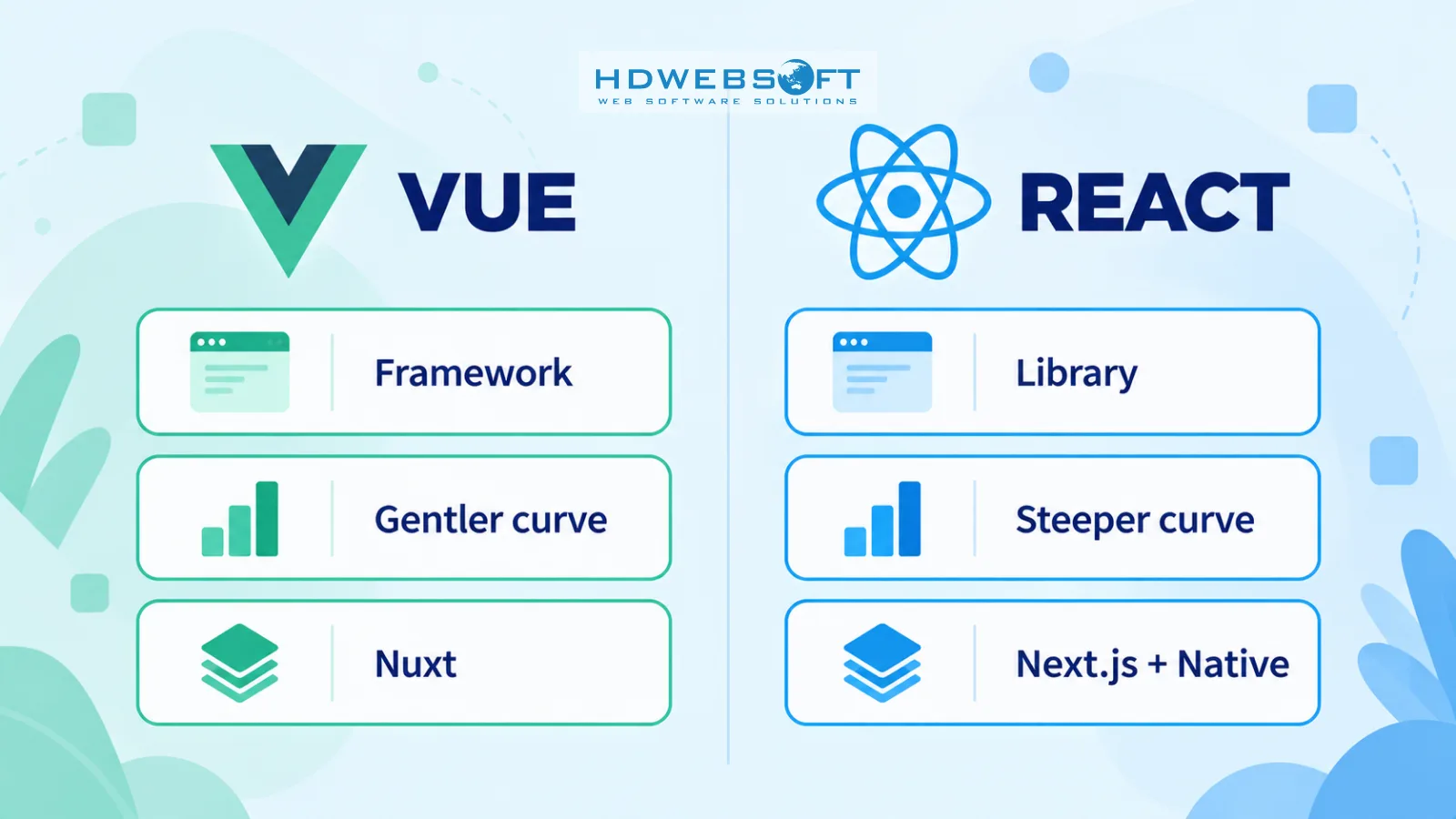
| Vue | React | |
|---|---|---|
| What it is | Progressive front-end framework | UI library for building component trees |
| First released | 2014 (Evan You) | 2013 (Meta) |
| Primary style | Single-file components, HTML templates | JSX — JavaScript with markup inside |
| Official ecosystem | Router, Pinia, devtools, Nuxt — all first-party | Router/data tools left to the community |
| Meta-framework | Nuxt | Next.js, Remix |
| Mobile story | Via community wrappers (NativeScript, Capacitor) | React Native — first-party, mature |
| Learning curve | Gentler | Steeper — JSX, re-render model, hooks |
| Ecosystem size | Smaller but complete | Largest in front-end |
| Best fit | Small-to-medium teams, fast iteration, incremental adoption | Large teams, enterprise scale, React Native ambitions |
The differences that actually matter
Design philosophy: convention versus composition
Vue ships with opinions. Routing, state management, single-file components, and the build tooling are all officially maintained — which means a Vue project has a recognizable shape, and a Vue developer can walk into any codebase and feel at home. React deliberately stays a library: it gives you a component model and rendering engine, and leaves routing, state, and project structure to you. That freedom is powerful and produces more architectural variety — and more decisions — per project.
Templates versus JSX
Vue uses HTML templates with directives (v-if, v-for, v-model) — familiar to anyone who knows HTML, easy to read, and cleanly separated from logic. React uses JSX, which puts markup inside JavaScript — more expressive, more integrated with the language, but a larger mental model. Neither is objectively better; teams coming from traditional web development often find Vue faster to pick up, while teams already strong in JavaScript tend to prefer JSX.
Reactivity model
Vue’s reactivity is automatic — change a reactive value and dependent UI updates without you thinking about it. React re-renders on state change and asks you to think about what re-renders when (memoization, useMemo, useCallback). Vue’s model is easier to reason about; React’s model gives you explicit control that pays off in very large applications.
Mobile
This is the biggest real technical difference. React Native is a mature, production-proven way to build native iOS and Android apps with React skills — and if you’re weighing native approaches, our comparison of Flutter vs React Native covers that decision separately. Vue has community options (NativeScript, Capacitor + Vue) but nothing with React Native’s depth or industry adoption — though Vue does have a credible cross-platform story for shared codebases between web and mobile shells. If native mobile is on your roadmap, React pulls ahead decisively.
Ecosystem gravity
React’s ecosystem is the largest in front-end development — more libraries, more tutorials, more Stack Overflow answers, more tooling, more enterprise integrations. Vue’s ecosystem is smaller but complete and well-curated, with high-quality official packages for everything essential. In practice, Vue has what you need; React has what you need plus three alternatives.
The numbers tell the same story. As of early 2026, React remains the more widely adopted of the two ecosystems. The State of JavaScript 2025 survey, published in February 2026, continues to rank React ahead of Vue in front-end framework usage. npm trends also shows React receiving substantially more weekly downloads than Vue, reflecting its larger package ecosystem and developer footprint.
Hiring and the talent market
React developers are substantially easier to hire in Western markets — the labor pool is deeper, and most front-end bootcamps and CS programs teach React first. Vue talent exists but is thinner in the US and Europe; it’s considerably stronger in China and Southeast Asia. For a team building in Vietnam, this difference narrows considerably — Vue has strong regional adoption. If you need to scale a team fast, or you’re hiring remote internationally, React’s hiring advantage is real. See our Vue.js developers for hire and React developers for hire pages if team composition is part of your decision.

When Vue is the better choice
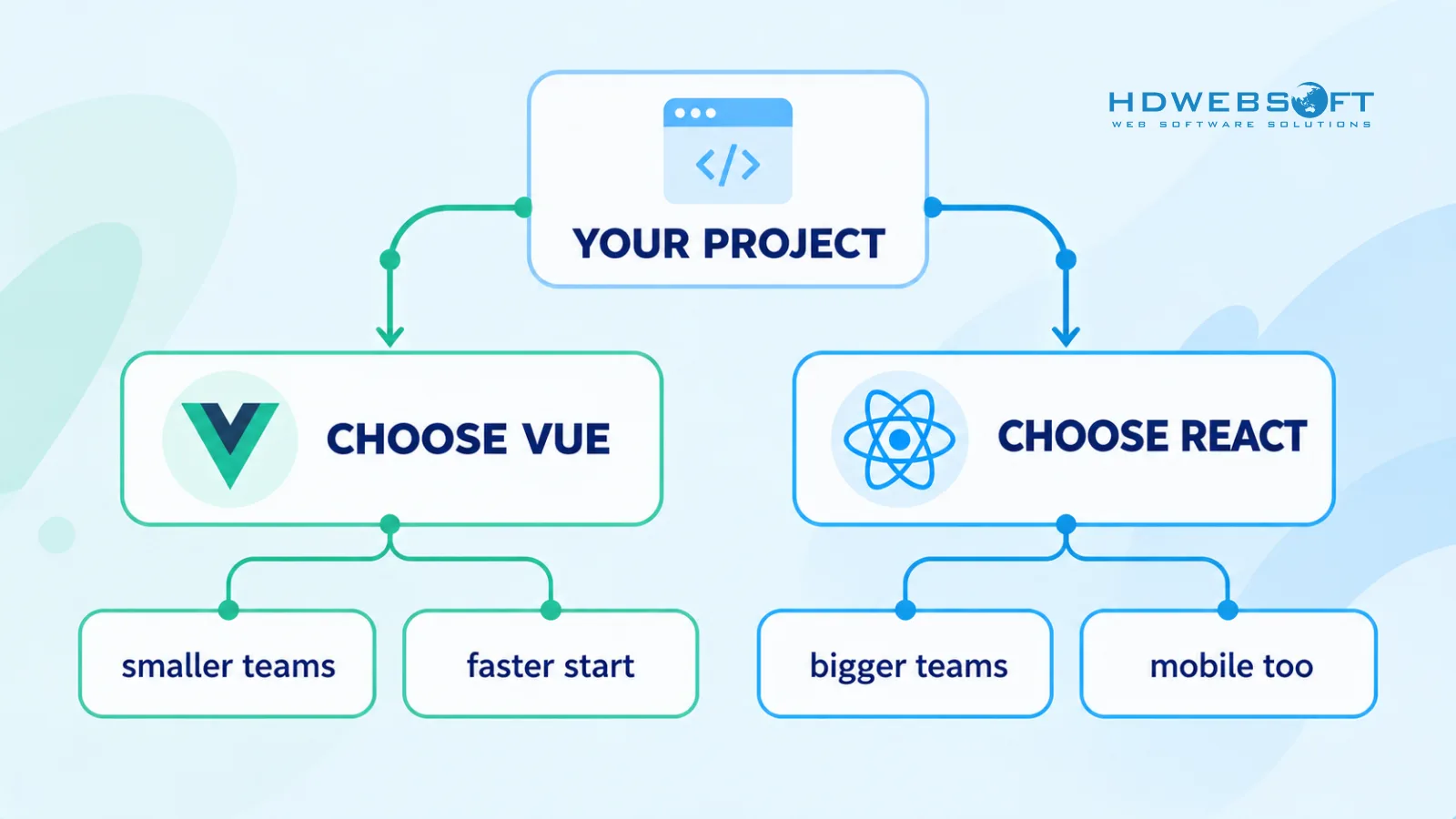
- Small-to-medium products where iteration speed matters. Vue’s single-file components, built-in conventions, and official tooling let small teams move fast without assembling the stack themselves.
- Gradual adoption into an existing site. Vue was designed to be incrementally adopted — you can drop it into a page without rewriting the whole front end, which React’s component tree model makes harder.
- Teams that prefer HTML/CSS-forward development. Templates are more approachable for developers coming from traditional web backgrounds, and single-file components keep markup, logic, and styles together.
- Products that benefit from first-party tooling. Vue’s official router, Pinia, devtools, and Vite integration remove the decision fatigue React’s ecosystem imposes.
- Asia-Pacific market teams. Vue’s adoption is strong in Vietnam, China, and Japan — relevant if your hiring and community are regional.
When React is the better choice
- Large teams and enterprise scale. React’s conventions are more standardized at scale, hiring is easier, and the enterprise tooling ecosystem (design systems, internal libraries, testing infrastructure) is deeper.
- Mobile on the roadmap. React Native is the only credible path to native mobile from a web framework — if a mobile app is even a possibility, React’s optionality is worth a lot.
- Maximum library flexibility. React’s ecosystem means more options for every problem — animation, forms, data fetching, state — and more mature integrations with third-party services.
- Next.js or Remix-centric architectures. If your product needs the SSR/SSG capabilities of a full meta-framework with the largest community behind it, React’s meta-framework ecosystem is bigger and better-resourced.
- Long-term hiring pipeline. For companies that will be hiring front-end developers continuously for years, React’s talent pool is a durable advantage — and React’s production track record shows up in the companies running it at scale.
The meta-framework question: Nuxt vs Next.js
Increasingly, the Vue vs React decision is really a Nuxt vs Next.js decision — most serious production apps today live inside a meta-framework rather than raw Vue or React.
Next.js is the bigger and more battle-tested of the two: massive adoption, Vercel’s backing, the App Router architecture, and an enterprise story that’s hard to argue with. Nuxt is Vue’s answer and it’s genuinely excellent — file-based routing, server-side rendering, static generation, a module ecosystem, and a developer experience many teams find friendlier than Next.js. For most real products, both can do the job. The meta-framework choice should follow your team’s base library skills rather than drive them.

The talent and maintenance reality
A framework choice is a multi-year commitment — what matters isn’t just what you can build today but who will maintain it in three years. React’s longevity and hiring depth make the maintenance story straightforward; Vue is stable and actively maintained, but the pool of senior Vue developers is smaller outside Asia-Pacific. Neither is at risk of disappearing — both are firmly established — but if your succession planning depends on a large local hiring market, check what’s actually available in yours before deciding.
Vue’s recent direction — the Composition API, <script setup>, improved TypeScript support, Vapor Mode exploration — shows a framework still actively evolving toward better ergonomics and performance. React’s recent direction — Server Components, the compiler, tighter Next.js integration — shows a platform consolidating around a more integrated architecture. Neither is stagnant.
Frequently Asked Questions
Is Vue or React better for a new project?
Neither is universally better. Vue tends to win for small-to-medium products, teams that value batteries-included tooling, and gradual adoption into existing pages. React tends to win for large teams, React Native ambitions, and ecosystems where hiring volume and library depth matter most.
Is Vue easier to learn than React?
Generally yes. Vue’s single-file components, HTML-based templates, and official documentation make the entry path gentler, while React requires JSX and a more mental-model-heavy approach to state and re-rendering. That said, both are learnable, and React’s fundamentals pay off across a huge ecosystem.
Which is more popular — Vue or React?
React is substantially more popular by job listings, npm downloads, GitHub stars, and enterprise adoption. Vue is smaller in the West but strong in Asia and among developers who prefer its ergonomics. Popularity matters for hiring and long-term hiring pipelines more than for technical capability.
Can Vue do what React does — and vice versa?
Almost everything either can do, the other can too. Both handle component-based UIs, SSR via meta-frameworks, TypeScript, and complex state. The real differences are ecosystem size, hiring, mobile (React Native has no Vue equivalent at the same maturity), and design philosophy — not raw capability.
What is the Vue vs React equivalent of Next.js?
Vue’s equivalent is Nuxt. Both meta-frameworks add file-based routing, server-side rendering, static generation, and API routes on top of their base libraries. Next.js is larger and more enterprise-adopted; Nuxt is praised for developer experience and covers the same architectural ground.
Should I choose Vue or React for a large team?
React is usually the safer default for large teams because the hiring pool is bigger, enterprise tooling is deeper, and architectural conventions are more standardized. Vue is a strong alternative if your team already knows it or your codebase is Vue — switching costs usually outweigh theoretical gains.
Conclusion
The Vue vs React debate is older than most of the codebases running on either — and it’s still unresolved because it genuinely depends on what you’re optimizing for. Choose Vue if you value developer ergonomics, batteries-included tooling, and fast iteration on a small-to-medium product. Choose React if you need the deepest ecosystem, the largest hiring pool, native mobile via React Native, or enterprise-scale conventions.
Whichever you pick, the more important decision is committing to it well — both are mature, proven, and capable of powering a serious product. If you’re weighing the choice for a real build, our Vue.js development services and ReactJS development services teams can help you assess the fit for your product and team.