
Node.js applications are best suited for real-time, data-intensive, API-driven, and scalable backend systems where speed, concurrency, and JavaScript-based development matter.
Node.js has been around for years, but it remains highly relevant for modern software development. It is widely used for web application backends, APIs, streaming platforms, chat systems, collaboration tools, eCommerce platforms, marketplace systems, microservices, serverless functions, and MVP development.
The important question is not only whether Node.js is popular. The better question is: which types of applications are the best fit for Node.js, and when should businesses consider another technology?
This article explains the most practical Node.js use cases, the best applications for Node.js, and the situations where Node.js may not be the right technical choice.
What Is Node.js?
Node.js is a free, open-source, cross-platform JavaScript runtime environment that allows developers to run JavaScript outside the browser. First released in 2009, Node.js is built on Chrome’s V8 JavaScript engine and is widely used to create servers, web applications, command-line tools, scripts, APIs, and real-time applications.
According to the official Node.js website, Node.js allows developers to create servers, web apps, command-line tools, and scripts. This makes it flexible enough for both small product teams and large engineering teams building scalable software systems.
Why Node.js Still Matters
Node.js still matters because modern applications often need fast APIs, real-time user experiences, cloud deployment, microservices, serverless functions, and full-stack JavaScript development.
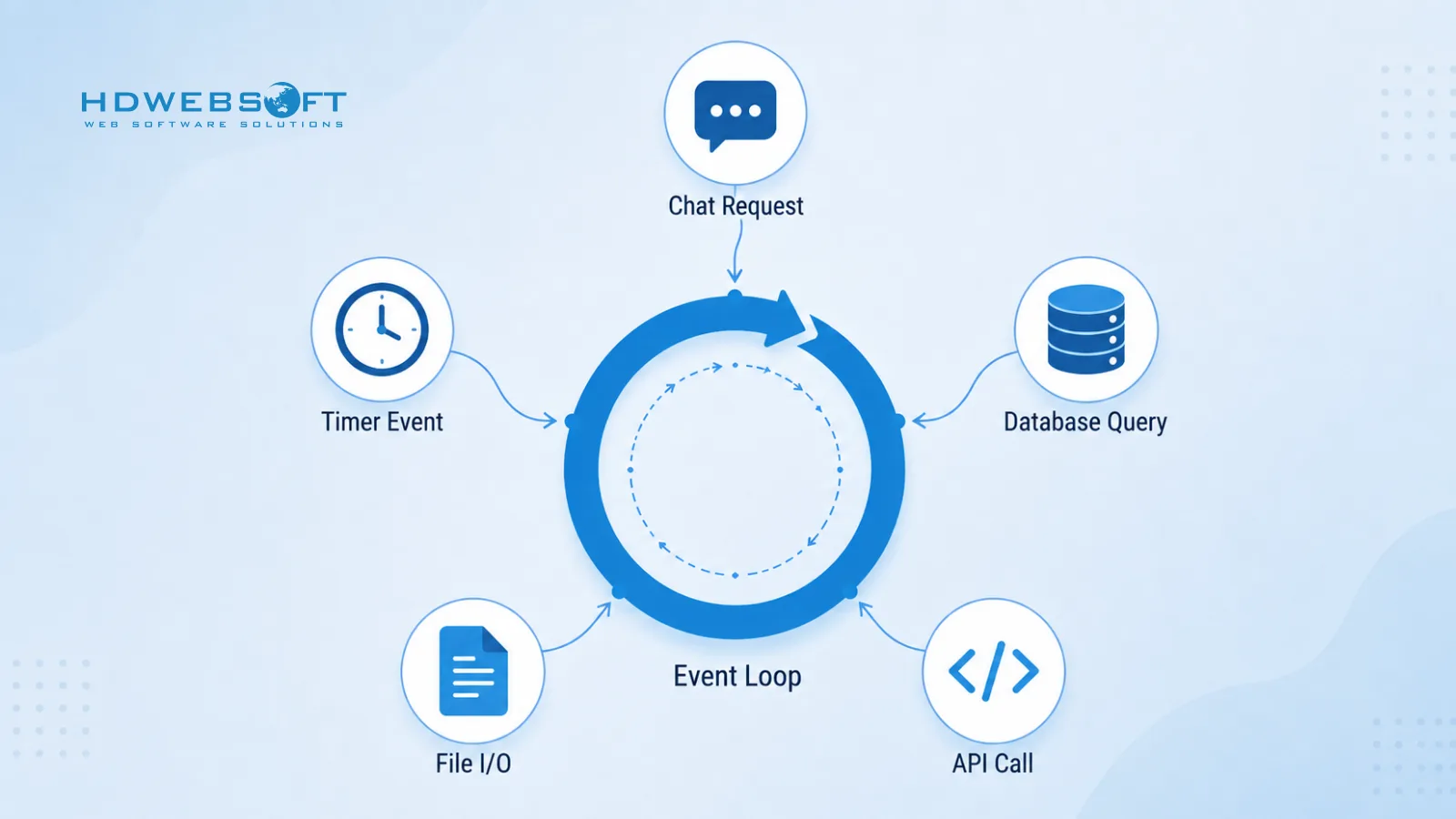
Its event-driven, non-blocking I/O model allows Node.js to handle many requests efficiently. Instead of waiting for one operation to finish before starting another, Node.js can process many tasks at the same time. This makes many Node.js applications useful for frequent data exchange, real-time updates, and high-concurrency workloads.
The Stack Overflow 2025 Developer Survey shows that Node.js was used by 49.1% of professional developers among web frameworks and technologies, showing that it remains one of the most widely used technologies in the developer ecosystem.
Use LTS Versions for Production
For production systems, version management is important. The official Node.js release guidance states that production applications should only use Active LTS or Maintenance LTS releases. This helps teams reduce security, compatibility, and maintenance risks.
For serious Node.js app development, choosing a supported Node.js version is part of long-term application reliability.
Why Businesses Choose Node.js
Businesses choose Node.js because it can support fast development, scalable backend systems, and efficient real-time communication. However, Node.js should be selected based on project requirements, not only popularity.
JavaScript Across the Full Stack
One of the biggest advantages of Node.js is that development teams can use JavaScript across frontend and backend layers. This can make collaboration easier between frontend engineers, backend engineers, and full-stack developers.
For startups and product teams, this can be useful because a smaller team can build the frontend, backend, APIs, and admin tools using a more unified technology stack.
Strong Ecosystem for Faster Development
Node.js has a large ecosystem of open-source packages and mature frameworks such as Express.js, NestJS, and Fastify. These tools can help teams build APIs, backend services, authentication flows, database connections, and third-party integrations faster.
However, the ecosystem also requires careful dependency management. Teams should review packages, update dependencies, and follow security practices to avoid long-term maintenance risks. For practical guidance, see our article on best practices for secure Node.js applications.
Best Applications for Node.js
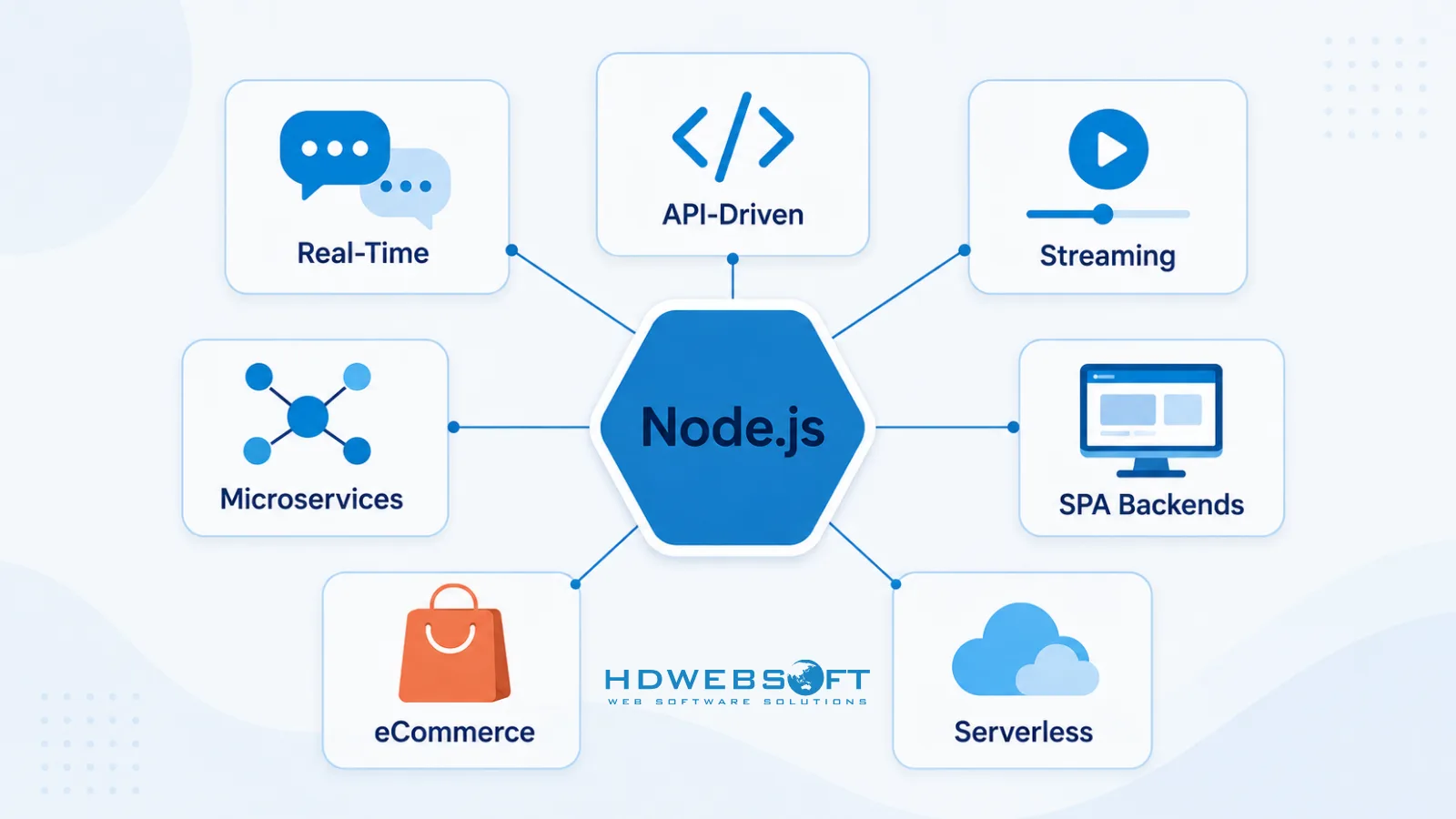
The following are some of the best applications for Node.js. These are not the only possible use cases, but they are the areas where Node.js often makes the most technical and business sense.
1. Real-Time Applications
Real-time applications are one of the strongest Node.js use cases. These applications need to send and receive data instantly or near-instantly between users, servers, and systems.
Common examples include:
- Chat applications
- Messaging platforms
- Live collaboration tools
- Real-time dashboards
- Live notifications
- Customer support systems
- Live tracking applications
Why Node.js Works Well
Node.js is a strong fit for real-time applications because it can handle many simultaneous connections efficiently. With technologies such as WebSocket and event-driven architecture, developers can build systems that update users quickly without constant page refreshes.
For example, a live chat platform may need to show new messages immediately. A project management tool may need to update task status across multiple users. A delivery tracking system may need to show location updates in real time.
These are classic Node.js applications because they depend on fast data exchange and concurrent connections.
2. API-Driven Web Applications
API-driven web applications are another major fit for Node.js. Many modern systems use APIs to connect frontend interfaces, mobile apps, third-party services, databases, and internal business systems.
Where Node.js Fits
Node.js is often used for REST APIs, GraphQL APIs, and backend-for-frontend systems. It is lightweight, fast to develop with, and supported by mature frameworks.
API-focused Node.js applications can support:
- SaaS platforms
- Mobile app backends
- Admin dashboards
- eCommerce platforms
- Booking systems
- Marketplace platforms
- Internal business tools
This makes Node.js a strong choice for businesses that need flexible backend services connected to multiple frontend or third-party systems.
3. Streaming Applications
Streaming is one of the practical Node.js use cases because Node.js can process data in chunks instead of waiting for an entire file or payload to load.
Streaming applications may include:
- Video streaming platforms
- Audio streaming tools
- File upload systems
- Real-time data processing
- Media delivery tools
- Log processing systems
Business Value of Streaming Applications
Streaming features can improve user experience by reducing waiting time. Instead of forcing users to wait for a full process to finish, the system can begin sending or processing data earlier.
This is useful for industries such as media, education, logistics, analytics, entertainment, and enterprise collaboration.
4. Microservices Architecture
Node.js applications can also be a good fit for microservices architecture. Microservices divide a large application into smaller, independent services that communicate through APIs, messages, or events.
Why Node.js Fits Microservices
Node.js is lightweight, fast to start, and suitable for building small services that perform focused tasks. A Node.js service may handle authentication, notifications, payments, file processing, user profiles, reporting, or API gateway functions.
This is why Node.js for microservices is common in SaaS platforms, eCommerce systems, marketplace platforms, and enterprise applications with many moving parts. For a deeper look at this pattern, see our guide on Node.js and microservices architecture.
However, not every system needs microservices. A small product may work better as a modular monolith first. Microservices add complexity in deployment, monitoring, testing, data consistency, and service communication.
5. Single-Page Application Backends
Single-page applications, or SPAs, often use frontend frameworks such as React, Vue, or Angular. These applications need backend APIs to handle authentication, business logic, data storage, file uploads, notifications, and third-party integrations.
Where Node.js Helps SPA Projects
SPA-related Node.js applications may include:
- SaaS dashboards
- Analytics portals
- Learning management systems
- Customer portals
- Admin panels
- Booking platforms
- Internal business applications
Because Node.js uses JavaScript, frontend developers can often understand backend logic more easily. This does not mean backend engineering becomes simple, but it can reduce communication friction between teams.
6. eCommerce and Marketplace Platforms
eCommerce and marketplace platforms often need speed, scalability, API integrations, real-time updates, and reliable backend workflows. These requirements make Node.js a strong option for many commerce-related systems.
Node.js Use Cases in Commerce
Commerce-related systems can use Node.js for:
- Product catalogs
- Shopping carts
- Checkout systems
- Payment integrations
- Order tracking
- Inventory updates
- Seller dashboards
- Buyer notifications
- Promotion engines
Marketplace systems often involve many users interacting at the same time: buyers, sellers, admins, delivery teams, and support agents. Node.js can help handle event-driven workflows such as order status updates, chat, live notifications, and transaction-related API calls.
These requirements make eCommerce and marketplace systems some of the best applications for Node.js, especially when the platform needs fast iteration and strong API integration.
7. Serverless and Cloud-Native Applications
Node.js is widely used in serverless and cloud-native environments. Many cloud platforms support Node.js for functions, backend services, APIs, automation scripts, and event-driven workflows.
Common Serverless Use Cases
Serverless Node.js applications may include:
- API endpoints
- Scheduled tasks
- File processing
- Image resizing
- Notification triggers
- Payment event handlers
- Webhook processing
- Chatbot backend functions
Node.js works well in serverless systems because it is lightweight and suitable for short-lived event-driven tasks.
For cloud-native Node.js app development, teams can use containers, managed databases, serverless functions, message queues, cloud storage, and monitoring tools to build scalable systems.
When Node.js May Not Be the Best Fit
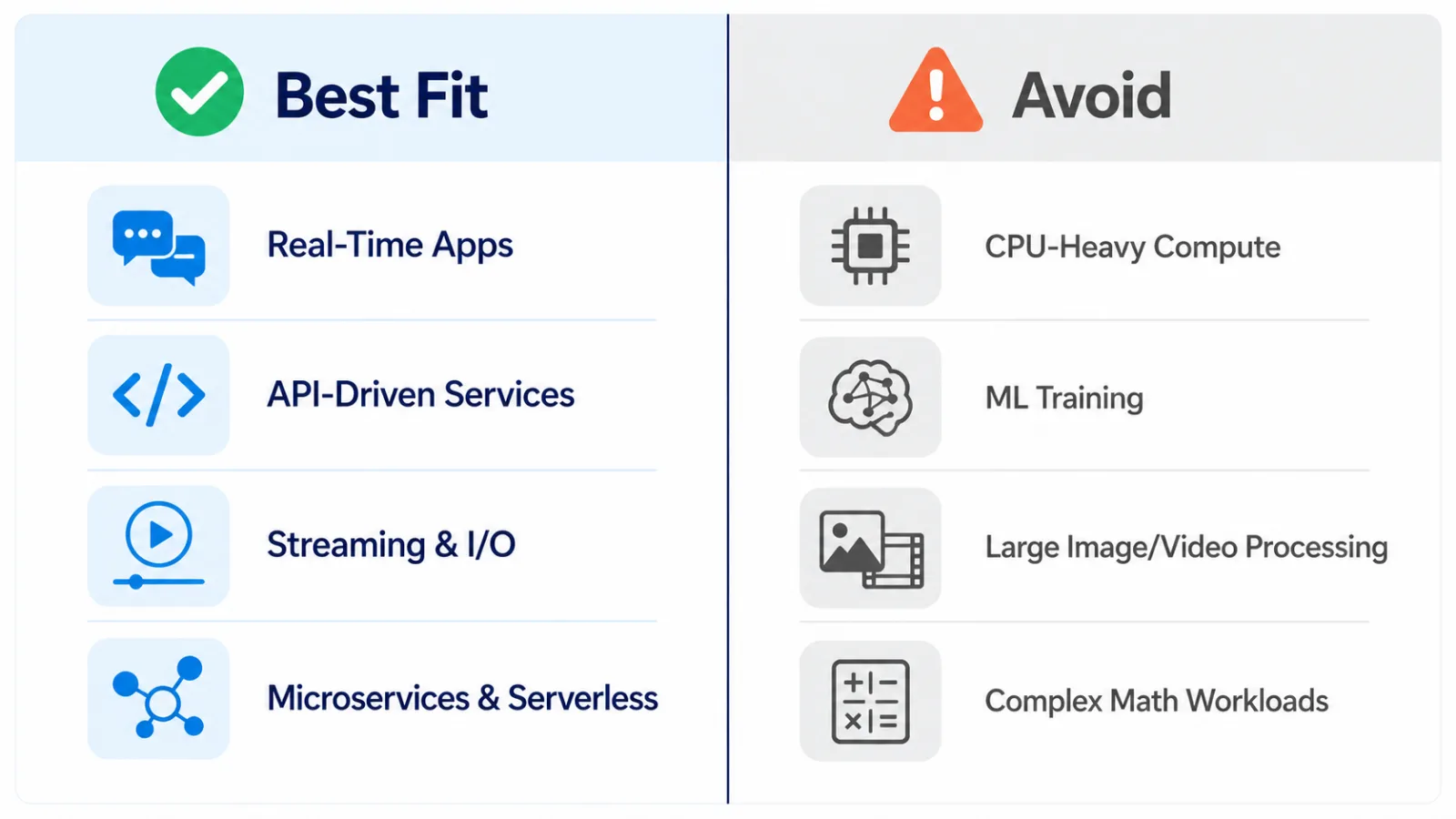
Node.js is powerful, but it is not the right solution for every project. A good technology decision should include both strengths and limitations.
1. CPU-Heavy Applications
Node.js is not usually the best choice for CPU-heavy workloads. These include tasks that require heavy computation, complex mathematical processing, large image or video processing, machine learning training, or intensive data science workloads.
Node.js is strong for I/O-heavy applications, but CPU-intensive tasks can block the event loop if they are not handled properly. For CPU-heavy systems, technologies such as Python, Go, Java, Rust, or specialized processing services may be better depending on the use case.
2. Large Systems Without Strong Architecture
Node.js can support enterprise applications, but the team must design the architecture carefully. Without clear structure, large Node.js systems can become difficult to maintain.
For enterprise-grade Node.js applications, teams should consider:
- TypeScript
- Modular architecture
- Clear API design
- Testing standards
- Secure coding rules
- Dependency management
- Observability
- CI/CD pipelines
- Documentation
Node.js is not the problem in these cases. Poor architecture is.
3. Projects With Weak Dependency Management
Node.js has a large package ecosystem, but that also means projects may depend on many third-party packages. This creates security and maintenance responsibilities.
Teams should manage dependency updates, vulnerability scanning, package quality, license compliance, version compatibility, and supply chain risks. For serious Node.js backend development, dependency management should be part of the development workflow from the beginning.
How to Decide Whether Node.js Is Right for Your Project
Choosing Node.js should depend on the application’s goals, architecture, team capability, performance needs, and long-term maintenance plan.
Check the Application Type
Node.js is often a strong fit for real-time applications, API-driven platforms, SaaS products, streaming systems, marketplace platforms, eCommerce platforms, microservices, serverless functions, MVPs, and IoT backends.
These are some of the best applications for Node.js because they benefit from speed, concurrency, and event-driven architecture.
Check the Team’s Skills
Node.js applications are a good fit when the team already has strong JavaScript or TypeScript experience. It is also useful when a business wants a full-stack JavaScript team.
However, the team should still understand backend engineering, databases, security, performance, testing, and deployment. JavaScript knowledge alone is not enough for production-ready Node.js app development.
Check Performance and Maintenance Needs
Node.js is strong for many concurrent connections and I/O-heavy work. It may not be the best fit for CPU-heavy computation unless the architecture separates heavy processing into other services.
Businesses should also evaluate security and maintenance. Node.js can be secure and stable, but only when teams use supported versions, manage dependencies, and monitor production systems.
Final Thoughts

The best Node.js applications are not defined by trend alone. They are defined by technical fit. Node.js works especially well for real-time systems, API-driven platforms, streaming applications, eCommerce platforms, marketplace systems, microservices, serverless functions, IoT backends, and MVPs.
At the same time, Node.js is not ideal for every workload. CPU-heavy applications, poorly structured enterprise systems, and projects with weak dependency management may need a different architecture or additional technologies.
For businesses, the right question is not “Is Node.js good?” The better question is: “Is Node.js the right fit for this application’s performance, scalability, team, and maintenance needs?”
HDWEBSOFT provides Node.js development services for businesses that need scalable backend systems, API development, real-time features, cloud-native applications, and long-term software product support. You can also hire Node.js developers from our team to accelerate your project. With the right architecture and development process, Node.js can become a strong foundation for modern web and software products.
FAQs About Node.js Applications
What are Node.js applications?
Node.js applications are software applications that use Node.js as the runtime environment for backend logic, APIs, server-side scripts, real-time communication, or event-driven processing.
What are the best applications for Node.js?
The best applications for Node.js include real-time chat apps, API-driven web apps, streaming platforms, eCommerce systems, marketplace platforms, microservices, serverless functions, IoT backends, and MVPs.
Is Node.js good for backend development?
Yes. Node.js is good for backend development when the project needs fast APIs, real-time features, many concurrent connections, cloud deployment, or full-stack JavaScript development.
When should businesses avoid Node.js?
Businesses should be careful with Node.js for CPU-heavy tasks, complex computation, machine learning training, or large systems without strong architecture and dependency management.
What should businesses check before choosing Node.js?
Businesses should check the application type, performance requirements, team skills, security needs, scalability goals, dependency management process, and long-term maintenance plan before choosing Node.js.