
Laravel has been the default PHP web framework for most teams for over a decade — and the reasons for that haven’t fundamentally changed, even as the ecosystem around it has grown considerably. The question isn’t whether Laravel is the most popular PHP framework; it clearly is. The question is whether it deserves that position, and more importantly, whether it fits your project.
This is a practical look at why Laravel holds its ground — not a feature checklist, but the actual reasons teams keep choosing it and the cases where something else might serve better.
Key Takeaways
- Laravel is the most popular PHP framework because it made the right conventions early — a clean ORM, simple templating, powerful CLI tooling, and a batteries-included approach that removes decision fatigue.
- The ecosystem is the real advantage — Artisan, Eloquent, Blade, queues, auth scaffolding, plus first-party tools like Forge, Vapor, Herd, Livewire, and Inertia keep Laravel modern without assembling the stack yourself.
- Convention over configuration means faster starts and maintainable code — especially valuable for teams building real products on deadlines.
- Laravel vs Symfony isn’t about which is “better” — Laravel favors convention and speed, Symfony favors explicit modularity for very large enterprise systems.
- For most PHP web projects, Laravel is the right default — the exceptions are usually enterprise systems that need Symfony’s granularity or projects outside PHP entirely.
What makes Laravel different
Laravel didn’t win because it has the most features — other PHP frameworks do comparable things. It won because it made the right choices early and kept them consistent. Where other frameworks left teams to assemble routing, ORM, templating, auth, and queueing separately, Laravel shipped them as one coherent package with sensible defaults.
That philosophy — convention over configuration — means a Laravel project looks recognizably the same across teams and codebases. A Laravel developer can join a new project and know where everything lives. That predictability compounds over time into real productivity, which is why the framework stays dominant.
Convention over configuration, in practice
The most visible difference between Laravel and older PHP frameworks is how much the framework decides for you. Directory structure, naming, routing style, service providers, middleware registration — all have a “Laravel way” that the documentation teaches and the tooling generates. New developers spend their time learning the framework’s opinions instead of inventing their own, and teams avoid the bikeshedding that slows down architecture discussions. The payoff shows up months later: code reviews are faster, onboarding is faster, and refactoring is safer because every Laravel app shares the same skeleton.
Batteries included, not bolted on
Authentication, authorization, queues, scheduled tasks, caching, mail, notifications, validation, file storage, rate limiting — in most frameworks these are packages you evaluate and integrate one by one. In Laravel they’re first-party features documented alongside the core. That means less time spent on plumbing decisions that add no business value, and fewer third-party dependencies to audit and maintain. For a business, that translates directly into lower cost per feature and less dependency risk over the app’s lifetime.
A release cadence you can plan around
Laravel ships a major version roughly once a year with a clear support window, and the framework’s upgrade tooling — Laravel Shift and the detailed upgrade guides — makes staying current a manageable routine rather than a dreaded migration project. Predictable releases matter for production apps: security fixes arrive on schedule, deprecations are announced ahead of time, and planning technical debt work becomes an ordinary backlog item instead of a gamble.
Laravel’s core strengths
Eloquent ORM
Laravel’s ORM maps database tables to models with a fluent, readable API. Relationships, eager loading, migrations, and seeding all live in one place. For teams writing data-driven apps, Eloquent is one of the main reasons Laravel feels faster to work with than alternatives.
Blade templating
Blade is Laravel’s built-in template engine — clean syntax, template inheritance, and no compilation overhead. It gives you proper structure without the weight of a heavier engine, and it’s one of the reasons views stay readable even as apps grow.
Artisan CLI
Artisan is the command-line interface that handles the repetitive work — generating controllers, models, migrations, jobs, tests, and boilerplate. It keeps developers in flow and reduces the boilerplate that makes PHP feel slower than it should.
Ecosystem tooling
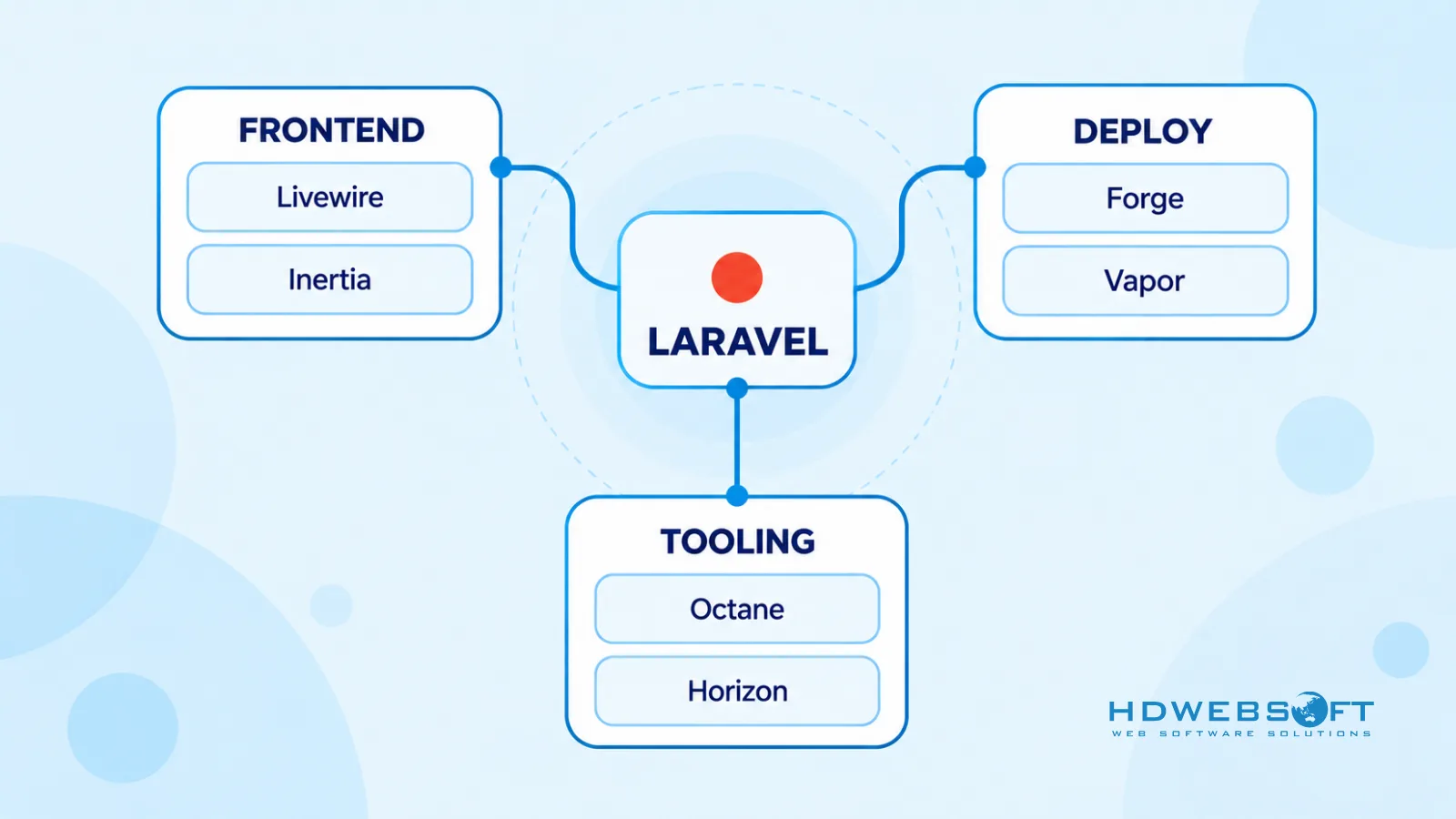
Laravel’s real power today is the ecosystem around it — both the first-party tooling and the packages on Packagist, the PHP package registry where Laravel is by far the most-installed framework:
- Livewire — build reactive UI in PHP without a JavaScript frontend
- Inertia.js — connect Laravel to Vue or React without building a separate API
- Laravel Octane — serve apps through high-performance application servers (RoadRunner, Swoole, FrankenPHP)
- Laravel Herd — native local dev environment for PHP and Laravel
- Forge and Vapor — first-party server management and serverless deployment
- Nova — admin panel generation for internal tooling
This ecosystem is what makes Laravel feel like a platform rather than a library — it covers the whole lifecycle from local dev to deployment.
Laravel vs the alternatives
Laravel vs Symfony
The most common comparison, and the most over-simplified. Both are mature PHP frameworks; the real difference is philosophy.
| Laravel | Symfony | |
|---|---|---|
| Philosophy | Convention over configuration | Explicit modularity |
| Best for | Speed, conventions, ecosystem | Very large, long-lived enterprise systems |
| Learning curve | Gentler | Steeper — more components to assemble |
| Components | Bundled first-party | Reusable Symfony components |
| Community feel | Batteries-included | Enterprise-grade |
For most projects, Laravel wins on speed and developer experience. For very large systems where granular architectural control matters more than convention, Symfony is the stronger pick.
Laravel vs plain PHP
This comparison comes up sometimes — “why use a framework at all?” Raw PHP requests are technically faster, but that’s meaningless for real development. Laravel’s abstractions make code faster to write, easier to read, and far more maintainable. The productivity gain vastly outweighs any request-time overhead, and Octane narrows even that gap for performance-critical paths.
Laravel vs CodeIgniter / Yii / others
CodeIgniter is lighter and faster to spin up for very simple apps, but it lacks the ecosystem depth and conventions that make Laravel productive at scale. Yii is capable but smaller community and less first-party tooling. Neither is “wrong” — Laravel just offers more for the typical real-world project.
For the broader PHP landscape, see our PHP programming solutions for SMBs and outsourcing PHP development posts — they cover when PHP makes sense as a stack and what it takes to staff a team.
When Laravel is the right choice
- Web applications and APIs of any real size — SaaS products, e-commerce, internal tools, content platforms
- Teams that want predictable structure — conventions mean less architectural debate and more shipping
- Projects that need an ecosystem — auth, queues, jobs, admin panels, deployment — all available first-party or via mature packages
- Startups and SMBs — the framework’s speed and community make it the default for PHP products on a deadline
- Teams hiring PHP talent — the Laravel developer pool is the largest in the PHP world
If staffing is part of your decision, our PHP developers for hire page covers what a Laravel team looks like.
When Laravel might not be the right fit
- Extremely performance-critical APIs — if raw throughput is the only metric and you don’t need the abstractions, a lighter framework or plain PHP can win; but this is a narrow slice of real work
- Enterprise systems that need Symfony-style modularity — if architectural granularity matters more than convention, Symfony’s component approach fits better
- Projects outside PHP — if your team doesn’t write PHP, there’s no reason to start; Laravel is a PHP framework and should be evaluated as one
- Simple scripts or one-off pages — the framework’s structure is overkill for a contact form or a landing page
The ecosystem case
The reason Laravel keeps winning isn’t the core framework alone — it’s what surrounds it. Laravel has effectively become a platform, and each layer of that platform removes a piece of work your team would otherwise build or buy separately.
Development environment and frontend
Getting a Laravel project running locally used to mean configuring PHP, a web server, a database, and Redis by hand. Laravel Herd collapses that to a native app install, while Laravel Sail gives the same result through Docker for teams that prefer containers. On the frontend side, the choice is unusually flexible: Blade for classic server-rendered views, Livewire for reactive UI written entirely in PHP, or Inertia.js to pair Laravel with Vue or React without maintaining a separate API layer. A small team can ship a modern, interactive product without standing up a JavaScript build pipeline at all — or go full SPA when the project justifies it.
Infrastructure and deployment
Deployment is where most PHP stacks historically hurt, and where the Laravel ecosystem pulls furthest ahead. Forge provisions and manages servers on the provider of your choice; Vapor deploys Laravel apps serverlessly on AWS with autoscaling, queues, and CDN handling baked in; Envoyer handles zero-downtime deployments for teams running their own servers. Laravel Cloud, the newer first-party hosting platform, bundles this further — an app can go from repository to a managed production environment without a DevOps hire, which is a genuinely differentiating claim among web frameworks.
Observability and performance
Production Laravel apps aren’t flying blind either. Horizon gives queues a real dashboard and metrics; Telescope records requests, jobs, and exceptions for local and staging debugging; Pulse covers live application performance monitoring. On the throughput side, Octane serves Laravel through long-running application servers — RoadRunner, Swoole, or FrankenPHP — keeping the framework warm between requests and dramatically reducing the per-request overhead that used to be PHP’s tax.
Why this ecosystem matters commercially
Every one of these tools exists because the framework’s scale justifies building it — and the existence of the tools feeds the scale back. For a business, the practical consequence is fewer vendors, fewer integrations to maintain, and a hiring market where Laravel developers arrive already fluent in the surrounding stack. Very few frameworks — in any language — offer this level of integrated tooling from a single vendor, and that platform effect is the structural reason Laravel stays dominant.
Frequently Asked Questions
Is Laravel still the best PHP framework?
Laravel is generally considered the best PHP framework for most projects because it combines a convention-driven structure, the largest package ecosystem, and first-party tooling like Artisan, Eloquent, and Blade. For teams that want rapid, maintainable web development in PHP, it remains the default choice — though Symfony is a stronger fit for enterprise-grade modularity and very large codebases.
Why is Laravel so popular?
Laravel became popular because it bundled the right conventions early — a clean ORM, a simple templating engine, CLI tooling, auth scaffolding, and a batteries-included ecosystem. The framework removed the friction that PHP development used to carry, and the ecosystem around it (Forge, Vapor, Herd, Livewire, Inertia) keeps it modern without forcing developers to assemble the stack themselves.
What is the difference between Laravel and Symfony?
Laravel favors convention over configuration — fewer decisions, faster start, more defaults — while Symfony favors explicit modularity and is often preferred for very large, long-lived enterprise applications. Laravel is generally easier to learn and faster to ship with; Symfony offers more granular control for teams that want it.
Is Laravel good for large projects?
Yes, but with caveats. Laravel handles large production apps well — many SaaS products run on it — but it relies on conventions that can become constraining at extreme scale. For very large, highly modular enterprise systems, Symfony’s component model sometimes fits better; for most real-world products, Laravel is more than sufficient.
Is Laravel faster than plain PHP?
Raw request time favors plain PHP, but that’s a misleading comparison. Laravel’s abstractions (Eloquent, routing, middleware, queues) make development dramatically faster and code far more maintainable. For real apps, the productivity gain vastly outweighs the small performance overhead — and Octane narrows even that.
What companies use Laravel?
Laravel powers a wide range of production products — from SaaS platforms and e-commerce sites to content tools and internal business applications. It’s especially common among startups and SMBs building PHP web products, and it’s widely used by offshore and agency development teams for predictable delivery.
Conclusion
Laravel is the best PHP framework for most teams not because it’s technically superior in every way, but because it made the right structural choices and built the ecosystem around them. The convention-over-configuration approach, the batteries-included tooling, and the platform-level ecosystem are why it stays the default — and why most new PHP projects start there.
If you’re weighing Laravel for a real product, our Laravel development services and PHP development services teams can help you evaluate the fit for your codebase and roadmap.