Flutter and React Native are the two dominant ways teams build cross-platform mobile apps — and the question of which to pick comes up on almost every new mobile project. The honest answer hasn’t changed since both frameworks matured: there is no universal winner. What has changed is the context. Flutter has grown from a promising Google toolkit into a genuinely multi-platform framework with its own rendering engine, while React Native has rebuilt its internals around a new architecture and tightened its bond with the React ecosystem.
This is a practical comparison for people actually making the decision — not a feature checklist, but the trade-offs that matter when you have to commit.
Key Takeaways
- Flutter ships its own rendering engine and widget set — more consistent UI, more predictable performance, better for design-heavy apps and multi-platform beyond mobile.
- React Native builds on JavaScript and React skills — easier hiring, bigger ecosystem, faster ramp for web teams, and the only realistic path if you want to share code with an existing web app.
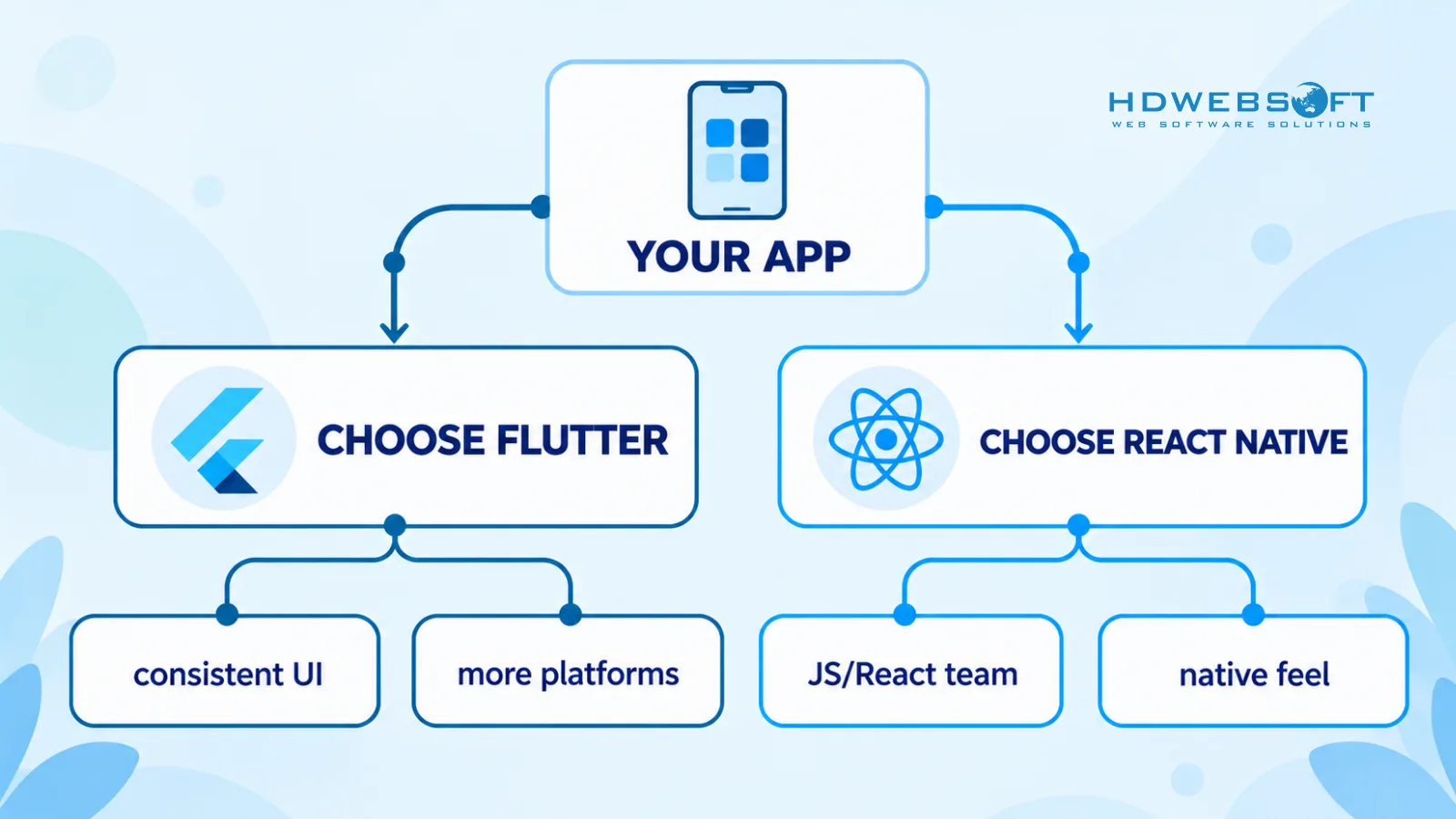
- Both produce real native-quality apps; the choice hinges on your team’s language skills, whether UI consistency or native feel matters more, and your long-term hiring market.
- If you already have React experience in-house, React Native usually wins on productivity alone. If you want one codebase doing more platforms, Flutter pulls ahead.
Flutter and React Native at a glance
| Flutter | React Native | |
|---|---|---|
| What it is | UI toolkit + framework | Mobile framework |
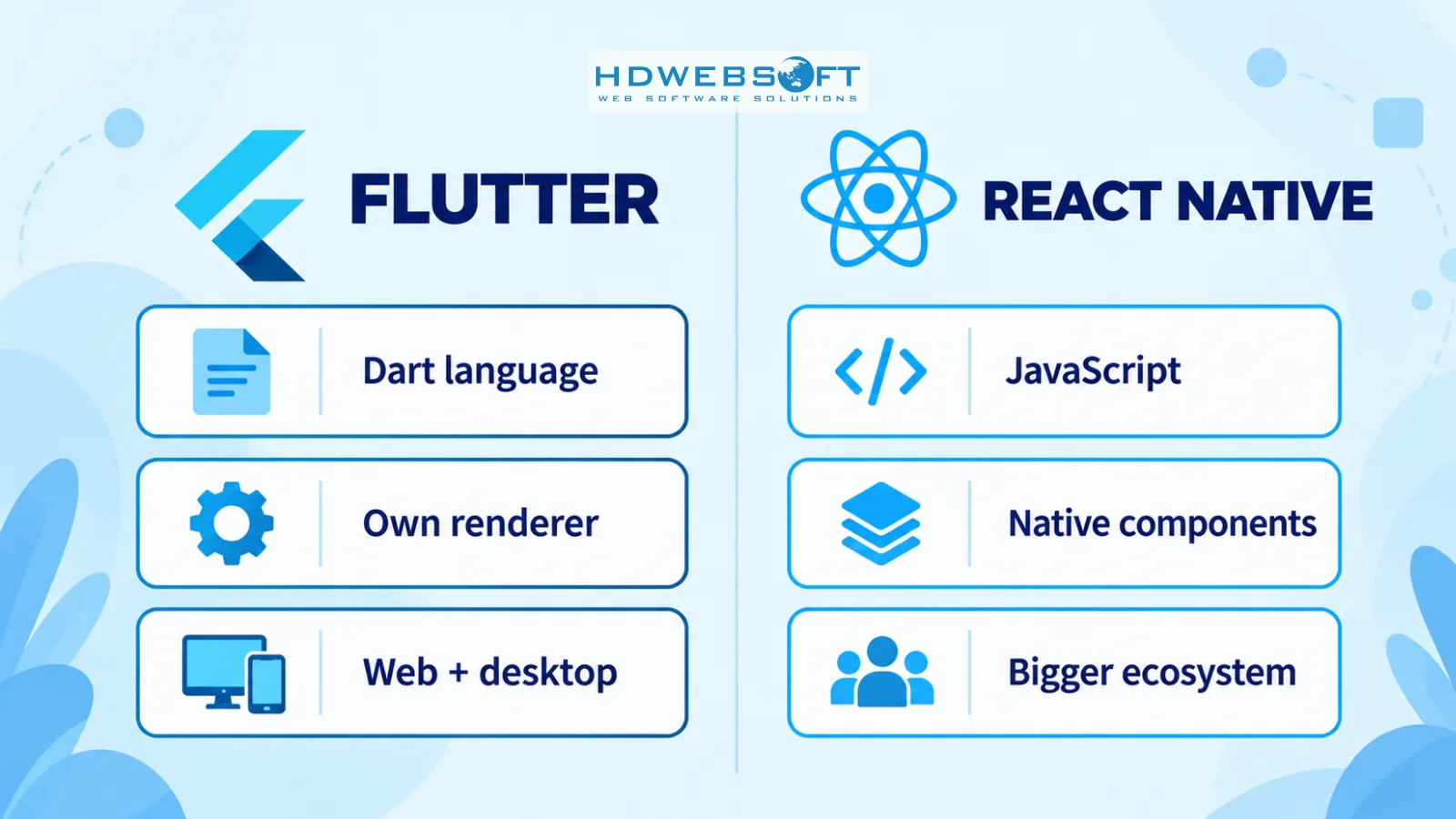
| Language | Dart | JavaScript / TypeScript |
| First released | 2017 (Google) | 2015 (Meta) |
| UI approach | Custom widgets rendered by its own engine | Native platform components bridged from JS |
| Rendering | Impeller (its own GPU pipeline) | New Architecture (Fabric + TurboModules) |
| Platforms | iOS, Android, web, desktop (official) | iOS, Android; web via community (Expo) |
| Hot reload | Yes — fast stateful reload | Yes — Fast Refresh |
| Ecosystem | pub.dev, smaller but cohesive | npm + React ecosystem, much larger |
| Hiring pool | Smaller (Dart specialists) | Larger (JS/React background transfers) |
| Best fit | Design-heavy apps, multi-platform ambition, consistent UI | Teams with JS/React talent, shared code with web |
The differences that actually matter
Language: Dart versus JavaScript
Flutter uses Dart — a language Google designed for UI work, with a gentle learning curve and strong typing. React Native uses JavaScript/TypeScript, which most web developers already know; if your team is new to it, our React Native quick guide covers the basics. For a team without Dart experience, Flutter has a ramp-up cost; for a web-native team, React Native is nearly zero-cost to adopt.
How each renders UI
Flutter draws every pixel itself through its Impeller engine — your app looks identical on every platform and screen size, and it doesn’t depend on the OS’s component behavior. React Native bridges to actual native components — your app uses the real platform buttons, pickers, and navigation, which gives an authentically native feel but means UI can subtly differ between OS versions.
Performance consistency
Flutter’s self-contained rendering makes performance more predictable — the same 60fps UI on old and new devices. React Native’s new architecture has closed most of the historical performance gap, but animation-heavy or graphics-intensive apps still tend to run more smoothly on Flutter because there’s no bridge bottleneck. For typical business apps, both are now fast enough that the difference rarely decides the project.
Ecosystem and packages
React Native sits on top of the npm and React ecosystems — more libraries, more integrations, more tutorials, more Stack Overflow answers. Flutter’s pub.dev is smaller but well-curated, with Google maintaining the core packages. In practice, Flutter has what most apps need; React Native has more alternatives per problem and a deeper pool of pre-built integrations.
Hiring and the talent market
React Native sits on the largest talent pool in software — anyone fluent in JavaScript or React can be productive quickly, which makes staffing and succession planning straightforward. Flutter needs Dart specialists, and while the pool is growing, senior Flutter developers are still thinner on the ground in Western markets — though considerably easier to find in Southeast Asia where Dart adoption is stronger. Talent availability feeds directly into project economics; our mobile app development cost guide covers how team composition shapes the budget.
Multi-platform beyond mobile
Flutter’s web and desktop support is official and stable — one codebase can realistically cover iOS, Android, web, and desktop. React Native can reach web via Expo or community tooling, but it’s not the same first-class story. If your product needs to live on more than mobile, Flutter’s multi-platform claim is stronger. For the broader landscape beyond these two, see our top cross-platform frameworks roundup.

When Flutter is the better choice
- Design-heavy or custom-branded UI. Flutter’s widget model gives you pixel-perfect control and identical visuals across every platform — ideal when brand consistency matters more than platform-native feel.
- Products that need more than mobile. If web or desktop is on the roadmap, Flutter’s official multi-platform support covers them without bolting on extra tooling.
- MVPs and fast iteration. Hot reload, a rich widget library, and one codebase make Flutter very efficient for demos and investor-facing prototypes.
- Teams starting from scratch on mobile. No legacy JS/React skills to leverage anyway — Dart is quick to learn and Flutter’s batteries-included approach removes decision fatigue.
- Apps with heavy animation or custom graphics. Flutter’s rendering pipeline handles complex visual work more predictably than a bridged approach.
When React Native is the better choice
- Teams with JavaScript or React experience. The biggest practical advantage — your existing web developers can ship mobile without learning a new language or framework paradigm.
- Products that share code with a web app. Shared TypeScript, shared React patterns, and partial component reuse between web and mobile reduce total effort meaningfully.
- Apps that need a native look and feel. Because React Native uses actual platform components, the app feels like it belongs on iOS or Android without fighting the framework.
- Long-term hiring and maintenance. The JavaScript talent pool is the largest in software — React Native taps into it directly, which matters when you’re staffing a team for years.
- Deep ecosystem dependencies. If your app leans on mature third-party integrations — analytics, payments, auth, analytics SDKs — React Native’s ecosystem depth usually means less custom work.
If you’re weighing React Native for a real product, our React Native developers for hire page covers what’s involved, and our React Native or native app comparison covers the native-vs-cross-platform layer of the same decision.
What changed recently — and why it matters
Flutter has moved well past its early days. Dart 3 brought null safety, records, and pattern matching; Impeller replaced Skia as the default renderer for smoother performance and fewer shader-compilation stutters; and official web/desktop support turned it into a genuine multi-platform framework rather than a mobile-only one.
React Native’s story has been a rebuild rather than a launch. The New Architecture (Fabric renderer and TurboModules) is now the default, which means faster rendering, better interop with native code, and synchronous calls that used to be impossible. Hermes is the standard JS engine, and Expo has become the recommended path for most new projects — the framework is meaningfully more polished than it was a few years ago.
Real-world proof
Both frameworks have earned their stripes at scale — the question is not whether they can handle production, but which production profile matches yours.
Flutter in production
- Google Pay runs on Flutter across iOS and Android — Google’s own vote of confidence in the framework’s maturity.
- BMW uses Flutter for its in-car and companion apps — a brand where UI consistency and polish are non-negotiable.
- eBay Motors shipped its app on Flutter, citing the speed of building a consistent experience on both platforms.
- Alibaba’s Xianyu — one of the largest consumer apps in China — runs core flows on Flutter.
- Toyota has publicly committed to Flutter for in-vehicle infotainment work.
React Native in production
- Facebook and Instagram — the framework’s birthplace — still run major surfaces on React Native, including the Facebook app itself.
- Shopify moved its flagship app to React Native after evaluating the alternatives at scale.
- Discord’s mobile app is built on React Native — a demanding case for real-time performance and rapid iteration.
- Microsoft uses React Native in Office mobile and Outlook components.
- Coinbase and Tesla both ship React Native apps serving millions of users.
The pattern is consistent: Flutter wins where pixel-perfect, brand-controlled UI matters most; React Native wins where deep native integration and web-team transfer matter most.

Frequently Asked Questions
Is Flutter or React Native better for a new app?
Neither is universally better. Flutter tends to win for design-heavy apps, teams that want one codebase with a consistent UI across platforms, and products where predictable performance matters. React Native tends to win for teams with existing JavaScript or web talent, apps that need deep native-platform feel, and projects where ecosystem maturity and hiring depth matter most.
Is Flutter faster than React Native?
Flutter generally offers more consistent performance because it renders UI directly via its own engine rather than bridging to native components. React Native’s new architecture has narrowed the gap significantly — for most real apps the difference is no longer dramatic, but Flutter still has the edge on animation-heavy and graphics-intensive work.
Which is easier to hire for — Flutter or React Native?
React Native is generally easier to hire for because it builds on JavaScript and React skills that most web developers already have. Flutter requires Dart, which has a smaller — though growing — developer pool. In markets with strong Dart adoption, the gap narrows considerably.
Can Flutter and React Native both target iOS and Android?
Yes, both produce iOS and Android apps from a single codebase. Flutter also supports web and desktop targets more officially than React Native does. React Native leans on the community for web support, while Flutter’s multi-platform story is more baked-in.
Is Flutter better for MVPs?
Flutter is often the better MVP choice when time is tight — its widget library, consistent UI, and hot reload let small teams move fast with a polished result. React Native is equally viable for MVPs if your team is already fluent in JavaScript and React.
Should a company already using React choose React Native?
Usually yes — shared mental models, reusable TypeScript and React skills, and some code reuse between web and mobile reduce ramp-up significantly. It’s not a hard requirement, but when the team knows React, React Native usually wins on productivity alone.
Conclusion
The Flutter vs React Native choice isn’t really about which framework is better — it’s about which one fits your team and product. In the Flutter vs React Native comparison, the differences that actually matter are language skills, UI consistency, and where the product needs to live. Choose Flutter if you want consistent UI across platforms, multi-platform reach beyond mobile, and a self-contained toolkit that works out of the box. Choose React Native if your team already speaks JavaScript, if you want the deepest possible ecosystem and hiring pool, or if native platform feel is a priority.
Either way, you’re choosing between two mature, proven options — the real risk is committing to the wrong fit, not picking a bad tool. If you’re evaluating this for a real product, our Flutter app development services and React Native development services teams can help you work through which one suits your codebase, team, and roadmap.