
Outsourcing is contracting an external provider to run a business function — a service, a process, or a build — that you could technically do yourself. The provider delivers agreed results under contract; you keep the strategy, the ownership, and the customer relationship. Companies outsource for access to skills, capacity, and cost structure they cannot or do not want to build internally.
That is the short version. The useful version requires three more distinctions: what kinds of work get outsourced, how outsourcing differs from offshoring and outstaffing, and what separates engagements that work from those that quietly fail.
How Outsourcing Works in Practice
An outsourcing engagement is, at its core, a transfer of execution — not of responsibility. The client defines what needs to be delivered; the provider owns how it gets done, staffing and managing the work under the terms both sides sign.

In practice that means three things get written down before work starts:
- Scope — what is included, what is excluded, and what happens when the boundary moves.
- Service levels — measurable commitments: response times, quality thresholds, delivery cadence.
- Accountability — who is responsible when targets are missed, and how disputes get resolved.
Those terms live in the outsourcing contract, and they matter more than any sales conversation. Our software outsourcing contract guide walks through what SLAs, payment structures, and IP terms should look like — worth reading before you sign anything, not after.
What Companies Outsource
Almost any non-core function can be outsourced, but three categories account for most of the market:
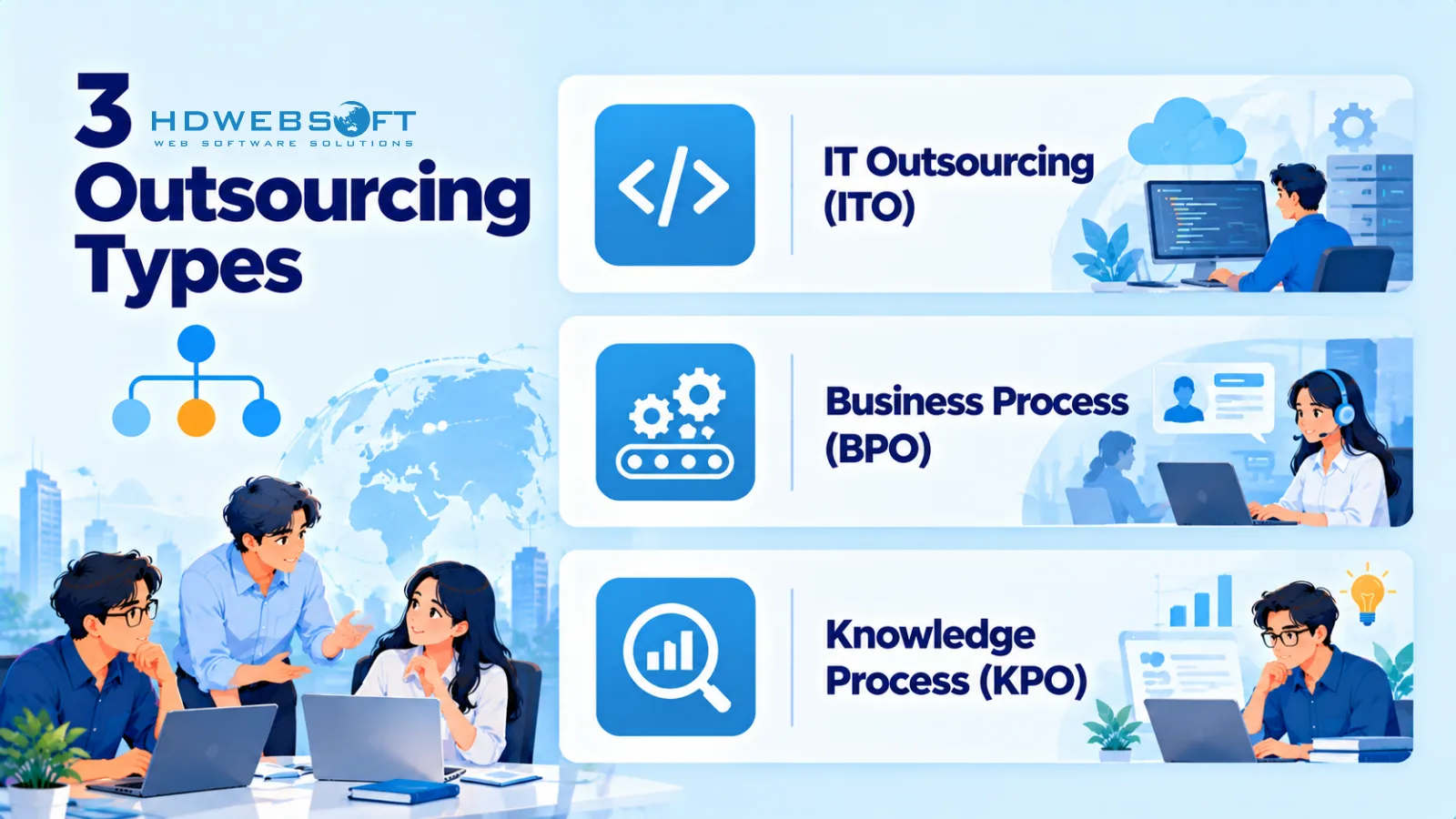
- IT Outsourcing (ITO). Software development, application maintenance, infrastructure management, QA and testing, cybersecurity, help desk. This is the largest and fastest-growing segment — and the one this site covers in depth.
- Business Process Outsourcing (BPO). Repeatable operational functions: customer service, payroll, recruitment, data entry, finance and accounting. BPO trades on process maturity — the vendor runs the function better and cheaper because it is their core business, not yours.
- Knowledge Process Outsourcing (KPO). Higher-expertise work where the output is analysis rather than transactions: market research, financial modeling, legal research, engineering design, data science. KPO vendors sell judgment, not just capacity.
- Manufacturing outsourcing. Contracting production to external factories — it predates all of the above and follows the same logic: someone else can run the function at a scale you cannot justify building.
The same function can also be outsourced at different distances. Onshore keeps the provider in your country. Nearshore puts it in a neighboring region with overlapping time zones. Offshore moves it to a distant, lower-cost geography — which is a separate axis entirely, covered below.
Outsourcing vs Offshoring, Outstaffing, and Insourcing
The term gets confused with its neighbors, and the difference matters when you are choosing a model:

| Model | What it means | Who manages the work |
|---|---|---|
| Outsourcing | External provider delivers a defined result | The provider |
| Offshoring | Work moves to a distant country — outsourced or not | Depends: your team abroad, or a vendor |
| Outstaffing | External specialists join your team | You |
| Insourcing / in-house | Your own employees do the work | You |
| Captive / GCC | You open your own office abroad | You — offshore without outsourcing |
The two independent axes are who does the work (you vs. a provider) and where it is done (domestic vs. abroad). A company can outsource to a vendor across the street or offshore with its own office in Hanoi — different strategies with different trade-offs. The full comparison, including when each combination makes sense, is in outsourcing vs offshoring.
Why Companies Outsource
The motivations are consistent enough that they show up the same way in every survey of the practice. In Deloitte’s Global Outsourcing Survey, cost reduction has historically been the most-cited objective — followed by access to talent, faster delivery, and the ability to focus internal teams on core work.
In practice the reasons cluster:
- Cost structure — converting fixed headcount costs into variable, contract-priced services.
- Access to skills — hiring specialists (QA automation, security, specific frameworks) that are slow or impossible to build in-house.
- Speed — a provider’s ready team starts in weeks; recruiting your own takes months.
- Focus — freeing internal leadership and engineers for work only your team can do.
- Scale elasticity — growing and shrinking capacity without hiring and layoffs.
Each of those benefits has a failure mode attached, and chasing the benefit without designing against its failure mode is where engagements go wrong.
When Outsourcing Goes Wrong
Most outsourcing failures are not about the vendor’s technical skill. They are about structure: vague scope that each side interprets differently, reporting opaque enough to hide drift, knowledge that lives only inside the vendor’s team, and incentives that reward looking busy rather than delivering results.
The warning signs are usually visible within the first month — missed small commitments, answers that stay at slide-deck level, and a team whose members you cannot name. Why IT outsourcing fails catalogs the ten root causes and how to spot each early.
What Good Outsourcing Looks Like
Successful engagements share a recognizable shape: a defined outcome, a single accountable lead on each side, transparent progress metrics, documentation that survives individual departures, and a review rhythm that surfaces problems while they are still cheap.
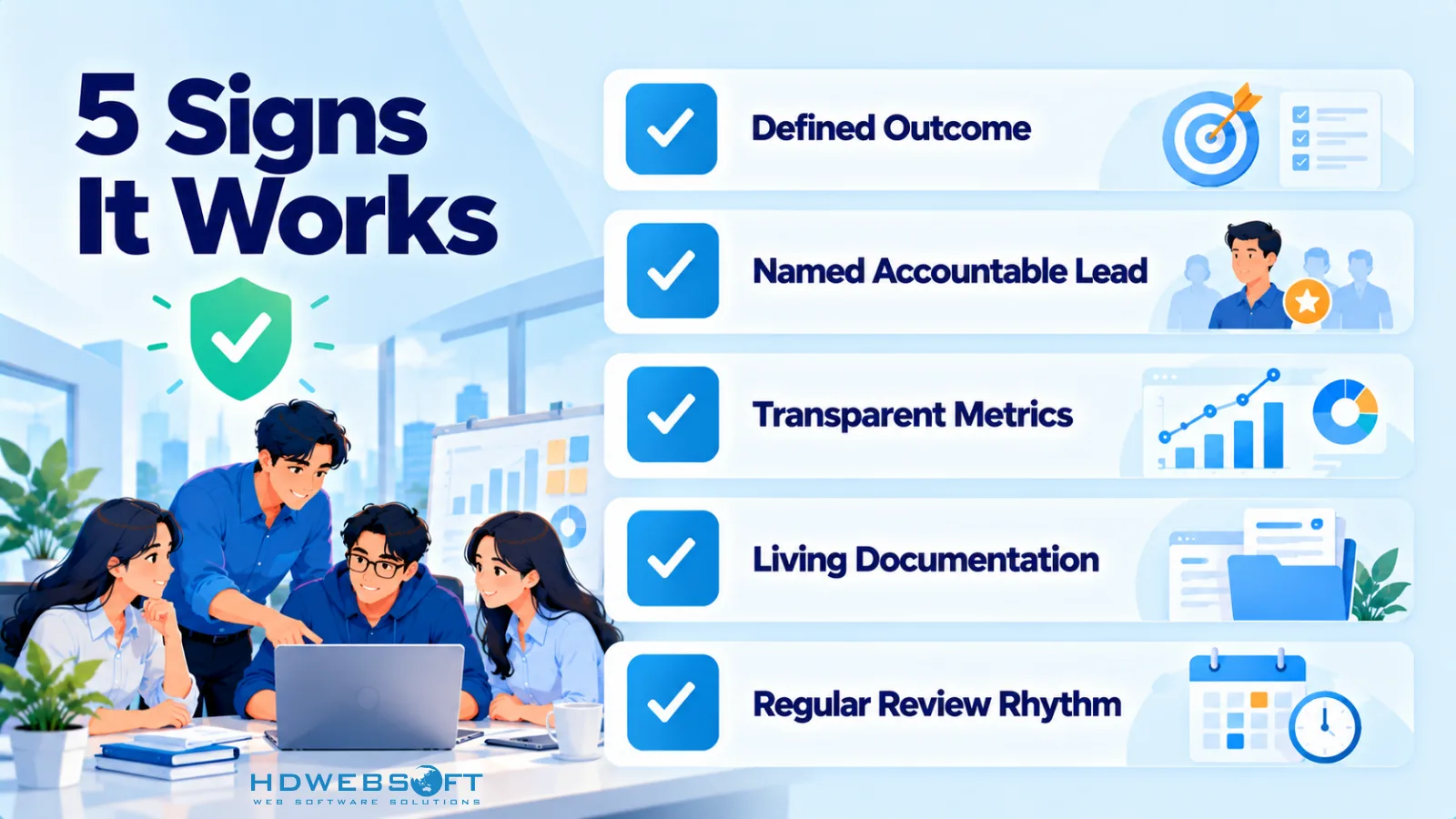
Notice what is absent from that list: the vendor’s size, hourly rate, or marketing. The mechanics that make outsourcing work are operational, and they can be measured. Successful outsourcing lays out the five-phase lifecycle and the metrics that predict whether an engagement will hold.
Why HDWEBSOFT
14 years of delivery across 750 projects is what those mechanics look like in practice: named roles, shared dashboards, written handover discipline, and contracts structured around outcomes.
If your outsourced function is software — a build, a dedicated team, or an end-to-end delivery — our software outsourcing services cover the full lifecycle from scoping to post-release.
Frequently Asked Questions
What is outsourcing in simple terms?
Outsourcing means contracting an external company or team to perform a business function instead of handling it in-house. The provider delivers defined results under a contract — typically governed by scope, service levels, and pricing terms — while the client keeps ownership of the outcome and the strategic direction.
What is the difference between outsourcing and offshoring?
Outsourcing is about who does the work — an external provider rather than your own employees. Offshoring is about where the work is done — in a distant country, typically for cost or talent reasons. A company can outsource locally, offshore without outsourcing (by opening a foreign office), or combine both by outsourcing to an offshore vendor.
What is the difference between outsourcing and outstaffing?
With outsourcing, a provider delivers a completed result and manages its own team. With outstaffing, individual specialists join your team and work under your management — the provider supplies people, not outcomes. Choose outsourcing when you want a result handed over; choose outstaffing when you have in-house management capacity and need extra hands.
What are the main types of outsourcing?
By function, the main types are IT outsourcing (software development, infrastructure, support), business process outsourcing or BPO (payroll, customer service, back office), and knowledge process outsourcing or KPO (research, analytics, legal work). By location, the same work can be onshore, nearshore, or offshore.
Is outsourcing only for large companies?
No. Smaller companies often benefit most, because outsourcing gives them access to skills and scale they could not justify hiring for. The real qualifiers are clarity of scope and willingness to manage a provider relationship — not company size.
What are the main risks of outsourcing?
The common risks are misaligned incentives, unclear scope, weak governance, communication gaps, and knowledge concentrated inside the vendor. Most are preventable with precise contracts, transparent reporting, shared documentation, and regular checkpoints — which is why the contract terms matter as much as the vendor’s skills.
Conclusion
Outsourcing is a simple idea with operational depth: hand execution to a provider, keep ownership of the result. What separates useful engagements from expensive ones is not the concept but the mechanics — scope, accountability, transparency, and knowledge that outlasts people.
This page answers the definitional question. The deeper guides linked throughout — benefits, failure modes, contracts, and the outsourcing-offshoring comparison — carry the detail for each decision that follows.
Ready to see what outsourcing would look like for your product or function? Contact HDWEBSOFT to discuss your scope.