IT outsourcing extends beyond software development to encompass infrastructure management, IT support, security operations, and day-to-day technology operations. Companies leveraging IT outsourcing strategy reduce operational costs by 30-50% while accessing specialized expertise and 24/7 monitoring capabilities. Deloitte’s 2024 Global Outsourcing Survey found that 83% of surveyed executives are already leveraging AI as part of their outsourced services, highlighting how outsourcing models continue to evolve beyond traditional cost-saving objectives. This comprehensive guide explores IT infrastructure outsourcing, managed services, support models, and implementation strategies for businesses of all sizes.
Key Takeaways
- IT outsourcing encompasses infrastructure, support, security, and operations beyond software development
- Managed IT services provide 24/7 monitoring, reducing downtime by up to 85% compared to in-house teams
- Choosing between MSP, co-managed, or IaaS models depends on internal IT capabilities and control requirements
- IT outsourcing costs are typically 30-50% lower than maintaining equivalent in-house infrastructure teams
- Successful IT outsourcing requires clear SLAs, security protocols, and integration planning
What is IT Outsourcing Beyond Software?
IT outsourcing involves contracting external service providers to manage technology infrastructure, support systems, security operations, and day-to-day IT functions. While software outsourcing focuses on application development, IT outsourcing addresses the foundational technology layers that keep businesses running: servers, networks, help desks, cybersecurity, cloud infrastructure, and data center operations.
The scope of IT outsourcing has evolved significantly from basic break-fix support to comprehensive managed services that proactively monitor, maintain, and optimize entire technology environments. Modern IT outsourcing partners provide strategic guidance alongside operational support, helping businesses align technology investments with business objectives while reducing the burden on internal teams.
IT Infrastructure Outsourcing
IT infrastructure outsourcing transfers responsibility for servers, storage, networks, and data center operations to external specialists. This includes hardware procurement, maintenance, upgrades, and lifecycle management. Companies outsourcing infrastructure eliminate capital expenditures on equipment while gaining access to enterprise-grade technology and expertise that would be cost-prohibitive to build internally.
Infrastructure outsourcing models range from complete data center management to hybrid approaches where critical systems remain on-premises while non-critical workloads move to cloud environments. The flexibility to scale infrastructure resources based on business needs without long-term commitments provides significant agility for growing companies.
IT Support and Help Desk Services
IT support outsourcing handles day-to-day user support, troubleshooting, and technical assistance for employees. This includes help desk operations, desktop support, mobile device management, and application support. Outsourced IT support typically provides 24/7 coverage through global teams, ensuring employees receive assistance whenever needed regardless of time zones. Learn more about unlocking efficiency with IT support outsourcing.
The structured approach to IT support outsourcing includes ticketing systems, escalation protocols, knowledge bases, and performance metrics that improve service consistency compared to ad-hoc internal support. Companies can choose from tiered support models ranging from basic troubleshooting to comprehensive technical assistance for complex enterprise applications.
Network and Security Management
Network and security outsourcing addresses one of the most critical IT functions: protecting business systems and data. This includes firewall management, intrusion detection, security monitoring, vulnerability assessments, and incident response. Security outsourcing provides access to specialized expertise and advanced threat intelligence that would be difficult to maintain internally.
The cybersecurity landscape evolves rapidly, with new threats emerging constantly. Outsourced security providers invest heavily in threat intelligence, advanced security tools, and certified personnel, helping organizations stay ahead of emerging risks while maintaining compliance with industry regulations and standards. The NIST Cybersecurity Framework identifies continuous monitoring, risk assessment, and governance as important components of cybersecurity risk management. Organizations often partner with specialized security providers to help implement and maintain these capabilities.
Cloud Services Management
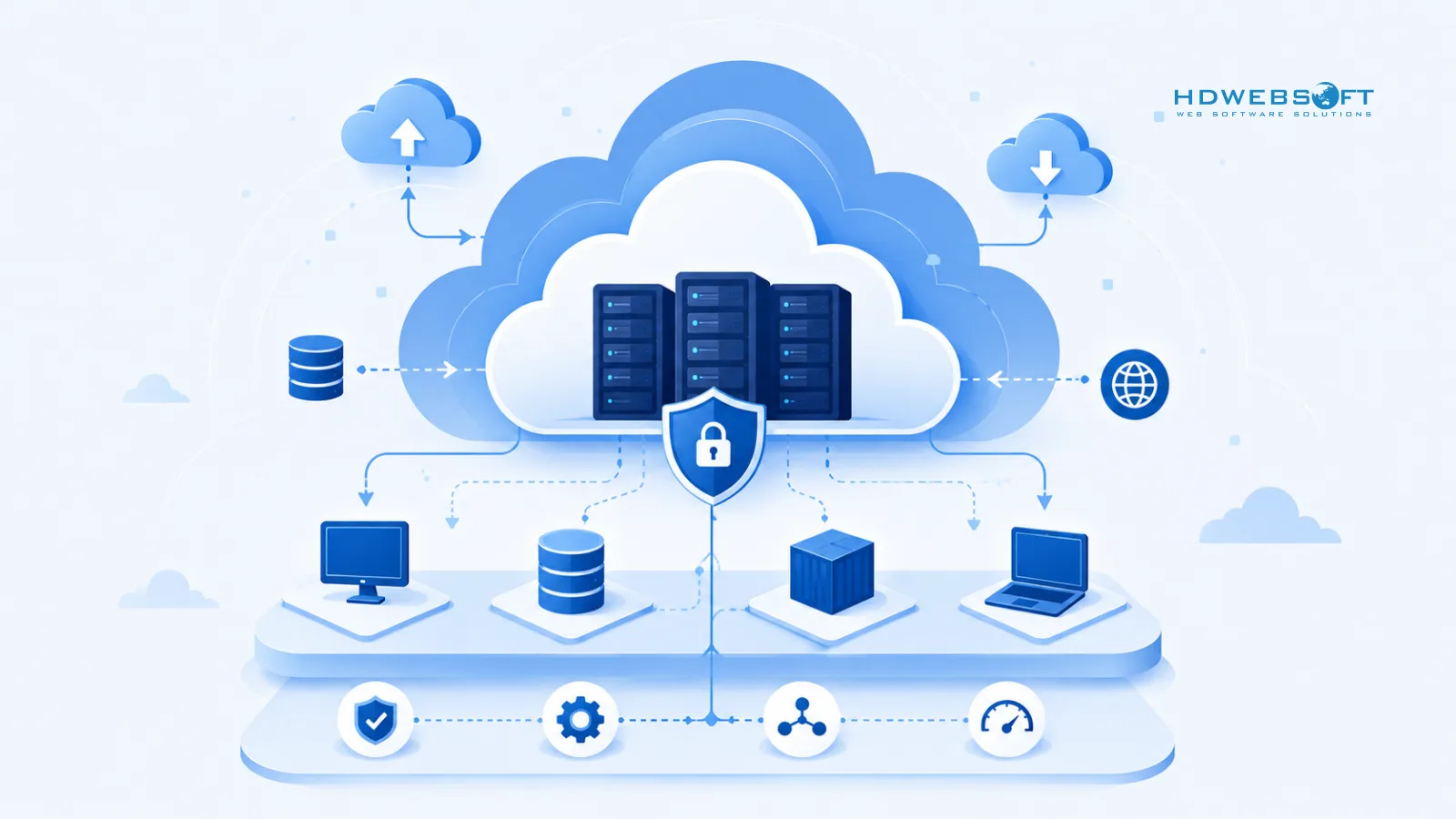
Cloud services outsourcing involves managing cloud infrastructure, platforms, and services across providers like AWS, Azure, and Google Cloud. This includes cloud architecture design, migration planning, cost optimization, security configuration, and ongoing operations management. Cloud outsourcing helps businesses navigate the complexity of multi-cloud environments while controlling costs and ensuring optimal performance.
The specialized knowledge required for effective cloud management spans multiple platforms, services, and best practices. Outsourced cloud providers bring deep expertise across different cloud environments, helping businesses avoid common pitfalls and maximize the value of their cloud investments.
Data Center Operations
Data center outsourcing transfers responsibility for facility management, power, cooling, physical security, and equipment maintenance to specialized providers. This includes colocation services where companies house their own equipment in provider facilities, as well as fully managed data center services where the provider owns and operates all infrastructure.
Data center outsourcing eliminates the need for companies to invest in specialized facilities and staff while gaining access to enterprise-grade infrastructure with redundant power, cooling, and connectivity. The scalability and reliability of professional data centers far exceed what most companies can achieve internally.
IT Outsourcing vs Software Outsourcing
The distinction between IT outsourcing and software outsourcing lies in scope and focus. IT outsourcing addresses operational technology infrastructure and support, while software outsourcing focuses on application development and programming. Companies often leverage both approaches simultaneously, using IT outsourcing for day-to-day operations and software outsourcing for development projects.
Key Differences and Overlaps
IT outsourcing emphasizes operational excellence, reliability, and cost efficiency in running existing systems. Software outsourcing prioritizes development speed, technical expertise, and innovation in building new applications. While there’s overlap in areas like DevOps and cloud services, the primary objectives and success metrics differ significantly between the two approaches.
The operational nature of IT outsourcing requires different vendor selection criteria than software outsourcing. IT outsourcing partners need strong processes, certifications, and service level guarantees. Software outsourcing partners require technical expertise, development methodologies, and creative problem-solving capabilities.
When to Choose IT Outsourcing
IT outsourcing makes sense when companies lack internal expertise for complex infrastructure, need 24/7 support capabilities, face budget constraints for building internal teams, or require specialized security and compliance knowledge. It’s particularly valuable for businesses experiencing rapid growth, geographic expansion, or digital transformation initiatives.
Companies should consider IT outsourcing when the cost of building and maintaining internal capabilities exceeds the value of those capabilities to the core business. This analysis should consider not just direct costs but also opportunity costs, risk exposure, and strategic alignment with business objectives.
Complementary Approaches
Many successful companies combine IT outsourcing with software outsourcing to create comprehensive technology strategies. IT outsourcing handles operational stability and support while software outsourcing drives innovation and development. This hybrid approach allows companies to focus internal resources on strategic initiatives while leveraging external expertise for both operations and development.
The coordination between IT and software outsourcing requires careful planning and clear communication. Companies must ensure that outsourced IT infrastructure supports software development requirements and that development teams understand operational constraints and security requirements.
IT Infrastructure Outsourcing Models
Managed Service Providers (MSP)
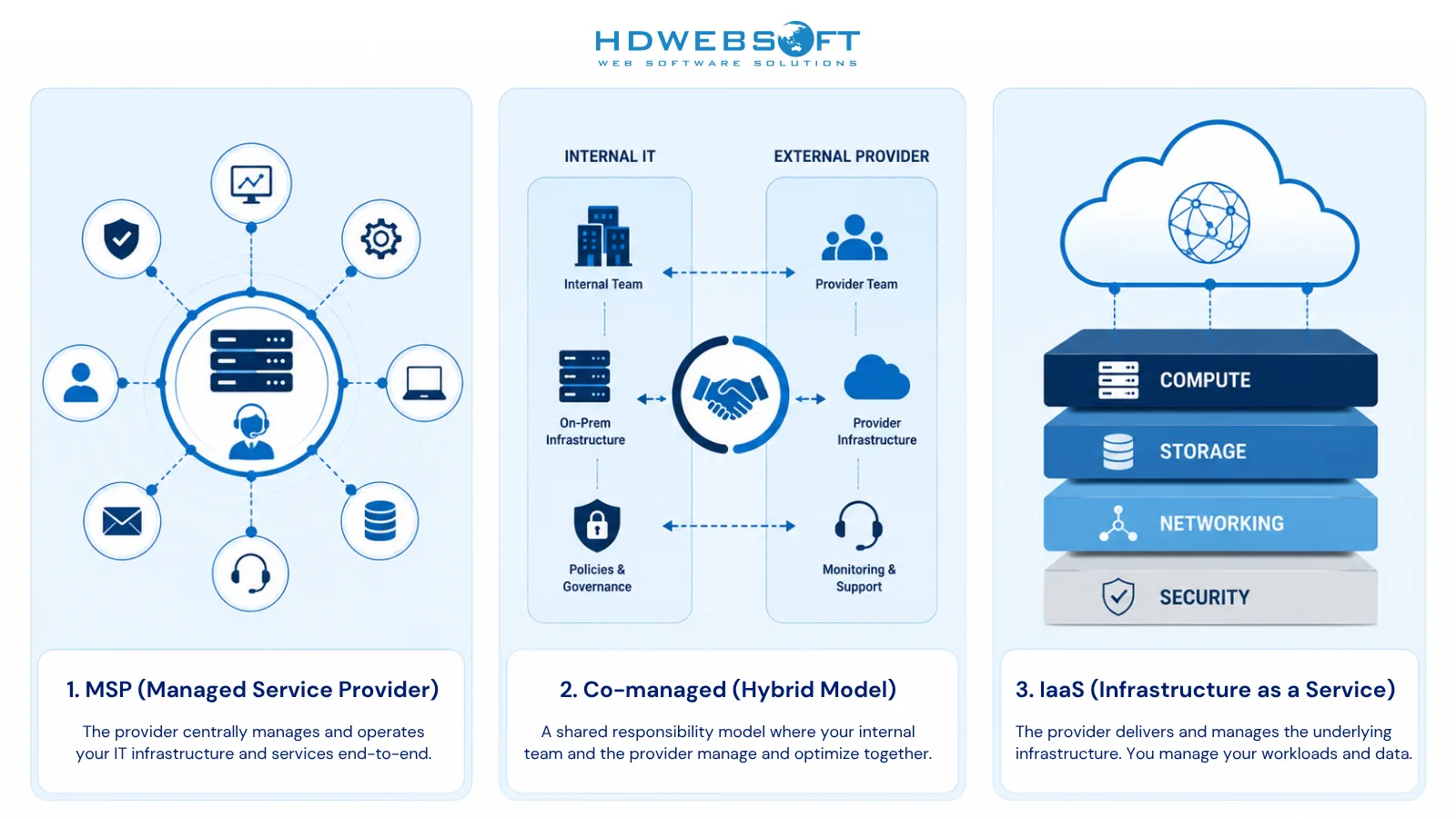
Managed service providers take comprehensive responsibility for IT infrastructure and operations under fixed-fee arrangements. MSPs typically provide 24/7 monitoring, proactive maintenance, help desk support, and strategic planning. The fixed-fee model provides cost predictability while aligning provider incentives with client success through performance-based components.
MSP relationships work best for companies seeking to outsource most or all IT functions to focus on core business activities. The comprehensive nature of MSP services requires strong vendor relationships and clear governance structures to ensure alignment with business objectives.
Co-Managed IT Services
Co-managed IT services combine internal IT staff with external expertise, allowing companies to maintain control over strategic decisions while leveraging specialized skills for specific functions. This model works well for companies with some internal IT capabilities that need to supplement their teams with specialized expertise or 24/7 coverage.
The co-managed approach provides flexibility to scale expertise based on project needs while maintaining internal control over critical systems and strategic decisions. Companies can gradually increase outsourcing as internal capabilities evolve or business requirements change.
Infrastructure as a Service (IaaS)
Infrastructure as a Service provides virtualized computing resources over the internet, eliminating the need for companies to own and manage physical hardware. IaaS providers handle server maintenance, storage management, and networking while companies control operating systems, applications, and data. The pay-as-you-go model provides scalability and cost efficiency.
IaaS works well for companies with variable workloads, seasonal demands, or rapid growth trajectories. The ability to provision resources in minutes rather than weeks provides significant agility for businesses responding to market opportunities.
Hybrid IT Models
Hybrid IT models combine on-premises infrastructure with cloud services and managed services to optimize performance, cost, and control. Companies keep critical systems and sensitive data on-premises while leveraging cloud and managed services for less critical workloads. This approach provides control where needed while gaining flexibility and cost efficiency where possible.
Hybrid models require careful architecture planning and integration between different environments. Companies must ensure consistent security, monitoring, and management across on-premises and cloud environments while optimizing for cost and performance.
IT Support Outsourcing Benefits
24/7 Availability and Response Times
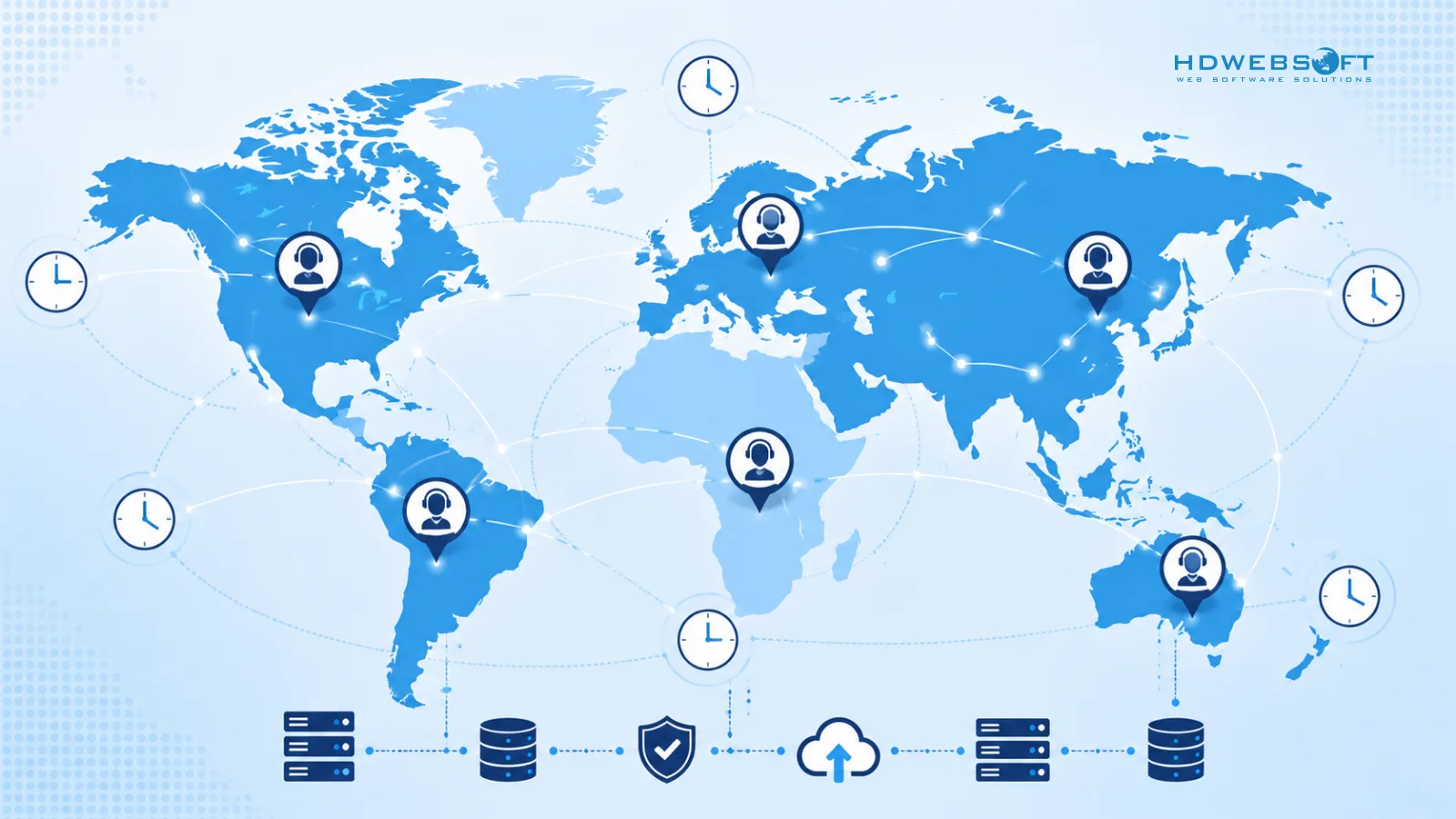
Outsourced IT support provides round-the-clock coverage through global teams, ensuring employees receive assistance whenever needed. This 24/7 availability significantly reduces downtime compared to internal support limited to business hours. The structured approach to support includes defined response times, escalation protocols, and performance metrics that improve service consistency.
The global nature of outsourced support means companies can provide consistent service across multiple time zones and geographic locations. This capability is particularly valuable for distributed teams and international operations.
Cost Predictability and Budget Control
IT support outsourcing converts variable support costs into predictable fixed fees through service level agreements. This predictability helps with budget planning and eliminates unexpected expenses from system failures or emergency support needs. The fixed-fee model also aligns provider incentives with preventing issues rather than profiting from problems.
Companies can choose from tiered support models with different service levels and pricing, allowing them to match support investment to business requirements. The ability to scale support based on business needs without long-term commitments provides additional flexibility.
Access to Specialized Expertise
Outsourced IT support providers maintain teams with expertise across diverse technologies, platforms, and systems. This breadth of expertise would be cost-prohibitive to build internally for most companies. The specialized knowledge includes enterprise applications, cybersecurity, cloud platforms, and industry-specific systems.
The continuous training and certification requirements for support staff mean outsourced providers invest heavily in keeping their teams current with evolving technologies. Companies benefit from this expertise without bearing the full cost of continuous training and certification.
Scalability for Business Growth
IT support outsourcing scales seamlessly with business growth, from small startups to large enterprises. Companies can add users, locations, and systems without hiring additional support staff or investing in support infrastructure. The scalability extends to seasonal peaks, project-based needs, and geographic expansion.
The ability to scale support without long-term commitments provides significant agility for growing companies. Businesses can respond to market opportunities and challenges rapidly without being constrained by internal support capacity.
Compliance and Security Standards
Outsourced IT support providers typically maintain certifications and compliance with industry standards including SOC 2, ISO 27001, HIPAA, and PCI DSS. These certifications provide assurance that support processes meet rigorous security and compliance requirements. The investment in certifications and compliance would be significant for most companies to achieve internally.
The standardized approach to security and compliance across all clients means outsourced providers have mature processes and controls that exceed what most companies implement internally. Companies benefit from enterprise-grade security and compliance without bearing the full cost of implementation and maintenance.
Managed IT Services Breakdown
Network Monitoring and Management
Network monitoring and management services provide continuous oversight of network performance, security, and availability. This includes monitoring network traffic, identifying performance issues, managing network devices, and implementing security policies. Proactive monitoring identifies and addresses issues before they impact business operations.
The comprehensive approach to network management includes capacity planning, performance optimization, and security hardening. Companies benefit from optimized network performance and reduced downtime through proactive monitoring and management.
Cybersecurity and Threat Protection
Cybersecurity services protect against threats through firewall management, intrusion detection, vulnerability assessments, and incident response. The continuous monitoring and threat intelligence capabilities identify and respond to security incidents rapidly. The specialized expertise and advanced tools provide protection beyond what most companies can achieve internally. Learn more about cybersecurity services.
The evolving threat landscape requires continuous investment in security technologies and expertise. Outsourced security providers stay current with emerging threats and security best practices, ensuring companies maintain strong security postures without bearing the full cost of continuous security investment.
Backup and Disaster Recovery
Backup and disaster recovery services ensure business continuity through automated backups, replication, and recovery planning. This includes designing recovery strategies, testing recovery procedures, and managing backup infrastructure. The comprehensive approach to disaster recovery reduces the risk of data loss and ensures rapid recovery from disruptions.
The expertise required for effective disaster recovery spans backup technologies, recovery procedures, and business continuity planning. Outsourced providers bring deep experience across different industries and regulatory requirements, ensuring comprehensive disaster recovery capabilities.
VoIP and Communication Systems
VoIP and communication system management handles voice over IP, unified communications, and collaboration platforms. This includes system configuration, user management, performance monitoring, and troubleshooting. The specialized knowledge required for effective communication system management spans multiple platforms and integration requirements.
The complexity of modern communication systems, including integration with other business systems and mobile devices, requires specialized expertise. Outsourced providers maintain expertise across different communication platforms and ensure optimal performance and reliability.
Hardware and Software Management
Hardware and software management services handle procurement, deployment, maintenance, and lifecycle management for IT assets. This includes inventory management, software licensing, patch management, and technology refresh planning. The structured approach to asset management improves efficiency and reduces costs through optimized procurement and lifecycle planning.
The expertise required for effective hardware and software management spans multiple vendors, technologies, and best practices. Outsourced providers maintain knowledge across different technology stacks and ensure optimal asset management without requiring internal expertise across all areas.
IT Outsourcing for Different Business Sizes
Startups and Small Businesses
For startups and small businesses, IT outsourcing provides access to enterprise-level IT capabilities without the corresponding cost structure. This enables small companies to compete with larger organizations by leveraging specialized expertise and scalable resources. The flexibility to scale IT services based on business needs is particularly valuable for startups navigating uncertain market conditions.
Startups also benefit from the reduced time-to-value that IT outsourcing enables, allowing them to focus on product development and business growth rather than building IT infrastructure. The predictable costs of outsourced IT services help with budget planning in resource-constrained environments.
Medium-Sized Enterprises
Medium-sized enterprises leverage IT outsourcing to access specialized expertise, improve service levels, and optimize costs across their IT operations. The ability to scale IT resources for growth initiatives without permanent headcount increases provides significant flexibility for budget management and resource allocation.
For medium-sized companies, IT outsourcing also enables geographic expansion by providing IT support and infrastructure in new locations without building local IT teams. This capability accelerates growth while reducing the risks and costs associated with geographic expansion.
Large Enterprises and Corporations
Large enterprises use IT outsourcing to optimize costs, access specialized expertise, and improve service levels across complex IT environments. The scale of enterprise IT operations makes outsourcing attractive for standardizing processes, improving efficiency, and reducing costs across distributed organizations.
Enterprises also leverage IT outsourcing for digital transformation initiatives, using external expertise to accelerate technology modernization while internal teams focus on strategic initiatives. The ability to scale resources for major initiatives without permanent headcount increases provides significant flexibility for large organizations.
IT Outsourcing Implementation Strategy
Assessment and Planning Phase
The assessment and planning phase involves evaluating current IT capabilities, identifying outsourcing opportunities, and developing implementation roadmaps. This includes inventorying IT assets, assessing service levels, analyzing costs, and defining requirements. The comprehensive assessment ensures outsourcing decisions align with business objectives and address real needs.
Companies should involve stakeholders across the organization in the assessment process to ensure all requirements are captured and potential concerns are addressed. The planning phase should include risk assessment, contingency planning, and change management preparation.
Provider Selection Criteria
Provider selection should consider technical expertise, service capabilities, cultural fit, geographic coverage, and financial stability. Companies should evaluate potential providers through detailed reference checks, technical assessments, and pilot projects before committing to long-term engagements.
The selection process should include evaluation of certifications, compliance capabilities, security practices, and service level commitments. Companies should choose providers that combine technical excellence with strong service management capabilities and cultural alignment.
Transition and Migration Process
The transition and migration process involves transferring responsibilities from internal teams to external providers while maintaining business continuity. This includes detailed planning, phased implementation, parallel operations, and comprehensive testing. The structured approach to transition minimizes disruption and ensures successful knowledge transfer.
Companies should establish clear governance structures, communication protocols, and performance metrics during transition. The transition process should include training for internal teams on working with the new provider and establishing ongoing management processes.
Ongoing Management and Optimization
Ongoing management and optimization ensure outsourcing relationships continue to deliver value over time. This includes regular performance reviews, service level monitoring, continuous improvement initiatives, and strategic alignment reviews. The structured approach to ongoing management ensures outsourcing relationships evolve with business needs.
Companies should establish clear governance structures with regular reviews at multiple levels. The ongoing management process should include opportunity identification for service improvements and cost optimization as the relationship matures.
IT Outsourcing Pricing Models
Per-User Pricing
Per-user pricing charges a fixed fee per employee or user for IT services. This model provides predictable costs that scale with business growth and is easy to budget. The per-user approach works well for companies with stable user counts and straightforward IT requirements.
The simplicity of per-user pricing makes it easy to understand and budget, but may not align costs with actual usage for companies with highly variable or complex IT requirements. Companies should ensure per-user pricing includes all required services to avoid unexpected add-on charges.
Per-Device Pricing
Per-device pricing charges based on the number of devices managed, including computers, servers, mobile devices, and other IT equipment. This model aligns costs with the actual infrastructure being managed and works well for companies with device-heavy IT environments.
The per-device approach provides cost alignment but may create complexity in device classification and counting. Companies should establish clear definitions of what constitutes a managed device to avoid disputes and unexpected charges.
Tiered Service Levels
Tiered service levels offer different packages with varying service levels, response times, and included services. This model allows companies to match service investment to business requirements and provides clear upgrade paths as needs evolve. The tiered approach works well for companies with diverse requirements across different business units.
The clarity of tiered pricing helps with budget planning and expectation management. Companies should carefully evaluate what’s included in each tier to ensure chosen service levels meet actual business requirements.
Custom Enterprise Solutions
Custom enterprise solutions provide tailored pricing based on specific requirements, service levels, and delivery models. This approach works well for large enterprises with complex IT environments and specialized requirements. The custom nature requires detailed scoping and negotiation but provides the best alignment between costs and requirements.
The complexity of custom solutions requires strong vendor management and clear governance structures. Companies should invest in detailed requirements definition and ongoing performance monitoring to ensure custom solutions deliver expected value.
IT Outsourcing Challenges and Solutions
Security and Data Protection
Security and data protection concerns represent significant challenges for IT outsourcing. Companies must ensure providers maintain strong security practices, comply with regulations, and protect sensitive data. These concerns can be addressed through careful provider selection, clear security requirements, and ongoing monitoring.
Companies should include detailed security requirements in contracts, conduct regular security assessments, and maintain clear ownership of security decisions. The shared responsibility model for security requires clear delineation of responsibilities between companies and providers.
Service Quality Consistency
Service quality consistency challenges arise from geographic distribution, cultural differences, and communication barriers. These issues can be addressed through clear service level agreements, regular performance monitoring, and structured communication protocols. Companies should establish clear expectations and metrics for service quality.
The investment in relationship management and governance helps ensure consistent service quality over time. Companies should treat outsourcing relationships as strategic partnerships rather than transactional vendor relationships.
Vendor Dependency Management
Vendor dependency creates risks if providers fail to deliver or if relationships deteriorate. These risks can be mitigated through exit planning, knowledge transfer, and maintaining some internal capabilities. Companies should avoid complete dependency on single providers where possible.
The multi-vendor strategies and hybrid approaches reduce dependency on any single provider. Companies should maintain sufficient internal expertise to manage providers effectively and make informed decisions about outsourcing relationships.
Integration with Existing Systems
Integration challenges arise when outsourced services must work with existing systems, processes, and teams. These challenges can be addressed through detailed planning, phased implementation, and clear integration requirements. Companies should invest in architecture planning and change management to ensure smooth integration.
The complexity of integration increases with the scope of outsourcing and the complexity of existing environments. Companies should prioritize integration planning and allocate sufficient resources to ensure successful integration.
IT Outsourcing Trends 2025
AI-Driven IT Operations
AI and automation are transforming IT operations through predictive maintenance, automated troubleshooting, and intelligent resource allocation. These technologies improve service levels while reducing costs through automation of routine tasks and predictive issue identification. The integration of AI into IT operations is enabling more efficient and proactive service delivery.
The AI-driven approach to IT operations requires new skills and capabilities from both providers and clients. Companies should evaluate providers’ AI capabilities and experience when selecting outsourcing partners for IT operations.
Zero Trust Security Models
Zero trust security models are becoming standard for IT outsourcing, with providers implementing continuous verification, least privilege access, and micro-segmentation. These approaches provide stronger security than traditional perimeter-based models. The adoption of zero trust requires changes to both technology and processes.
The zero trust model requires close collaboration between companies and providers to implement effectively. Companies should ensure providers have experience with zero trust implementations and can adapt security practices to specific requirements.
Cloud-Native Infrastructure Management
Cloud-native infrastructure management is becoming standard as companies migrate workloads to cloud environments. This includes container orchestration, serverless computing, and cloud-native security practices. The specialized knowledge required for cloud-native management drives demand for outsourcing expertise.
The rapid evolution of cloud technologies requires continuous investment in training and certification. Companies should choose providers with strong cloud expertise across multiple platforms and experience with cloud-native architectures.
Remote Work Infrastructure Support
Remote work infrastructure support has become critical as distributed work models become standard. This includes secure remote access, collaboration tools, and support for distributed teams. The complexity of supporting remote work drives demand for specialized outsourcing expertise.
The geographic distribution of remote work requires global support capabilities and 24/7 coverage. Companies should ensure providers have the geographic coverage and support models needed for distributed work environments.
Conclusion
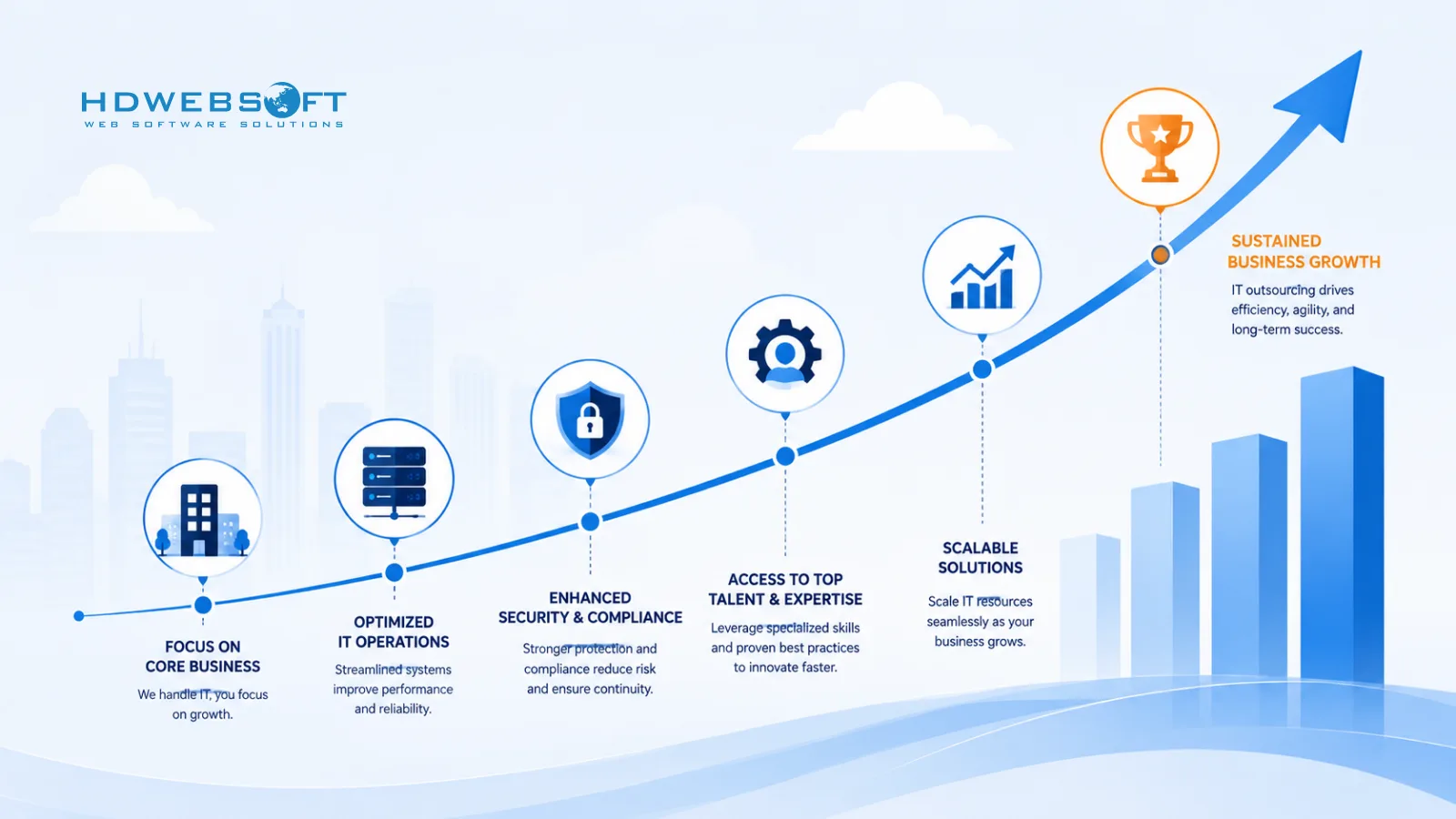
IT outsourcing strategy extends beyond software development to encompass infrastructure, support, security, and operations. Companies leveraging IT outsourcing reduce costs while accessing specialized expertise and improving service levels. The key to success lies in choosing the right models, selecting appropriate providers, and managing relationships effectively.
The evolution of IT outsourcing from tactical cost-saving to strategic business enabler reflects its growing importance in modern business. Companies that approach IT outsourcing strategically can leverage it as a competitive advantage, focusing internal resources on core business while external experts handle technology operations. For software development needs, consider software outsourcing services to complement your IT infrastructure strategy.
HDWEBSOFT provides comprehensive IT outsourcing services including infrastructure management, IT support, security operations, and cloud services. Our expertise spans multiple technologies and industries, ensuring tailored solutions that align with your business objectives. Contact us to discuss how IT outsourcing can support your business growth and operational excellence.
FAQ
What is the difference between IT outsourcing and software outsourcing?
IT outsourcing focuses on operational technology infrastructure, support, security, and day-to-day IT operations. Software outsourcing concentrates on application development, programming, and building new software systems. Companies often use both approaches simultaneously—IT outsourcing for operational stability and software outsourcing for development initiatives.
What services are included in IT infrastructure outsourcing?
IT infrastructure outsourcing includes server management, storage systems, network operations, data center facilities, cloud infrastructure management, and hardware lifecycle management. Services encompass monitoring, maintenance, upgrades, security, and capacity planning for all infrastructure components.
How much does IT outsourcing cost compared to in-house IT?
IT outsourcing typically costs 30-50% less than maintaining equivalent in-house capabilities. Savings come from reduced labor costs, eliminated infrastructure investments, optimized software licensing, and economies of scale. The fixed-fee model also provides cost predictability compared to variable in-house costs.
What are the security risks of IT outsourcing?
Security risks include data breaches, unauthorized access, compliance violations, and vendor dependency. These risks can be mitigated through careful provider selection, clear security requirements, regular security assessments, and maintaining ownership of security decisions. Choose providers with strong security certifications and proven track records.
How do I choose between managed services and co-managed IT?
Choose managed services when you want comprehensive outsourcing with minimal internal IT involvement. Select co-managed IT when you have internal IT capabilities but need specialized expertise or 24/7 coverage. The decision depends on your internal capabilities, control requirements, and strategic IT objectives.
Can IT outsourcing work with existing internal IT teams?
Yes, IT outsourcing often complements internal teams rather than replacing them entirely. Co-managed models and hybrid approaches allow internal teams to focus on strategic initiatives while outsourced providers handle operational tasks. Successful integration requires clear role definition, communication protocols, and governance structures.